
- STQC Certification Documents typically needs 8 to 10 core documents, led by the Technical Construction File and a signed Declaration of Conformity.
- Incomplete or generic documentation — especially the Technical Construction File — is the single biggest cause of STQC application delays and rejections.
- The STQC e-Services portal accepts documents in specific digital formats, with PDF uploads commonly capped around 50MB per file.
- CCTV and IoT applicants must now also submit firmware-version and firmware-hash documentation under the 2026 IoTSCS security requirements.
Introduction
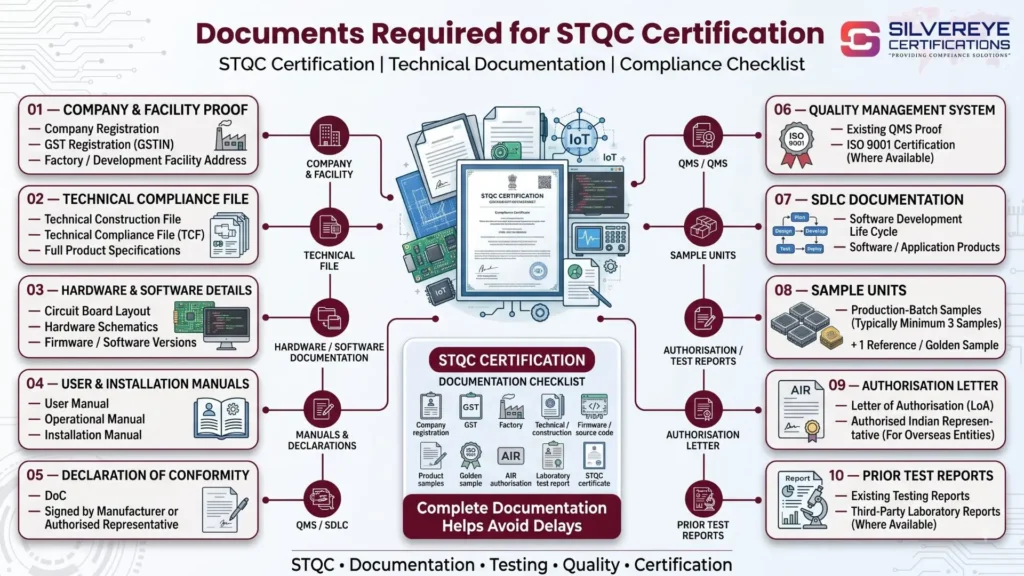
STQC Certification requires a defined set of documents submitted through the STQC e-Services portal, including a Technical Construction File (TCF) with full product specifications, a signed Declaration of Conformity, user and installation manuals, proof of an existing Quality Management System, company registration and GSTIN details, and production-batch sample units (typically at least three, plus one reference sample).
Software applicants also need Software Development Life Cycle (SDLC) documentation, while overseas applicants must submit a Letter of Authorization for their Authorized Indian Representative. The exact checklist varies slightly by scheme — biometric, IoT/CCTV, software, or website certification each have their own specific document requirements.
Why Are STQC Certification Documents So Important?
STQC's entire evaluation is built on paper trail plus lab result. The Directorate cannot verify your manufacturing process, your software development practices, or your quality controls just by looking at a physical sample — the documents are what tell that story. A test report only proves the sample that was tested works; the documentation is what proves the product in front of the lab represents what you'll actually manufacture and sell at scale.
- A complete document set lets STQC assign the correct scheme and lab on the first pass, avoiding review-stage rejections.
- Detailed technical documentation reduces the chance of testing surprises, since the lab knows exactly what to test against.
- Proper documentation is what makes your certificate defensible later — during surveillance audits, tenders, or buyer due diligence.
- For regulated categories like CCTV and biometric devices, missing documentation isn't just a delay risk — it's a hard block on legal market entry.
Complete STQC Certification Documents Checklist
Here is the core document list most applicants need, regardless of scheme. Scheme-specific additions are covered in the next section.
| Document | Purpose | Mandatory? |
| Technical Construction File (TCF) | Full product specifications, technical drawings, rated parameters | Yes |
| Declaration of Conformity (DoC) | Signed statement confirming the product meets applicable standards | Yes |
| User & installation/operation manual | Describes intended operating conditions and correct usage | Yes |
| Company registration & GSTIN | Confirms legal entity status of the applicant | Yes |
| Production-batch sample units | Physical units for lab testing (min. 3 + 1 reference sample) | Yes |
| QMS proof (e.g., ISO 9001 certificate) | Evidence of a documented quality management system | Recommended |
| SDLC documentation | Software Development Life Cycle records for software products | Software only |
| Circuit schematics / hardware layout | Technical verification for hardware and IoT devices | Hardware only |
| Letter of Authorisation (LoA) for AIR | Appoints an Authorised Indian Representative for overseas applicants | Importers only |
| Prior test reports (if any) | Supports faster review if credible third-party testing exists | Optional |
Understanding Each Document: What STQC Actually Looks For
1. Technical Construction File (TCF)
The TCF is the backbone of your application. It should include full product specifications, block diagrams, rated electrical/technical parameters, a list of applicable standards, and — for connected devices — firmware version details. A generic or templated TCF with placeholder part numbers is the fastest way to get your application sent back; STQC reviewers are specifically checking whether this document matches the physical samples you will submit.
2. Declaration of Conformity (DoC)
This is a signed statement from the manufacturer or authorised representative declaring that the product meets the relevant technical and safety standards for its category. It needs to be signed by someone authorised to make that declaration on behalf of the company, and it should reference the specific standards the TCF also cites — inconsistency between the two documents is a common review flag.
3. User and Installation Manuals
STQC wants to see how the product is meant to be operated and installed, since several test parameters (environmental limits, safety warnings, intended use case) are evaluated against what the manual actually claims. Manuals that don't match the tested configuration can cause a mismatch between certification scope and real-world product use.
4. Quality Management System (QMS) Proof
An existing ISO 9001 certificate, or equivalent documented quality process, strengthens your application by showing your manufacturing process is controlled and repeatable — not just that one sample happened to pass. It's not always mandatory, but its absence can lead to closer scrutiny during any factory audit stage.
5. Software Development Life Cycle (SDLC) Documentation
For software applicants, STQC expects evidence of a defined development process — requirements gathering, design, coding standards, testing phases, and release management. This is particularly important for government-facing software and applications evaluated under cybersecurity-related schemes.
6. Production Samples
Most schemes require a minimum of three production-batch sample units, plus one reference or 'golden' sample retained by the lab. Samples must be actual production units — prototypes or hand-built demo units are typically not accepted, since they may not reflect what reaches the market.
7. Letter of Authorization (LoA) for Overseas Applicants
If you're a foreign manufacturer or importer, you need a notarised LoA appointing an Authorised Indian Representative (AIR) who will handle all communication, sample coordination, and post-certification surveillance with STQC on your behalf. Without a valid AIR, an overseas application is generally considered incomplete.
How Document Requirements Differ by Scheme
The core checklist above applies broadly, but each STQC scheme layers on category-specific documentation. Knowing this upfront avoids assembling the wrong paperwork for your product.
| Scheme | Additional Documents Typically Needed |
| Biometric Device Certification Scheme (BDCS) | UIDAI technical specification compliance sheet, device calibration records |
| IoT System Certification Scheme (IoTSCS) — incl. CCTV | Firmware version lock declaration, firmware hash record, network/security architecture diagram |
| Software Testing & Assessment | SDLC documentation, source-code access details, prior vulnerability assessment reports (if any) |
| Website Quality Certification (GIGW) | Website content and accessibility compliance statement, hosting and security architecture summary |
| IT Security / Common Criteria | Security target document, vulnerability analysis report, cryptographic module details |
Document Format and Portal Upload Requirements
- Most technical documents, including the TCF, are uploaded as PDF files through the STQC e-Services portal, commonly with a file-size cap around 50MB per document.
- Keep the TCF and DoC internally consistent — the same standards, model numbers, and firmware versions should appear identically across both.
- Name files clearly (e.g., 'TCF_ModelXYZ_v2.pdf') so reviewers and lab staff can match documents to physical samples without back-and-forth queries.
- Scan or export documents at readable resolution — illegible circuit diagrams or blurry manuals are treated the same as missing documents during review.
- Retain original signed copies of the Declaration of Conformity and LoA, since physical verification may be requested during a factory audit.
Common Documentation Mistakes That Delay STQC Certification
| Mistake | Why It Causes Delay |
| Generic or templated TCF with placeholder specifications | Reviewers cannot verify the actual product being certified |
| Mismatch between DoC standards and TCF standards | Creates doubt about which standard the product is actually being tested against |
| Sending prototype or hand-assembled samples | Samples must represent production units; non-production samples are typically rejected |
| Missing AIR/LoA for overseas applicants | Application is treated as incomplete without a valid Indian point of contact |
| Firmware not locked before sample submission (IoT/CCTV) | Certificate cannot be tied to a final, verifiable firmware version |
| Incomplete SDLC documentation for software | Reviewers cannot assess development process maturity, a required evaluation criterion |
Documents Needed for Renewal and Surveillance
Documentation doesn't end once you're certified. Keeping your certificate valid through its three-year term and any renewal requires ongoing paperwork too.
- Updated Declaration of Conformity, if any product specification has changed since original certification.
- Records confirming no unauthorized change to the certified model, firmware version, or manufacturing location.
- Annual surveillance audit documentation, confirming continued compliance with the certified standard.
- A fresh or updated TCF at renewal time, particularly if the product has gone through a hardware or firmware revision.
STQC Certification Documents: What's New for 2026
Firmware-Hash Documentation for IoT and CCTV Products
Since the CCTV/IoT security mandate took effect on April 1, 2026, IoTSCS applicants must submit documentation recording the exact firmware version and firmware hash tested, not just the general firmware family. This is a new, specific document requirement that didn't exist in earlier scheme documentation, and it means any post-certification firmware update requires fresh supporting documentation.
Aadhaar eSign Replacing Physical Signature Verification
The STQC e-Services portal now uses Aadhaar-based eSign for applicant identity verification at registration, reducing the need for physically notarised signature documents for many Indian applicants at the application stage.
GIGW 3.0 Documentation for Website Certification
Applicants pursuing Website Quality Certification now need documentation aligned with GIGW 3.0 — the updated Guidelines for Indian Government Websites — which places more explicit documentation weight on accessibility compliance statements and security-hardening records than earlier guideline versions.
Cross-Lab Documentation Sharing
Following the February 2026 collaboration between the National Test House and STQC's ERTL (North) lab for drone EMI/EMC testing, applicants in eligible categories can now submit a single consolidated technical documentation set that is used across both labs, rather than preparing duplicate paperwork for each testing partner.
Getting Documentation Right the First Time
Because so much of the STQC timeline is determined at the documentation stage — before a sample ever reaches a lab — it's worth treating document preparation as its own project rather than an afterthought. Businesses that invest time upfront in a complete, internally consistent TCF and DoC consistently move through review faster than those who submit and hope for the best.
| Get Expert Help Preparing STQC Certification Documents Silvereye Certifications helps manufacturers, brands and their suppliers prepare complete, review-ready STQC Certification Documents — including the Technical Construction File, Declaration of Conformity, and scheme-specific paperwork — alongside related compliance work such as BIS, WPC, and CDSCO approvals. Getting documentation right the first time is often the single biggest lever for a faster certification timeline. |
Conclusion
STQC Certification Documents aren't just administrative overhead — they're how the STQC Directorate verifies that the product tested in a lab is genuinely the product you intend to manufacture and sell. A complete, internally consistent document set (Technical Construction File, Declaration of Conformity, manuals, QMS proof, and production samples) is what moves an application through review smoothly, while a generic or incomplete one is the most common reason applications stall for weeks.
Treat documentation as the first real milestone of your certification journey, not paperwork to rush through. Check your document set against your specific scheme's requirements, keep every document internally consistent, and factor in the newer 2026 requirements like firmware-hash records for IoT and CCTV products. Whether you prepare these in-house or bring in experienced support like Silvereye Certifications, getting the documentation right the first time is the clearest way to keep your STQC Certification on schedule.
Frequently Asked Questions
What documents are required for STQC certification?
Core documents include a Technical Construction File, a signed Declaration of Conformity, user/installation manuals, company registration and GSTIN, production-batch samples, and QMS proof where available. Software applicants also need SDLC documentation, and overseas applicants need a Letter of Authorization for their Authorized Indian Representative.
What is a Technical Construction File (TCF) in STQC certification?
The TCF is the primary technical document submitted for STQC Certification, containing full product specifications, technical drawings, rated parameters, and the standards the product is being tested against. It's the single most important document in the application.
Is a Declaration of Conformity mandatory for STQC certification?
Yes. The Declaration of Conformity is a signed statement, from the manufacturer or authorised representative, confirming the product meets the applicable technical and safety standards, and it is required across virtually all STQC schemes.
How many product samples do I need to submit?
Most schemes require a minimum of three production-batch sample units, plus one reference or golden sample kept by the lab for future comparison during surveillance.
What format should STQC certification documents be in?
Technical documents are typically uploaded as PDF files through the STQC e-Services portal, commonly with a file-size limit around 50MB per document. Files should be clearly named and internally consistent across the application.
Do software products need different documents for STQC certification?
Yes. Software applicants need Software Development Life Cycle (SDLC) documentation covering requirements, design, coding standards, and testing phases, in addition to the standard document set.
What documents do overseas manufacturers need for STQC certification?
In addition to the standard document checklist, overseas manufacturers and importers need a notarized Letter of Authorization appointing an Authorized Indian Representative (AIR) who coordinates with STQC on their behalf.
What new documents are required for CCTV cameras in 2026
Since the April 2026 IoTSCS mandate, CCTV and IoT applicants must submit documentation recording the exact firmware version and firmware hash tested, in addition to the standard technical and compliance documents.
What is the most common documentation mistake in STQC applications?
Submitting a generic or templated Technical Construction File with placeholder or non-specific part numbers is the most common mistake, since it prevents reviewers from verifying the actual product being certified.
Do I need proof of a Quality Management System for STQC certification?
It's not mandatory for every scheme, but having an existing QMS certificate such as ISO 9001 strengthens your application and can reduce scrutiny during any factory or process audit.
What documents are needed to renew an STQC certificate?
Renewal typically needs an updated Declaration of Conformity if the product has changed, records confirming no unauthorised modification to the certified model, annual surveillance audit documentation, and a refreshed TCF if there's been a hardware or firmware revision.
Can I submit third-party test reports as part of my documentation?
Yes, prior test reports from credible labs can be submitted to support your application, though STQC's own accredited lab testing is still required before a certificate can be issued.