- STQC Certification is issued by the STQC Directorate under MeitY to certify IT, electronics, biometric, IoT and cybersecurity products for quality and security.
- It is mandatory for biometric devices used in Aadhaar authentication, select government IT projects, and — from April 1, 2026 — for CCTV cameras and recorders sold or manufactured in India.
- A standard STQC certificate is valid for 3 years, subject to annual surveillance audits to keep it active.
- Total cost typically ranges between ₹2 lakh and ₹8 lakh depending on the product category, scheme, and testing scope.
Introduction
STQC Certification is a government-backed quality and security certification issued by the STQC Directorate, a body under India's Ministry of Electronics and Information Technology (MeitY). It verifies that IT products, electronic devices, software and IoT systems — such as biometric scanners, smart cards, CCTV cameras and government-facing applications — meet defined performance, safety and cybersecurity standards.
The certificate is obtained through document review, accredited-lab testing, and (where applicable) a factory audit. It is mandatory for specific categories like UIDAI biometric devices and, from April 2026, CCTV systems, and voluntary but valuable for most other electronics and software products entering government or enterprise supply chains.
If you manufacture, import, or develop IT hardware, software, biometric devices, or connected electronics in India, you have probably come across the term STQC Certification in a tender document, a government RFP, or a compliance checklist from a buyer. It is not just another paperwork requirement — for several product categories, it is the difference between being allowed to sell in India and being blocked at the border or disqualified from a government tender.
What Is STQC Certification?
STQC stands for Standardization Testing and Quality Certification. It is a Directorate that functions under the Ministry of Electronics and Information Technology (MeitY), Government of India, and has operated since 1980 as the country's core quality-assurance infrastructure for the IT and electronics sector.
In practical terms, STQC runs a network of testing laboratories and certification schemes that evaluate whether an electronic product, software system, or IoT device performs reliably, is built securely, and complies with the relevant Indian and international standards (ISO, IEC, and sector-specific frameworks like UIDAI's Aadhaar specifications). When a product clears this evaluation, STQC issues a Certificate of Conformity (CoC) that buyers, regulators, and government departments can rely on instead of testing the product themselves.
STQC Certification is often compared to BIS certification, but the two serve different purposes — a distinction covered in detail later in this guide.
Products and Systems Covered Under STQC Certification
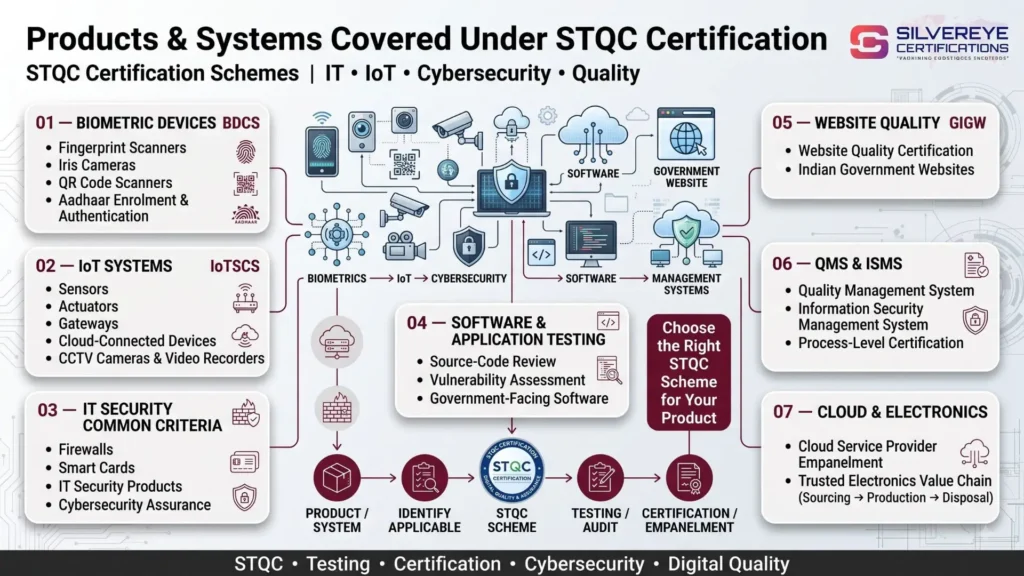
STQC operates several distinct certification schemes, each aimed at a different product category. Understanding which scheme applies to your product is the first real step in the certification journey.
- Biometric Devices Certification Scheme (BDCS) — Fingerprint scanners, iris cameras, and QR code scanners used for Aadhaar enrolment and authentication.
- IoT System Certification Scheme (IoTSCS) — Sensors, actuators, gateways, cloud-connected devices, and — as of 2026 — CCTV cameras and video recorders.
- IT Security / Common Criteria Certification — Firewalls, smart cards, and other IT security products evaluated for cybersecurity assurance.
- Software and Application Testing — Including source-code review and vulnerability assessment for government-facing software.
- Website Quality Certification — Under the Guidelines for Indian Government Websites (GIGW) framework.
- Quality Management System (QMS) and Information Security Management System (ISMS) audits — Process-level certifications for manufacturers and developers.
- Cloud Service Provider empanelment testing and the Trusted Electronics Value Chain scheme covering electronics from sourcing to disposal.
Key Benefits of Getting STQC Certificate
Beyond regulatory compliance, businesses pursue STQC Certification because it directly opens doors that would otherwise stay closed.
- Eligibility for government tenders, GeM (Government e-Marketplace) listing, and ONDC and PSU procurement, where STQC compliance is frequently a pre-qualification condition.
- Demonstrated trust and credibility with enterprise buyers, system integrators, and public-sector clients who need documented proof of quality and security.
- Reduced risk of data breaches, device tampering, or field failures, since the certification process forces rigorous functional, environmental, and security testing before launch.
- A cleaner path for foreign manufacturers to enter the Indian market, since STQC evaluation is often the benchmark buyers use to assess unfamiliar overseas products.
- A documented Quality Management System that tends to reduce downstream product recalls, warranty costs, and compliance rework.
Eligibility Criteria for STQC Certification
STQC Certification is not open-ended — applicants and products both need to meet baseline conditions before an application will even be accepted.
- The applicant must be the product owner, the original developer/manufacturer, or a formally authorized representative of the manufacturer.
- The product must fall within an active STQC scheme — commonly biometric devices, smart cards, IoT/CCTV systems, software applications, or cybersecurity products.
- The product should be at a stable, near-final or production-ready stage; prototypes are generally not accepted for full certification.
- The applicant's processes must align with relevant ISO, IEC, MeitY, and — where applicable — UIDAI technical guidelines.
- For software, a defined and documented Software Development Life Cycle (SDLC) is expected.
- Overseas manufacturers and importers must appoint an Authorized Indian Representative (AIR) to liaise with STQC on their behalf.
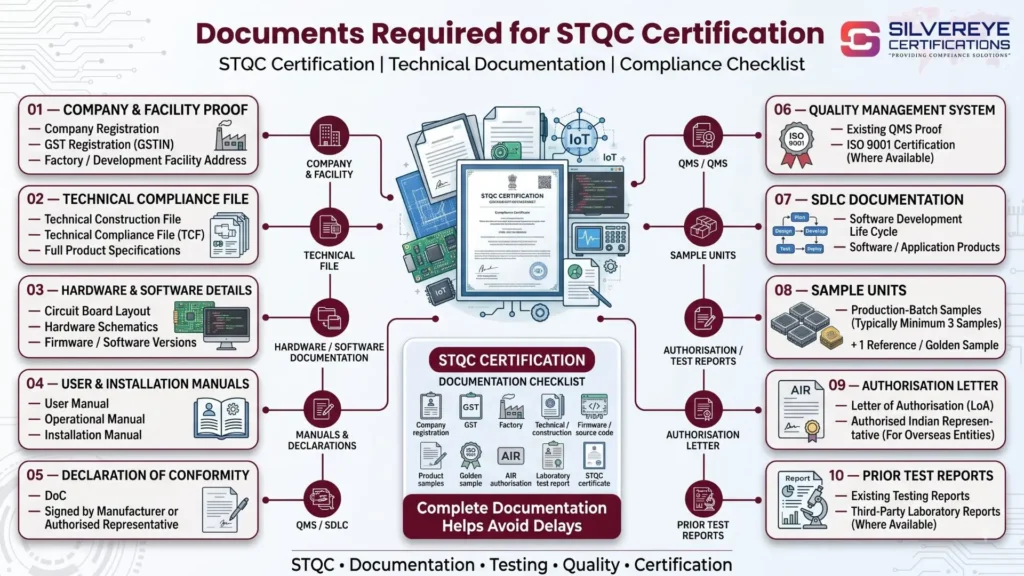
Documents Required for STQC Certification
Documentation is where most STQC applications lose time. Missing or generic paperwork is consistently the top cause of delayed or rejected applications, so it is worth treating this list as non-negotiable.
- Company registration proof, GST registration (GSTIN), and factory or development-facility address.
- Technical Construction File / Technical Compliance File (TCF) with full product specifications.
- Circuit board layout, hardware schematics, and firmware or software version details (for hardware and IoT products).
- User manual and operational/installation manual for the product.
- Declaration of Conformity (DoC) signed by the manufacturer or authorized representative.
- Proof of an existing Quality Management System (QMS), such as ISO 9001 certification, where available.
- Software Development Life Cycle (SDLC) documentation, for software and application-based products.
- Production-batch sample units of the product — typically a minimum of three samples, plus one reference/golden sample.
- Letter of Authorization (LoA) for the Authorized Indian Representative, where the applicant is an overseas entity.
- Prior test reports or third-party lab reports, if any testing has already been carried out.
STQC Certification Process: Step-by-Step
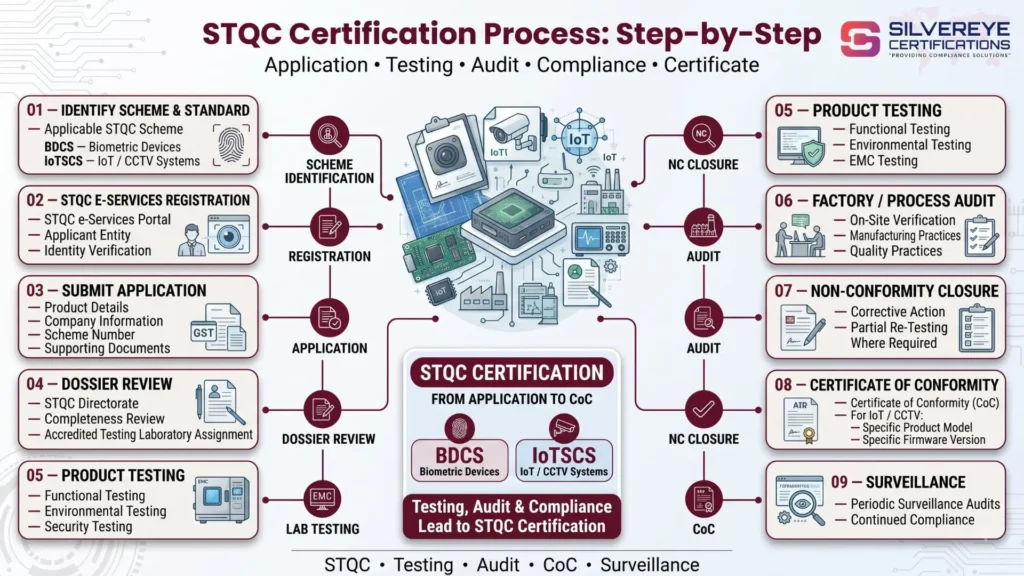
The overall workflow is broadly similar across schemes, though testing protocols differ by product category. Here is how the process typically unfolds from application to certificate issuance.
- Identify the correct scheme and standard applicable to your product (for example, BDCS for biometric devices or IoTSCS for IoT/CCTV systems).
- Register on the STQC e-Services portal (stqc.gov.in) and complete identity verification for the applicant entity.
- Submit the formal application with product details, company information, scheme number, and supporting documents.
- STQC's Directorate reviews the submitted dossier for completeness and assigns the product to an accredited testing laboratory.
- Send the required sample units to the designated lab for functional, environmental, EMC, and security testing.
- If the scheme requires it, STQC conducts a factory or process audit to verify manufacturing and quality practices on-site.
- Any non-conformities identified during testing or audit must be rectified, followed by partial re-testing where needed.
- Once all test results and audit findings meet the required standard, STQC issues the Certificate of Conformity (CoC), which is tied to the specific product model and, for IoT/CCTV devices, a specific firmware version.
- During the validity period, the certificate holder undergoes periodic surveillance audits to confirm continued compliance.
STQC Certification Timeline
There is no single official turnaround time published for every scheme, since it depends on product complexity, lab queues, and how complete the initial application is. As a general, realistic range based on typical scheme timelines:
| Stage | Typical Duration |
| Application & document review | 1–3 weeks |
| Sample submission & lab testing | 3–6 weeks |
| Factory/process audit (if required) | 1–2 weeks |
| Rectification & re-testing (if non-conformities found) | 1–4 weeks additional |
| Total (well-prepared application) | 6–12 weeks |
Incomplete Technical Construction Files, non-production samples, or a missing Authorized Indian Representative for importers are the most common causes of extended delays, sometimes pushing the timeline well beyond 90 days.
STQC Certification Cost and Fee Structure
STQC does not publish one uniform fee schedule that applies to every scheme — costs are largely determined case by case based on the product category, number of test parameters, and lab charges. However, published reference points from comparable schemes give a reasonably reliable cost picture.
| Cost Component | Approximate Range |
| Application/processing fee | ₹20,000 – ₹50,000 |
| Laboratory testing & evaluation | ₹2,00,000 – ₹6,00,000+ per product series |
| Factory/process audit (where applicable) | Included in scheme fee or charged separately |
| Annual surveillance audit | ₹50,000 – ₹55,000 per year |
| Consultant/documentation support (optional) | ₹1,00,000 – ₹3,00,000 |
| Typical total cost (per product series) | ₹2,00,000 – ₹8,00,000 |
Costs are generally invoiced per product series, meaning each distinct model or firmware variant may need separate testing and fees. GST applies on top of the quoted charges. For an accurate, product-specific quotation, it is best to request a formal estimate from STQC or an experienced certification consultant once your scheme and test plan are confirmed.
STQC Certificate Validity, Renewal and Surveillance
Most STQC certificates, including those under the Biometric Device Certification Scheme and the IoT System Certification Scheme, are valid for three years from the date of issue. The certificate is scheme-specific and is usually locked to the exact model number and, for connected devices, the exact firmware version and firmware hash tested — changing any of these effectively invalidates the original certificate.
How Renewal Works
- The certificate holder must undergo an annual surveillance audit during the validity period to confirm the product and manufacturing process still meet the certified standard.
- Before the three-year validity expires, the holder needs to file a renewal application, which may involve a fresh or partial re-test depending on whether the product or firmware has changed.
- If surveillance findings reveal non-conformity, STQC can suspend or revoke the certificate before its natural expiry.
- Any change to the product's hardware revision, firmware version, or manufacturing location typically requires a fresh application rather than a simple renewal.
STQC Certification vs BIS Certification: What's the Difference?
These two are frequently confused because both are Indian government certification systems for electronics, but they test for different things and sit under different ministries.
| Parameter | STQC Certification | BIS Certification |
| Governing body | MeitY (Ministry of Electronics & IT) | Bureau of Indian Standards |
| Primary focus | Performance, quality, cybersecurity | Electrical & product safety |
| Typical products | Biometric devices, software, IoT, CCTV, government IT systems | Consumer electronics, appliances, cables, batteries |
| Mandatory for | UIDAI biometric devices, select govt IT projects, CCTV (from 2026) | Notified electronics under Compulsory Registration Scheme |
| Certificate marking | STQC Certificate of Conformity | ISI mark / BIS-CRS registration |
STQC Certification 2026 Updates: What's New
STQC Certification has seen its most significant expansion in years during 2026, largely driven by national-security concerns around connected surveillance devices. The most important development is the mandatory certification requirement for CCTV cameras and video recorders.
Mandatory STQC Certification for CCTV Cameras (Effective April 1, 2026)
Under the IoT System Certification Scheme (IoTSCS), new CCTV cameras and recorders manufactured, sold, or imported in India must now carry STQC certification against MeitY's Essential Requirements (ER) for security before they can legally enter the market. This mandate followed real security incidents in early 2026, including cases uncovered in Ghaziabad and Hapur,
Uttar Pradesh, where uncertified, foreign-made surveillance cameras were found transmitting live feeds to servers outside India from sensitive locations. The certificate issued under this scheme carries a unique identifier in the format STQC/IoTSCS/ER/xxx and is locked to a specific model number, firmware version, and firmware hash — any change to these invalidates the certificate.
Other Notable 2026 Developments
- Expanded lab capacity for IoT and cybersecurity testing, reducing what were previously long queues for penetration-testing and EMC evaluation slots.
- Greater emphasis on Declaration of Conformity documentation and firmware-hash verification as a standard part of the IoTSCS process, reflecting the shift toward supply-chain security.
- Continued expansion of biometric device certification requirements as UIDAI tightens the specification for Aadhaar-linked authentication hardware.
If your product falls under connected devices, cameras, or biometric hardware, it is worth checking your current certification status against the latest scheme rules on the official STQC portal (stqc.gov.in), since requirements in this space are being updated more frequently than in previous years.
Choosing the Right Testing Lab and Certification Support
STQC works through a network of accredited labs (such as ERTL and ETDC centres) that specialize in different test categories — EMC and safety, IoT and penetration testing, climatic and vibration testing, and RF/medical device testing. Picking a lab that matches your product category, rather than the nearest or cheapest option, reduces the risk of delays from sample transfers or mismatched expertise.
Because documentation is consistently the biggest bottleneck in STQC applications, many applicants — particularly first-time applicants and SMEs — choose to work with experienced certification consultants who prepare the Technical Construction File, coordinate with the lab, and manage the audit process end-to-end.
Conclusion
STQC Certification is not just a compliance checkbox — it is how the Indian government verifies that IT, electronics, biometric, and connected devices are safe, reliable, and secure enough to be trusted in sensitive environments, from Aadhaar authentication to public surveillance infrastructure. For mandatory categories like biometric devices and, from April 2026, CCTV systems, certification is now a hard market-entry requirement, not an optional differentiator.
Getting it right means starting with the correct scheme, building a complete and accurate documentation set, budgeting realistically for lab testing and surveillance audits, and tracking your certificate's three-year validity so renewal never catches you off guard. Whether you handle the process in-house or bring in experienced support such as Silvereye Certifications, treating STQC Certification as a planned compliance milestone — rather than a last-minute hurdle — is what keeps products moving into government tenders, enterprise deals, and the wider Indian market without costly delays.
Frequently Asked Questions
What is STQC certification?
STQC Certification is a quality and security certification issued by the STQC Directorate under India's Ministry of Electronics and Information Technology (MeitY). It confirms that an IT, electronic, biometric, or IoT product has passed defined performance, safety, and cybersecurity testing.
Is STQC certification mandatory?
It is mandatory for specific categories: biometric devices used for UIDAI/Aadhaar authentication, certain government IT and website projects (under GIGW), and — from April 1, 2026 — CCTV cameras and recorders sold or manufactured in India. For most other consumer electronics and software, it is currently voluntary but often expected by government and enterprise buyers.
Who issues STQC certification?
The STQC Directorate, operating under MeitY, Government of India, issues the certificate through its network of accredited testing laboratories and certification schemes.
How long does STQC certification take?
For a well-prepared application, the process typically takes about 6 to 12 weeks from application to certificate issuance. Incomplete documentation, non-production samples, or a missing Authorised Indian Representative can extend this well beyond 90 days.
What is the validity of an STQC certificate?
Most STQC certificates, including those under the Biometric Device Certification Scheme and IoT System Certification Scheme, are valid for three years, subject to annual surveillance audits during that period.
How much does STQC certification cost?
Total cost typically ranges from about ₹2 lakh to ₹8 lakh per product series, covering the application fee, lab testing, and certification charges. Optional consultant support and annual surveillance audits add further cost. STQC does not publish one fixed fee for every scheme, so exact costs vary by product category.
What documents are required for STQC certification?
Core requirements include a Technical Construction File, product specifications and manuals, a signed Declaration of Conformity, proof of a Quality Management System, SDLC documentation for software, and at least three production-sample units, plus an Authorised Indian Representative appointment for overseas applicants.
Is STQC certification mandatory for CCTV cameras in 2026?
Yes. Since April 1, 2026, new CCTV cameras and video recorders sold, manufactured, or imported in India must be certified under the IoT System Certification Scheme (IoTSCS) against MeitY's security-focused Essential Requirements before they can be legally marketed.
What is the difference between STQC and BIS certification?
BIS certification focuses primarily on electrical and product safety for notified consumer electronics, while STQC certification focuses on performance, quality, and cybersecurity, particularly for biometric, IoT, and government-linked IT products. Some connected devices now require both.
Can a foreign or importer company apply for STQC certification?
Yes. Overseas manufacturers and importers can apply, but they must appoint an Authorised Indian Representative (AIR) with a notarised Letter of Authorisation to handle communication, testing coordination, and post-certification surveillance with STQC.
How do I check if a product is already STQC certified?
You can verify a product's certification status, including its certificate number and validity, through the official STQC e-Services portal at stqc.gov.in, which lists certified products under each active scheme.
What happens if my STQC certificate expires?
An expired certificate means the product is no longer recognised as STQC compliant. You will need to file a fresh application or renewal, which may involve a full or partial re-test depending on whether the product or firmware has changed since the original certification.