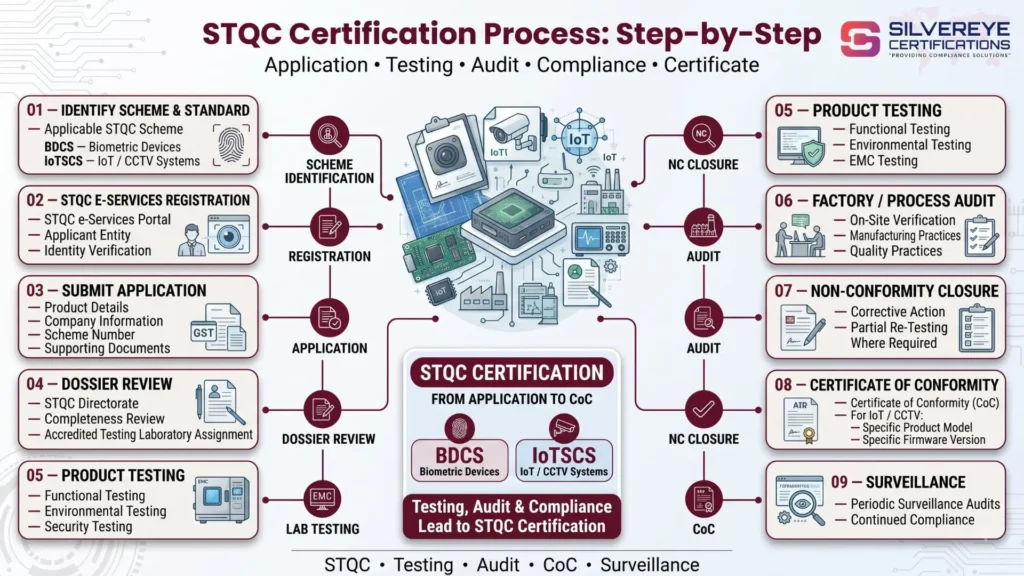
- The STQC Certification Process runs through six core stages: scheme selection, online application, document review, lab testing, audit, and certificate issuance.
- Applications are filed entirely through the STQC e-Services portal, with identity verification and application fees paid via the government's BharatKosh payment gateway.
- A complete, well-documented application typically moves through the full process in 6 to 12 weeks, start to finish.
- CCTV and IoT applicants now follow an added firmware-hash verification step introduced under the 2026 IoTSCS security mandate.
Introduction
The STQC Certification Process is the official step-by-step procedure applicants follow to get an IT, electronics, biometric or IoT product certified by India's STQC Directorate under MeitY. It starts with selecting the right certification scheme, then moves through online application on the STQC e-Services portal, document/Technical Construction File review, sample submission to an accredited lab, testing against IS/IEC standards, a factory or process audit where required, correction of any non-conformities, and finally certificate issuance.
The whole process usually takes 6 to 12 weeks for a well-prepared applicant, with fees paid online via BharatKosh at the application stage.
Knowing that you need STQC Certification is one thing. Actually walking through the process — which portal to use, what form to fill, which documents go where, and what happens if the lab flags a problem — is where most first-time applicants get stuck. This guide breaks the entire STQC Certification Process down stage by stage, so you know exactly what to expect at every point between opening the application and receiving your Certificate of Conformity.
What Is the STQC Certification Process?
The STQC Certification Process is the defined administrative and technical workflow that the STQC Directorate — operating under India's Ministry of Electronics and Information Technology (MeitY) — uses to move an applicant from 'I need this certified' to 'I have a valid Certificate of Conformity.' It combines online application filing, document scrutiny, physical lab testing at an accredited ERTL, ETDC or IT Centre, and, for many schemes, an on-site audit of the manufacturing or development process.
The exact checklist differs slightly by scheme — biometric devices, IoT/CCTV systems, software, and website quality certification each have their own procedure documents — but the overall structure of the process stays consistent across categories.
Why Getting the Process Right Matters
- A correctly sequenced application avoids the single biggest cause of delay: submitting samples or documents before the scheme and lab assignment are confirmed.
- Following the process properly the first time protects your budget — re-testing after a rejected application means paying lab charges twice.
- Certificates are tied to exact process outcomes (model number, firmware version, test parameters), so skipping a step can invalidate the certificate later even if it was issued.
- For regulated categories like CCTV and biometric devices, an incomplete process simply means you cannot legally sell the product in India — there's no informal workaround.
Who Can Enter the STQC Certification Process
- The product owner, original manufacturer/developer, or a formally authorized representative of the manufacturer.
- Products that fall under an active STQC scheme — biometric devices, IoT/CCTV systems, software applications, smart cards, or cybersecurity products.
- Products at a stable, near-production stage — prototypes are generally not accepted into the formal process.
- Overseas manufacturers and importers, provided they appoint an Authorized Indian Representative (AIR) with a notarized Letter of Authorization before applying.
Documents Require For STQC Certification
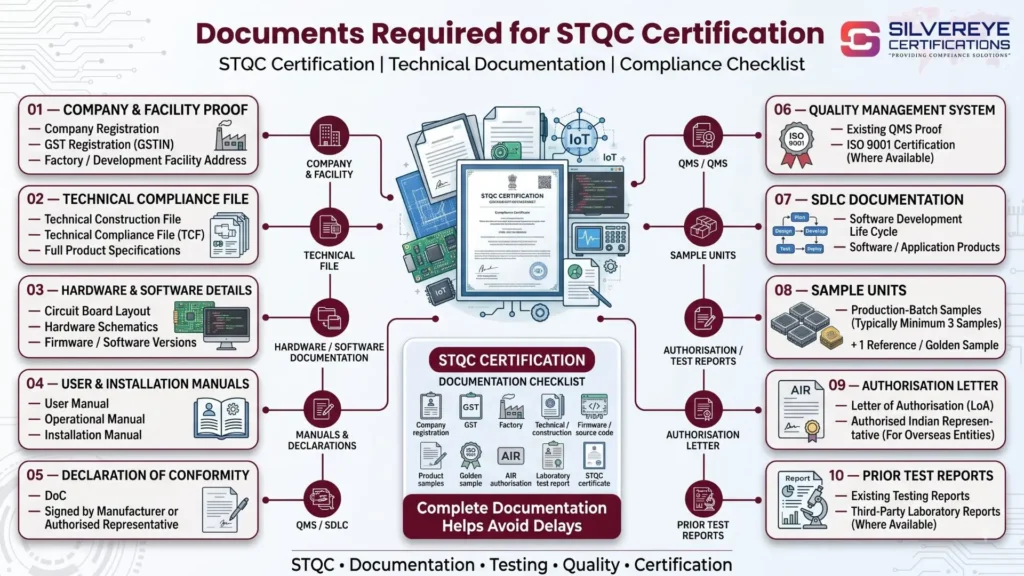
Having these ready before you open the STQC e-Services portal account is what keeps the process moving without back-and-forth delays.
- Company registration proof, GSTIN, and factory/development facility address.
- Technical Construction File (TCF) with full product specifications and technical drawings.
- Declaration of Conformity (DoC), signed by the manufacturer or authorized representative.
- User and installation/operation manuals for the product.
- Proof of an existing Quality Management System (e.g., ISO 9001), where available.
- SDLC documentation, for software or application-based products.
- Production-batch sample units — usually a minimum of three, plus one reference sample.
- Letter of Authorization (LoA) for the AIR, for overseas applicants.
Step-By-Step STQC Certification Process
This is the core of the guide — a stage-by-stage walkthrough of what actually happens, who is involved, and roughly how long each part takes.
Stage 1: Identify the Correct Scheme
Before touching the portal, confirm which STQC scheme applies to your product — for example, the Biometric Device Certification Scheme (BDCS) for fingerprint or iris scanners, or the IoT System Certification Scheme (IoTSCS) for connected devices and CCTV. Applying under the wrong scheme is one of the most common reasons applications get sent back at the review stage.
Stage 2: Register and Apply on the STQC e-Services Portal
Create an account on the official STQC e-Services portal (stqc.gov.in) and complete identity verification for your applicant entity, typically through Aadhaar-based eSign for Indian applicants. Once verified, navigate to the certification section and open a new application, filling in product name, model number, HS code, the relevant scheme number, and company details including GSTIN and MSME status where applicable. Importers additionally submit their Authorised Indian Representative details at this stage.
Stage 3: Upload Documents and Pay the Application Fee
Upload your Technical Construction File, Declaration of Conformity, and supporting technical documents through the portal. The application/processing fee is paid online through the government's BharatKosh payment gateway, after which your application enters STQC's review queue.
Stage 4: Document Review and Lab Assignment
STQC's Directorate reviews the submitted dossier for completeness, accuracy, and eligibility. If everything checks out, the Directorate outlines the specific testing protocols and assigns your product to an accredited laboratory suited to your test category — for instance, ERTL (North) in Delhi for EMC and safety testing, or ETDC Bengaluru for IoT and penetration testing.
Stage 5: Sample Submission and Laboratory Testing
Once the lab assignment is confirmed, you typically have a defined window — commonly around 15 days — to submit production samples (usually at least three units plus a reference sample) to the designated lab. The lab then conducts the relevant tests: functional performance, EMC/EMI, environmental stress, safety, and, for connected devices, security and penetration testing.
Stage 6: Factory or Process Audit (Where Required)
For several schemes, STQC officials conduct an on-site audit of the manufacturing facility or software development process to confirm that real-world production matches what was tested and documented. This step is scheme-dependent — not every category requires a physical audit.
Stage 7: Rectification and Re-Testing (If Needed)
If testing or audit reveals non-conformities — a firmware vulnerability, an environmental failure, incomplete documentation — you must fix the issue and resubmit for partial re-testing of only the affected parameters, rather than starting the entire process over.
Stage 8: Certificate Issuance
Once all test results and audit findings meet the required standard, STQC issues the Certificate of Conformity (CoC). The certificate carries a unique reference number and is tied to the specific product model — and, for IoT/CCTV devices, the exact firmware version and firmware hash tested.
Stage 9: Post-Certification Surveillance
Certification is not the end of the process. Certificate holders undergo periodic (typically annual) surveillance audits during the validity period to confirm the product and manufacturing process continue to meet the certified standard.
What Happens If Your STQC Certification Application Is Rejected or Delayed
Rejections at the document-review stage are usually procedural — an incomplete Technical Construction File, a missing Declaration of Conformity, or a mismatch between the declared scheme and the actual product category. In these cases, the Directorate typically returns the application with the specific gap flagged, and you can correct and resubmit without paying the application fee again.
- Incomplete or generic Technical Construction File — the single most common cause of delay at the review stage.
- Non-production or prototype samples sent to the lab instead of production-batch units.
- Missing Authorised Indian Representative details for overseas applicants.
- Firmware not locked to a final version before testing, which is now specifically checked for IoT/CCTV applications.
If you disagree with a testing or audit outcome, most schemes allow you to raise the concern with the assigned lab or the STQC Directorate directly for clarification before deciding whether to contest the finding or proceed with rectification — this is worth doing through official written correspondence so there's a documented record.
Fees Involved at Each Stage of the STQC Certification Process
| Process Stage | Fee Component | Approximate Range |
| Application | Processing fee (via BharatKosh) | ₹20,000 – ₹50,000 |
| Lab testing | Testing & evaluation charges | ₹2,00,000 – ₹6,00,000+ per product series |
| Factory/process audit | Audit fee (where applicable) | Often bundled into scheme fee |
| Post-certification | Annual surveillance audit | ₹50,000 – ₹55,000 per year |
| Optional | Consultant/documentation support | ₹1,00,000 – ₹3,00,000 |
STQC does not publish one universal fee schedule for every scheme — the final cost depends on the product category and number of test parameters. GST applies on top of quoted charges, and fees are generally invoiced per product model or series.
Certificate Validity and the Renewal STQC Certification Process
Most STQC certificates are valid for three years from the date of issue. Renewal is itself a mini version of the original process rather than a rubber stamp.
- Track your certificate's expiry date and initiate the renewal application before the three-year validity lapses.
- Confirm whether the product, firmware, or manufacturing process has changed since original certification — any change usually triggers a fresh or partial re-test.
- Submit renewal documentation through the STQC e-Services portal, referencing your original certificate number.
- Complete any required re-testing or audit before the renewed certificate is issued.
- Continue annual surveillance audits throughout the new validity period to keep the certificate active.
What's New in the STQC Certification Process for 2026
Firmware-Hash Verification for IoT and CCTV Applications
Since the CCTV/IoT security mandate took effect on April 1, 2026, applications under the IoT System Certification Scheme now include an added verification step: the certificate is locked not just to the model number, but to the exact firmware version and firmware hash tested. Any firmware update after certification requires re-verification through the process again — a meaningful procedural change from earlier years.
Streamlined Digital Application via Aadhaar eSign
The STQC e-Services portal now relies on Aadhaar-based eSign for applicant identity verification at the registration stage, which has reduced the paperwork previously needed for physical signature verification during application filing.
GIGW 3.0 Alignment for Website Quality Certification
Applicants pursuing STQC's Website Quality Certification Scheme now go through document review aligned with GIGW 3.0 — the updated Guidelines for Indian Government Websites issued by the Department of Administrative Reforms and Public Grievances — which places greater process emphasis on security hardening and accessibility compliance during review.
Cross-Lab Collaboration for Specialized Testing
A February 2026 collaboration between the National Test House and STQC's ERTL (North) lab now allows EMI/EMC testing for certain product categories, like drones, to be processed jointly across two government labs rather than requiring separate applications — a template that may extend the process for other specialised categories going forward.
Getting Help Navigating the STQC Certification Process
Because the STQC Certification Process involves multiple hand-offs — portal application, document review, lab coordination, and audit scheduling — a single missed step at any stage can add weeks to your timeline. This is exactly why many first-time applicants, particularly SMEs and overseas manufacturers, choose to work with experienced consultants who manage the process end-to-end rather than learning it through trial and error.
| Get Expert Help With the STQC Certification Process Silvereye Certifications guides manufacturers, brands and their suppliers through every stage of the STQC Certification Process — from scheme selection and Technical Construction File preparation to lab coordination and post-certification surveillance — alongside related compliance work such as BIS, WPC, and CDSCO approvals. Working with a team that already knows where applications typically stall can meaningfully shorten your path from application to certificate. |
Conclusion
The STQC Certification Process is thorough by design — it exists to make sure products entering government systems, identity infrastructure, and now home and business surveillance networks are genuinely safe and secure, not just paperwork-compliant. Once you see it as a sequence of nine defined stages rather than one large, vague requirement, it becomes far easier to plan around: pick the right scheme, prepare a complete Technical Construction File before you apply, budget for both testing and a possible rectification cycle, and track your certificate's three-year clock for renewal.
The 2026 changes — firmware-hash verification for connected devices, Aadhaar eSign registration, and the GIGW 3.0 alignment for website certification — show that the process itself keeps evolving alongside the security landscape it is meant to protect. Whether you manage the journey in-house or bring in experienced support like Silvereye Certifications, treating the STQC Certification Process as a structured project with clear stages is what keeps your product moving toward market instead of stuck in review.
Frequently Asked Questions
What are the main steps in the STQC certification process?
The process runs through scheme identification, online application on the STQC e-Services portal, document review, lab assignment, sample submission and testing, a factory/process audit where required, rectification of any issues, and finally certificate issuance.
How do I start the STQC certification process?
You start by identifying the correct scheme for your product, then registering on the STQC e-Services portal, where you complete identity verification and submit your application along with the Technical Construction File and other required documents.
How long does the entire STQC certification process take?
For a well-prepared application, the full process typically takes 6 to 12 weeks from initial application to certificate issuance. Incomplete documentation or non-production samples can push this well beyond 90 days.
How is the application fee paid during the STQC certification process?
The application/processing fee is paid online through the government's BharatKosh payment gateway as part of the portal application step, before the dossier moves into STQC's review queue.
What happens if my application is rejected during document review?
Rejections at this stage are usually procedural — an incomplete Technical Construction File, missing Declaration of Conformity, or wrong scheme selection. STQC typically flags the specific gap so you can correct and resubmit.
Is a factory audit always part of the STQC certification process?
No. Whether a factory or process audit is required depends on the specific scheme. Some categories require an on-site audit to verify manufacturing practices; others rely primarily on lab test results and documentation review.
How many samples do I need to submit during the process?
Most schemes require a minimum of three production-batch sample units, plus one reference or 'golden' sample, submitted to the assigned lab within a defined window after application approval — commonly around 15 days.
What is the renewal process for an STQC certificate?
Before your three-year validity expires, you file a renewal application through the STQC e-Services portal referencing your original certificate number, undergo any required re-testing if the product or firmware has changed, and continue annual surveillance audits.
Has the STQC certification process changed for CCTV cameras in 2026?
Yes. Since April 1, 2026, CCTV and IoT applications include an added firmware-hash verification step under the IoTSCS security mandate, with the certificate locked to the exact model, firmware version, and firmware hash tested.
Can I track my STQC application status online?
Yes. Applications filed through the STQC e-Services portal can be tracked through your registered account, which shows the current stage of review, lab assignment, and testing status.
Do overseas companies follow a different process?
The core process stages are the same, but overseas manufacturers and importers must additionally appoint an Authorized Indian Representative (AIR) with a notarized Letter of Authorization before applying, since the AIR handles communication and coordination with STQC on their behalf.
What causes the most delays in the STQC certification process?
The most common causes are incomplete or generic Technical Construction Files, sending non-production or prototype samples instead of production units, and missing Authorized Indian Representative details for importers.