- STQC Testing is carried out by MeitY's accredited ERTL, ETDC and IT Centre laboratories spread across more than 20 locations in India.
- It covers EMC/EMI, environmental, safety, software, cybersecurity, and biometric device testing, each mapped to specific IS/IEC standards.
- Test reports generated during STQC Testing feed directly into STQC Certification, government tender eligibility, and mandatory schemes such as IoTSCS for CCTV cameras.
- Turnaround typically runs 3 to 8 weeks per product depending on the test category, sample readiness, and lab queue.
Introduction
STQC Testing is the laboratory evaluation process run by India's STQC Directorate (under MeitY) to check whether electronics, IT, software, IoT and biometric products meet defined performance, safety, environmental and cybersecurity standards. Testing happens at accredited ERTL (Electronics Regional Test Laboratory), ETDC (Electronics Test & Development Centre) and IT Centre labs located across India, using standards such as IEC 61000 for EMC and IEC 60601 for medical devices.
The resulting test report is what STQC Certification is built on — so testing is the technical core of the whole compliance process, not a separate formality. It's required for biometric devices, many IoT/security products, and, since April 2026, CCTV cameras and recorders.
Most people searching for STQC Testing already know they need a certificate — what they actually need clarity on is the testing step itself: which lab will test the product, what exactly gets tested, how long it takes, and what it costs before a Certificate of Conformity is even on the table. That is the gap this guide fills.
STQC Testing is the technical backbone of India's STQC Certification system. Every certificate the STQC Directorate issues is built on a test report generated in one of its accredited laboratories. If you are preparing a biometric scanner, an IoT device, a CCTV camera, a piece of government-facing software, or any electronics product for the Indian market, understanding the testing stage — not just the certification paperwork — is what actually determines your timeline and budget.
What Is STQC Testing?
STQC Testing refers to the laboratory-based evaluation conducted by the Standardization Testing and Quality Certification Directorate, a body operating under India's Ministry of Electronics and Information Technology (MeitY). The Directorate runs a network of specialized labs that test electronics, IT hardware, software and connected devices against Indian Standards (IS), international standards (IEC, ISO), and sector-specific technical requirements set by bodies like UIDAI.
Unlike a paperwork-only compliance check, STQC Testing involves physically evaluating product samples — subjecting them to electromagnetic interference chambers, environmental stress chambers, safety rigs, and, for software and connected devices, source-code review and penetration testing. The test report produced at the end is the evidentiary basis for the STQC Certificate of Conformity.
Why STQC Testing Matters for Your Product
- It is the technical gatekeeper for STQC Certification — no certificate is issued without a passing test report from an accredited STQC lab.
- STQC's EMI/EMC facilities are recognized by NABL, FCC, UL and SASO, which gives Indian test reports credibility beyond the domestic market.
- For regulated categories — biometric devices, government IT systems, and now CCTV/IoT devices — passing STQC Testing is a legal precondition for sale, not an optional quality signal.
- Early, structured testing surfaces design flaws (EMC leakage, weak firmware security, environmental failure points) before mass production, which is far cheaper to fix than a post-launch recall.
- A clean STQC test history strengthens your position in GeM listings, PSU tenders, and enterprise RFPs that specifically ask for STQC-tested products.
Types of Tests Conducted Under STQC
STQC Testing is not one uniform test — it is a set of specialised test categories, each targeting a different risk area of the product. The table below covers the major categories relevant to most applicants.
| Test Category | What It Evaluates | Common Standards Used |
| EMI/EMC Testing | Electromagnetic interference emitted and immunity to external interference | IEC 61000 series, IS 14700 |
| Environmental Testing | Performance under heat, cold, humidity, salt spray and corrosion | IEC 60068 series |
| Safety Testing | Electrical safety, insulation, and hazard protection | IEC 60950 / IEC 62368, IEC 60601-1 (medical) |
| Software Testing & Assessment | Functional correctness, source-code quality, and process maturity | ISO/IEC 25010, SDLC-based assessment |
| Cybersecurity / Penetration Testing | Vulnerability to unauthorised access, firmware security, secure boot | Common Criteria, MeitY Essential Requirements |
| Biometric Device Testing | Accuracy and reliability of fingerprint/iris capture devices | UIDAI Aadhaar device specifications |
| Reliability & Component Testing | Long-term performance and failure-rate analysis of components | IS/IEC component-level standards |
STQC Testing Labs and Centres Across India
STQC Testing is delivered through a nationwide network rather than a single central lab. This matters because choosing a lab that specialises in your product category — instead of the nearest one — meaningfully affects both accuracy and turnaround.
| Lab / Centre | Location | Core Specialisation |
| ERTL (North) | New Delhi | EMI/EMC, environmental, power/energy testing, high-precision calibration |
| ERTL (East) | Kolkata | Opto-electronics, mining electronics, environmental & safety testing |
| ERTL (West) | Mumbai | Safety testing, environmental testing, semiconductor testing |
| ERTL (South) | Thiruvananthapuram | Component testing, medical electronics, environmental testing |
| ETDC Bengaluru / Chennai / Hyderabad / Pune | Multiple states | IoT, software, SME product development testing, calibration |
| ETDC Jaipur / Mohali / Solan / Goa / Guwahati / Agartala / Ajmer | Multiple states | Region-specific electronics testing & calibration support for local industry |
| IT Centres (Delhi, Kolkata, Bengaluru, Chennai, Hyderabad, Pune, Mumbai, and others) | Pan-India | Software testing, ISMS/QMS assessment, information-security training |
STQC's electronics labs are accredited under ISO/IEC 17025 and several are additionally recognised by international bodies including NABL, FCC, UL and SASO — a point worth citing if your product also needs export-market acceptance.
Who Needs STQC Testing? Eligibility and Applicability
- Manufacturers and developers of biometric devices intended for Aadhaar enrolment or authentication.
- Companies building IoT devices, sensors, gateways and — since April 2026 — CCTV cameras and video recorders sold or imported into India.
- Software vendors and system integrators delivering government-facing applications, websites (under GIGW), or e-governance platforms.
- IT security product makers (firewalls, smart cards, secure boot systems) seeking Common Criteria or cybersecurity validation.
- Any electronics manufacturer that needs a credible, government-recognised test report to support GeM listing, PSU tenders, or export documentation.
Overseas manufacturers can also route products through STQC Testing but must work through an Authorised Indian Representative (AIR) who manages sample submission and communication with the lab on their behalf.
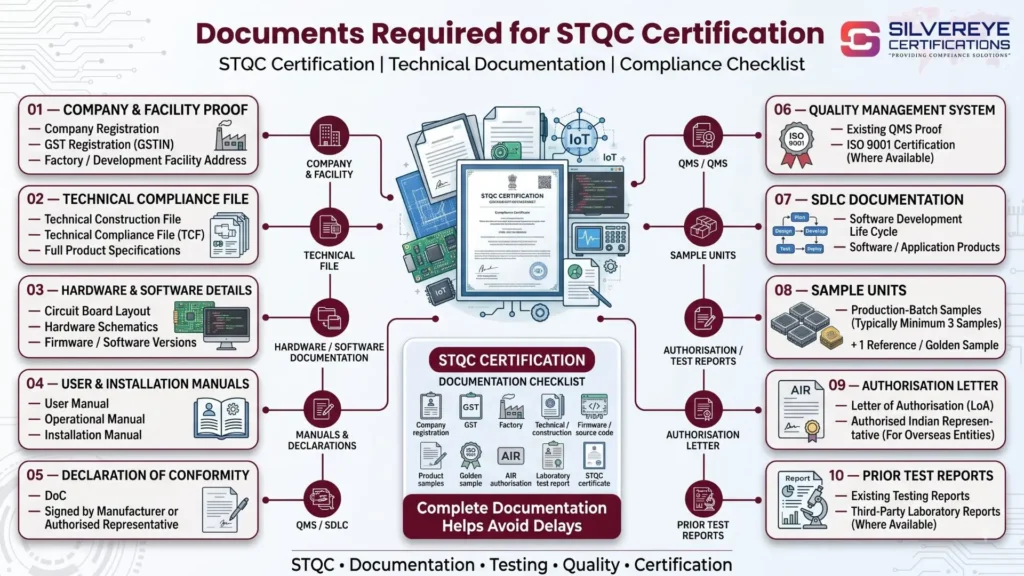
Documents Required Before STQC Testing
- Technical Construction File (TCF) with complete product specifications, block diagrams and rated parameters.
- Circuit schematics and firmware/software version details, where applicable.
- User and installation manuals describing intended operating conditions.
- Company registration, GSTIN, and manufacturing/development facility address.
- Test-ready product samples — typically a minimum of three production units, plus one reference sample.
- Declaration of Conformity (DoC) and any prior in-house or third-party test reports, if available.
- Software Development Life Cycle (SDLC) documentation, for software-based products.
- Letter of Authorization (LoA) for the Authorized Indian Representative, for overseas applicants.
STQC Testing Process: Step-by-Step
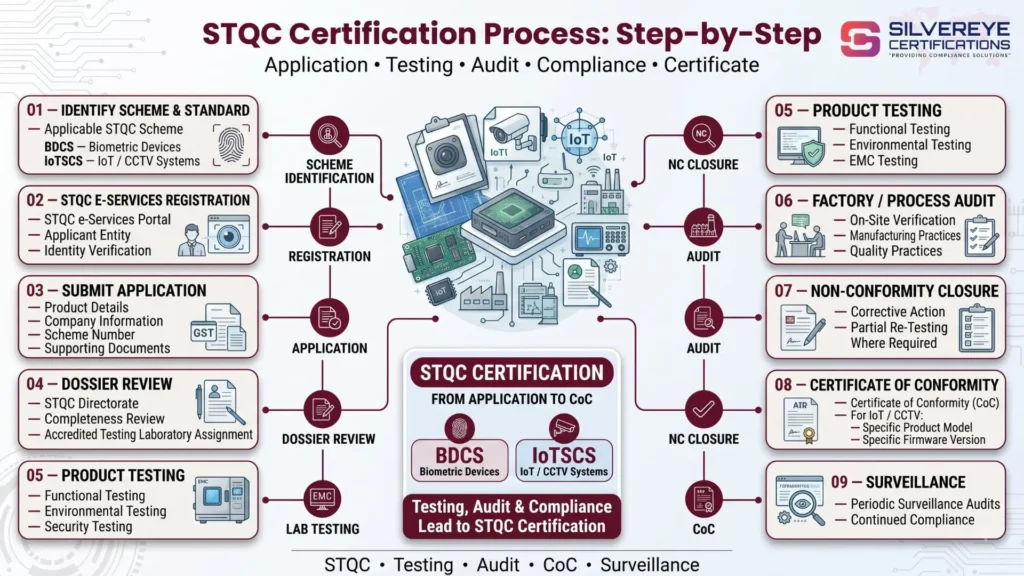
- Confirm the applicable scheme and identify which lab specialises in your product's test category (EMC, environmental, software, biometric, etc.).
- Register on the STQC e-Services portal and submit the application with product and company details.
- STQC's Directorate reviews the Technical Construction File and other documents for completeness before assigning a lab.
- The lab conducts the relevant tests — EMC chamber testing, environmental stress cycles, safety checks, source-code or penetration testing, as applicable.
- If required for the scheme, STQC schedules a factory or development-process audit alongside lab testing.
- Non-conformities identified during testing must be corrected, followed by partial re-testing of the affected parameters.
- On successful completion, the lab issues the test report, which STQC's Directorate uses to process the Certificate of Conformity.
STQC Testing Timeline
| Stage | Typical Duration |
| Document review & lab assignment | 1–2 weeks |
| Sample dispatch & lab queue wait | 1–3 weeks (varies by lab load) |
| Active testing (EMC/environmental/safety/software) | 2–4 weeks |
| Re-testing after rectification (if needed) | 1–3 weeks additional |
| Total, well-prepared application | 3–8 weeks |
Complex categories — cybersecurity/penetration testing for IoT and CCTV devices, or IEC 60601 medical safety testing — tend to sit at the longer end of this range, since fewer specialised lab slots are available nationally.
STQC Testing Fees and Cost Factors
STQC does not publish one flat testing fee across every product category — the cost depends on how many parameters need testing, the number of samples, and how many re-test cycles are needed. Based on published reference points from comparable schemes, applicants can expect the following broad ranges.
| Cost Component | Approximate Range |
| Application/document processing fee | ₹20,000 – ₹50,000 |
| EMC/environmental/safety lab testing | ₹1,50,000 – ₹4,00,000 per product series |
| Software/cybersecurity/penetration testing | ₹1,00,000 – ₹3,00,000 per product series |
| Factory/process audit (where required) | Often bundled into scheme fee or charged separately |
| Re-testing after non-conformity | Charged per affected parameter, not full retest |
GST applies on top of quoted lab charges, and costs are generally invoiced per product model/series rather than per company — so a manufacturer with five product variants should budget for five separate test cycles unless variants share an identical tested configuration.
STQC Testing vs STQC Certification: How They Relate
These two terms get used interchangeably, but they are not the same step. Testing is the technical evaluation; certification is the administrative outcome built on top of a passing test result.
| Aspect | STQC Testing | STQC Certification |
| What it is | Lab-based technical evaluation of the product | Official Certificate of Conformity issued after testing |
| Where it happens | ERTL / ETDC / IT Centre labs | STQC Directorate (based on lab test report) |
| Output | Test report with pass/fail results per parameter | Certificate with a unique number and validity period |
| Can you have one without the other? | Yes — testing can be done standalone for internal QA | No — certification always requires a passing test report first |
STQC Testing 2026 Updates: What's New
New Drone EMI/EMC Testing Collaboration (February 2026)
In a memorandum signed on 2 February 2026, the National Test House (NTH) partnered with STQC's ERTL (North) laboratory to jointly deliver EMI and EMC testing for drones and their subsystems, tested against IEC 61000 and IS 14700 standards. Test results from this collaboration now feed directly into the Type Certification process for drones under the Drone Rules 2021 and the Certification Scheme for Unmanned Aircraft Systems 2022. The arrangement was specifically designed to give startups and MSMEs access to affordable, government-backed EMC testing without duplicating expensive private lab infrastructure.
Mandatory IoTSCS Testing for CCTV Cameras (April 2026)
Since April 1, 2026, CCTV cameras and video recorders sold, manufactured or imported into India must pass testing under the IoT System Certification Scheme (IoTSCS) against MeitY's security-focused Essential Requirements before they can be legally marketed. This followed real security incidents earlier in 2026 involving uncertified, foreign-made surveillance cameras discovered transmitting data outside India. Test reports under this scheme are tied to a specific model number, firmware version, and firmware hash — any change to these requires fresh testing.
Continued Lab Capacity Expansion
- Growing accreditation recognition for STQC's EMC labs from international bodies (NABL, FCC, UL, SASO), improving acceptance of Indian test reports abroad.
- Increased focus on firmware-hash verification and penetration testing as standard components of IoT-related test cycles, reflecting the shift toward supply-chain security.
- Ongoing expansion of ETDC calibration and testing capacity in tier-2 industrial hubs to reduce queue times for SME applicants.
Choosing the Right Lab and Getting Testing Support
Matching your product to the right specialised lab — rather than defaulting to whichever centre is geographically closest — is one of the simplest ways to avoid delays. A CCTV or IoT device belongs with a lab experienced in cybersecurity and penetration testing; a medical device belongs with a lab equipped for IEC 60601 safety testing; a consumer electronics product needs strong EMC and environmental chamber capacity.
Because assembling a complete Technical Construction File and coordinating sample logistics across multiple labs is genuinely time-consuming, many applicants — especially first-time exporters and SMEs — bring in experienced compliance consultants to manage the testing and certification journey end-to-end.
| Get Expert Help With STQC Testing Silvereye Certifications supports manufacturers, brands and their suppliers through the STQC Testing process, alongside related compliance work such as BIS, WPC, and CDSCO approvals. Their team helps applicants prepare test-ready documentation, coordinate with the appropriate STQC lab, and manage the full path from sample submission to certificate issuance — reducing the trial-and-error that often slows down first-time applicants. |
Conclusion
STQC Testing is the technical foundation that everything else in India's STQC Certification system is built on. Whether you're validating a biometric scanner, an IoT gateway, a CCTV camera under the new 2026 mandate, or a government-facing software platform, the lab test report is what actually proves your product is safe, reliable and secure — the certificate is simply the official record of that result.
Getting through STQC Testing efficiently comes down to three things: sending your product to a lab that specialises in your test category, submitting a complete and accurate documentation set the first time, and budgeting realistically for both the testing fee and the possibility of a rectification cycle. Whether you manage this in-house or work with experienced support like Silvereye Certifications, treating STQC Testing as a planned engineering milestone — not a last-minute compliance task — is what keeps your product on schedule for the Indian market.
Frequently Asked Questions
What is STQC testing?
STQC Testing is the laboratory evaluation of electronics, IT, software, IoT and biometric products against Indian and international standards, carried out by accredited ERTL, ETDC and IT Centre labs under India's STQC Directorate (MeitY). The resulting test report is the basis for STQC Certification.
Where can I get STQC testing done?
STQC operates a nationwide lab network, including ERTL centres in Delhi, Kolkata, Mumbai and Thiruvananthapuram, plus ETDC and IT Centre labs in cities such as Bengaluru, Chennai, Hyderabad, Pune, Jaipur, Mohali, Goa, Guwahati and Agartala. You apply through the STQC e-Services portal, which assigns your product to the lab suited to your test category.
What is the difference between STQC testing and STQC certification?
Testing is the technical lab evaluation of your product; certification is the official Certificate of Conformity issued after your product passes that testing. You cannot get an STQC certificate without first completing STQC testing, but testing itself can also be done standalone for internal quality assurance.
How long does STQC testing take?
Most well-prepared applications take about 3 to 8 weeks for the testing stage, depending on the test category, sample readiness, and current lab queue. Cybersecurity and penetration testing for IoT/CCTV devices often takes longer due to limited specialised lab slots.
How much does STQC testing cost?
Lab testing charges typically range from about ₹1.5 lakh to ₹4 lakh per product series for EMC, environmental and safety testing, with software or cybersecurity testing adding ₹1 lakh to ₹3 lakh. STQC does not publish one fixed fee for every category, so costs vary by product and test scope.
What standards does STQC testing follow?
STQC testing follows Indian Standards (IS) and international standards such as IEC 61000 for EMC, IEC 60068 for environmental testing, IEC 60601-1 for medical device safety, and MeitY's Essential Requirements for IoT and cybersecurity-related products.
Is STQC testing mandatory for CCTV cameras?
Yes. Since April 1, 2026, CCTV cameras and video recorders sold, manufactured or imported in India must pass testing under the IoT System Certification Scheme (IoTSCS) before they can be legally marketed.
Are STQC test reports accepted internationally?
STQC's EMI/EMC testing facilities are accredited under ISO/IEC 17025 and recognised by international bodies including NABL, FCC, UL and SASO, which gives STQC test reports credibility beyond the Indian market for several product categories.
How many product samples are needed for STQC testing?
Most schemes require a minimum of three production-ready sample units, plus one reference or golden sample retained by the lab for comparison during surveillance testing.
Can software be tested under STQC?
Yes. STQC's IT Centres conduct software testing and assessment, source-code review, and Software Development Life Cycle (SDLC) evaluation for applications, particularly those used in government or e-governance projects.
What happens if a product fails STQC testing?
The lab identifies the specific non-conforming parameters in the test report. The applicant must rectify the hardware, firmware or software issue and resubmit for partial re-testing of only the affected parameters, rather than a full retest in most cases.
Do imported products need STQC testing in India?
Yes, if they fall under a mandatory category such as biometric devices, IoT/CCTV systems, or government-linked IT products. Importers must appoint an Authorised Indian Representative to coordinate sample submission and communication with the STQC lab.