- The publisher is the person appointed by the owner to file the main registration form, sign the Form-I declaration, and take charge of PRGI compliance for a periodical.
- Any Indian citizen, or an entity legally registered in India, can act as a publisher on the Press Sewa Portal — individuals, companies, firms, NGOs, and trusts all qualify.
- Once the Certificate of Registration is issued, the publisher is legally required to commence publication of the periodical without undue delay.
- Publishers carry ongoing compliance duties even after registration, including annual filings and keeping owner, printer, and title details accurate on the portal.
Introduction
RNI registration for publisher is the process by which the person or entity responsible for bringing out a newspaper, magazine, or periodical gets legally registered with the Press Registrar General of India (PRGI) through the Press Sewa Portal. The publisher is appointed by the owner, completes the main registration form, signs the Form-I declaration, and coordinates with the printer to finalize Form-IV.

Any Indian citizen or Indian-registered entity can be a publisher, provided they haven't been convicted of offences involving terrorist acts, unlawful activity, or acts against the security of the State. Once PRGI issues the Certificate of Registration, the publisher must commence publication and then keep the periodical compliant through Annual Statement filings and timely updates.
What is RNI Registration For Publisher?
In RNI/PRGI terminology, the “owner” is the individual, firm, or entity that owns the periodical, while the “publisher” is the person the owner appoints to actually run the registration and publication process. On the Press Sewa Portal, the owner initiates the application and proposes the title, then invites a publisher, who completes the main registration form, signs the Form-I declaration, and works with the appointed printer to finalize Form-IV before the Certificate of Registration is issued.
For sole proprietors and small publications, the same person often plays both the owner and publisher role — but the two responsibilities remain legally distinct on the portal, and PRGI records both separately against the periodical's registration.
Benefits of Completing RNI Registration as a Publisher
- Legal authority to publish: A publisher named on a valid Certificate of Registration has the legal right to bring out issues of the periodical.
- Clear accountability: Being the registered publisher establishes you as the recognized point of contact for PRGI, advertisers, and readers.
- Access to government advertising: DAVP/BOC empanelment and government ad schemes require the periodical to have a valid, publisher-verified RNI/PRGI registration.
- Smoother Annual Statement filing: A publisher who understands the process files accurate yearly statements and avoids compliance gaps.
- Protection from penalties: Proper registration and timely filings shield the publisher from monetary penalties under the PRP Act, 2023.
Who Can Register as a Publisher?
The PRP Act, 2023 sets a fairly broad eligibility standard for who can act as a publisher, with one important restriction:
- Any citizen of India can be appointed as a publisher, provided they haven't been convicted of an offence involving a terrorist act, unlawful activity, or acts against the security of the State.
- Any entity incorporated and registered in India under applicable law — companies, LLPs, partnership firms, NGOs, and trusts — can also bring out a periodical through an appointed publisher.
- Individual proprietors, journalists, and media professionals launching their own newspaper or magazine can act as both owner and publisher.
- A publisher can be appointed or changed by the owner at any time by updating records on the Press Sewa Portal, subject to PRGI verification.
Documents Required for RNI Registration For Publisher
Here is the document checklist a publisher typically needs to complete registration on the Press Sewa Portal:
| Document | Purpose |
| Aadhaar Card / Passport / Voter ID | Identity proof for the publisher |
| PAN Card | Required for smoother verification, mandatory if the publisher is a company or firm |
| Address proof (utility bill, rent agreement) | Verifies the publisher's contact and correspondence address |
| Form-I (Declaration) | The core declaration the publisher signs, naming the owner, title, language, and periodicity |
| Passport-size photograph | Publisher identification on the application |
| Authorization letter from the owner | Confirms the owner has appointed this individual as publisher |
| Publisher's Certificate (or CA certificate for 25,000+ copies) | Declares circulation figures for Annual Statement and renewal purposes |
| Printer coordination documents (Form-IV, printing agreement) | The publisher must ensure the appointed printer's Form-IV is completed and verified |
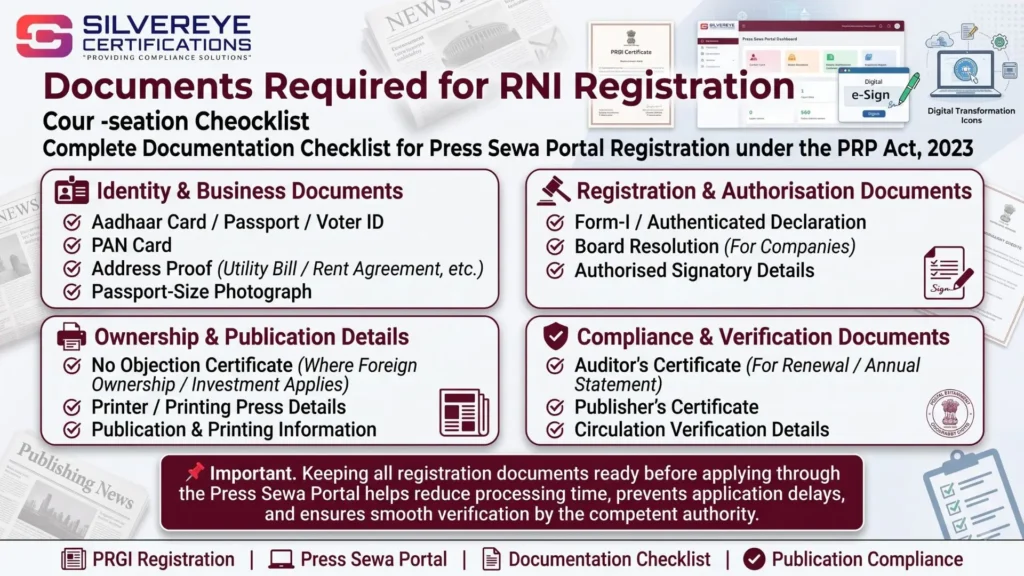
Keep scanned soft copies ready for portal upload and physical originals on hand in case PRGI or the specified local authority requests verification. Document requirements are periodically refined, so always confirm the latest fields on the official Press Sewa Portal before filing.
Step-by-Step Process: How a Publisher Registers on the Press Sewa Portal
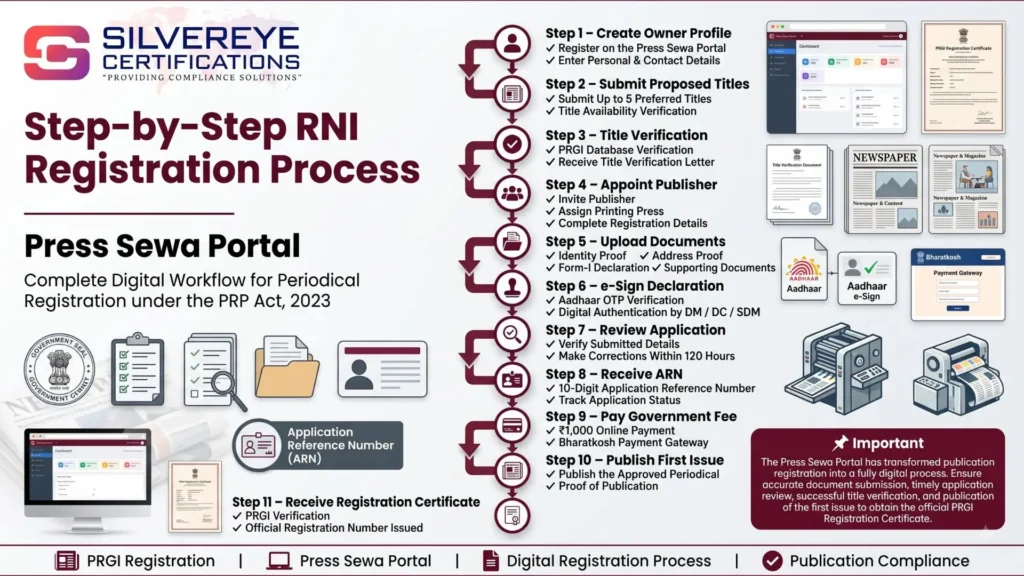
- The owner creates a profile on the Press Sewa Portal and submits up to 5 proposed titles for the periodical.
- Once the title is cleared, the owner invites and appoints a publisher through the portal.
- The publisher accepts the appointment and completes the main registration form with personal, contact, and periodical details.
- The publisher signs the Form-I declaration, e-Signed via Aadhaar-based OTP or authenticated by the DM/DC/SDM online.
- The publisher coordinates with the appointed printer to ensure Form-IV (Printer's Certificate) is completed and digitally co-signed.
- The publisher reviews the full application within the 120-hour (5-day) correction window before it locks for processing.
- Once documents are verified and the ₹1,000 government fee is paid, PRGI issues the Certificate of Registration.
- The publisher must then commence publication of the periodical without undue delay, as required under Section 7(6) of the PRP Act, 2023.
A Publisher's Ongoing Legal Duties After Registration
- Registration isn't the finish line for a publisher — it's the start of an ongoing compliance relationship with PRGI. Key duties include:
- Commencing publication promptly after receiving the Certificate of Registration, as required under Section 7(6) of the PRP Act, 2023.
- Ensuring every issue carries an accurate imprint line: name of the printer, place of printing, editor, publisher, and place of publication.
- Filing the Annual Statement each year, generally by 31 May, with accurate circulation figures.
- Updating the portal promptly if there's a change in title, ownership, printer, periodicity, or place of publication.
- Responding to any Deficiency Communication from PRGI within the notified time to avoid delays or penalties.
Fees Involved in RNI Registration for Publisher
| Component | Approximate Cost | Notes |
| Government registration fee | ₹1,000 | Paid via Bharatkosh gateway after document verification |
| Late Annual Statement filing (per year, where applicable) | Penalty as per current PRGI advisory | Publisher's responsibility to file on time |
| CA certification of circulation (25,000+ copies) | Varies by CA firm | Required as supporting document at Annual Statement stage |
| Consultant/professional charges (optional) | Varies by service provider | For documentation and portal filing support, e.g. Silvereye Certifications |
Validity, Renewal & Annual Statement Duties for Publishers
- RNI/PRGI registration doesn't expire on a fixed date, but the publisher must keep it active through consistent annual compliance.
- The publisher is responsible for filing the Annual Statement each year, generally by 31 May, confirming circulation and publication details.
- Continuous failure to file correct details for two consecutive years can lead to suspension of the registration under the PRP Act, 2023.
- If ownership or publisher details change, the new publisher must be verified and updated on the Press Sewa Portal to keep the registration valid.
Latest 2026 Updates for Publishers
- Time-bound compliance requirements for Deficiency Communications during Circulation Verification through Desk Audit, requiring publishers to respond within the notified window.
- Extensions to the last date for e-Filing of Annual Statements for the current financial year, announced periodically through official PRGI advisories.
- Continued digital-first processing, with the publisher, owner, and printer roles all managed through separate portal logins on the same application.
- A dedicated helpline and grievance/meeting-token system for publishers facing technical issues on the Press Sewa Portal.
Because PRGI advisories change periodically, publishers should regularly check the official notice board on the Press Sewa Portal for the latest requirements.
Penalties & Compliance Risks for Publishers
The PRP Act, 2023 places clear obligations on publishers, and non-compliance carries real consequences. Common risk areas include:
- Publishing a periodical with public news content without completing registration.
- Failing to commence publication within a reasonable time after receiving the Certificate of Registration.
- Not filing the Annual Statement within the prescribed period.
- Providing inaccurate circulation figures or other false disclosures on the portal.
Chapter V of the PRP Act, 2023 empowers the Press Registrar General to impose penalties in such cases, though publishers are entitled to an opportunity for a hearing before any penalty or suspension is finalised.
Common Mistakes Publishers Make During RNI Registration
- Confusing the owner and publisher roles on the portal, leading to incomplete or mismatched applications.
- Delaying publication after certificate issuance, which can raise compliance questions under Section 7(6).
- Missing the 120-hour correction window and losing the chance to fix errors before the application locks.
- Forgetting to coordinate with the printer, leaving Form-IV incomplete and holding up the entire registration.
- Ignoring the Annual Statement deadline year after year, risking suspension of an otherwise valid registration.
How Silvereye Certifications Helps Publishers With RNI Registration
Managing the publisher's role — declarations, printer coordination, and annual compliance — can be a lot to juggle alongside actually running a publication. Silvereye Certifications is a compliance and regulatory consulting firm that helps publishers navigate RNI/PRGI registration and ongoing compliance on the Press Sewa Portal.
- Guidance on completing the publisher's Form-I declaration and coordinating with the printer's Form-IV.
- Support preparing identity, address, and authorization documents before submission.
- Assistance tracking the Application Reference Number (ARN) and responding to Deficiency Communications.
- Ongoing compliance reminders for Annual Statement filing so the registration doesn't lapse.
Silvereye Certifications is a private consulting firm and does not issue government certificates or approvals; the Certificate of Registration is issued solely by the Press Registrar General of India (PRGI). For professional support with your publisher registration, you can reach out to Silvereye Certifications for consultation-based assistance.
Conclusion
RNI registration for publisher is about more than filling out a form — it's about taking on the legal responsibility of running a compliant periodical from title approval all the way through Annual Statement filings.
Understand the eligibility rules, keep your Form-I declaration and printer coordination accurate, commence publication promptly after your certificate is issued, and stay consistent with yearly compliance. Get these right, and your role as a registered publisher will stay in good standing with PRGI year after year.
Frequently Asked Questions
Who is considered the publisher in RNI registration?
The publisher is the person appointed by the owner to complete the main registration form, sign the Form-I declaration, and take responsibility for the periodical's compliance with PRGI.
Can the owner and publisher be the same person?
Yes. For sole proprietors and small publications, the same individual often acts as both owner and publisher, though the two roles remain recorded separately on the Press Sewa Portal.
Who is eligible to become a publisher for RNI registration
Any citizen of India or any entity legally incorporated and registered in India can become a publisher, provided they haven't been convicted of an offence involving terrorist acts, unlawful activity, or acts against the security of the State.
What is Form-I and why does the publisher need to sign it?
Form-I is the core declaration naming the owner, publisher, title, language, and periodicity of the publication. The publisher signs it, and it's authenticated via Aadhaar-based e-Sign or the DM/DC/SDM.
What must a publisher do after receiving the RNI/PRGI certificate?
Under Section 7(6) of the PRP Act, 2023, the publisher is required to commence publication of the periodical after the Certificate of Registration is issued.
Does the publisher need to coordinate with the printer?
Yes. The publisher must ensure the appointed printer completes and digitally co-signs Form-IV (Printer's Certificate) before the periodical's registration can be finalised.
What ongoing compliance is required from a publisher?
Publishers must file an Annual Statement each year, generally by 31 May, and update the portal promptly for any change in title, ownership, printer, or place of publication.
Can a publisher be changed after registration?
Yes. The owner can appoint a new publisher by updating the records on the Press Sewa Portal, subject to PRGI verification of the new publisher's details.
What happens if a publisher misses the Annual Statement deadline?
Missing the deadline can attract a penalty per year of default, and continuous failure to file correct details for two consecutive years can lead to suspension of the registration.
Is a government fee paid by the publisher or the owner?
The ₹1,000 registration fee is typically paid as part of the overall application process on the Press Sewa Portal, regardless of whether the owner or publisher initiates the payment.
Can a foreign national be a publisher under RNI/PRGI rules?
Publisher eligibility under the PRP Act, 2023 is generally tied to Indian citizenship or Indian-registered entities; foreign-linked publications need additional NOC/FDI documentation, so it's best to verify current rules on the Press Sewa Portal.
Can Silvereye Certifications help with publisher registration?
Yes, consultants such as Silvereye Certifications can guide Form-I preparation, printer coordination, and Annual Statement compliance, though the final Certificate of Registration is issued only by PRGI.