- A loan license lets a brand manufacture cosmetics at someone else's GMP-approved facility, without owning or building a factory of its own.
- You apply via Form COS-6 with a Good Manufacturing Practices self-declaration (Form COS-7) to your State Licensing Authority, which grants a Form COS-9 license within 45 days.
- COS-9 is the loan-license equivalent of COS-8 — same authority, same 45-day timeline, but issued to a brand using a third party's premises instead of its own.
- This route is the fastest legal way for D2C and private-label cosmetic brands to start domestic manufacturing without capital-heavy factory setup.
Introduction
A cosmetic loan license lets a brand legally manufacture cosmetics in India using another company's GMP-compliant facility, instead of owning its own factory. You apply via Form COS-6, along with a Good Manufacturing Practices self-declaration in Form COS-7, to your State Licensing Authority — which grants the Form COS-9 loan license within 45 days of application, provided documentation is complete.
COS-9 works exactly like COS-8, the standard manufacturing license, except it's issued to a brand that doesn't own the premises where its products are made. This route is commonly used by D2C brands, private-label companies, and startups that want to launch domestic manufacturing without the capital and time needed to build their own facility.
What Is a Cosmetic Loan License Process?
A loan license is a manufacturing approval CDSCO State Licensing Authorities grant to a company that wants to manufacture cosmetics but doesn't own or operate its own production facility. Instead, the applicant uses — or "borrows" — a third party's manufacturing premises, which must already be equipped and GMP-compliant, typically holding its own COS-8 manufacturing license.
The regulatory logic is simple: CDSCO cares that cosmetics are made safely under Good Manufacturing Practice, not necessarily who owns the building they're made in. So a brand can hold the loan license and legal responsibility for its products, while production physically happens at a contract manufacturer's site.
- Form COS-6 — The application a brand files for a loan license.
- Form COS-7 — The Good Manufacturing Practices self-declaration filed alongside COS-6, confirming the facility being used meets GMP standards.
- Form COS-9 — The loan license itself, granted by the State Licensing Authority once the application is approved.
This mirrors the standard manufacturing route almost exactly — Form COS-5 (application) leads to Form COS-8 (own-premises license) — except the loan license path is built for brands manufacturing at someone else's facility instead of their own.
Who Needs a Cosmetic Loan License?
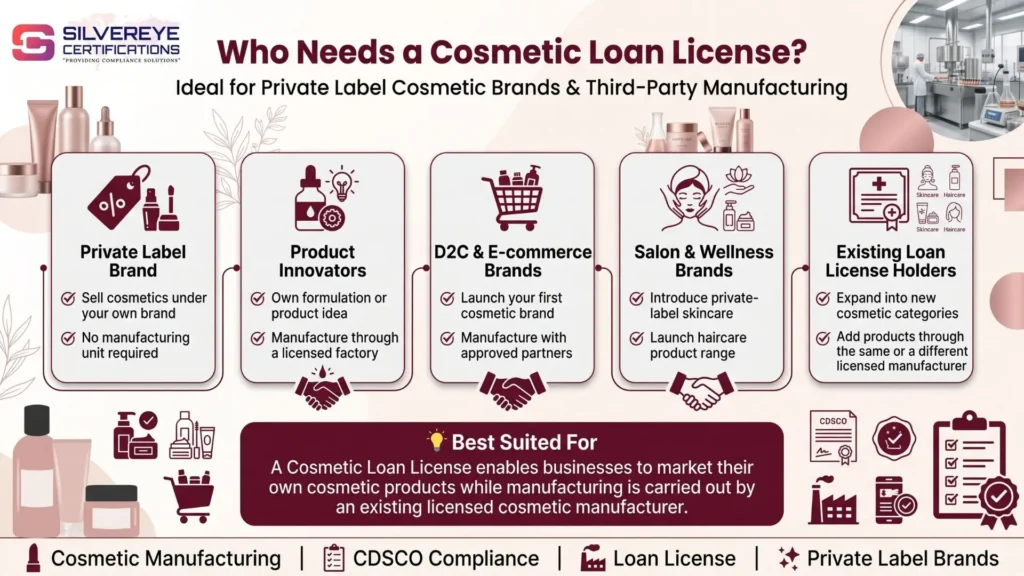
- D2C and private-label cosmetic brands that want to manufacture domestically without building or leasing their own GMP-compliant factory.
- Startups testing product-market fit that need production flexibility before committing capital to owned manufacturing infrastructure.
- Established brands expanding into new product categories that want to use a specialized contract manufacturer's expertise (e.g., a skincare brand entering colour cosmetics through a manufacturer that already specializes in it).
- Any company that has secured a manufacturing agreement with a facility that already holds its own COS-8 license, and wants its own brand-level legal manufacturing approval for products made there.
Legal Framework Governing the Loan License Route
- Drugs and Cosmetics Act, 1940 and Cosmetics Rules, 2020 — the same parent framework governing all cosmetic manufacturing licenses, including loan licenses.
- State Licensing Authority (State Drug Controller) — grants COS-9 loan licenses, the same authority responsible for standard COS-8 manufacturing licenses in that state.
- Seventh Schedule, Cosmetics Rules, 2020 — sets premises, plant, and equipment norms the manufacturing facility (owned or borrowed) must meet.
- Fourth Schedule — the same ~80 product category list used to classify every cosmetic manufactured under a loan license.
- Third Schedule — prescribes the applicable government fee structure for manufacturing and loan licenses.
Documents Required For Cosmetic Loan License Registration
Because production happens at a third party's premises, the loan license dossier includes everything a standard manufacturing application needs, plus proof of the legal arrangement between the brand and the facility owner.
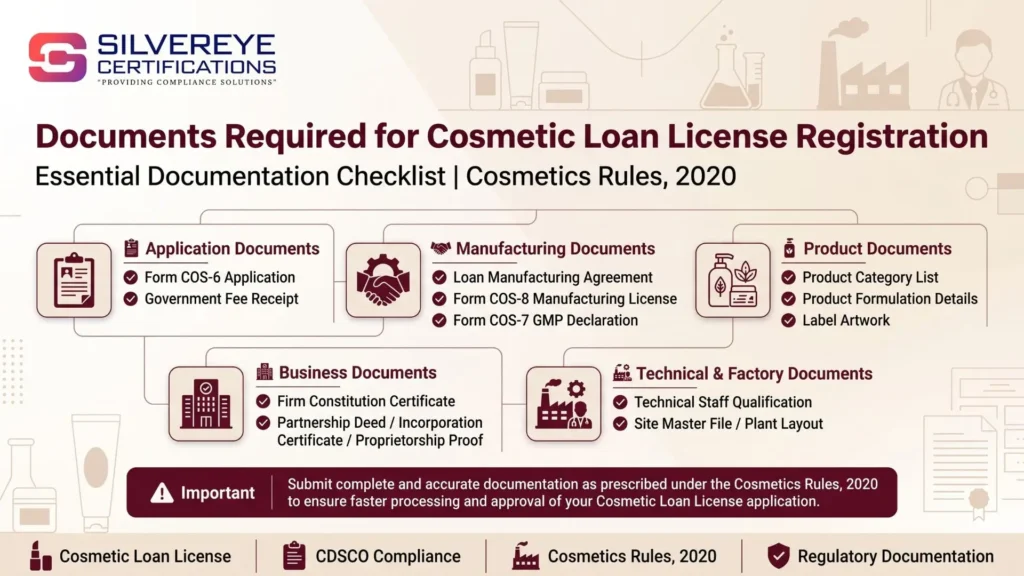
- Covering letter stating the purpose of the application and the products to be manufactured under the loan arrangement.
- Duly filled Form COS-6.
- Manufacturing agreement or contract between the applicant brand and the premises owner, clearly defining the loan-license arrangement.
- Copy of the premises owner's own valid manufacturing license (Form COS-8) for the facility being used.
- Form COS-7 — Good Manufacturing Practices self-declaration for the facility.
- List of cosmetic products to be manufactured, mapped to Fourth Schedule categories.
- Proof of qualified technical/competent staff overseeing the products manufactured under the loan license.
- Undertaking of compliance with the Cosmetics Rules, 2020 for every listed product.
- Proof of business registration of the applicant brand (incorporation certificate, partnership deed, or proprietorship documents).
- Fee payment receipt as prescribed under the Third Schedule.
Step-by-Step Cosmetic Loan License Process
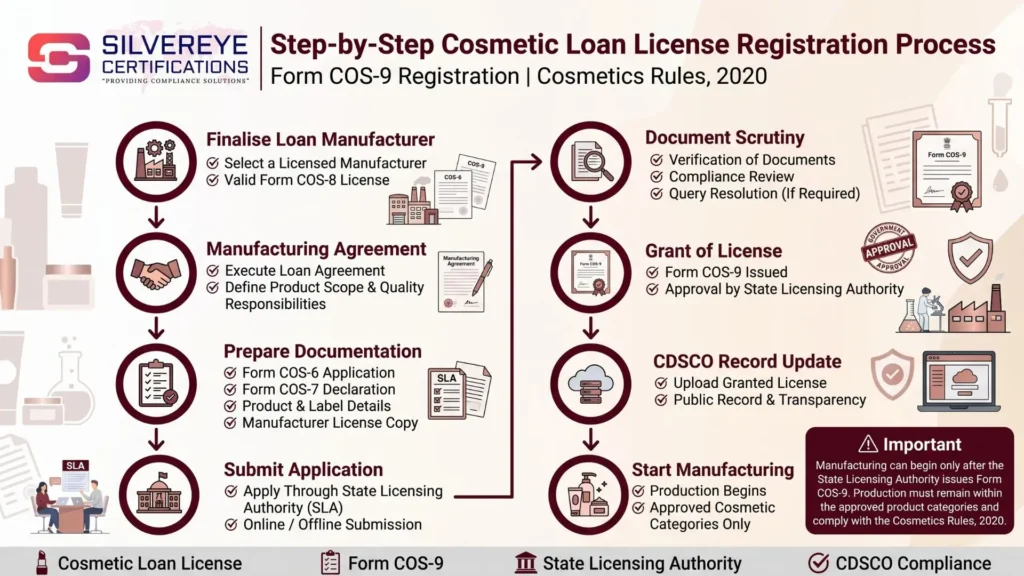
- Identify and finalize a manufacturing partner — A facility that already holds a valid COS-8 manufacturing license and is willing to produce under a loan-license arrangement.
- Formalize the manufacturing agreement between your brand and the facility owner, clearly setting out product scope, responsibilities, and terms.
- Map every product you intend to manufacture to its correct Fourth Schedule category.
- Compile the COS-6 dossier — covering letter, manufacturing agreement, the facility's COS-8 copy, technical staff proof, and the Form COS-7 GMP self-declaration.
- Register on the CDSCO SUGAM portal and file Form COS-6 along with Form COS-7 and the prescribed fee.
- Submit the application to the State Licensing Authority where the manufacturing premises is located, for scrutiny.
- Respond promptly to any queries the SLA raises on the agreement, documentation, or product categorization.
- Receive Form COS-9 — the loan license — generally within 45 days of the application date, once the SLA is satisfied.
- Upload the granted license to the CDSCO portal and begin manufacturing under the loan-license arrangement.
Because the manufacturing premises typically already holds its own COS-8 license and has already been inspected under that approval, the State Licensing Authority's review for a loan license often centres on verifying the manufacturing agreement, the applicant's product list, and technical staff documentation, rather than a completely fresh facility inspection — though the SLA retains discretion to inspect or verify the arrangement at any point.
Loan License vs Standard Manufacturing License: Key Differences
| Parameter | Standard Manufacturing (COS-5 → COS-8) | Loan License (COS-6 → COS-9) |
| Who owns the facility | The applicant owns or operates the manufacturing premises | A third party owns the premises; the applicant manufactures there under agreement |
| Application form | Form COS-5 | Form COS-6 |
| Licence granted | Form COS-8 | Form COS-9 |
| GMP declaration | Form COS-7, for the applicant's own facility | Form COS-7, for the third-party facility being used |
| Capital requirement | Higher — factory setup, equipment, ongoing facility compliance | Lower — no factory ownership or setup cost |
| Licensing authority | State Licensing Authority | Same State Licensing Authority (where the premises is located) |
| Typical timeline | Around 45 days after document verification, following a 30–60 day inspection window | Generally within 45 days of application, often with lighter inspection since the premises already holds COS-8 |
Fees for Cosmetic Loan License Registration
Loan license fees are charged under the same Third Schedule fee structure used for standard manufacturing licenses, and are commonly cited as follows — though exact amounts can vary slightly by state, so it's worth confirming with your State Licensing Authority before filing.
| Fee Component | Typical Amount | Notes |
| Grant of loan license (per category, up to 10 items) | ₹10,000 | Covers up to 10 items within one cosmetic category under the Fourth Schedule |
| Additional item within a category | ₹500 per item | Charged for each item beyond the first 10 within the same category |
| 5-year retention fee | Generally comparable to the original grant fee | Payable to keep COS-9 active past each 5-year mark from date of issue |
Validity and Renewal of Cosmetic Loan License
| Aspect | Detail |
| Validity period | Indefinite / lifetime, unless suspended or cancelled by the State Licensing Authority — subject to a retention fee due before completing every 5-year period from date of issue |
| Renewal/retention process | Retention fee submitted to the State Licensing Authority; the SLA may request updated documentation if the manufacturing agreement, products, or technical staff have changed |
| Inspection cycle | Licensed premises are typically inspected at least once every 3 years by the State Licensing Authority, in addition to any inspection tied to the original COS-8 held by the facility owner |
| Lapse risk | Non-payment of the retention fee, or a lapsed manufacturing agreement with the facility owner, can lead to suspension or cancellation of COS-9 |
Typical Timeline For Cosmetic Loan License
| Stage | Typical Duration |
| Finalising the manufacturing agreement with the facility owner | Varies by negotiation; plan for 2–4 weeks |
| Document compilation (COS-6 dossier, COS-7 declaration, product list) | 1–3 weeks |
| Filing on SUGAM and fee payment | 1–3 days |
| State Licensing Authority review and query resolution | Ongoing |
| COS-9 grant | Generally within 45 days of application date |
Common Mistakes That Delay a Loan License Application
- Using a facility that doesn't hold a valid, current COS-8 manufacturing license of its own.
- A manufacturing agreement that is vague about product scope, responsibilities, or duration, which the SLA may flag during review.
- Mismatched product names or categories between the loan-license application and the facility's own COS-8 product list.
- Missing or unclear proof of the applicant's own technical/competent staff overseeing the products manufactured under the arrangement.
- Assuming a loan license is a one-time formality — like COS-8, COS-9 requires ongoing GMP compliance and a retention fee to stay active.
- Not updating CDSCO/SLA when the manufacturing agreement with the facility owner changes or ends, which can leave the loan license in limbo.
Post-License Compliance for Loan License Holders
- Legal Metrology labelling — MRP, net quantity, batch number, manufacturing date, ingredient list, and the brand's address must appear on every retail unit, exactly as with own-premises manufacturing.
- Ongoing GMP compliance — both the brand (as license holder) and the manufacturing facility (as premises operator) need to maintain Good Manufacturing Practice standards.
- Agreement continuity — if the manufacturing agreement with the facility owner lapses or changes, the brand should update its loan license status with the State Licensing Authority rather than continuing to manufacture informally.
- No animal testing — Rule 39(7) of the Cosmetics Rules, 2020 applies to loan-license products exactly as it does to any other cosmetic manufactured or imported in India.
Benefits of the Cosmetic Loan License Route
- Lower capital requirement — no need to build, lease, or equip a full manufacturing facility to start domestic production.
- Faster market entry — brands can begin manufacturing as soon as COS-9 is granted, without the lead time of setting up a factory.
- Access to specialized manufacturing — brands can use contract manufacturers with existing expertise in a specific product category.
- Same legal standing as COS-8 — COS-9 gives full legal manufacturing status; products made under a loan license are treated identically to those made at an owned facility from a compliance standpoint.
- Flexibility to scale — brands can work with multiple manufacturing partners or switch facilities more easily than if capital were locked into owned infrastructure.
How Silvereye Certifications Helps with Loan License Registration
Silvereye Certifications is a Noida-based regulatory compliance consultancy supporting manufacturers, importers, and D2C cosmetic brands with BIS Certification, CDSCO Registration, EPR Authorization, and related compliance services across India. For the loan license route specifically, the Silvereye Certifications team assists with:
- Reviewing whether a prospective manufacturing partner's COS-8 license and facility are suitable for a loan-license arrangement.
- Structuring the manufacturing agreement and product list to align with what the State Licensing Authority expects to see in a COS-6 filing.
- Preparing the Form COS-7 GMP self-declaration and technical staff documentation for the application.
- End-to-end COS-6 filing on the CDSCO SUGAM portal and coordination with the relevant State Licensing Authority.
- Tracking COS-9 validity and retention-fee deadlines so the loan license stays active without lapses.
Brands exploring contract manufacturing in India can reach out to Silvereye Certifications for a loan-license feasibility review before finalising a manufacturing partner.
Conclusion
The loan license route exists precisely for brands that want to manufacture cosmetics in India without the capital, time, and operational weight of owning a factory. Form COS-6, backed by a solid manufacturing agreement and a clean Form COS-7 GMP self-declaration, is what gets a brand to Form COS-9 — generally within 45 days — with the same legal manufacturing standing as a company that built its own facility from scratch.
Whether you're a startup exploring contract manufacturing for the first time or an established brand adding a new product category through a specialized partner, treating the loan-license agreement and documentation with the same rigor as a standard COS-5/COS-8 filing is what keeps the process on its 45-day track. For help evaluating manufacturing partners or preparing a COS-6 filing, Silvereye Certifications' regulatory team can guide the process end to end.
Frequently Asked Questions
What is a cosmetic loan license in India?
It's a manufacturing approval that lets a brand produce cosmetics at another company's GMP-compliant facility instead of owning its own factory. It's applied for via Form COS-6 and granted as Form COS-9 by the State Licensing Authority.
What is the difference between COS-8 and COS-9?
Both are cosmetic manufacturing licenses granted by the State Licensing Authority. COS-8 is issued to a company manufacturing at its own premises; COS-9 is issued to a company manufacturing at a third party's premises under a loan-license arrangement.
How long does it take to get a COS-9 loan license?
Generally within 45 days from the date of application, provided the documentation — including the manufacturing agreement and Form COS-7 GMP self-declaration — is complete.
Does the manufacturing facility need its own license for a loan license to work?
Yes. The premises being used should already hold a valid manufacturing license (Form COS-8) of its own, since the loan license lets a brand use that already-approved facility rather than replacing its approval.
What is Form COS-7?
Form COS-7 is the Good Manufacturing Practices self-declaration filed alongside Form COS-6 (or COS-5), confirming the manufacturing facility being used meets GMP requirements.
How much does a cosmetic loan license cost?
Fees are commonly cited as around ₹10,000 for grant of the license per category (covering up to 10 items), plus ₹500 for each additional item, under the Third Schedule fee structure. Confirm exact current rates with your State Licensing Authority.
How long is a COS-9 loan license valid?
Indefinitely, unless suspended or cancelled, subject to a retention fee payable before completing every 5-year period from the date of issue — the same structure used for COS-8.
Can I switch manufacturing partners after getting a COS-9 loan license?
Changing the manufacturing premises generally requires updating your loan license status with the State Licensing Authority rather than simply switching partners informally, since COS-9 is tied to the specific agreement and facility reviewed at the time of grant.
Is a loan license a good fit for a new D2C cosmetic brand?
It's commonly used by D2C and private-label brands precisely because it avoids the capital and time needed to build an owned manufacturing facility, while still giving the brand full legal manufacturing status for its products.
Does a loan license require a separate facility inspection?
Since the premises typically already holds its own COS-8 license and has been inspected under that approval, the State Licensing Authority's review for COS-9 often focuses on the manufacturing agreement and documentation rather than a completely fresh inspection — though the SLA retains discretion to inspect at any point.
What documents does the brand need to provide versus the manufacturing facility?
The brand typically provides the covering letter, Form COS-6, the manufacturing agreement, product list, and technical staff proof; the facility owner provides a copy of its own COS-8 license and confirms the arrangement in the Form COS-7 GMP self-declaration.
Can a loan license cover multiple product categories?
Yes, provided each category and product is correctly declared and mapped to the Fourth Schedule, and the manufacturing facility is equipped and licensed to produce those categories.