

- Medical devices have been regulated as "drugs" under the Drugs and Cosmetics Act since 1 April 2020, bringing them within the applicable regulatory framework for medical devices and pricing.
- Registration is handled through IPDMS 2.0, where businesses first register their company and then add the applicable medical devices, models and pricing details.
- Scheduled medical devices must comply with the applicable NPPA ceiling price, while non-scheduled medical devices are generally subject to the 10% annual price-increase limit under the applicable DPCO provisions.
- No government registration fee is listed for IPDMS 2.0, but businesses must ensure that their pricing and product data is accurate. Incorrect pricing can result in refund obligations, including applicable interest, under the pricing-control framework.
What Is NPPA Registration for Medical Devices?
NPPA registration for medical devices generally refers to registering the relevant company and medical-device pricing information on IPDMS 2.0, the Integrated Pharmaceutical Database Management System operated by the National Pharmaceutical Pricing Authority (NPPA).
NPPA uses IPDMS 2.0 to collect and manage pricing information for pharmaceutical products and medical devices. The portal provides the registration and submission framework for the applicable forms under the pricing-control system.
One important point for first-time applicants is that NPPA registration is not the same as CDSCO product approval or a medical-device license. CDSCO regulates the medical-device regulatory pathway under the Medical Devices Rules, 2017, while NPPA deals with applicable price-control and pricing-compliance requirements. CDSCO separately provides the licensing route for medical-device imports, including MD-14 application and MD-15 import license.
Why Do Medical Devices Come Under NPPA Pricing Rules?
Medical devices were brought within the definition of "drugs" under the Drugs and Cosmetics Act with effect from 1 April 2020 through the relevant government notification. This brought medical devices within the broader framework under which the Drugs (Prices Control) Order, 2013 (DPCO) can apply.
In practice, NPPA's medical-device pricing framework can involve:
- Ceiling-price control: Applicable scheduled devices must comply with the ceiling price notified by NPPA.
- Price monitoring: Applicable non-scheduled devices are subject to the prescribed restrictions on annual MRP increases.
- Special pricing orders: NPPA can issue specific orders for particular medical devices, including ceiling-price or trade-margin measures under its powers under the DPCO.
NPPA continues to publish medical-device ceiling-price notifications and other pricing-related orders. For example, its current medical-device section includes 2026 notifications revising coronary-stent ceiling prices.
Who Needs NPPA Registration for Medical Devices?
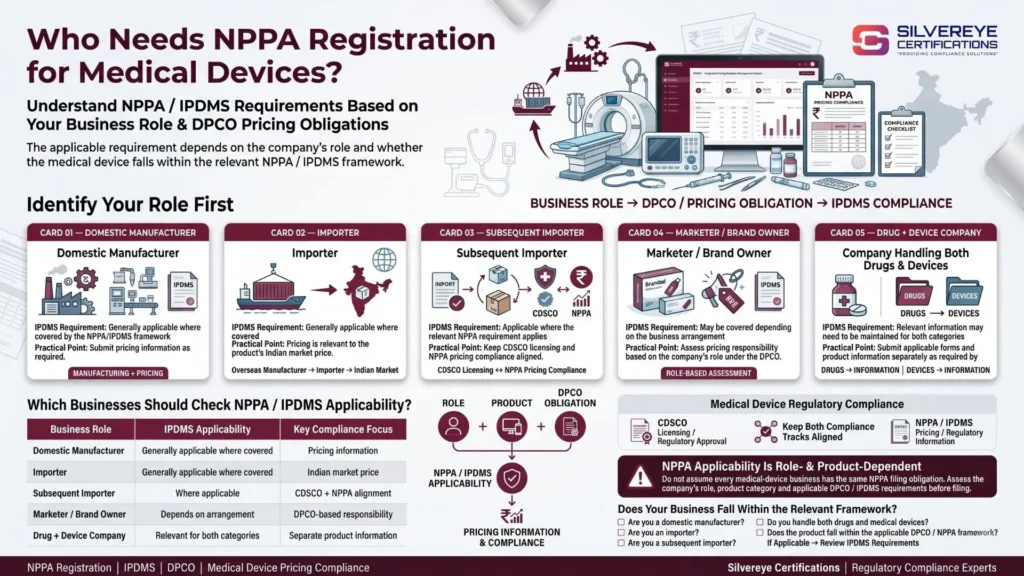
The applicable requirement depends on the company's role and the product's pricing obligations under the DPCO.
| Your role | IPDMS requirement | Practical point |
|---|---|---|
| Domestic manufacturer | Generally applicable where covered by the NPPA/IPDMS framework | Pricing information must be submitted as required. |
| Importer | Generally applicable where covered | Pricing is relevant to the product's Indian market price. |
| Subsequent importer | Applicable where the relevant NPPA requirement applies | Keep both CDSCO licensing and NPPA pricing compliance aligned. |
| Marketer/brand owner | May be covered depending on the business arrangement | The pricing responsibility should be assessed based on the company's role under the DPCO. |
| Company handling both drugs and devices | Relevant information may need to be maintained for both categories | The applicable forms and product information should be submitted separately as required by IPDMS. |
NPPA's IPDMS platform currently provides dedicated registration and instructions for IPDMS 2.0.
If your business model involves a loan licence, exclusive distribution arrangement, private-label product or e-commerce brand, it is better to confirm the applicable responsibility before filing rather than assuming that the manufacturer or importer automatically handles everything.
What Is the Difference Between Scheduled and Non-Scheduled Medical Devices?
The pricing treatment depends on whether the device is covered by the applicable Schedule I/DPCO provisions or by a specific NPPA pricing order.
| Point | Scheduled / price-controlled devices | Other/non-scheduled devices |
|---|---|---|
| Pricing basis | Subject to the applicable NPPA ceiling price | Subject to the applicable DPCO provisions governing price increases |
| Who controls the price? | NPPA determines/notifies the applicable ceiling price | Company determines its MRP within the applicable regulatory limits |
| Price increase | MRP must remain within the applicable notified ceiling | Applicable annual MRP-increase restriction must be followed |
| Overcharging risk | Excess recovery may be subject to recovery with applicable interest | NPPA may take action where the applicable pricing provisions are breached |
| Special orders | Additional NPPA orders may apply | Specific trade-margin or price-control orders may also apply |
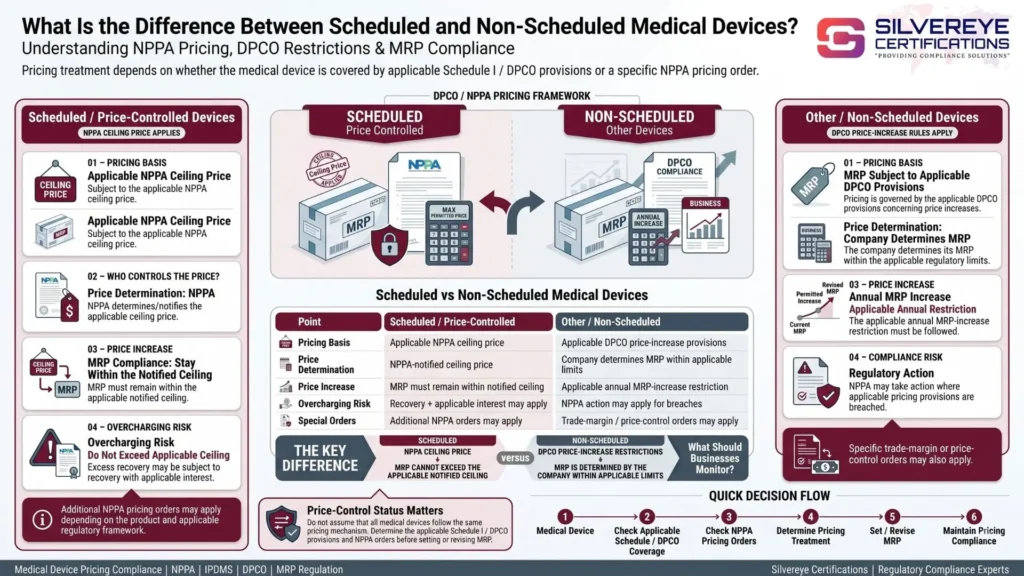
The exact status of a particular device should be checked against the current DPCO Schedule, NLEM-linked provisions and NPPA notifications/orders, rather than relying only on an older product list.
Special NPPA Orders
Some medical devices have been subject to specific NPPA orders outside the general pricing treatment. NPPA's medical-device section currently publishes notifications relating to products such as coronary stents and orthopaedic knee implants.
Because these notifications can be revised, extended or replaced, businesses should check the latest NPPA notification applicable to their device before fixing or changing the MRP.
What Are the Main NPPA Pricing Compliance Rules?
| Requirement | What it means for the business |
|---|---|
| Ceiling price | Where a device is subject to a notified ceiling price, the MRP must comply with the applicable ceiling. |
| Annual MRP increase | For applicable non-scheduled devices, follow the prescribed limit on MRP increases during the relevant 12-month period. |
| Price submission | Submit the required pricing information through IPDMS 2.0 in the applicable form. |
| MRP declaration | Retail packs must carry the applicable MRP declaration and also comply with relevant packaging requirements. |
| Record keeping | Maintain the pricing and sales records required under the applicable DPCO provisions. |
| Special NPPA orders | Follow any product-specific ceiling-price, trade-margin or other pricing order applicable to the device. |
NPPA's current IPDMS documentation confirms that Form V is part of the IPDMS workflow, while the system also handles different categories of product submissions.
What Are the Benefits of Completing NPPA Compliance Correctly?
Although NPPA compliance adds another regulatory step, maintaining accurate pricing records can provide practical benefits:
- Better regulatory compliance: Helps the business meet applicable requirements under the DPCO and NPPA pricing framework.
- Smoother regulatory management: Keeping NPPA records aligned with your CDSCO device information reduces inconsistencies between regulatory records.
- Better hospital and tender readiness: Pricing documentation may be requested during institutional procurement and commercial due diligence.
- Fewer pricing disputes: A documented pricing history makes it easier to explain how an MRP was determined.
- Faster response to NPPA queries: Accurate company, product and pricing information makes it easier to respond when the authority requests clarification.
- Better compliance during business expansion: Maintaining updated IPDMS records becomes increasingly important as you add new devices, models or pricing changes.
Important Compliance Note
NPPA/IPDMS registration should not be treated as a substitute for CDSCO medical-device licensing. A business may need to satisfy both regulatory frameworks: CDSCO requirements for the manufacture/import/sale of medical devices and NPPA requirements relating to applicable pricing control.
NPPA continues to update its IPDMS 2.0 system, medical-device notifications and pricing orders, so businesses should verify the latest requirements before submitting pricing information or revising an MRP.
Who Is Eligible for NPPA Registration for Medical Devices?
There is no exam or approval test for IPDMS 2.0 registration. Businesses operating in the medical-device value chain can register where the applicable NPPA requirements cover their activities.
The IPDMS registration process requires basic company, tax and contact information, including:
- Corporate entities: CIN or LLPIN, GSTIN and PAN.
- Non-corporate entities: GSTIN and PAN.
- A working email ID and mobile number, as login credentials are sent to the registered contact details.
- Details of the primary contact person and alternative contact person.
- Head/corporate office address and related contact details.
- Required supporting documents uploaded through the portal.
In addition, medical-device businesses should keep their CDSCO licence details, device list, model/catalogue numbers and current MRP information ready because product-level information is required after company registration.
What Documents Are Required for NPPA Registration?
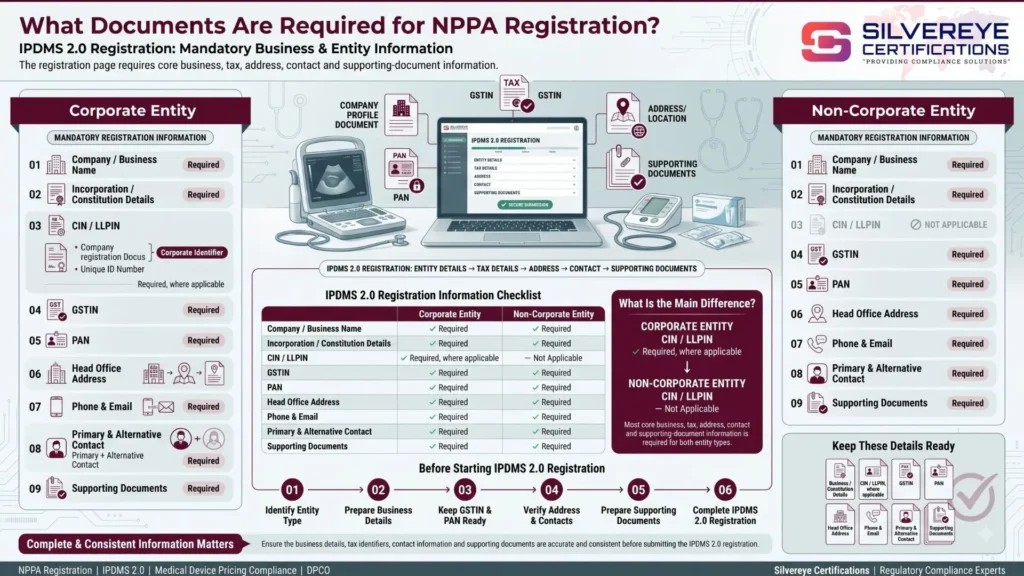
Mandatory Information on the IPDMS 2.0 Registration Page
| Information | Corporate Entity | Non-Corporate Entity |
|---|---|---|
| Company/business name | Required | Required |
| Incorporation/constitution details | Required | Required |
| CIN / LLPIN | Required, where applicable | Not applicable |
| GSTIN | Required | Required |
| PAN | Required | Required |
| Head office address | Required | Required |
| Phone and email | Required | Required |
| Primary and alternative contact | Required | Required |
| Supporting documents | Required | Required |
What Should You Keep Ready Before Applying?
The exact supporting-document requirements can depend on the applicant and NPPA's instructions. As a practical preparation checklist, keep the following available:
- Certificate of incorporation/constitution documents, where applicable.
- GST and PAN documents.
- Authorisation letter or board resolution for the person handling the filing, where required.
- Applicable CDSCO manufacturing or import licence details.
- A complete device list, including brand name, model/catalogue number and pack information.
- Current MRP and applicable GST information for each product.
- Relevant pricing history, particularly where you need to assess compliance with the applicable annual MRP-increase restriction.
- Any NPPA letter, notice or direction received by the company.
The safest approach is to check the current IPDMS instructions and any NPPA communication issued to your company before uploading documents.
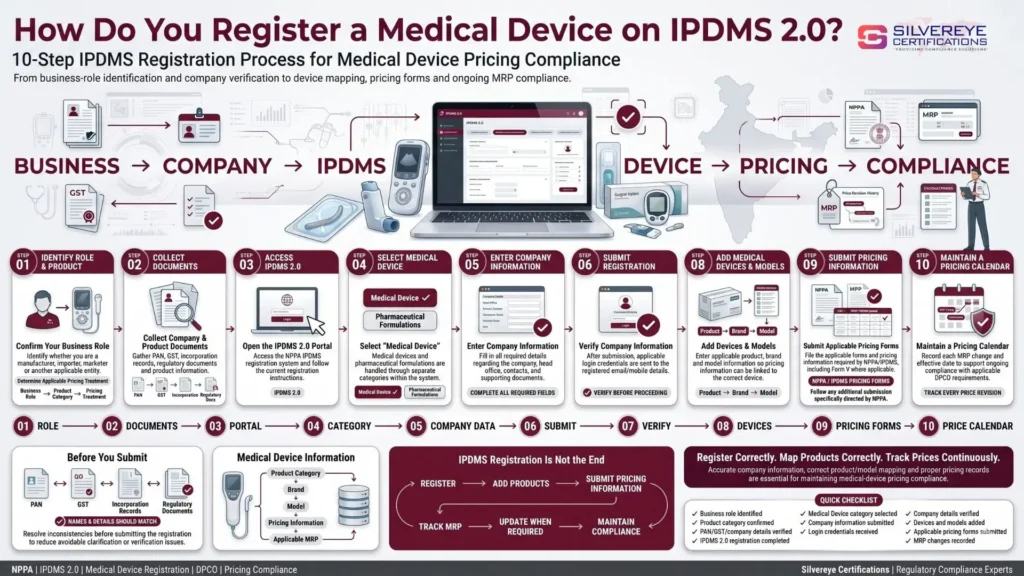
How Do You Register a Medical Device on IPDMS 2.0?
The general registration process is:
- Confirm your business role and product category. Identify whether you are registering as a manufacturer, importer, marketer or another applicable entity, and determine the relevant pricing treatment for each device.
- Collect your company and product documents. Make sure the names and details in your PAN, GST, incorporation records and regulatory documents are consistent.
- Open the IPDMS 2.0 portal. Access the NPPA IPDMS registration system and follow the current registration instructions.
- Select "Medical Device" as the applicable product category. Pharmaceutical formulations and medical devices are handled through separate categories within the system.
- Enter company information. Complete the required sections covering company details, head office, primary contact, alternative contact and supporting documents.
- Submit the registration. After submission, the portal sends the applicable login credentials to the registered email/mobile details.
- Log in and verify company information. Complete the required verification of basic company, other and plant details, where applicable.
- Add your medical devices and models. Enter the applicable product, brand and model information so pricing information can be linked to the correct device.
- Submit the applicable pricing forms. File the forms and price information required by NPPA/IPDMS, including Form V where applicable, along with any additional submission specifically directed by NPPA.
- Maintain a pricing calendar. Record each MRP change and effective date so that future price revisions remain within the applicable DPCO requirements.
What If You Already Have an IPDMS 1.0 Login?
Businesses that previously used IPDMS 1.0 should follow NPPA's current migration/registration instructions. The requirements for medical-device registration on IPDMS 2.0 should be checked separately rather than assuming that an older formulation login automatically completes device registration.
What Are the NPPA Registration Fees, Validity and Renewal Requirements?
One important point is that IPDMS registration should not be confused with a conventional licence that has a fixed renewal period.
Based on the information published through the IPDMS registration process, no separate government fee is shown for basic company registration. Businesses should nevertheless check the live portal before filing, because portal procedures and requirements can change.
| Item | Government Fee | Validity / Status | Update Requirement |
|---|---|---|---|
| IPDMS 2.0 company registration | No separate fee shown on the registration information reviewed | No fixed expiry period stated on the registration page | Keep company and contact details updated |
| Device/model information | No separate fee shown | Remains on the system unless changed/updated | Update when adding, changing or withdrawing applicable products |
| Price list/Form V | No separate fee shown | Applies according to the submitted price information | Submit a revised price list when the applicable price changes |
| NPPA returns/submissions | No separate fee shown | Depends on the applicable reporting requirement | File the submissions/returns directed by NPPA |
| Ceiling-price compliance | Not a registration fee | Continues while the relevant NPPA notification applies | Follow revised NPPA ceiling-price notifications |
| Consultant/professional fee | Not fixed by NPPA | Depends on the service arrangement | Optional; depends on the scope of work |
Does NPPA Registration Need Renewal?
There is no conventional annual renewal certificate shown for basic IPDMS 2.0 company registration. Instead, businesses should keep their company, plant, product and pricing information current and complete any filings or updates required by NPPA.
This is different from CDSCO medical-device licences, which have their own regulatory requirements and should not be treated as being renewed through IPDMS.
Important Compliance Point
IPDMS registration is only one part of medical-device compliance. Before selling or importing a device in India, businesses should separately confirm their CDSCO licence/registration requirements, applicable DPCO pricing provisions, NPPA submissions and Legal Metrology MRP requirements, where applicable.
Because NPPA can issue product-specific pricing orders and directions, always check the latest NPPA notification applicable to your particular device before fixing or revising its MRP.
Who Is Eligible for NPPA Registration for Medical Devices?
There is no exam or approval test for IPDMS 2.0 registration. Businesses operating in the medical-device value chain can register where the applicable NPPA requirements cover their activities.
The IPDMS registration process requires basic company, tax and contact information, including:
- Corporate entities: CIN or LLPIN, GSTIN and PAN.
- Non-corporate entities: GSTIN and PAN.
- A working email ID and mobile number, as login credentials are sent to the registered contact details.
- Details of the primary contact person and alternative contact person.
- Head/corporate office address and related contact details.
- Required supporting documents uploaded through the portal.
In addition, medical-device businesses should keep their CDSCO licence details, device list, model/catalogue numbers and current MRP information ready because product-level information is required after company registration.
What Documents Are Required for NPPA Registration?
Mandatory Information on the IPDMS 2.0 Registration Page
| Information | Corporate Entity | Non-Corporate Entity |
|---|---|---|
| Company/business name | Required | Required |
| Incorporation/constitution details | Required | Required |
| CIN / LLPIN | Required, where applicable | Not applicable |
| GSTIN | Required | Required |
| PAN | Required | Required |
| Head office address | Required | Required |
| Phone and email | Required | Required |
| Primary and alternative contact | Required | Required |
| Supporting documents | Required | Required |
What Should You Keep Ready Before Applying?
The exact supporting-document requirements can depend on the applicant and NPPA's instructions. As a practical preparation checklist, keep the following available:
- Certificate of incorporation/constitution documents, where applicable.
- GST and PAN documents.
- Authorisation letter or board resolution for the person handling the filing, where required.
- Applicable CDSCO manufacturing or import licence details.
- A complete device list, including brand name, model/catalogue number and pack information.
- Current MRP and applicable GST information for each product.
- Relevant pricing history, particularly where you need to assess compliance with the applicable annual MRP-increase restriction.
- Any NPPA letter, notice or direction received by the company.
The safest approach is to check the current IPDMS instructions and any NPPA communication issued to your company before uploading documents.
How Do You Register a Medical Device on IPDMS 2.0?
The general registration process is:
- Confirm your business role and product category. Identify whether you are registering as a manufacturer, importer, marketer or another applicable entity, and determine the relevant pricing treatment for each device.
- Collect your company and product documents. Make sure the names and details in your PAN, GST, incorporation records and regulatory documents are consistent.
- Open the IPDMS 2.0 portal. Access the NPPA IPDMS registration system and follow the current registration instructions.
- Select "Medical Device" as the applicable product category. Pharmaceutical formulations and medical devices are handled through separate categories within the system.
- Enter company information. Complete the required sections covering company details, head office, primary contact, alternative contact and supporting documents.
- Submit the registration. After submission, the portal sends the applicable login credentials to the registered email/mobile details.
- Log in and verify company information. Complete the required verification of basic company, other and plant details, where applicable.
- Add your medical devices and models. Enter the applicable product, brand and model information so pricing information can be linked to the correct device.
- Submit the applicable pricing forms. File the forms and price information required by NPPA/IPDMS, including Form V where applicable, along with any additional submission specifically directed by NPPA.
- Maintain a pricing calendar. Record each MRP change and effective date so that future price revisions remain within the applicable DPCO requirements.
What If You Already Have an IPDMS 1.0 Login?
Businesses that previously used IPDMS 1.0 should follow NPPA's current migration/registration instructions. The requirements for medical-device registration on IPDMS 2.0 should be checked separately rather than assuming that an older formulation login automatically completes device registration.
What Are the NPPA Registration Fees, Validity and Renewal Requirements?
One important point is that IPDMS registration should not be confused with a conventional licence that has a fixed renewal period.
Based on the information published through the IPDMS registration process, no separate government fee is shown for basic company registration. Businesses should nevertheless check the live portal before filing, because portal procedures and requirements can change.
| Item | Government Fee | Validity / Status | Update Requirement |
|---|---|---|---|
| IPDMS 2.0 company registration | No separate fee shown on the registration information reviewed | No fixed expiry period stated on the registration page | Keep company and contact details updated |
| Device/model information | No separate fee shown | Remains on the system unless changed/updated | Update when adding, changing or withdrawing applicable products |
| Price list/Form V | No separate fee shown | Applies according to the submitted price information | Submit a revised price list when the applicable price changes |
| NPPA returns/submissions | No separate fee shown | Depends on the applicable reporting requirement | File the submissions/returns directed by NPPA |
| Ceiling-price compliance | Not a registration fee | Continues while the relevant NPPA notification applies | Follow revised NPPA ceiling-price notifications |
| Consultant/professional fee | Not fixed by NPPA | Depends on the service arrangement | Optional; depends on the scope of work |
Does NPPA Registration Need Renewal?
There is no conventional annual renewal certificate shown for basic IPDMS 2.0 company registration. Instead, businesses should keep their company, plant, product and pricing information current and complete any filings or updates required by NPPA.
This is different from CDSCO medical-device licences, which have their own regulatory requirements and should not be treated as being renewed through IPDMS.
Important Compliance Point
IPDMS registration is only one part of medical-device compliance. Before selling or importing a device in India, businesses should separately confirm their CDSCO licence/registration requirements, applicable DPCO pricing provisions, NPPA submissions and Legal Metrology MRP requirements, where applicable.
Because NPPA can issue product-specific pricing orders and directions, always check the latest NPPA notification applicable to your particular device before fixing or revising its MRP.
How Long Does NPPA Registration for Medical Devices Take?
NPPA does not publish a fixed end-to-end processing timeline for every IPDMS 2.0 registration. The actual time depends on document readiness, portal processing, product data and any NPPA communication.
| Stage | Typical time | What affects the timeline? |
|---|---|---|
| Gap check and document collection | 1–3 working days as a planning estimate | How organised your GST, PAN, CIN and CDSCO records are |
| IPDMS 2.0 registration submission | Same day once documents are ready | Accuracy and completeness of company details |
| Login credentials | No fixed timeline published by NPPA | Portal processing |
| Device and model listing | Depends on portfolio size | Number of products/models and quality of product data |
| Filing after an NPPA letter | Follow the deadline stated in the letter | The specific deadline communicated by NPPA |
The 1–3 working days mentioned above is only a practical preparation estimate, not an official NPPA processing timeline.
Similarly, some NPPA communications to medical-device companies have specified a 15-day deadline for registration or filing. This should not be treated as a universal deadline. If you receive an NPPA letter, always follow the exact deadline stated in that communication.
What Is the NPPA Pricing Compliance Calendar After Registration?
Registration is only the first step. Businesses should continue monitoring MRP, product information and NPPA notifications after completing IPDMS registration.
| When | What to do |
|---|---|
| When registering | Confirm company, plant and contact details and add the applicable devices/models. |
| Before changing an MRP | Check the applicable pricing category and confirm that the proposed change complies with the relevant DPCO/NPPA requirements. |
| After a price change | Submit the revised price information through IPDMS where required. |
| When NPPA issues a notification | Check whether it affects your device, including any ceiling price, trade-margin measure or extension. |
| When you receive an NPPA letter | Respond within the specific deadline stated in the letter. |
| During applicable reporting periods | Submit any returns or information specifically required for your product category. |
| At least annually | Review your price history, MRP declarations and supporting records for consistency and compliance. |
How Should You Track the 10% MRP Limit?
For a device subject to the applicable 10% annual MRP-increase restriction, do not look only at the last price change.
Before increasing the MRP, review the price history for the relevant preceding 12-month period and calculate the cumulative increase applicable under the DPCO. This helps prevent an apparently small increase from exceeding the permitted limit when earlier increases are taken into account.
What Happens If You Do Not Follow NPPA Pricing Rules?
The consequences depend on the type of device, applicable pricing provision and nature of the breach. Potential consequences can include:
- Recovery of overcharged amounts: Where a price-controlled device has been sold above the applicable permissible price, NPPA can require recovery of the excess amount along with applicable interest.
- Price correction and refund: Where applicable pricing provisions have been breached, the company may be required to reduce the price and refund excess amounts.
- Inspection of records: Under the applicable DPCO provisions, NPPA can require or inspect relevant pricing, sales and other records.
- Regulatory or penal action: Serious or continuing violations may attract action under the DPCO and applicable provisions of the Essential Commodities Act, 1955.
- Commercial impact: Pricing non-compliance can also create problems with hospitals, distributors, tenders and other institutional buyers.
What Are the Common NPPA Registration Mistakes?
Some of the most common mistakes made by medical-device businesses include:
- Treating NPPA registration as part of CDSCO licensing: CDSCO medical-device licensing and NPPA pricing compliance are separate regulatory requirements.
- Assuming imported devices are exempt: Importing a device does not automatically remove applicable NPPA pricing obligations.
- Misunderstanding the 10% rule: The applicable limit should be assessed using the relevant 12-month pricing history, rather than looking only at one individual price revision.
- Registering the company but not completing product information: Company registration alone does not mean that all applicable devices and models have been properly recorded.
- Using inconsistent company details: Differences between the legal names or details in PAN, GST, CIN and regulatory records can create avoidable queries.
- Missing an NPPA deadline: NPPA communications should be monitored carefully so that a time-bound filing or response is not missed.
- Using an outdated ceiling price: Always check the latest NPPA notification before relying on an older ceiling price.
Do You Need an NPPA Registration Consultant?
You can complete the IPDMS registration process yourself. The portal is publicly accessible, and the registration process itself is not necessarily complicated.
Where professional assistance can be useful is in the work around the registration — such as understanding the DPCO requirements, reviewing product classification, checking price history, preparing filings and responding to NPPA communications.
A medical-device pricing consultant may provide services such as:
| Service | What You Get |
|---|---|
| Applicability and gap assessment | Review of whether and under what role the business is covered by the applicable NPPA requirements |
| IPDMS 2.0 registration | Company registration with checked company information and supporting documents |
| Product and model listing | Consistent product data for applicable devices and models |
| Pricing classification review | Product-wise assessment of applicable pricing provisions |
| Form V and other filings | Preparation and submission of applicable pricing forms |
| MRP and pricing audit | Review of relevant pricing history and proposed price changes |
| NPPA letter response | Assistance with preparing responses and required filings within the stated deadline |
| Ongoing compliance monitoring | Tracking applicable NPPA notifications and pricing changes |
How Should You Choose an NPPA Compliance Consultant?
Before hiring a Silvereye Certifications consultant, consider the following:
- Ask for a written scope of work covering the filings and services included.
- Ask who will actually handle the work and whether they have DPCO and medical-device compliance experience.
- Be cautious of anyone promising "guaranteed approval" because IPDMS registration is primarily a registration and pricing-compliance process, not a conventional product-approval process.
- Choose someone who can explain the difference between scheduled and non-scheduled pricing requirements rather than only explaining how to use the portal.
- Prefer consultants who can provide or point you toward official NPPA notifications and DPCO provisions.
- Confirm how they will handle future MRP changes, revised NPPA notifications and additional products after the initial registration.
The right consultant should help you build a repeatable pricing-compliance process, not simply complete the initial IPDMS registration.
Frequenlty Asked Questions
Is NPPA registration mandatory for medical devices in India?
Yes. NPPA registration for medical devices is mandatory because all devices are treated as drugs, manufacturers, importers and marketers must register on IPDMS and file the forms NPPA requires under the DPCO.
Is NPPA registration the same as CDSCO registration?
No. CDSCO licenses you to make or import a device. NPPA only monitors and controls its price. You usually need both.
What is IPDMS 2.0?
It is NPPA’s online platform for registering companies and products and filing pricing forms for drugs and medical devices.
What is the fee for NPPA registration?
The IPDMS registration page lists no government fee. Confirm on the portal when you file. Consultant fees are separate and depend on your scope.
Does NPPA registration expire? Do I need to renew it?
We found no published expiry date or renewal cycle. Your duty continues through updated price lists, returns and compliance with new notifications.
How long does NPPA registration take?
NPPA does not publish a processing time. Preparing documents usually takes a few working days. If NPPA has written to you, the letter normally sets a deadline, often 15 days.
Which documents are needed for NPPA registration?
CIN or LLPIN (for corporates), GSTIN, PAN, incorporation date, office address, two contact persons and supporting documents. Keep your CDSCO licence and product list handy too.
Can I increase the MRP of my medical device?
For a non-scheduled device, yes, but not by more than 10% in any 12-month period. For a scheduled device, no increase beyond the ceiling price is allowed.
Which medical devices have ceiling prices?
Intrauterine devices, bare metal stents, drug-eluting stents and condoms are regulated as scheduled devices. NPPA has also fixed ceilings for knee implants by special order. Check for updates.
Do I have to list every device model for NPPA registration?
Yes. For NPPA registration, list your devices and their model numbers on the portal so NPPA can link prices to specific products.
I already have an IPDMS login for medicines. Can I use it for devices?
Not automatically. NPPA asks companies with both drugs and devices to register separately in each category. Existing IPDMS 1.0 credentials continue for formulation logins.
What if I ignore an NPPA letter?
You risk follow-up action, inspection of records and penal provisions under the Essential Commodities Act, 1955. Respond within the deadline, even if you need help drafting the reply.
Do importers need NPPA registration?
Yes. Importers, including subsequent importers under the MD-15 route, must register and comply with DPCO pricing rules.
Do I need a consultant for NPPA registration?
Not legally. But a consultant saves time when you have many models, mixed scheduled and non-scheduled products, or an NPPA deadline.