


- Scheduled devices, including certain coronary stents, must comply with the ceiling price notified by NPPA, along with applicable GST.
- Non-scheduled devices are generally subject to the applicable 10% annual MRP-increase limit under the DPCO.
- NPPA can issue product-specific price or trade-margin controls for certain medical devices, including measures that have applied to orthopaedic knee implants.
- Overcharging can lead to recovery of excess amounts with applicable interest, price corrections or refunds, and regulatory or penal action, depending on the nature of the violation.
Introduction
NPPA medical device pricing rules in India work across several requirements. Scheduled devices, such as certain coronary stents, must not be sold above the ceiling price notified by NPPA, along with applicable GST. Non-scheduled devices are generally subject to the 10% MRP-increase limit within the applicable 12-month period under Paragraph 20 of the Drugs (Prices Control) Order, 2013 (DPCO).
NPPA can also use Paragraph 19 of the DPCO to impose specific price or trade-margin controls on selected medical devices, including measures that have applied to orthopaedic knee implants.

Companies must also submit applicable price information through IPDMS and maintain the pricing and sales records required under the DPCO. Failure to comply can result in price corrections, recovery of overcharged amounts with applicable interest, refunds and regulatory or penal action, depending on the nature of the violation.
What Are the NPPA Medical Device Pricing Rules in India?
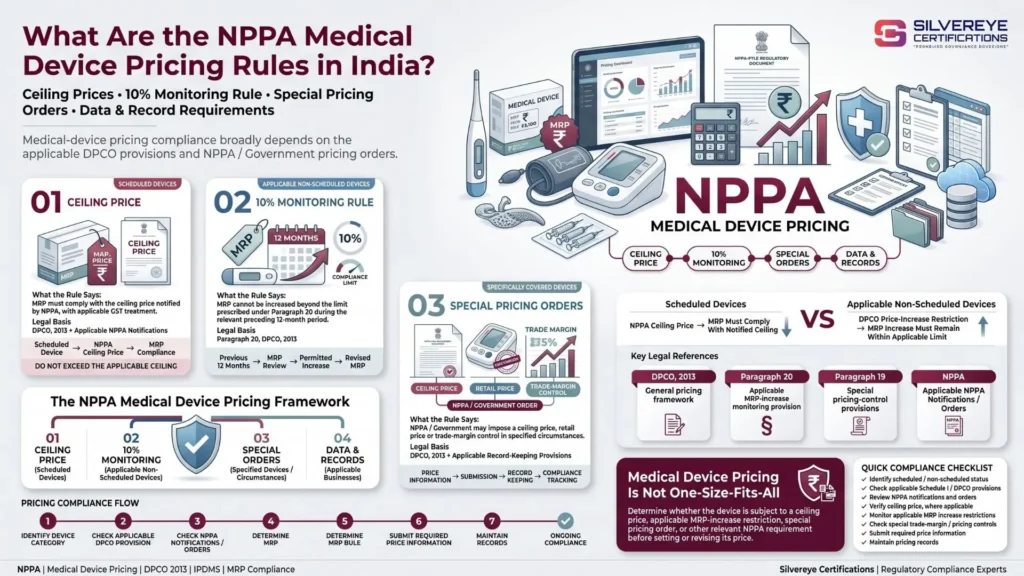
If you are looking for a quick explanation of medical device pricing rules in India, the requirements can broadly be understood through four areas:
| Level | Applies to | What the rule says | Legal basis |
|---|---|---|---|
| Ceiling price | Scheduled devices covered by the applicable Schedule I provisions | MRP must comply with the ceiling price notified by NPPA, with applicable GST treatment | DPCO, 2013 and applicable NPPA notifications |
| 10% monitoring rule | Applicable non-scheduled devices | MRP cannot be increased beyond the limit prescribed under Paragraph 20 during the relevant preceding 12-month period | Paragraph 20, DPCO, 2013 |
| Special pricing orders | Devices specifically covered by NPPA/Government orders | NPPA/Government may impose a ceiling price, retail price or trade-margin control in specified circumstances | Paragraph 19, DPCO, 2013 |
| Data and records | Businesses covered by the applicable pricing framework | Submit required price information and maintain records as directed by NPPA | DPCO, 2013, including applicable record-keeping provisions |
Where Does This Medical Device Pricing Guide Fit?
This page explains the NPPA pricing rules that apply to medical devices.
If you are looking for the registration process itself, you should first understand NPPA/IPDMS 2.0 registration for medical devices. If you need to understand how to use the portal, a separate IPDMS 2.0 guide for device companies can provide the step-by-step process.
Why Are Medical Devices Covered by NPPA Pricing Rules?
The regulatory position changed significantly in 2020, when the Central Government specified medical devices covered by the notification as drugs under the Drugs and Cosmetics Act, 1940, with effect from 1 April 2020. The relevant notification is S.O. 648(E), dated 11 February 2020.
This brought medical devices within the broader framework under which the Drugs (Prices Control) Order, 2013 (DPCO) can apply.
The DPCO provides different pricing mechanisms. It includes ceiling-price control for scheduled products, monitoring of MRP increases for non-scheduled products, and powers to impose special pricing measures in specified circumstances. The current DPCO text states the 10% monitoring rule in Paragraph 20 and the special pricing power in Paragraph 19.
NPPA maintains a dedicated Medical Devices section containing pricing notifications, ceiling-price orders, overcharging information and other regulatory documents.
What Is Rule 1? Ceiling Prices for Scheduled Medical Devices
Where a medical device is covered by the applicable scheduled/price-controlled provisions, the business must follow the ceiling price notified by NPPA.
Coronary stents are a prominent example. NPPA's records confirm that coronary stents were included in Schedule I and that NPPA continues to revise their ceiling prices.
Other devices may also be covered by scheduled or product-specific pricing provisions. Therefore, always check the current Schedule I and latest NPPA notification for your specific product.
What Does the Ceiling Price Mean for Your MRP?
For a device subject to a notified ceiling price:
- The applicable MRP must comply with the notified ceiling price.
- Where the notification specifies that the ceiling price is exclusive of GST, applicable GST is added according to the notification.
- If an existing MRP is above a newly notified ceiling, the business must bring the MRP into compliance.
- Any permitted revision must follow the current NPPA notification and applicable DPCO provisions.
What Are the Current Coronary Stent Ceiling Prices?
NPPA issued a revised coronary-stent ceiling-price notification on 27 March 2026, based on WPI.
Because NPPA revises notified prices and product-specific orders can change, the latest NPPA notification should always be treated as the controlling source rather than relying permanently on figures published in a secondary article or older notification.
Important: If you publish specific 2026 stent figures on this page, link them directly to the 27 March 2026 NPPA notification and update the figures whenever NPPA issues a subsequent revision.
What Is Rule 2? The 10% MRP Limit for Non-Scheduled Devices
For applicable non-scheduled products, Paragraph 20 of the DPCO provides that the Government monitors MRP and ensures that a manufacturer does not increase the MRP by more than 10% of the MRP during the preceding 12 months. Where the increase exceeds the permitted level, the DPCO provides for reduction to the permitted level and recovery of the overcharged amount with applicable interest and penalty.
How Should You Check the 10% Rule?
The important point is that this is not simply a calendar-year rule.
Before changing the MRP, review the applicable preceding 12-month pricing history and determine whether the proposed increase complies with Paragraph 20.
For example, if a company has already increased the MRP during the relevant 12-month period, it should not assume that another increase of up to 10% is automatically available.
Because the precise application of Paragraph 20 can depend on the pricing history, product circumstances and applicable NPPA interpretation, businesses with complex or borderline pricing changes should document their calculation and obtain professional advice where necessary.
Common Problems With the 10% Rule
Businesses can run into problems by:
- Making multiple increases that collectively exceed the applicable limit.
- Treating the 10% rule as a calendar-year limit rather than reviewing the relevant preceding period.
- Changing pack sizes or variants in a way that effectively increases the price per unit.
- Assuming a new model number automatically removes an existing pricing obligation.
- Changing the MRP after a GST change without checking the applicable NPPA position.
- Maintaining a price list that does not match the MRP printed on the product packaging.
For any GST-related MRP change, check the latest NPPA clarification or notification before revising your price.
Can NPPA Impose Special Price or Trade-Margin Controls?
Yes. Paragraph 19 of the DPCO gives the Government power, in specified extraordinary circumstances and in the public interest, to fix a ceiling price or retail price for a drug for a specified period or to allow an increase or decrease in an existing notified price.
NPPA has used specific pricing measures for medical devices. Its current Medical Devices section includes notifications concerning orthopaedic knee implants, as well as coronary stents and other device-related pricing matters.
This means a device should not be classified as "non-scheduled" and then assumed to have unrestricted pricing. Product-specific NPPA orders can create additional controls.
What Records and Pricing Data Must Medical Device Companies Maintain?
Pricing compliance does not end after setting the MRP.
Depending on the applicable requirements, businesses should maintain accurate records relating to:
- Product and model information
- MRP and price changes
- Effective dates of price revisions
- Sales and pricing records
- Applicable IPDMS submissions
- NPPA notifications or communications affecting the product
- Supporting calculations used to determine the applicable MRP
This is particularly important because NPPA maintains a dedicated Medical Devices section covering pricing, overcharging and enforcement matters.
What Happens If a Medical Device Company Violates NPPA Pricing Rules?
The consequences depend on the type of device, applicable pricing provision and nature of the violation.
Potential consequences can include:
- Reduction of the MRP where the applicable pricing limit has been exceeded.
- Recovery of overcharged amounts, together with applicable interest.
- Refund or deposit obligations arising from overcharging.
- Penalty or other regulatory action under the applicable legal framework.
- Requests for pricing and sales records or other information.
- Additional commercial consequences with hospitals, distributors and institutional buyers.
Paragraph 20 itself provides for the manufacturer to deposit the overcharged amount with applicable interest, in addition to the penalty, where the provision is breached.
Important Compliance Tip
Medical-device pricing should be reviewed against the latest DPCO provisions and current NPPA notifications, not only against an old pricing table.
NPPA's official Medical Devices page currently shows a 27 March 2026 revision for coronary-stent ceiling prices and continuing notifications relating to other medical devices.
Before fixing or revising an MRP, check the latest NPPA notification applicable to your exact device, model and category.
What Are Special NPPA Pricing Orders Under Paragraph 19?
Paragraph 19 of the Drugs (Prices Control) Order, 2013 (DPCO) gives the Government powers to fix or revise prices in specified circumstances and in the public interest. NPPA has used this framework for certain medical devices that are not necessarily covered by the ordinary scheduled-device ceiling-price mechanism.
Two important examples are orthopaedic knee implants and selected devices that have been subject to trade-margin controls.
How Are Orthopaedic Knee Implants Regulated?
NPPA has issued and extended ceiling-price notifications for orthopaedic knee implants over several years. The Authority's November 2025 decision extended the applicable knee-implant ceiling prices up to 15 November 2026, unless further orders apply.
However, businesses should not rely only on the November 2025 order. NPPA's website now shows an OM for Knee Implant Data Collection dated 14 September 2026, indicating continuing regulatory activity in this category.
Practical point: If you manufacture, import or market knee implants, check the latest NPPA notification, order or office memorandum before fixing your MRP. Do not assume that an older ceiling remains unchanged simply because its original validity period has not yet expired.
Can NPPA Control Trade Margins for Medical Devices?
Yes. NPPA has previously used the Trade Margin Rationalisation (TMR) approach for selected medical devices under Paragraph 19.
During the COVID-19 period, NPPA capped the trade margin for oxygen concentrators and five other medical devices—pulse oximeters, blood-pressure monitoring machines, nebulizers, digital thermometers and glucometers—at 70% at the Price to Distributor level.
The original 2021 notification records that these devices were non-scheduled medical devices and that the Government invoked Paragraph 19 in view of extraordinary circumstances and public interest.
These measures were subject to specific notifications and extensions. NPPA's Medical Devices archive shows the extensions issued through 2022 and 2023, including an extension of the TMR notification for five medical devices in January 2023.
Therefore, do not state that the 70% trade-margin cap is currently applicable in 2026 unless the latest NPPA order confirms it for the relevant device.
What Price Data, Labels and Records Must Medical Device Companies Maintain?
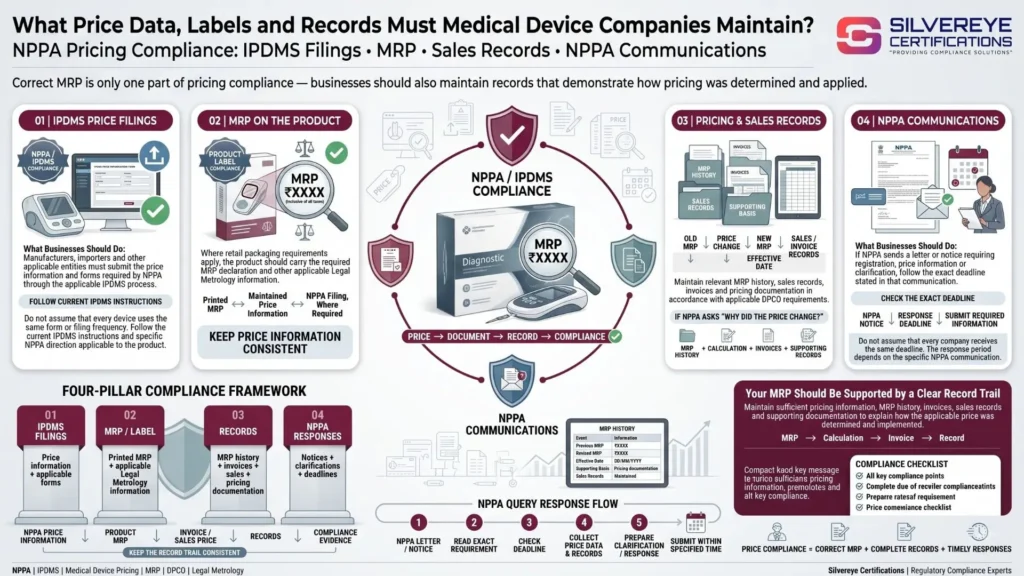
Having the correct MRP is only one part of NPPA pricing compliance. Businesses should also maintain the information needed to demonstrate how that MRP was determined.
IPDMS Price Filings
Manufacturers, importers and other applicable entities must submit the price information and forms required by NPPA through the applicable IPDMS process.
Do not assume that every device uses the same form or filing frequency. Follow the current IPDMS instructions and the specific NPPA direction applicable to your product.
MRP on the Product
Where retail packaging requirements apply, the product should carry the required MRP declaration and other applicable Legal Metrology information.
The printed MRP should be consistent with the price information maintained and submitted to NPPA, wherever such filing is required.
Pricing and Sales Records
Businesses should maintain relevant MRP history, sales records, invoices and pricing documentation in accordance with the applicable DPCO requirements.
These records are particularly important if NPPA asks the company to explain a price increase, overcharging allegation or product-specific pricing calculation.
Responding to NPPA Communications
If NPPA sends a letter or notice requiring registration, price information or clarification, follow the exact deadline stated in that communication.
Do not assume that every company receives the same deadline. The response period depends on the specific NPPA communication.
What NPPA Pricing Rule Applies to Each Medical Device?
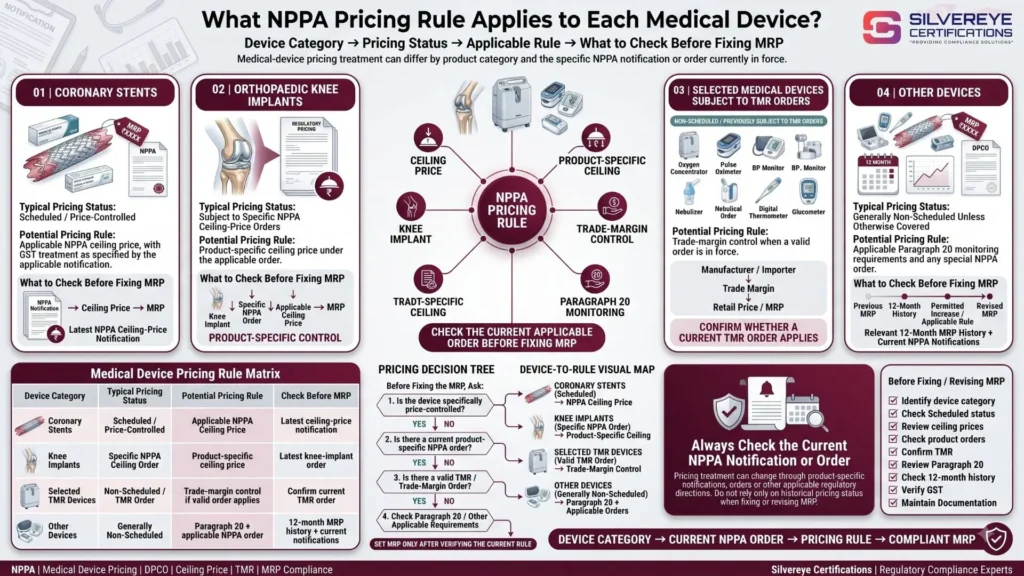
| Device category | Typical pricing status | Potential pricing rule | What to check before fixing the MRP |
|---|---|---|---|
| Coronary stents | Scheduled/price-controlled | Applicable NPPA ceiling price, with the treatment of GST specified by the notification | Latest NPPA ceiling-price notification |
| Orthopaedic knee implants | Subject to specific NPPA ceiling-price orders | Product-specific ceiling price under the applicable order | Latest knee-implant notification/order |
| Oxygen concentrators, pulse oximeters, BP monitors, nebulizers, digital thermometers and glucometers | Non-scheduled devices that have previously been subject to TMR orders | Trade-margin control when a valid order is in force | Confirm whether a current TMR order applies |
| Other devices | Generally non-scheduled unless otherwise covered | Applicable Paragraph 20 monitoring requirements and any special NPPA order | Relevant 12-month MRP history and current NPPA notifications |
Important: Device classification should be checked against the current DPCO, Schedule I and NPPA notifications. A device being non-scheduled does not automatically mean that no product-specific NPPA order can apply.
How Can You Find Out Which NPPA Pricing Rule Applies to Your Device?
Use the following process before fixing or changing the MRP:
- List every device and model you manufacture, import or market, along with its current MRP.
- Check the applicable Schedule I/DPCO provisions to determine whether the device is subject to scheduled price control.
- Search the latest NPPA Medical Devices notifications for any product-specific ceiling-price or trade-margin order. NPPA maintains a dedicated Medical Devices section for these notifications.
- Check the applicable Paragraph 20 requirements if the device is not covered by a specific ceiling-price order.
- Record your conclusion in a pricing-compliance sheet, including the notification/order and the date on which you checked it.
- Review the classification whenever NPPA issues a new order or notification, rather than relying permanently on an old assessment.
Who Needs to Follow NPPA Medical Device Pricing Rules?
The applicable DPCO and NPPA requirements can affect manufacturers, importers and marketers of medical devices.
This can include businesses that:
- Manufacture medical devices in India, including products sold under their own brand.
- Import medical devices into India.
- Market or sell devices under their own name or brand, even where manufacturing is outsourced.
- Operate through arrangements where pricing responsibility needs to be assessed based on the company's contractual and regulatory role.
Businesses with less straightforward arrangements—such as loan-licence structures, private-label brands, exclusive distributors or online brands—should determine their specific responsibility before fixing prices.
What Are the Benefits of Following NPPA Pricing Rules Correctly?
Maintaining proper pricing compliance can provide several practical benefits:
- Lower overcharging risk: Proper price controls reduce the risk of having to deposit or refund excess amounts with applicable interest.
- Faster response to NPPA queries: A clean pricing history makes it easier to respond to notices and information requests.
- Safer product launches: Knowing whether a device is subject to a ceiling price, special order or monitoring requirement helps you set the MRP correctly from the beginning.
- Better hospital and tender readiness: Clear pricing records can make regulatory due diligence easier.
- Better business due diligence: Investors, lenders and potential acquirers may review regulatory and pricing records.
- Planned pricing decisions: Maintaining a documented price history helps the business assess future MRP changes against the applicable rules.
What Documents Should You Keep for NPPA Pricing Compliance?
NPPA does not provide one universal document checklist for every company's internal pricing file. However, the following records are useful for demonstrating pricing compliance:
| Document/Record | Why It Is Useful |
|---|---|
| SKU/model-wise MRP history | Helps demonstrate compliance with applicable MRP restrictions |
| Price-to-distributor records and invoices | Useful where trade-margin calculations apply |
| Device classification sheet | Records whether the device is scheduled, subject to a special order or governed by general monitoring provisions |
| NPPA notifications and orders | Shows which pricing rule was relied upon |
| NPPA letters and responses | Maintains a clear regulatory correspondence trail |
| IPDMS acknowledgements and submitted price information | Helps reconcile regulatory submissions with business records |
| GST rate history | Helps explain price changes associated with tax changes where applicable |
| Label artwork showing MRP | Helps confirm that the printed MRP is consistent with the applicable pricing records |
| Landed-cost or cost-of-production records | May be useful when responding to regulatory queries or supporting a pricing review |
Keep the Pricing File Current
The safest approach is to maintain one product-wise pricing file for every medical device/model and update it whenever there is an MRP change, a new NPPA notification, a change in the product's regulatory status or a communication from NPPA.
Because NPPA continues to publish new medical-device notifications and data requests—including September 2026 activity concerning knee implants—pricing compliance should be treated as an ongoing process rather than a one-time registration exercise.
How Can You Build a Process for NPPA Medical Device Pricing Compliance?
A simple internal process can help you manage MRP changes, NPPA notifications and IPDMS filings without having to review the entire portfolio from scratch every time.
- Map your portfolio. Create one row for each device, model and relevant pack, including the current MRP.
- Classify each device. Determine whether it is scheduled, covered by a product-specific NPPA order, or otherwise subject to the applicable non-scheduled pricing provisions.
- Build the price history. Maintain at least the relevant 12-month MRP history for each applicable product.
- Calculate the applicable pricing limit. For scheduled devices, compare the MRP with the current notified ceiling price. For applicable non-scheduled devices, review the Paragraph 20 requirements against the relevant pricing history.
- Check current NPPA orders. Search for new Paragraph 19 orders, ceiling-price notifications, extensions and product-specific directions before changing a price.
- Set the MRP. Apply the applicable pricing rule and ensure that GST and other required declarations are correctly reflected on the product packaging.
- File the price information. Submit the applicable price list or other required information through IPDMS in the form and manner specified by NPPA.
- Maintain supporting records. Keep invoices, price lists, MRP history, IPDMS acknowledgements and NPPA correspondence together.
- Monitor regulatory updates. Review NPPA notifications regularly, particularly around the period when annual ceiling-price revisions are normally issued.
- Conduct an annual review. Recheck the device classification, pricing history, current NPPA orders, labels and records at least once a year.
Are There Any Government Fees for NPPA Medical Device Pricing Compliance?
NPPA pricing compliance is different from obtaining a CDSCO medical-device licence. No separate government fee was identified for the basic pricing-compliance activities described below in the sources reviewed. Businesses should nevertheless verify the current IPDMS instructions and applicable NPPA notification before filing.
| Rule or activity | Government fee | Validity / applicability | Update or revision |
|---|---|---|---|
| Ceiling price for scheduled devices | No separate pricing fee identified | Applies while the relevant NPPA ceiling notification remains in force | Check each new NPPA ceiling-price notification |
| Knee-implant ceiling order | No separate pricing fee identified | Subject to the period and conditions stated in the applicable order | Check for extensions or replacement orders |
| Product-specific trade-margin order | No separate pricing fee identified | Applies only while the relevant order is in force | Verify the latest NPPA notification |
| Paragraph 20 monitoring requirement | No separate pricing fee identified | Ongoing pricing requirement | Review whenever an MRP is changed |
| IPDMS price submission | No separate fee identified on the sources reviewed | Applies according to the submitted pricing information and NPPA requirements | Update when the applicable price changes |
| Consultant pricing audit/retainer | Not fixed by law | Depends on the engagement | Optional |
Important: The absence of a separate NPPA filing fee does not mean there are no other regulatory costs. Businesses may incur expenses for testing, legal advice, compliance consultants, documentation or other regulatory work, depending on their situation.
What Is the NPPA Pricing Compliance Calendar for 2026–2027?
| When | What to do |
|---|---|
| Before every MRP change | Review the applicable 12-month pricing history or current ceiling price, as applicable. |
| Around the annual WPI revision period | Check NPPA's latest ceiling-price notifications and their effective dates. |
| Before 15 November 2026 | If you deal in knee implants, check whether NPPA has extended, replaced or otherwise modified the applicable ceiling-price order. |
| When an NPPA letter arrives | Respond within the specific deadline stated in the communication. |
| During the year | Reconcile MRPs, labels, distributor price information and IPDMS submissions where applicable. |
| At least once a year | Conduct a complete review of classification, price history, NPPA orders and supporting records. |
For 2026, NPPA revised the ceiling prices for coronary stents with effect from 1 April 2026. Rather than permanently publishing the WPI percentage in a general guide, use the latest NPPA notification as the source for the applicable ceiling price.
What Happens If You Violate NPPA Medical Device Pricing Rules?
The consequences depend on the device, applicable pricing provision and nature of the violation.
| Situation | Potential consequence |
|---|---|
| Scheduled device sold above the applicable ceiling | Price correction and recovery of the overcharged amount with applicable interest, subject to the applicable provisions |
| Non-scheduled device exceeds the applicable Paragraph 20 limit | Price correction and recovery/deposit of the applicable overcharged amount with interest, as prescribed |
| Breach of a Paragraph 19 order | Regulatory action and recovery of excess amounts, where applicable |
| Missing required filings or records | NPPA queries, requests for information, inspection and possible regulatory/penal action |
The exact outcome depends on the facts and the legal provision involved. If a company receives an NPPA demand or overcharging notice, it is sensible to obtain legal or regulatory advice promptly rather than responding based only on a generic pricing calculation.
What Are the Common NPPA Medical Device Pricing Mistakes?
Businesses commonly make the following mistakes:
- Assuming a device is free from price controls because it is not in Schedule I. A product-specific NPPA order may still apply.
- Checking only the last price change: The applicable Paragraph 20 requirement should be assessed using the relevant preceding 12-month pricing history.
- Using an outdated ceiling price: Always check the latest NPPA notification before fixing or revising an MRP.
- Assuming an old trade-margin order is still active: Product-specific orders have their own validity periods and extensions.
- Using pack or model changes to justify a higher price: Changes in model number, pack size or variant should not be treated as an automatic way around applicable pricing requirements.
- Confusing GST treatment: Check the specific NPPA notification to determine whether the notified ceiling price is exclusive of GST and how the final MRP should be displayed.
- Failing to update pricing information: Keep IPDMS submissions, internal price lists and product labels consistent where applicable.
When Should You Hire an NPPA Medical Device Pricing Consultant?
A small business with a limited number of products may be able to manage its pricing compliance internally. Professional support can become more useful when you have a large product portfolio, scheduled devices, product-specific NPPA orders, frequent MRP changes or an active NPPA query.
| Service | What You Get |
|---|---|
| Device classification review | Product-wise assessment of scheduled, special-order and applicable non-scheduled pricing requirements |
| MRP and Paragraph 20 review | Review of relevant pricing history and proposed MRP changes |
| Ceiling-price verification | Check against the current NPPA notification applicable to the device |
| IPDMS price filings | Preparation of applicable price information in the form specified by NPPA |
| NPPA notice response | Assistance with calculations, replies and supporting documentation |
| Notification tracking | Monitoring of relevant ceiling-price revisions, extensions and product-specific orders |
Frequently Asked Questions
Do NPPA medical device pricing rules apply to all devices in India?
Yes. Since all devices became "drugs" on 1 April 2020, NPPA applies the DPCO to them. It fixes ceiling prices for scheduled devices and monitors the rest.
Can I increase the MRP of my medical device?
For non-scheduled devices, yes, but by no more than 10% of the MRP during the preceding 12 months. For scheduled devices you cannot go above the ceiling price plus GST.
What is a scheduled medical device?
It is a device listed in Schedule I of the DPCO, which follows the National List of Essential Medicines. Coronary stents are the best-known example.
What is the current ceiling price of coronary stents?
From 1 April 2026, ₹10,762.15 per unit for bare metal stents and ₹39,186.03 per unit for drug-eluting stents, excluding GST. Always confirm on the latest NPPA notice.
Is there a price cap on knee implants?
Yes. NPPA fixed ceiling prices in 2017 using Paragraph 19. The current order runs up to 15 November 2026, or until further orders, whichever is earlier.
How does the 10% rule work?
Look back 12 months from the date of your planned increase. Your new MRP cannot be more than 10% above the MRP in that window. The window rolls forward with every day.
What is trade margin rationalization?
It is a cap on the margin between the price to the distributor and the MRP. NPPA used a 70% cap for six devices in 2021, with MRP set as price to distributor plus margin plus GST.
Does the trade margin cap still apply to pulse oximeters and glucometers?
The last extension I could verify ended on 30 June 2023. Check NPPA’s notifications for any current order before you assume either way.
Is GST included in the ceiling price?
No. Ceiling prices are stated before GST. GST at the applicable rate is added to reach the MRP.
What happens if I raise MRP by more than 10%?
NPPA can direct the price back to the 10% level for the next 12 months and require you to deposit the overcharged amount with interest.
Does NPPA approve my device price before launch?
For most non-scheduled devices, there is no prior approval step. You set the price within the rules and file the details on IPDMS as NPPA directs.
Do importers have to follow the same device pricing rules?
Yes. The DPCO covers manufacturers, importers and marketers alike, including subsequent importers.
Is there a government fee to follow the medical device pricing rules?
I did not find any government fee for following the rules. Your costs are internal effort, plus any consultant fee you choose to pay.
Do I need to register on IPDMS to follow the NPPA pricing rules?
Yes, device companies are expected to register on IPDMS 2.0 and file the forms NPPA directs. Our registration and IPDMS guides explain how.
Where can I check the latest changes to the pricing rules?
On NPPA’s official website, nppa.gov.in, in its notifications and medical devices sections.