- Different trigger points: Indian manufacturers must register the IMEI before the first sale of equipment manufactured in India. Importers must register the IMEI before importing the equipment into India. The importer requirement also applies when the equipment is imported for sale, testing, research or any other purpose.
- Importers may have additional compliance requirements: In addition to IMEI registration, an importer may need other applicable approvals and import documents depending on the device and its intended use, such as an IEC, BIS requirements, WPC ETA and Bill of Entry. These requirements are separate from the IMEI registration itself and should be checked based on the specific product. WPC ETA, for example, applies to applicable wireless devices operating in permitted de-licensed frequency bands.
- Testing and R&D imports are not automatically exempt from IMEI registration: The Telecom Cyber Security Rules specifically require importers to register IMEIs for equipment imported for testing, research or any other purpose. The rule does not provide a general minimum-quantity waiver for such imports.
- 2026 compliance update: The Telecom Cyber Security Amendment Rules, 2025, together with subsequent DoT directions and the August 2026 ICDR guidance, have strengthened enforcement around IMEI registration and IMEI tampering. DoT has specifically cautioned manufacturers, importers and resellers about mandatory IMEI registration and the consequences of tampering with IMEIs.
Introduction
Manufacturers and importers both have IMEI registration obligations, but the trigger point is different. Manufacturers must register the IMEIs of applicable India-made devices before the first sale. Importers must register the IMEI before importing the device into India, including equipment imported for applicable sale, testing or research purposes.
For importers, IMEI registration is only one part of the import compliance process. Depending on the device, importers may also need an Importer Exporter Code (IEC), applicable BIS certification, WPC ETA approval and customs documentation such as the Bill of Entry filed through ICEGATE. These requirements depend on the product and its intended use, so they should be checked separately from the IMEI registration requirement.
Skipping mandatory IMEI registration can create serious compliance problems for an importer, including issues with the lawful import and subsequent use or sale of the device in India.
IMEI Registration for Importers vs Manufacturers: What Is the Difference?
IMEI registration in India is governed by the Telecommunications Act, 2023 and the Telecom Cyber Security Rules, 2024. The Department of Telecommunications (DoT) has implemented the relevant process through the ICDR portal.
Although manufacturers and importers use the same government system for IMEI registration, their compliance trigger is different. The rules specifically state that:
- Manufacturers: must register the IMEI of equipment manufactured in India before its first sale.
- Importers: must register the IMEI of equipment before importing it into India, whether it is imported for sale, testing, research or any other purpose.
This difference is important because an importer has to complete the IMEI registration before the import takes place, rather than waiting until the goods arrive in India.
What Is the Difference Between IMEI Registration for Manufacturers and Importers?
| Aspect | Manufacturers | Importers |
|---|---|---|
| Trigger point | Before the first sale of applicable equipment manufactured in India | Before importing applicable equipment into India |
| Testing / R&D | The manufacturer obligation applies before first sale; the rules also cover the relevant equipment manufactured in India | The importer obligation expressly covers equipment imported for sale, testing, research or any other purpose |
| Cross-border import | Not applicable to India-made production | IMEI registration must be completed before import |
| Customs documentation | No import customs documentation for domestically manufactured devices | Importers may need Bill of Entry and other applicable customs documents |
| Other regulatory approvals | Depends on the product and applicable Indian regulations | May include BIS, WPC/ETA, MTCTE or other approvals, depending on the device |
| Primary compliance authority for IMEI | Department of Telecommunications | Department of Telecommunications |
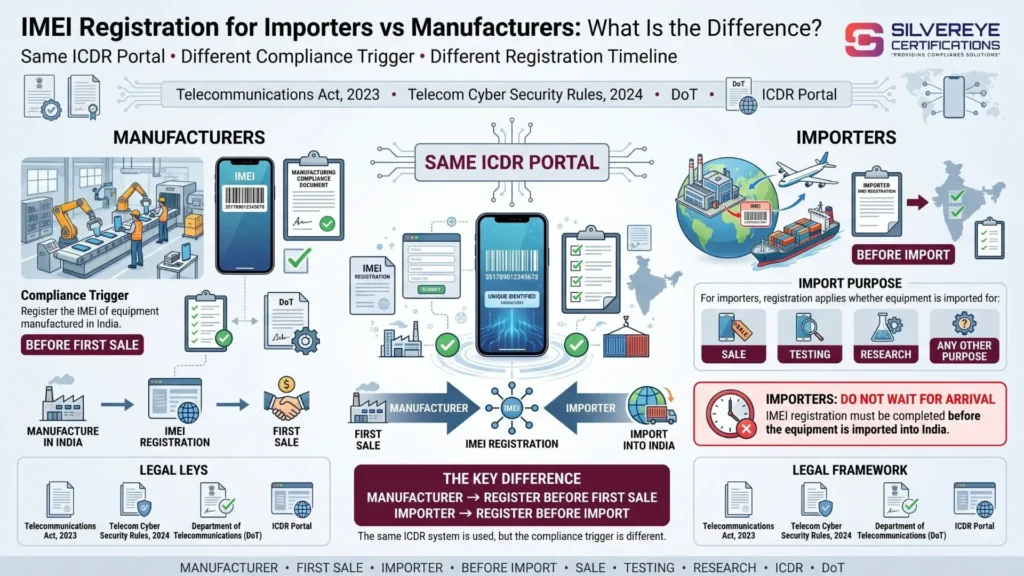
The IMEI obligation itself comes from Rule 8 of the Telecom Cyber Security Rules, 2024.
Who Is Considered an Importer for IMEI Registration?
The importer requirement can apply to businesses bringing IMEI-bearing equipment into India for different purposes, including:
- Commercial importers bringing finished mobile phones into India for sale.
- Indian brand owners whose phones are manufactured overseas and imported into India.
- Companies and laboratories importing phones for testing or research.
- Businesses importing used or refurbished devices, where the devices fall within the applicable IMEI requirements.
- Importers of record handling consignments on behalf of a business.
The important point is that the rule does not limit the importer obligation to phones imported for resale. It expressly covers equipment imported for sale, testing, research or any other purpose.
How Does an Importer Register IMEI Through the ICDR Portal?
The exact portal workflow and documentation can be updated by DoT, so importers should follow the current ICDR instructions rather than relying only on an older checklist. DoT issued further ICDR-related instructions on 12 August 2026.
In general, the process involves:
- Create or access the importer account on the designated ICDR system.
- Provide the required company and authorised-person details.
- Provide the relevant brand, OEM and device information.
- Submit the required IMEI data in the format specified by the portal.
- Upload the required commercial and import documentation, where applicable.
- Allow the system to perform the required IMEI/TAC validation.
- Obtain the applicable IMEI registration certificate or confirmation before proceeding with the import.
For customs clearance, DoT's published ICDR procedure states that the consignment-wise IMEI certificate is submitted along with relevant import documents such as the packing list and invoice, and customs officials can verify the certificate through the ICDR system.
What Documents May an Importer Need?
The exact documents depend on the device and import arrangement. Commonly relevant documents can include:
| Document / Approval | Manufacturer | Importer |
|---|---|---|
| Company registration details | ✓ | ✓ |
| Brand / OEM details | ✓ | ✓ |
| Technical specifications | ✓ | ✓ |
| IMEI / TAC information | ✓ | ✓ |
| IEC | Not generally required for domestic manufacturing | Required for import activity |
| Commercial invoice | Not applicable to domestic production | ✓ |
| Packing list | Not applicable to domestic production | ✓ |
| Bill of Entry | Not applicable | Applicable for customs clearance |
| BIS certification | Only where applicable | Only where applicable |
| WPC ETA | Only where applicable | Only where applicable |
| MTCTE certification | Only where applicable | Only where applicable |
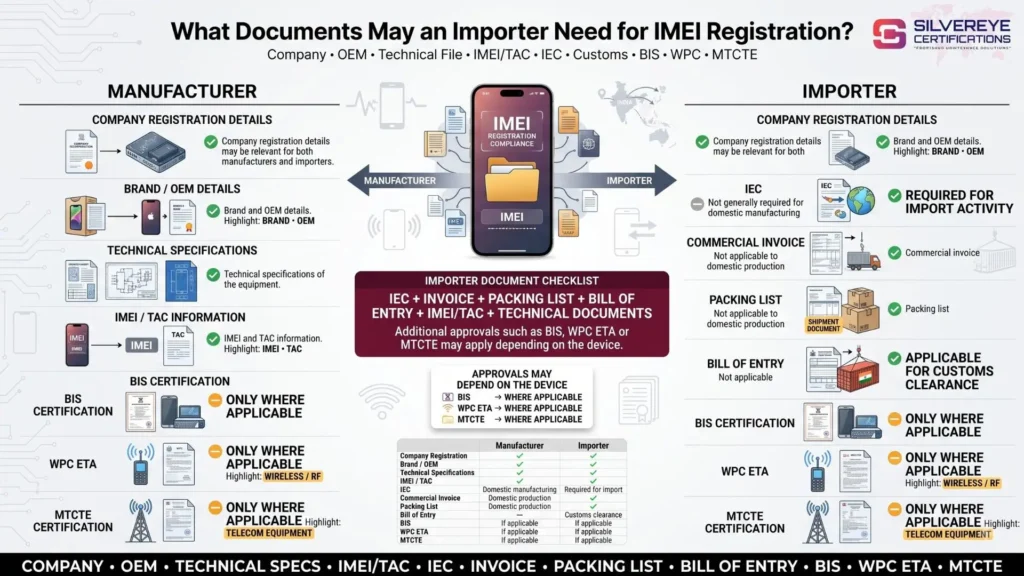
It is important not to treat BIS CRS, WPC ETA or MTCTE as automatically required for every mobile-device import. Their applicability depends on the particular product and the relevant regulatory framework. For example, DoT states that WPC Equipment Type Approval (ETA) applies to applicable wireless/RF devices operating in permitted de-licensed frequency bands.
Why Does the Importer-vs-Manufacturer Difference Matter?
For a manufacturer, the key compliance point is before the first sale of applicable India-manufactured equipment.
For an importer, the critical point comes earlier in the supply chain: the IMEI must be registered before the equipment is imported into India. This means an importer should complete its IMEI compliance and verify the applicable product approvals before the shipment reaches the Indian customs stage.
This is particularly important for businesses importing mobile phones, refurbished devices, test units or other IMEI-bearing equipment, because a missing or incorrect IMEI registration can create problems during the import process.
Important 2026 Update
DoT published additional ICDR-related instructions on 12 August 2026 and also cautioned manufacturers, importers and resellers about mandatory IMEI registration and the consequences of IMEI tampering.
For importers, the practical takeaway is simple: complete IMEI registration before import, verify the applicable BIS/WPC/other product requirements separately, and keep the IMEI certificate and import documents consistent with the actual consignment.
What Compliance Requirements Do Mobile Phone Importers Need Beyond IMEI Registration?
IMEI registration is only one part of the compliance process for businesses importing mobile phones into India. Unlike a domestic manufacturer, an importer may need to deal with several regulatory and customs requirements, including DoT/ICDR, DGFT and Indian Customs.
The exact approvals depend on the device, its technical specifications, intended use and applicable regulations.
- IEC (Importer Exporter Code): An IEC issued by DGFT is generally required for commercial imports into India. DGFT describes the IEC as a 10-digit PAN-linked code used for customs clearance and international trade transactions. The current DGFT guidance lists an ₹500 application fee for a new IEC.
- BIS Certification: Applicable mobile phones and other electronic products may fall under BIS compulsory registration requirements. The applicable standard depends on the product and the current notified scheme. Therefore, importers should verify the current BIS standard and certification requirement for the particular device rather than assuming one standard applies to every phone. BIS records continue to show testing under relevant mobile/electronics standards.
- WPC ETA (Equipment Type Approval): Wireless devices operating in applicable de-licensed frequency bands may require WPC ETA. DoT specifically lists mobile handsets and smartphones among products for which ETA through self-declaration may be used where applicable. The current WPC service page lists a ₹10,000 fee for ETA.
- Customs duty and IGST: Imported mobile phones are subject to customs duties and applicable IGST according to the tariff classification and current notifications. The exact amount should be checked against the HS classification and prevailing customs tariff applicable on the date of import rather than relying on a fixed rate in a general guide.
How Do These Requirements Usually Fit Together?
For a new importer, the practical sequence is generally:
IEC → Product-specific BIS/WPC and other approvals → IMEI/ICDR compliance → Shipment documentation → Bill of Entry and Customs clearance
The exact sequence can vary depending on the product, certification status, import arrangement and customs requirements.
What Does It Cost to Import a Mobile Phone Legally?
| Requirement | Typical Cost / Fee Position | Paid To |
|---|---|---|
| ICDR / IMEI registration | Check the current ICDR process for any applicable government fee; separate costs may arise for documentation and compliance support | Department of Telecommunications |
| IEC | ₹500 application fee for a new IEC under DGFT guidance | DGFT |
| BIS certification / testing | Varies by product, standard and testing requirements | BIS / BIS-recognised laboratory |
| WPC ETA | Current DoT service page lists ₹10,000 | WPC Wing, DoT |
| Customs duty | Depends on HS classification, applicable tariff and current notifications | Indian Customs |
| IGST | Depends on the applicable tax rate and assessable value | Indian Customs |
The important point for an importer is that IMEI registration should not be treated as the only cost or approval. Product testing, certification, customs duty, taxes, logistics and professional compliance support can all form part of the overall import cost.
How Long Does Mobile Phone Import Compliance Take?
There is no single processing timeline for the entire import-compliance process because different approvals are handled by different authorities.
- IEC: DGFT processes the application after submission and verification of the required information and documents.
- BIS certification: Timing can vary considerably where product testing and certification are involved.
- WPC ETA: Processing depends on the application, technical documents and applicable RF requirements. DoT's current service allows self-declaration for eligible products.
- IMEI/ICDR: The time required can depend on company, brand/model information, IMEI data and validation requirements.
- Customs clearance: This depends on the completeness of the Bill of Entry, supporting documents, applicable approvals and customs assessment.
For this reason, importers should complete business-level and product-level approvals well before the expected shipment date, rather than starting compliance after the goods have already been dispatched.
Does IMEI Registration Need to Be Renewed?
IMEI registration should not be treated like a periodic licence renewal. The importer must follow the applicable ICDR process for the IMEI data associated with the equipment being imported.
Importers should also maintain consistent records of the IMEI data, commercial documents and shipment details, because discrepancies can create problems during verification or customs processing.
For subsequent consignments of the same device model, the importer should follow the current ICDR procedure for submitting and validating the relevant IMEI data rather than assuming that an earlier certificate automatically covers a new shipment.
Manufacturer vs Importer: What Is Different?
| Parameter | Manufacturer | Importer |
|---|---|---|
| Who is covered? | Entity manufacturing applicable IMEI-bearing equipment in India | Entity importing applicable IMEI-bearing equipment into India |
| Core IMEI requirement | Register IMEI before first sale | Register IMEI before import |
| IEC | Generally not required for domestic manufacturing alone | Required for import activity |
| BIS requirements | Applicable where the product falls under a compulsory BIS scheme | Applicable where the product falls under a compulsory BIS scheme |
| WPC ETA | Applicable where relevant to the wireless/RF characteristics | Applicable where relevant to the wireless/RF characteristics |
| Customs documentation | Not applicable to domestic production | Bill of Entry and other applicable import documents |
| IMEI compliance | Manufacturer-side registration obligation | Importer-side registration obligation |
| Main practical concern | Ensuring IMEI and product compliance before sale | Ensuring IMEI, product approvals and import documentation are ready before import |
The Practical Takeaway for Importers
If you are planning to import mobile phones into India, do not look at IMEI registration in isolation. First identify the exact device and its regulatory requirements, obtain the necessary IEC and applicable product approvals, complete the required IMEI/ICDR compliance, and keep the invoice, packing list, IMEI data and customs documents consistent before the shipment reaches India.
2026 Regulatory Updates Importers Need to Track
- Telecommunications (Telecom Cyber Security) Amendment Rules, 2025: The amendment allows the Central Government to direct manufacturers of IMEI-bearing equipment not to assign IMEIs that are already in use on Indian telecom networks to new equipment, including equipment manufactured in India or imported into India, from a date specified by the Government. The amendment also provides for a government-maintained database of tampered or restricted IMEIs.
- November 2025 DoT advisory: On 17 November 2025, the Department of Telecommunications advised manufacturers, brand owners, importers and sellers/resellers to comply with the IMEI registration framework and warned about the legal consequences of IMEI tampering.
- Central IMEI database: The amended rules provide for a central database of IMEIs that are tampered with or whose use has been restricted. DoT's CEIR framework also maintains IMEI-related status information, including invalid, stolen and cloned identifiers. Importers dealing with used or refurbished equipment should therefore verify the IMEI status and regulatory requirements before bringing devices into India.
- Penalties under the Telecommunications Act, 2023: Section 42(3) covers offences including tampering with telecommunication identifiers and knowingly possessing radio equipment using unauthorised or tampered identifiers. The punishment can extend to three years' imprisonment, a fine of up to ₹50 lakh, or both. Under Section 42(7), offences specified under Section 42 are cognizable and non-bailable, while Section 42(6) provides punishment for abetment, attempt or conspiracy where the statutory conditions are met.
- Export-related treatment: The IMEI registration framework distinguishes between equipment manufactured in India and equipment imported into India. For importers, the Telecom Cyber Security Rules specifically require registration of IMEI-bearing equipment before it is imported into India for sale, testing, research or any other purpose.
Common Mistakes Importers Make (and How to Avoid Them)
- Registering IMEI after the shipment has already left the origin port: The rules require an importer to register the IMEI before importing the equipment into India. Treat ICDR registration as a pre-import compliance step, rather than waiting until the shipment reaches customs.
- Assuming foreign IMEI allocation is enough: An IMEI allocated internationally does not replace the Indian regulatory requirement. Equipment with an IMEI imported into India must meet the Indian registration requirement through the prescribed government process before import.
- Treating IMEI registration as the only compliance requirement: IMEI registration is only one part of an importer's compliance process. Depending on the product, technology and intended use, the importer may also need IEC, applicable BIS requirements, WPC ETA or other regulatory/customs clearances. Completing IMEI registration does not automatically satisfy these separate requirements.
- Not checking IMEI status for used or refurbished stock: The 2025 amendment introduced provisions concerning IMEIs already in use in Indian networks and a government database of tampered or restricted IMEIs. Importers dealing in used or refurbished devices should therefore conduct appropriate IMEI verification and due diligence before placing an order.
- Assuming an old ICDR record can simply be reused after material changes: If the device, model information or registration details change, the importer or manufacturer should follow the current ICDR process and portal instructions rather than assuming that an existing registration automatically covers the modified configuration. The exact workflow should be checked against the latest ICDR requirements.
Conclusion
If you're importing mobile phones into India — whether as a brand owner, distributor, or R&D lab — treat IMEI registration as one part of a broader compliance process, not a standalone task. The ICDR portal handles the IMEI registration requirement, but depending on the product and its intended use, you may also need IEC, applicable BIS requirements, and WPC ETA approval before your shipment reaches Indian customs. Unlike a manufacturer's domestic sale, an importer must complete the prescribed IMEI registration before importing the equipment into India.
Build your compliance timeline backward from the shipment date, keep GSMA TAC documentation ready for each model where applicable, and verify used or refurbished devices for duplicate, tampered, or restricted IMEIs before placing your purchase order. These checks can help reduce compliance problems and delays when importing mobile devices into India under the 2025–26 regulatory framework.
Frequently Asked Questions
What is the main difference between IMEI registration for importers and manufacturers?
Manufacturers register a device's IMEI before its first domestic sale, testing, or R&D use. Importers must register before the device is imported into India — the registration has to be completed before the consignment clears customs, not afterward.
Which portal is used for importer IMEI registration?
The same one used by manufacturers: the Department of Telecommunications' Device Setu — Indian Counterfeited Device Restriction (ICDR) portal at icdr.ceir.gov.in. Importers register under a separate "Importer" category rather than "Local Manufacturer."
Do importers need an IEC code in addition to IMEI registration?
Yes. The Importer Exporter Code, issued by the DGFT, is mandatory for any commercial import into India and is entirely separate from IMEI/ICDR registration. Without it, customs cannot process your Bill of Entry.
Is IMEI registration required for phones imported only for testing or R&D, not for sale?
Yes. The rule explicitly covers devices imported "for sale, testing, research & development (R&D) or any other purpose" — there's no exemption for non-commercial or small-quantity imports.
What documents does an importer need that a manufacturer doesn't?
Primarily the IEC code, import invoice, packing list, Bill of Lading or Airway Bill, and the Bill of Entry filed on ICEGATE. Manufacturers of India-made devices don't need any of these, since there's no cross-border shipment involved.
How long does importer IMEI registration take?
Once your company, brand, and device model are already registered on the ICDR portal, validating a new consignment's IMEI file is comparatively quick. First-time registration takes longer, since it involves GSMA TAC verification. Budget separately for BIS CRS and WPC ETA approvals, which involve lab testing and can take several weeks.
Does the IMEI registration certificate expire, and does it need renewal?
The certificate issued for a specific consignment doesn't expire or need renewal. However, every new import consignment — even of the same device model — requires its own IMEI file to be uploaded and validated afresh.
What happens if an importer skips IMEI registration?
The consignment cannot legally clear Indian customs, since the IMEI certificate is required alongside the Bill of Entry. Knowingly importing or possessing devices with unregistered or tampered IMEIs can also attract penalties under the Telecommunications Act, 2023, including imprisonment of up to three years and fines up to ₹50 lakh.
Can an importer bring in used or refurbished phones without extra scrutiny?
No — used and refurbished imports face closer scrutiny under the Telecom Cyber Security (Amendment) Rules, 2025, which lets the government block the reassignment of IMEIs already active on Indian networks. Importers should verify a consignment's IMEIs aren't already in use in India before finalising a purchase.
Do BIS CRS and WPC ETA apply only to importers, or to manufacturers too?
Both. Manufacturers producing phones in India also need BIS CRS certification and WPC ETA approval for their devices. The difference is that importers face these checks alongside customs clearance, adding a trade-compliance layer manufacturers of India-made devices don't have to navigate.
Is there a government fee for IMEI registration on the ICDR portal?
No separate government fee for the ICDR registration step itself has been publicly notified. The real, budgetable costs for importers sit in the IEC filing fee (roughly ₹500 for individuals/proprietorships), BIS and WPC testing and certification charges, and customs duty plus IGST on the shipment.
Who is legally responsible if an imported phone's IMEI turns out to be duplicated or tampered?
The importer bringing the device into India bears the compliance obligation to register and verify its IMEI before import. Knowingly possessing or dealing in a device with a tampered or unauthorised IMEI is a cognizable, non-bailable offence under Section 42 of the Telecommunications Act, 2023, applying to importers just as it does to manufacturers and resellers.