

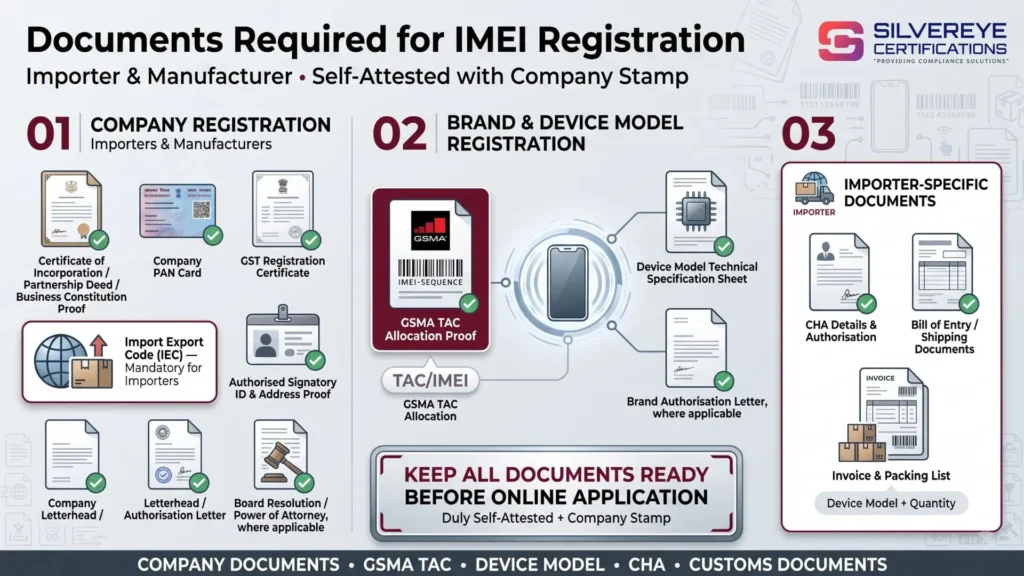
- IMEI registration documents split into three groups: company-level, brand/device-level, and importer-specific — miss any group and your application stalls.
- An Import Export Code (IEC) is mandatory for importers and now needs a free annual DGFT update every April–June, or it deactivates and blocks your Device Setu filing too.
- Your GSMA TAC allocation proof must match your registered brand name exactly — this single mismatch causes more rejected IMEI applications than any other document issue.
- All documents are submitted self-attested with the company stamp, not notarized — so gathering them is quick once you know the exact list.
Introduction
IMEI registration documents in India fall into three groups on the Device Setu (ICDR) portal: company documents (Certificate of Incorporation or Partnership Deed, PAN, GST certificate, and Import Export Code for importers), brand/device documents (GSMA TAC allocation proof, device model specification sheet, brand authorization letter), and importer-specific documents (CHA authorization, invoice, packing list, and Bill of Entry).
All are submitted self-attested with the company stamp. Missing or mismatched documents — especially a brand name that doesn't match GSMA's TAC records — are the single biggest cause of delayed IMEI registration in 2026.
Why IMEI Registration Documents Matter More Than People Expect
Most businesses treat the documentation stage as a formality — something to rush through before the “real” work of uploading IMEI numbers begins. In practice, it's the opposite. On the Device Setu (ICDR) portal, run by the Department of Telecommunications (DoT), your documents are what establish your company's identity, your legal right to import or manufacture, and your brand's ownership of the device model you're registering. Get any of these wrong, and the system won't let you past the very first stage.
The documents required for IMEI registration Process exist to answer three questions the government needs verified before a device enters the Indian market: is this a real, legally constituted business; does it have the legal right to import or manufacture in India; and does it genuinely own or represent the brand behind the device model's GSMA Type Allocation Code (TAC)? Every document on the checklist below maps back to one of those three questions.
This obligation sits under the Telecommunications Act, 2023, and the Telecom Cyber Security Rules, 2024, tightened further by the Telecom Cyber Security Amendment Rules, 2025. None of these rules changed the documents themselves dramatically, but enforcement has become noticeably stricter — the DoT issued public cautions to manufacturers, importers, and resellers in late 2025 specifically about compliance gaps, which makes clean, complete documentation more important heading into 2026 than it was a couple of years ago.
IMEI Registration Documents by Applicant Type
The exact document set depends on whether you're registering as an importer, a domestic manufacturer, or a contract manufacturer. Here's how the requirement breaks down.
| Applicant type | Core documents needed | Additional requirement |
| Importer | Certificate of Incorporation/Partnership Deed, PAN, GST certificate, IEC certificate, authorized signatory ID proof | CHA authorisation, invoice, packing list, and Bill of Entry per consignment |
| Local manufacturer / brand owner | Certificate of Incorporation/Partnership Deed, PAN, GST certificate, authorised signatory ID proof | GSMA TAC allocation proof and device model specification for each model manufactured |
| Contract manufacturer | Same company-level documents as manufacturers | Manufacturing agreement or authorisation from the brand owner, alongside the brand owner's TAC details |
| Brand owner using a third-party importer/distributor | Company documents as above | Brand authorisation letter naming the importer/distributor permitted to register on the brand's behalf |
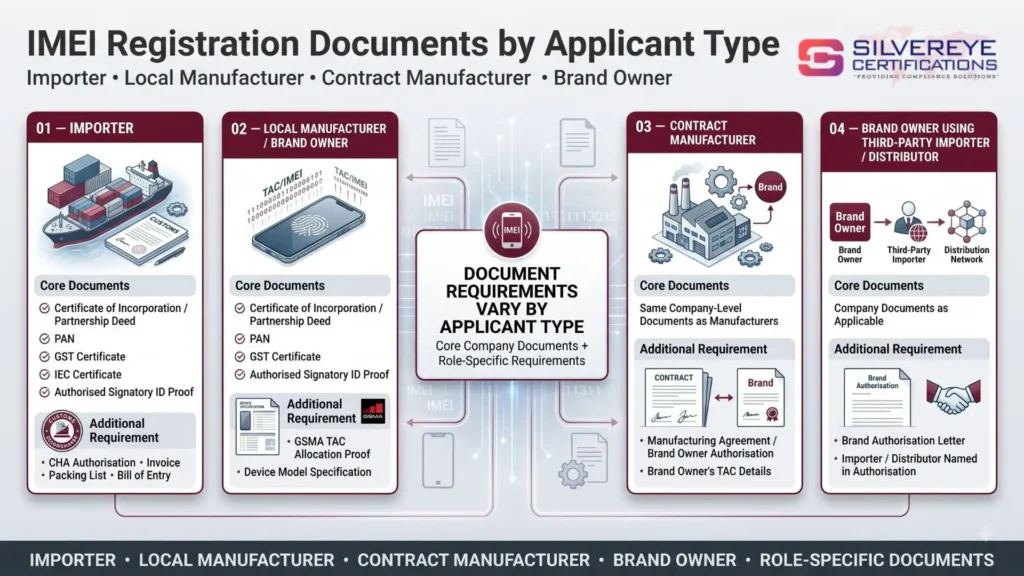
Notice that IEC is the one document that's importer-specific and non-negotiable — without it, DGFT-linked customs systems won't recognise your business as an importer, and your Device Setu application won't proceed past the company-registration stage.
Document-by-Document Breakdown: What Each One Actually Does
1. Certificate of Incorporation / Partnership Deed
This proves your business legally exists. Companies submit their Certificate of Incorporation; partnership firms submit their Partnership Deed. Sole proprietorships typically submit their GST certificate and PAN as constitution proof instead, since there's no separate incorporation document. This is the foundation document — every other registration on the portal is linked back to this legal identity.
2. Company PAN Card
Your business PAN ties your ICDR registration to your tax identity, and it's cross-checked against your GST and IEC records, since post-GST, your IEC number is effectively the same as your PAN.
3. GST Registration Certificate
Confirms you're a registered taxpayer for goods and services, which matters because customs and DoT systems increasingly cross-reference GSTIN details against shipping bills and bills of entry for imported goods.
4. Import Export Code (IEC) Certificate — Importers Only
The IEC is a 10-digit code issued by the DGFT (Directorate General of Foreign Trade) under the Foreign Trade (Development and Regulation) Act, 1992, and it's the baseline requirement for any commercial import into India. Without a valid, active IEC, customs will not process your bills of entry — which means your IMEI certificate has nothing to attach to at the port. One detail that catches importers off guard: IEC has lifetime validity, but DGFT requires every holder to complete a free annual profile update between April 1 and June 30 each year, even if nothing has changed. Miss that window, and DGFT automatically deactivates the IEC, which halts customs clearance until it's reactivated — so treat your IEC's annual update as part of your ongoing IMEI registration document hygiene, not a one-time task.
5. Authorized Signatory's ID and Address Proof
Establishes exactly who is legally allowed to operate your company's portal account and sign off on submissions — typically a director, partner, or designated compliance officer.
6. Authorization Letter or Board Resolution
A short internal document naming the specific individual who will handle the Device Setu (ICDR) account day to day, distinct from the company's authorised signatory if they're different people.
7. GSMA TAC Allocation Proof
This is arguably the most important document on the entire list, and the one most often mishandled. The Type Allocation Code (TAC) — the first eight digits of any IMEI — is assigned by GSMA to a specific brand-and-model combination. Your registration on the portal must use the exact brand name tied to that TAC in GSMA's records. Extra spaces, abbreviations, or slightly different brand spellings between your portal submission and GSMA's database are the number one reason device-model registrations get rejected.
8. Device Model Technical Specification Sheet
A basic technical profile of the device model being registered — confirms what exactly is being imported or manufactured under the TAC you're claiming.
9. Brand Authorization Letter
Required when the entity registering on the portal isn't the original brand owner — for example, an authorised Indian distributor importing on behalf of a global smartphone brand. This letter proves you have the brand's permission to register and sell their devices in India.
10. Customs House Agent (CHA) Details and Authorization — Importers Only
Your CHA is the licensed customs broker who handles clearance formalities on your behalf. The portal needs their details linked to your importer profile so the IMEI certificate connects correctly to your customs filings.
11. Invoice, Packing List, and Bill of Entry — Importers Only
These consignment-specific documents confirm the device model and quantity being imported, and they're what the IMEI certificate is ultimately matched against during customs clearance.
Who Needs to Submit These Documents
Document submission obligations follow the same eligibility rules as IMEI registration itself — there's no separate, lighter documentation track for smaller businesses or one-off shipments.
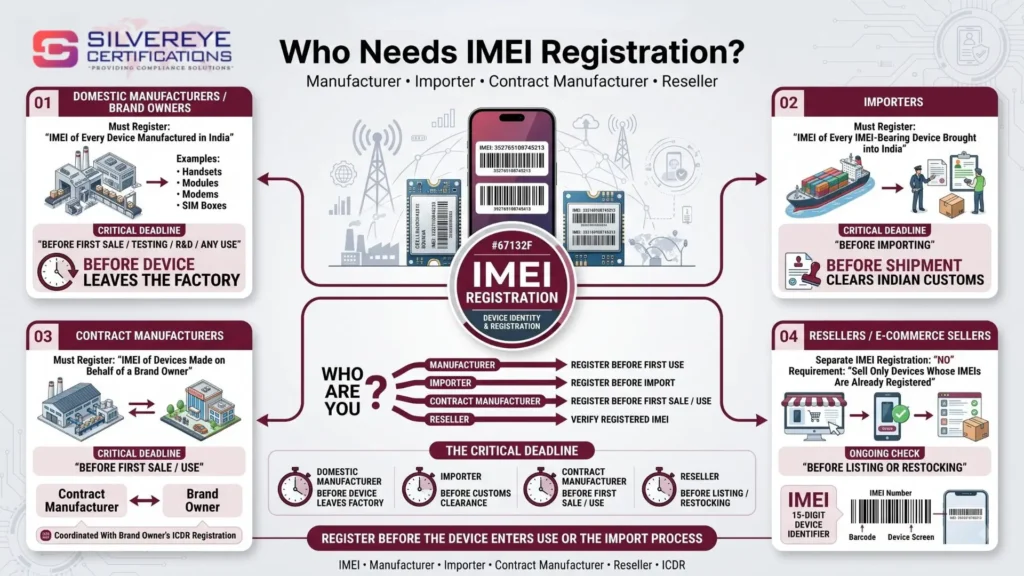
- Importers bringing in any IMEI-bearing device — phones, tablets, smartwatches, modems, modules, dongles, laptops with cellular radios, or SIM boxes — must submit the full importer document set, regardless of shipment size.
- Domestic manufacturers and brand owners must submit company and brand/model documents before a device's first sale, testing, or R&D use.
- Contract manufacturers submit company documents plus proof of their manufacturing agreement with the brand owner.
- Resellers and e-commerce sellers do not submit documents to Device Setu (ICDR) directly — that obligation sits with whoever first imported or manufactured the device.
- Businesses importing devices purely for internal testing or R&D still fall under the same document requirements as commercial imports — there's no exemption for non-sale purposes.
Benefits of Getting Your IMEI Registration Documents Right the First Time
- Faster approval: complete, correctly matched documents move through company and brand/model registration without the back-and-forth correction cycles that add weeks to the process.
- No customs delays: a ready IMEI certificate, backed by accurate CHA and consignment paperwork, means your shipment isn't held up for document verification at the port.
- Fewer rejected device-model registrations: getting your GSMA TAC and brand name documentation aligned upfront avoids the most common single point of failure in the entire process.
- Reusable compliance records: once your company and brand documents are approved, they support every future shipment or manufacturing batch — you're not rebuilding this file from scratch each time.
- Stronger position in a compliance audit: organised documentation gives you a clean paper trail if customs or DoT ever reviews your import or manufacturing history.
Where Each Document Fits in the IMEI Registration Process
Documents aren't submitted all at once — they're uploaded in stages as you move through the Device Setu (ICDR) portal.
| Portal stage | Documents uploaded here |
| Company registration | Certificate of Incorporation/Partnership Deed, PAN, GST certificate, IEC (importers), authorised signatory ID proof |
| CHA / Importer / OEM profile creation | CHA authorisation, IEC-linked importer profile details, brand/OEM authorisation if not already on file |
| Brand & device model registration | GSMA TAC allocation proof, device model specification sheet, brand authorization letter (if applicable) |
| IMEI upload & validation | No new documents — this stage uses the IMEI numbers themselves, validated against your already-approved brand/model registration |
| Certificate generation | Invoice, packing list, and Bill of Entry (importers) attached to finalise the consignment-specific IMEI certificate |
Understanding this sequence helps you avoid a common frustration: uploading consignment-specific paperwork like invoices too early, before your company and brand profiles are even approved. Get the earlier stages cleared first — the later documents only become relevant once you're generating a certificate for an actual batch of IMEIs.
Common Document Mistakes That Delay IMEI Registration
- Brand name mismatch: the name entered on the portal doesn't exactly match the brand name tied to the GSMA TAC — the single most frequent rejection reason.
- Expired or deactivated IEC: importers who miss the DGFT's April–June annual IEC update find their code deactivated, which blocks the importer profile on Device Setu until it's reactivated.
- Unsigned or unstamped self-attestation: documents submitted without the company stamp or the authorized signatory's signature are routinely sent back for resubmission.
- Missing brand authorization letter: distributors or importers registering on behalf of a global brand forget this letter, which stalls brand/model approval.
- Inconsistent company details across documents: a registered address, company name spelling, or PAN that doesn't match exactly across GST, IEC, and incorporation documents.
- Submitting consignment documents (invoice, Bill of Entry) before company and brand registration is approved, instead of after.
Costs Tied to Obtaining IMEI Registration Documents
The Device Setu (ICDR) portal itself does not charge a separate, published fee for uploading company or brand documents. Where actual cost shows up is in obtaining the underlying documents, several of which have their own government fees, entirely separate from IMEI registration.
| Document | Typical cost involved |
| Import Export Code (IEC) | One-time DGFT government fee of ₹500; the mandatory annual profile update itself is free |
| GST registration | No government fee for standard GST registration; professional filing assistance, if used, is a separate cost |
| Certificate of Incorporation / Partnership Deed | Tied to your original company formation cost, not a recurring IMEI-registration expense |
| GSMA TAC allocation | Arranged directly through GSMA if your brand doesn't already hold one, with its own separate fee structure outside the DoT process |
| Digital Signature Certificate (DSC), where required for online filings | A modest, one-time or annual cost depending on the certifying authority, valid for a fixed term |
Because government fees and portal charges are revised periodically, always confirm current figures on the official DGFT, GST, and icdr.ceir.gov.in portals before budgeting, rather than relying on a fixed number from any single article.
Validity and Renewal Timeline of IMEI Registration Documents
Unlike the IMEI certificate itself, which is generated fresh per batch, several of the underlying documents have their own validity and renewal rules that you need to track independently.
| Document | Validity | Renewal requirement |
| Certificate of Incorporation | Permanent | No renewal; update only if company structure changes |
| PAN card | Permanent | No renewal needed |
| GST registration | Ongoing, subject to compliance | No fixed renewal, but requires regular return filing to stay active |
| Import Export Code (IEC) | Lifetime | Mandatory free annual update on the DGFT portal between April 1 and June 30, or the IEC is automatically deactivated |
| GSMA TAC allocation | Tied to the brand/model it's issued for | No routine renewal, but a new TAC is needed for genuinely new device models or major hardware revisions |
| IMEI Certificate (portal output, not a submitted document) | Specific to the validated IMEI batch/consignment it covers | A fresh certificate is generated for every new shipment or manufacturing run — not a periodic renewal |
The practical habit worth building: put a recurring reminder in your compliance calendar for the IEC's April–June update window specifically, since it's the one document on this list with a hard annual deadline and an automatic deactivation penalty if missed — and a deactivated IEC quietly blocks your entire IMEI registration process until it's fixed.
Why Choose Silvereye Certifications for IMEI Registration Documents?
- Complete Document Support: Assistance in preparing and reviewing all required IMEI registration documents.
- TAC Verification Support: Ensuring your GSMA TAC and brand details are correctly matched to avoid rejection.
- Importer Documentation: Support with IEC, CHA authorisation, invoice, packing list, and Bill of Entry requirements.
- Error-Free Filing: Careful document checking helps reduce mismatches, corrections, and processing delays.
- End-to-End Assistance: Support from document preparation to successful Device Setu (ICDR) registration.
Conclusion
Having the right IMEI registration documents is essential for a smooth and timely registration process. Accurate company details, valid IEC, correct GSMA TAC information, and complete importer documents can help prevent unnecessary delays.
Silvereye Certifications helps businesses prepare, verify, and organise their documentation so they can complete the IMEI registration process with greater confidence and fewer compliance issues.
Frequently Asked Questions
What documents are required for IMEI registration in India?
Core documents fall into three groups: company documents (Certificate of Incorporation/Partnership Deed, PAN, GST certificate, authorized signatory proof), brand/device documents (GSMA TAC allocation proof, device model specification, brand authorization letter), and importer-specific documents (IEC certificate, CHA authorization, invoice, packing list, Bill of Entry).
Is an Import Export Code (IEC) mandatory for IMEI registration documents?
Yes, for importers. Without a valid, active IEC, customs cannot process your bills of entry, which means your Device Setu (ICDR) importer profile and IMEI certificate have nothing to attach to. Manufacturers who don't import don't need an IEC for their domestic registration.
Do I need GST registration to submit IMEI registration documents?
Yes, a GST registration certificate is part of the standard company document set for both importers and manufacturers, since GSTIN details are increasingly cross-checked against shipping and customs records.
What is GSMA TAC allocation proof, and why does it matter so much?
The TAC (Type Allocation Code) is the first eight digits of any IMEI, assigned by GSMA to a specific brand-and-model combination. Your portal registration must use the brand name exactly as it appears in GSMA's TAC records — mismatches here are the leading cause of rejected device-model registrations.
Do documents need to be notarized for IMEI registration?
No. Documents are submitted self-attested, along with the company stamp — not notarized. This keeps the documentation stage relatively quick once you have the right paperwork gathered.
What documents does a distributor need if they're not the original brand owner?
A brand authorization letter from the original brand owner, in addition to the standard company documents, proving the distributor or importer has permission to register and sell that brand's devices in India.
Does my IEC expire, and does that affect my IMEI registration documents?
Your IEC has lifetime validity, but DGFT requires a free annual profile update between April 1 and June 30 every year. Missing this window automatically deactivates the IEC, which in turn blocks your importer profile on Device Setu (ICDR) until it's reactivated.
What happens if my documents don't match across different registrations?
Inconsistencies — like a company name spelled differently on your GST certificate versus your PAN, or a brand name that doesn't match your GSMA TAC records — are a leading cause of applications being sent back for correction rather than approved outright.
Are the same documents required for every new device model?
Company-level documents are submitted once and reused, but brand/device documents — GSMA TAC proof and the technical specification sheet — are typically needed again for each genuinely new device model or major hardware variant.
Is there a fee for submitting IMEI registration documents on Device Setu (ICDR)?
The portal itself doesn't charge a separate published fee for document upload. Costs instead come from obtaining the underlying documents — for example, the one-time ₹500 DGFT fee for an IEC — which are separate from the IMEI registration process itself.
What documents does an importer need per shipment, versus once overall?
Company, brand, and TAC documents are largely one-time submissions reused across shipments. Invoice, packing list, and Bill of Entry are consignment-specific and needed fresh for every new shipment when generating that batch's IMEI certificate.
Can I fix a rejected document without restarting the entire IMEI registration process?
Yes. The portal typically flags the specific document or field that caused a rejection, and you can correct and resubmit just that item rather than restarting your entire company or brand registration from scratch.