

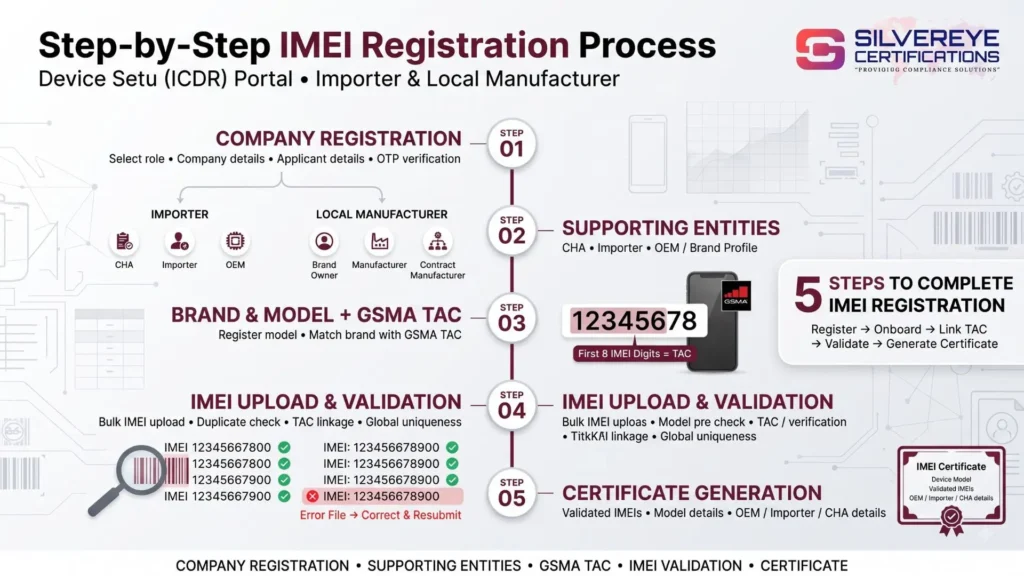
- The IMEI registration process has 5 core stages: company setup, CHA/Importer/OEM creation, brand & TAC-linked model registration, IMEI upload & validation, and certificate generation.
- Manufacturers must finish the process before first sale; importers must finish it before customs clearance — the deadline is what most applicants get wrong.
- A first-time application typically takes 2–4 weeks end-to-end; repeat IMEI uploads for an already-registered brand/model move much faster.
- The process is mandatory under the Telecom Cyber Security Rules, 2024, and the 2025 amendment added stricter enforcement around duplicate and already-active IMEIs.
Introduction
The IMEI registration process in India runs entirely through the Device Setu (ICDR) portal. It has five stages: company registration (as an Importer or Local Manufacturer), setting up CHA/Importer/OEM profiles, registering your brand and device model against its GSMA TAC code, uploading and validating your IMEI numbers, and generating the final IMEI certificate.
Manufacturers must complete this before a device's first sale; importers must complete it before the shipment clears Indian customs. The process is mandatory under the Telecom Cyber Security Rules, 2024, and skipping it can block customs clearance and network access.
What is the IMEI Registration Process?
Strip away the legal language and the IMEI registration process is really just a government identity check for hardware. Before a mobile handset, tablet, smartwatch, or any other cellular device is sold in India or brought across the border, the business behind it has to prove three things: who made it, who is bringing it in, and that its 15-digit IMEI number is genuine — not duplicated, cloned, or already active on another device.
That proof happens on one portal: Device Setu, also referred to as the ICDR (Indian Counterfeited Device Restriction) portal, run by the Department of Telecommunications (DoT). Whether you're a global brand's Indian importer or a domestic contract manufacturer, the IMEI registration process is the same underlying workflow, with small branches depending on your role.
The legal basis for the process sits in the Telecommunications Act, 2023, the Telecom Cyber Security Rules, 2024, and the Telecom Cyber Security Amendment Rules, 2025 — the 2025 amendment specifically empowers the government to direct manufacturers not to assign IMEIs that are already active on Indian telecom networks, which is why the validation stage of the process has become stricter over the past year.
Who Needs to Follow the IMEI Registration Process?
Eligibility here isn't about qualifying for a benefit — it's about who is legally required to go through the process before their devices reach the Indian market.
| Category | Must follow the process? | Notes |
| Importers of IMEI-bearing devices | Yes, mandatory | Applies to any handset, module, modem, tablet, smartwatch, or dongle with an IMEI, regardless of order size |
| Domestic manufacturers / brand owners | Yes, mandatory | Required before first sale, testing, or R&D use of a device made in India |
| Contract manufacturers | Yes, mandatory | Registers alongside or on behalf of the brand owner, depending on the commercial arrangement |
| Resellers and e-commerce sellers | No separate registration | Must only sell devices whose IMEIs were already registered upstream by the manufacturer/importer |
| Individual consumers importing 1 device for personal use | Generally outside the scope of business registration | Personal imports typically fall under separate customs baggage/personal-import rules rather than the commercial ICDR process — confirm current customs guidance for your specific situation |
| Businesses importing for R&D, testing, or trial units | Yes, mandatory | The rules explicitly cover devices imported for testing and R&D, not just commercial sale |
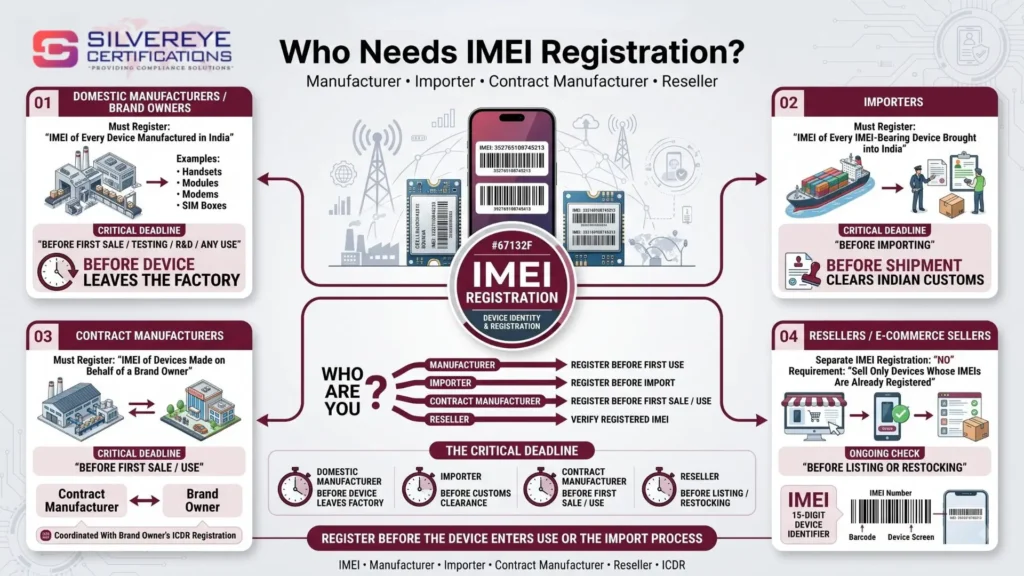
A distinction worth remembering: eligibility to use the portal (who can register) and obligation to register (who must) are the same group here — there's no optional or voluntary registration tier for businesses. If your device carries an IMEI and is entering the Indian market through a commercial channel, the process applies to you.
Benefits of Completing the IMEI Registration Process Properly
It's easy to see this purely as a compliance cost. In practice, a clean IMEI registration process pays for itself in a few concrete ways.
- Faster customs clearance: a ready IMEI certificate means your consignment isn't stopped for verification at the port, avoiding demurrage and storage charges.
- Network access from day one: registered, validated IMEIs are recognised by Indian telecom operators' Equipment Identity Registers, so devices work on Indian networks without connectivity issues.
- Legal protection for your business: completing the process shields your company from the penalties tied to unregistered or tampered IMEIs under the Telecommunications Act, 2023.
- Brand and consumer trust: when customers check a device's IMEI through CEIR/KYM and see accurate manufacturer, brand, and model details, it reinforces that they've bought a genuine, traceable product.
- Cleaner audit trail: the IMEI certificate generated at the end of the process becomes a compliance record you can produce during customs audits or regulatory reviews.
- Reduced counterfeit risk to your own brand: registering your TAC-linked models makes it easier to distinguish your genuine stock from grey-market or counterfeit devices carrying your brand name.
Documents Required Before You Start the IMEI Registration Process
Having these ready before you log into the portal is the single biggest thing you can do to speed up the process. Applications stall most often because a document is missing or doesn't match company records exactly.
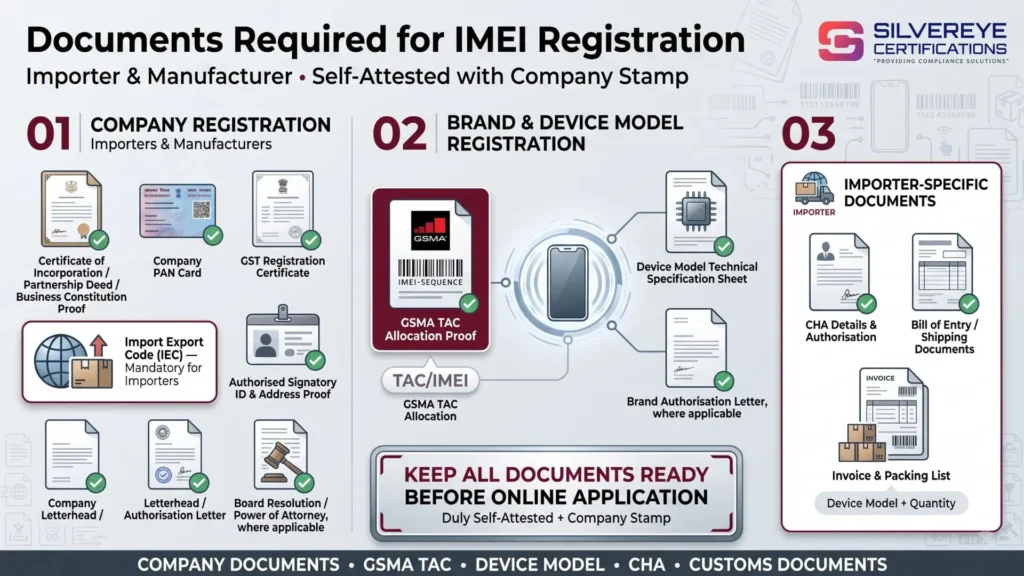
Company-level documents (importers and manufacturers)
- Certificate of Incorporation, or Partnership Deed for partnership firms
- Company PAN card
- GST registration certificate
- Import Export Code (IEC) certificate — mandatory for importers
- Authorised signatory's identity and address proof
- Authorisation letter or board resolution naming the applicant who will operate the portal account
Brand and device-model documents
- Proof of GSMA TAC allocation matching the exact brand name being registered
- Device model technical specification sheet
- Brand authorisation letter, where the importer is not the original brand owner
Importer-specific documents
- Customs House Agent (CHA) details and authorisation
- Invoice and packing list for the consignment, listing device model and quantities
- Bill of Entry or shipping documents, used at the certificate-generation stage
All of these are submitted self-attested, with the company stamp. One practical note from how the process actually plays back in the field: mismatches between your registered brand name and the brand name attached to your GSMA TAC are the most common reason a device-model registration gets bounced back — double-check spelling, spacing, and capitalization before submitting.
Step by Step IMEI Registration Process
This is the sequence exactly as it runs on the Device Setu (ICDR) portal. Follow it in order — each stage unlocks the next.
Step 1: Sign Up and Register Your Company
Visit icdr.ceir.gov.in and choose “Signup for Registration.” Select your company's role — Importer or Local Manufacturer — and for manufacturers, the applicable sub-type: Brand Owner, Manufacturer, or Contract Manufacturer. Fill in company details, applicant details, and set up your login. This step is verified through OTP, and you'll upload your company-level documents here.
Step 2: Create Your CHA, Importer, and OEM Profiles
Once your company account is approved, add the supporting entities the process needs. Importers add their Customs House Agent (CHA) and Importer profile (linked to their IEC). If the brand/OEM isn't already present on the portal, you create that profile too. Manufacturers go through the equivalent step to set up their own OEM/brand profile.
Step 3: Register Your Brand and Device Model Against Its GSMA TAC
This is the step that decides whether the rest of the process goes smoothly. The first eight digits of any IMEI form the Type Allocation Code (TAC), which GSMA assigns to a specific brand-and-model combination. On the portal, you register your device model and select the brand name from a drop-down — and it must exactly match the brand tied to that TAC in GSMA's records. Confirm your TAC allocation with GSMA or your OEM before this step to avoid a rejected model registration.
Step 4: Upload IMEI Numbers for Validation
With the device model approved, upload your IMEI numbers, typically in bulk via a formatted spreadsheet. The portal runs each number through the GSMA/ICDR validation checks: duplicate detection, cloned or fake IMEI screening, correct TAC linkage, and global uniqueness. Since the 2025 amendment, the system also checks whether an IMEI is already active on an Indian network before allowing it to be assigned to a new device. Any IMEI that fails is listed in a downloadable error file so you can correct and resubmit.
Step 5: Generate Your IMEI Certificate
Once validation clears, generate the IMEI Certificate from the portal. It lists the device model, the validated IMEIs, and the OEM/importer/CHA details. For importers, this certificate is what customs officials check the consignment against at the port. For manufacturers, it becomes your compliance record ahead of first sale.
What happens after the certificate is generated?
For importers, the certificate travels with your shipping/customs documentation and is verified at the port. For manufacturers, keep the certificate on file as your compliance record, and repeat Steps 4–5 for every new batch of IMEIs, even for a device model you've already registered — the model registration is a one-time step per model, but IMEI validation happens for each new batch or shipment.
Fees Involved in the IMEI Registration Process
The DoT has not published a fixed, universal filing fee for company or device-model registration on Device Setu (ICDR), unlike BIS CRS or WPC ETA, which have their own published fee schedules. For most importers and manufacturers, the direct cost of the ICDR registration steps themselves is minimal to none — where real cost enters the process is around it, not inside it.
| Cost item | When it applies |
| GSMA TAC allocation / membership | If your brand doesn't already hold a TAC allocation, this is arranged through GSMA and carries its own fee structure, separate from the DoT process |
| Compliance consultant / filing assistance | Optional, but common for first-time applicants who want help with documentation and TAC verification |
| WPC ETA and BIS CRS certification fees | Run in parallel with IMEI registration for most mobile devices — these have their own published, separate fee schedules |
| Portal registration itself | No standard universal fee published by DoT for ICDR company/model/IMEI registration as of this writing |
Because government fee structures and processing charges can be revised, always confirm current charges directly on icdr.ceir.gov.in or with the DoT before finalising your compliance budget — don't rely on a fixed number quoted in any single article, including this one.
Validity and Renewal Timeline of IMEI Registration
This is one of the most-searched questions about the process, and it doesn't have a single neat answer — because IMEI registration isn't structured like a licence with a fixed annual expiry.
How validity actually works
- Company and brand/OEM registration on Device Setu (ICDR) is a one-time setup per entity — it doesn't expire on a fixed calendar the way an annual licence does, but it should be kept accurate and updated if your company or brand details change.
- Device model registration (linked to your GSMA TAC) is also effectively a one-time step per model — you don't re-register the same model for every shipment.
- The IMEI Certificate itself is generated per batch of validated IMEIs — each new consignment or new manufacturing run of IMEIs needs its own certificate, because it's tied to a specific set of device serial numbers, not a rolling licence.
So is there a “renewal”?
Not in the sense of paying a fee every year to keep your registration alive. What actually needs repeating is the IMEI-upload-and-certificate cycle: every new shipment (for importers) or every new manufacturing batch (for manufacturers) needs its own IMEI validation and certificate. And every new device model, and in many cases every new colour or storage variant, needs its own model registration against the correct TAC before its IMEIs can be uploaded.
Common Mistakes That Slow Down the IMEI Registration Process
Most delays in this process trace back to a handful of avoidable errors.
- Brand name mismatch: registering a brand name on the portal that doesn't exactly match the name tied to your GSMA TAC allocation.
- Starting too late: importers who begin registration after the shipment has already left the origin port, instead of before it clears Indian customs.
- Incomplete company documents: missing GST, IEC, or authorised-signatory proof, which stalls company-level approval before you even reach the model or IMEI stage.
- Duplicate or already-active IMEIs: uploading IMEI batches without pre-checking for duplicates internally, leading to validation failures that need correction and resubmission.
- Treating registration as one-time for every variant: assuming a registered device model covers a new storage or colour variant automatically, when it typically needs its own registration.
- Skipping WPC ETA and BIS CRS: assuming IMEI registration alone makes a device market-ready, when radio-frequency and safety certifications are separate, parallel requirements.
What's New in the IMEI Registration Process for 2026
A few shifts are worth knowing if you last went through this process before 2025.
- Stricter enforcement: the DoT issued formal public cautions to manufacturers, importers, and resellers in late 2025 about mandatory IMEI registration, signalling active monitoring rather than a passive, rarely-checked rule.
- Duplicate-IMEI blocking: Under the Telecom Cyber Security Amendment Rules, 2025, the government can direct manufacturers not to assign IMEIs that are already active on Indian telecom networks — validation now checks against live network usage, not just the GSMA database.
- Broader device coverage confirmed: Official guidance has reiterated that the process covers far more than phones — cellular-enabled smartwatches, mobile hotspots, tablets, modems, modules, dongles, laptops with embedded cellular radios, and SIM boxes are all explicitly in scope.
- WPC ETA self-declaration for finished devices: While a separate certification from IMEI registration, the WPC leg of the compliance journey now allows self-declaration for finished commercial products like smartphones and tablets in licence-exempt bands, simplifying (but not replacing) the overall market-entry checklist.
- Sharper tampering penalties: the Telecommunications Act, 2023 treats IMEI tampering as a cognisable, non-bailable offence, with penalties of up to three years' imprisonment, a fine of up to ₹50 lakh, or both — a deterrent the DoT has been actively publicising alongside the registration requirement.
How to Track Your IMEI Registration Status After Applying
Once your certificate is generated, you can confirm your devices are showing up correctly in the wider IMEI ecosystem using the consumer-facing CEIR tools.
| Method | How to use it |
| CEIR web portal | Visit ceir.sancharsaathi.gov.in and use the IMEI Verification tool with the device's 15-digit IMEI (find it by dialling *#06#) |
| KYM mobile app | Download “KYM” from the Play Store or App Store and enter the IMEI to see manufacturer, brand, device type, and model |
| SMS to 14422 | Send “KYM <15-digit IMEI>” to 14422 from any mobile number for an instant, no-internet check |
A registered, validated IMEI returns clear manufacturer and model details through any of these three channels. If a spot-check comes back invalid or unrecognized after you've completed the registration process, treat it as a signal to revisit your certificate and portal records before the device goes further into distribution.
Why Choose Silvereye Certifications for IMEI Registration?
Choosing an experienced compliance partner can make the IMEI registration process easier and help reduce avoidable delays. Silvereye Certifications provides end-to-end support for manufacturers, importers, and brand owners seeking IMEI registration in India.
- Complete Process Support: Assistance from company registration to IMEI certificate generation.
- Documentation Assistance: Support in preparing and reviewing company, IEC, GST, TAC, technical, and authorization documents.
- GSMA TAC Support: Help ensure the registered brand and device model correctly match the applicable GSMA TAC.
- IMEI Validation Support: Assistance with IMEI formatting, bulk uploading, validation, and correction of errors.
- Importer & Manufacturer Support: Guidance tailored to the specific requirements of importers, manufacturers, and contract manufacturers.
- Reduced Delays: Proper document and application checks help minimise common errors and unnecessary re-submissions.
- Related Compliance Guidance: Support in understanding IMEI registration alongside other applicable requirements such as WPC ETA and BIS CRS.
Conclusion
The IMEI registration process is an important requirement for businesses bringing IMEI-bearing devices into the Indian market. From company registration and GSMA TAC verification to IMEI validation and certificate generation, each stage needs to be completed correctly.
Silvereye Certifications helps businesses manage this process with professional documentation support, technical coordination, and step-by-step assistance. Our goal is to make IMEI registration simpler, faster, and more efficient, helping you avoid common compliance issues and move confidently toward your product launch or shipment.
Frequently Asked Questions
What is the IMEI registration process in India?
It's the mandatory sequence of steps — company registration, CHA/Importer/OEM setup, brand and model registration linked to a GSMA TAC, IMEI upload and validation, and certificate generation — that manufacturers and importers complete on the Device Setu (ICDR) portal before a device is sold or imported.
Who is eligible to go through the IMEI registration process?
Importers of IMEI-bearing devices, domestic manufacturers, brand owners, and contract manufacturers are all required to complete the process. Resellers and e-commerce sellers don't register separately but must only sell devices whose IMEIs are already registered upstream.
How long does the IMEI registration process take?
A first-time applicant typically needs 2–4 weeks end-to-end, mostly driven by document verification and GSMA TAC confirmation. Once your company and brand/model are already registered, uploading a new IMEI batch and generating a certificate is usually much faster — often same-day to a few days.
What documents do I need to start the IMEI registration process?
At minimum: Certificate of Incorporation or Partnership Deed, company PAN, GST certificate, Import Export Code (for importers), authorised signatory proof, GSMA TAC allocation proof, and CHA details for importers. All are submitted self-attested with the company stamp.
Is there a government fee for the IMEI registration process?
DoT has not published a fixed universal filing fee for ICDR company or device-model registration, unlike BIS CRS or WPC ETA. Cost typically comes from GSMA TAC allocation, optional compliance consultants, and the separate WPC ETA/BIS CRS certifications. Confirm current charges on the official portal before budgeting.
Does the IMEI registration certificate expire or need renewal?
Not in the sense of an annual renewal fee. Company and device-model registration stay open indefinitely once approved, but the IMEI Certificate itself is generated fresh for each new batch of IMEIs or shipment — so “renewal” in practice means repeating the upload-and-certificate step for every new consignment or manufacturing run.
What is the deadline for completing IMEI registration?
Manufacturers must complete it before the device's first sale, testing, or R&D use. Importers must complete it before the shipment is imported into India — ideally before it even leaves the origin port, so the certificate is ready when the consignment reaches Indian customs.
What happens if my IMEI fails validation during the process?
The portal generates a downloadable error file identifying which IMEIs failed — common reasons include duplicates, invalid TAC linkage, or an IMEI already active on an Indian network. You correct the flagged entries and resubmit that batch for validation.
Do I need to repeat the process for every device variant?
Yes, in most cases. A new storage capacity, colour variant, or hardware revision of an existing model typically needs its own device-model registration against the correct GSMA TAC before its IMEIs can be validated and uploaded.
How is the IMEI registration process different from WPC ETA or BIS CRS?
IMEI registration verifies device identity — that the IMEI is genuine, unique, and traceable. WPC ETA checks radio-frequency compliance. BIS CRS checks safety and quality standards. They're separate, parallel processes, and a mobile device generally needs to clear all three before it's fully market-ready in India.
Can I check whether my IMEI registration process was successful?
Yes — after your certificate is generated, spot-check individual IMEIs through the CEIR web portal, the KYM app, or by sending “KYM <IMEI>” to 14422. A successful, registered IMEI returns manufacturer, brand, and model details.
What happens if I skip the IMEI registration process entirely?
Importers risk shipments being held at customs, since officials verify consignments against the IMEI certificate. Devices with unregistered or invalid IMEIs can also be blocked from working on Indian telecom networks, and knowingly using tampered or unauthorised IMEIs carries penalties under the Telecommunications Act, 2023, including fines up to ₹50 lakh and imprisonment up to three years.