

- Mandatory under the Telecom Cyber Security Rules, 2024 — manufacturers register before first sale, importers register before import/customs clearance.
- Done entirely on the Device Setu (ICDR) portal not the same as the consumer-facing CEIR / Sanchar Saathi portal people use to check a phone's IMEI.
- Non-compliance risks customs holds at the port, IMEI blocking on Indian telecom networks, and penalties under the Telecommunications Act, 2023.
- Works alongside — not instead of — WPC Equipment Type Approval (ETA) and BIS CRS certification, which cover radio-frequency and safety compliance separately.
Introduction
IMEI registration in India is the mandatory process, under the Telecom Cyber Security Rules, 2024, of registering the IMEI numbers of every mobile handset, tablet, smartwatch, or other cellular device on the government's Device Setu (ICDR) portal before it is sold, tested, or imported. Manufacturers must register before the device's first sale; importers must register before customs clearance.
The process runs through company registration, GSMA TAC-linked brand and model approval, IMEI upload and validation, and certificate generation. Devices without a valid, registered IMEI can be blocked from Indian telecom networks and held at customs under the Telecommunications Act, 2023.
What Is IMEI Registration?
Forget the legal phrasing for a second. Every phone, tablet, or smartwatch that connects to a mobile network has a 15-digit serial number burned into it called an IMEI — International Mobile Equipment Identity. Think of it as the device's fingerprint. It has nothing to do with your SIM card or phone number; even if you swap SIMs, the IMEI stays the same because it identifies the physical hardware, not the subscriber.
IMEI registration in India is simply the government's way of saying: “Before this fingerprint enters our telecom network, we want to know who made the device, who is bringing it into the country, and that the number itself is genuine, not duplicated, cloned, or already blacklisted.” It's a pre-clearance check, similar in spirit to how a passport is verified before someone enters a country — except here the “traveller” is a mobile device, and the checkpoint is the Department of Telecommunications (DoT).
Legally, this obligation flows from the Telecommunications Act, 2023 and the Telecom Cyber Security Rules, 2024, which were tightened further by the Telecom Cyber Security Amendment Rules, 2025. Under these rules, manufacturers must register the IMEI of every device made in India before its first sale, testing, or R&D use, and importers must register IMEIs before bringing IMEI-bearing equipment into the country — for sale, testing, R&D, or any other purpose.
The rules apply well beyond “just phones.” The list of covered devices includes smartphones, cellular-enabled smartwatches, mobile Wi-Fi hotspots, tablets, USB modems, modules, dongles, laptops with embedded cellular radios, and even assembled equipment like SIM boxes. If it carries an IMEI and can talk to a mobile network, it is in scope.
Why does the government care this much? Three reasons come up again and again in official communications: stopping counterfeit and cloned devices from entering Indian networks, helping law enforcement trace stolen or misused handsets, and closing tax and customs loopholes that grey-market imports have historically exploited. IMEI registration is the compliance layer that makes all three possible at scale.
Device Setu / ICDR Portal Explained — What It Replaced, and Why the Name Keeps Confusing People
If you've searched for this topic before, you've probably seen three names thrown around almost interchangeably: Device Setu, ICDR, and CEIR. They are not the same thing, and mixing them up is the single most common mistake importers make.
ICDR is the system. Device Setu is its public name.
ICDR stands for Indian Counterfeited Device Restriction. It is the online platform — hosted at icdr.ceir.gov.in — built for device makers and importers to generate the IMEI certificates that customs authorities check at the port. “Device Setu” is simply the citizen- and industry-facing brand name the DoT now uses for this same ICDR system, positioned as part of the broader Sanchar Saathi family of telecom portals (the same government ecosystem that also runs the CEIR lost-phone and IMEI-check services). In practice, when official notices say “register on Device Setu (ICDR),” they mean one single portal, referenced by two names.
What changed in 2024–2025
The ICDR portal itself has existed for import-certificate generation for some time, used mainly by importers who needed an IMEI certificate for customs clearance at Indian ports. What changed with the Telecom Cyber Security Rules, 2024 — and was reinforced by the 2025 amendment — is scope and enforcement.
Registration is no longer a courtesy step some importers used for smoother customs clearance; it is now a binding legal requirement for both importers and domestic manufacturers, backed by penalties under the Telecommunications Act, 2023, and the government began actively cautioning the industry about it through formal press notices in late 2025.
Why the confusion persists
- Both Device Setu (ICDR) and CEIR live under the same broader Sanchar Saathi umbrella, so people assume they're one portal.
- Both deal with IMEI numbers, but for opposite purposes — one registers new devices before they enter the market, the other tracks devices already in the market (including lost/stolen ones).
- News coverage in 2025 referred to the requirement mostly as “ICDR portal registration,” while the DoT's own official press release used “Device Setu (ICDR)” side by side, which is where most of the naming confusion online originates.
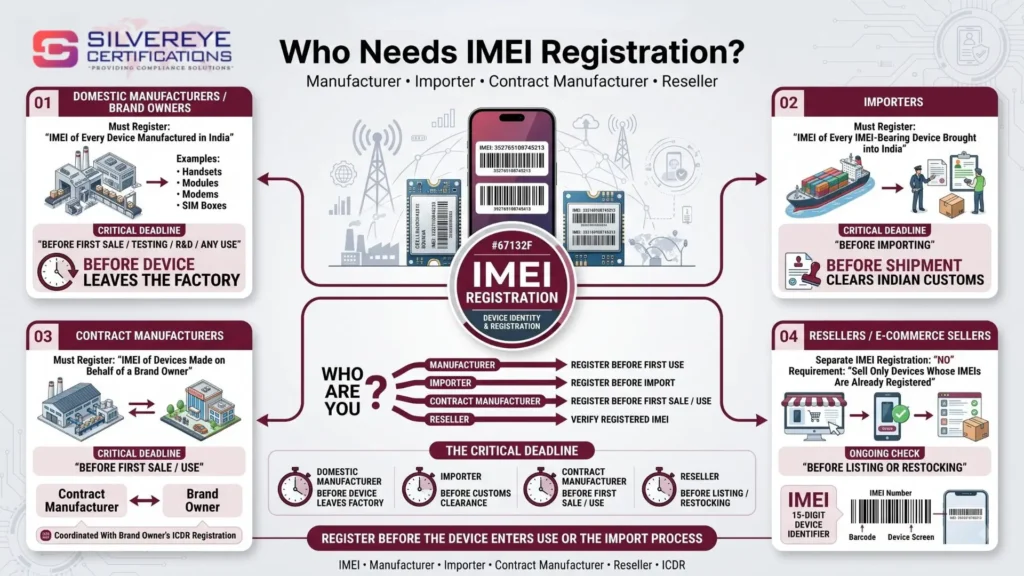
Who Needs IMEI Registration: Importers vs Manufacturers
The obligation is written slightly differently for the two groups, and the timing difference is the part most businesses get wrong.
| Entity | What they must register | When (the critical deadline) |
| Domestic manufacturers / brand owners | IMEI of every device manufactured in India (handsets, modules, modems, SIM boxes, etc.) | Before first sale, testing, R&D use, or any other purpose — i.e., before the device leaves the factory for any use. |
| Importers | IMEI of every IMEI-bearing device brought into India | Before importing the equipment — i.e., before the shipment clears Indian customs, not after. |
| Contract manufacturers | IMEI of devices made on behalf of a brand owner | Same as manufacturers — before first sale/use, coordinated with the brand owner's ICDR registration. |
| Resellers / e-commerce sellers | No separate IMEI registration — but must sell only devices whose IMEIs are already registered by the manufacturer/importer | Ongoing — verify before listing or restocking a device model. |
Step-by-Step IMEI Registration Process on the Device Setu (ICDR) Portal
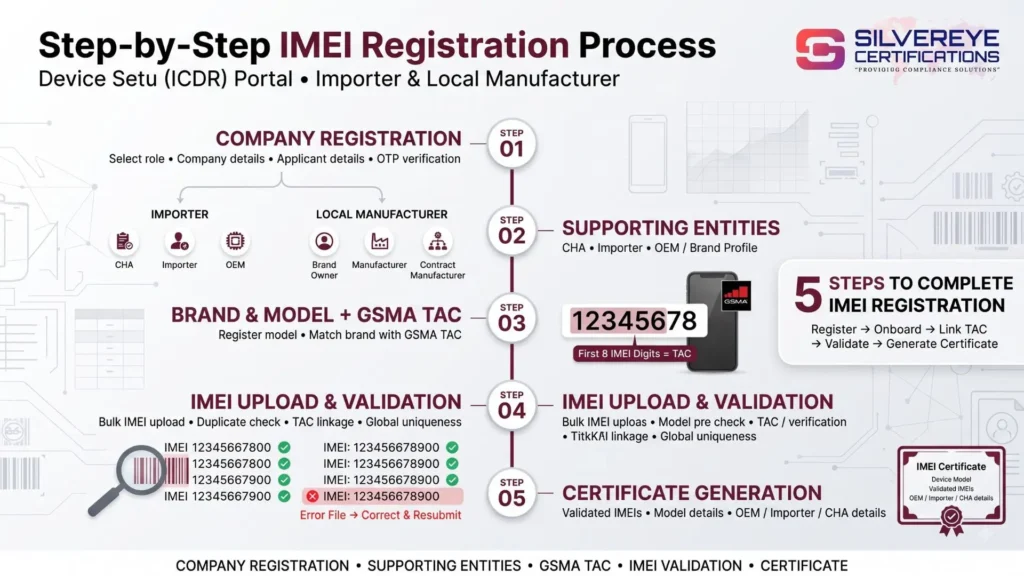
The process is broadly the same whether you're an importer or a local manufacturer, with a couple of role-specific branches. Here's the sequence as it runs on today.
Step 1: Company Registration
Go to icdr portal and choose “Signup for Registration.” You'll select your company's role — Importer or Local Manufacturer — and, for manufacturers, a sub-type (Brand Owner, Manufacturer, or Contract Manufacturer). You'll fill in company details, applicant details, and login credentials, then submit self-attested company documents (covered in Section 5). This step is verified by OTP.
Step 2: Create Supporting Entities — CHA, Importer, OEM
If you're importing, you'll need to add your Customs House Agent (CHA) details on the portal if not already present, along with your Importer profile (IEC-linked) and your OEM (original equipment manufacturer) details if the brand isn't already registered. Manufacturers registering domestically go through an equivalent onboarding for their own OEM/brand profile.
Step 3: Brand and Model Registration Linked to GSMA TAC
This is the step people underestimate. The first eight digits of any IMEI form the Type Allocation Code (TAC) — a unique identifier that GSMA (the global mobile industry body) issues to a specific brand and model combination. On the ICDR portal, you must register your device model, and the brand name you select must match the brand associated with that TAC in GSMA's records. If your TAC-to-brand mapping doesn't line up, the device model registration will be rejected, so it pays to confirm your TAC allocation with GSMA (or your OEM/brand owner) before you start this step.
Step 4: IMEI Upload and Validation
Once the device model is approved, you upload the actual IMEI numbers (usually in bulk, via a formatted spreadsheet) for that model. The system runs these through the GSMA/ICDR validation checks described in Section 6 — duplicate detection, cloned/fake IMEI screening, TAC linkage, and global uniqueness. Any IMEI that fails validation is flagged in a downloadable error file so you can correct and resubmit.
Step 5: Certificate Generation
After validation clears, you generate the IMEI Certificate through the portal. This certificate lists the device model, the validated IMEIs, and the OEM/importer/CHA details, and it is the document customs officials check against your consignment at the port — or that forms your compliance record if you're a domestic manufacturer.
Documents Required for IMEI Registration
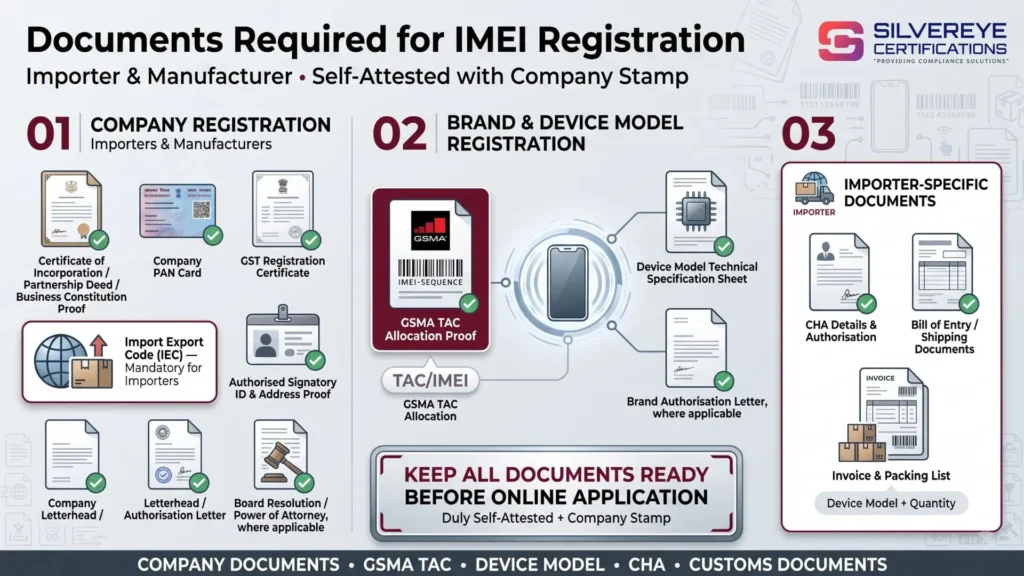
Documents are submitted duly self-attested, along with the company stamp. The exact list varies slightly by role, but here's what you should have ready before you start the online application.
For company registration (importers and manufacturers)
- Certificate of Incorporation (companies) or Partnership Deed (for partnership firms) / equivalent proof of business constitution
- PAN card of the company
- GST registration certificate
- Import Export Code (IEC) certificate — mandatory for importers
- Authorized signatory's ID and address proof
- Company letterhead / authorization letter for the applicant submitting the form
- Board resolution or power of attorney authorizing the applicant, where applicable
For brand and device model registration
- Proof of GSMA TAC allocation for the brand/model (TAC allocation letter or GSMA IMEI database reference)
- Device model technical specification sheet
- Brand authorization letter, if the importer is not the brand owner (e.g., an authorized distributor importing on behalf of a global brand)
For importers specifically
- Customs House Agent (CHA) details and authorization
- Bill of Entry / shipping documents for the consignment (used at the certificate-generation stage)
- Invoice and packing list showing device model and quantities
Cost and Realistic Timeline for IMEI Registration
The DoT has not published a fixed, universal fee schedule for IMEI/Device Setu registration itself in the way BIS or WPC publish theirs — for most manufacturers and importers, company and device-model registration on the ICDR portal does not carry a government filing fee comparable to BIS CRS or WPC ETA charges. Where cost genuinely enters the picture is the surrounding compliance stack: GSMA TAC allocation/membership costs (if you don't already hold one), consultant or compliance-partner fees if you use one to manage the paperwork, and the WPC ETA and BIS CRS certifications that typically run in parallel (covered in Section 10).
Because published fee figures move and vary by company category, treat any specific rupee amount you see quoted online with caution and confirm current charges directly on icdr.ceir.gov.in or with the DoT before budgeting — this is one detail worth verifying at the time you apply rather than relying on a fixed number.
Realistic timeline
| Stage | Typical time needed |
| Company registration + document verification | A few working days to 1–2 weeks, depending on document completeness and OTP/KYC checks |
| Brand & device model registration (TAC linkage) | Several days to a few weeks — longer if your TAC-to-brand mapping needs to be corrected or re-verified with GSMA |
| IMEI upload and validation | Same day to a few days for a clean IMEI batch; longer if duplicate/invalid IMEIs are flagged and need correction |
| Certificate generation | Near-instant once validation is complete |
| End-to-end, first-time applicant | Commonly 2–4 weeks in total — plan for the longer end if this is your first registration and your TAC/company documentation isn't already in order |
How CEIR and Device Setu / ICDR Relate (The Part Most Guides Get Wrong)
This is where a lot of otherwise good articles blur two very different systems together. Here's the clean distinction.
| Device Setu (ICDR) | CEIR | |
| Full form | Indian Counterfeited Device Restriction | Central Equipment Identity Register |
| Who uses it | Manufacturers and importers (businesses) | General public, plus police/telecom operators for lost or stolen phones |
| Purpose | Register and validate IMEIs of new devices before they enter the market (pre-market compliance) | Track devices already in the market; block lost, stolen, duplicate, or blacklisted IMEIs on the network |
| When it's used | Before first sale (manufacturers) or before import/customs clearance (importers) | After a device is already in a consumer's hands — to check, block, or unblock an IMEI |
| Access point | icdr.ceir.gov.in — business/portal login required | ceir.sancharsaathi.gov.in or ceir.gov.in — open to any citizen, plus SMS/app options |
| Typical user question | “How do I register my imported device model's IMEIs?” | “Is this second-hand phone genuine, blacklisted, or already registered?” |
Here's the part that actually connects them: once your IMEIs are validated and registered through Device Setu (ICDR), they effectively become part of the recognised national IMEI ecosystem that CEIR checks against. That's why a consumer using KYM on CEIR can pull up manufacturer, brand, and model details for a legitimately registered device — that data traces back to the ICDR registration your business completed. If a device's IMEI was never registered on Device Setu in the first place, a CEIR lookup is far more likely to come back as invalid, unrecognised, or flagged.
So the relationship in one line: Device Setu (ICDR) is the front door devices walk through to get validated; CEIR is the ongoing registry and consumer-protection layer that relies on that validated data afterward. Businesses live in ICDR. Consumers live in CEIR. They talk to the same underlying IMEI database, but you almost never need to use both for the same task.
How to Check IMEI Registration Status
Once your devices are registered and in the market, here's how anyone — your compliance team, a distributor, or an end customer — can verify an IMEI's status.
| Method | How to use it | Best for |
| CEIR web portal | Visit ceir.sancharsaathi.gov.in, use the IMEI Verification tool, enter the 15-digit IMEI (find it by dialling *#06# on the handset) | Detailed lookups; also used to block/unblock lost or stolen devices |
| KYM mobile app | Download “KYM” from the Play Store or App Store, enter the IMEI to see manufacturer, device type, brand, and model | Quick checks on the go, especially for resellers verifying stock |
| SMS to 14422 | Send “KYM <15-digit IMEI>” to 14422 from any mobile number | No internet needed; fastest option in low-connectivity areas |
A valid, registered IMEI will return manufacturer, device type, brand, and model details. An IMEI made of all zeros, an invalid sequence, or one that returns no match is a red flag — such numbers are explicitly barred from working on Indian telecom networks. For businesses, it's worth building a habit of spot-checking a sample of your own registered IMEIs through KYM after certificate generation, simply to confirm the data is showing up correctly on the consumer-facing side too.
What Happens If You Skip IMEI Registration
Skipping this step doesn't just mean “paperwork left undone” — it has two very concrete, very costly consequences.
At customs: your shipment gets stuck
For importers, the IMEI certificate generated on Device Setu (ICDR) is what customs officials verify a consignment against. Without it, expect your shipment to be held at the port, potentially facing demurrage charges, delayed release, or in persistent non-compliance cases, seizure or return of the goods. This is not a theoretical risk — it is the explicit mechanism the certificate is designed to enforce at the point of entry.
On the network: devices simply won't connect
Even if a device somehow makes it to market without registration, or its IMEI is tampered with, invalid, or duplicated, it faces a second gate: Indian telecom operators' Equipment Identity Registers (EIRs) are built to reject unauthorized or non-genuine IMEIs. A phone with all-zero, null, or otherwise invalid IMEI digits is explicitly barred from working on Indian telecom networks — meaning the device may power on and even connect to Wi-Fi, but it won't be able to make calls, send SMS, or use mobile data on any Indian carrier.
Legal exposure for tampering
The consequences escalate sharply if the issue involves IMEI tampering rather than simple non-registration. Under the Telecommunications Act, 2023, tampering with a telecommunication identifier like an IMEI — or knowingly possessing a device with a tampered or unauthorised IMEI — is treated as a cognisable, non-bailable offence, carrying penalties that can include imprisonment of up to three years, fines of up to ₹50 lakh, or both. The government also maintains a central database of tampered IMEIs and can direct telecom operators to block them across every network in the country.
The practical takeaway for importers and manufacturers: build IMEI registration into your pre-shipment and pre-launch checklist the same way you would customs duty calculations or BIS labelling — not as an afterthought once goods are already in transit.
IMEI Registration vs WPC ETA vs BIS CRS: Does Your Phone Need All Three?
Short answer: yes, in almost all cases, a mobile handset entering the Indian market needs to clear all three — they check completely different things, and none of them substitutes for another.
| Authority | IMEI Registration (Device Setu / ICDR) | WPC ETA | BIS CRS |
| Issuing authority | Department of Telecommunications (DoT) | WPC Wing of DoT | Bureau of Indian Standards (BIS) |
| What it checks | Device identity — genuine, unique, non-duplicated IMEI, traceable manufacturer/importer | Radio-frequency compliance — that the device transmits within permitted frequency bands and power limits (Wi-Fi, Bluetooth, cellular radios) | Safety and quality — electrical safety, electromagnetic compatibility, and performance benchmarks under standards like IS 13252 |
| Basis of approval | Company + brand/model registration, GSMA TAC linkage, per-IMEI validation | Largely self-declaration for finished commercial products like smartphones, tablets, laptops, and wearables operating in licence-exempt bands | Lab test reports from a BIS-recognised laboratory, followed by CRS registration |
| When it's needed | Before first sale (manufacturers) / before import (importers) | Before import, sale, or use of the device in India | Before import or domestic sale of the device |
| Governing framework | Telecommunications Act, 2023 + Telecom Cyber Security Rules, 2024 | Wireless licensing framework under the Indian Wireless Telegraphy Act | BIS Compulsory Registration Scheme |
A useful way to remember the difference: BIS CRS asks “is this device safe and well-built?” WPC ETA asks “is this device's radio signal legal to transmit in India?” And IMEI registration asks “is this specific device's identity genuine, traceable, and accounted for?” A phone can pass two of the three and still be non-compliant on the third — so treat them as three separate checklist items in your import or launch plan, not as one combined “certification.”
One helpful 2026 update for importers: WPC Equipment Type Approval for finished commercial products — mobile handsets, smartphones, tablets, laptops, smartwatches, and similar consumer devices operating in licence-exempt bands — is now permitted on a self-declaration basis, with the importer or their authorised Indian representative's declaration treated as sufficient evidence for customs to process clearance. That simplifies the WPC leg of the process, but it does not reduce or replace the BIS CRS or IMEI registration requirements, which remain separate obligations with their own documentation.
Why Choose Silvereye Certifications for IMEI Registration?
Choosing the right compliance partner can help avoid application errors, registration delays, and customs-related complications. Silvereye Certifications supports importers, manufacturers, and brand owners with end-to-end assistance for IMEI registration in India.
- End-to-End Registration Support: Assistance from company registration and brand/model approval to IMEI upload, validation, and certificate generation.
- Documentation Assistance: Help in preparing and reviewing the required company, IEC, GST, GSMA TAC, technical, and authorization documents.
- GSMA TAC & Model Coordination: Support in ensuring the brand and device model details are correctly aligned with the applicable TAC information.
- IMEI Upload & Validation Support: Assistance with formatting IMEI data and addressing validation errors before certificate generation.
- Customs Compliance Support: Guidance to help ensure the required IMEI certificate is available for the import and customs-clearance process.
- Integrated Compliance Approach: Support for understanding IMEI registration alongside WPC ETA and BIS CRS, where applicable, so that separate compliance requirements are not overlooked. The source guide specifically identifies these as separate requirements that generally work alongside IMEI registration.
- Practical Industry Experience: A structured approach focused on reducing unnecessary back-and-forth and helping businesses prepare their applications correctly from the beginning.
Conclusion
IMEI registration is an important compliance requirement for manufacturers and importers of IMEI-bearing devices in India. It should be completed at the appropriate stage—before first sale or use for manufacturers and before import/customs clearance for importers.
With the process involving company registration, GSMA TAC-linked model registration, IMEI validation, and certificate generation, proper preparation can help minimise delays and application issues. Silvereye Certifications can assist businesses throughout the IMEI registration process and help coordinate the documentation and compliance requirements needed for a smoother registration journey.
If you are planning to import or manufacture mobile phones, tablets, smartwatches, modules, or other IMEI-bearing devices in India, start the registration process before your shipment or product launch to avoid unnecessary compliance and customs delays.
Frequently Asked Questions
What is IMEI registration in India?
IMEI registration in India is the mandatory process of registering a mobile device's unique 15-digit IMEI number with the government, via the Device Setu (ICDR) portal, before the device is sold (for manufacturers) or imported (for importers). It confirms the device's identity is genuine, unique, and traceable under the Telecom Cyber Security Rules, 2024.
Is IMEI registration mandatory for all mobile phones sold in India?
Yes. Any device bearing an IMEI — smartphones, cellular-enabled smartwatches, tablets, mobile hotspots, USB modems, modules, dongles, laptops with cellular radios, and SIM boxes — must have its IMEI registered before it is sold or imported into India.
What is the difference between Device Setu (ICDR) and the CEIR portal?
Device Setu (ICDR) is where businesses — importers and manufacturers — register new devices' IMEIs before they enter the market. CEIR is the public-facing registry people use afterward to check if a device's IMEI is genuine, or to block a lost or stolen phone. They're connected but serve different users and different stages of a device's life.
Who exactly needs to register: importers, manufacturers, or both?
Both, but at different points. Manufacturers register before the device's first sale, testing, or R&D use. Importers register before the equipment is imported into India, so the certificate is ready before customs clearance, not after.
How long does IMEI registration take in India?
For a first-time applicant, company and brand/model registration typically takes anywhere from a few days to a few weeks, mainly depending on document completeness and GSMA TAC verification. Once your company and brand are set up, IMEI upload, validation, and certificate generation for subsequent shipments is usually much faster — often same-day to a few days.
What documents are required for IMEI registration?
Core documents include Certificate of Incorporation or Partnership Deed, company PAN, GST registration, Import Export Code (for importers), authorised signatory ID proof, GSMA TAC allocation proof for your brand/model, and CHA details for importers. All documents are submitted self-attested with the company stamp.
Is there a fee for IMEI registration on the Device Setu (ICDR) portal?
The DoT has not published a fixed universal filing fee for ICDR/Device Setu registration comparable to BIS or WPC fee schedules. Most cost in this process comes from surrounding requirements — GSMA TAC allocation, compliance consultants, and the separate WPC ETA and BIS CRS certifications. Confirm current charges directly on the portal before budgeting.
What happens if I import phones without IMEI registration?
Your shipment can be held at customs since officials verify consignments against the IMEI certificate generated on Device Setu (ICDR). Even if a device reaches the market unregistered, Indian telecom networks are built to reject invalid or unregistered IMEIs, so the device won't be able to make calls, send texts, or use mobile data on any Indian carrier.
How can I check if a phone's IMEI is registered and genuine?
Three ways: use the CEIR web portal's IMEI Verification tool, download the KYM app and enter the IMEI, or send an SMS in the format “KYM <15-digit IMEI>” to 14422. All three return the manufacturer, device type, brand, and model if the IMEI is valid and registered.
Do I need WPC ETA and BIS CRS in addition to IMEI registration?
In almost all cases, yes. IMEI registration, WPC ETA, and BIS CRS check three different things — device identity, radio-frequency compliance, and safety/quality standards, respectively — and none of them replaces the other two. A compliant device typically needs all three.
Does an IMEI registration certificate expire, or does it need renewal?
The IMEI certificate itself is tied to a specific validated batch of IMEIs for a registered device model, generated per consignment or registration cycle rather than on a fixed annual renewal like some other licences.
Can resellers or e-commerce sellers register IMEIs themselves?
Generally no — resellers and e-commerce sellers don't independently register IMEIs on Device Setu (ICDR); that responsibility sits with the manufacturer or importer who first brings the device into the Indian market. Resellers' responsibility is to sell only devices whose IMEIs are already validly registered, which they can spot-check using the CEIR/KYM tools in Section 8.