
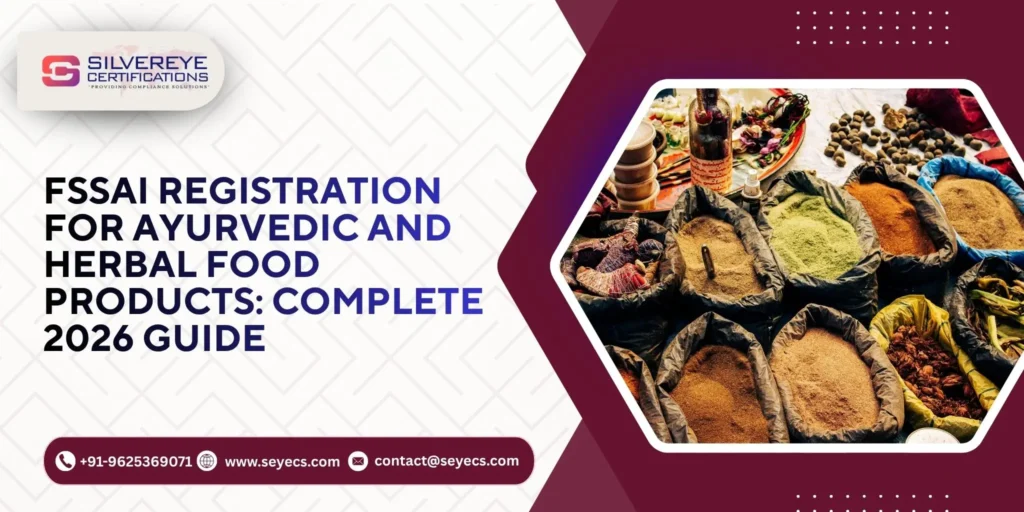
- Food or wellness claims: If your product is marketed as a food or wellness item, such as herbal tea, chyawanprash, or ashwagandha powder for energy and vitality, it may fall under FSSAI regulations, depending on its ingredients, composition, intended use, and claims. However, if a product is intended to diagnose, treat, cure, or prevent a specific disease, it may fall under drug regulations and require the applicable AYUSH or other drug-related license.
- Dedicated Ayurveda Aahara category: FSSAI introduced the Ayurveda Aahara category in 2022 under dedicated regulations, along with a distinct product logo. As of July 2025, a list of 91 approved traditional Ayurveda Aahara recipes was available to help eligible manufacturers formulate products without seeking separate product approval for each listed recipe, subject to the applicable conditions.
- Central FSSAI License: Manufacturing products under the Ayurveda Aahara category requires a Central FSSAI License, irrespective of the manufacturer's annual turnover, subject to the applicable licensing provisions. The annual government license fee should be confirmed against the current FoSCoS fee schedule before quoting ₹7,500 per year.
- Ingredients excluded from the FSSAI route: Certain ingredients and preparations are not eligible for the Ayurveda Aahara category and may fall under the AYUSH drug regulatory framework instead. These include specified substances listed under Schedule E-1 of the Drugs and Cosmetics Rules and certain metal-based preparations, such as bhasma and pishti, subject to their regulatory classification.
Introduction
FSSAI registration for Ayurvedic and herbal food products applies to eligible traditional formulations, herbal teas, tonics, and wellness foods marketed as food rather than medicinal products. Common examples include chyawanprash, herbal teas, and ashwagandha-based wellness powders. To regulate this category, FSSAI introduced a dedicated Ayurveda Aahara category in 2022, with separate regulations, a distinct product logo, and a list of 91 approved traditional recipes released in July 2025.
Manufacturers of Ayurveda Aahara products are required to obtain a Central FSSAI License, irrespective of their annual turnover, subject to the applicable licensing provisions. The most important distinction is the product's intended use and claims: if its labelling or marketing presents it as diagnosing, treating, curing, or preventing a specific disease, it may fall under the drug regulatory framework rather than the food category and require the applicable AYUSH manufacturing license.
Therefore, manufacturers must carefully assess their product composition, intended use, ingredients, and marketing claims before choosing between FSSAI and AYUSH compliance.
What Is FSSAI Registration for Ayurvedic and Herbal Food Products?
FSSAI registration for Ayurvedic and herbal food products is the food safety approval required for eligible traditional formulations, herbal preparations, and wellness foods marketed as food products rather than medicines. These products include chyawanprash, herbal teas, traditional tonics, ashwagandha-based wellness powders, and other packaged foods prepared using ingredients or formulations recognised under the applicable food safety regulations.
To regulate this growing product category, FSSAI, in consultation with the Ministry of Ayush, introduced the Food Safety and Standards (Ayurveda Aahara) Regulations, 2022, notified in the Gazette on 5 May 2022.
These regulations establish a dedicated category known as Ayurveda Aahara, covering food products prepared according to recipes, ingredients, and processes described in recognized authoritative Ayurvedic texts. This provides a separate regulatory framework for eligible Ayurvedic food products instead of treating every such formulation as an ordinary proprietary food or an Ayurvedic medicine.
The Line That Matters Most: FSSAI Food vs AYUSH Drug
Before manufacturing or selling an Ayurvedic or herbal product, it is important to understand whether it falls under FSSAI food regulations or the AYUSH drug regulatory framework. The distinction affects the license you need, the claims you can make, and the regulatory requirements applicable to your product.
An ingredient such as ashwagandha may be used in an eligible food product or in an Ayurvedic medicinal formulation. However, the product's composition, intended purpose, dosage, presentation, and labelling or advertising claims help determine its regulatory classification.
| Parameter | Regulated as Food (FSSAI) | Regulated as a Drug (AYUSH) |
|---|---|---|
| Product purpose | Food, beverage, or eligible general wellness product | Medicinal product intended for a therapeutic or medicinal purpose |
| Governing framework | Food Safety and Standards Act, 2006, and applicable Ayurveda Aahara Regulations, 2022 | Drugs and Cosmetics Act, 1940, and applicable rules governing Ayurvedic, Siddha, and Unani medicines |
| Product examples | Eligible herbal beverages, Ayurveda Aahara formulations, and traditional food products | Ayurvedic medicines and formulations intended for medicinal use |
| Claims | Permitted food and nutrition claims, subject to applicable FSSAI requirements | Medicinal claims permitted under the applicable drug regulations |
| Approval required | Applicable FSSAI registration or license, including the required Central License for Ayurveda Aahara manufacturing | Applicable manufacturing licence from the relevant AYUSH drug licensing authority |
The practical distinction is not simply the presence of a particular herb. How the product is formulated, intended to be used, labelled, and marketed matters. For example, an eligible ashwagandha-based food product marketed for general wellness must comply with applicable FSSAI requirements. A formulation presented as an Ayurvedic medicine for treating a specific disease may instead fall under the AYUSH drug framework.
Manufacturers should pay particular attention to the following situations:
- Herbal teas and infusions: Products sold as beverages or eligible food preparations generally fall under the applicable FSSAI food category.
- Chyawanprash and traditional formulations: These may fall under the Ayurveda Aahara framework when their ingredients, recipes, and intended use satisfy the relevant regulatory requirements.
- Disease-related claims: Claims that a product diagnoses, treats, cures, or prevents a named disease may bring it within the drug regulatory framework, depending on the product's overall classification.
- Medicinal or therapeutic positioning: If the product is presented as a medicine or its labelling and marketing create ambiguity between food and drug classification, manufacturers should obtain regulatory advice before launching it. Separate FSSAI and AYUSH requirements may apply where the business manufactures products falling under both categories.
Therefore, manufacturers should assess their product formulation, ingredients, intended use, label declarations, and advertising claims before selecting the appropriate regulatory route.
What's Explicitly Excluded From the FSSAI Ayurveda Aahara Route?
The Ayurveda Aahara Regulations, 2022 define not only the products covered under this category but also the products and substances that are excluded from its scope. These exclusions are important because a product cannot automatically qualify as Ayurveda Aahara simply because it contains traditional Ayurvedic ingredients.
The category does not cover:
- Ayurvedic drugs and proprietary Ayurvedic medicines: Products classified as medicinal formulations are governed by the applicable drug regulations.
- Cosmetics: Products intended for cosmetic use are regulated under the relevant cosmetics framework.
- Narcotic and psychotropic substances: Substances falling under the applicable narcotic and psychotropic control framework are not covered as Ayurveda Aahara ingredients.
- Specified Schedule E-1 substances: Ingredients listed under Schedule E-1 of the Drugs and Cosmetics Rules, 1945 are subject to specific restrictions and cannot automatically be used through the Ayurveda Aahara route.
- Metal-based Ayurvedic medicinal preparations: Certain medicinal preparations, including bhasma and pishti, fall under the Ayurvedic drug framework rather than the Ayurveda Aahara category.
- Other notified exclusions: Ingredients or products specifically excluded by the Food Authority through applicable notifications must also be considered.
Ordinary food products such as rice, pulses, and flour do not need to be classified as Ayurveda Aahara merely because they are part of traditional diets. They are generally governed by their applicable regular FSSAI food categories.
If your formulation contains a restricted or excluded ingredient, you should verify its regulatory status before proceeding. Depending on the ingredient and product classification, the applicable route may be AYUSH drug licensing rather than FSSAI Ayurveda Aahara approval.
The Ayurveda Aahara Licensing Framework: What's New?
Since introducing the Ayurveda Aahara Regulations, 2022, FSSAI has taken additional steps to establish a more structured compliance framework for manufacturers. Several developments introduced in 2025 are particularly relevant to businesses planning to manufacture or market these products.
- Dedicated FoSCoS licensing pathway: FSSAI introduced a specific licensing and registration pathway for Ayurveda Aahara businesses through the FoSCoS portal. This helps eligible manufacturers identify the appropriate category and submit applications under the dedicated regulatory framework.
- List of 91 approved traditional recipes: Through an order dated 25 July 2025, FSSAI released a list of 91 Ayurveda Aahara recipes based on classical Ayurvedic texts recognised under Schedule A of the regulations. Manufacturers whose formulations comply with the listed recipes and applicable conditions can benefit from this predefined regulatory framework without having to independently establish the traditional basis of the formulation from scratch.
- Dedicated Ayurveda Aahara logo: FSSAI introduced a separate Ayurveda Aahara logo to help identify products covered under this category. Manufacturers must follow the applicable logo and labelling requirements when marketing eligible products.
- Expert Committee oversight: An Expert Committee involving the Ministry of Ayush has an important role in addressing technical and regulatory matters related to Ayurveda Aahara products, including relevant product, formulation, claims, testing, and compliance considerations. Manufacturers should follow the applicable approval and licensing procedures rather than assuming that inclusion in a traditional recipe list removes every regulatory requirement.
These developments provide greater clarity for businesses entering the Ayurvedic food market. However, manufacturers must still ensure that their ingredients, recipes, manufacturing practices, product labels, and claims comply with the applicable FSSAI regulations before launching their products.
Do You Need Product Approval for Your Herbal Formulation?
Whether you need separate product approval for an Ayurvedic or herbal food formulation depends on its ingredients, recipe, and compliance with the Ayurveda Aahara Regulations, 2022.
FSSAI released a list of 91 approved traditional Ayurveda Aahara recipes through its order dated 25 July 2025. If your formulation matches one of the listed recipes and satisfies the applicable conditions, you can follow the prescribed licensing route without seeking separate product approval for that formulation.
However, if you are developing a new herbal combination, non-traditional preparation, or formulation not covered by the approved recipe list, you should first determine whether it requires approval under the applicable non-specified food regulations.
Important points to understand include:
- Non-standard formulations: Products that do not fall within the recognized Ayurveda Aahara recipes may require prior approval under the Food Safety and Standards (Approval for Non-Specified Food and Food Ingredients) Regulations, 2017, where applicable.
- Expert Committee review: Applications involving specialised Ayurveda Aahara formulations may require technical assessment and expert input, including consideration by the relevant FSSAI–Ministry of Ayush Expert Committee.
- Check the approved recipe list: Before applying for separate product approval, compare your formulation with the latest 91-recipe list available through FSSAI's official resources. This can help you identify the appropriate approval route.
Manufacturers should not assume that every traditional herbal formulation is automatically approved. The recipe, ingredients, preparation method, and applicable regulatory conditions must all be considered.
License Type and Eligibility for Ayurveda Aahara Manufacturers
Manufacturing products under the Ayurveda Aahara category requires a Central FSSAI License, irrespective of annual turnover, subject to the applicable licensing provisions. This is an activity-based licensing requirement and differs from the general turnover-based eligibility criteria applicable to many other food businesses.
The following table summarises the licensing position:
| Licence Type | Turnover Threshold (as stated in the 2026 framework) | Eligibility for Ayurveda Aahara Manufacturing |
|---|---|---|
| Basic Registration | Up to ₹1.5 crore | Not applicable to Ayurveda Aahara manufacturing |
| State Licence | ₹1.5 crore–₹50 crore | Not applicable to Ayurveda Aahara manufacturing |
| Central Licence | Mandatory irrespective of turnover | Required for Ayurveda Aahara manufacturers |
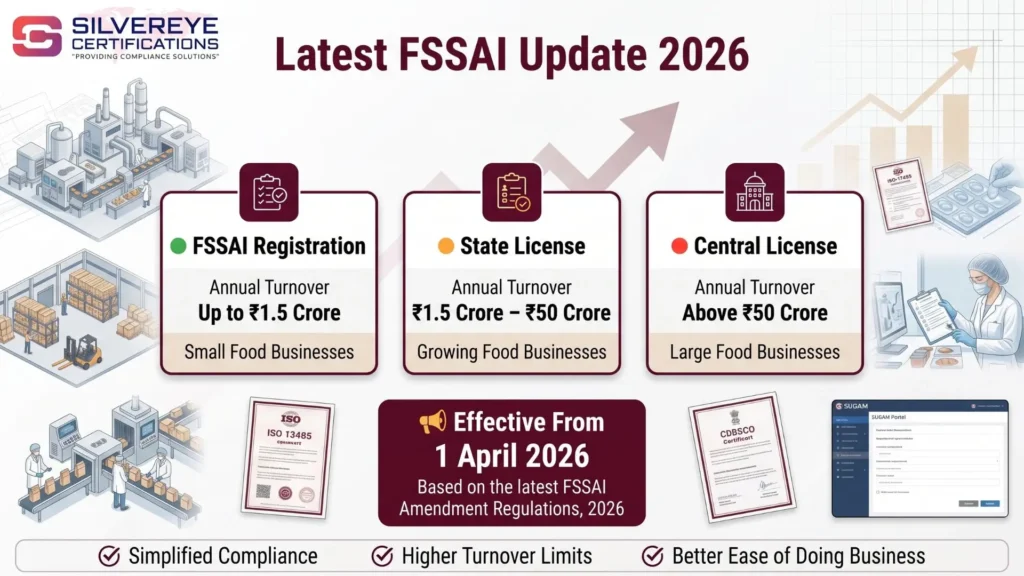
This distinction is important for small manufacturers entering the herbal food market. Even if your annual turnover falls below the general Basic Registration threshold, you cannot automatically select Basic Registration for Ayurveda Aahara manufacturing. You must follow the Central License requirement applicable to this activity.
The annual government license fee should be checked against the latest FoSCoS fee schedule before submitting the application.
Documents Required for Ayurveda Aahara / Herbal Food FSSAI License
Before applying for a Central FSSAI License, manufacturers should prepare the relevant business, manufacturing, product, and food safety documents. The exact requirements may vary depending on the business constitution, manufacturing activity, and formulation.
Commonly required documents and information include:
- Identity and address proof: Documents of the Food Business Operator (FBO) or authorised signatory.
- Business constitution proof: Certificate of Incorporation, Partnership Deed, LLP Agreement, or other applicable business registration document.
- Manufacturing premises layout: A layout plan showing the manufacturing area, storage facilities, and relevant sections of the premises.
- Machinery and equipment details: A list of equipment used for manufacturing, processing, packaging, and storage.
- Food Safety Management System (FSMS) plan: Details of the food safety procedures and hygiene practices followed at the manufacturing facility.
- Ingredient and formulation details: A complete ingredient list with quantities, sources, and relevant references to recognised Ayurvedic texts.
- Recipe compliance documents: Evidence that the formulation matches an applicable approved Ayurveda Aahara recipe or supporting technical documentation where a separate approval route is required.
- Water testing report: A report from an appropriately recognised or accredited laboratory, where applicable.
- Recall and responsible-person details: A product recall plan and applicable nomination documents, such as Form IX and the relevant board resolution for companies.
- Product label drafts: Proposed labels showing the required declarations, applicable Ayurveda Aahara logo, and food-compliant claims.

Manufacturers should ensure that product labels do not make unauthorized disease-treatment or medicinal claims. Product classification and labelling should be reviewed before commercial production.
Step-by-Step FSSAI Application Process for Ayurveda Aahara Manufacturers
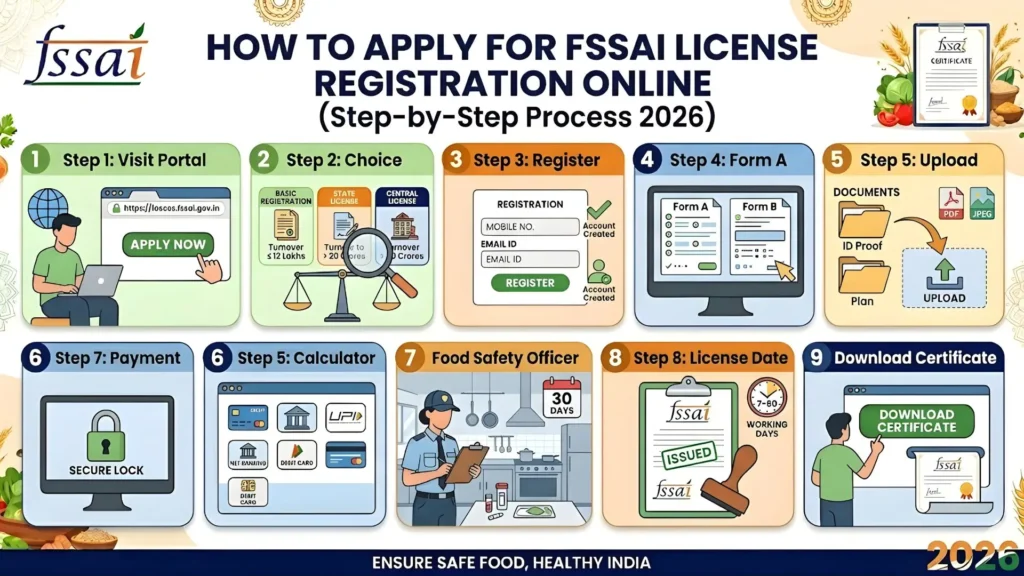
Obtaining an FSSAI Central License involves checking the product category, reviewing the formulation, preparing manufacturing documents, and submitting the application through FoSCoS.
Follow these steps:
- Confirm your product classification: First, determine whether your formulation qualifies as an Ayurveda Aahara food product or falls under the AYUSH drug regulatory framework. Review its ingredients, intended use, dosage, and proposed marketing claims.
- Check the 91 approved recipes: Compare your formulation with FSSAI's approved Ayurveda Aahara recipe list. Verify that the ingredients, preparation method, and other applicable conditions match the recognized formulation.
- Determine whether separate product approval is required: If your formulation is not covered by the approved list, check whether it requires prior approval under the Non-Specified Food Regulations, 2017, before proceeding with manufacturing.
- Apply through the FoSCoS portal: Visit the official FoSCoS website and select the applicable Ayurveda Aahara Kind of Business for the Central License application.
- Prepare and upload the documents: Submit the required business details, manufacturing premises information, FSMS plan, ingredient list, recipe references, and other applicable supporting documents.
- Pay the applicable government fee: Pay the licence fee displayed on the FoSCoS portal for the selected application category. Verify the current fee before making payment.
- Complete the scrutiny and inspection process: FSSAI may examine your application, request additional information, and arrange a manufacturing premises inspection, as applicable. The facility must comply with relevant hygiene, sanitation, and Schedule 4 requirements.
- Receive your license and follow labelling requirements: Once the application is approved, you will receive the applicable 14-digit FSSAI license number. Use the required license details and the dedicated Ayurveda Aahara logo, where applicable, in accordance with the prescribed packaging and labelling requirements.
FSSAI Fee Chart for Ayurvedic and Herbal Food Products
The cost of obtaining regulatory approval for Ayurvedic and herbal food products depends on the type of application and the applicable approval requirements. Manufacturers should distinguish between the annual FSSAI license fee and any separate product approval fee.
| Requirement | Government Fee | Typical Timeline |
|---|---|---|
| Central FSSAI Licence for Ayurveda Aahara manufacturing | Verify the applicable annual fee on FoSCoS | Depends on document scrutiny, inspection, and application processing |
| Non-Specified Food Approval for eligible novel formulations | Verify the applicable fee under the 2017 Regulations | May take several months, depending on scientific and expert review |
Important: The figures of ₹7,500 per year for a Central License and ₹50,000 plus GST for non-specified food approval should be verified against the latest official fee schedule before publication. Processing timelines are also not guaranteed and may vary with the complexity of the formulation, completeness of documents, and regulatory review.
Renewal and Ongoing Compliance
- Perpetual Validity: Licenses granted from 1 April 2026 are subject to the perpetual validity framework rather than a fixed renewal period, with continued compliance monitored through risk-based inspections and applicable regulatory requirements.
- Renewal of Older Licenses: Licenses issued under the earlier fixed-term system may remain subject to their original validity conditions. Check the license expiry date and applicable renewal requirements. Where the earlier renewal provisions apply, late renewal may attract a fee of ₹100 per day, subject to the relevant rules.
- Annual Return (Form D-1): Eligible Central License holders must submit their annual return in Form D-1 by 31 May for the preceding financial year, where applicable.
- Continuous Review of Product Claims: Compliance does not end once the license is granted. Manufacturers should regularly review product labels, packaging, websites, advertisements, and social media content to ensure that claims remain appropriate for food products and do not create confusion with medicinal or AYUSH drug claims.
- Monitoring Approved Recipe Updates: FSSAI may revise or update the approved Ayurveda Aahara recipe list. Businesses should check the latest official list before launching new formulations or making significant changes to existing products.
Penalties for Non-Compliance
Manufacturing or selling food products without the required FSSAI registration or license can lead to regulatory action under the Food Safety and Standards Act, 2006. Under Section 63, carrying on a food business without the required license may attract imprisonment of up to six months, a fine of up to ₹5 lakh, or both.
Businesses should also be careful about making medicinal or disease-treatment claims for products marketed as food. Claims suggesting that a product can diagnose, treat, cure, or prevent a disease may raise questions about whether the product is being presented as a drug rather than a food. Depending on its composition, intended use, presentation, and applicable legal classification, the product may fall under the Drugs and Cosmetics Act, 1940 and related AYUSH drug requirements.
Therefore, businesses should verify their product classification and review all marketing claims before launching or promoting Ayurvedic and herbal products. Following the correct FSSAI or AYUSH regulatory route, as applicable, helps reduce the risk of penalties, enforcement action, and disruptions to business operations.
Why Choose Silvereye Certifications?
Getting FSSAI approval for Ayurvedic and herbal food products requires the right product classification, accurate documentation, and a clear understanding of applicable food safety regulations. Silvereye Certifications helps businesses navigate these requirements with practical regulatory guidance and application support.
How we can help:
- Product Category Assessment: Help determine whether your product falls under the Ayurveda Aahara category, another food category, or requires a different regulatory route.
- FSSAI Licensing Guidance: Support you in identifying the applicable FSSAI licence and the correct application process through FoSCoS.
- Documentation Support: Assist with preparing and organising the required business, manufacturing, ingredient, and product-related documents.
- Regulatory Route Guidance: Help assess whether your formulation may require approval under the Non-Specified Food Regulations, 2017.
- Label and Claims Review: Guide you on food labelling requirements and help identify claims that may create regulatory concerns.
- Application Assistance: Provide support throughout the application process, including responding to regulatory queries and addressing documentation gaps.
With a practical understanding of Indian compliance requirements, Silvereye Certifications helps manufacturers, startups, and herbal food businesses approach FSSAI licensing with greater clarity and confidence.
Conclusion
FSSAI registration for Ayurvedic and herbal food products is an important step for businesses that want to manufacture, market, or sell traditional wellness foods legally in India. However, the correct licensing route depends on the product's ingredients, formulation, intended use, manufacturing process, and marketing claims.
Before applying, check whether your product qualifies as Ayurveda Aahara, matches one of the approved traditional recipes, or requires a separate regulatory assessment. Also ensure that your manufacturing practices, documentation, and product labels meet the applicable FSSAI requirements.
Taking the right compliance steps before launching your product can help reduce application delays and avoid classification-related issues. If you need assistance with FSSAI licensing, product classification, documentation, or regulatory guidance, Silvereye Certifications can help you understand the applicable requirements and navigate the process.
Frequently Asked Questions
Do all Ayurvedic and herbal food products need FSSAI registration?
Yes, if they're sold as food or wellness products rather than medicines. Chyawanprash, herbal teas, and adaptogenic herb powders marketed for general wellness fall under FSSAI's Ayurveda Aahara category.
What is Ayurveda Aahara?
A specific FSSAI category, defined under the Food Safety and Standards (Ayurveda Aahara) Regulations, 2022, covering food prepared according to recipes, ingredients, or processes from recognised, authoritative Ayurvedic texts.
What's the difference between FSSAI and AYUSH licensing for herbal products?
FSSAI regulates herbal products sold as food, with general wellness claims. AYUSH regulates products marketed as medicines that claim to diagnose, treat, cure, or prevent a specific disease — the deciding factor is your claims language, not just the ingredients used.
Can my ashwagandha powder be sold under FSSAI alone?
Yes, if it's marketed as a food supplement for general energy and vitality. If you claim it cures a specific condition like adrenal fatigue or clinical anxiety, it legally becomes a drug requiring an AYUSH manufacturing license instead.
What license does an Ayurveda Aahara manufacturer need?
A Central FSSAI License, mandatory regardless of turnover — Basic Registration and State License aren't available for this manufacturing activity, the same rule applied to nutraceutical and health supplement manufacturers.
What is the FSSAI fee for an Ayurveda Aahara license?
₹7,500 per year for the Central License. A separate ₹50,000 plus GST fee applies if your formulation requires Non-Specified Food approval because it's not on FSSAI's pre-approved recipe list.
What are the 91 approved Ayurveda Aahara recipes?
A definitive list of traditional Ayurvedic food formulations, released by FSSAI via an Order dated 25 July 2025, drawn from classical texts listed in Schedule A of the Ayurveda Aahara Regulations, 2022 — manufacturers using a matching recipe have a clearer regulatory path than those with entirely novel formulations.
Are all herbs allowed in Ayurveda Aahara food products?
No. Herbs listed under Schedule E-1 of the Drugs and Cosmetics Act, 1940 are specifically excluded from the FSSAI/Ayurveda Aahara route and fall under AYUSH drug regulation instead.
Is there a special logo for Ayurveda Aahara products?
Yes, FSSAI created a dedicated Ayurveda Aahara logo, distinct from the standard FSSAI mark, to help consumers identify genuine, compliant products in this category.
What words should I avoid on my herbal food packaging?
Avoid words like 'cures,' 'treats,' 'heals,' or naming a specific disease your product addresses — this language legally converts a food product into a drug, requiring AYUSH licensing rather than (or in addition to) FSSAI.
Can bhasma or pishti-based products be sold under FSSAI?
No. Metal-based Ayurvedic preparations like bhasma and pishti are explicitly excluded from the Ayurveda Aahara/FSSAI framework and fall under AYUSH drug regulation.
What is the penalty for making unauthorized medicinal claims on a food product?
Beyond standard FSSAI licensing penalties, unauthorised disease-treatment claims can be treated as manufacturing an unlicensed drug under the Drugs and Cosmetics Act, 1940 — a separate and generally more serious regulatory risk than a food-labelling violation alone.