
- FSSAI State License is mandatory for food businesses with annual turnover between ₹20 lakh and ₹20 crore.
- Apply online via the FoSCoS portal — no need to visit any government office in person.
- State License is valid for 1 to 5 years and must be renewed before expiry to avoid penalties.
- Non-compliance with FSSAI State License norms can attract fines up to ₹10 lakh and even business closure.
Introduction
FSSAI State License registration is the middle-tier food safety license issued by the Food Safety and Standards Authority of India (FSSAI). If you run a food manufacturing unit, a restaurant chain, a catering business, a storage facility, or any food-related operation with an annual turnover between ₹20 lakh and ₹20 crore, this is the license you need. Not the basic registration. Not the central license. The state one — and getting it right from day one saves you a lot of trouble down the road.
This guide covers every single detail you need for 2026 — turnover thresholds (including the latest FSSAI update), eligibility, documents, the step-by-step online process, fees, timelines, validity, renewal, and penalties. Read it once, and you will not need to search again.
What is FSSAI State License? (And Why It Matters in 2026)
The Food Safety and Standards Act, 2006 divides food business operators (FBOs) into three categories based on the scale and nature of their business. The State License sits right in the middle — bigger than a basic registration but not large enough to require a Central License from FSSAI headquarters.
In simple terms, if your food business is medium-sized — say you own a chain of restaurants, run a food processing unit, or operate a dairy with moderate output — you need a State FSSAI License issued by the Designated Officer of the respective state government. The license is issued under Form C and is valid for 1 to 5 years.
Latest FSSAI Turnover Update for 2026 — What Has Changed?
FSSAI periodically revises the turnover slabs to keep pace with economic growth and business realities. Here is what applies in 2026:
| Licence Category | Annual Turnover | Issuing Authority |
| Basic Registration | Up to ₹20 Lakh | Local Body / Panchayat |
| State License | ₹20 Lakh – ₹20 Crore | State Government (Designated Officer) |
| Central License | Above ₹20 Crore | FSSAI HQ, New Delhi |
Important 2026 Note: FSSAI has been actively enforcing license categorization audits in 2025-26. Businesses that cross the turnover threshold and are still operating on a basic registration are being penalized heavily. If your turnover has crossed ₹20 lakh in the last financial year, upgrade to a State License without delay.

Who Needs an FSSAI State License? Eligibility Criteria
You need to apply for FSSAI State License registration if your business falls under any of the following categories:
Based on Turnover
- Annual turnover between ₹20 lakh and ₹20 crore
- Applies to manufacturers, processors, distributors, retailers, importers (within state), transporters, and storage units
Based on Business Type
| Business Category | State License Required? |
| Food manufacturer / processor | ✅ Yes |
| Restaurant / Hotel (mid-size) | ✅ Yes |
| Catering service | ✅ Yes |
| Food storage / cold chain | ✅ Yes |
| Dairy unit (up to 50,000 litres/day) | ✅ Yes |
| Edible oil processing unit (capacity < 2 MT/day) | ✅ Yes |
| Slaughterhouse (up to 50 large / 150 small animals) | ✅ Yes |
| Proprietary food manufacturer | ✅ Yes |
| Online food aggregator (regional) | ✅ Yes |
Benefits of Getting an FSSAI State License
Beyond legal compliance, the FSSAI State License opens real business opportunities that you simply cannot access without it. Here is what changes once you have it:
- Legal protection — operate your food business without the constant fear of raids, shutdowns, or penalties
- Consumer trust — FSSAI number on your packaging builds brand credibility instantly
- E-commerce eligibility — platforms like Swiggy, Zomato, Amazon Pantry and Flipkart Grocery require a valid FSSAI license before listing
- Bank loans and credit — financial institutions prefer FSSAI-licensed businesses for food sector loans
- Government tenders — FSSAI license is mandatory for most government food supply contracts
- Export readiness — state license is a stepping stone to central license for businesses planning to export
- Easier partnership deals — distributors, supermarkets, and institutional buyers ask for FSSAI proof before onboarding
Documents Required for FSSAI State License Registration
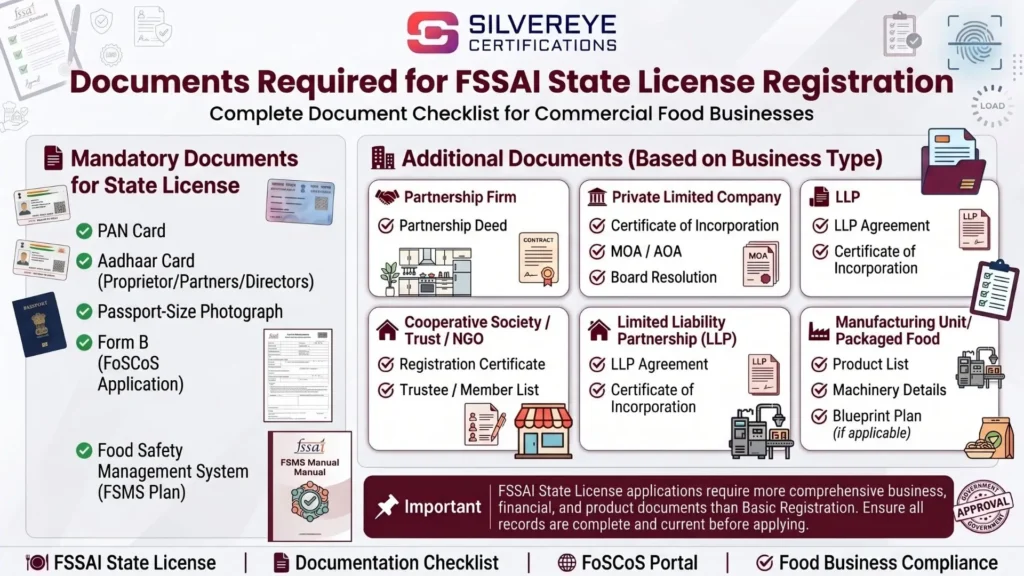
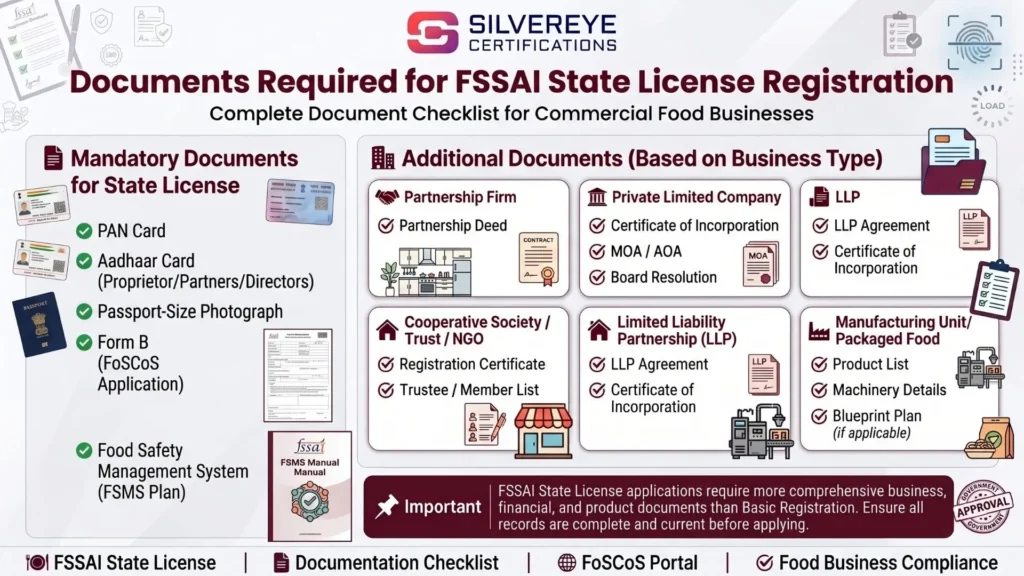
This is one of the most searched parts — what documents do you actually need? Here is the complete checklist for 2026:
Identity and Business Proof
- PAN Card of the business or proprietor
- Aadhaar Card of proprietor / partners / directors
- Passport-size photograph of the FBO / authorized signatory
Business Constitution Documents
- Certificate of Incorporation (for Pvt Ltd / LLP / OPC)
- Partnership deed (for partnership firms)
- MOA and AOA (for companies)
- Board resolution or authorization letter if someone other than director is applying
Premises and Operational Documents
- Proof of possession of premises — rent agreement / lease deed / NOC from owner
- Blueprint or layout plan of the processing unit with dimensions
- List of machinery and equipment installed (with horse power details if applicable)
- Water test report (for manufacturing units — from a NABL-accredited lab)
- NOC from municipality / local body
Compliance and Other Documents
- Form B (duly filled and signed) — available on FoSCoS portal
- Declaration form signed by the FBO
- Food safety management system plan or certificate (if applicable — e.g., ISO 22000)
- Recall plan for the manufacturer (if producing packaged food)
- Source of raw material declaration
Pro Tip: Keep all documents in PDF format and ensure they are clear, legible, and not password protected. Blurry scans are a leading cause of application rejection.
FSSAI State License Fee Structure 2026
The government fee for FSSAI State License is fixed based on the category of the food business and the duration of the license chosen. Here is the official fee table:
| Business Category | 1 Year (₹) | 3 Years (₹) | 5 Years (₹) |
| Manufacturer (up to 500 MT/year) | 2,000 | 5,000 | 7,500 |
| Manufacturer (500 MT – 5,000 MT/year) | 5,000 | 12,000 | 20,000 |
| Manufacturer (above 5,000 MT/year) | 7,500 | 18,000 | 30,000 |
| Retailer / Restaurant / Hotel | 2,000 | 5,000 | 7,500 |
| Catering Business | 2,000 | 5,000 | 7,500 |
| Storage (Cold / Dry) | 2,000 | 5,000 | 7,500 |
| Transporter | 2,000 | 5,000 | 7,500 |
Note: These are government fees only. Professional/service charges (if you hire a consultant) are separate. Payments are made online through the FoSCoS portal — no cash accepted.
How to Apply for FSSAI State License Online — Step-by-Step Process (2026)
The entire FSSAI State License application process is online through the FoSCoS (Food Safety Compliance System) portal at foscos.fssai.gov.in. Here is how to do it correctly:
Step 1: Create Your FoSCoS Account
- Go to foscos.fssai.gov.in
- Click on 'Sign Up' and register using your mobile number and email ID
- Verify OTP and set a strong password
- Log in to your newly created account
Step 2: Select License Type
- After login, click on 'Apply for License / Registration'
- Select your state from the dropdown menu
- The portal will prompt you to enter your annual turnover
- Based on the turnover entered, the system will automatically suggest State Licence — confirm and proceed
Step 3: Fill Application Form B
- Enter business details — name, type, address, contact information
- Add details of all food products / categories you deal with
- Provide details of installed machinery and production capacity
- Enter ownership details — proprietor / partners / directors
- Mention the number of workers employed
Step 4: Upload Documents
- Upload all required documents in PDF or JPG format (max 2 MB per file)
- Ensure documents are clear and match the information filled in the form
- Double-check that the premises address on documents matches the application
Step 5: Pay the Fee Online
- Select the license duration (1, 2, 3, 4, or 5 years)
- Review the fee amount auto-calculated by the portal
- Pay via Net Banking, Debit Card, Credit Card, or UPI
- Download and save the payment receipt
Step 6: Inspection (If Required)
- After submission, a Designated Officer reviews your application
- For manufacturing units, a physical inspection may be scheduled
- The inspection checks premises hygiene, machinery, water supply, and compliance with food safety standards
- Address any observations raised by the officer within the stipulated time
Step 7: Receive Your License
- Once approved, you receive the license digitally via the portal
- Download and print Form C — your official FSSAI State License
- Display the license prominently at your premises (legally required)
- Note the 14-digit FSSAI license number — this goes on all your food labels and packaging
FSSAI State License Processing Timeline
| Stage | Timeline | What Happens |
| Application Submission | Day 1 | FBO submits form and documents online |
| Initial Scrutiny | Day 1–7 | Designated Officer reviews documents |
| Query / Deficiency Notice | Within 15 days | Any objection raised — FBO must respond within 15 days |
| Physical Inspection | Day 10–30 | Premises inspected (for manufacturing units) |
| Grant of Licence | Within 60 days | Licence issued if all conditions met |
| Deemed Approval | Day 61+ | If no response from officer, licence is deemed approved |
Statutory Deadline: As per FSS Act, FSSAI must process State Licence applications within 60 days. If the authority does not act within this period, the licence is considered automatically granted (deemed approval). Always apply well in advance — especially before starting operations.
FSSAI State License Validity and Renewal — Key Rules
Validity Period
FSSAI State License can be obtained for a period of 1 to 5 years depending on what the FBO selects at the time of application. Choosing a longer duration (3 or 5 years) is generally cost-effective and reduces the renewal burden.
Renewal Process
The licence must be renewed before its expiry date. Here is what you need to know:
- Renewal application must be submitted at least 30 days before expiry date
- If renewal is not filed within 30 days prior, a late fee of ₹100 per day is charged
- Log in to FoSCoS portal, go to 'Renewal of Licence' section, update information, and pay the renewal fee
- Renewal fee is the same as the original fee for the corresponding duration
- If a licence expires without renewal, the FBO cannot legally operate — a fresh application is required
2026 Reminder: FSSAI has integrated renewal reminders via SMS and email. Ensure your registered mobile number and email ID on the FoSCoS portal are active and updated.
Penalties for Non-Compliance — Do Not Ignore These
Operating a food business without an FSSAI licence or with an expired licence is a serious offence under the Food Safety and Standards Act, 2006. Here is the penalty structure:
| Offence | Penalty |
| Operating without any FSSAI licence | Imprisonment up to 6 months + fine up to ₹5 lakh |
| Selling substandard food | Fine up to ₹5 lakh |
| Selling misbranded food | Fine up to ₹3 lakh |
| Selling adulterated food (causing injury) | Imprisonment up to 1 year + fine up to ₹10 lakh |
| Obstructing Food Safety Officer | Fine up to ₹2 lakh |
| Expired licence — operation not stopped | Fine up to ₹2 lakh + business closure |
State-Wise Contact for FSSAI State License
FSSAI State Licenses are processed by the Designated Officers appointed by each state government. For queries specific to your state, contact the respective State Food Safety Commissioner's office. The central helpline for FoSCoS portal issues is 1800-11-4406 (toll-free) and the email is foscos-support@nic.in.
FSSAI State Licence vs Central Licence vs Basic Registration — Comparison
| Factor | Basic Registration | State Licence | Central Licence |
| Turnover | Up to ₹20L | ₹20L–₹20Cr | Above ₹20Cr |
| Form | Form A | Form B | Form B |
| Licence Type | Form A Certificate | Form C | Form C |
| Authority | Local Body | State Govt. | FSSAI HQ |
| Inspection | Rarely | Usually Yes | Always |
| Min Fee (1yr) | ₹100 | ₹2,000 | ₹7,500 |
| Best For | Petty vendors, home bakers | Mid-size restaurants, manufacturers | Large scale, export, multi-state |
Common Mistakes to Avoid During FSSAI State License Application
- Applying for the wrong license category — always cross-check your annual turnover first
- Uploading blurry or mismatched documents — premises address on all documents must match exactly
- Not responding to deficiency queries within 15 days — this can lead to rejection
- Choosing a short validity period — opt for 3 or 5 years to save money and effort in the long run
- Not displaying the FSSAI license number on food labels — this is a statutory requirement
- Forgetting to apply for renewal 30 days before expiry — late fees add up quickly
Conclusion
Getting your FSSAI State License registration done right is not just a legal checkbox — it is the foundation of a credible, scalable food business in India. The process is entirely online, the fees are reasonable, and the benefits far outweigh the paperwork involved.
If you are confused about which licence applies to your business, start with your annual turnover figure. That single number tells you exactly where you stand. And if you are already approaching the ₹20 lakh mark, do not wait — apply now and stay ahead.
Frequently Asked Questions
What is the turnover limit for FSSAI State Licence in 2026?
The State Licence applies to food businesses with annual turnover between ₹20 lakh and ₹20 crore. Below ₹20 lakh, basic registration suffices. Above ₹20 crore, you need a Central Licence
How long does it take to get FSSAI State Licence?
Typically 30 to 60 days from the date of application submission. FSSAI is legally bound to process it within 60 days. If they do not, the licence is deemed approved.
Can I apply for FSSAI State Licence offline?
No. As of 2024, all FSSAI applications are processed exclusively online through the FoSCoS portal (foscos.fssai.gov.in). There is no offline process.
What is Form B and where do I get it?
Form B is the application form for FSSAI State and Central Licences. It is available directly on the FoSCoS portal and is filled online — you do not need to download or print it separately.
Is physical inspection mandatory for FSSAI State Licence?
Inspection is usually required for manufacturing and processing units. For traders, retailers, and restaurants, inspection may or may not be conducted based on the Designated Officer's discretion.
Can I operate multiple locations under one FSSAI State Licence?
No. FSSAI requires a separate licence for each premises. If you have multiple manufacturing units or outlets at different addresses, each needs its own licence.
What happens if I cross the turnover limit for State Licence?
If your turnover crosses ₹20 crore, you must upgrade to a Central Licence. Continue operating on your State Licence until the Central Licence is granted, but apply as soon as your turnover crosses the threshold.
What is the penalty for running a food business with an expired FSSAI licence?
Operating with an expired licence can attract fines up to ₹2 lakh and forced closure of operations. Renewal must be done before the expiry date — ideally 30 days in advance.
Is FSSAI State License required for home-based food businesses?
If your annual turnover is below ₹20 lakh, basic registration is sufficient. If you have grown beyond that threshold — even from a home kitchen — you need the State Licence. Turnover, not location, determines the category.
Can the FSSAI State License be transferred if I sell my business?
FSSAI licenses are not transferable. If the ownership of the food business changes, the new owner must apply for a fresh license in their name. The previous license needs to be surrendered.