
- FSSAI Basic License is legally mandatory for food businesses with annual turnover up to Rs. 12 lakh — no exemptions.
- Apply 100% online via the FoSCoS portal (foscos.fssai.gov.in) — no office visit, no physical paperwork.
- Government fee starts at just Rs. 100 per year — making it the most affordable food compliance step in India.
- Approved certificate is issued within 30 days — and is required to sell on Swiggy, Zomato, Amazon & all food platforms.
Introduction
If you are running a small food business in India — a home kitchen, tiffin centre, tea stall, roadside snack cart, or a small grocery shop — one thing you absolutely cannot skip in 2026 is the FSSAI Basic License registration. It is not just a formality. It is a legal requirement under the Food Safety and Standards Act, 2006, and operating without it can land you in serious legal trouble, including fines up to Rs. 5 lakh and even jail time.
Yet, every day thousands of small food entrepreneurs either delay this process or do not know how to go about it. Some feel the process is complicated. Others are not sure if they even qualify. A few have heard that you need a lot of documents.
None of that is true — and this guide is going to prove it.
In this comprehensive FSSAI Basic License registration guide for 2026, we cover everything from scratch: what FSSAI is, who needs a basic license, the updated turnover limits, complete document checklist, step-by-step application process on the FoSCoS portal, fees, approval timeline, food category list, compliance obligations, renewal procedure, penalties, and much more.
Whether you are a first-time applicant or looking to renew your existing registration, this guide has you covered. Let us dive straight in.
What Is FSSAI Registration?
FSSAI stands for the Food Safety and Standards Authority of India. It was established under the Food Safety and Standards Act, 2006 and operates under the Ministry of Health and Family Welfare, Government of India. FSSAI is the single apex national regulatory body responsible for laying down science-based standards for food products and regulating their manufacture, storage, distribution, sale, and import to ensure availability of safe and wholesome food for human consumption in India.
In simple terms — if you are making, storing, distributing, or selling food in India, FSSAI is the authority that oversees your operation.
Three Types of FSSAI Registrations and Licenses
FSSAI has classified food businesses into three tiers based on the scale of operations and annual turnover. Each tier requires a different type of registration or license:
| License Type | Who Needs It |
| FSSAI Basic Registration | Food businesses with annual turnover up to Rs. 12 lakh |
| FSSAI State License | Businesses with turnover between Rs. 12 lakh and Rs. 20 crore (within one state) |
| FSSAI Central License | Businesses with turnover above Rs. 20 crore, importers/exporters, or multi-state operations |

If your food business falls in the smallest category — annual turnover up to Rs. 12 lakh — the FSSAI Basic License (also called Basic Registration) is your entry point into legal food business compliance.
FSSAI 2024-2026 Notification: Updated Turnover Thresholds & Key Changes
| NOTICE | FSSAI has issued updated guidelines under the FoSCoS portal upgrade in 2023-24 that are fully in effect in 2026. All food businesses must apply under the correct category as per the revised thresholds below. |
The updated annual turnover thresholds that apply across all FSSAI categories in 2026 are as follows:
| Category | Annual Turnover Limit | License/Registration Type |
| FSSAI Basic Registration | Up to Rs. 12 lakh per year | Registration Certificate |
| FSSAI State License | Rs. 12 lakh to Rs. 20 crore per year | State License |
| FSSAI Central License | Above Rs. 20 crore per year | Central License |
Key Changes Effective in 2026
The old license and FoSCoS portals have been fully merged — all applications, renewals, and modifications now happen exclusively on foscos.fssai.gov.in.
- Home-based food businesses (home kitchens, cloud kitchens with low turnover) are now explicitly required to obtain Basic Registration before selling food commercially.
- FSSAI has clarified that petty food retailers, street vendors, hawkers, and small manufacturers below the Rs. 12 lakh turnover threshold must not operate without registration.
- Annual Returns filing obligation has been clarified: Basic Registration holders (non-manufacturers) are generally exempt from filing annual returns. Manufacturers under Basic Registration must file a simplified return.
- Food labelling requirements have been tightened in 2024-2026: even small packaged food producers must display the FSSAI logo and 14-digit license number prominently on packaging.
- FSSAI has increased the frequency of inspections and surprise raids, particularly in tier-2 and tier-3 cities, targeting unregistered food businesses.
| PRO TIP | If your annual turnover is close to Rs. 12 lakh and is likely to cross this threshold in the next 1-2 years, consider directly applying for a State License. Upgrading mid-year can be a hassle. |
FSSAI Basic License Eligibility Criteria 2026 — Who Qualifies?
Understanding whether you qualify for FSSAI Basic Registration (rather than a State or Central License) is the very first step. Here is a detailed breakdown:
Food Businesses Eligible for FSSAI Basic Registration
- Petty food manufacturers with annual turnover not exceeding Rs. 12 lakh
- Street food vendors, food cart operators, and mobile food units
- Home-based food producers — home bakers, homemade snack makers, pickle and jam producers
- Small tiffin centres, cloud kitchens, and home delivery food services with low turnover
- Small tea shops, juice stalls, paan shops, and local dhabas
- Small retail shops, kirana stores, and grocery outlets selling packaged food
- Temporary stalls at fairs, exhibitions, religious events, and seasonal markets
- Distributors and wholesalers of food products with turnover below Rs. 12 lakh
- Mid-day meal caterers operating at schools under government schemes (subject to scale)
- Small-scale food storage units (cold storage, warehouses) with low turnover
Who Is NOT Eligible for Basic Registration?
- Businesses with annual turnover exceeding Rs. 12 lakh — they need a State License
- Food businesses operating across multiple states — they need a Central License
- All importers and exporters of food products — Central License is mandatory
- Large manufacturers, dairy plants, and meat processing units
- Businesses manufacturing proprietary food, nutraceuticals, or novel food items
- E-commerce food platforms (like Zomato, Swiggy as platforms) — they need a Central License
Benefits of FSSAI Basic License Registration
A lot of small food business owners treat FSSAI Basic Registration as a bureaucratic hurdle. It is not. Here is what you actually gain:
Legal and Regulatory Benefits
- Complete legal protection against FSSAI raids, penalties, and business shutdowns
- Establishes your food business as a legitimate, law-abiding operation
- Protects you in case of any consumer complaint related to food quality
- Required for availing government schemes, subsidies, and FSSAI-linked initiatives
Business Growth Benefits
- Mandatory for food delivery platforms — Swiggy, Zomato, Dunzo, Blinkit, Amazon, and Flipkart Grocery all require a valid FSSAI number before onboarding.
- Required for opening a bank account in the name of your food business in several banks
- Supports eligibility for MUDRA loans, PMEGP subsidies, and food business grants
- Allows you to participate in government tenders and institutional supply contracts
- Strengthens your case for business insurance related to food products
Consumer Trust and Brand Benefits
- The 14-digit FSSAI number on your packaging builds customer confidence instantly
- Positions your brand as safety-conscious and quality-focused in a competitive market
- Helps get listed on ONDC (Open Network for Digital Commerce) — India's government-backed e-commerce network
- Makes your product shelf-ready for modern trade channels like supermarkets and general stores
Operational Benefits
- Provides a clear, government-recognized identity for your food business
- Simplifies GST registration linkage and trade license compliance
- Makes your business audit-ready from day one
FSSAI Food Categories Covered Under Basic Registration
When applying for FSSAI Basic Registration, you will be asked to select the food categories your business deals in. Getting this right is important — selecting incorrect categories can lead to rejection or penalties. Here is a reference to the major food categories under FSSAI:
| Category No. | Food Category Name | Common Examples |
| Category 1 | Dairy Products & Analogues | Milk, curd, paneer, butter, ghee, cheese, khoa |
| Category 2 | Fats, Oils & Fat Emulsions | Cooking oils, vanaspati, margarine, salad dressings |
| Category 3 | Fruit & Vegetable Products | Juices, jams, pickles, chutneys, dried fruits, squashes |
| Category 4 | Confectionery & Bakery | Biscuits, bread, cakes, chocolates, candies, mithai |
| Category 5 | Cereal & Cereal Products | Flour, rice, pasta, noodles, breakfast cereals, poha |
| Category 6 | Meat, Poultry & Seafood | Chicken, mutton, fish, eggs, processed meat products |
| Category 7 | Beverages (Non-alcoholic) | Water, soft drinks, fruit drinks, energy drinks, tea, coffee |
| Category 8 | Snack Foods & Namkeens | Chips, namkeen, popcorn, roasted nuts, papad, bhujia |
| Category 9 | Condiments & Spices | Salt, sugar, masalas, sauces, ketchup, vinegar, food additives |
| Category 10 | Ready-to-Eat / Cook Foods | Frozen foods, instant mixes, RTE meals, tiffin packs |
| Category 11 | Proprietary Food Products | Novel food items, health drinks, fortified foods |
| Category 12 | Food for Special Dietary Use | Diabetic food, infant food, sports nutrition, weight management |
| IMPORTANT | Select only the food categories that your business actually deals in. Over-claiming categories you do not operate in can result in your application being flagged during scrutiny. |
Documents Required for FSSAI Basic License Registration 2026 — Complete Checklist
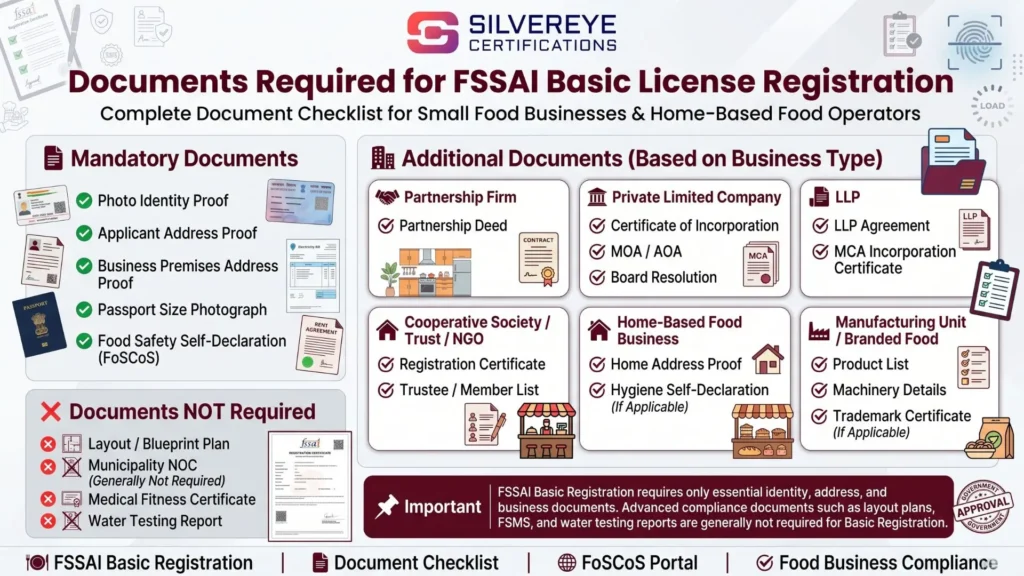
The documentation for FSSAI Basic Registration is intentionally kept minimal to make it accessible for micro and small food businesses. Here is the complete, up-to-date document checklist:
Mandatory Documents for All Applicants
| Document | Accepted Proof Options | File Format & Size |
| Photo Identity Proof (Proprietor/Partner/Director) | Aadhaar Card, PAN Card, Voter ID, Passport, Driving Licence | PDF or JPG — max 1 MB |
| Address Proof of Applicant | Aadhaar Card, Voter ID, Passport, Driving Licence, Bank Passbook | PDF or JPG — max 1 MB |
| Business Premises Address Proof | Latest electricity bill, municipal tax receipt, rent/lease agreement, NOC from property owner | PDF — max 1 MB |
| Passport Size Photograph | Recent photograph of applicant (proprietor/partner/director) | JPG — max 100 KB |
| Food Safety Self-Declaration (Form B) | Filled online on FoSCoS portal — no separate upload needed | Online form on FoSCoS |
Additional Documents Based on Business Type
| Business Type | Additional Documents Required |
| Partnership Firm | Partnership Deed (registered or unregistered) with partner details |
| Private Limited Company | Certificate of Incorporation, MOA/AOA, Board Resolution for authorised signatory |
| LLP (Limited Liability Partnership) | LLP Agreement, Certificate of Incorporation from MCA |
| Cooperative Society / Trust / NGO | Registration Certificate and list of members/trustees |
| Rented or Leased Premises | Valid rent agreement (minimum 11 months) or NOC from landlord |
| Manufacturing Unit | List of food products manufactured, details of machinery/equipment used |
| Home-based Food Business | Proof of home address + a self-declaration that food is prepared in hygienic conditions |
| Food sold under Brand Name | Trademark certificate (if registered) or brand name declaration |
How to Apply for FSSAI Basic License Online 2026 — Step-by-Step Process on FoSCoS
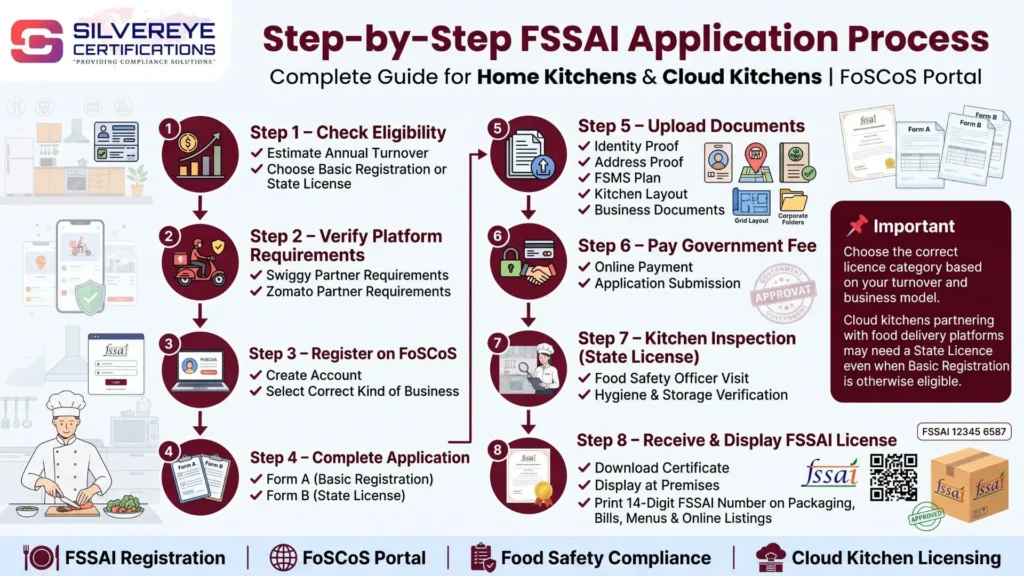
The entire FSSAI Basic License registration process is now 100% online through the FoSCoS (Food Safety Compliance System) portal. The old Flicense portal no longer accepts new applications. Here is the complete, up-to-date process:
Step 1 — Create Your Account on FoSCoS Portal
Visit foscos.fssai.gov.in. Click on "Sign Up" to create a new account. Enter your mobile number and email ID, verify via OTP, and set a password. Your account is ready.
- Use a mobile number that is active and accessible, as all OTPs and notifications will be sent here.
- Remember your login credentials — you will need them to track your application and download the certificate later.
Step 2 — Start a New Application
After logging in, click on "Apply for Registration / License." The portal will ask a few screening questions to confirm the right license type for your business. Answer honestly — this determines whether you go through the Basic Registration flow or the State/Central License flow.
Step 3 — Fill Form A (Basic Registration Form)
Form A is the official application form for FSSAI Basic Registration. You will need to fill in:
- Name and type of food business (proprietorship, partnership, company, etc.)
- Full address of the food business premises
- Nature of business activity (manufacturer, retailer, distributor, transporter, etc.)
- Food categories you deal in (refer to the food category list in this guide)
- Proprietor / Partner / Director personal details
- Estimated annual turnover
- Contact details — mobile and email
Take your time filling this form. Errors in food category selection or business activity type are the most common reason for application rejection.
Step 4 — Upload Supporting Documents
Upload scanned copies of all required documents as per the checklist. Ensure:
- Each file is under 1 MB in size
- Documents are clearly legible — not blurry, cropped, or dark
- File formats are PDF or JPG only (no Word documents or Excel sheets)
- All documents are current and valid (expired ID proofs will be rejected)
Step 5 — Pay the Application Fee Online
After filling the form and uploading documents, you will be directed to the payment gateway. Select the validity period you want (1 to 5 years). The government fee is Rs. 100 per year of validity. Payment options include:
- UPI (Google Pay, PhonePe, Paytm)
- Net banking
- Debit or Credit Card
After successful payment, save the payment receipt. Your Application Reference Number (ARN) will be generated immediately.
Step 6 — Application Scrutiny by the Designated Officer
Your application is assigned to a Designated Officer (DO) in the jurisdiction where your food business is located. The DO will review your application, verify the documents, and may or may not conduct a physical inspection of your premises.
- For most small food businesses and home-based operations, physical inspection is not mandatory.
- For small manufacturing units, a brief inspection may be conducted.
- If any document or information is found incomplete, you will receive a query via email/SMS and must respond within the specified time.
Step 7 — Grant of Registration Certificate
Once the Designated Officer is satisfied with your application, the FSSAI Basic Registration Certificate is issued digitally. You will receive an email and SMS notification. Log in to your FoSCoS account, go to "My Certificates," and download your certificate.
Deemed Approval: If the DO fails to respond within 30 days of your application (without issuing a query or rejection), your application is deemed approved under the Food Safety and Standards Act, 2006.
Step 8 — Display Your Certificate and FSSAI Number
Once you receive your registration certificate, you are required by law to:
- Display the original or a copy of the FSSAI Registration Certificate at your business premises
- Print the FSSAI Logo and 14-digit Registration Number on all food product packaging
- Keep the certificate accessible for inspection by FSSAI officials at any time
FSSAI Basic License Registration Fees 2026 — Government Charges
One of the most common questions people ask is: how much does FSSAI Basic Registration cost? The answer might surprise you — it is extremely affordable.
| Validity Period Chosen | Government Registration Fee |
| 1 Year | Rs. 100 |
| 2 Years | Rs. 200 |
| 3 Years | Rs. 300 |
| 4 Years | Rs. 400 |
| 5 Years (Maximum) | Rs. 500 |
Our Recommendation: Always opt for the 5-year validity at Rs. 500. You save the effort and time of annual renewals, and the cost is negligible compared to what your food business earns or can earn.
FSSAI Basic License Registration Timeline 2026 — How Long Does It Actually Take?
This is one of the most searched questions by food entrepreneurs in India. The timeline depends on several factors — document completeness, state jurisdiction, workload of the Designated Officer, and whether an inspection is required.
| Stage | Realistic Time Estimate |
| Account creation on FoSCoS portal | 15 to 30 minutes |
| Form filling and document preparation | 1 to 3 hours (if all documents are ready) |
| Online fee payment | 5 to 10 minutes |
| Application scrutiny by Designated Officer | 7 to 30 working days |
| Physical inspection (if triggered) | Adds 5 to 15 working days |
| Certificate issuance post-approval | 1 to 3 working days after DO approval |
| Total end-to-end timeline | Minimum 7 days, typically 15-30 working days |
State-Wise Variation in Approval Time
Approval timelines vary significantly by state. States with better digital infrastructure and higher FoSCoS adoption — such as Maharashtra, Karnataka, Telangana, Tamil Nadu, and Gujarat — generally process applications faster. States with higher food business density (Uttar Pradesh, Bihar, West Bengal) may take slightly longer due to volume.
Deemed Approval Rule — Your Safety Net
Legal Provision: Under Rule 2.1.2 of the Food Safety and Standards (Licensing and Registration of Food Businesses) Regulations, 2011, if the Designated Officer does not grant or refuse the registration certificate within 30 days of receiving the application, the registration is deemed to have been granted. In this case, you can legally operate your food business.
FSSAI Basic License Validity and Renewal — Everything You Need to Know
How Long Is the FSSAI Basic License Valid?
When applying, you can choose a validity period of 1, 2, 3, 4, or 5 years. The maximum validity at a time is 5 years. After that, you need to renew. There is no limit on how many times you can renew — your registration can be kept alive indefinitely as long as you renew on time.
When Should You Apply for Renewal?
Key Rule: You must submit your renewal application at least 30 days before the expiry date of your current registration. If you apply late, a penalty of Rs. 100 per day is charged from the date of expiry until the date of renewal application.
FSSAI Basic Registration Renewal Process — Step by Step
1. Log in to your FoSCoS account at foscos.fssai.gov.in
2. Go to "Registered Business" and click on "Renew" against your existing registration
3. Review and update your business details if anything has changed (address, food categories, contact info)
4. Select the new validity period (1 to 5 years)
5. Upload any updated documents if your previous ones have expired (like address proof)
6. Pay the renewal fee (Rs. 100 per year of validity chosen)
7. Submit the application and note the new ARN
8. Download the renewed certificate once approved
Modification of Existing FSSAI Registration
If you need to change any details in your existing registration — business address, addition of new food categories, change of proprietor name due to marriage or other reasons — you must apply for modification on the FoSCoS portal. Do not operate under incorrect registration details; it is treated as non-compliance.
Cancellation and Surrender of Registration
If you permanently close your food business, you should apply for voluntary surrender/cancellation of your FSSAI registration on the FoSCoS portal. This prevents the accumulation of late renewal penalties and maintains a clean compliance record.
FSSAI Basic License for Specific Food Business Types
FSSAI Registration for Home-Based Food Business
Home-based food businesses are one of the fastest-growing segments in India's food economy, especially after the pandemic. If you run a food business from your home — selling homemade snacks, pickles, baked goods, cakes, tiffins, or meal boxes — here is what you need to know:
- You qualify for FSSAI Basic Registration if your annual turnover is below Rs. 12 lakh
- Your home address serves as the registered business address
- You do not need a separate commercial kitchen — your home kitchen is acceptable
- You must ensure basic food hygiene standards in your kitchen area
- Selling on WhatsApp, Instagram, or local delivery apps all require a valid FSSAI number
FSSAI Registration for Street Food Vendors and Hawkers
Street food vendors and hawkers form the backbone of India's informal food economy. FSSAI has made specific provisions for this segment:
- All street food vendors, food carts, and hawkers must obtain FSSAI Basic Registration
- The registration is linked to the location where you primarily operate
- FSSAI has launched the Street Food Vendor Training and Certification Programme in partnership with FICSI — completing this training adds a "Trained" badge to your FSSAI profile
- Municipal corporations in several cities now require an FSSAI registration number at the time of issuing street vending certificates
FSSAI Registration for Tiffin Services and Cloud Kitchens
If you run a tiffin service from home or a cloud kitchen with a small setup, you need FSSAI Basic Registration if your turnover is under Rs. 12 lakh. Key requirements:
- Register the address where food is prepared (not just the delivery location)
- Select the correct food category — "Ready-to-Eat / Cook Foods" is applicable for tiffin services
- Cloud kitchen partners on Swiggy and Zomato must mandatorily display the FSSAI number on the app
FSSAI Registration for Kirana Stores and Small Retailers
Kirana stores and small grocery shops that sell packaged food products are required to obtain FSSAI Basic Registration. As a retailer, your compliance is relatively straightforward:
- You are responsible for ensuring the food products you sell are from FSSAI-licensed manufacturers
- Do not sell food products with expired dates or damaged packaging
- Keep the FSSAI certificate displayed at your shop — prominently, not tucked away in a drawer
How to Use the FSSAI Online Portal
FoSCoS (Food Safety Compliance System) is the official, unified digital portal launched by FSSAI for all food safety related services. It replaced the older Flicense portal completely and is now the single-window platform for registration, licensing, renewals, modifications, annual returns, and inspection reports.
Key Features of the FoSCoS Portal
- Online application for Basic Registration, State License, and Central License
- Online renewal of all license and registration types
- Real-time application status tracking using your ARN
- Digital issuance and download of FSSAI Registration Certificate
- Filing of Annual Returns by manufacturers
- Modification of existing registration details
- Surrender/cancellation of registration
- Inspection reports and notices — viewable by the food business
- Training and certification records under FOSTAC (Food Safety Training and Certification)
How to Track Your FSSAI Application Status
- Visit foscos.fssai.gov.in
- Click on "Track Application Status" on the home page
- Enter your Application Reference Number (ARN)
- View the current status — Submitted, Under Scrutiny, Query Raised, Approved, or Rejected
- If a query is raised, log in to your account and respond to the query with the required additional information
How to Download Your FSSAI Certificate
- Log in to your FoSCoS account
- Go to "My Dashboard" or "Registered Business"
- Click on the relevant registration / license
- Click "Download Certificate" — a PDF will be generated
- Print and display the certificate at your business premises
Conclusion — Your FSSAI Basic License Is Just One Step Away
Getting your FSSAI Basic License registration done is one of the simplest, most affordable, and most impactful things you can do for your food business in 2026. It is a Rs. 100 to Rs. 500 investment that legally protects a business you have poured your hard work, savings, and passion into.
It opens doors to food delivery platforms, government schemes, bank loans, and institutional buyers. It tells your customers that you take food safety seriously. And it keeps you safe from the rising tide of FSSAI enforcement activities across India.
The process is 100% online. The documents are minimal. The approval is typically within a month. And the benefits last for up to 5 years before you need to renew.
There is no reason to delay it any further. Head to foscos.fssai.gov.in, create your account, fill Form A, and get your food business registered today.
Frequently Asked Questions
Is FSSAI Basic Registration mandatory for home-based food businesses in 2026?
Yes, absolutely. If you are selling food products commercially from your home — homemade snacks, tiffins, baked goods, pickles, or any food product — and your annual turnover is below Rs. 12 lakh, FSSAI Basic Registration is legally mandatory. FSSAI has specifically clarified in 2024 that home-based food businesses are not exempt from registration requirements.
Can I sell food on Swiggy, Zomato, or Amazon without an FSSAI license?
No. Both Swiggy and Zomato require a valid FSSAI registration number before they onboard a food partner. Amazon and Flipkart also require FSSAI certification for listing food products. Without an FSSAI number, your account will not be approved on any major food or e-commerce platform.
What is the minimum cost of FSSAI Basic Registration in 2026?
The minimum government fee is Rs. 100 for a 1-year validity. For maximum 5-year validity, the total government fee is Rs. 500. If you apply through a consultant or third-party service, their professional fee (typically Rs. 500 to Rs. 2,500) will be additional. We recommend applying directly on the FoSCoS portal to save this cost.
How long does it take to get FSSAI Basic License approval?
Typically between 7 and 30 working days. Applications with complete and accurate documents are processed faster — often within 7 to 15 days. The maximum legal timeframe is 30 days, after which the application is deemed approved automatically under the Food Safety and Standards Act, 2006.
What is the FSSAI annual turnover limit for Basic Registration in 2026?
The annual turnover threshold for FSSAI Basic Registration continues to be Rs. 12 lakh per annum in 2026. If your food business turnover exceeds this, you must upgrade to an FSSAI State License.
Can one FSSAI registration cover multiple locations or outlets?
No. Each food business premise requires a separate FSSAI registration or license. If you operate two tiffin centres at two different addresses, you need two registrations. However, if you have one kitchen that delivers to multiple locations, a single registration for the kitchen address is sufficient.
What happens if my annual turnover crosses Rs. 12 lakh after I get Basic Registration?
You are legally required to upgrade to an FSSAI State License. You must apply for the State License before your turnover crosses the threshold. Continuing to operate with a Basic Registration when your turnover exceeds Rs. 12 lakh is a violation of FSSAI regulations.
Is a physical inspection mandatory for FSSAI Basic Registration?
Not always. For most small food businesses, home-based food operations, and retail/distribution businesses, physical inspection is discretionary. However, for small manufacturing units, the Designated Officer may conduct a site visit before issuing the certificate. Manufacturing units should keep their premises clean and compliant at all times.
Can I modify my FSSAI Basic Registration details after approval?
Yes. You can apply for modification of your registration certificate on the FoSCoS portal. Modifications are allowed for business address, food categories, contact information, and change in ownership/entity type. There is a nominal government fee of Rs. 100 for each modification. All changes must be reported within 90 days of the change occurring.
Does FSSAI Basic Registration cover all food products I sell?
Your registration covers only the food categories you have mentioned in your application (Form A). If you start dealing in new food categories not covered in your registration, you must apply for modification to add those categories. Operating in unlisted food categories is treated as non-compliance.