- Most new restaurants and cafes qualify for FSSAI Basic Registration (turnover up to ₹1.5 crore) or a State License (₹1.5 crore–₹50 crore), while 5-star and above hotels need a Central License regardless of turnover.
- FSSAI is only one part of the legal permit stack — most cities also require a Health Trade License, Eating House License, Fire NOC, and GST registration before you can legally open.
- Delhi abolished the MCD Health Trade License for restaurants in 2025, with the FSSAI license now serving that regulatory function there — but this varies by city, so always confirm current local rules.
- Standalone restaurants charge GST at a flat 5% without input tax credit; only restaurants inside hotels charging above ₹7,500 a night for rooms fall under the 18% GST-with-credit rate.
Introduction
An FSSAI license for restaurants and cafes is the mandatory food safety approval every dine-in, takeaway, or coffee-only outlet needs before serving customers in India. Most new restaurants and cafes fall under Basic Registration (turnover up to ₹1.5 crore, ₹100/year) or a State License (up to ₹50 crore, ₹2,000–₹5,000/year), while 5-star and above hotels always need a Central License regardless of turnover.
FSSAI is just one license in a larger stack, though — most cities also expect a Health Trade License, Eating House License, Fire NOC, GST registration, and possibly a Liquor or Music License depending on what you serve and offer. Confirm current local requirements, since rules like the Health Trade License vary significantly by city.
What Is an FSSAI License for Restaurants and Cafes?
An FSSAI license for restaurants and cafes is the food safety approval issued by the Food Safety and Standards Authority of India to any establishment preparing and serving food and drinks to customers — dine-in restaurants, quick-service outlets, coffee shops, bakeries with a seating area, and cafes of every format. Even a coffee-only outlet with no cooked food needs FSSAI approval under the 'Restaurant' Kind of Business, since serving any food or beverage for consumption falls within FSSAI's scope.
This license confirms your kitchen, storage, and service practices meet baseline food safety standards, and it's the foundational permit that most other restaurant-specific licenses (like an Eating House License) will ask you to already have in place before they're issued.
Why Restaurants and Cafes Need This License
- Legal requirement: Operating a restaurant or cafe without valid FSSAI approval is a punishable offence under the FSS Act, 2006, with penalties of up to ₹5 lakh and imprisonment of up to six months.
- Foundational for other permits: many local licenses, including the Eating House License in cities that still require it, expect your FSSAI registration to already be in place.
- Customer trust: FSSAI's hygiene rating scheme and displayed license number give customers a quick, visible signal of food safety compliance before they even sit down.
- Platform onboarding: if you also want to list on Swiggy, Zomato, or similar delivery platforms, your FSSAI number is checked and verified as a precondition.
2026 FSSAI Turnover Update: What It Means for Restaurants and Cafes
FSSAI's Order No. RCD-01002/1/2021-Regulatory-FSSAI-Part(1), dated 13 March 2026, revised the turnover thresholds for food business categorisation under the Food Safety and Standards (Licensing and Registration of Food Businesses) Amendment Regulations, 2026 (Gazette notification dated 10 March 2026), effective 1 April 2026.
| License Type | Old Turnover Limit (pre-2026) | New Turnover Limit (from 1 April 2026) |
| Basic Registration | Up to ₹12 lakh | Up to ₹1.5 crore |
| State License | ₹12 lakh – ₹20 crore | Above ₹1.5 crore up to ₹50 crore |
| Central License | Above ₹20 crore | Above ₹50 crore |
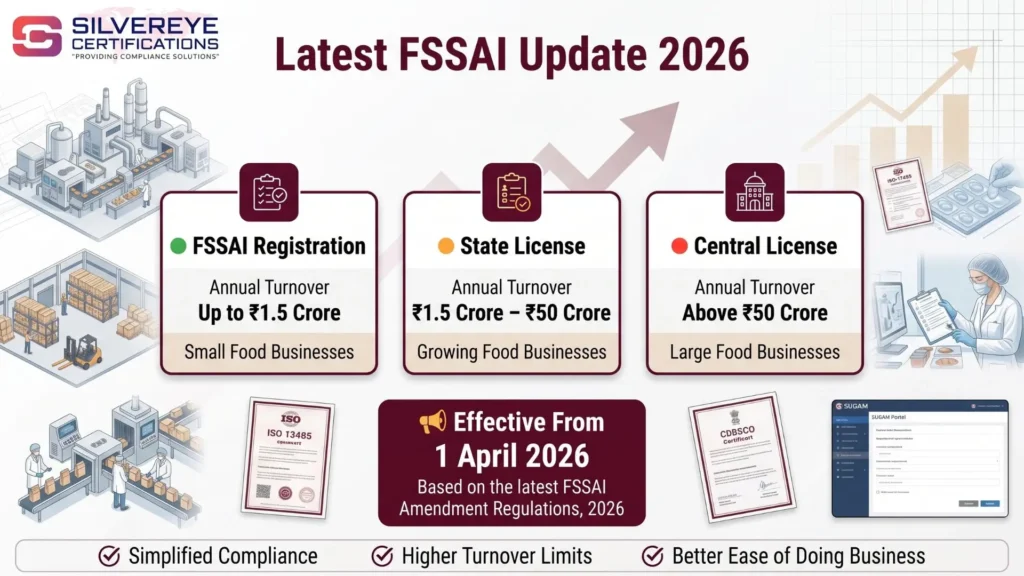
This is a meaningful shift for the restaurant and cafe sector: many establishments that would previously have needed a State License purely because they crossed ₹12 lakh in turnover now comfortably sit within the much higher ₹1.5 crore Basic Registration ceiling. That said, one important exception remains fixed regardless of turnover: 5-star and above hotels are required to hold a Central License, since this is one of FSSAI's activity-based exceptions rather than a turnover-driven category.
- Perpetual validity: licenses granted after 1 April 2026 no longer expire on a fixed 1–5 year term, subject to risk-based inspections.
- Automatic upgrade: if your restaurant's turnover crosses your current slab, FSSAI moves you up automatically, at no extra cost, keeping your existing 14-digit number.
FSSAI License Type by Restaurant/Cafe Category
| Establishment Type | Typical FSSAI License | Annual Government Fee |
| New or small cafe/restaurant (turnover up to ₹1.5 crore) | Basic Registration | ₹100 |
| Established restaurant or cafe chain (₹1.5 crore–₹50 crore) | State License | ₹2,000 – ₹5,000 |
| Large restaurant chain or hotel group (above ₹50 crore) | Central License | ₹7,500 |
| 5-star and above hotel restaurants | Central License (mandatory regardless of turnover) | ₹7,500 |
The Full Legal Permit Stack: FSSAI Is Just One Piece
A genuinely important point for anyone opening a restaurant or cafe: FSSAI approval alone doesn't make you fully legal to operate. Most cities expect a stack of licenses working together, and skipping any one of them can still get you shut down even with a valid FSSAI number.
| License | Issuing Authority | When You Need It |
| FSSAI License/Registration | Food Safety and Standards Authority of India | Always — for any food or beverage service |
| Health Trade License | Municipal Corporation (varies by city; e.g., BMC, BBMP, GHMC) | Required in most cities, though several municipalities have begun phasing this out (see note below) |
| Eating House License | Local Police Licensing Department | Required in some states/cities (varies — Delhi has scrapped it, other cities like Mumbai still require it as of current rules) |
| Fire NOC | Local Fire Department | Generally required for AC restaurants and establishments above a certain seating capacity, commonly cited around 50+ seats |
| Shops and Establishment Registration | State Labour Department | Always — standard for any commercial establishment employing staff |
| GST Registration | Central Board of Indirect Taxes and Customs | Mandatory once turnover crosses the GST threshold, or voluntarily for input credit purposes |
| Liquor License | State Excise Department | Only if you plan to serve alcohol — a separate, state-specific, and often lengthy process |
| Music/Entertainment License (Public Performance License) | Copyright society (e.g., PPL, as reinstated in June 2026) | Required if you play recorded or live music in your establishment |
| Signage Permit | Local municipal authority | Required for outdoor signage in most cities |
Local rules genuinely vary city by city, and they change over time — Delhi, for instance, abolished the MCD Health Trade License for restaurants in 2025, with the FSSAI license now effectively serving that regulatory role there, while other cities continue to require both licenses separately. Always confirm current requirements with your local municipal corporation before assuming any permit on this list is or isn't needed for your specific location.
Documents Required for FSSAI License for Restaurants and Cafes
Common documents (all categories)
- Photo ID proof of the Food Business Operator (Aadhaar, PAN, Voter ID, Passport, or Driving License)
- Address proof of the restaurant/cafe premises (electricity bill, rent agreement with owner NOC, or property tax receipt)
- Passport-size photograph of the applicant/authorised signatory
- Menu or list of food/beverage categories to be served
Additional documents for State/Central License
- Business constitution certificate — GST registration, Certificate of Incorporation, Partnership Deed, or Udyam Registration
- Kitchen and seating layout plan (also used for the Fire NOC application in many cities)
- Food Safety Management System (FSMS) certificate/declaration
- List of food handlers/staff with medical fitness certificates
- Water testing report from an NABL-accredited laboratory, where applicable
- NOC from the Central Ground Water Authority (CGWA), if the establishment extracts groundwater
- Commercial LPG connection proof for the kitchen

Step-by-Step FSSAI Application Process
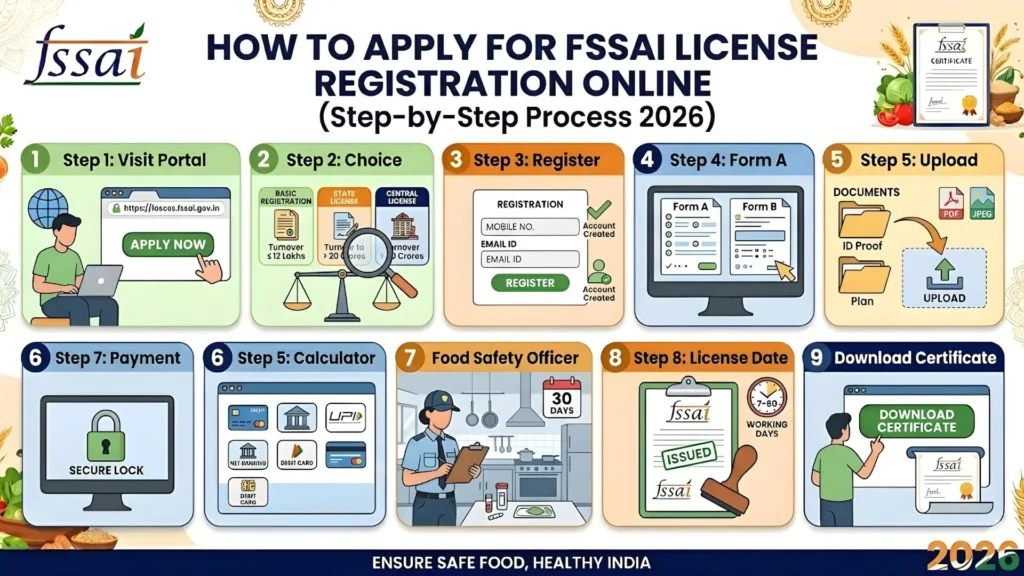
Confirm your expected turnover to identify whether you need Basic Registration, State License, or (for 5-star+ hotels) mandatory Central License.
- Register on the FoSCoS portal (foscos.fssai.gov.in) and select 'Restaurant' as your Kind of Business — this applies even to a coffee-only cafe with no cooked food.
- Fill Form A (Basic Registration) or Form B (State/Central License) with your business, premises, and menu details.
- Upload the required documents, including your kitchen layout plan and FSMS declaration for State/Central applications.
- Pay the applicable government fee online.
- For State/Central applications, a Food Safety Officer inspects the premises before approval, checking kitchen hygiene, storage, and staff practices.
- On approval, display your FSSAI certificate prominently at the premises and print your 14-digit number on menus, bills, and any delivery platform listings.
- Move in parallel on your other local permits — Health Trade License, Eating House License (if applicable), Fire NOC, and GST — since these often depend on your FSSAI approval already being in place.
FSSAI Fee Chart for Restaurants and Cafes
| License Category | Government Fee (per year) | Typical Timeline |
| Basic Registration | ₹100 | 7–10 working days |
| State License | ₹2,000 – ₹5,000 (scale-dependent) | 30–45 working days (includes premises inspection) |
| Central License | ₹7,500 | 60–90 working days (includes premises inspection) |
These are FSSAI government fees only. Budget separately for your Health Trade License (commonly ₹500–₹5,000 per year, set by the local municipal authority, depending on seating capacity and location), Fire NOC, Eating House License, and any Liquor or Music licenses relevant to your establishment.
The FSSAI Hygiene Rating Scheme
Beyond your license itself, FSSAI operates a voluntary Hygiene Rating Scheme that assesses restaurants and food establishments on a scale of smileys (typically 1 to 5), based on an independent audit of food safety and hygiene practices. While not mandatory in every state, many municipal authorities and consumer-facing platforms encourage or increasingly expect participation, since it gives customers a quick, visible signal of food safety standards beyond just the license number itself.
Displaying a high hygiene rating alongside your FSSAI number is a straightforward way to build customer confidence, particularly for cafes and restaurants competing in dense, high-footfall areas.
GST for Restaurants and Cafes
Since GST registration is part of the broader compliance picture for any restaurant or cafe, it's worth knowing the current rate structure: standalone restaurant services are taxed at a flat 5% GST without input tax credit — this remained unchanged under GST 2.0. The higher 18% GST-with-credit rate applies only to restaurants operating inside hotels where room tariffs exceed ₹7,500 per night. Most independent cafes and restaurants will fall under the simpler 5% no-credit structure.
Renewal and Ongoing Compliance
- Perpetual validity: FSSAI licenses granted after 1 April 2026 no longer expire on a fixed 1–5 year term, subject to risk-based inspections.
- Older, fixed-term licenses: renew at least 30 days before expiry to avoid the ₹100-per-day late fee.
- Annual Return (Form D-1): due by 31 May every year for State/Central License holders.
- Local license renewals: Health Trade Licenses, Eating House Licenses, and Fire NOCs typically follow their own separate, often annual, renewal cycles set by the respective local authority — track these independently of your FSSAI renewal calendar.
- Staff medical fitness certificates: expect these to need periodic renewal as part of maintaining your FSMS and hygiene compliance record.
Penalties for Non-Compliance
Operating a restaurant or cafe without valid FSSAI approval is a punishable offence under the FSS Act, 2006 — penalties of up to ₹5 lakh and imprisonment of up to six months apply for operating without a license. Beyond FSSAI-specific penalties, missing local permits like the Fire NOC or Eating House License (where required) can independently trigger closure notices from municipal or police authorities, regardless of your FSSAI compliance status.
Frequently Asked Questions
Is FSSAI license mandatory for a cafe that only serves coffee, no food?
Yes. Serving any food or beverage for consumption — including a coffee-only outlet — falls under FSSAI's 'Restaurant' Kind of Business and requires registration or a license.
What FSSAI license does a new restaurant or cafe need?
Most new establishments with turnover up to ₹1.5 crore need Basic Registration; those between ₹1.5 crore and ₹50 crore need a State License; and 5-star and above hotels need a Central License regardless of turnover.
Do I need more licenses than just FSSAI to open a restaurant?
Yes. FSSAI is foundational but not sufficient on its own — most cities also require a Health Trade License, Shops and Establishment registration, GST registration, and possibly a Fire NOC, Eating House License, Liquor License, or Music License depending on your establishment and local rules.
Is the Health Trade License still required alongside FSSAI?
It depends on your city. Some municipalities, like Delhi (from 2025), have abolished the separate Health Trade License for restaurants, with the FSSAI license now serving that function — but many other cities still require both. Confirm current rules with your local municipal corporation.
What is the FSSAI license fee for a restaurant?
₹100 per year for Basic Registration, ₹2,000–₹5,000 per year for a State License, and ₹7,500 per year for a Central License, based on turnover and category.
Do 5-star hotels always need a Central FSSAI License?
Yes. This applies regardless of turnover — 5-star and above hotels are one of FSSAI's fixed activity-based categories requiring a Central License.
What documents are required for a restaurant FSSAI license?
At minimum: photo ID, premises proof, and a menu/product list. State and Central applications additionally need a kitchen layout plan, FSMS certificate, staff medical fitness certificates, and water testing report where applicable.
How long does it take to get an FSSAI license for a restaurant?
Basic Registration typically takes 7–10 working days. State Licenses usually take 30–45 working days, and Central Licenses 60–90 working days, since both involve a premises inspection.
What is the FSSAI Hygiene Rating Scheme?
A voluntary scheme where FSSAI or an accredited auditor assesses a restaurant's food safety and hygiene practices, typically displayed as a smiley rating — separate from your license but increasingly valued by customers and, in some cases, municipal authorities.
What GST rate applies to restaurants in 2026?
Standalone restaurants charge a flat 5% GST without input tax credit. The 18% GST-with-credit rate applies only to restaurants inside hotels with room tariffs above ₹7,500 per night.
Do I need a Fire NOC for a small cafe?
It depends on your seating capacity and whether you're air-conditioned — many cities require a Fire NOC once seating crosses a certain threshold, commonly cited around 50 seats, but exact rules vary by local fire department.
What is the penalty for running a restaurant without an FSSAI license?
Operating without a valid FSSAI license can attract a penalty of up to ₹5 lakh and imprisonment of up to six months under the FSS Act, 2006, independent of any penalties for missing local permits like a Fire NOC or Eating House License.