- 5-star and 5-star deluxe hotels must hold a Central FSSAI License regardless of turnover — this is one of FSSAI's fixed activity-based exceptions, not a turnover-driven category.
- Non-star, 1-star, 2-star, 3-star, and 4-star hotels follow the standard 2026 turnover thresholds instead: Basic Registration up to ₹1.5 crore, State License up to ₹50 crore.
- Star classification itself comes from the Ministry of Tourism's HRACC committee, not FSSAI — it's a separate, largely optional certification, distinct from your mandatory FSSAI food safety approval.
- A hotel serving alcohol needs its own separate liquor license from the state excise department (commonly L-15 for room service, L-16 for restaurant/bar service), entirely apart from FSSAI.
Introduction
FSSAI license for hotels depend primarily on turnover, with one fixed exception: 5-star and 5-star deluxe hotels must hold a Central FSSAI License (₹7,500/year) regardless of turnover, while non-star through 4-star hotels follow the standard 2026 thresholds — Basic Registration up to ₹1.5 crore, State License up to ₹50 crore. Star rating itself is a separate Ministry of Tourism certification (via HRACC), not an FSSAI credential, so a hotel can legally operate without ever being star-rated as long as it holds its FSSAI license.
Hotels also typically need a full stack of other approvals — Health Trade License, Fire NOC, Eating House License (in some cities), and a liquor license if serving alcohol — none of which substitute for FSSAI.
What Is an FSSAI License for Hotels?
An FSSAI license for hotels is the food safety approval every hotel serving food or beverages — through an in-house restaurant, room service, banquet catering, or a bar — must hold under the Food Safety and Standards Act, 2006. This applies to every size of hospitality business, from a small budget guesthouse with a simple breakfast counter to a large luxury resort running multiple restaurants, bars, and banquet operations under one roof.
Hotels are treated somewhat differently from a standalone restaurant because of one specific rule: FSSAI's activity-based exceptions list 5-star and above hotels as requiring a Central License automatically, regardless of how small or large their actual food and beverage turnover is.
FSSAI License vs Hotel Star Rating: Two Completely Separate Systems
This is the single most important thing to understand before working out what your hotel needs, because the two get confused constantly. FSSAI licensing and hotel star classification are issued by entirely different authorities, for entirely different purposes, and neither substitutes for the other.
| Authority | FSSAI License | Hotel Star Classification |
| Issuing authority | Food Safety and Standards Authority of India | Ministry of Tourism, through the Hotel and Restaurant Approval and Classification Committee (HRACC) |
| Mandatory or optional? | Mandatory for any hotel serving food or beverages | Largely optional — used for branding, marketing, and eligibility for certain tourism-related incentives |
| What it certifies | Food safety compliance of your kitchen, storage, and service practices | Overall quality and service standard of the property (rooms, amenities, service level) |
| Validity | Perpetual (for approvals issued on/after 1 April 2026) or fixed-term for older licenses | Typically valid for a set period (commonly around 5 years), after which re-classification is needed |
| Consequence of not having it | Illegal to operate a food/beverage service without it — penalties apply | No star rating displayed; doesn't prevent you from legally operating, just from marketing yourself at that tier |
In other words: you can run a fully legal, FSSAI-licensed hotel restaurant without ever applying for a star rating. But if your hotel does hold or is pursuing a 5-star or 5-star deluxe classification from HRACC, that status specifically changes your FSSAI licensing requirement — see below.
2026 FSSAI Update: Turnover Thresholds for Hotels
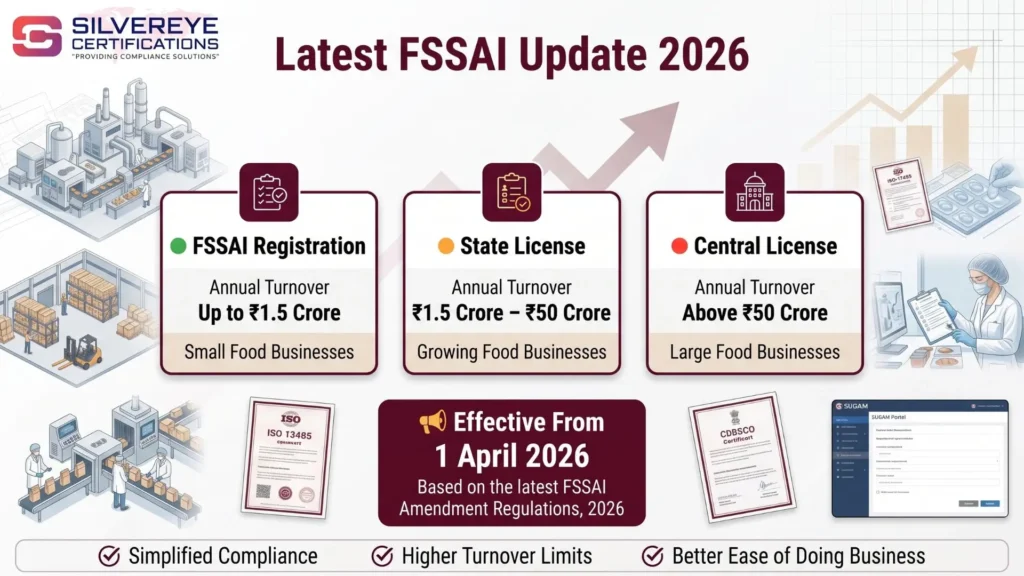
FSSAI's Order No. RCD-01002/1/2021-Regulatory-FSSAI-Part(1), dated 13 March 2026, revised the turnover thresholds for food business categorization under the Food Safety and Standards (Licensing and Registration of Food Businesses) Amendment Regulations, 2026 (Gazette notification dated 10 March 2026), effective 1 April 2026.
| License Type | Old Turnover Limit (pre-2026) | New Turnover Limit (from 1 April 2026) |
| Basic Registration | Up to ₹12 lakh | Up to ₹1.5 crore |
| State License | ₹12 lakh – ₹20 crore | Above ₹1.5 crore up to ₹50 crore |
| Central License | Above ₹20 crore | Above ₹50 crore |
FSSAI License Requirements by Star Category
| Hotel Category | FSSAI License Basis | Typical Annual Fee |
| Non-star / unrated hotel or guesthouse | Standard turnover thresholds — Registration up to ₹1.5 crore, State up to ₹50 crore, Central above ₹50 crore | ₹100 – ₹7,500 |
| 1-star or 2-star | Standard turnover thresholds apply — most fall under State License once past small guesthouse scale | ₹2,000 – ₹5,000 (State), depending on turnover |
| 3-star | Standard turnover thresholds apply | ₹2,000 – ₹5,000 (State), or Central if turnover exceeds ₹50 crore |
| 4-star | Standard turnover thresholds apply | ₹2,000 – ₹5,000 (State), or Central if turnover exceeds ₹50 crore |
| 5-star | Central License mandatory, regardless of turnover | ₹7,500 |
| 5-star deluxe | Central License mandatory, regardless of turnover | ₹7,500 |
Practical implication: a small, non-star budget hotel with modest turnover can legally operate on a ₹100/year Basic Registration, while a large but formally unrated boutique property might sit comfortably in the State License band even with substantial revenue — because turnover, not luxury level, is what drives the FSSAI category for anything below 5-star.
Once a hotel is officially classified 5-star or 5-star deluxe by HRACC, that classification itself becomes the trigger for a mandatory Central License, overriding whatever the turnover-based calculation would otherwise suggest.
How Hotel Star Classification Actually Works (Separate From FSSAI)
Since this affects your FSSAI category once you hit 5-star, it's worth understanding briefly how the classification itself is granted. The Ministry of Tourism's Hotel and Restaurant Approval and Classification Committee (HRACC) evaluates hotels against defined criteria — room quality, service standards, amenities, staff training, and more — before granting a star rating.
- 4-star and 5-star category hotels (with or without alcohol service) and 5-star deluxe properties are evaluated by a committee chaired at the central/national level.
- 1-star, 2-star, and 3-star category hotels are evaluated through state-level tourism authorities instead.
- Classification approval doesn't substitute for any statutory license — HRACC's own guidelines explicitly note that Ministry of Tourism approval can be withdrawn without notice if statutory violations or misrepresentation are found, and it exists alongside, not instead of, your FSSAI, fire, health, and other mandatory approvals.
- Hotels availing government subsidies or tax benefits at 1 to 4-star level are typically subject to a lock-in period (commonly cited around 8 years) before they can apply to upgrade to a higher star category.
Documents Required for FSSAI License for Hotels
Common documents (all categories)
- Photo ID proof of the Food Business Operator (Aadhaar, PAN, Voter ID, Passport, or Driving License)
- Address proof of the hotel premises
- List of food and beverage services offered — restaurant, room service, banquet catering, bar, etc.
Additional documents for State/Central License
- Business constitution certificate — Certificate of Incorporation, Partnership Deed, LLP Agreement, or relevant Cooperative Society Act certificate, as applicable
- Layout plan covering all food and beverage service areas — kitchen, restaurant, bar, and banquet/catering facilities
- Food Safety Management System (FSMS) plan
- Water testing report from an NABL-accredited laboratory
Hotel-specific documents
- Ministry of Tourism (HRACC) classification certificate or NOC, where the hotel holds or has applied for a star rating — commonly requested for 3-star and above properties as part of the application
- Details of each food/beverage outlet operating within the hotel, since multiple Kind of Business categories (Restaurant, Storage, sometimes Manufacturer for in-house bakery/confectionery) may need to be endorsed on a single license

The Full Hotel Licensing Stack: FSSAI Is One Piece Among Many
Hotels are among the most heavily regulated business types in India precisely because they combine lodging, food service, alcohol, public gatherings, and entertainment — each governed by a different authority. FSSAI is mandatory and foundational, but it's rarely the only approval a hotel needs.
| License/Approval | Issuing Authority | When It Applies |
| FSSAI License/Registration | Food Safety and Standards Authority of India | Always, for any hotel serving food or beverages |
| Health Trade License | Municipal Corporation | Required in most cities, though some (e.g., Delhi from 2025) have phased this out in favour of FSSAI serving that function |
| Fire NOC | State/local Fire Department | Generally required for hotels above a certain size, and virtually always for multi-storey properties |
| Eating House License | Local Police Licensing Department (Ministry of Home Affairs Unified Portal in some states) | Required in some cities for premises serving food/drinks on-site; discontinued in favour of municipal approval in some states like Delhi and Maharashtra |
| Liquor License (L-15 / L-16, or state equivalents) | State Excise Department | Required if the hotel serves alcohol — L-15 typically covers in-room service, L-16 covers bar/restaurant service; exact permit types and names vary by state |
| Lodging House / Hotel Registration | State/local tourism or police authority, depending on state | Required for the accommodation function itself, separate from food service |
| Music/Entertainment License | Copyright society (e.g., PPL) or local authority | Required if playing recorded or live music in restaurants, bars, or banquet spaces |
| GST Registration | Central Board of Indirect Taxes and Customs | Mandatory once turnover crosses the applicable GST threshold |
Because these requirements vary meaningfully by city and state — as seen with Delhi and Maharashtra discontinuing the separate Eating House License and Health Trade License in favour of streamlined approvals — always confirm current local rules with your municipal authority rather than assuming a fixed national checklist applies everywhere.
Step-by-Step FSSAI Application Process for Hotels
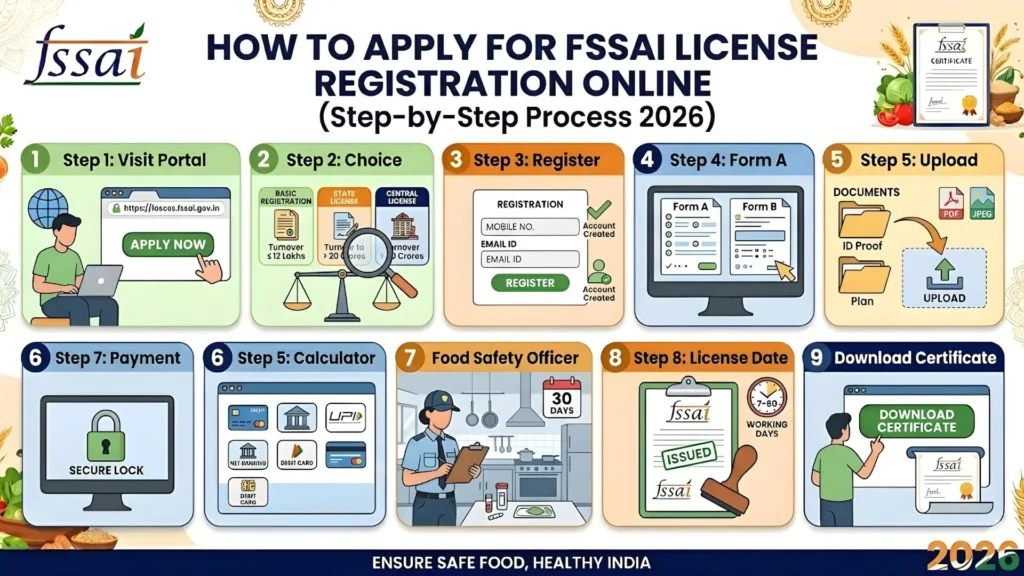
- Determine your FSSAI category: check whether your hotel is formally classified 5-star/5-star deluxe (mandatory Central License) or falls under the standard turnover-based thresholds.
- Register on the FoSCoS portal and select 'Restaurant'/'Hotel' along with any additional Kind of Business categories relevant to your operations (Storage for a wine cellar or dry goods store, Manufacturer for an in-house bakery, etc.).
- Fill Form A (Basic Registration) or Form B (State/Central License) with details of every food and beverage outlet within the property.
- Upload required documents, including your layout plan covering all F&B areas and your FSMS plan.
- Pay the applicable government fee online.
- A Food Safety Officer inspects the premises — expect this to cover every kitchen, bar, and food storage area in the property, not just the main restaurant.
- On approval, display your FSSAI certificate prominently and print your 14-digit number on menus, bills, and room service materials across the property.
- Coordinate your FSSAI timeline with your other pending approvals — Fire NOC, liquor license, and Health Trade License processes often run in parallel and can affect your overall opening timeline.
FSSAI Fee Chart for Hotels
| License Category | Government Fee (per year) | Applies To |
| Basic Registration | ₹100 | Small guesthouses/budget hotels, turnover up to ₹1.5 crore |
| State License | ₹2,000 – ₹5,000 (scale-dependent) | Non-star to 4-star hotels, ₹1.5 crore–₹50 crore turnover |
| Central License | ₹7,500 | 5-star and 5-star deluxe hotels (mandatory), or any hotel above ₹50 crore turnover |
Renewal and Ongoing Compliance
- Perpetual validity: FSSAI licenses granted after 1 April 2026 no longer expire on a fixed 1–5 year term, subject to risk-based inspections.
- Older, fixed-term licenses: renew at least 30 days before expiry to avoid the ₹100-per-day late fee.
- Annual Return (Form D-1): due by 31 May every year for State/Central License holders.
- Star classification renewal: tracked separately from FSSAI, typically requiring re-classification with HRACC after the validity period of your existing rating expires.
- Multi-outlet compliance: as a hotel adds new restaurants, bars, or banquet spaces, these should be reflected on your FSSAI license through a modification, not assumed to be automatically covered.
Penalties for Non-Compliance
Operating a hotel's food and beverage service without valid FSSAI approval is a punishable offence under the FSS Act, 2006 — penalties of up to ₹5 lakh and imprisonment of up to six months apply for operating without a license. A 5-star or 5-star deluxe hotel operating on a State License rather than the mandatory Central License would also be in violation of FSSAI's activity-based licensing rule, independent of its actual turnover.
Frequently Asked Questions
Do all hotels need an FSSAI license?
Yes, any hotel serving food or beverages — through a restaurant, room service, bar, or banquet catering — needs FSSAI Basic Registration or a State/Central License.
Do 5-star hotels always need a Central FSSAI License?
Yes. This applies regardless of turnover — 5-star and 5-star deluxe hotels are one of FSSAI's fixed activity-based categories requiring a Central License automatically.
Does a hotel need a star rating to get an FSSAI license?
No. Star classification is a separate, largely optional certification from the Ministry of Tourism (via HRACC) and is not required to obtain an FSSAI license or registration.
What FSSAI license does a 3-star or 4-star hotel need?
Standard turnover-based thresholds apply — most 3-star and 4-star hotels fall under a State License, unless their turnover exceeds ₹50 crore, in which case a Central License applies
What is the FSSAI license fee for a hotel?
₹100 per year for Basic Registration, ₹2,000–₹5,000 per year for a State License, and ₹7,500 per year for a Central License — with 5-star and above hotels always falling into the Central License tier.
Does my hotel need a separate FSSAI license for the bar?
Generally no separate license, but the bar/restaurant activity should be reflected as part of your Kind of Business declaration on your single hotel FSSAI license — a separate liquor license from the state excise department is required in addition, but that's a different approval entirely.
What documents does a hotel need for FSSAI licensing?
At minimum: photo ID, premises proof, and a list of food/beverage services. State and Central applications additionally need a layout plan covering all F&B areas, an FSMS plan, water testing report, and, where applicable, Ministry of Tourism classification documentation.
Can a small guesthouse or homestay use FSSAI Basic Registration?
Yes, if turnover is up to ₹1.5 crore and the property isn't classified 5-star or above — most small guesthouses and homestays comfortably fall under Basic Registration.
Do I need a liquor license in addition to FSSAI if my hotel serves alcohol?
Yes. A liquor license (commonly L-15 for room service and L-16 for bar/restaurant service, though names vary by state) is issued separately by the state excise department and is entirely independent of your FSSAI license.
What happens if a 5-star hotel operates on a State License instead of Central?
This would be a violation of FSSAI's activity-based licensing rule for 5-star and above hotels, regardless of the hotel's actual turnover, and should be corrected by applying for the mandatory Central License.
Is the FSSAI license for hotels now valid for a lifetime?
Licenses granted under the 2026 amended regulations carry perpetual validity, subject to periodic risk-based inspections — they no longer need renewal every 1–5 years.
What is the penalty for a hotel operating without a valid FSSAI license?
Operating without a valid FSSAI license can attract a penalty of up to ₹5 lakh and imprisonment of up to six months under the FSS Act, 2006, independent of any penalties for missing other required permits like a Fire NOC or liquor license.