

- FSSAI recognizes three distinct storage Kind of Business categories — Cold/Refrigerated Storage, Controlled Atmosphere + Cold Storage, and general Storage (warehouses/godowns) — and you must pick the one that matches your actual facility.
- As of the FoSCoS Kind of Business matrix updated 1 April 2026, all three storage categories are classified purely by annual turnover: Registration up to ₹1.5 crore, State License up to ₹50 crore (₹5,000/year), Central License above ₹50 crore (₹7,500/year).
- Storage without atmospheric control qualifies for FSSAI's Tatkal instant-issuance scheme (subject to standard exclusions), while cold storage and controlled-atmosphere facilities generally go through the standard licensing route with inspection.
- Dedicated food transport vehicles — refrigerated vans, milk tankers, and similar specialized carriers — fall under their own separate 'Transportation' Kind of Business, distinct from storage.
Introduction
An FSSAI license for food storage and warehousing units is the mandatory food safety approval of every cold store, warehouse, or godown handling packaged or bulk food needs before operating in India.
FSSAI splits this into three Kind of Business categories — Cold/Refrigerated Storage, Controlled Atmosphere + Cold Storage, and general Storage (warehouses/godowns) — and as of the FoSCoS matrix updated 1 April 2026, all three now follow the same turnover-based structure: Registration up to ₹1.5 crore (₹100/year), State License up to ₹50 crore (₹5,000/year), or Central License above ₹50 crore (₹7,500/year). Picking the correct storage category matters, since it affects your Tatkal instant-license eligibility and inspection requirements.
What Is an FSSAI License for Food Storage and Warehousing Units?
An FSSAI license for food storage and warehousing units is the food safety approval required by any business that stores food — packed or unpacked, ambient, refrigerated, frozen, or under controlled atmosphere conditions — for further distribution. This covers cold storage operators, general warehouses and godowns, 3PL logistics providers handling food inventory, and controlled-atmosphere facilities used for dry commodities and agricultural produce.
FSSAI treats storage as a distinct activity from manufacturing, wholesale, or retail — the compliance focus here is on maintaining the safety and quality of food that's already been produced, through correct temperature control, hygiene, pest management, and stock rotation, until it reaches the next point in the supply chain.
Why Storage and Warehousing Businesses Need This License
- Legal requirement: Storing food for commercial distribution without valid FSSAI registration or license is a punishable offence under the FSS Act, 2006.
- Supply chain trust: FMCG brands, retailers, and 3PL clients require warehouse partners to hold a valid, correctly categorized FSSAI approval before signing storage or fulfilment contracts.
- Insurance and financing: Warehouse receipt financing, cold chain project loans, and facility insurance for food storage operations typically require proof of valid FSSAI licensing.
- Avoiding spoilage-related liability: correct licensing goes hand in hand with the temperature control, hygiene, and stock rotation practices that protect you from spoilage claims and food safety incidents.
2026 FSSAI Turnover Update: What It Means for Storage Operators
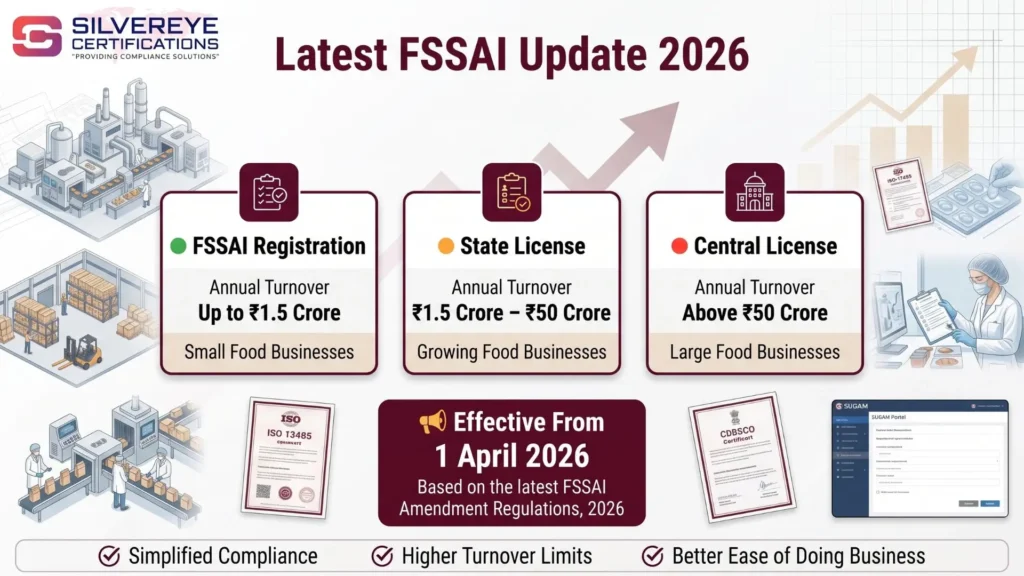
FSSAI's Order No. RCD-01002/1/2021-Regulatory-FSSAI-Part(1), dated 13 March 2026, revised the turnover thresholds for food business categorisation under the Food Safety and Standards (Licensing and Registration of Food Businesses) Amendment Regulations, 2026 (Gazette notification dated 10 March 2026), effective 1 April 2026. The FoSCoS Kind of Business Eligibility Matrix, updated 1 April 2026, confirms these thresholds apply identically across all three storage categories:
| License Type | Turnover Threshold (from 1 April 2026) | Annual Fee |
| Basic Registration | Annual turnover up to ₹1.5 crore | ₹100 |
| State License | Annual turnover above ₹1.5 crore up to ₹50 crore | ₹5,000 |
| Central License | Annual turnover above ₹50 crore | ₹7,500 |
Two other 2026 changes apply to storage and warehousing operators as well:
- Perpetual validity: licenses/registrations granted after 1 April 2026 no longer expire on a fixed 1–5 year term, subject to risk-based inspections.
- Automatic category upgrade: if your turnover crosses your current slab, FSSAI upgrades you automatically at no extra cost, keeping your existing 14-digit number.
Note: 100% Export-Oriented storage units, or storage facilities operating within Central Government agency, airport, or seaport premises, fall under separate activity-based Central License rules regardless of turnover — check the relevant KoB carefully if your facility fits one of these special categories.
The Three FSSAI Storage Kind of Business Categories Explained
Getting your Kind of Business selection right on FoSCoS matters — the wrong category can mean the wrong inspection standard, the wrong Tatkal eligibility, and potential rejection at application stage. Per FSSAI's official Kind of Business definitions, storage splits into three distinct types:
| Storage Category | Official FSSAI Definition | Typical Facilities |
| Storage (Cold/Refrigerated) | An activity where refrigerated or frozen food products, in packed or unpacked condition, are stored for further distribution in refrigeration/freezing storage facilities | Cold stores, blast freezers, frozen food distribution hubs, ice cream and dairy cold chains |
| Storage (Controlled Atmosphere + Cold) | An activity where food products, packed or unpacked, are stored in controlled-atmosphere facilities where oxygen, carbon dioxide, nitrogen concentration, temperature, and humidity are all regulated — generally used for dry commodities and agricultural produce | Fruit and grain CA storage facilities, specialised agri-commodity warehouses |
| Storage (except Controlled Atmosphere + Cold) | An activity where food products, packed or unpacked, are stored in ambient facilities without temperature or atmosphere control, also called warehouses or godowns | General FMCG warehouses, dry goods godowns, 3PL ambient storage facilities |
All three categories follow the same turnover-based fee structure shown above, but the practical compliance expectations differ significantly — a controlled-atmosphere facility will face closer scrutiny of its environmental monitoring systems than a simple ambient godown.
Storage vs Transportation: Don't Confuse These Two FSSAI Categories
If your business also moves food using specialized vehicles — insulated refrigerated vans, milk tankers, or similar carriers — that activity falls under FSSAI's separate 'Transportation' Kind of Business, not Storage. Many cold chain and 3PL businesses need both KoBs registered if they both store and transport food using specialized vehicles, so map out your actual operations before applying rather than assuming one license covers everything you do.
Eligibility and Compliance Requirements for Storage Facilities
- Premises must maintain hygienic conditions appropriate to the stored food category, with adequate pest control and cleaning protocols.
- Cold and controlled-atmosphere storage operators must maintain temperature/humidity monitoring and logging systems, since these parameters are core to food safety in this category.
- Stock rotation discipline — commonly FIFO (first-in-first-out) or FEFO (first-expiry-first-out) — is expected to prevent spoilage and expired stock reaching the market.
- Clear physical or procedural separation between different food categories (raw vs processed, allergen-containing vs allergen-free) helps prevent cross-contamination.
- A documented Food Safety Management System (FSMS), scaled to the complexity of the storage operation, is required for State and Central License applicants.
Documents Required for FSSAI Storage/Warehousing License
Common documents (all categories)
- Photo ID proof of the Food Business Operator (Aadhaar, PAN, Voter ID, Passport, or Driving License)
- Address proof of the storage/warehouse premises (electricity bill, rent agreement, or property tax receipt)
- List of food products/categories to be stored
- Passport-size photograph of the applicant
Additional documents for State/Central License
- Business constitution certificate — GST registration, Certificate of Incorporation, Partnership Deed, or Udyam Registration
- Layout plan of the storage facility, showing storage zones, loading/unloading areas, and temperature-controlled sections where applicable
- Details of refrigeration/temperature-control or controlled-atmosphere equipment, for cold and CA storage applicants
- Food Safety Management System (FSMS) plan
- Water testing report from an NABL-accredited laboratory, where applicable
- Partnership deed / MOA & AOA, and board resolution authorising the signatory, for companies

Step-by-Step FSSAI Application Process
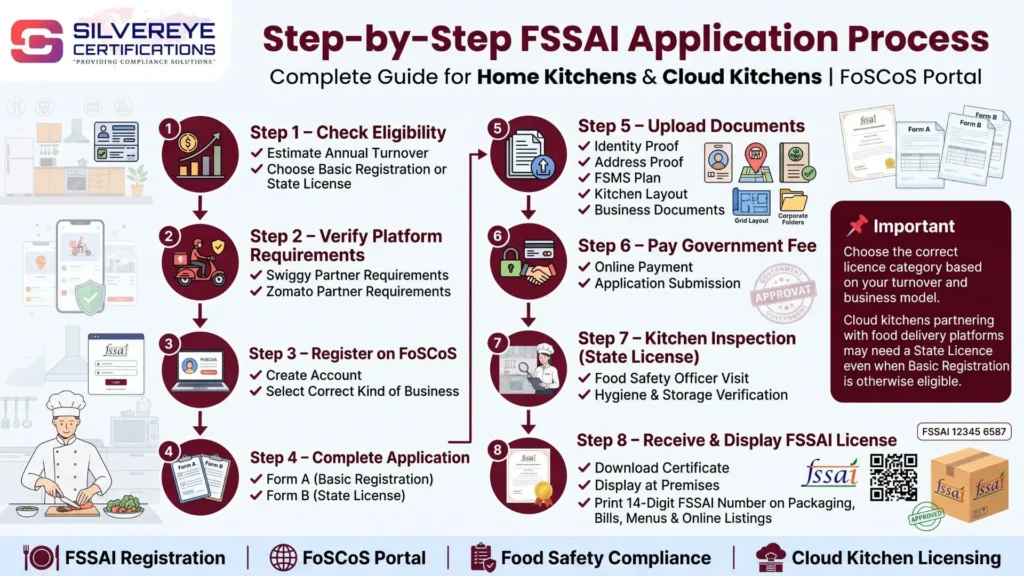
- Identify which of the three storage Kind of Business categories matches your facility — Cold/Refrigerated, Controlled Atmosphere + Cold, or general Storage.
- Confirm your turnover slab against the 2026 thresholds to determine Registration, State License, or Central License eligibility.
- Check Tatkal eligibility — storage without atmospheric control generally qualifies for instant issuance (subject to standard exclusions like dairy, meat, or fish handling), while cold storage and CA facilities typically follow the standard route.
- Register on the FoSCoS portal (foscos.fssai.gov.in) and select the correct storage KoB.
- Fill Form A (Basic Registration) or Form B (State/Central License), uploading the layout plan, equipment details, and FSMS plan as applicable.
- Pay the applicable government fee online.
- For State/Central applications outside Tatkal, a Food Safety Officer inspects the facility, checking temperature control, hygiene, and storage practices.
- On approval, display your FSSAI certificate at the premises and reference your 14-digit number on invoices and consignment documentation.
FSSAI Fee Chart for Storage and Warehousing Units
| License Category | Government Fee (per year) | Typical Timeline |
| Basic Registration | ₹100 | Instant via Tatkal (where eligible) or 7–10 working days standard |
| State License | ₹5,000 | Instant via Tatkal (where eligible, ambient storage only) or 30–60 working days standard |
| Central License | ₹7,500 | 60–90 working days (standard route only; not Tatkal-eligible) |
These are government fees only. Note that a Tatkal instant license/registration for storage is valid for 1 year only, unlike the standard route, which can be chosen for up to 5 years or now carries perpetual validity under the 2026 rules.
Renewal and Ongoing Compliance
- Perpetual validity: standard-route licenses granted after 1 April 2026 no longer expire on a fixed term, subject to risk-based inspections.
- Tatkal-issued approvals: valid for 1 year only; renewal after that follows the standard, non-instant process.
- Older, fixed-term licenses: renew at least 30 days before expiry to avoid the ₹100-per-day late fee.
- Annual Return (Form D-1): due by 31 May every year for State/Central License holders.
- Ongoing monitoring records: cold and controlled-atmosphere storage operators should maintain temperature/humidity logs on an ongoing basis, since these are typically checked during inspections, not just at the time of initial approval.
- Address changes: since FSSAI approval is premises-specific, adding a new warehouse or cold storage site requires its own application, not just an amendment to an existing one.
Penalties for Non-Compliance
Storing food for commercial distribution without valid FSSAI registration or license is a punishable offence under the FSS Act, 2006 — penalties of up to ₹5 lakh and imprisonment of up to six months apply for operating without a license. Beyond the legal penalty, poor storage practices that lead to spoiled or contaminated stock can trigger separate liability for the food safety incident itself, independent of the licensing violation.
Frequently Asked Questions
Is FSSAI license mandatory for a warehouse or cold storage business?
Yes. Any facility storing food — ambient, refrigerated, frozen, or under controlled atmosphere — for commercial distribution needs FSSAI Basic Registration or a State/Central License, based on turnover.
What are the different types of FSSAI storage licenses?
FSSAI recognises three storage Kind of Business categories: Storage (Cold/Refrigerated), Storage (Controlled Atmosphere + Cold), and Storage (except Controlled Atmosphere + Cold) — covering general warehouses and godowns.
What is the FSSAI license fee for a warehouse or cold storage unit?
₹100 per year for Basic Registration (turnover up to ₹1.5 crore), ₹5,000 per year for a State License (₹1.5 crore–₹50 crore turnover), and ₹7,500 per year for a Central License (above ₹50 crore turnover) — the same fee structure applies to all three storage categories.
Can a warehouse get an instant FSSAI license through the Tatkal scheme?
Storage without atmospheric control (general ambient warehouses/godowns) generally qualifies for Tatkal instant issuance, subject to standard exclusions like dairy, meat, or fish handling. Cold storage and controlled-atmosphere facilities typically go through the standard licensing route with inspection.
Do I need a separate license for food transport vehicles alongside my warehouse license?
Yes, if you operate specialised food transport vehicles like refrigerated vans or milk tankers — this falls under FSSAI's separate 'Transportation' Kind of Business, distinct from Storage.
What documents are required for a cold storage FSSAI license?
At minimum: photo ID, premises address proof, and product list. State and Central applications additionally need a layout plan, refrigeration/temperature-control equipment details, and an FSMS plan.
How long does it take to get an FSSAI license for a warehouse?
Ambient storage often qualifies for instant Tatkal issuance. Where the standard route applies, Basic Registration typically takes 7–10 working days, State Licenses 30–60 working days, and Central Licenses 60–90 working days.
Does a controlled-atmosphere storage facility need extra documentation?
Yes — since these facilities regulate oxygen, carbon dioxide, nitrogen, temperature, and humidity, applicants should be prepared to document their environmental control and monitoring systems in more detail than a standard ambient warehouse.
Do the 2026 turnover thresholds apply the same way to all three storage categories?
Yes. As confirmed by the FoSCoS Kind of Business matrix updated 1 April 2026, Cold/Refrigerated Storage, Controlled Atmosphere + Cold Storage, and general Storage all follow the identical turnover-based structure: Registration up to ₹1.5 crore, State License up to ₹50 crore, Central License above ₹50 crore.
Is FSSAI registration now valid for a lifetime for storage businesses?
Standard-route licenses/registrations granted after 1 April 2026 carry perpetual validity, subject to risk-based inspections. Tatkal instant issuances remain valid for 1 year only, regardless of this change.
What happens if I add a new warehouse location to my business?
Since FSSAI approval is premises-specific, a new storage location needs its own separate application — you cannot simply extend an existing license to cover an additional site.
What is the penalty for operating a food warehouse without an FSSAI license?
Operating without a valid FSSAI registration or license can attract a penalty of up to ₹5 lakh and imprisonment of up to six months under the FSS Act, 2006.