
- Selling food online — through your own website, Amazon, Flipkart, or quick commerce apps like Blinkit — requires a Central FSSAI License, regardless of your turnover, since e-commerce is an activity-based exception on FSSAI's Kind of Business matrix.
- The platform itself (Amazon, Flipkart, Blinkit) is separately required to hold its own Central FSSAI License as a Food Business Operator, and must verify and display every seller's FSSAI number before listing them.
- FSSAI mandates that any food product delivered through e-commerce must retain at least 30% of its shelf life, or a minimum of 45 days before expiry, whichever is greater, at the time of delivery.
- FSSAI licenses are premises-based — if you use Amazon FBA or Flipkart's fulfilment network, you generally need a separate FSSAI license for each fulfilment centre address storing your stock.
Introduction
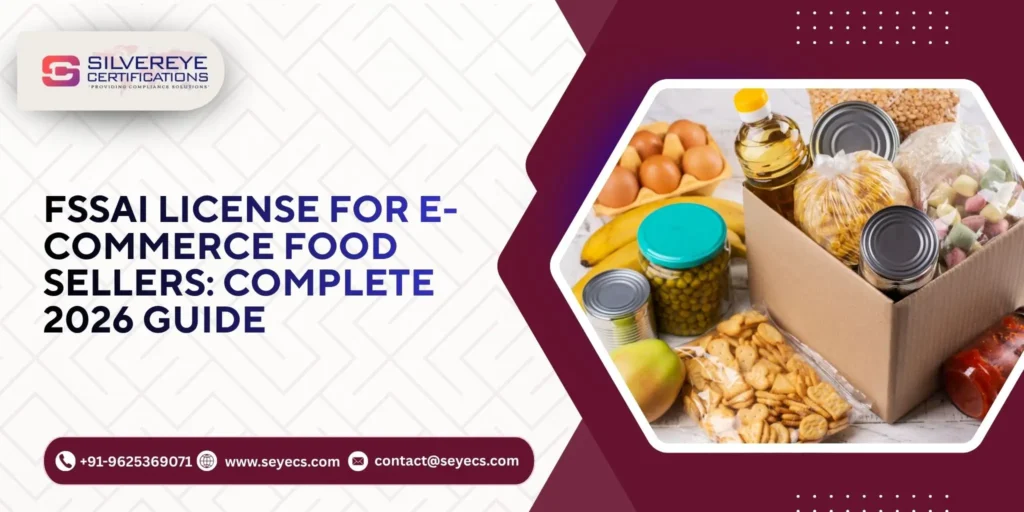
An FSSAI license for e-commerce food sellers is the mandatory Central License every business needs before selling food online — on Amazon, Flipkart, Blinkit, your own website, or any marketplace. Unlike most food businesses, turnover doesn't matter here: e-commerce is one of FSSAI's fixed activity-based exceptions, so a small D2C brand and a large FMCG seller both need the same ₹7,500/year Central License.
Beyond licensing, e-commerce sellers must follow FSSAI's shelf-life delivery rule (at least 30% shelf life or 45 days remaining at delivery), display their FSSAI number on both packaging and product listings, and — if using fulfilment centres like Amazon FBA — hold a separate license for each fulfilment centre address.
What Is an FSSAI License for E-Commerce Food Sellers?
An FSSAI license for e-commerce food sellers is the Central License issued by the Food Safety and Standards Authority of India to any business selling food online — whether through your own D2C website, a marketplace like Amazon or Flipkart, or a quick commerce app like Blinkit, Zepto, or Swiggy Instamart. This applies to packaged snacks, spices, health foods, beverages, and any other food product sold through a digital storefront.
FSSAI treats e-commerce as fundamentally different from a physical retail counter, because a single online listing can reach customers across every state simultaneously — which is exactly why it's one of the fixed categories that requires a Central License regardless of how small the seller actually is.
Why This License Matters for Amazon, Flipkart, and Blinkit Sellers
- Legal gateway: platforms are required to verify every seller's FSSAI number before activating a food listing — you cannot go live on Amazon, Flipkart, or Blinkit without it.
- Listing suspension risk: expired, missing, or invalid FSSAI numbers get listings pulled down, sometimes with little warning, directly hitting your sales and account standing.
- Consumer trust and transparency: FSSAI has specifically flagged unsupported product claims made by online sellers as a compliance concern — accurate labelling and claims matter more, not less, in the online environment.
- Scale readiness: getting your licensing structure right from day one — especially around fulfilment centres — avoids painful retrofitting once you're running significant volume through FBA-style warehousing.
2026 FSSAI Turnover Update: Why It Doesn't Reduce the E-Commerce Requirement
FSSAI's Order No. RCD-01002/1/2021-Regulatory-FSSAI-Part(1), dated 13 March 2026, revised the turnover thresholds for food business categorization under the Food Safety and Standards (Licensing and Registration of Food Businesses) Amendment Regulations, 2026 (Gazette notification dated 10 March 2026), effective 1 April 2026.
| License Type | Old Turnover Limit (pre-2026) | New Turnover Limit (from 1 April 2026) |
| Basic Registration | Up to ₹12 lakh | Up to ₹1.5 crore |
| State License | ₹12 lakh – ₹20 crore | Above ₹1.5 crore up to ₹50 crore |
| Central License | Above ₹20 crore | Above ₹50 crore |
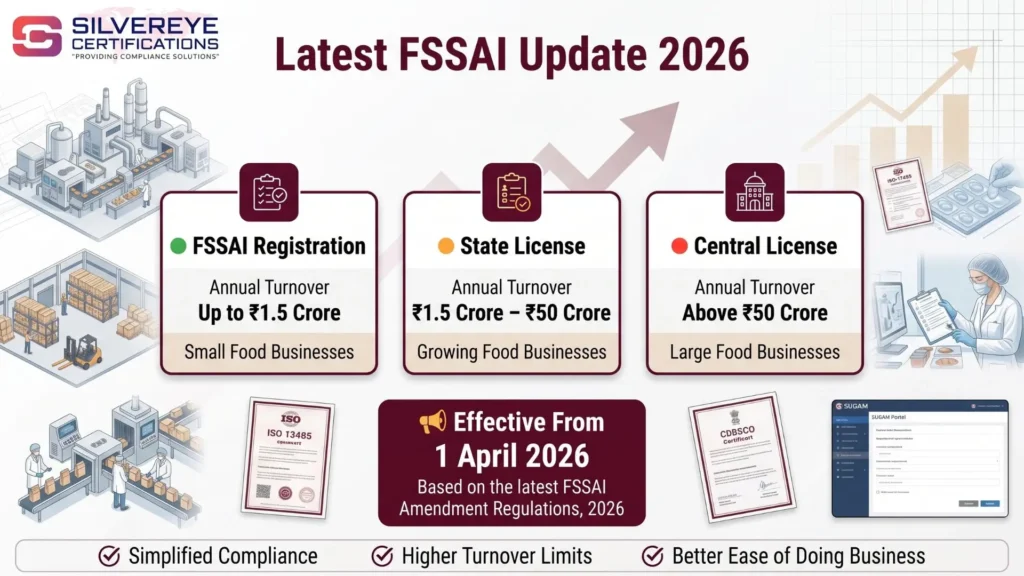
These slabs govern general food businesses by turnover. E-commerce is explicitly listed on the FoSCoS Kind of Business Eligibility Matrix as a 'no restriction on turnover threshold' category — meaning a first-time D2C seller with modest sales and an established FMCG brand selling through Amazon both need the same ₹7,500/year Central License.
This is one of the most common mistakes new online food sellers make: assuming their small turnover qualifies them for Basic Registration simply because the general 2026 threshold went up to ₹1.5 crore. It doesn't apply here — the activity itself (selling online) is what triggers the Central License requirement, not your revenue.
Platform Obligations vs Seller Obligations: Who Needs What
A lot of confusion around e-commerce FSSAI compliance comes from not separating two different sets of obligations — the platform's and the individual seller's. Both must be independently FSSAI-compliant; neither substitutes for the other.
| Party | FSSAI Obligation | License Type |
| The platform (Amazon, Flipkart, Blinkit, Swiggy, Zomato, etc.) | Must hold its own FSSAI license as a Food Business Operator, since it operates pan-India as the marketplace/aggregator | Central License, mandatory regardless of turnover |
| Individual seller / brand / D2C business selling food through the platform | Must hold its own separate FSSAI license, valid and current before listing any food product | Central License, mandatory regardless of turnover, since selling via e-commerce is itself the activity-based trigger |
| Platform's ongoing duty toward sellers | Must verify each seller's FSSAI number before onboarding, display it on the seller/listing page, and remove listings from sellers whose license has expired or been cancelled | Not applicable — platform responsibility, not a separate license |
The FSSAI Fulfilment Centre Rule: A Common Blind Spot for Amazon/Flipkart Sellers
FSSAI licenses are premises-based — issued for a specific address, not a business in the abstract. This creates a genuinely easy-to-miss requirement for sellers using Fulfilled by Amazon (FBA), Flipkart Assured, or similar fulfilment programmes: if your inventory is stored at a fulfilment centre, that address typically needs to be reflected on your FSSAI license, and if you use fulfilment centres across multiple states, you may need a separate license entry for each one.
- Kind of Business: sellers operating through a fulfilment centre generally select 'Retailer' as the relevant Kind of Business for that premises, since products are being sold from that location, even though you don't personally staff it.
- Multi-state fulfilment: if you're using FBA warehouses in more than one state, this pushes you toward needing licensing coverage in each state, in addition to your Central License for the e-commerce activity itself.
- Practical tip: before enrolling in FBA or a similar programme, check which specific warehouse addresses will hold your stock, and make sure your FSSAI documentation reflects them — retrofitting this after listings go live is far more disruptive than setting it up correctly from the start.
The FSSAI Shelf-Life Rule for Online Food Delivery
This is a rule specific to e-commerce and quick commerce that doesn't apply the same way to a physical retail shelf. Following an FSSAI advisory to e-commerce Food Business Operators, any food product delivered to a consumer through e-commerce must have at least 30% of its total shelf life remaining, or a minimum of 45 days before expiry — whichever gives the longer remaining period — at the exact time of delivery.
| Product Shelf Life | Minimum Remaining Life Required at Delivery |
| Short shelf life (e.g., a 10-day product like fresh butter) | At least 30% remaining — roughly 3 days |
| Long shelf life (e.g., a 3–6 month packaged product) | At least 45 days remaining, since 45 days is the higher of the two thresholds for longer-life items |
| Fresh food ordered from a restaurant or caterer through an app | Must be delivered fresh — the percentage/day rule doesn't apply the same way; freshness itself is the standard |
For sellers, this means inventory management and warehouse rotation (FIFO/FEFO) aren't just good practice — they're a compliance requirement, since selling near-expiry stock through a fast-moving online channel is exactly the scenario this rule was designed to prevent.
Display and Labelling Requirements on E-Commerce Listings
- FSSAI license/registration number must be displayed on the seller's profile or seller detail page on the platform (on Amazon, this is set under Seller Central > Settings > Your Info & Policies > About Seller).
- A clear, legible image of the complete label — the 'principal display panel' — must be available for customers to view before purchase, excluding only the batch/lot number, best-before date, expiry date, and manufacturing/packing date, since these vary by batch.
- Nutritional information, ingredient list, and any allergen declarations shown on the physical label should match what's shown in the online listing — inconsistency between the two is a compliance red flag.
- Any product claims made in the online listing (health claims, 'natural,' 'organic,' etc.) must be backed by the same substantiation required under FSSAI's Labelling and Display Regulations — FSSAI has specifically flagged unsupported online claims as an enforcement concern.
- Food and non-food items should be packed and delivered separately by the platform's logistics to avoid cross-contamination — a platform-level obligation, but worth knowing as a seller shipping through the platform's own fulfilment.
Documents Required for FSSAI License for E-Commerce Food Sellers
- Photo ID and address proof of the Food Business Operator / authorized signatory
- Business constitution certificate — Certificate of Incorporation, Partnership Deed, GST registration, or Udyam Registration
- Premises proof for your registered business address, and for each fulfilment centre address if using FBA/similar programmes (rent agreement or utility bill, geo-tagged as required by the current FoSCoS process)
- List of food product categories to be sold online
- Food Safety Management System (FSMS) plan
- Recall plan — a documented process for withdrawing unsafe stock, especially important given the speed and reach of online distribution
- Turnover proof and Form IX nomination of the responsible person, as required for Central License applications

Step-by-Step FSSAI Application Process for E-Commerce Sellers
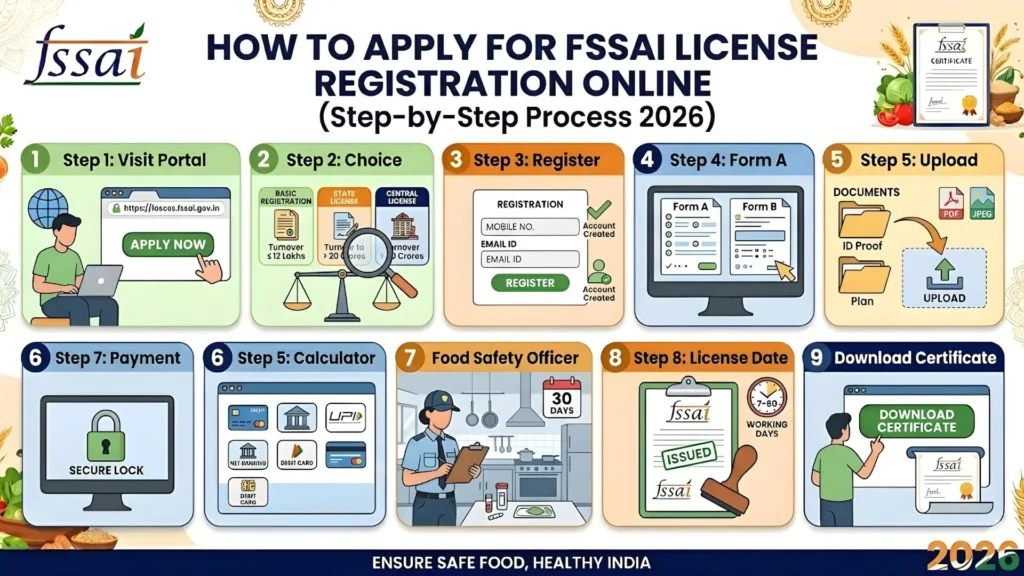
- Register on the FoSCoS portal (foscos.fssai.gov.in) and select 'E-Commerce' as your Kind of Business, under the Trade/Retail group.
- Fill Form B for the Central License, since e-commerce doesn't allow Basic or State License regardless of your scale.
- Map out every premises involved — your registered office, warehouse, and any third-party fulfilment centre addresses — before finalising your application, since retrofitting this later is disruptive.
- Upload your business constitution documents, FSMS plan, recall plan, and premises proof.
- Pay the ₹7,500 government fee online.
- Once approved, log in to FoSCoS and download your 14-digit FSSAI License Certificate.
- Add your FSSAI number to your seller profile on each platform you sell through (Amazon Seller Central, Flipkart Seller Hub, Blinkit's seller portal, etc.).
- Ensure your product listings include a clear label image and accurate claims matching your physical packaging before going live.
FSSAI Fee Chart for E-Commerce Food Sellers
| Requirement | Government Fee | Typical Timeline |
| Central FSSAI License (E-Commerce KoB) | ₹7,500 per year | 30–60 working days for first-time approval |
| Additional premises license (per fulfilment centre address, if applicable) | As per that premises' own applicable category/fee | Varies by state and premises type |
These are government fees only; consultancy charges, if you use an agent for document preparation and filing, are billed separately.
Renewal and Ongoing Compliance
- Perpetual validity: licenses granted after 1 April 2026 no longer expire on a fixed 1–5 year term, subject to risk-based inspections.
- Older, fixed-term licenses: renew at least 30 days before expiry to avoid the ₹100-per-day late fee — and to avoid a lapsed license triggering listing suspension on your sales platforms.
- Annual Return (Form D-1): due by 31 May every year for Central License holders.
- Shelf-life discipline: this isn't a one-time check at licensing — every single delivery is expected to meet the 30%/45-day rule, so inventory rotation needs to be an ongoing operational practice.
- Platform re-verification: some platforms periodically re-check seller FSSAI status, so keeping your license current avoids sudden listing takedowns.
Penalties for Non-Compliance
Selling food online without a valid FSSAI license is a punishable offence under the FSS Act, 2006 — penalties of up to ₹5 lakh and imprisonment of up to six months apply for operating without a license. Beyond the legal penalty, the more immediate business risk for most e-commerce sellers is losing platform access entirely: Amazon, Flipkart, and quick commerce apps will suspend or delist food sellers whose FSSAI number is missing, expired, or flagged as invalid, often with limited notice.
Frequently Asked Questions
Is FSSAI license mandatory for selling food on Amazon, Flipkart, or Blinkit?
Yes. Any business selling food through an e-commerce platform needs a Central FSSAI License, regardless of turnover — this applies to small D2C sellers and large brands alike.
Can a small e-commerce food seller get Basic Registration instead of a Central License?
No. E-commerce is one of FSSAI's fixed activity-based exceptions on the Kind of Business matrix — the general turnover thresholds don't apply here, and a Central License is required regardless of how small the business is.
Does the platform (Amazon, Flipkart, Blinkit) also need its own FSSAI license?
Yes. The platform itself is treated as a Food Business Operator and must hold its own Central FSSAI License, in addition to verifying and displaying the FSSAI number of every seller it lists.
What is the FSSAI shelf-life rule for online food delivery?
Food products delivered through e-commerce must have at least 30% of their total shelf life remaining, or a minimum of 45 days before expiry, whichever is greater, at the time of delivery to the consumer.
Do I need a separate FSSAI license for each Amazon fulfilment centre I use?
Generally yes, if your stock is stored across fulfilment centres in different states — FSSAI licenses are premises-based, so each fulfilment centre address typically needs to be reflected on your licensing.
Where do I display my FSSAI number on my Amazon or Flipkart seller account?
On your seller profile/seller detail page — on Amazon, this is under Seller Central > Settings > Your Info & Policies > About Seller — and it should also be reflected in your product listings and packaging.
What is the FSSAI license fee for an e-commerce food seller?
₹7,500 per year for the Central License, which is mandatory for this category regardless of business size.
Can I sell home-cooked or home-baked food through Amazon or Flipkart?
Generally not in the same form as a standard D2C listing — these platforms require packaged, properly labelled products meeting formal compliance standards; home-based food is more commonly sold through food delivery apps or direct social media channels rather than large e-commerce marketplaces.
What happens if my FSSAI license expires while I'm actively selling online?
Your listing risks suspension or removal by the platform, in addition to the legal risk of operating without a valid license — platforms are required to remove listings from sellers with expired or cancelled FSSAI licenses.
How long does it take to get a Central FSSAI License for an e-commerce food business?
Typically 30–60 working days for first-time approval, since Central License applications involve more detailed document review than Basic Registration or, in some cases, a premises inspection.