
FSSAI classifies food businesses by their Kind of Business (KoB), such as manufacturing, trading, retailing, importing, transportation, storage, restaurants and food services. Your KoB and the nature of your activities determine the applicable licensing requirements. Turnover is important, but it is not the only factor.
- Revised turnover thresholds: According to the FoSCoS eligibility matrix updated on 1 April 2026, the general turnover-based categories are:
- FSSAI Registration: Annual turnover up to ₹1.5 crore.
- State FSSAI License: Annual turnover above ₹1.5 crore and up to ₹50 crore.
- Central FSSAI License: Annual turnover above ₹50 crore.
- Activities requiring a Central License regardless of turnover: Certain food businesses have specific eligibility criteria. These include food importers, e-commerce operators, merchant exporters, 100% Export Oriented Units (EOUs), exporter-manufacturers, and manufacturers dealing in specified categories such as nutraceuticals and health supplements. The head or registered office of a food business operating in two or more States or Union Territories also requires a Central License. Other activity-specific rules and exceptions may apply.
- Multiple KoBs at one premises: A food business operator carrying out more than one eligible food-related activity at the same premises can generally include multiple applicable KoBs under a single FSSAI license or registration, subject to FoSCoS eligibility and approval requirements. Separate premises and activities must be assessed according to their applicable licensing conditions.
Important: Do not select an FSSAI license category based on turnover alone. First identify every food-related activity carried out by the business, check the applicable KoB in the latest FoSCoS eligibility matrix, and then determine the required licence or registration.
Introduction
Your FSSAI Kind of Business (KoB) category depends on the food-related activities your business carries out, such as manufacturing, trading, transportation, storage, importing or serving food. It is not determined by business size alone.
Under the revised FoSCoS eligibility criteria effective from 1 April 2026, most food businesses follow these turnover-based licensing categories:
- Basic FSSAI Registration: Annual turnover up to ₹1.5 crore.
- State FSSAI License: Annual turnover above ₹1.5 crore and up to ₹50 crore.
- Central FSSAI License: Annual turnover above ₹50 crore.
However, certain activities have specific licensing requirements and may require a Central FSSAI License regardless of turnover. These include food importing, e-commerce food business operations, specified nutraceutical and health supplement manufacturing activities, 100% Export Oriented Units (EOUs), and the head office or registered office of businesses operating in multiple States or Union Territories.
Use the checklist below to identify the Kind of Business (KoB) applicable to your activities. Then check the latest FoSCoS eligibility matrix to determine whether your business requires Basic Registration, a State License or a Central License. Always consider activity-specific conditions before relying on turnover alone.
What Is an FSSAI Kind of Business (KoB) — and Why Does It Matter?
A Kind of Business (KoB) is the category FSSAI uses to identify the food-related activities carried out by a Food Business Operator (FBO). These activities may include manufacturing, processing, repacking, trading, retailing, storage, transportation, importing, exporting or serving food.
When applying through the FoSCoS portal, you must select the KoB or KoBs that accurately describe your business operations. Your selection is important because it determines the applicable licensing category, supporting documents and activity-specific compliance requirements.
Your KoB can also affect whether your business is eligible for the Tatkal (instant) licensing or registration facility. FoSCoS maintains a separate list of eligible KoBs for this facility; eligibility does not mean every application is automatically approved.
Choosing an incorrect KoB can lead to application queries, delays, rejection or a license that does not correctly cover your business activities. This guide helps you identify the relevant category before applying.
2026 FSSAI Turnover Thresholds: The Starting Point for Most Categories
FSSAI revised the turnover thresholds under the Food Safety and Standards (Licensing and Registration of Food Businesses) Regulations, 2011, through the 2026 amendment and the subsequent order dated 13 March 2026.
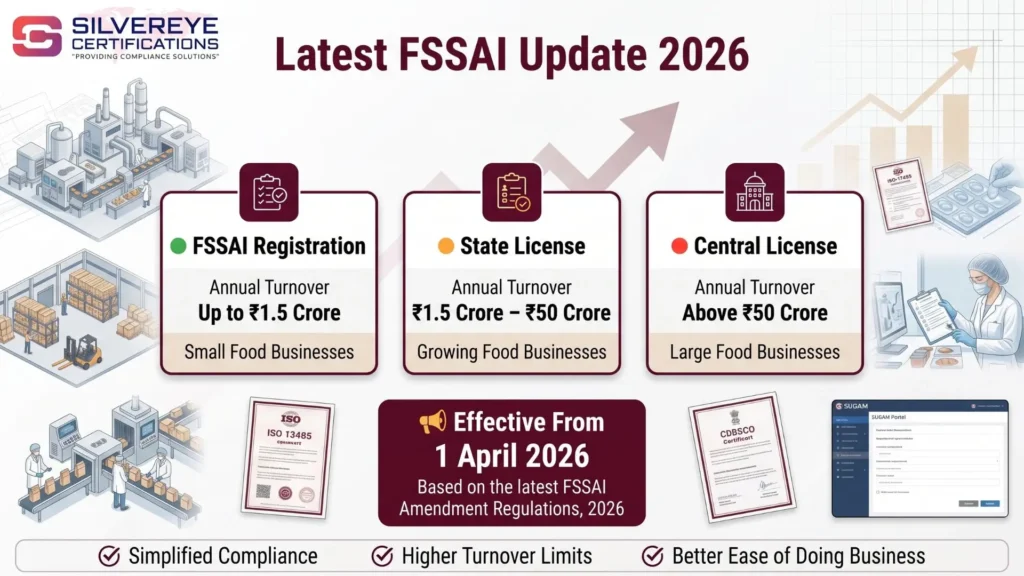
The revised thresholds became effective on 1 April 2026. For most eligible food business categories, the applicable licensing structure is:
| Licence or registration type | Annual turnover | General applicability |
|---|---|---|
| Basic FSSAI Registration | Up to ₹1.5 crore | Eligible small food businesses |
| State FSSAI Licence | Above ₹1.5 crore and up to ₹50 crore | Businesses falling under State licensing criteria |
| Central FSSAI Licence | Above ₹50 crore | Businesses crossing the Central licensing threshold |
Important: These are the general turnover thresholds, not a universal rule for every KoB. Certain activities and food categories have independent eligibility conditions. For example, importers, e-commerce operators, specified food or health supplement businesses, 100% Export Oriented Units and multi-state head offices have Central licensing requirements without a general turnover threshold. Some other categories, such as hotels, railway premises and certain manufacturing activities, also have specific criteria.
The exact KoB and its eligibility criteria must therefore be checked before deciding the licence type.
Step 1: Identify What You Actually Do With Food
Start by identifying every food-related activity carried out by your business. You may need to select more than one KoB if your business performs multiple activities.
Use this checklist to identify the categories that may apply:
- I manufacture, process, prepare or package food products myself (Manufacturer).
- I get food products manufactured or packed by a third-party factory and sell them under my own brand (Relabeller).
- I repack food products into different pack sizes without changing their nature, composition or formulation (Repacker).
- I purchase food in bulk and sell it to retailers or other businesses (Wholesaler).
- I distribute food products through the supply chain (Distributor).
- I sell food directly to consumers through a shop or retail outlet (Retailer).
- I store food products in warehouses, cold storage or controlled-atmosphere facilities (Storage).
- I transport food using vehicles or containers, including refrigerated vans and milk tankers (Transporter).
- I prepare and serve food or beverages to customers (Restaurant / Food Service).
- I bring food products or food ingredients into India from another country (Importer).
- I export food products to other countries (Exporter / Merchant Exporter / Exporter-Manufacturer, as applicable).
- I operate an online food business or an e-commerce platform involved in food transactions (E-commerce).
- I provide food catering services for events, institutions or government programmes (Caterer / Mid-Day Meal Caterer).
- I operate a food business at an airport, seaport, railway station or Central Government premises (Location-specific KoB).
- My food business operates in two or more States or Union Territories under the same organisation (Head Office / Registered Office).
This checklist is a starting point. The final KoB must match the definitions and eligibility conditions shown in the current FoSCoS matrix.
Step 2: Match Your Activity to the Correct FSSAI Kind of Business
The following table explains the major KoB categories and their general licensing basis under the FoSCoS eligibility matrix updated on 1 April 2026.
| What you do | FSSAI Kind of Business (KoB) | General licensing basis |
|---|---|---|
| Manufacture or process food products | Manufacturer | Generally turnover-based; specified product categories have separate Central Licence requirements |
| Get food manufactured or packed by a third-party manufacturer under your brand | Relabeller (under the Manufacturer group) | Based on the applicable manufacturing and product-category eligibility criteria |
| Repack food into different sizes without changing its nature or formulation | Repacker (under the Manufacturer group) | Based on the applicable manufacturing category and product details |
| Purchase food in bulk and sell it to retailers or resellers | Wholesaler | Generally turnover-based |
| Distribute food products through the supply chain | Distributor | Generally turnover-based |
| Sell food products directly to consumers | Retailer | Generally turnover-based |
| Store food in refrigerated or frozen facilities | Storage (Cold / Refrigerated) | Generally turnover-based |
| Store food in controlled-atmosphere and cold facilities | Storage (Controlled Atmosphere + Cold) | Generally turnover-based |
| Operate a warehouse or godown for food storage | Storage (Except Controlled Atmosphere + Cold) | Generally turnover-based |
| Transport food using specialised vehicles or containers | Transporter | Generally turnover-based |
| Prepare and serve meals and beverages, including takeaway and delivery | Restaurant | Generally turnover-based |
| Operate a hotel rated five stars or above | Hotel | Central Licence |
| Operate a hotel rated up to four stars | Hotel | State Licence, subject to the applicable eligibility criteria |
| Import food products or ingredients into India | Importer | Central Licence, regardless of turnover |
| Export food as a trader or merchant | Trader / Merchant-Exporter | Central Licence, regardless of turnover |
| Manufacture food specifically under the qualifying exporter-manufacturer category | Exporter-Manufacturer | Central Licence, regardless of turnover |
| Manufacture food exclusively for export under a qualifying 100% EOU | 100% Export Oriented Unit | Central Licence, regardless of turnover |
| Operate an e-commerce food business | E-commerce | Central Licence, regardless of turnover |
| Manufacture specified food or health supplements and nutraceuticals | Food or Health Supplements and Nutraceuticals | Central Licence, regardless of turnover |
| Manufacture proprietary food or non-specified food | Proprietary Food / Non-specified Food | Central Licence, subject to the applicable product approval requirements |
| Operate food businesses at Central Government agency premises | Central Government Agency Premises | Central Licence for the specified activities |
| Carry out food business activities at airport or seaport premises | Airport / Seaport Food Business | Central Licence for the specified activities |
| Operate a food business in two or more States or Union Territories | Head Office / Registered Office | Central Licence for the declared head office or registered office; each other operating premises needs its own applicable licence or registration |
| Prepare and supply meals under the Mid-Day Meal Scheme | Mid-Day Meal Caterer | Central or State Licence, depending on the applicable turnover criteria |
| Operate a canteen serving food under the Mid-Day Meal Scheme | Mid-Day Meal Canteen | State Licence or Registration, depending on turnover |
Important KoB Classification Notes
1. Manufacturer, Relabeller and Repacker are not interchangeable.
A manufacturer processes or manufactures food. A relabeller gets products manufactured or packed by another manufacturer or processor. A repacker changes the pack size without changing the food's nature, composition or formulation, subject to the FoSCoS definition. Select the category that reflects your actual role.
2. Importer and exporter are separate classifications.
An importer bringing food into India requires a Central License regardless of turnover. Exporters must identify the correct category, such as Trader/Merchant-Exporter, Exporter-Manufacturer or 100% Export Oriented Unit. The Central License requirement applies to the relevant categories listed in the FoSCoS matrix, not automatically to every business that makes an occasional overseas sale.
3. E-commerce does not mean every seller with an online listing.
The E-commerce KoB applies to food business operations falling within FSSAI's e-commerce classification. An ordinary retailer selling food through an online marketplace should not automatically assume that it needs a separate E-commerce KoB. The actual role of the business in the online food transaction must be assessed.
4. Specified food categories have independent requirements.
Manufacturers of food or health supplements, nutraceuticals, proprietary food, non-specified food and Ayurveda Aahara may require a Central Licence regardless of turnover. Non-specified food and food ingredients may also require separate product approval from FSSAI before the licensing application.
5. Multi-state businesses need to consider every operating premises.
A business carrying out food activities in two or more States or Union Territories must declare one Head Office or Registered Office and obtain the applicable Central License for it. Each other food business premises must obtain its own license or registration based on its activities and eligibility.
6. Food businesses at specific locations have separate criteria.
Activities at Central Government agency premises, airports, seaports and railway stations may follow special licensing provisions. Do not automatically apply the general restaurant or retailer turnover table to these locations.
Step 3: Check Whether Your Business Requires a Central FSSAI License Regardless of Turnover
This is one of the most important checks before applying for an FSSAI license. Although most food businesses follow the revised turnover thresholds, certain Kinds of Business (KoBs) require a Central License without a general turnover limit.
According to the FoSCoS eligibility matrix updated on 1 April 2026, the following activities have specific Central Licence requirements:
- Food importers: Businesses importing food products, food ingredients or additives for commercial purposes.
- E-commerce food businesses: FBOs operating under the E-commerce KoB.
- Food or health supplement and nutraceutical manufacturers: Businesses manufacturing products covered under the applicable FSSAI regulations, including specified Foods for Special Dietary Use (FSDU).
- Proprietary food manufacturers: Businesses manufacturing food products classified as proprietary food under FSSAI regulations.
- Non-specified food and food ingredient businesses: These require the applicable product approval before the licensing application, where prescribed.
- Ayurveda Aahara manufacturers: Businesses manufacturing products classified as Ayurveda Aahara under the relevant FSSAI regulations.
- Radiation processing facilities: Businesses carrying out food irradiation or radiation processing.
- 100% Export Oriented Units (EOUs): Qualifying manufacturers or processors with the required EOU certification and export-only operations.
- Exporter-manufacturers: Manufacturers producing food for export that does not comply with Indian food standards but complies with the importing country's requirements.
- Trader/Merchant-exporters: Businesses exporting food products under the applicable merchant-exporter category.
- Five-star and higher-rated hotels: Hotels classified as five-star or above under the applicable eligibility criteria.
- Food businesses at Central Government agency premises: Specified activities such as storage, wholesale, distribution and retail.
- Food businesses at airport and seaport premises: Specified activities such as storage, wholesale, distribution and retail.
- Multi-state food businesses: The declared head office or registered office of an FBO carrying out food business activities in two or more States or Union Territories must obtain a Central Licence.
Important exceptions to understand
Not every food business connected with exports, online sales or government institutions automatically falls into the same category. The precise KoB definition and eligibility conditions matter.
For example:
- A Mid-Day Meal Caterer follows the turnover-based criteria in the revised matrix: State Licence up to ₹50 crore and Central Licence above ₹50 crore.
- A Mid-Day Meal Canteen follows a separate category, with Registration up to ₹1.5 crore and State Licence above that threshold.
- Food service establishments at Central Government premises have specific provisions, including separate Central Licence and Central Registration criteria.
- Food businesses at railway stations also have separate Central Railway licensing and registration provisions.
Before applying: Check the exact activity in the latest FoSCoS eligibility matrix. Do not assume that every exporter, caterer, online food seller or food service provider requires a Central Licence simply because it operates in one of these broad sectors.
Step 4: Understand How Multiple KoBs Work Under One FSSAI License
Food businesses often carry out more than one activity from the same premises. For example, a manufacturer may also wholesale its products, or a restaurant may sell packaged food from a retail counter.
In such cases, you generally do not need a separate FSSAI license for every activity at the same premises. Multiple applicable KoBs can be endorsed under one license or registration for that premises, subject to the relevant eligibility conditions and FoSCoS requirements.
However, separate operating premises generally require separate licences or registrations. A multi-state business must also obtain a Central Licence for its declared head office or registered office.
| Business scenario | General FSSAI licensing approach |
|---|---|
| You manufacture snacks and wholesale them from the same factory premises | One licence with the applicable Manufacturer and Wholesaler KoBs endorsed |
| You operate a restaurant and sell packaged snacks from a retail counter at the same premises | One licence with the applicable Restaurant and Retailer KoBs endorsed |
| You operate a manufacturing unit in Maharashtra and a separate warehouse in Gujarat | Separate licensing or registration for each premises, based on its activities and eligibility |
| You operate a food transport business with multiple specialised vehicles | Apply under the Transporter KoB and follow the applicable licensing conditions; do not assume that vehicle count creates an automatic exemption from premises-related requirements |
| Your company operates food businesses in five States | A Central Licence for the declared head office or registered office, plus the applicable licence or registration for each other operating premises |
Can One FSSAI License Cover Manufacturing and Trading?
Yes, where the activities are carried out from the same premises and the relevant KoBs are eligible to be included together.
For example, if a company manufactures packaged snacks and also sells them wholesale from the same factory premises, it can apply for the applicable Manufacturer and Wholesaler categories under one license.
However, if the company operates a separate warehouse or retail outlet at another address, that location must be assessed separately.
Remember: One license per premises does not mean one license for every location operated by the company. Each food business premises must meet its own applicable licensing requirements.
Common FSSAI Kind of Business Mistakes to Avoid
Selecting the wrong KoB can result in application queries, incorrect licence coverage and avoidable compliance problems. Watch out for these common mistakes:
- Selecting the disabled Supplier or Marketer KoB: FSSAI disabled these categories on FoSCoS from 16 September 2021 because their activities overlapped with other KoBs. Businesses involved in supplying food should identify the appropriate category, such as Distributor, Wholesaler or Transporter.
- Selecting Trader instead of Relabeller: If you get food manufactured or packed by a third-party manufacturer and sell it under your own brand, the applicable category is generally Relabeller under the Manufacturer group.
- Treating storage and transportation as the same activity: These are separate KoBs. A business operating a cold-storage facility and independently transporting food may need both categories.
- Choosing Registration based only on turnover: Importers, e-commerce operators and other activity-based categories may require a Central Licence regardless of turnover.
- Selecting the wrong storage category: FoSCoS distinguishes between Cold/Refrigerated Storage, Controlled Atmosphere + Cold Storage and Storage (Except Controlled Atmosphere + Cold).
- Ignoring additional activities at the same premises: If you manufacture and wholesale food from one location, check whether both KoBs need to be endorsed on the licence.
- Using one licence for separate premises: A licence for a factory does not automatically cover a separate warehouse, retail outlet or restaurant.
- Assuming every exporter requires the same licence route: Check whether your business falls under Trader/Merchant-Exporter, Exporter-Manufacturer or 100% Export Oriented Unit criteria.
- Overlooking product-specific licensing requirements: Nutraceuticals, proprietary food, non-specified food and Ayurveda Aahara have separate regulatory conditions in addition to the KoB selection.
FSSAI License Fee Summary by Category
The revised FoSCoS matrix provides the following general annual fee structure for most food business categories from 1 April 2026:
| Licence or registration type | General annual fee | Typical eligibility |
|---|---|---|
| Basic FSSAI Registration | ₹100 | Eligible businesses with turnover up to ₹1.5 crore |
| State FSSAI Licence | ₹5,000 | Eligible businesses with turnover above ₹1.5 crore and up to ₹50 crore |
| Central FSSAI Licence | ₹7,500 | Eligible businesses with turnover above ₹50 crore or specific activity-based Central Licence requirements |
Special fee provisions: Certain food businesses have different fees. For example, the FoSCoS matrix specifies a ₹2,000 annual fee for certain Central Government agency food catering licenses and Central Railway licenses. Hawker registration and certain Anganwadi registrations also have fee waivers under the applicable provisions.
The actual fee depends on the selected KoB, license category and applicable eligibility criteria. Check the current FoSCoS fee structure before submitting an application.
Documents You'll Generally Need for an FSSAI Application
FSSAI does not require every applicant to submit an identical set of documents. The checklist depends on the selected Kind of Business, licence category, premises and business activity.
The following are common document categories to prepare:
| Document or information | Why it may be required |
|---|---|
| Identity and address proof of the proprietor, authorised signatory or relevant applicant | Establishes the identity of the applicant |
| Business constitution documents | Establishes the legal status of the business, such as proprietorship, partnership or company |
| Address proof of the food business premises | Verifies the location where the food activity is carried out |
| List of food products and food categories | Identifies the products handled or manufactured |
| Layout plan of the premises | Shows the arrangement of manufacturing, processing or storage areas, where applicable |
| Food Safety Management System (FSMS) plan | Describes food safety controls and procedures |
| Manufacturing or processing details | Explains the production process and relevant technical arrangements |
| Equipment and machinery details | Supports applications involving manufacturing or processing |
| Import Export Code (IEC) and relevant declarations | Supports applicable importer or exporter applications |
| Third-party manufacturer details and relevant declarations | May be required for Relabeller applications |
| Product labels and packaging information | Supports applicable product and labelling checks |
| Water analysis report | Required where applicable to the activity and source of water |
| No Objection Certificate (NOC) or other permissions | Required where specified by the relevant authority or category |
| Premises-specific declarations and supporting records | Supports the selected KoB and licensing conditions |

Where Can You Check the Exact Document Checklist?
FoSCoS provides a KoB-wise document requirement facility. Select the relevant Kind of Business and licence category to identify the documents required for your application.
Do not upload unrelated documents simply to make the application appear more complete. Prepare the documents applicable to your actual business activity and follow the current FoSCoS instructions.
Validity and Renewal: What Applies Across All KoBs?
The FSSAI reforms effective from 1 April 2026 introduced perpetual validity for food business licences and registrations. However, perpetual validity does not mean that businesses are exempt from fees, food safety requirements or other statutory obligations.
- Perpetual validity: FSSAI licences and registrations issued on or after 1 April 2026 remain valid unless they are suspended, cancelled or surrendered. Food Business Operators (FBOs) no longer need to renew them periodically under the revised framework.
- Tatkal applications: Perpetual validity also applies to licences and registrations issued through the Tatkal or instant-issuance facility. FSSAI's official FAQ expressly confirms that the revised validity provisions apply to Tatkal approvals as well. They are not restricted to a one-year validity period.
- Fee payment: Perpetual validity does not mean that the licence or registration is free. FBOs can choose to pay the applicable fee for the number of years they select. FSSAI's March 2026 FAQ clarifies that fees can be paid for multiple years at once or at any time during the year.
- Annual returns: Form D-1 is not mandatory for every KoB. It generally applies to licensed manufacturers, including repackers and relabellers, importers and manufacturer-exporters. The usual deadline is 31 May for the previous financial year's activities. Manufacturers of milk and milk products have separate half-yearly return requirements under Form D-2.
- Risk-based inspections: Perpetual validity does not remove FSSAI's inspection and enforcement powers. Food businesses remain subject to applicable hygiene, safety, testing and other compliance requirements. FSSAI's revised framework provides for risk-based inspections, taking compliance history and other relevant factors into account.
- Turnover-based category migration: FSSAI introduced revised turnover thresholds from 1 April 2026: Registration up to ₹1.5 crore, State Licence above ₹1.5 crore and up to ₹50 crore, and Central Licence above ₹50 crore. For migration required because of these revised thresholds, FSSAI states that FoSCoS will make the change automatically based on the FBO's self-declaration, without separate approval or a modification fee. The existing 14-digit licence or registration number remains unchanged. This should not be confused with an automatic upgrade every time a business's turnover increases; FBOs must check the applicable KoB eligibility and follow the relevant modification or migration procedure.
Important: Always check the current status of your licence or registration on the official FoSCoS portal and follow any applicable filing, fee-payment, modification and inspection requirements.
Common Mistakes to Avoid When Selecting an FSSAI KoB
Selecting the wrong Kind of Business can lead to application queries, incorrect licensing and compliance problems. Avoid these common mistakes before submitting your application:
- Selecting a KoB based only on turnover: Turnover is important, but it is not the only eligibility factor. Activities such as importing, e-commerce, proprietary food manufacturing and certain specialised food operations may have separate licensing criteria.
- Choosing Manufacturer instead of Relabeller: If a third-party manufacturer produces or packs food under your brand, the Relabeller category may apply. Do not select the ordinary Manufacturer category without checking the actual business arrangement.
- Ignoring separate premises: A licence for one operating premises should not be assumed to cover every branch, warehouse or manufacturing unit. Check the applicable premises-wise licensing requirements.
- Selecting an incorrect storage or transportation category: Ordinary storage, cold storage, controlled-atmosphere storage and specialised food transportation are distinct activities. Select the KoB that accurately describes the service being provided.
- Assuming every food seller needs the same KoB: A retailer, wholesaler, distributor, direct seller and e-commerce operator may fall under different categories. The correct selection depends on the actual role performed in the food supply chain.
- Assuming every exporter follows the same licensing route: Merchant-exporters, manufacturer-exporters and qualifying 100% Export Oriented Units have specific eligibility conditions. Check the relevant category rather than applying a blanket exporter rule.
- Ignoring annual return obligations: Manufacturers, repackers, relabellers, importers and manufacturer-exporters should check whether Form D-1 applies to them. Milk and milk product manufacturers should also check their separate Form D-2 filing requirements.
- Treating perpetual validity as exemption from compliance: A licence may remain valid indefinitely, but food safety standards, hygiene conditions, applicable returns, fee obligations and regulatory directions still need attention.
- Uploading an incomplete or incorrect document set: Document requirements vary by KoB. Use the FoSCoS document checklist for the selected activity instead of relying on a generic list.
- Assuming application submission guarantees approval: The licensing authority may examine the application, raise queries or require an inspection, depending on the applicable category and circumstances.
Why Choose Silvereye Certifications for FSSAI Registration and Licensing?
Choosing the correct FSSAI Kind of Business is an important step in obtaining the appropriate food business registration or licence. Silvereye Certifications (SEYECS) provides consultancy and application support to help businesses understand the applicable requirements and prepare their applications.
With Silvereye Certifications, businesses can get support with:
- KoB identification: Guidance on selecting the appropriate Kind of Business based on the actual food-related activities.
- Eligibility assessment: Assistance in understanding the applicable Registration, State Licence or Central Licence criteria.
- Document preparation: Help with identifying and organising the documents required for the selected KoB.
- Application assistance: Support with completing the FoSCoS application and submitting the relevant information.
- Application query guidance: Assistance in understanding and responding to queries raised during the application process.
- Modification and compliance guidance: Support in understanding applicable licence modifications, turnover-related category migration and other relevant requirements.
Silvereye Certifications provides consultancy and documentation support. FSSAI and the authorised licensing or registering authorities are responsible for issuing, modifying, suspending or cancelling licences and registrations. The final decision rests with the competent authority, and approval cannot be guaranteed.
Conclusion
Selecting the correct FSSAI Kind of Business is essential for obtaining the appropriate registration or licence and meeting food safety requirements in India. The revised framework effective from 1 April 2026 has introduced perpetual validity, updated turnover thresholds and a risk-based inspection approach. However, businesses must still select the correct KoB, maintain applicable food safety standards, pay the required fees and fulfil their return-filing and other statutory obligations.
Before applying, review your actual business activities, operating premises, product categories and turnover against the latest FSSAI eligibility criteria. If you need assistance with KoB selection, document preparation or the FoSCoS application process, Silvereye Certifications can provide professional consultancy and application support.
Frequently Asked Questions
What is a Kind of Business (KoB) in FSSAI licensing?
A Kind of Business is FSSAI's classification of what your food business actually does — manufacturing, trading, transporting, storing, importing, and so on — selected during your FoSCoS application alongside your turnover-based license category.
Can I select more than one Kind of Business on my FSSAI license?
Yes. A single FSSAI license issued for one premises can have multiple Kind of Business categories endorsed on it, as long as all those activities happen at that same premises.
Which businesses need a Central License regardless of turnover?
Importers, exporters, e-commerce food sellers, nutraceutical/health supplement manufacturers, proprietary food manufacturers, 100% Export-Oriented Units, businesses at airports/seaports or Central Government premises, 5-star and above hotels, and multi-state head offices, among others.
What KoB should I select if I outsource manufacturing to a third party?
You should apply under the Relabeller category, which sits under the Manufacturer Group on FoSCoS — not as a simple trader — since you're responsible for the branded product even though a third party made it.
Is 'Supplier' or 'Marketer' still a valid FSSAI Kind of Business?
No. Both categories were disabled on FoSCoS from 16 September 2021 due to overlapping activity with other KoBs. If you supply food, apply under Distributor, Wholesaler, or Transporter instead.
Do storage and transportation need separate FSSAI licenses?
They're separate Kind of Business categories, but can often be endorsed on the same license if operated from the same premises. Transportation has a special rule: one license covers all vehicles for a single transporter/business, regardless of location.
How many FSSAI licenses does a multi-state business need?
The declared head office/registered office needs a Central License, and each other state location needs its own separate license, assessed on that location's own turnover or activity-based eligibility.
What's the difference between the three FSSAI storage categories?
Storage (Cold/Refrigerated) covers refrigerated/frozen food; Storage (Controlled Atmosphere + Cold) covers facilities with regulated oxygen, carbon dioxide, nitrogen, temperature, and humidity for commodities like grains and produce; and general Storage covers ambient warehouses and godowns without any atmosphere control.
Does my Kind of Business affect whether I can use the Tatkal instant-issuance scheme?
Yes. Tatkal is available for specific low-risk KoBs — including wholesalers, distributors, retailers, transporters, and ambient storage — but generally excludes dairy, meat, fish-handling businesses, and cold/controlled-atmosphere storage.
I run a cloud kitchen that also does small-batch manufacturing for retail. What KoB do I need?
You'd typically need both 'Restaurant/Food Service' and 'Manufacturer' KoBs endorsed on your license, since these are treated as distinct activities even when run from the same premises.
Does selecting the wrong Kind of Business cause application delays?
Yes — it's one of the most common reasons FoSCoS applications get sent back or delayed, since the wrong KoB can trigger the wrong document checklist, inspection requirement, or license category.
How often does FSSAI update the Kind of Business Eligibility Matrix?
Periodically — the matrix was last confirmed updated on 1 April 2026 alongside the revised turnover thresholds. Always check the live FoSCoS portal for the current version before finalising your application.