
- Importing attar? You generally need a CDSCO Import Registration Certificate (Form COS-2) before importing it into India.
- Making attar to sell in India? You generally need a cosmetic manufacturing licence from the State Licensing Authority.
- What follows: This guide covers fees, documents, labelling, validity, renewal and 12 FAQs, based on CDSCO requirements and updated for 2026.
Does Attar Require CDSCO Registration?
In most cases, yes. Attar meets the legal definition of a cosmetic when it is intended to be applied to the body for fragrance. If you import attar, you need a CDSCO Import Registration Certificate in Form COS-2. If you make attar for sale in India, you need a cosmetic manufacturing license — Form COS-8, or Form COS-9 for a loan license — from your State Licensing Authority, not directly from CDSCO. Exporters and small resellers may have different requirements depending on their activities. Fees, documents and timelines are explained below.
Is Attar Considered a Cosmetic in India?
Attar, also spelt ittar or itr, is a natural perfume oil traditionally made by distilling flowers, woods or herbs into a base such as sandalwood oil. People commonly apply it to the wrists, neck or clothes. This intended use is important when determining how the product is regulated.
Section 3(aaa) of the Drugs and Cosmetics Act, 1940 defines a cosmetic as an article intended to be rubbed, poured, sprinkled, sprayed or otherwise applied to the human body for cleansing, beautifying, promoting attractiveness or altering appearance. The definition also covers articles intended to be used as components of cosmetics.

Therefore, attar intended for application to the body as a fragrance generally falls within the cosmetic framework.
We did not find an attar-specific exemption in the Drugs and Cosmetics Act, the Cosmetics Rules, 2020, or CDSCO's general import guidance. For regulatory purposes, attar intended for use as a personal fragrance is generally treated as a perfume-type cosmetic.
What Happens If Attar Is Sold for Religious or Incense Use?
The intended use and presentation of the product matter. A product sold exclusively for ritual, religious or room-use purposes, without instructions or claims for application to the body, may require a different regulatory assessment.
However, many attar products are marketed and used as personal fragrances. If your product falls into a grey area, it is better to obtain a written classification view before launching or importing the product, rather than waiting until an inspection or regulatory query.
Does Attar Need CDSCO Registration or a State Manufacturing License?
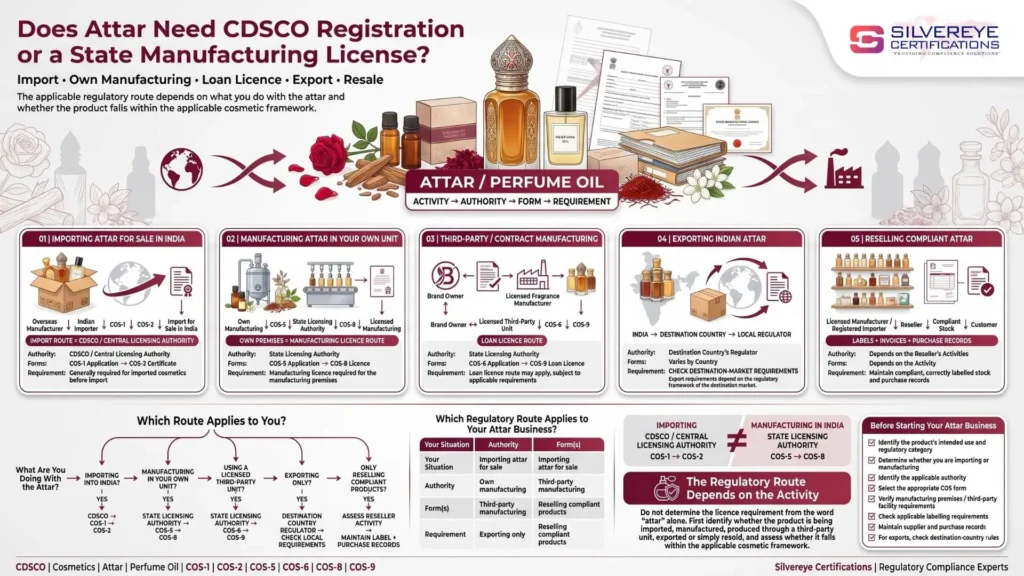
The applicable requirement depends on what you do with the attar. CDSCO Registration and the State Licensing Authorities have different roles under the cosmetics regulatory framework.
| Your situation | Authority | Form(s) | Requirement |
|---|---|---|---|
| Importing attar or perfume oil into India for sale | CDSCO / Central Licensing Authority | COS-1 application, COS-2 certificate | Generally required for imported cosmetics before import |
| Manufacturing attar in your own unit for sale in India | State Licensing Authority | COS-5 application, COS-8 licence | Manufacturing licence required for the manufacturing premises |
| Manufacturing attar through a licensed third-party unit | State Licensing Authority | COS-6 application, COS-9 loan licence | Loan licence route may apply, subject to the applicable requirements |
| Exporting Indian attar only | Destination country's regulator | Varies by country | Check the regulatory requirements of the destination market |
| Reselling compliant attar purchased from a licensed manufacturer or registered importer | Depends on the reseller's activities | Depends on the activity | Maintain compliant, correctly labelled stock and purchase records |
What Is the Difference Between CDSCO Registration and a State Cosmetic License?
This is an important distinction.
When people search for "CDSCO registration for attar," they may be referring to two different regulatory routes.
For an importer, the relevant route is the cosmetic import registration through CDSCO, including the COS-1 application and COS-2 certificate.
For an Indian manufacturer, the relevant route is a cosmetic manufacturing licence issued by the State Licensing Authority where the manufacturing premises is located, such as COS-8 or the applicable COS-9 loan licence route.
Both operate under the same broader cosmetics law, but the authority, application and licence/registration are different.
What Are the Benefits of Attar Registration and Licensing?
Getting the correct registration or manufacturing licence can provide several practical benefits for an attar business:
- Legal compliance: Imported cosmetics must meet the applicable registration requirements, while domestic manufacturing requires the appropriate manufacturing licence.
- Buyer and retailer confidence: Distributors, retailers and marketplace partners may ask for regulatory documents before onboarding a product.
- Clear regulatory identification: Indian-made cosmetics and imported cosmetics carry the applicable licence or registration details as required by the labelling rules.
- Better product control: Maintaining proper ingredient records, specifications and quality documentation helps support product consistency and regulatory compliance.
- Easier business expansion: Once your regulatory framework is properly established, you can manage additional variants and product changes through the applicable amendment or approval process rather than treating every change as a completely new business setup.
- Lower compliance risk: Proper documentation and compliant manufacturing or import practices can help reduce the risk of regulatory queries, product issues and enforcement action.
What Claims Can You Make for Attar?
Attar marketed as a cosmetic should be presented consistently with its cosmetic intended use. Avoid claims suggesting that the product treats, cures or prevents diseases or medical conditions.
For example, claims such as "cures headaches" or "treats anxiety" can create regulatory concerns because they go beyond a normal fragrance or cosmetic claim.
A safer approach is to keep the product presentation focused on its fragrance, cosmetic or beautifying purpose, where that accurately reflects the product's intended use.
Who Can Apply for Attar Registration or a Manufacturing License?
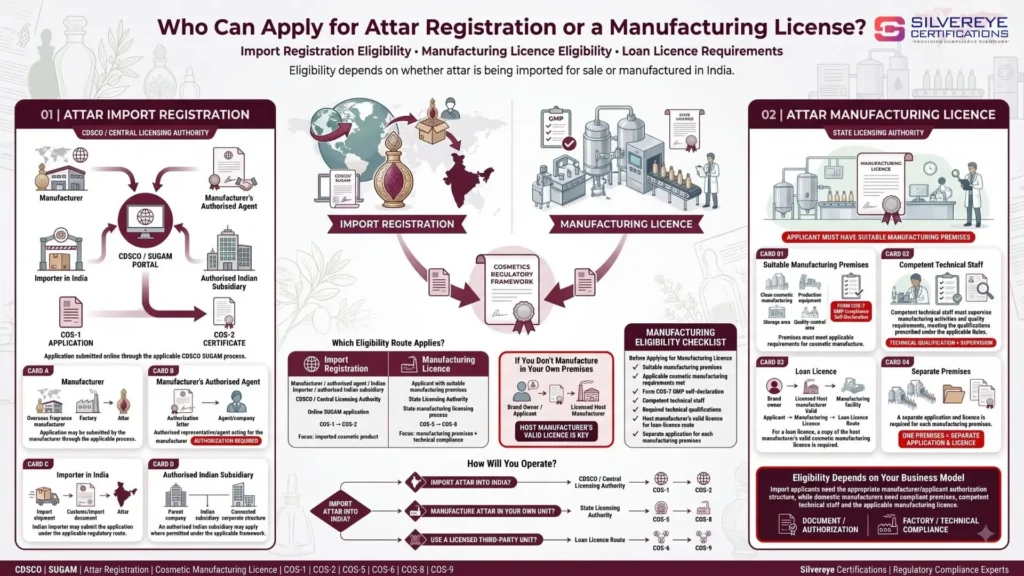
The eligibility requirements depend on whether you are importing attar or manufacturing it in India.
Who Can Apply for Attar Import Registration?
For cosmetic import registration, the application is filed online through the CDSCO SUGAM portal. Depending on the applicant structure, it may be submitted by the manufacturer, the manufacturer's authorised agent or importer in India, or an authorized Indian subsidiary.
The application is submitted to the Central Licensing Authority/CDSCO in accordance with the applicable Cosmetics Rules.
Who Can Apply for an Attar Manufacturing License?
For manufacturing attar in India, the applicant must have a premises that meets the applicable cosmetic manufacturing requirements.
Key requirements include:
- Suitable manufacturing premises that meet the requirements for cosmetic manufacture, supported by the required Form COS-7 self-declaration on GMP compliance.
- Competent technical staff to supervise manufacturing activities and quality requirements, meeting the qualifications prescribed under the Rules.
- For a loan licence, a copy of the host manufacturer's valid cosmetic manufacturing licence is required.
- A separate application and licence is required for each manufacturing premises.
What Product Requirements Must Attar Meet?
Getting registration or a manufacturing licence is only one part of compliance. The attar itself must also meet the applicable requirements under the Cosmetics Rules, 2020 and relevant standards.
Ingredients
Raw materials prohibited under the applicable IS 4707 (Part 2) requirements must not be used. Ingredients should be properly identified using standard nomenclature, along with the applicable percentages and formulation records.
Colours and Heavy Metals
Only permitted colours, dyes and pigments may be used where applicable. Colouring materials must comply with the relevant requirements of IS 4707 and the applicable Schedule.
The applicable limits for arsenic, lead and other heavy metals should be verified against the current standard and product formulation rather than assumed from general industry limits.
Mercury
Finished cosmetics must comply with the applicable mercury limits under the relevant standards and Cosmetics Rules.
Quality Standards
Attar marketed as a cosmetic must comply with the applicable quality and safety standards, including the relevant specifications under the Cosmetics Rules and applicable standards.
Animal Testing
Cosmetics tested on animals after 12 November 2014 are subject to import restrictions under the applicable requirements. Import documentation may therefore require an appropriate manufacturer undertaking regarding animal testing.
Claims and Advertising
Cosmetic claims must not be false or misleading. Avoid presenting attar as a product that cures, treats or prevents diseases or medical conditions unless a different regulatory framework specifically permits such claims.
Natural does not automatically mean exempt. Some raw materials, bases or adulterants used in attar may require additional quality checks. Maintaining batch-wise ingredient records, supplier specifications and relevant test reports can help demonstrate product compliance.
What Documents Are Required for Attar Registration?
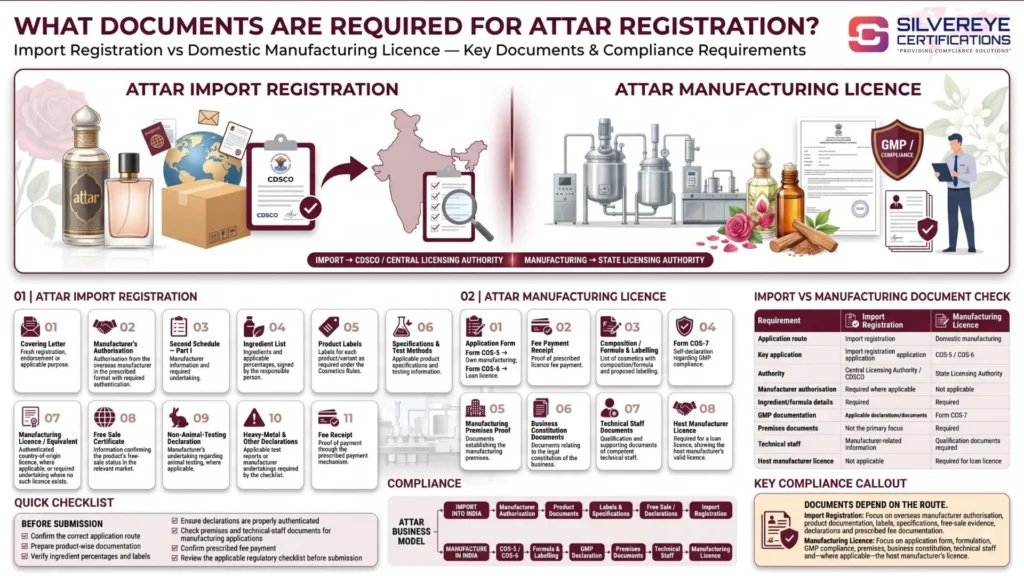
The exact documents depend on whether you are applying for import registration or a domestic manufacturing licence.
Documents Required for Attar Import Registration
| Document | What to Know |
|---|---|
| Covering letter | Mention whether the application is for fresh registration, endorsement or another applicable purpose. |
| Manufacturer's authorisation | Authorization from the overseas manufacturer in the prescribed format, with the required authentication. |
| Second Schedule, Part I | Manufacturer information and the required undertaking. |
| Ingredient list | Include the ingredients and applicable percentages, signed by the responsible person. |
| Product labels | Submit labels for each product/variant as required under the Cosmetics Rules. |
| Specifications and test methods | Provide applicable product specifications and testing information. |
| Manufacturing licence or equivalent | Authenticated copy from the country of origin, where applicable, or the required undertaking where no such licence exists. |
| Free Sale Certificate | Should provide the required information regarding the product's free sale status in the relevant market. |
| Non-animal-testing declaration | Manufacturer's undertaking regarding animal testing, where applicable. |
| Heavy-metal and other declarations | Provide the applicable test reports or manufacturer undertakings required by the checklist. |
| Fee receipt | Fee paid through the prescribed payment mechanism, with the receipt submitted with the application. |
Documents Required for an Attar Manufacturing License
For domestic manufacturing, the application generally includes:
- Completed Form COS-5 for own manufacturing or Form COS-6 for a loan licence.
- Fee payment receipt.
- List of cosmetics with their composition/formula and proposed labelling.
- Form COS-7 self-declaration regarding GMP compliance.
- Proof of manufacturing premises.
- Documents relating to the constitution of the business.
- Details and qualification documents of the technical staff.
- For a loan licence, a copy of the host manufacturer's valid licence.
State portals and supporting-document checklists can vary, so confirm the current requirements with the relevant State Licensing Authority before filing.
How Do You Get Attar Import Registration?
The general process for obtaining an import registration certificate is as follows:
- Confirm the product classification. Determine whether the attar is being marketed as a cosmetic and identify the applicable cosmetic category and variants.
- Prepare the manufacturer authorisation. The overseas manufacturer provides the required authorisation for the Indian applicant/agent and completes the applicable authentication requirements.
- Prepare the registration dossier. Compile the ingredient list, labels, specifications, Free Sale Certificate and required declarations.
- Pay the applicable fee through the prescribed payment mechanism and retain the receipt.
- Submit Form COS-1 online through the CDSCO SUGAM portal.
- Respond to regulatory queries. CDSCO may request clarification or additional documents during the review. Under Rule 13, the Central Licensing Authority may grant or reject a complete application within the prescribed period, with reasons recorded in case of rejection.
- Receive Form COS-2. Once registration is granted, comply with the applicable registration number and labelling requirements for the imported cosmetic.
How Do You Get an Attar Manufacturing License in India?
For domestic manufacturing, the general process is:
- Prepare the manufacturing premises and ensure that the required equipment, facilities and technical staff meet the applicable Rules.
- Submit the application in Form COS-5 for own manufacturing or Form COS-6 for a loan licence, along with the applicable fee and documents.
- Undergo inspection. The State Licensing Authority may inspect the manufacturing premises to verify compliance with the applicable requirements.
- Receive the manufacturing license. If the requirements are satisfied, the authority issues Form COS-8 for the applicable manufacturing license or Form COS-9 for the applicable loan-license route.
- Complete the required labelling details. The applicable manufacturing license information must be displayed on the product label in the format prescribed under the Cosmetics Rules.
Important Note
The exact application route, documents, technical-staff requirements and inspection procedure can depend on the type of product and the applicable State Licensing Authority. For attar, it is therefore important to confirm the product classification and regulatory route before filing, especially where the product is marketed for religious, room-use or other non-cosmetic purposes.
How Much Does Attar Registration Cost in India?
The cost depends on whether you are importing attar or manufacturing it in India. Import registration fees are prescribed under the Third Schedule of the Cosmetics Rules, 2020, while domestic manufacturing fees are administered through the applicable State Licensing Authority.
CDSCO Import Registration Fees for Attar
Under the Third Schedule of the Cosmetics Rules, the main government fees include:
| Fee head | Amount |
|---|---|
| Registration or retention, per category of cosmetic | USD 1,000 or INR equivalent |
| Each manufacturing site | USD 500 |
| Each variant | USD 50 |
| Each additional category | USD 1,000 |
Example: If one attar range falls within one category, is manufactured at one site and contains 10 variants, the government fee would be:
USD 1,000 + USD 500 + (10 × USD 50) = USD 2,000
This does not include consultant fees, document authentication, testing, translation or other professional costs, where applicable.
What Is the Attar Manufacturing License Fee in India?
Domestic manufacturing fees are handled through the State Licensing Authority, so the exact fee structure should be checked with the relevant State Drugs Control Department.
For example, a Delhi fee schedule provides the following amounts:
| Fee head | Amount |
|---|---|
| Licence grant/retention, up to 10 items per category | ₹10,000 |
| Each additional item in the category | ₹500 |
| Duplicate copy of licence | ₹500 |
| Late retention within the permitted period | Applicable licence fee plus prescribed late fee |
Because state-level procedures and fee schedules can differ, confirm the current fee with your State Licensing Authority before filing.
How Long Is Attar Registration or License Valid?
The validity and retention requirements are important because missing the applicable retention deadline can affect the status of your registration or licence.
| Item | Import Registration (COS-2) | Manufacturing Licence (COS-8/COS-9) |
|---|---|---|
| Issuing authority | Central Licensing Authority/CDSCO | State Licensing Authority |
| Validity | Continues subject to payment of the prescribed retention fee within the applicable period | Perpetual, subject to the prescribed retention fee |
| Retention cycle | Retention fee is required before completion of the applicable five-year period | Retention fee is required before completion of the applicable five-year period |
| Late payment | Subject to the applicable late-fee and cancellation provisions | Subject to the applicable late-fee and cancellation provisions |
| Processing time | Rule 13 provides for disposal within the prescribed period, subject to a complete application | Depends on the State Licensing Authority, inspection and application review |
| Post-approval changes | Certain changes to product details, labels, composition or specifications may require notification or amendment | Changes and additional products are handled through the applicable State Licensing Authority procedure |
Practical tip: Put your retention-fee due date in your calendar well in advance. This is a simple way to avoid an unnecessary compliance problem.
What Are the Labelling Requirements for Attar Bottles?
Attar is often sold in small bottles, so certain small-pack provisions can become relevant. However, these exemptions are specific to the type and size of the pack and should not be applied automatically to every attar bottle.
The main labelling requirements can include:
| Label item | Requirement |
|---|---|
| Product name | Required. |
| Manufacturer name and address | Required, subject to the specific small-pack provisions under the Cosmetics Rules. |
| Batch/Lot number | Required. |
| Use-before/expiry information | Must be declared in the prescribed manner. |
| Manufacturing licence number | Indian-made cosmetics must carry the applicable licence information in the prescribed format. |
| Registration certificate number | Imported cosmetics must carry the applicable RC/registration certificate details and importer information as prescribed. |
| Net contents | Check the applicable small-pack exemption before omitting this declaration. |
| Ingredient declaration | The applicable ingredient-declaration requirements depend on the product and pack size; do not assume that every small attar bottle is exempt. |
| Warnings and directions | Required where applicable, particularly where the product or its ingredients require specific warnings or precautions. |
For very small packs, the Cosmetics Rules provide specific relaxations for certain declarations, but the exemption depends on the product type and pack size. It is therefore better to verify the applicable rule before printing labels.
Also remember that Legal Metrology (Packaged Commodities) Rules may apply to packaged attar sold in India. Cosmetics compliance and Legal Metrology compliance should be checked separately.
What Are the Common Attar Registration Mistakes?
Attar businesses commonly face compliance problems because of a few avoidable mistakes:
- Assuming "natural" means "no licence": Botanical or traditional ingredients do not automatically exempt a product from cosmetic requirements.
- Confusing CDSCO with the State Licensing Authority: Importers follow the central cosmetic import-registration route, while Indian manufacturers apply through the relevant State Licensing Authority.
- Submitting weak manufacturer authorisation: For imported attar, the overseas manufacturer's authorisation and authentication must meet the applicable requirements.
- Missing the retention fee: Failing to pay the applicable retention fee on time can affect the validity/status of the registration or licence.
- Making medical claims: Claims such as "cures headaches" or "treats anxiety" can create regulatory problems because they go beyond ordinary cosmetic fragrance claims.
- Ignoring variants: Different fragrance variants may have separate documentation and fee implications, so they should be identified correctly during the application.
What Other Registrations or Rules Apply to Attar?
CDSCO registration or a State manufacturing licence is only one part of attar compliance. Depending on your business model, additional requirements may apply, including:
- GST registration and tax compliance, where applicable.
- Legal Metrology compliance for packaged products sold in India.
- DGFT and Customs requirements for imports and exports.
- Applicable import documentation and customs classification.
- Requirements for protected or regulated raw materials.
For example, certain agarwood/oud species and related materials may be subject to CITES and wildlife-trade controls when traded internationally. The exact requirement depends on the species, source, form and country involved.
Before importing or exporting attar containing regulated raw materials, confirm the applicable requirements with the relevant regulatory authority and customs/wildlife authorities.
So, Does Attar Require CDSCO Registration?
For commercial attar intended as a personal fragrance, the applicable regulatory route generally depends on whether you import or manufacture the product in India. Importers generally need a COS-2 registration certificate from CDSCO, while Indian manufacturers need the applicable COS-8 or COS-9 licence from the State Licensing Authority.
In either case, the product must meet the applicable ingredient and quality requirements, carry the correct label information, and avoid false or misleading treatment claims.
Good compliance can also support business growth. A valid registration or licence number and properly prepared documentation can help when dealing with distributors, marketplaces and export buyers.
Start by confirming the product classification, preparing the required documents, submitting the application and keeping the retention date on your compliance calendar. If you need professional assistance, Silvereye Certifications can help you review the applicable requirements before filing.
How Can Silvereye Certifications Help With Attar Registration?
Silvereye Certifications supports businesses with regulatory compliance and certification services in India, including guidance on CDSCO cosmetic registration and State cosmetic manufacturing licences for perfumes, attar and other fragrance products.
Whether you are an importer preparing Form COS-1, a brand owner planning a loan licence, or a manufacturer determining which licence applies to your attar products, the team can help review your product details, labels and documentation and guide you through the applicable filing process.
Share your product list, manufacturer details and target market with Silvereye Certifications for a compliance review before filing. This can help identify documentation gaps and clarify the appropriate regulatory route for your attar business.
Frequently Asked Questions
Does attar require CDSCO registration in India?
Mostly yes. Attar applied on the body for fragrance is a cosmetic under the Drugs and Cosmetics Act, 1940. Importers need a CDSCO registration certificate (COS-2). Manufacturers need a state-issued license (COS-8 or COS-9).
Is attar a cosmetic or a drug?
When sold for fragrance with no treatment claim, it is a cosmetic. Therapeutic claims can push a product towards drug rules, so keep your labelling and ads cosmetic only.
Can I sell attar without a license?
Selling stock made or imported without the required licence or registration is non-compliant. A reseller who buys from a licensed manufacturer or registered importer is on safer ground, but should keep invoices and check labels.
Do I need a licence to make attar at home?
If you manufacture for sale or distribution, yes. The Cosmetics Rules require a licence for manufacturing premises, and each premises needs its own. Home use for yourself is not "sale or distribution".
Who issues the attar manufacturing license, CDSCO or the state?
The State Licensing Authority (state drugs controller) issues Form COS-8 and COS-9. CDSCO handles import registration.
How much does CDSCO registration for imported attar cost?
The Third Schedule sets USD 1,000 per category, USD 500 per manufacturing site and USD 50 per variant. A single category with one site and ten variants comes to USD 2,000 in government fees.
How long does COS-2 take?
Under Rule 13, CDSCO must grant or reject the application, with written reasons, within six months of the application. Complete documents help avoid delays.
How long is the attar manufacturing license valid?
It remains in force subject to payment of the retention fee every five years. Late payment attracts a 2% per month fee for up to six months.
Does an exporter of Indian attar need CDSCO registration?
The import registration route applies to products coming into India. For exports, follow the rules of the destination country, and keep your manufacturing license and batch records ready for buyers.
What documents do I need to import attar?
Authorization from the manufacturer, ingredient list, labels, specifications, manufacturing license or equivalent, Free Sale Certificate, non-animal-testing declaration, heavy-metal declaration and fee receipt.
Does the label need an ingredient list on a small attar bottle?
Not for liquid packs of 60 ml or less. Larger packs need a list, with ingredients above 1% in descending order.
Can I add new fragrances after registration?
Yes, but through the proper route. Importers file for endorsement of new variants and fees apply per variant. Manufacturers add products through the State Licensing Authority.