
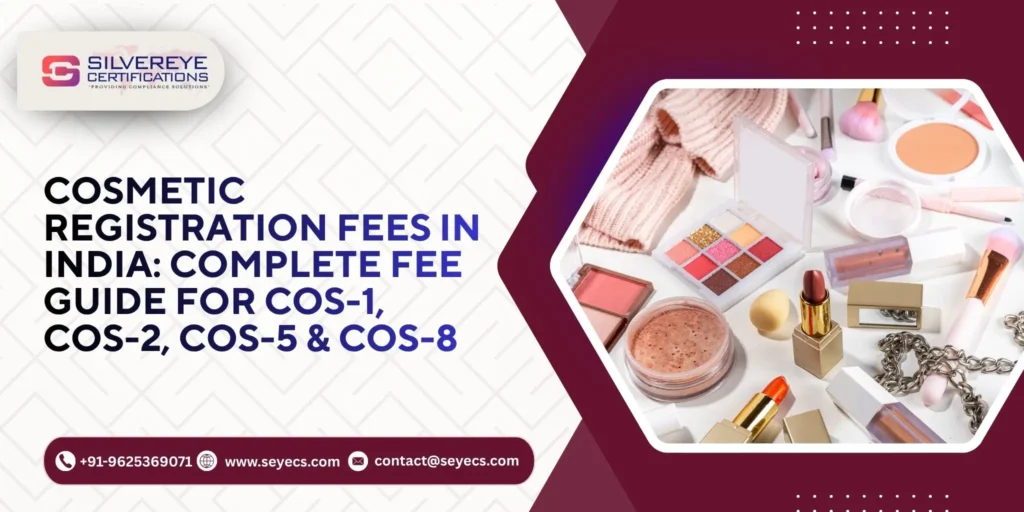
Cosmetic registration fees in India depend on the application type, number of products and applicable regulatory requirements. Import applications are submitted using Form COS-1, with the import registration certificate issued in Form COS-2. Manufacturing applications use Form COS-5, with the license issued in Form COS-8.
- Government fees: Verify the current CDSCO fee schedule before budgeting, including any applicable product or category-based charges.
- Validity and renewal: Confirm the applicable validity and renewal requirements for import registration certificates and manufacturing licenses under current regulations.
- Additional charges: State-level inspection, processing or other applicable charges may vary depending on the relevant authority and application.
- Registration support: Silvereye Certifications provides end-to-end CDSCO cosmetic registration assistance, helping businesses prepare documentation, address application deficiencies and reduce avoidable delays.
What Are Cosmetic Registration Fees in India?
Cosmetic registration fees in India are the government charges payable for obtaining the applicable CDSCO cosmetic import registration or manufacturing license under the relevant provisions of the Drugs and Cosmetics Act, 1940, and the Cosmetics Rules, 2020. For importers, the application is submitted using Form COS-1, and the registration certificate is issued in Form COS-2.
For manufacturers, the application is submitted using Form COS-5, and the manufacturing license is issued in Form COS-8. The total registration cost depends on the type of application, applicable government fees, product category and other regulatory requirements.
Any additional inspection or professional service charges should be confirmed with the relevant authority or service provider. Before applying, check the latest official CDSCO fee schedule to confirm the applicable charges and avoid relying on outdated fee estimates or unverified validity periods.
Why Should You Know Cosmetic Registration Fees in India?
Whether you are an importer bringing international beauty brands into India or a manufacturer launching your own cosmetic line, understanding cosmetic registration fees is important for accurate business planning. Incorrect fee estimates, missed retention-fee deadlines or incomplete applications can lead to additional costs and delays.
Under the Cosmetics Rules, 2020, import registration is handled by CDSCO's Central Licensing Authority, while domestic cosmetic manufacturing licences are issued by the relevant State Licensing Authority. The applicable government fees depend on the type of application, number of cosmetic categories, product variants and manufacturing sites. Knowing these requirements in advance helps you prepare your compliance budget and avoid unnecessary application errors.
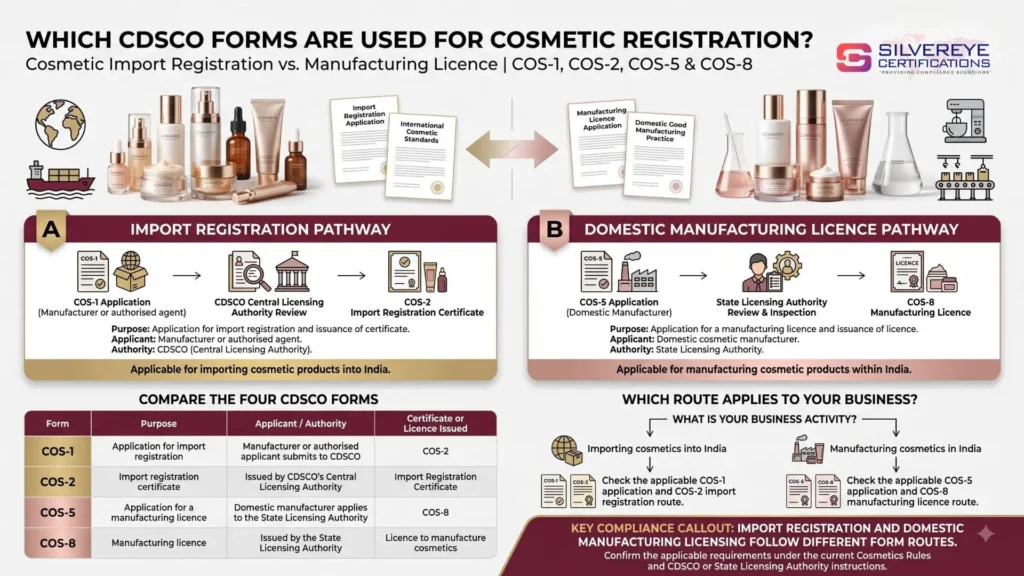
Which CDSCO Forms Are Used for Cosmetic Registration?
The applicable form depends on whether you intend to import cosmetics or manufacture them in India.
| Form | Purpose | Applicant / Authority | Certificate or Licence Issued |
|---|---|---|---|
| COS-1 | Application for import registration | Manufacturer or authorised applicant submits to CDSCO | COS-2 |
| COS-2 | Import registration certificate | Issued by CDSCO's Central Licensing Authority | Import Registration Certificate |
| COS-5 | Application for a manufacturing licence | Domestic manufacturer applies to the State Licensing Authority | COS-8 |
| COS-8 | Manufacturing licence | Issued by the State Licensing Authority | Licence to manufacture cosmetics |
Important: COS-2 and COS-8 are not generally limited to three-year and five-year validity periods, respectively. Under the Cosmetics Rules, 2020, both remain valid in perpetuity, subject to payment of the applicable retention fee every five years, unless suspended or cancelled under the rules.
What Is the COS-1 Import Registration Fee?
Form COS-1 is used to apply for registration of imported cosmetics, including products such as perfumes, skincare products, haircare products, sunscreens and makeup. The application is submitted to CDSCO through the applicable online process.
The Third Schedule of the Cosmetics Rules, 2020, specifies the following import registration fees:
| Fee Component | Prescribed Fee | What It Covers |
|---|---|---|
| Registration certificate | US$1,000 | Grant or retention of registration for each cosmetic category |
| Additional cosmetic category | US$1,000 | Each additional category |
| Product variant | US$50 per variant | Each variant covered by the registration |
| Manufacturing site | US$500 per site | Registration of each manufacturing site |
| Permission for a new cosmetic | US$500 | Application for permission for a new cosmetic |
| Inspection of an overseas manufacturing site | US$5,000 per site | Where the prescribed inspection fee applies |
These amounts are prescribed in the Third Schedule of the Cosmetics Rules, 2020. The total depends on the categories, variants and manufacturing sites included in the application. Testing charges may also apply when a product is selected for testing.
A Useful Tip for Cosmetic Importers
If you plan to import several cosmetic products, organize them by manufacturer, manufacturing site, product category and variant before applying. The rules allow a single application to cover multiple cosmetics from the same manufacturer when the specified conditions are met. Correctly grouping products can help you calculate the applicable fees and prepare the required documents more efficiently.
What Are the COS-2 Import Registration and Retention Fees?
Form COS-2 is the import registration certificate issued after the COS-1 application is approved. Under the Cosmetics Rules, 2020, the certificate remains valid in perpetuity, subject to payment of the prescribed retention fee before completion of each five-year period.
| Fee Component | Applicable Requirement | Important Detail |
|---|---|---|
| Initial registration | Fees prescribed under the Third Schedule | Based on cosmetic categories, variants and manufacturing sites |
| Retention fee | Applicable prescribed fee | Payable before completion of each five-year period |
| Late retention fee | 2% of the retention fee for each month or part of a month | Applies within the period specified under Rule 14 |
| Non-payment | Registration may be deemed cancelled | If the required fee remains unpaid beyond the prescribed 180-day period |
| Product or registration amendments | Depends on the proposed change and applicable rules | Confirm the relevant procedure and fee before filing |
Do not assume that a new COS-1 application is always required for every product addition or amendment. The correct process depends on the type of change and the applicable CDSCO requirements.
What Is the COS-5 Manufacturing License Fee?
Form COS-5 is the application form for a license to manufacture cosmetics for sale or distribution in India. Applications are submitted to the relevant State Licensing Authority with the required documents and prescribed fees.
The Third Schedule of the Cosmetics Rules, 2020, specifies the following fees for a manufacturing license in Form COS-8:
| Fee Component | Prescribed Fee | Applicable Scope |
|---|---|---|
| Initial manufacturing licence | ₹10,000 | Up to 10 items in each cosmetic category |
| Additional item | ₹500 per item | Each additional item in a category |
| Additional category | ₹10,000 | Up to 10 items in each additional category |
| Manufacturing licence retention fee | ₹10,000 | Up to 10 items in each category |
| Retention fee for additional items | ₹500 per item | Applicable additional items |
| Duplicate licence | ₹500 | If the original licence is lost, damaged or defaced |
These are the amounts specified in the Third Schedule. The total fee depends on the number of cosmetic items and categories covered by the application. A separate license is required for each manufacturing premises, as provided under the rules.
Note: The figures above are the prescribed fees listed in the cited rules. Before submitting an application, check the latest official CDSCO and State Licensing Authority instructions for any applicable updates, payment procedures or additional costs specific to your case.
What Are the COS-8 Manufacturing License Fees?
Form COS-8 is the manufacturing license issued by the State Licensing Authority after approval of the COS-5 application and completion of the applicable regulatory requirements. The license remains valid in perpetuity, subject to payment of the prescribed retention fee every five years, unless suspended or cancelled under the applicable rules.
The government fees specified in the Third Schedule of the Cosmetics Rules, 2020 include the following:
| Fee Component | Prescribed Fee | Applicable Details |
|---|---|---|
| Initial manufacturing licence | ₹10,000 | Covers up to 10 items in each cosmetic category |
| Additional item | ₹500 per item | Applies to each additional item in a category |
| Additional category | ₹10,000 | Covers up to 10 items in each additional category |
| Retention fee | ₹10,000 | Covers up to 10 items in each category for the applicable retention period |
| Retention fee for additional items | ₹500 per item | Applies to additional items covered by the licence |
| Duplicate licence | ₹500 | Applicable when a duplicate licence is requested under the prescribed conditions |
The total cost depends on the number of cosmetic categories and items included in the application. Changes to products, manufacturing premises or other license details may require additional documentation, approval or inspection, depending on the nature of the change. Confirm the applicable procedure with the relevant State Licensing Authority before filing an amendment.
How Do Cosmetic Registration Fees Vary by Product Category in India?
The applicable cosmetic registration fees in India depend on the type of application and the fee provisions under the Cosmetics Rules, 2020. Products such as perfumes, sunscreens, skincare products, haircare products and makeup may fall within different cosmetic categories for regulatory purposes. However, a separate fixed government fee does not automatically apply to every individual product name or marketing variation.
| Product Category | Example Products | Import Registration (COS-1/COS-2) | Manufacturing Licence (COS-5/COS-8) |
|---|---|---|---|
| Fine fragrances and perfumes | Eau de parfum, eau de toilette, cologne | Fees depend on applicable categories, variants and manufacturing sites | Fees depend on categories and the number of items covered |
| Traditional fragrances | Attar, ittar, oud oil, rose attar | Confirm the applicable category and prescribed fee | Confirm the applicable category and prescribed fee |
| Body mists and deodorants | Body mist, fragrance spray, non-medicated deodorant | Depends on the applicable import fee provisions | Depends on the applicable manufacturing fee provisions |
| Sunscreens | SPF lotions, mineral sunscreens, tinted sunscreens | Confirm the applicable registration category and variant requirements | Confirm the applicable category and number of items |
| After-sun products | After-sun lotion, cooling gel | Depends on the product's classification and applicable requirements | Depends on the applicable category and licence scope |
| Face skincare | Moisturisers, serums, cleansers, toners | Fees depend on the applicable categories, variants and manufacturing sites | Fees depend on the categories and items covered |
| Body skincare | Body lotion, body butter, exfoliating scrub | Confirm the applicable registration requirements | Confirm the applicable manufacturing fee structure |
| Haircare | Shampoo, conditioner, hair oil, hair mask | Depends on the applicable registration category and variants | Depends on the applicable categories and items |
| Colour cosmetics and makeup | Foundation, lipstick, kajal, mascara | Confirm the applicable registration and variant fees | Confirm the applicable category and item fees |
| Oral-care cosmetics | Cosmetic toothpaste, mouthwash, cosmetic tooth-whitening products | Confirm the applicable cosmetic classification and registration requirements | Confirm the applicable category and item fees |
| Baby cosmetics | Baby powder, baby lotion, baby shampoo | Fees depend on the applicable registration requirements | Fees depend on the applicable category and items |
| Nail-care products | Nail polish, nail oil, nail polish remover | Confirm the applicable category and variant requirements | Confirm the applicable category and item fees |
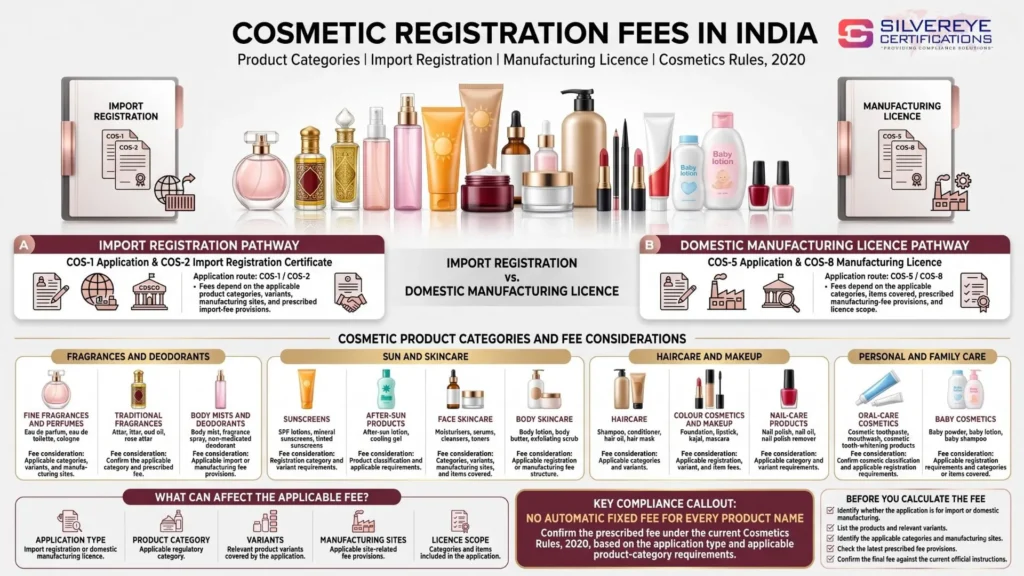
Important: This table is a general guide to common product groups, not an official fee classification list. The applicable fee must be determined using the prescribed rules and the details of the proposed application.
Products marketed with therapeutic or medicinal claims may fall under a different regulatory framework depending on their composition, intended use and claims. Confirm the applicable classification before applying.
What Is the Total Cost of Cosmetic Registration in India?
The total cost of cosmetic registration in India includes the prescribed government fee and any additional business expenses, such as document authentication, translation, product testing, labelling support or regulatory consultancy. These additional expenses are not fixed CDSCO fees and depend on the application and service provider.
Importer Costs: COS-1 / COS-2
| Cost Component | Cost or Fee Basis | Important Details |
|---|---|---|
| Government registration fee | US$1,000 per cosmetic category | Prescribed under the Third Schedule of the Cosmetics Rules, 2020 |
| Additional category | US$1,000 per category | Applies to each additional category |
| Product variants | US$50 per variant | Prescribed fee for each variant |
| Manufacturing site | US$500 per site | Applies to each manufacturing site |
| Overseas-site inspection | US$5,000 per site | Where inspection is required |
| Document authentication | Varies | Depends on the country, document and authentication procedure |
| Translation | Varies | Depends on the language and service provider |
| Label compliance support | Varies | Depends on the number of products and scope of work |
| Regulatory consultancy | Varies | Professional service charges are separate from government fees |
| Testing charges | Varies | Payable when applicable testing is required |
The total import registration cost depends on the number of cosmetic categories, variants and manufacturing sites, along with any applicable testing, documentation and professional service expenses. The government fee should be calculated using the official rules rather than a flat per-brand estimate.
Manufacturer Costs: COS-5 / COS-8
| Cost Component | Government Fee or Cost Basis | Important Details |
|---|---|---|
| Initial manufacturing licence | ₹10,000 | Covers up to 10 items in each cosmetic category |
| Additional item | ₹500 per item | Applies to each additional item within a category |
| Additional category | ₹10,000 | Covers up to 10 items in each additional category |
| Retention fee | ₹10,000 for up to 10 items per category | Payable every five years |
| Retention fee for additional items | ₹500 per item | Applies to additional items |
| Premises preparation | Varies | Depends on existing facilities and applicable manufacturing requirements |
| SOPs and documentation | Varies | Depends on the facility and the level of support required |
| Quality-control testing | Varies | Depends on testing arrangements and product requirements |
| Technical personnel | Varies | Depends on staffing and applicable qualification requirements |
| Regulatory consultancy | Varies | Professional fees are separate from government charges |
The total manufacturing setup cost cannot be accurately determined from government license fees alone. Premises preparation, staffing, testing and consultancy expenses vary between businesses and should be budgeted separately. The prescribed license fees are listed in the Third Schedule of the Cosmetics Rules, 2020.
Important: The figures above distinguish prescribed government fees from variable business expenses. The earlier estimates for state processing fees, inspection charges, consultancy and total registration costs should not be presented as official government rates unless independently verified.
Do Cosmetic Registration Fees Differ by State?
The regulatory authority depends on the activity being undertaken. CDSCO's Central Licensing Authority handles import registration for cosmetics, while the relevant State Licensing Authority handles domestic cosmetic manufacturing licenses. The prescribed central fee structure is set out in the Cosmetics Rules, 2020.
| State / Authority | Regulatory Role | What to Verify |
|---|---|---|
| Maharashtra FDA | Domestic cosmetic manufacturing | Applicable application procedure and any officially prescribed state charges |
| Delhi Drugs Control Department | Domestic cosmetic manufacturing | Current forms, documentation and applicable charges |
| Karnataka Drugs Control Department | Domestic cosmetic manufacturing | Current application and inspection requirements |
| Gujarat FDA | Domestic cosmetic manufacturing | Applicable licensing process and charges |
| Tamil Nadu Drugs Control Department | Domestic cosmetic manufacturing | Current application requirements and official fee information |
| Uttar Pradesh Drugs Control Department | Domestic cosmetic manufacturing | Applicable licensing procedure and charges |
| Rajasthan Drugs Control Department | Domestic cosmetic manufacturing | Current forms and licensing requirements |
| West Bengal Drugs Control Department | Domestic cosmetic manufacturing | Applicable application and inspection procedure |
| Telangana / Andhra Pradesh Drugs Control Departments | Domestic cosmetic manufacturing | Current state licensing requirements |
Do not assume that every state charges an additional processing or inspection fee. Confirm any such charge with the relevant authority and request the official fee schedule or payment instructions. The figures previously listed for individual states are not included here because I could not verify them as prescribed government fees.
When Do You Need to Pay Cosmetic License Retention Fees?
Cosmetic import registration certificates and manufacturing licenses are valid in perpetuity, subject to payment of the applicable retention fee every five years, unless suspended or cancelled under the rules. This means the usual process is not a conventional three-year or five-year license renewal.
| Registration / Licence | Validity | Retention Fee | Late Payment Rule |
|---|---|---|---|
| COS-2 Import Registration Certificate | In perpetuity, subject to applicable conditions | US$1,000 per category, US$1,000 per additional category, US$50 per variant and US$500 per manufacturing site, as applicable | Late fee of 2% of the retention fee per month or part of a month within the prescribed 180-day period |
| COS-8 Manufacturing Licence | In perpetuity, subject to applicable conditions | ₹10,000 for up to 10 items per category, plus applicable fees for additional items or categories | Late fee of 2% of the retention fee per month or part of a month within the prescribed 180-day period |
If the required retention fee remains unpaid beyond the specified 180-day period, the registration certificate or manufacturing license is deemed cancelled under the applicable provisions. Track the five-year payment deadline and retain proof of payment.
For changes to an existing registration or license, such as a change of manufacturer details, product information or manufacturing premises, check the applicable amendment procedure before making the change. Amendment fees and documentation depend on the nature of the change and should not be assumed to be a fixed amount for every application.
What Hidden Costs Should You Avoid During CDSCO Cosmetic Registration?
Businesses may incur additional expenses during CDSCO cosmetic registration because of incomplete documents, incorrect applications, labelling issues or repeated preparation of supporting documents. These costs are not all government fees; many depend on the service provider, country of origin or corrective work required.
| Potential Additional Cost | Why It May Occur | How to Avoid It | Cost Consideration |
|---|---|---|---|
| Reapplication or document correction | Missing documents, incorrect forms or unresolved deficiencies | Review the application and supporting documents before submission | Government fees and any reapplication charges depend on the applicable rules and circumstances |
| Certificate of Free Sale (CFS) authentication | Missing, outdated or incorrectly authenticated documents | Confirm the certificate's acceptability and authentication requirements before filing | Varies by country, issuing authority and service provider |
| Label redesign | Labels do not meet applicable cosmetic labelling requirements | Review labels against the relevant Cosmetics Rules, 2020, and other applicable requirements before printing | Depends on the number of products and the extent of revisions |
| Additional inspection or corrective work | Manufacturing premises do not meet applicable requirements | Prepare the premises and required records before the inspection | Any official charges must be confirmed with the relevant authority; corrective work may add separate costs |
| Late retention-fee payment | Missing the applicable five-year payment deadline | Set reminders and track retention-fee due dates | Late fees are governed by the applicable rules, not a flat ₹1,000-per-month charge |
| Duplicate applications | Poor planning or failure to group eligible products appropriately | Map products by manufacturer, category, variants and manufacturing site before filing | Additional fees depend on the application and applicable fee schedule |
| Additional consultancy charges | Changes in scope, repeated corrections or changes in service provider | Agree on the scope, deliverables and professional fees before starting | Depends on the consultant and the additional work required |
How Can You Reduce Avoidable Registration Costs?
Before applying, prepare a complete document checklist, confirm the correct application route, organize product details and manufacturing-site information, and review labels against the applicable requirements. For imported cosmetics, verify the Certificate of Free Sale (CFS) and any required authentication with CDSCO's current guidance rather than relying on a universal validity period.
For manufacturing applications, ensure that the premises, quality records and required technical arrangements are ready for regulatory assessment. Also track the applicable retention-fee deadlines for COS-2 registration certificates and COS-8 manufacturing licenses.
Planning these steps in advance can help reduce avoidable corrections, professional service expenses and delays. Actual costs depend on the application, product portfolio and circumstances; they should not be treated as fixed government charges unless confirmed by an official fee schedule.
How Silvereye Certifications Helps You Manage Cosmetic Registration Costs
Silvereye Certifications supports cosmetic importers and manufacturers with CDSCO cosmetic registration and regulatory compliance in India. Our assistance helps businesses understand applicable government fees, prepare documentation and reduce avoidable application errors.
How We Can Help:
- Registration cost guidance: Understand the applicable government fees and potential additional expenses before applying.
- Application support: Assistance with COS-1, COS-2, COS-5 and COS-8 procedures, as applicable to your business.
- Document review: Help organise and review documents, including the Certificate of Free Sale (CFS) and other required supporting records.
- Label compliance guidance: Review cosmetic labelling information against applicable regulatory requirements.
- Fee and deadline guidance: Help identify the relevant authority, confirm applicable fees and track retention-fee deadlines.
- Post-registration support: Assistance with applicable amendments, product additions and ongoing compliance requirements.
- Initial consultation: Discuss your cosmetic registration requirements and the documents needed for your application.
Conclusion
Cosmetic registration fees in India depend on whether you are importing cosmetics or manufacturing them domestically, along with the number of product categories, variants and manufacturing sites involved. Under the Cosmetics Rules, 2020, import registration fees are calculated using the prescribed fee structure for categories, variants and manufacturing sites, while manufacturing license fees depend on the number of items and categories covered.
The total compliance budget may also include document authentication, translation, product testing, labelling support and professional consultancy, where applicable. These additional expenses vary by business and should be distinguished from government-prescribed fees.
To manage costs effectively, confirm the latest official fee schedule, prepare complete documentation, review product labels before printing and track the applicable five-year retention-fee deadlines for COS-2 and COS-8. Silvereye Certifications can assist cosmetic importers and manufacturers with registration preparation, documentation review and regulatory compliance guidance to help reduce avoidable delays and expenses.
Frequently Asked Questions
What is the government fee for CDSCO cosmetic import registration?
The base government fee for a COS-1 import license application is ₹3,000 per application (per manufacturer), plus ₹1,000 for each additional product. State processing fees of ₹500–₹2,000 may also apply.
Is there a separate fee for the COS-2 license itself?
In most states, the COS-2 license is issued upon approval of your COS-1 application without a separate issuance fee. However, some State Licensing Authorities charge an additional issuance fee of ₹500–₹2,000. Always verify with your state SLA.
What is the government fee for a cosmetic manufacturing license (COS-8)?
The COS-5 application for manufacturing costs ₹3,500 base plus ₹1,500 per product category. Drug inspector inspection fees of ₹1,000–₹3,000 are additional. State-specific COS-8 issuance fees may also apply.
How much does it cost to renew a COS-2 import license?
Renewal of a COS-2 import license costs approximately ₹3,000 base plus ₹1,000 per product, similar to the original COS-1 application fee. Renewal should be filed at least 3 months before the license expires to avoid penalties.
What is the penalty for late renewal of a cosmetic license?
A late renewal penalty of ₹1,000 per month is charged for every month the license remains expired beyond its validity date. Avoid this by tracking expiry dates and filing renewals well in advance.
Do sunscreen products have different registration fees?
No. Sunscreen products — including SPF creams, mineral sunscreens, tinted sunscreens, sunscreen sprays, and after-sun products — are classified as Schedule S cosmetics and follow the same fee structure as all other cosmetics under the D&C Rules, 2020.
How much does it cost to add a new product to an existing cosmetic license?
Adding a new product to an existing COS-2 import license costs ₹1,000 per product. Adding a new product to a COS-8 manufacturing license costs ₹1,000–₹1,500 per product depending on whether it falls in a new or existing category.
Are CDSCO cosmetic registration fees the same across all Indian states?
No. While the base fee is set centrally, each State Licensing Authority charges additional processing and inspection fees that vary. Maharashtra, Delhi, Gujarat, and Karnataka are among the most active SLAs with varying additional charges.
Is there a CDSCO fee for importing cosmetics from different countries?
The CDSCO fee structure for import is the same regardless of the country of origin. However, document preparation costs — especially apostille of the CFS and COA — vary significantly by country. Countries with lower apostille costs (e.g., EU countries vs some Southeast Asian countries) can result in meaningfully different total costs.
Can I get a refund of CDSCO cosmetic registration fees if my application is rejected?
No. Government fees paid for COS-1 or COS-5 applications are non-refundable, even if the application is rejected or withdrawn. This is why it is critical to submit complete, compliant applications from the start — ideally with the help of an experienced regulatory consultant.
What is the total cost of CDSCO cosmetic registration for a small business?
For a small importer with one brand and three products from a single manufacturer, total costs including government fees, document preparation, and basic consulting typically range from ₹40,000 to ₹1,00,000. For a small-scale domestic manufacturer setting up a new facility, the first-time total cost including premises upgrades can range from ₹1,00,000 to ₹5,00,000.