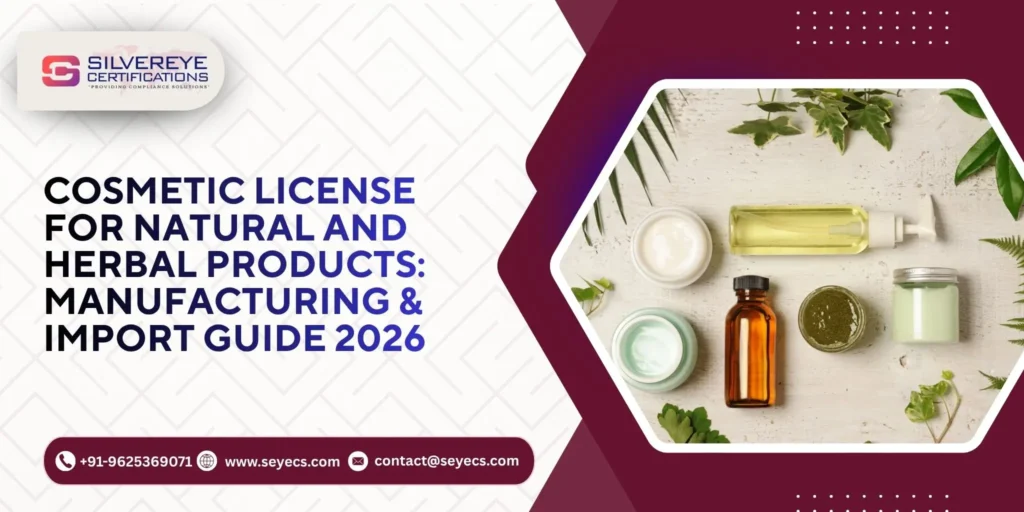
- All natural and herbal cosmetics sold in India — from neem shampoo and herbal face wash to plant-based serums and ayurvedic hair oil — must be licensed under the Drugs and Cosmetics Act, 1940 and Cosmetics Rules, 2020 before commercial sale.
- Domestic manufacturers apply via Form COS-5 and receive their license in Form COS-8 from the State Licensing Authority; importers apply via Form COS-1 and receive approval in Form COS-2 from CDSCO.
- Herbal and natural cosmetics follow the same licensing framework as synthetic cosmetics — there is no separate 'herbal exemption' under Indian law for cosmetic products.
- Licenses are valid for 5 years; failing to renew before expiry means all manufacturing or importing activity becomes instantly non-compliant under the Drugs and Cosmetics Act.
Understanding the Regulatory Framework for Cosmetic License For Natural and Herbal Products
India's natural and herbal beauty market is one of the fastest-growing segments in the Indian FMCG sector. From traditional ayurvedic formulations to modern plant-based skincare imported from Korea, Japan, or Europe, consumers are increasingly seeking products with botanical and natural credentials. However, from a regulatory standpoint, the Indian government makes no distinction between a synthetic shampoo and an organic herbal shampoo — both are cosmetics under Indian law and both need a license.
The Drugs and Cosmetics Act, 1940 defines a cosmetic as any article intended for use on the human body for cleansing, beautifying, promoting attractiveness, or altering appearance — other than soap. This definition captures every natural, herbal, organic, and botanical cosmetic product, regardless of how the brand labels or markets it. The Cosmetics Rules, 2020 replaced the older Schedule S provisions and modernized the licensing, GMP, labelling, and safety assessment framework for all cosmetics in India.
Governing Legal Framework
| Legal Instrument | Relevance to Natural and Herbal Cosmetics |
| Drugs and Cosmetics Act, 1940 | Primary legislation defining cosmetics and regulating their manufacture, import, sale, and distribution in India |
| Cosmetics Rules, 2020 | Prescribes licensing forms (COS-1 to COS-9), fees, GMP standards, labelling requirements, and safety assessment norms for all cosmetics |
| Schedule M-II (GMP Standard) | Good Manufacturing Practice standards for cosmetic manufacturers — applies to all herbal and natural cosmetic producers holding COS-8 license |
| Schedule VII (Safety Assessment) | Mandates Safety Assessment Report (SAR) for cosmetic import applications — applies to all imported natural and herbal cosmetics (COS-1) |
| Schedule VIII (Stability) | Stability testing requirements for cosmetics — mandatory for import applications; recommended for domestic production |
| Schedule XI (Labelling) | Labelling requirements for all cosmetics sold in India — applies to natural/herbal cosmetics including INCI ingredient list, expiry date, net content, country of origin |
| CDSCO (Central Licensing Authority) | Grants cosmetic import licenses (COS-2) for natural and herbal cosmetics; oversees national regulatory policy |
| State Licensing Authority (SLA) | Grants cosmetic manufacturing licenses (COS-8) and loan licenses (COS-9) to herbal/natural cosmetic manufacturers in each state |
What is Cosmetic License For Natural and Herbal Products?
Natural and herbal cosmetics in India require a CDSCO cosmetic license under the Drugs and Cosmetics Act, 1940 and Cosmetics Rules, 2020. Domestic manufacturers need a Cosmetic Manufacturing License (Form COS-5 application, Form COS-8 grant) from the State Licensing Authority.
Importers need a Cosmetic Import License (Form COS-1 application, Form COS-2 grant) from CDSCO. Both categories — whether the product contains neem, turmeric, aloe vera, plant stem cells, or any other botanical ingredient — are treated as cosmetics under Indian law and must comply with the same licensing, labelling, GMP, and safety requirements as any other cosmetic product.
Types of Natural and Herbal Cosmetic Products — Complete Category Table
The following table covers the major categories and specific product types in the natural and herbal cosmetics space, the applicable license form, and key regulatory considerations. This is one of the most comprehensive product-specific tables available for natural cosmetic licensing in India.
| Product Category | Specific Product Examples | License Form (Mfg) | License Form (Import) | Key Regulatory Note |
| Herbal Hair Care | Neem shampoo, amla hair oil, bhringraj hair oil, brahmi hair mask, hibiscus conditioner, onion hair serum, henna-based hair colour | COS-5 → COS-8 | COS-1 → COS-2 | Henna as a colouring agent: ensure it is cosmetic-grade; lead acetate in henna is prohibited in India |
| Natural Skin Care | Turmeric face pack, rose water toner, aloe vera gel, sandalwood cream, multani mitti (fuller's earth) mask, neem face wash, kumkumadi tailam (cosmetic grade) | COS-5 → COS-8 | COS-1 → COS-2 | Kumkumadi tailam: verify cosmetic vs. ayurvedic drug classification based on claims made |
| Herbal Face Care | Herbal face scrub (walnut, apricot), charcoal face mask, clay cleanser, tea tree face wash, green tea face cream, plant stem cell serum | COS-5 → COS-8 | COS-1 → COS-2 | Charcoal and clay face masks: cosmetic classification confirmed; no therapeutic claims to be made |
| Organic / Natural Moisturisers | Shea butter body lotion, argan oil face cream, jojoba oil moisturiser, coconut oil body butter, vitamin C brightening cream (botanical source) | COS-5 → COS-8 | COS-1 → COS-2 | Vitamin C from botanical source (kakadu plum, amla): cosmetic claim only — no therapeutic skin brightening claims |
| Herbal Sunscreen | Plant-based SPF (zinc oxide-based natural sunscreen, raspberry seed oil SPF, carrot seed oil SPF) | COS-5 → COS-8 | COS-1 → COS-2 | SPF claim products: require SAR with UV protection efficacy data; permitted UV filter list under Cosmetics Rules applies |
| Natural Lip Care | Beeswax lip balm, shea butter lip balm, herbal lip butter, plant-based lip gloss, fruit-tinted lip colour | COS-5 → COS-8 | COS-1 → COS-2 | Pigments used in lip products must comply with the permitted colorant list under Cosmetics Rules, 2020 |
| Natural Colour Cosmetics | Mineral foundation, plant-based mascara, organic kajal, mineral blush, botanical lipstick, natural eye shadow | COS-5 → COS-8 | COS-1 → COS-2 | Mineral and oxide-based pigments: verify compliance with Schedule II permitted colorant list; heavy metal contaminant limits apply |
| Herbal Body Care | Neem body wash, herbal bath powder, ayurvedic ubtan (cosmetic), activated charcoal soap (if classified as cosmetic), herbal body scrub | COS-5 → COS-8 | COS-1 → COS-2 | Soap is excluded from the cosmetic definition under D&C Act; herbal body wash and bath gels that are not soap fall under cosmetics |
| Natural Oral Care | Herbal toothpaste (neem, clove, charcoal), oil pulling product (cosmetic claim), tongue scraper (not a cosmetic — device), herbal mouthwash | COS-5 → COS-8 | COS-1 → COS-2 | Toothpaste with fluoride at therapeutic levels may shift to drug classification; clove-based toothpaste is typically cosmetic |
| Herbal Baby Cosmetics | Herbal baby oil, natural baby lotion, organic baby shampoo, herbal baby powder, aloe vera baby gel | COS-5 → COS-8 | COS-1 → COS-2 | Baby cosmetics undergo enhanced CDSCO/SLA scrutiny; SAR must specifically address infant skin safety; no essential oils at high concentrations |
| Natural Fragrances and Deodorants | Essential oil-based perfume, natural deodorant (crystal alum, baking soda), herbal body spray, botanical cologne, attar (if cosmetic claim) | COS-5 → COS-8 | COS-1 → COS-2 | Attar with cosmetic-only claims: cosmetic license; essential oil blends marketed therapeutically may need drug classification review |
| Natural Men's Grooming | Herbal shaving cream, natural aftershave (witch hazel, aloe), organic beard oil (argan, jojoba), herbal face scrub for men | COS-5 → COS-8 | COS-1 → COS-2 | Same cosmetic licensing framework as women's products; no separate men's grooming category under Cosmetics Rules |
| Ayurvedic Cosmetics (Cosmetic Claims Only) | Kumkumadi face serum (cosmetic), triphala hair rinse, ashwagandha face cream, brahmi scalp oil (cosmetic), chandan (sandalwood) face pack | COS-5 → COS-8 | COS-1 → COS-2 | If marketed with therapeutic or medicinal claims, product may require Ayurvedic drug license under Schedule E — always review claim language carefully |
| K-Beauty / J-Beauty Natural Products (Imported) | Korean rice water serum, Japanese green tea moisturiser, bamboo extract toner, yuzu vitamin C essence, fermented herbal cream | Not applicable | COS-1 → COS-2 | All imported natural K-Beauty and J-Beauty products require COS-1/COS-2; CFS from country of origin (Korea/Japan) mandatory |
| Natural Hair Colouring Products | Henna powder, indigo powder, amla hair colour, herbal hair dye (botanical), natural hair highlighter | COS-5 → COS-8 | COS-1 → COS-2 | Permitted hair dye ingredients under Cosmetics Rules Schedule IV apply; PPD (paraphenylenediamine) is permitted but requires warning label; lead-based dyes are prohibited |
| Natural Nail Care | Herbal nail oil (vitamin E, jojoba), natural cuticle cream, plant-based nail strengthener | COS-5 → COS-8 | COS-1 → COS-2 | Nail polish is a cosmetic but solvent-heavy formulations require compliance with volatile organic compound (VOC) limits in some states |
| Organic and Natural Suncare (Body) | Natural after-sun lotion (aloe vera), botanical tan-enhancing oil, organic self-tanning lotion | COS-5 → COS-8 | COS-1 → COS-2 | Self-tanning products (DHA-based) are cosmetics; tanning accelerators making UV protective claims shift to sunscreen category requiring SPF efficacy data |
Who Needs a Natural and Herbal Cosmetics License in India?
Whether you are a D2C herbal beauty brand, an ayurvedic cosmetics startup, a global organic beauty company entering India, or a contract manufacturer making natural products for other brands — you need a cosmetic license. Here is a clear breakdown of who needs what:
| Entity Type | License Required | Authority |
| Indian manufacturer of natural/herbal cosmetics | COS-8 Manufacturing License | State Licensing Authority (SLA) |
| Indian brand outsourcing to a contract manufacturer | COS-9 Loan License | State Licensing Authority (SLA) |
| Importer / Indian agent of a foreign natural cosmetic brand | COS-2 Import License | CDSCO (Central) |
| Foreign brand selling directly through Indian e-commerce | COS-2 Import License (via Indian authorised agent) | CDSCO (Central) |
| Online D2C herbal cosmetics brand (own manufacturing) | COS-8 Manufacturing License | State Licensing Authority (SLA) |
| Ayurvedic cosmetics manufacturer (cosmetic claims only) | COS-8 Manufacturing License | State Licensing Authority (SLA) |
| Organic beauty brand importing K-Beauty / J-Beauty products | COS-2 Import License | CDSCO (Central) |
| Retailer / distributor buying from licensed manufacturer | No separate license needed — the manufacturer's COS-8 covers the product | N/A |
Cosmetic Import License for Natural and Herbal Products (COS-1 and COS-2)
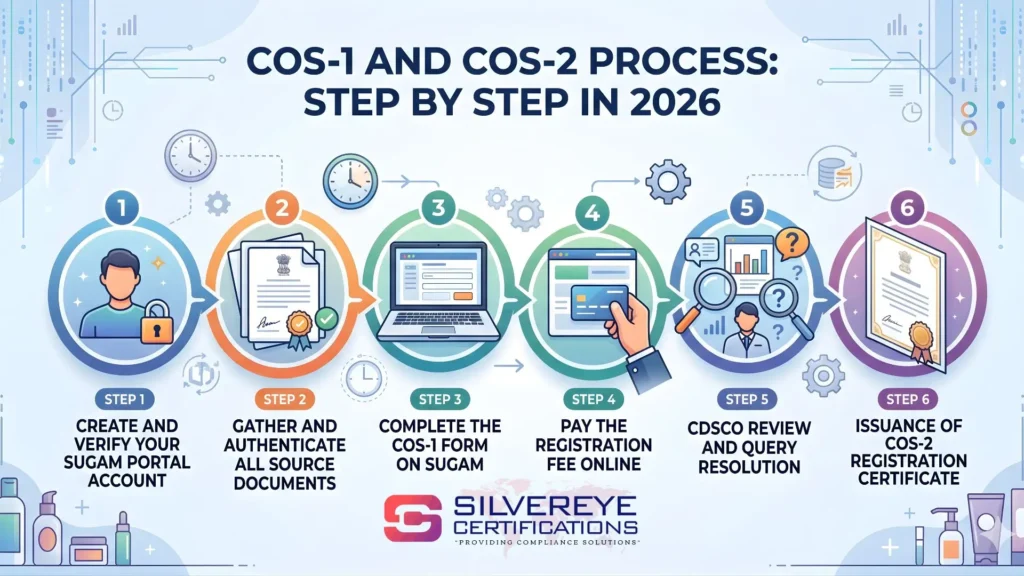
Any person or company that wishes to import natural, herbal, organic, or botanical cosmetics into India for commercial sale must obtain a Cosmetic Import License from CDSCO. The application is submitted in Form COS-1, and the license is granted in Form COS-2. Applications are filed through the SUGAM portal (sugamapp.cdsco.gov.in).
Eligibility for Cosmetic Import License (COS-1 / COS-2)
- Any Indian legal entity — proprietorship, partnership, LLP, or company — with a valid Import Export Code (IEC) from DGFT
- Foreign brands entering India through an Indian authorised agent or distributor — the Indian entity applies and holds the license
- Indian e-commerce sellers sourcing natural cosmetics from foreign manufacturers for direct sale
- Natural cosmetics importers adding new products to their existing licensed portfolio
Form COS-1: Application for Natural/Herbal Cosmetic Import License
Form COS-1 is the prescribed application under Cosmetics Rules, 2020 for a cosmetic import license. For natural and herbal cosmetics, the following sections of COS-1 require special attention:
| COS-1 Section | Special Considerations for Natural / Herbal Products |
| Product Formulation (INCI List) | All botanical extracts, essential oils, herbal powders, and plant-derived actives must be listed with their correct INCI names — not just the common name (e.g., 'Azadirachta Indica Leaf Extract', not 'neem extract') |
| Ingredient Safety | Botanical ingredients not listed in the EU Cosmetics Regulation or similar international reference must be supported by additional safety data in the SAR |
| Colorants | If natural colorants (beetroot extract, turmeric, henna) are used, they must appear in Schedule II permitted colorant list or be supported by safety justification |
| Preservatives | Natural preservation systems (rosemary extract, vitamin E as antioxidant, grapefruit seed extract) must be validated for efficacy; not all natural preservatives are internationally accepted |
| Claims Scrutiny | Avoid therapeutic or medicinal claims ('cures', 'treats', 'heals') — these shift the product toward drug classification; use cosmetic claims ('moisturises', 'cleanses', 'conditions') |
| Country of Origin | For imported natural products, specify country of origin of both the product and key botanical raw materials — CDSCO may scrutinise supply chain for quality assurance |
Documents Required for COS-1 (Natural/Herbal Cosmetic Import)
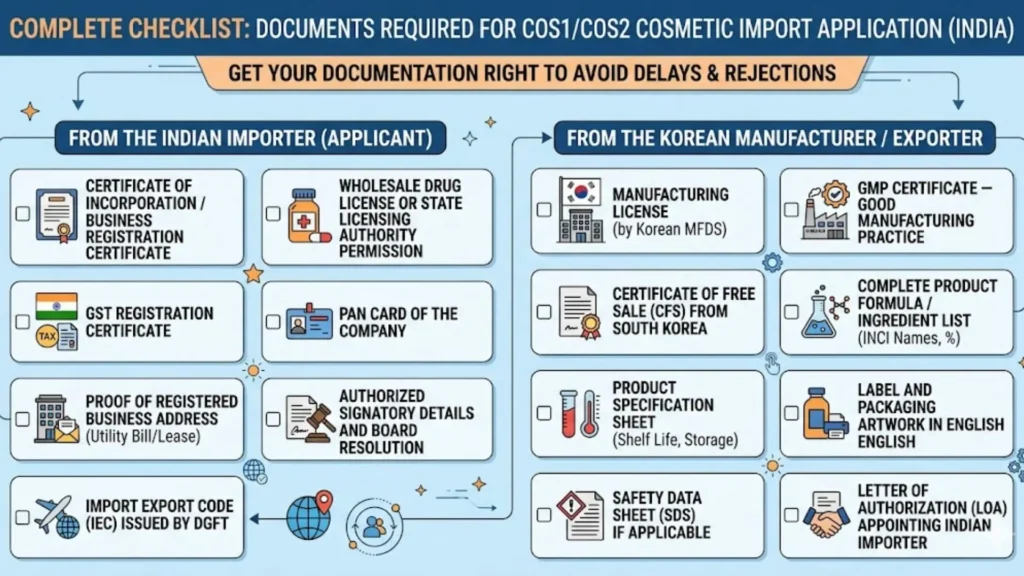
- Duly filled Form COS-1 with complete product details
- Certificate of Free Sale (CFS) from the country of origin — apostilled or notarised by the competent authority of that country
- Good Manufacturing Practice (GMP) certificate of the foreign manufacturing facility — ISO 22716 (Cosmetic GMP) is the internationally accepted standard
- Complete formulation with INCI names and percentage composition of all ingredients including botanical extracts, carrier oils, essential oils, and preservatives
- Safety Assessment Report (SAR) as per Schedule VII of Cosmetics Rules, 2020 — prepared by a qualified cosmetic safety assessor or toxicologist
- Stability data (minimum 6 months accelerated or 12 months real-time) as per Schedule VIII of Cosmetics Rules, 2020
- Labelling and packaging details — draft label for Indian market compliant with Schedule XI (INCI list, country of origin, importer name and address, batch no., expiry date, net content, MRP)
- Power of Attorney or Authorisation Letter from the foreign manufacturer to the Indian applicant
- Import Export Code (IEC) of the Indian applicant
- Technical dossier or product information file (PIF) for each natural/herbal product
- Safety data on any novel botanical ingredient not commonly used in Indian or international cosmetics
- Fee payment proof (challan or DD)
Form COS-2: Grant of Natural/Herbal Cosmetic Import License
Once CDSCO reviews the COS-1 application, verifies all documents, and is satisfied with the product's safety and compliance, it grants the Import License in Form COS-2. For natural and herbal cosmetics, CDSCO may take additional time to review novel botanical ingredients or unusual natural formulations. COS-2 specifies the licensed products, approved SKU sizes, and the validity period. The Indian applicant (importer/authorized agent) bears full regulatory responsibility for the product throughout the license period.
Import License Fees (COS-1 / COS-2)
| Fee Head | Amount (INR) |
| Application fee per product (COS-1) | Rs. 500 per product |
| License grant fee (COS-2) | Rs. 1,000 per product |
| Renewal fee | Rs. 1,000 per product |
| Amendment fee | Rs. 500 per amendment |
Note: Fee amounts are as specified in Cosmetics Rules, 2020. Verify current fees on the CDSCO official website (cdsco.gov.in) or SUGAM portal before filing, as government fee schedules are periodically revised.
SUGAM Portal — Online Application for COS-1
All cosmetic import license applications are filed through the SUGAM portal. The applicant must register on SUGAM, create a product profile for each natural or herbal cosmetic, upload all required documents in the prescribed format, and pay the application fee online. Track the application status and respond to CDSCO queries through the portal.
Cosmetic Manufacturing License for Natural and Herbal Products (COS-5 and COS-8)
Any person or company that manufactures natural or herbal cosmetics in India for sale must obtain a Cosmetic Manufacturing License from the State Licensing Authority (SLA) of the state where the manufacturing premises are located. The application is submitted in Form COS-5, and the license is granted in Form COS-8.
Eligibility for COS-5 / COS-8 (Natural/Herbal Cosmetics Manufacturing)
| Criterion | Requirement |
| Premises | Dedicated manufacturing facility meeting Schedule M-II GMP requirements; for herbal products, a separate raw material extraction/processing area is recommended if botanical extracts are prepared in-house |
| Technical Staff | Qualified technical person — minimum degree or diploma in pharmacy, chemistry, or relevant science discipline; knowledge of herbal/botanical ingredient handling is advantageous |
| Equipment | Appropriate mixing, emulsification, filling, and sealing equipment for the product forms (creams, oils, liquids, powders) — stainless steel equipment preferred for herbal manufacturing |
| Quality Control | In-house or approved third-party lab for raw material testing (botanical identity, microbial limits, heavy metals) and finished product testing — botanical identity testing capability is important for herbal products |
| Raw Material Standards | Botanical raw materials should meet quality standards — for ayurvedic botanicals, WHO monographs or Ayurvedic Pharmacopoeia of India (API) standards are references; pesticide residue testing recommended |
| Water System | Purified water system meeting pharmacopoeial standards where water is used in formulation — essential for herbal cosmetic manufacturing |
| Storage | Dedicated, hygienic storage for botanical raw materials — temperature and humidity-controlled storage for moisture-sensitive herbs, essential oils, and plant extracts |
| Legal Entity | Any legal entity registered in India — proprietorship, partnership, LLP, or company |
Form COS-5: Application for Natural/Herbal Cosmetic Manufacturing License
Form COS-5 is the prescribed application under Cosmetics Rules, 2020 for a domestic cosmetic manufacturing license, submitted to the State Licensing Authority (SLA). For natural and herbal cosmetic manufacturers, the following are particularly important sections in COS-5:
| COS-5 Section | Special Considerations for Natural / Herbal Manufacturers |
| Premises Layout | Layout plan should show botanical raw material storage area, extract preparation area (if applicable), formulation area, and QC lab — separate from each other to avoid cross-contamination |
| Product List | List all natural/herbal cosmetic products with their product category, dosage form (cream, oil, gel, powder, liquid), and key botanical ingredients |
| Equipment List | Include any botanical extraction equipment (percolators, Soxhlet extractors, steam distillation units for essential oil) alongside standard cosmetic manufacturing equipment |
| Technical Staff | Provide qualification details — a person with knowledge of botanical ingredient handling, herbal pharmacognosy, or cosmetic formulation with natural ingredients strengthens the application |
| QC Arrangements | Describe botanical identity testing arrangements — thin-layer chromatography (TLC), HPLC, or third-party botanical identity testing lab arrangements |

Documents Required for COS-5 (Herbal/Natural Cosmetics Manufacturing)
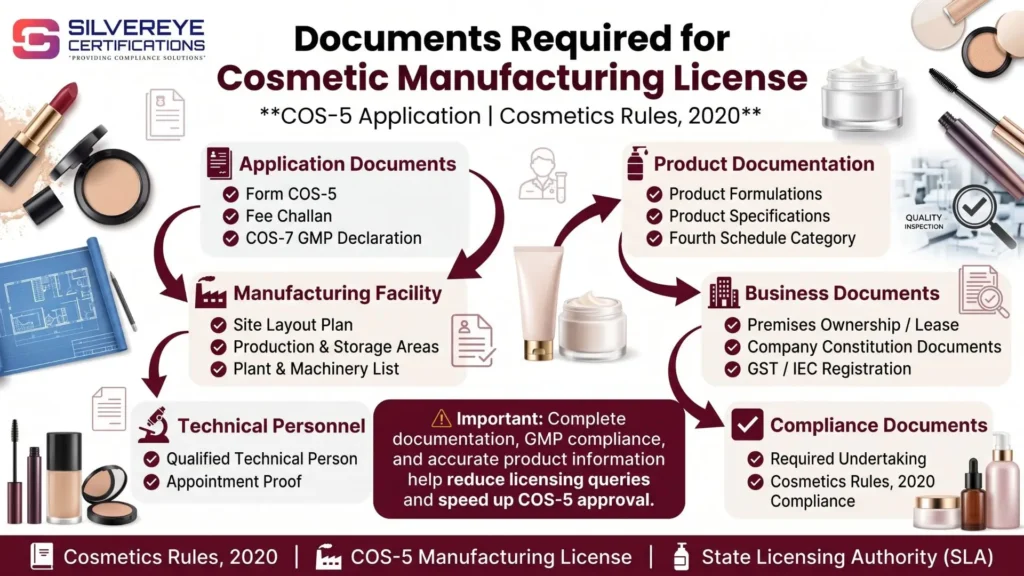
- Duly filled Form COS-5
- Site plan / layout plan of the manufacturing premises — including raw material, extraction, manufacturing, QC, and storage areas
- Proof of premises ownership or registered lease deed
- List of all manufacturing and QC equipment with specifications and capacities
- Qualification certificates and appointment letters of qualified technical staff
- Water analysis report — purified water or deionised water quality certificate
- Product list with botanical ingredient details for each product category
- Standard Operating Procedures (SOPs) for herbal raw material receipt, testing, manufacturing, and QC
- Botanical raw material specifications — including identity tests, purity standards, pesticide residue limits, heavy metal limits
- Environmental clearance or No Objection Certificate from State Pollution Control Board (if applicable)
- GST registration certificate
- Constitution of firm (MOA/AOA for companies; partnership deed; proprietorship declaration)
- Challan / fee payment receipt
Inspection Process for COS-5 / COS-8
After submission of COS-5, the SLA schedules a physical inspection of the manufacturing premises. The inspector verifies compliance with Schedule M-II GMP requirements. For herbal and natural cosmetic facilities, inspectors may pay additional attention to:
- Botanical raw material storage conditions — humidity, temperature, light protection
- Botanical identity and quality testing arrangements
- Segregation of botanicals from synthetic raw materials
- SOPs for handling potent or sensitising botanical ingredients (essential oils, plant extracts with allergen potential)
- Pest control and contamination prevention measures appropriate for organic raw materials
- Submit Form COS-5 with all documents and fee to the State Licensing Authority (SLA / State Drug Controller)
- Receive acknowledgment and scrutiny of documents by SLA
- SLA inspector visits manufacturing premises for physical inspection
- Deficiency notice issued (if any) — applicant rectifies within 30 days of notice
- Re-inspection conducted if required by SLA
- SLA grants Cosmetic Manufacturing License in Form COS-8 — display at premises prominently
Form COS-8: Grant of Natural/Herbal Cosmetic Manufacturing License
Form COS-8 is the official license document issued by the State Licensing Authority confirming the grant of cosmetic manufacturing permission. The COS-8 license specifies the licensed premises, product categories, and validity period. For herbal and natural cosmetic manufacturers, the SLA may impose special conditions regarding botanical raw material sourcing, testing, or storage on the COS-8 license.
Manufacturing License Fees (COS-5 / COS-8)
| Fee Head | Amount (INR) |
| Application fee (COS-5) | Rs. 3,000 (general categories); varies by state and product category |
| License fee (COS-8) | Rs. 5,000 – Rs. 10,000 (state-specific; confirm with your SLA) |
| Inspection fee | As per state schedule |
| Renewal fee | Varies by state — typically 50–100% of original license fee |
| Amendment fee (new product or category) | Rs. 1,000 – Rs. 3,000 per amendment (state-specific) |
Manufacturing license fees differ across states. Always confirm the current fee schedule with your State Drug Controller or SLA before submitting Form COS-5.
Schedule M-II GMP Compliance for Natural and Herbal Cosmetics
Schedule M-II of the Cosmetics Rules, 2020 prescribes Good Manufacturing Practice (GMP) standards for all cosmetic manufacturers in India — including natural and herbal cosmetics. Compliance with Schedule M-II is a mandatory prerequisite for obtaining and retaining a COS-8 manufacturing license.
For natural and herbal cosmetic manufacturers, Schedule M-II compliance has some specific considerations beyond standard cosmetic manufacturing:
| Schedule M-II Area | Special Considerations for Herbal/Natural Cosmetics |
| Raw Material Control | Botanical raw materials require identity testing (macroscopic, microscopic, TLC/HPLC) in addition to chemical purity tests; heavy metal and pesticide residue testing is critical for imported botanicals |
| Supplier Qualification | Botanical supplier qualification should include farm/source traceability, Good Agricultural and Collection Practices (GACP) compliance for key herbs |
| Processing Area | If herbal extracts are prepared in-house, the extraction area must be segregated from the main formulation area; extraction equipment must be cleanable and validated for cross-contamination control |
| Microbial Contamination Control | Natural and botanical ingredients are more susceptible to microbial contamination than synthetic raw materials — enhanced incoming material microbial testing and strict in-process microbial controls are essential |
| Stability Testing | Natural formulations — especially those with reduced or no synthetic preservatives — are more susceptible to degradation; stability testing is critical and accelerated + real-time data should be generated |
| Preservative Efficacy Testing (PET) | Natural preservation systems must be validated by PET (challenge test) — ISO 11930 or equivalent — to confirm the product is adequately preserved against microbial contamination throughout shelf life |
| Documentation | Batch Manufacturing Records (BMR) must include botanical raw material identity test results, supplier batch references, and any in-house extraction batch records |
| Allergen Management | Many botanical ingredients (essential oils, plant proteins, fragrances) are potential skin sensitisers — allergen management SOPs and label warnings (Schedule XI compliance) are essential |
Safety Assessment Report (SAR) for Natural and Herbal Cosmetics
The Safety Assessment Report (SAR) is one of the most critical documents in the cosmetic licensing process — particularly for natural and herbal cosmetics, where the ingredient list often includes novel botanical extracts, essential oils, and plant-derived actives that may not have well-established safety profiles in Indian or international cosmetic ingredient databases.
What Does the SAR Cover for Herbal Cosmetics?
- Ingredient-by-ingredient safety assessment — each botanical extract, carrier oil, essential oil, herb powder, and plant-derived active must be assessed
- Known allergens and sensitisers in botanical ingredients — contact dermatitis potential of essential oils, plant proteins, latex, fragrances
- Heavy metal content in herbal raw materials — particularly for botanicals sourced from regions with high soil contamination
- Pesticide residue assessment — for herbs and botanicals that may carry agricultural chemical residues
- Phototoxicity assessment — some botanical extracts (bergamot, St. John's Wort, fig leaf) are phototoxic and require special formulation precautions or label warnings
- Novel ingredient safety — for unusual botanicals not in EU Cosmetics Regulation Annexes or CIR (Cosmetic Ingredient Review) database, the SAR assessor must provide independent safety evidence
- Consumer exposure assessment — quantity used, frequency of application, body surface area, and vulnerable populations (infants, pregnant women) for baby and maternity cosmetics
Labelling Requirements for Natural and Herbal Cosmetics in India
All natural and herbal cosmetics sold in India must comply with Schedule XI labelling requirements under the Cosmetics Rules, 2020. Labels must not be misleading — particularly regarding 'natural', 'organic', 'herbal', or 'ayurvedic' claims, which are marketing terms and not defined or regulated as certification categories under Indian cosmetics law.
| Mandatory Label Element | Specific Requirements for Natural/Herbal Products |
| Brand Name and Product Name | As specified in the COS-2 or COS-8 license; any name change requires license amendment |
| Manufacturer / Importer Details | Full name and address of manufacturer (COS-8 holder) or importer (COS-2 holder) — for imported herbal products, both foreign manufacturer and Indian importer must be named |
| Country of Origin | For imported natural/herbal cosmetics — 'Country of Origin: [Country]' mandatory |
| Ingredient List (INCI) | All ingredients in descending order of weight; botanical extracts listed by INCI name (e.g., 'Aloe Barbadensis Leaf Extract', not 'aloe vera') — fragrance/parfum listed as single entry unless allergen disclosure required |
| Fragrance Allergen Disclosure | 26 fragrance allergens (per EU standard, which CDSCO references) must be individually declared on the label if present above threshold concentration |
| Batch Number | Mandatory — enables recall traceability |
| Date of Manufacture and Expiry | Both must appear — or 'Best Before [date]' — all natural/herbal products with reduced preservative content often have shorter shelf life than synthetic products |
| Net Content | In metric units — weight (g/kg) for solids and pastes; volume (ml/L) for liquids |
| MRP (Maximum Retail Price) | Mandatory for all retail products sold in India under Legal Metrology Act |
| 'Natural', 'Organic', 'Herbal' Claims | No statutory Indian standard defines 'organic' or 'natural' for cosmetics; these are marketing claims and must not be misleading; if 'certified organic' is claimed, the certification body and standard must be named on label |
| Warnings and Precautions | Essential oil-containing products: 'For external use only'; products with phototoxic ingredients: 'Avoid sun exposure after application'; baby cosmetics: 'Keep away from eyes' |
Prohibited and Restricted Ingredients in Natural/Herbal Cosmetics
Many ingredient sources that are used in traditional herbal beauty preparations are restricted or prohibited under Indian and international cosmetics regulations. Natural origin does not automatically mean safe or permitted. The following are key prohibited and restricted categories relevant to herbal cosmetic manufacturers and importers:
| Ingredient / Category | Regulatory Status in India |
| Lead acetate (used in some traditional henna-based hair dyes) | Prohibited under Cosmetics Rules — no permitted level; presence in any cosmetic is a violation |
| Mercury and mercury compounds (used in some traditional skin lightening preparations) | Prohibited — any detectable level is non-compliant; traditional 'safed' preparations with mercury are illegal as cosmetics |
| Arsenic compounds (found in some ayurvedic mineral preparations) | Prohibited in cosmetics — limit 3 ppm as impurity only; ayurvedic Bhasma formulations with arsenic are drugs, not cosmetics |
| Steroids (some traditional skin lightening creams contain hidden corticosteroids) | Prohibited in cosmetics — products tested positive for steroids are classified as misbranded drugs; major enforcement action target |
| Aristolochic acid (from Aristolochia plants, used in traditional preparations) | Prohibited — carcinogenic and nephrotoxic; not permitted in any cosmetic in India or internationally |
| Kava extracts (Piper methysticum) | Restricted — not permitted in leave-on cosmetics; hepatotoxicity concerns |
| Phototoxic essential oils at high concentrations (bergamot without bergapten removal, lime peel, fig leaf) | Restricted — permissible only within specified concentration limits; must carry phototoxicity warning if limits are approached |
| Essential oils at high concentrations in baby products | Restricted — many essential oils unsafe for infants; formulations for babies must use age-appropriate concentrations and omit sensitising oils |
| Colloidal silver (popular in 'natural' antimicrobial cosmetics) | Not a permitted preservative; use as cosmetic ingredient requires safety justification; therapeutic claims make it a drug |
| Pesticide residues in botanical raw materials (above Cosmetics Rules limits) | Maximum limits apply; botanical ingredient suppliers must provide pesticide residue test certificates |
| Heavy metals in botanical raw materials (lead, cadmium, chromium) | Maximum limits apply per Cosmetics Rules, 2020 and international references — botanical ingredients with high soil-metal accumulation (certain herbs from contaminated regions) need batch-wise testing |
Validity and Renewal of Natural/Herbal Cosmetic Licenses
| License Type | Form | Validity | Renewal Process |
| Cosmetic Import License (Natural/Herbal) | COS-2 | 5 years | Submit renewal application via SUGAM portal with updated CFS, GMP certificate, SAR (if expired), stability data, and renewal fee — at least 3 months before expiry |
| Cosmetic Manufacturing License (Natural/Herbal) | COS-8 | 5 years | Submit renewal application to SLA at least 3–6 months before expiry; updated documents required; premises re-inspection may be ordered |
| Cosmetic Loan License (Natural/Herbal brands) | COS-9 | Co-terminus with licensor's COS-8 (max 5 years) | Renew with COS-8 renewal; fresh Loan License Agreement required if contract manufacturer changes |
Key Renewal Triggers for Herbal Cosmetics
- If the botanical ingredient source or supplier has changed since the original application — SLA or CDSCO may require updated ingredient documentation
- If IS 3224 or Cosmetics Rules have been amended to add restrictions on any botanical ingredient in your product — you must ensure the renewed application reflects compliance
- If any stability data submitted at the time of original application has expired — fresh stability data must be generated and submitted at renewal
- If your foreign manufacturer's GMP certificate or CFS has expired — these must be renewed before the import license renewal can be processed
Benefits of Obtaining Natural/Herbal Cosmetics License
- Legal Market Access: Licensed products can be sold on all platforms — physical retail, modern trade, e-commerce (Amazon, Flipkart, Nykaa, Meesho), and export — without regulatory obstruction.
- Consumer Trust: Licensing signals that your natural cosmetic has undergone safety and quality review — increasingly important to informed consumers in the herbal and organic beauty segment.
- E-Commerce Onboarding: Major Indian e-commerce marketplaces require cosmetic license documentation for onboarding herbal and natural beauty brands — unlicensed products are removed from listings.
- Export Readiness: Many international buyers, particularly in Southeast Asia and the Middle East, require proof of Indian cosmetic licensing as a condition for accepting Indian herbal cosmetic exports.
- Investor Readiness: D2C herbal beauty brands seeking venture capital or PE investment must demonstrate regulatory compliance — CDSCO/SLA licensing is a key diligence checkpoint.
- Brand Credibility: In the crowded natural beauty market, regulatory licensing provides a verifiable trust signal that differentiates compliant brands from uncertified ones.
- Penalty Avoidance: Manufacturing or selling unlicensed cosmetics — even 'all-natural' ones — is a criminal offence under the Drugs and Cosmetics Act attracting imprisonment up to 3 years, fines, and product seizure.
Why Choose Silvereye Certifications for Your Herbal Cosmetics License?
Silvereye Certifications is a specialist regulatory compliance consultancy with deep expertise in CDSCO cosmetic licensing, Cosmetics Rules 2020 compliance, SUGAM portal filings, and herbal/natural product regulatory advisory. Our team has successfully guided ayurvedic cosmetics startups, D2C natural beauty brands, and international herbal cosmetic companies through every stage of the Indian licensing process.
- COS-1 and COS-2 import license applications for natural, herbal, organic, and botanical cosmetics
- COS-5 and COS-8 manufacturing license applications for herbal cosmetic producers
- COS-9 Loan License applications for D2C herbal beauty brands using contract manufacturers
- INCI ingredient list preparation and botanical formulation documentation
- Safety Assessment Report (SAR) coordination — connecting you with qualified cosmetic safety assessors
- Schedule M-II GMP gap assessment for herbal cosmetic manufacturing facilities
- Labelling compliance review — Schedule XI audit with INCI, allergen, and claim compliance check
- Prohibited and restricted ingredient screening for natural and herbal formulations
- SUGAM portal registration, filing, query response, and license download assistance
- Post-license compliance management and renewal tracking
Frequently Asked Questions
Do 100% natural or 'zero chemical' herbal cosmetics need a CDSCO license in India?
Yes, absolutely. The Drugs and Cosmetics Act, 1940 and Cosmetics Rules, 2020 apply to all cosmetics — there is no exemption for natural, herbal, organic, or ayurvedic cosmetics. The law regulates products based on their intended use (cosmetic purpose on the human body), not their ingredient origin. A 100% plant-based aloe vera gel sold as a cosmetic moisturiser needs the same license as a synthetic moisturiser.
Can I sell herbal cosmetics on Amazon or Nykaa without a cosmetic license?
No. Both Amazon India and Nykaa require valid cosmetic licensing documentation for all cosmetic and personal care products listed on their platforms. They routinely request COS-2 (for imported products) or COS-8 (for domestic manufactured products) as part of seller onboarding.
Is there a separate 'organic' or 'ayurvedic cosmetics' license in India?
No. India does not have a separate 'organic cosmetics' license or 'ayurvedic cosmetics' license (for cosmetic-use products). All cosmetics — synthetic, natural, herbal, organic, or botanical — are licensed under the same framework: COS-8 (manufacturing) or COS-2 (import).
What is the INCI name and why is it required for herbal ingredient labelling?
INCI stands for International Nomenclature of Cosmetic Ingredients — a standardised naming system for cosmetic ingredients used globally. Indian cosmetics regulations (Schedule XI, Cosmetics Rules, 2020) require ingredient lists to use INCI names. For botanical ingredients, the INCI name is typically the Latin binomial of the plant followed by the plant part and extract type — for example, 'Ocimum Sanctum Leaf Extract' (tulsi leaf extract), 'Curcuma Longa Root Extract' (turmeric), 'Azadirachta Indica Leaf Extract' (neem).
How long does it take to get a CDSCO import license (COS-2) for natural cosmetics?
For a well-prepared application with all documents in order, COS-2 is typically granted in 30 to 90 working days from complete submission on the SUGAM portal. Applications with novel botanical ingredients, unusual formulations, or missing SAR data take longer — sometimes 4 to 6 months — due to additional CDSCO scrutiny.
Do I need a separate license for each herbal cosmetic product I manufacture?
Not necessarily. The COS-8 manufacturing license covers product categories, not individual SKUs. However, the license specifies which product categories you are authorised to manufacture.
Can a small ayurvedic cosmetics startup get a COS-8 manufacturing license?
Yes. The COS-8 manufacturing license is available to any legal entity regardless of size, including startups and sole proprietorships, provided the manufacturing premises comply with Schedule M-II GMP requirements. Many small herbal cosmetics businesses use the Loan License route (COS-9) to avoid the cost of building a GMP-compliant facility from scratch — they partner with an established licensed contract manufacturer (COS-8 holder) and market products under their own brand.
Are imported K-Beauty or J-Beauty natural cosmetics subject to the same licensing rules?
Yes. All cosmetics imported into India — whether from South Korea, Japan, France, or any other country — must be licensed under the Cosmetics Rules, 2020 regardless of the product's natural or herbal credentials. The Indian authorised agent or importer must apply for COS-2 via the SUGAM portal, providing the Korean or Japanese manufacturer's GMP certificate, Certificate of Free Sale from the country of origin, complete INCI formulation, SAR, and stability data.
What is the penalty for selling herbal cosmetics without a license in India?
Selling or distributing cosmetics without a valid license is a criminal offence under Section 18 of the Drugs and Cosmetics Act, 1940. Penalties include imprisonment for a term that may extend to 3 years, a fine, or both. State drug authorities and CDSCO conduct regular market surveillance — including e-commerce monitoring — and can seize unlicensed products, issue show cause notices, and initiate prosecution against both the brand and the retailer.
How do I renew my COS-8 herbal cosmetics manufacturing license?
Submit a renewal application to the SLA at least 3 to 6 months before your COS-8 expiry date. Attach updated premises information, current technical staff details, and any new product additions. Pay the applicable renewal fee. The SLA may schedule a renewal inspection of your premises — ensure Schedule M-II GMP compliance is maintained. If your premises or processes have changed since the original COS-8 was granted, disclose this proactively in the renewal application.