- Orthodontic devices span three risk classes: CDSCO's dental device classification list places orthodontic elastomerics in Class A, orthodontic bands, wires, and adhesives in Class B, and certain implantable, bone-anchored orthodontic devices in Class C, depending on their intended use and classification.
- Manufacturing requirements depend on the device class: Class A and B devices generally follow the Form MD-3 application and MD-5 license route through the State Licensing Authority, while Class C devices follow the Form MD-7 application and MD-9 license route through the Central Licensing Authority.
- Importers use Form MD-14 and MD-15: An authorized Indian agent applies using Form MD-14 and, upon approval, receives the import license in Form MD-15 from CDSCO, subject to applicable requirements.
- Wholesalers and distributors use Form MD-41 and MD-42, where applicable: Businesses covered by the Medical Devices Rules, 2017 must apply using Form MD-41 to obtain a registration certificate in Form MD-42 for the relevant sale, stocking, distribution, or related activities.
Introduction
CDSCO registration for orthodontic devices is governed by the Medical Devices Rules, 2017, and the applicable licensing route depends on the device's risk classification and intended use. Orthodontic products may fall under Class A (e.g., orthodontic elastomerics), Class B (e.g., orthodontic bands, guide wires, and adhesives), or Class C (certain implantable, bone-anchored orthodontic devices).
- Class A and B manufacturers: Apply using Form MD-3 and, upon approval, receive the manufacturing licence in Form MD-5 from the State Licensing Authority, subject to applicable requirements.
- Class C manufacturers: Apply using Form MD-7 and, upon approval, receive the manufacturing licence in Form MD-9 from the Central Licensing Authority (CDSCO).
- Importers: Apply using Form MD-14 and receive the import license in Form MD-15 upon approval.
- Wholesalers and distributors: Where applicable, apply using Form MD-41 to obtain a registration certificate in Form MD-42 for regulated sale, stocking, distribution, or related activities.
Important: Confirm the exact classification of each device against the current official CDSCO classification list. The applicable requirements may vary according to the product's intended purpose and regulatory category.
What Is CDSCO Registration for Orthodontic Devices?
CDSCO registration for orthodontic devices refers to the applicable regulatory licensing and approval requirements administered by the Central Drugs Standard Control Organization (CDSCO) under India's Ministry of Health and Family Welfare. These requirements govern the manufacture, import, and regulated sale or distribution of medical devices used to correct the position of teeth and jaws.
Orthodontic products include orthodontic bands, guide wires, elastomerics, adhesives, and certain implantable anchorage devices. These products fall within the broader dental medical device category and are regulated under the Medical Devices Rules, 2017 (MDR 2017), framed under the Drugs and Cosmetics Act, 1940.
On 13 September 2021, CDSCO issued a classification notice covering 91 dental medical devices, including several orthodontic products. Because these devices differ in their design, intended purpose, and potential risks, the applicable regulatory requirements depend on the specific device's classification, rather than treating all orthodontic products as one uniform category.
How CDSCO Classifies Orthodontic Devices: Class A, B and C
CDSCO's dental medical device classification notice dated 13 September 2021 identifies specific orthodontic products and assigns risk classes to them. The official classification should be checked before determining the applicable manufacturing licence.
| Class | Risk Category | Orthodontic Examples | Manufacturing Licence Route |
|---|---|---|---|
| Class A | Low risk | Orthodontic elastomeric devices, as identified in the CDSCO classification list | Form MD-3 → MD-5, through the State Licensing Authority, subject to applicable requirements |
| Class B | Low-to-moderate risk | Orthodontic appliance bands, orthodontic guide wires, and orthodontic adhesives, as listed by CDSCO | Form MD-3 → MD-5, through the State Licensing Authority, subject to applicable requirements |
| Class C | Moderate-to-high risk | Certain implantable or bone-anchored orthodontic devices, if classified as Class C under the applicable rules or official classification | Form MD-7 → MD-9, through the Central Licensing Authority, where applicable |
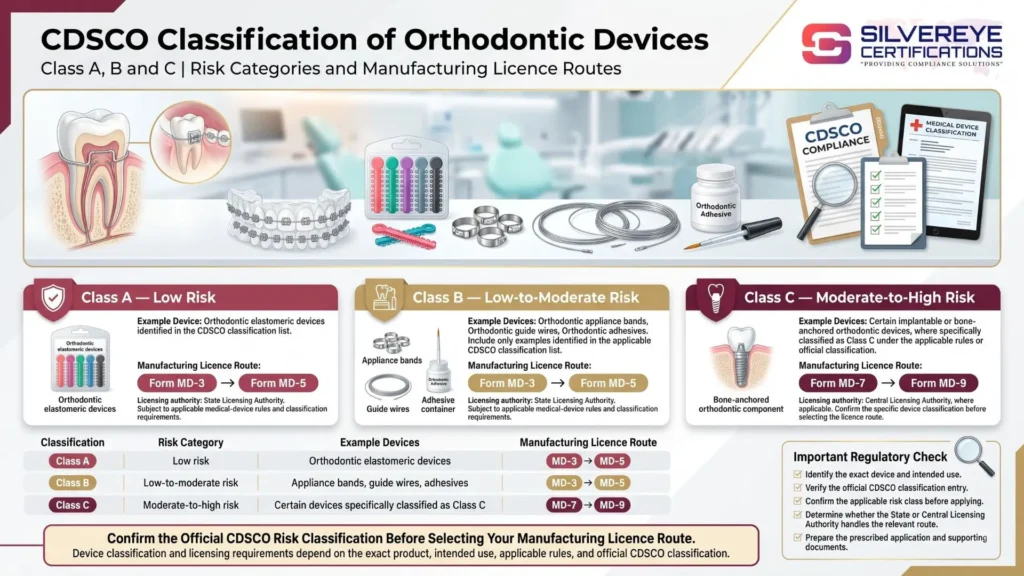
Important: Confirm Your Exact Orthodontic Device Classification
CDSCO's dental device classification notice directly identifies orthodontic elastomerics as Class A and orthodontic appliance bands, guide wires, and adhesives as Class B.
For implantable, bone-anchored orthodontic hardware, such as temporary anchorage devices or mini-implants, do not assume Class C solely because the device is implantable. The applicable classification must be established from the current official classification list and relevant classification rules. Where the product is not explicitly listed, seek clarification from CDSCO before submitting the application.
Who Needs CDSCO Registration for Orthodontic Devices?
The applicable regulatory requirements depend on whether a business manufactures, imports, or sells and distributes orthodontic medical devices. Different forms apply to different activities.
| Business Activity | Class A/B Manufacturing Route | Class C Manufacturing Route | Relevant Authority |
|---|---|---|---|
| Manufacturer | Form MD-3 → MD-5 | Form MD-7 → MD-9 | State Licensing Authority for the applicable Class A/B route; Central Licensing Authority for the applicable Class C route |
| Importer | Form MD-14 → MD-15 | Form MD-14 → MD-15 | CDSCO's Central Licensing Authority |
| Wholesaler / Distributor | Form MD-41 → MD-42, where applicable | Form MD-41 → MD-42, where applicable | Relevant State Licensing Authority |
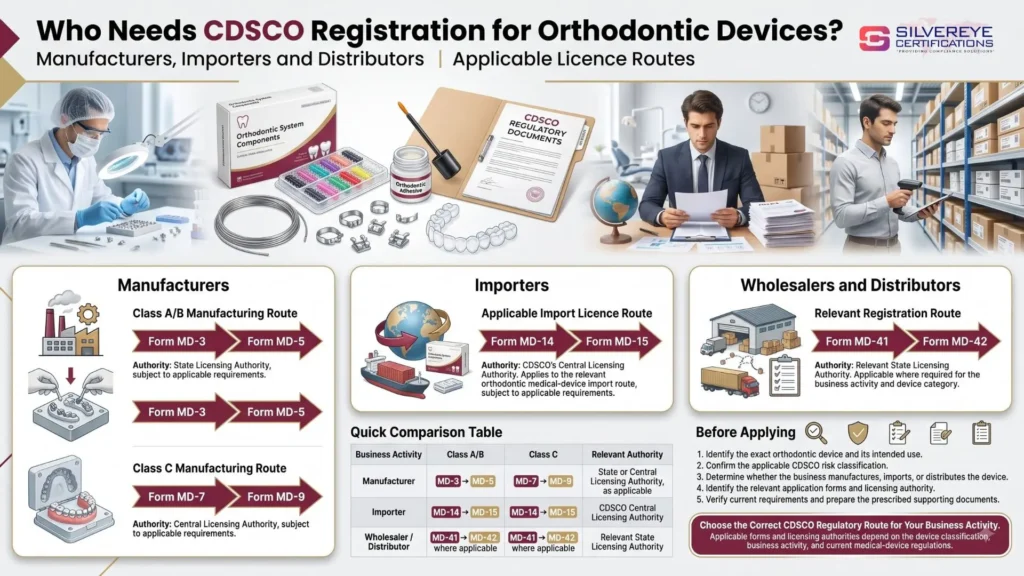
If your business performs more than one activity — for example, manufacturing orthodontic bands while importing bone-anchored orthodontic devices — you should assess the licensing requirements separately for each activity and product.
Before applying, verify the product's risk classification, intended use, applicable license forms, and current regulatory requirements through the official CDSCO resources. This helps prevent incorrect applications, documentation gaps, and avoidable delays.
CDSCO Manufacturing License: MD-3/MD-5 (Class A/B) vs. MD-7/MD-9 (Class C)
Class A/B Orthodontic Devices — Form MD-3 and MD-5
- Business and manufacturing premises: The applicant must meet the applicable legal and regulatory requirements for the business entity and manufacturing facility in India.
- Quality Management System (QMS): Maintain a QMS that meets applicable medical device regulatory requirements. ISO 13485:2016 can support quality management, while product-specific testing may include material safety and elasticity testing for elastomerics, bonding-strength testing for adhesives, and tensile-strength and corrosion-resistance testing for orthodontic wires and bands, as applicable.
- Application submission: Apply using Form MD-3 through the applicable licensing process, with the required Site Master File, Device Master File, and supporting documents.
- Licensing authority: The State Licensing Authority (SLA) reviews the application and grants the manufacturing licence in Form MD-5, where applicable.
- Processing time: The timeline depends on application completeness, regulatory scrutiny, testing requirements, and whether an inspection or additional information is required. Confirm the current timeline with the relevant authority.
Class C Orthodontic Devices — Form MD-7 and MD-9
- Business and facility requirements: Applicants must meet the applicable requirements for the business entity, manufacturing premises, and quality management system.
- Quality and safety evidence: Depending on the device's intended use and classification, supporting evidence may include biocompatibility data, mechanical performance testing, risk management documentation, and sterilisation and packaging validation, where applicable.
- Application submission: Apply using Form MD-7, accompanied by the required Device Master File, Site Master File, and relevant technical documentation.
- Licensing authority: The Central Licensing Authority (CDSCO) reviews the application and grants the manufacturing licence in Form MD-9, where applicable.
- Inspection and processing time: Inspection and approval timelines depend on the applicable regulatory process, the completeness of the submission, and the technical review. Avoid relying on a fixed inspection deadline or overall processing estimate unless confirmed by current official guidance.
Important: Confirm the exact risk class of an implantable or bone-anchored orthodontic device before selecting the manufacturing route. Implantable status alone does not establish that every such device belongs to Class C.
Documents Required for Orthodontic Device Registration
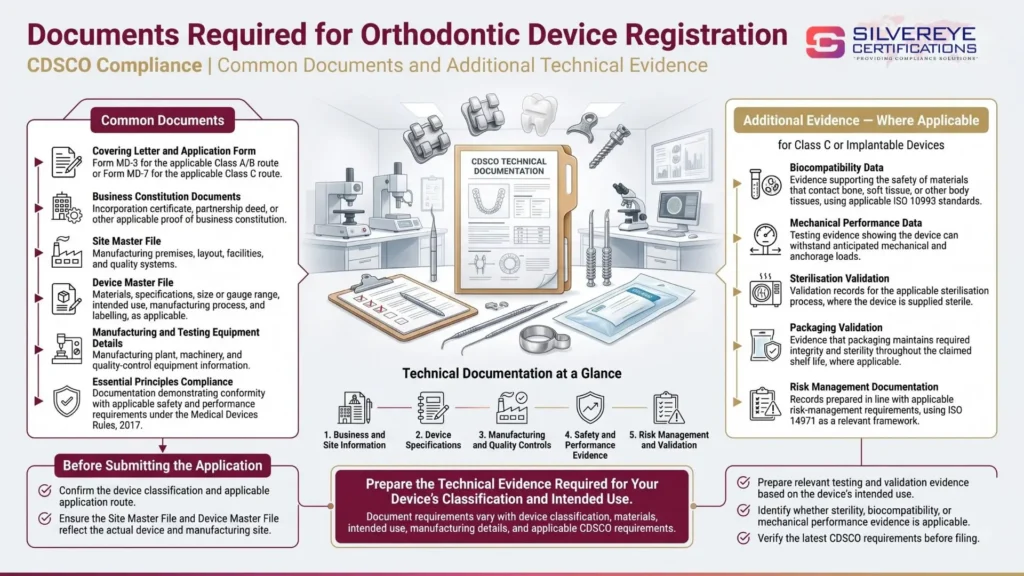
Common Documents
- Covering letter and application form: Form MD-3 for the applicable Class A/B route or Form MD-7 for the applicable Class C route.
- Business constitution documents: Relevant incorporation certificate, partnership deed, or other applicable proof of business constitution.
- Site Master File: Information about the manufacturing premises, layout, facilities, and quality systems.
- Device Master File: Details of the device's materials, specifications, size or gauge range, intended use, manufacturing process, and labelling, as applicable.
- Manufacturing and testing equipment details: Information about the manufacturing plant, machinery, and quality-control equipment.
- Essential Principles compliance: Documentation demonstrating conformity with the applicable Essential Principles of safety and performance under the Medical Devices Rules, 2017.
Additional Documents for Class C or Implantable Devices
Depending on the product and its classification, additional evidence may include:
- Biocompatibility data: Evidence supporting the safety of materials that contact bone, soft tissue, or other body tissues, using applicable ISO 10993 standards.
- Mechanical performance data: Testing to demonstrate that the device can withstand its anticipated mechanical and anchorage loads.
- Sterilisation validation: Validation records for the applicable sterilisation process, where the device is supplied sterile.
- Packaging validation: Evidence that the packaging maintains the required integrity and sterility throughout the claimed shelf life, where applicable.
- Risk management documentation: Records prepared in line with applicable risk management requirements, using ISO 14971 as a relevant framework.
CDSCO Import License for Orthodontic Devices (MD-14 and MD-15)
Foreign manufacturers seeking to market orthodontic devices in India must comply with the applicable medical device import licensing requirements. An eligible Authorized Indian Agent generally submits the import application using Form MD-14, and the import license is issued in Form MD-15 upon approval by CDSCO's Central Licensing Authority.
The agent must meet the applicable eligibility and licensing requirements. Do not assume that every importer must hold an MD-42 wholesale registration specifically; verify the agent's required credentials under the current Medical Devices Rules and the applicable import route.
Documents Required for an MD-14 Application
Depending on the device and application route, the supporting documents may include:
- Covering letter and completed Form MD-14.
- Proof of applicable government fee payment.
- Authorisation from the foreign manufacturer, including the prescribed Power of Attorney and authentication requirements, where applicable.
- Evidence of the Indian agent's eligibility and relevant licence or registration documents, as required.
- Free Sale Certificate or other regulatory evidence accepted under the applicable rules.
- Device Master File and Plant Master File or equivalent technical documentation required for the application.
- Quality management documentation, including an applicable ISO 13485 certificate.
- CE marking or other international regulatory approvals, where relevant or specifically required.
Import review depends on the device and its classification. Class A and Class C devices use the applicable MD-14/MD-15 import route, but the supporting evidence and regulatory scrutiny may differ. For implantable devices, the authority may require more detailed evidence concerning biocompatibility, mechanical performance, and other product-specific safety considerations.
CDSCO Wholesale or Distributor Registration for Orthodontic Devices (MD-41 and MD-42)
Businesses involved in the sale, stocking, exhibition, or distribution of medical devices should determine which registration or licensing requirements apply to their activities under the Medical Devices Rules, 2017. Where the MD-41/MD-42 route applies, the business submits Form MD-41, and the relevant State Licensing Authority issues the registration certificate in Form MD-42 upon approval.
Eligibility and Documents for MD-41/MD-42
Depending on the applicable requirements, the application may involve:
- Suitable storage premises with appropriate shelving, cleanliness, and recordkeeping arrangements.
- A technically competent person responsible for relevant storage and distribution activities, where required.
- Completed Form MD-41 and applicable business constitution documents.
- Premises address proof and layout details, as required.
- Proof of technical competence, where applicable.
- Government fee payment receipt.
- Inspection or verification of the premises, if required by the applicable procedure.
The State Licensing Authority may examine the application and verify compliance before granting Form MD-42 registration. Confirm the current checklist and inspection procedure before submitting the application.
Fees for Orthodontic Device Registration
Government fees for CDSCO registration of orthodontic devices depend on the applicable license type, device class, and requirements under the First Schedule of the Medical Devices Rules, 2017 (MDR 2017). Manufacturing and import applications may attract different fees, while wholesale registration has its own prescribed fee.
| Licence Type | Applicable Government Fee | Important Notes |
|---|---|---|
| Class A/B Manufacturing (MD-3/MD-5) | As prescribed under the applicable MDR 2017 fee schedule | Confirm the fee for the specific application and device category |
| Class C Manufacturing (MD-7/MD-9) | As prescribed under the applicable MDR 2017 fee schedule | Confirm the applicable central licensing fee |
| Import Licence (MD-14/MD-15) | As prescribed under the applicable MDR 2017 fee schedule | Fees may depend on the manufacturing site and device or product group |
| Wholesale Registration (MD-41/MD-42) | Verify the prescribed fee under the current rules | Confirm the fee and applicable requirements before payment |
Note: Government fees and professional consultancy charges are separate. Verify the current fee on the official CDSCO website or the applicable application portal before submitting payment.
Processing Timeline and License Validity
The processing time for CDSCO orthodontic device licensing depends on the completeness of the application, technical documentation, product classification, testing requirements, and any inspection or clarification requested by the licensing authority.
| Licence Type | Processing Time | Validity and Compliance |
|---|---|---|
| MD-5 (Class A/B manufacturing) | Depends on application review and applicable procedures | Follow the validity and retention requirements applicable to the issued licence |
| MD-9 (Class C manufacturing) | Depends on technical review, inspection, and applicable procedures | Follow the validity and retention requirements applicable to the issued licence |
| MD-15 (Import licence) | Depends on application completeness and regulatory review | Comply with applicable licence conditions and retention-fee requirements |
| MD-42 (Wholesale registration) | Depends on document verification and applicable procedures | Follow the validity and retention requirements applicable to the registration |
Avoid relying on fixed processing estimates unless the relevant authority confirms them. Similarly, renewal and retention requirements differ by license type. Check the current rules and the conditions printed on your license or registration certificate before planning a filing deadline.
Benefits of CDSCO Registration for Orthodontic Devices
- Legal market access: Obtaining the applicable CDSCO license or registration helps a business meet the regulatory requirements for manufacturing, importing, or distributing orthodontic devices in India.
- Orthodontist and dental clinic confidence: Maintaining appropriate regulatory documentation can help build trust with dental clinics, orthodontic practices, hospitals, and medical device distributors.
- Reduced compliance risk: Meeting applicable requirements helps reduce the risk of regulatory action, including possible seizure of stock, license suspension or cancellation, and prosecution, depending on the violation.
- Stronger regulatory documentation: Proper licensing, technical records, and quality documentation can support supplier assessments and future regulatory submissions in other markets. However, CDSCO approval does not automatically replace foreign-market authorisations.
Penalties for Non-Compliance
Manufacturing, importing, or distributing orthodontic devices without the applicable regulatory authorisation may violate the Medical Devices Rules, 2017, and the relevant provisions of the Drugs and Cosmetics Act, 1940.
Depending on the nature and seriousness of the violation, consequences may include regulatory action, seizure of products, suspension or cancellation of licenses, financial penalties, or prosecution. Businesses should also verify the regulatory status of their manufacturers and suppliers and maintain appropriate purchase, distribution, and traceability records.
Common Mistakes to Avoid
- Assuming all orthodontic products are Class A: CDSCO's notified list identifies certain orthodontic elastomerics as Class A and orthodontic bands, guide wires, and adhesives as Class B. Confirm the classification of each product individually.
- Selecting the wrong application form: The applicable manufacturing route depends on the officially established device class. Forms MD-3/MD-5 and MD-7/MD-9 apply to different manufacturing routes.
- Submitting incomplete technical documentation: Ensure the application includes the required Device Master File, material specifications, performance data, labelling, and relevant safety evidence.
- Assuming one authorization covers every activity: Manufacturing, importing, and wholesale distribution may require separate authorizations or registrations.
- Skipping classification verification: Check the latest applicable CDSCO dental medical device classification list before filing an application.
- Ignoring validity and retention requirements: Check the current requirements for the specific licence or registration and plan ahead to avoid compliance gaps.
Practical tip: Before applying, confirm your device's intended use, official risk class, manufacturing or import route, fee category, and supporting-document checklist. These details help you prepare a more accurate application and reduce avoidable queries.
Conclusion
CDSCO registration for orthodontic devices is an important step toward meeting India's medical device regulatory requirements. Identifying the correct risk classification—Class A for specified orthodontic elastomerics and Class B for listed orthodontic bands, guide wires, and adhesives—is essential for selecting the appropriate licensing route. For implantable, bone-anchored orthodontic devices, the official classification should be confirmed before applying. Preparing a complete Device Master File, relevant safety and performance data, and the required application documents can help reduce avoidable delays.
Why Choose Silvereye Certifications?
Silvereye Certifications provides regulatory compliance support for businesses seeking CDSCO approval for medical devices. Our team can help manufacturers, importers, and distributors understand the applicable requirements and prepare their documentation.
- Device Classification Guidance: Assistance in identifying the applicable regulatory category and licensing route.
- Technical Documentation Support: Guidance on preparing the Device Master File, material specifications, safety evidence, and performance documentation.
- Application Assistance: Support with the relevant forms, documentation, and SUGAM portal submission process.
- Import and Distribution Guidance: Assistance in understanding the applicable requirements for importers, wholesalers, and distributors.
- Ongoing Compliance Support: Guidance on applicable post-approval obligations and regulatory documentation.
Whether you manufacture orthodontic materials in India or import dental devices from overseas, Silvereye Certifications can help you understand the applicable CDSCO requirements and navigate the registration process with greater confidence.
Need help with CDSCO registration for orthodontic devices? Contact Silvereye Certifications for guidance tailored to your product and business activities.
Frequently Asked Questions
Is CDSCO registration mandatory for orthodontic devices in India?
Yes. Orthodontic devices are notified medical devices under CDSCO's dental device classification, so manufacturing, importing, or distributing them in India requires the applicable CDSCO license or registration.
What CDSCO class does an orthodontic elastomeric fall under?
Class A. CDSCO's official dental device notice classifies orthodontic elastomerics — used to control tooth position and minimize relapse after treatment — as Class A, the lowest-risk category
What CDSCO class do orthodontic bands, wire, and adhesive fall under
CDSCO's dental device notice specifically classifies orthodontic appliance bands, orthodontic guide wire, and orthodontic adhesive as Class B.
Are implantable orthodontic devices Class C?
Bone-anchored orthodontic hardware, such as temporary anchorage devices, follows the same higher-risk regulatory logic CDSCO applies to other bone-implanted dental devices, which points to Class C. Always confirm the specific product's classification on the SUGAM portal, since CDSCO's published dental device list does not include every possible orthodontic product by name.
What is the difference between Form MD-3, MD-7, MD-14, and MD-41?
MD-3 is the manufacturing license application for Class A/B devices (granted as MD-5). MD-7 is the manufacturing license application for Class C devices (granted as MD-9). MD-14 is the import licence application (granted as MD-15). MD-41 is the wholesale/distribution registration application (granted as MD-42).
How long does CDSCO registration for orthodontic devices take
Class A/B manufacturing licences (MD-5) typically take 3–6 months. Class C manufacturing licences (MD-9) typically take 6–9 months. Wholesale registrations (MD-42) usually take 30–60 days, and import licenses (MD-15) generally range from 3–9 months depending on class.
What is the validity of a CDSCO orthodontic device license?
MD-5, MD-9, and MD-42 are generally valid for 5 years from the date of issue. MD-15 import licences generally continue indefinitely, subject to payment of a retention fee every 5 years.
What documents are required for CDSCO orthodontic device registration?
Core documents include the relevant application form (MD-3, MD-7, MD-14, or MD-41), business constitution proof, site or premises details, a Device Master File with material and performance data appropriate to the product's class, and the applicable fee payment receipt. Importers additionally need a Power of Attorney and a Free Sale Certificate from the country of origin.
Can one business hold manufacturing, import, and wholesale licenses together?
Yes, if the business genuinely performs all three activities. Each activity still requires its own separate CDSCO authorisation — holding one licence does not automatically cover the others.
What happens if I sell orthodontic devices without CDSCO registration?
You risk stock seizure, financial penalties, cancellation of any existing licenses, and prosecution under the Drugs and Cosmetics Act, 1940, which can include imprisonment in serious cases.
Is BIS certification also required for orthodontic devices?
BIS and CDSCO are separate regulatory frameworks. CDSCO governs orthodontic devices as medical devices under MDR 2017. Whether a specific BIS standard for dental metals or resins also applies depends on the product's material composition, and should be checked independently of CDSCO compliance.
How do I renew my CDSCO orthodontic device license?
Renewal applications should be filed 60–90 days before expiry, using the previous license details, updated documents where applicable, and the prescribed renewal or retention fee, submitted through the SUGAM portal to the relevant State or Central Licensing Authority.