
It depends on how the essential oil is used and marketed. Essential oils intended for application to the body or hair can fall under the cosmetics framework, while other uses may be regulated differently. Where the product is a cosmetic, imports require CDSCO registration and domestic manufacturing requires the applicable State Licensing Authority license.
- Importing? You generally need an Import Registration Certificate in Form COS-2 before importing the cosmetic for sale in India.
- Making or blending to sell in India? Apply to the applicable State Licensing Authority for the relevant COS-8 or COS-9 license, depending on the manufacturing arrangement.
- What does this guide cover? It explains fees, documents, labelling, validity, retention, exemptions and 12 FAQs, based on applicable CDSCO documents and the Cosmetics Rules, 2020, with information updated for 2026.
Introduction
CDSCO registration for essential oils is required when the oil is sold as a cosmetic, meaning it is intended for application to the skin or hair, such as for massage, bath, body or certain aromatherapy uses. Importers need a CDSCO Import Registration Certificate (Form COS-2). Indian manufacturers and blenders need the applicable cosmetic manufacturing license (Form COS-8, or COS-9 for a loan license) from the State Licensing Authority.
Edible oils are regulated under the applicable food laws, while products making disease-treatment or therapeutic claims may fall under the applicable drug regulatory framework instead. Fees, documents and timelines are covered below.
When Is an Essential Oil a Cosmetic, a Drug or a Food?
India does not have a separate regulatory law specifically for essential oils or aromatherapy products. The applicable regulatory route depends largely on the intended use, how the product is marketed, and the claims made for it.
Under Section 3(aaa) of the Drugs and Cosmetics Act, 1940, a cosmetic includes an article intended to be rubbed, poured, sprinkled, sprayed or otherwise applied to the human body for cleansing, beautifying, promoting attractiveness or altering appearance. It also includes an article intended for use as a component of a cosmetic.
Therefore, an essential oil marketed for application to the skin or hair can fall within the cosmetic framework. However, products marketed for food use, therapeutic purposes or other non-cosmetic uses may fall under different regulatory frameworks.
| How you sell the oil | Likely treatment | What it means for you |
|---|---|---|
| Massage oil, body oil, bath oil, hair oil or skincare blend containing essential oils | Cosmetic, where it meets the cosmetic definition | CDSCO registration for applicable imports; State manufacturing licence for Indian manufacture |
| Pure essential oil sold for application to the skin or as a perfume-type cosmetic product | Cosmetic, where the intended use and presentation meet the definition | Follow the applicable cosmetic registration/licensing and labelling requirements |
| Essential oil sold only for diffusers, burners or room fragrance, with no body-use claim | May fall outside the cosmetic definition | The classification should be assessed based on the actual intended use, presentation and claims before import or manufacture |
| Essential oil or flavour sold for eating or drinking | Food, where it meets the applicable food definition | Follow the applicable food/FSSAI requirements, rather than the CDSCO cosmetic route |
| Oil marketed with claims to cure, treat or prevent a disease | May fall outside the ordinary cosmetic framework | The product may require assessment under the applicable drug or other regulatory framework; AYUSH requirements may also apply to qualifying Ayurvedic, Unani or Siddha products |
What Should Essential Oil Brands Know About Health Claims in 2026?
CDSCO's cosmetics section published a “Use of Cosmetics” notice in May 2026, reinforcing the requirement that cosmetics comply with the applicable rules and should not be presented for prohibited therapeutic purposes.
For essential oil brands, the practical distinction is important. A statement describing the product's fragrance or cosmetic use is different from a claim that the product cures migraine, treats anxiety or prevents a disease. Claims should therefore be reviewed carefully before they appear on labels, websites, advertisements or product listings.
What About Bulk Essential Oils Sold as Raw Material?
The cosmetic definition also includes articles intended for use as a component of a cosmetic. However, the regulatory treatment of a particular bulk essential oil can depend on its intended use, formulation, documentation and import/manufacturing arrangement.
If you plan to import bulk essential oil for use in a cosmetic or fragrance manufacturing operation, obtain the appropriate regulatory classification or clarification before shipment rather than assuming that the finished-product registration rules automatically apply in exactly the same way.
What CDSCO Registration or License Does an Essential Oil Business Need?
The term CDSCO registration is often used broadly, but imported cosmetics and domestically manufactured cosmetics follow different regulatory routes. CDSCO states that cosmetic imports are regulated through registration by the Central Licensing Authority, while domestic cosmetic manufacturing is regulated through inspection and licensing by the State Licensing Authorities.
| Your situation | Authority | Form(s) | What is required? |
|---|---|---|---|
| Importing essential-oil cosmetics for sale in India | CDSCO / Central Licensing Authority | COS-1 application → COS-2 certificate | Yes, where the product falls within the cosmetic framework |
| Manufacturing or blending cosmetics in your own Indian premises | State Licensing Authority | COS-5 application → COS-8 licence | Applicable manufacturing licence |
| Using a licensed third-party manufacturer under the loan-licence route | State Licensing Authority | COS-6 application → COS-9 licence | Applicable loan licence |
| Exporting Indian essential-oil products | Destination country's regulator | Varies | Check the requirements of the destination market |
| Reselling compliant products purchased from a registered/licensed supplier | Depends on the business activity | Varies | Maintain compliant stock, invoices and applicable business records |
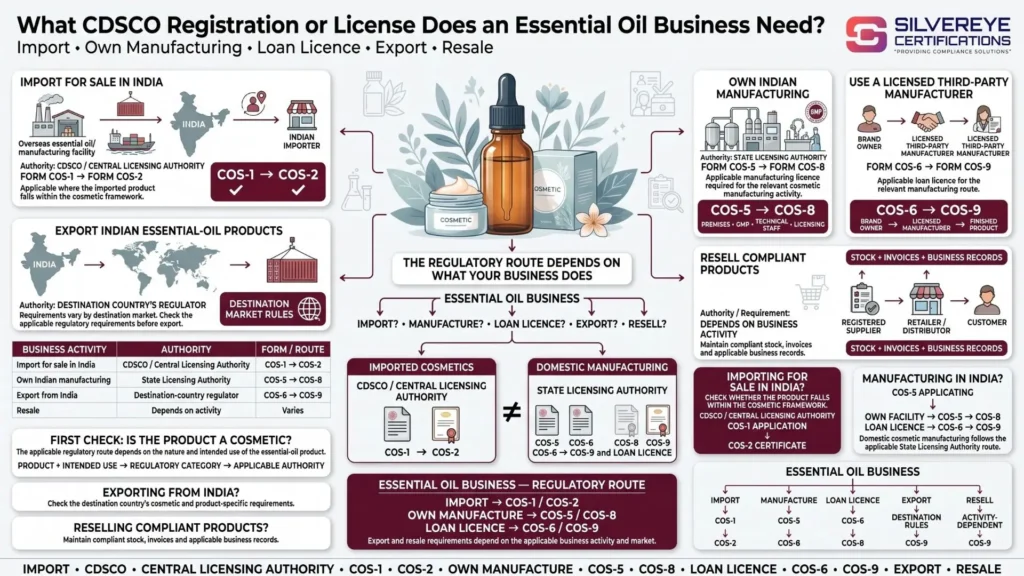
For imported cosmetics, CDSCO's guidance states that the application for an Import Registration Certificate is made online in Form COS-1 through the SUGAM portal, with the certificate issued in Form COS-2.
What Are the Benefits of Registering Essential Oil Products?
- Legal import and manufacturing compliance: Applicable cosmetic imports require registration, while domestic cosmetic manufacture is subject to the State Licensing Authority's licensing system.
- Retail and marketplace readiness: Regulatory documents can help demonstrate that the product is covered by the applicable compliance framework.
- Better label compliance: Imported and domestically manufactured cosmetics must follow the applicable labelling and product-information requirements.
- Product safety and quality: Compliance with applicable quality and safety standards helps reduce regulatory and product-quality risks.
- Easier product expansion: Additional products or variants can be handled through the applicable endorsement/additional-product procedures, where permitted.
- Lower enforcement risk: Maintaining accurate registration, manufacturing and product records helps the business respond to regulatory inspections or queries.
Who Can Apply for Essential Oil Import Registration?
Who Can Apply Through Form COS-1?
For cosmetic imports, CDSCO's guidance states that the application may be submitted by the manufacturer, the manufacturer's authorised agent or importer in India, or an authorised Indian subsidiary, as applicable. The application is made to the Central Licensing Authority through the SUGAM portal.
Who Can Apply for a Manufacturing License?
For domestic manufacturing, the relevant application is made to the State Licensing Authority.
The manufacturing requirements include:
- Compliant manufacturing premises meeting the applicable Cosmetics Rules requirements.
- Competent technical staff meeting the qualifications prescribed under Rule 26.
- Appropriate manufacturing equipment and testing arrangements.
- Compliance with the applicable Seventh Schedule requirements.
- For the loan-licence route, an eligible licensed manufacturing facility and the required supporting documents.
The Cosmetics Rules specifically provide that a cosmetic manufacturing licence or loan licence is granted in Form COS-8 or Form COS-9, respectively. They also prescribe requirements relating to competent technical staff, premises and testing arrangements.
What Product Requirements Must Essential Oils Meet?
Being natural or plant-based does not automatically exempt an essential oil from cosmetic requirements. Where the product is regulated as a cosmetic, it must comply with the applicable Cosmetics Rules, 2020 and relevant standards.
- Ingredients: Ingredients prohibited under IS 4707 (Part 2) must not be used. Ingredients should be declared using the applicable standard nomenclature and percentages.
- Fragrance ingredients: CDSCO guidance addresses the declaration of certain fragrance ingredients above the applicable thresholds and also refers to a manufacturer's undertaking regarding fragrance composition. This is particularly relevant for essential-oil blends because some naturally occurring constituents can be fragrance allergens. Confirm the applicable declaration requirements for your formulation before filing.
- Colours and heavy metals: Where colours are used, only permitted colours may be used and applicable heavy-metal limits must be followed. The relevant standards should be checked for the specific formulation and colour used.
- Quality standards: The product should comply with the applicable Ninth Schedule specifications. Where a particular cosmetic is not covered by the applicable Indian standard, the regulatory treatment should be confirmed rather than automatically assuming that any country-of-origin standard is sufficient.
- Animal testing: Cosmetics tested on animals after 12 November 2014 are subject to import restrictions under the applicable rules. The required manufacturer undertaking must be provided.
- No misleading claims: Rule 36 prohibits false or misleading claims in relation to cosmetics.
For essential oils, maintain batch-wise records, supplier specifications, formulation details and relevant test reports. Where appropriate, GC-MS or other analytical reports can also help demonstrate product identity and consistency.
What Documents Are Required for Essential Oil Import Registration?
What Documents Do Importers Need for Form COS-1?
| Document | What to know |
|---|---|
| Covering letter | State whether it is a fresh registration, endorsement or other applicable request, with previous certificate details where relevant. |
| Manufacturer's authorisation (First Schedule) | Must be appropriately authenticated and signed by the relevant manufacturer and Indian applicant/agent. |
| Second Schedule, Part I | Manufacturer information and required undertaking for the COS-1 application. |
| Ingredient list with percentages | Should be complete and provided by the manufacturer. |
| Labels | Provide legible original labels or copies for each applicable product/variant and ensure compliance with Chapter VI. |
| Specifications and test methods | Provide the applicable product specifications and testing information. |
| Manufacturing licence or equivalent | Authenticated copy from the country of origin where applicable, or the relevant undertaking where no such licence exists. |
| Free Sale Certificate | Should cover the relevant products and be appropriately authenticated where required. |
| Product correlation | Match the products listed in COS-1 with the Free Sale Certificate and manufacturer authorisation. |
| Non-animal-testing declaration | Manufacturer undertaking confirming compliance with the applicable requirements. |
| Heavy-metal and hexachlorophene declaration | Applicable test report, declaration or undertaking as required. |
| Fee receipt | Applicable fee paid through Bharatkosh, with the acknowledgement submitted with the application. |
What Documents Do Manufacturers Need for COS-5 or COS-6?
Domestic manufacturers generally need:
- Completed Form COS-5 for their own manufacturing licence or Form COS-6 for a loan licence.
- Applicable fee receipt and supporting documents required by the State Licensing Authority.
- Product list, composition/formula and labelling information.
- Form COS-7 self-declaration relating to compliance with applicable Good Manufacturing Practices.
- Proof relating to the manufacturing premises, constitution of the business and technical staff.
- For a loan licence, the applicable documents relating to the licensed host manufacturer's premises and licence.
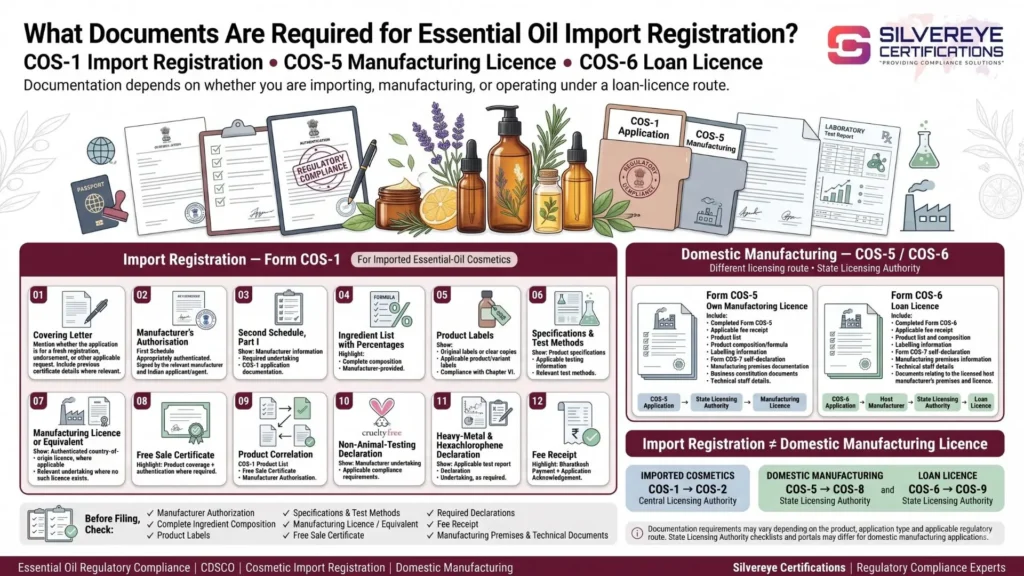
State portals and checklists can differ in their document-submission process, so confirm the current checklist with the relevant State Licensing Authority before filing.
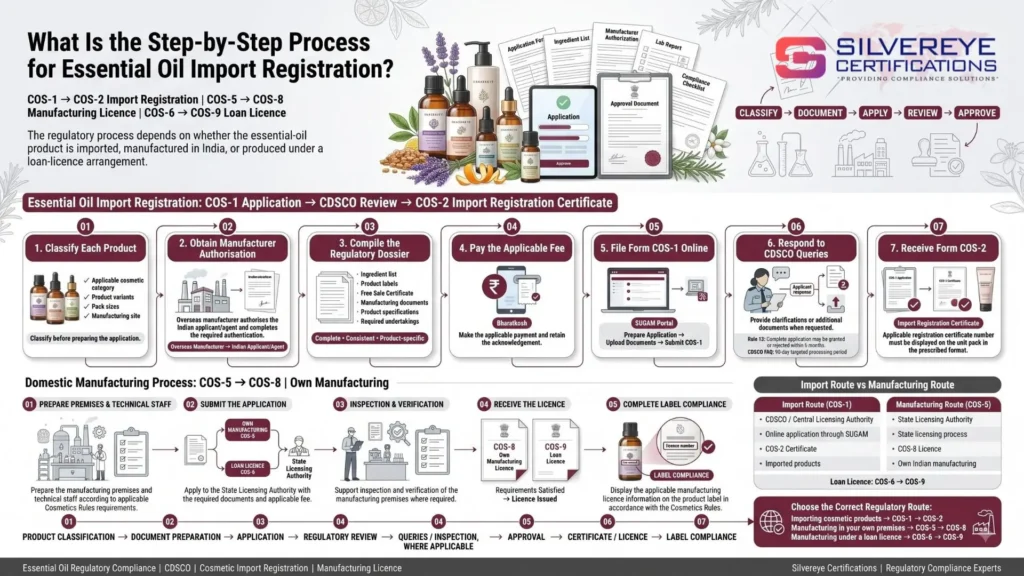
What Is the Step-by-Step Process for Essential Oil Import Registration?
How Does the COS-1 to COS-2 Process Work?
- Classify each product. Determine the applicable cosmetic category and list every product, variant, pack size and manufacturing site.
- Obtain manufacturer authorisation. The overseas manufacturer authorises the Indian applicant/agent and completes the required authentication.
- Compile the dossier. Prepare the ingredient list, labels, Free Sale Certificate, manufacturing documents, specifications and required undertakings.
- Pay the applicable fee. Make the payment through Bharatkosh and retain the acknowledgement.
- File Form COS-1 online. Submit the application and supporting documents through the SUGAM portal.
- Respond to CDSCO queries. Provide clarifications or additional documents when requested. Under Rule 13, the Central Licensing Authority may grant or reject a complete application within six months. CDSCO's FAQ also refers to a 90-day targeted processing period.
- Receive Form COS-2. After approval, the Import Registration Certificate is issued. The applicable registration certificate number must be displayed on the unit pack in the prescribed format.
How Does the COS-5 to COS-8 Manufacturing Process Work?
- Prepare the premises and technical staff according to the applicable Cosmetics Rules requirements.
- Apply to the State Licensing Authority in Form COS-5, or Form COS-6 for a loan licence, with the required documents and fee.
- Support inspection and verification of the manufacturing premises where required.
- Receive the licence. On satisfaction of the requirements, the State Licensing Authority issues Form COS-8 for own manufacturing or Form COS-9 for a loan licence.
- Complete label compliance. Display the applicable manufacturing license information on the product label in accordance with the Cosmetics Rules.
What Does CDSCO Registration for Essential Oils Cost?
What Are the Import Registration Fees?
The Third Schedule of the Cosmetics Rules, 2020 prescribes the following fees for cosmetic import registration:
| Fee head | Amount |
|---|---|
| Registration/retention – per category of cosmetic | USD 1,000 or applicable INR equivalent |
| Each manufacturing site | USD 500 |
| Each variant | USD 50 |
| Each additional category | USD 1,000 |
Worked example: If one category of cosmetic essential-oil body products is imported from one manufacturing site with 12 variants, the government fee would be:
USD 1,000 + USD 500 + (12 × USD 50) = USD 2,100
This excludes document authentication, testing, translation, courier and consultant/professional charges.
What Are the Domestic Manufacturing License Fees?
The applicable fees for COS-8 and COS-9 are prescribed under the Cosmetics Rules and administered through the relevant State Licensing Authority. A state may provide its own online payment and submission process.
As an example, a published fee structure may include:
| Fee head | Amount |
|---|---|
| Licence grant/retention for up to 10 items per category | ₹10,000 |
| Each additional item | ₹500 |
| Duplicate copy of licence | ₹500 |
| Late retention payment | Applicable retention fee plus the prescribed late fee |
Because state procedures and fee-payment mechanisms can change, confirm the current amount with your State Licensing Authority before payment.
What Is the Validity and Renewal Timeline for Essential Oil Registration?
Both CDSCO import registration and Indian cosmetic manufacturing licences can remain valid in perpetuity, subject to payment of the applicable retention fee within the prescribed period.
| Item | Import registration (COS-2) | Manufacturing licence (COS-8 / COS-9) |
|---|---|---|
| Issuing office | CDSCO / Central Licensing Authority | State Licensing Authority |
| Validity | Perpetual, subject to the applicable retention fee | Perpetual, subject to the applicable retention fee |
| Retention | Pay the applicable retention fee before completion of five years from issue | Pay the applicable retention fee before completion of five years from issue |
| Late payment | 2% of the retention fee per month or part thereof, within the prescribed late-payment period | Applicable retention fee plus the prescribed 2% late fee per month or part thereof, within the applicable period |
| Processing time | Rule 13 provides up to six months; CDSCO also refers to a 90-day target | Depends on the State Licensing Authority, documentation and inspection requirements |
| Adding products or sites | Additional products/categories/sites are handled through the applicable endorsement procedure and fees | Additional products or changes are handled through the applicable State Licensing Authority procedure |
Practical tip: Add the five-year retention date to your compliance calendar as soon as the registration or licence is granted. Setting a reminder several months in advance can help prevent an avoidable lapse.
When Is Import Registration for Essential Oils Not Required?
CDSCO provides limited exemptions from cosmetic import registration for specific situations. These exemptions are conditional, so the exact conditions should be checked before relying on them.
| Situation | General treatment |
|---|---|
| Bulk cosmetics imported for repackaging and 100% export | May be exempt where the applicable conditions and undertaking regarding no domestic sale are fulfilled |
| Small quantities for specified trials | Certain limited quantities imported for packaging, consumer-use, shelf-life or transport trials may be exempt |
| Research and development | The applicable CDSCO port-office procedure/NOC should be followed |
| Duty-free airport sales, international passenger amenity kits and certain hotel captive-use imports | Certain specified categories are exempt subject to the conditions prescribed under the applicable rules |
Because some CDSCO FAQs and guidance documents may contain older procedural information, confirm the current exemption and port requirements before shipping.
What Are the Labelling Rules for Essential Oil Bottles?
Essential oils are often sold in small 5 ml, 10 ml or 30 ml bottles. The Cosmetics Rules provide certain exemptions for small packs, but these exemptions apply only to specific declarations.
| Label item | Rule |
|---|---|
| Product name | Required. |
| Manufacturer name and address | Required. For certain liquid packs of 60 ml or less, the rules provide a specific relaxation where the full address cannot be accommodated. |
| Batch or lot number | Required as applicable. |
| Expiry/use-before information | Applicable month and year or prescribed equivalent dating information must be provided. |
| Licence number – Indian-made products | Display the applicable manufacturing licence information in the prescribed format. |
| Registration certificate number – imported products | Display the applicable RC number in the prescribed format, along with the importer information required by the Rules. |
| Net content | The specific small-pack exemption should be checked against the product type. Do not assume that every essential-oil bottle is automatically exempt. |
| Ingredient list | The applicable ingredient declaration requirements depend on the product and pack size. Certain liquid packs of 60 ml or less and solid/semi-solid packs of 30 g or less have specific exemptions. |
| Warnings and directions | Where a hazard exists, provide appropriate warnings, precautions and directions for safe use. For concentrated essential oils, clear dilution and skin-use directions may also be appropriate where relevant. |
Packaged essential oils may also fall under the Legal Metrology (Packaged Commodities) Rules, so applicable declarations should be reviewed separately.
What Are the Common Mistakes Essential Oil Businesses Make?
- “Natural” means “no licence.” Being botanical or natural does not automatically remove a product from the applicable cosmetic regulatory framework.
- Mixing up the regulatory authorities. Imported cosmetics are handled through CDSCO, while domestic cosmetic manufacturing is licensed by the State Licensing Authority.
- Making health or treatment claims. Claims that a product treats, cures or prevents a disease can take it outside the ordinary cosmetic framework.
- Using incomplete manufacturer authorisation. Overseas documents should be prepared and authenticated according to the applicable CDSCO requirements before filing.
- Skipping the retention fee. Failure to pay the applicable retention fee within the prescribed period can result in the registration or licence being deemed cancelled.
- Ignoring product variants and fragrance ingredients. Product variants can affect registration fees and documentation, while certain fragrance constituents may require appropriate declaration.
- Treating diffuser oils and body oils as the same product. The intended use, presentation and claims should be assessed when determining the applicable regulatory route.
What Other Rules May Apply Alongside CDSCO Requirements?
CDSCO or State cosmetic licensing is only one part of compliance. Depending on the product and business model, additional requirements may apply, including:
- GST registration and tax compliance
- Importer Exporter Code (IEC) and customs documentation for imports/exports
- Legal Metrology requirements for applicable packaged products
- AYUSH licensing where the product is marketed as a qualifying Ayurvedic, Unani or Siddha formulation
- Food/FSSAI requirements where an essential oil or flavour is intended for food use
- Plant, wildlife or conservation requirements for certain natural materials
For example, agarwood/oud and products derived from certain species can be subject to CITES controls depending on the species, source and form of the material. Check the applicable CITES and Indian wildlife/trade requirements before importing or exporting such materials.
The key point is that essential oil compliance depends on the product's intended use, formulation, claims and supply chain. Before launching, check the applicable requirements across cosmetics, customs, Legal Metrology, food, AYUSH or other regulatory frameworks as relevant.
Conclusion: Is CDSCO Registration for Essential Oils Worth Doing Right?
If your essential oils are intended for use on the skin or hair, they may fall under the cosmetics regulatory framework. Importers generally need Form COS-2 from CDSCO, while Indian manufacturers and eligible loan-licence applicants need Form COS-8 or COS-9 through the State Licensing Authority.
Before applying, make sure you have correctly identified the product category, listed all variants, collected the required manufacturer and product documents, and reviewed your labels and claims. Avoid medical or disease-treatment claims unless your product is legally authorised for such use.
Proper compliance can make it easier to work with retailers, marketplaces, distributors and export buyers while reducing the risk of regulatory issues later.
If you want professional support with the process, Silvereye Certifications can help you review your product category, documentation, labels and applicable registration or licensing requirements.
Why Choose Silvereye Certifications
Silvereye Certifications supports businesses with regulatory compliance and certification services in India, including guidance for CDSCO cosmetic registration and licensing.
Whether you are an importer preparing Form COS-1, a brand owner planning a loan licence, or a blender trying to determine the appropriate licence for your essential oil range, the team can help review your products, labels and documentation and guide you through the application process.
Share your product list, manufacturer details and target market with Silvereye Certifications for a compliance review before filing. This can help you identify documentation gaps and choose the appropriate regulatory route for your essential oil products.
Frequently Asked Questions
Is CDSCO registration mandatory for essential oils in India?
It is mandatory when the oil is a cosmetic, meaning it is meant for use on the body or hair. Imported cosmetics need a COS-2 registration certificate. Indian makers need a state license. Oils sold for eating, or with disease-treatment claims, fall under other regimes.
Are pure essential oils treated as cosmetics?
If they are sold for application on the skin, including aromatherapy use on the body, they fit the cosmetic definition. Oils sold only for diffusers or room fragrance are less clear, so get a written classification view.
Do I need CDSCO registration to sell essential oils online?
Selling does not create a separate CDSCO registration for resellers, but the products must be properly manufactured under a license or imported under a registration certificate, and labelled accordingly. Platforms may ask for those numbers.
Can I import essential oil products without a COS-2 certificate?
Generally no. No cosmetic may be imported unless it is registered. Narrow exemptions exist, such as bulk repackaging for 100% export or small trial quantities.
Who issues the license to blend essential oils for sale: CDSCO or the state?
The State Licensing Authority issues Form COS-8 (own unit) and COS-9 (loan license). CDSCO handles import registration.
How much does CDSCO registration for essential oils cost?
Import fees are USD 1,000 per category, USD 500 per manufacturing site and USD 50 per variant. A state manufacturing license in Delhi is INR 10,000 for up to 10 items per category, plus INR 500 per extra item.
How long does the registration take?
The Rules allow CDSCO up to six months to grant or reject a COS-1 application. CDSCO's FAQ says it targets 90 days. State license timelines depend on the state and the inspection.
Is the registration valid forever?
Both the import registration certificate and the manufacturing license stay valid as long as the retention fee is paid every five years. Late payment adds a fee, and long delays can lead to cancellation.
Can I claim that my essential oil treats stress, pain or infections?
Not on a cosmetic. CDSCO's May 2026 notice reaffirmed that cosmetics cannot be used for treatment. Stick to cosmetic-style statements and avoid disease claims.
Do food-grade or edible essential oils need CDSCO registration?
No, edible use falls under food regulation, which is separate from the cosmetic rules covered here.
Do I need registration to export essential oils from India?
The import registration route applies to goods entering India. For exports, follow the destination country's rules and keep your license and batch records ready.
Can I add new oils or sizes after I am registered?
Yes. For imports, CDSCO's FAQ describes endorsements, with no fee for more products in the same category and site, USD 1,000 for a new category and USD 500 for a new site. Manufacturers add items through the State Licensing Authority.