
- COS-1 → COS-2 (Cosmetic Import Registration): Form COS-1 is the application for importing cosmetics into India, and Form COS-2 is the Import Registration Certificate issued after approval. COS-2 remains valid in perpetuity, subject to payment of the prescribed retention fee before each five-year period ends, unless suspended or cancelled.
- COS-5 → COS-8 (Cosmetic Manufacturing License): Form COS-5 is the application for a license to manufacture cosmetics for sale or distribution in India. Form COS-8 is the manufacturing license granted by the State Licensing Authority. It remains valid in perpetuity, subject to payment of the prescribed retention fee before each five-year period ends, unless suspended or cancelled.
- Product classification: Before applying, identify the applicable cosmetic category and provide the required product details, variants, pack sizes, and manufacturing premises. The documentation and requirements depend on whether the application concerns import registration or a domestic manufacturing license.
- Regulatory approval before import or manufacture: Cosmetics must have the applicable registration before import into India. Domestic cosmetic manufacturing must be covered by the required manufacturing license, and products must comply with the applicable quality, safety, and labelling requirements.
Introduction
A CDSCO cosmetic registration consultant can help businesses navigate the regulatory requirements for importing or manufacturing cosmetics in India under the Drugs and Cosmetics Act, 1940, and the Cosmetics Rules, 2020. For imports, applicants submit Form COS-1 through the CDSCO SUGAM portal and, after approval, receive the COS-2 Import Registration Certificate. The certificate remains valid in perpetuity, subject to payment of the prescribed retention fee before each five-year period ends, unless suspended or cancelled.
For domestic cosmetic manufacturing, applicants submit Form COS-5 to the relevant State Licensing Authority and, after approval, receive the COS-8 Manufacturing License. This license also remains valid in perpetuity, subject to the applicable retention-fee requirements. In both routes, applicants must identify the appropriate cosmetic category and provide the required product, manufacturer, and supporting documentation.
The applicable registration or manufacturing license must be in place before the relevant regulated activity begins. Although appointing a consultant is not compulsory under the rules, professional assistance can help businesses prepare applications and address documentation gaps.
What Is a CDSCO Cosmetic Registration Consultant?
A CDSCO cosmetic registration consultant helps businesses understand and comply with India's regulatory requirements for importing or manufacturing cosmetic products. Cosmetic regulation in India is governed by the Drugs and Cosmetics Act, 1940, and the Cosmetics Rules, 2020.
Under Section 3(aaa) of the Act, a cosmetic is a product intended to be applied to the human body for cleansing, beautifying, promoting attractiveness, or altering appearance. Examples include face serums, moisturisers, shampoos, makeup products, and soaps.
The Central Drugs Standard Control Organization (CDSCO) regulates cosmetic imports through the Central Licensing Authority, while domestic cosmetic manufacturing is regulated by the relevant State Licensing Authority. The applicable approval depends on whether the product is imported or manufactured in India. Businesses that undertake both activities may need to comply with both regulatory pathways. A consultant can help prepare the application, review supporting documents, and address regulatory queries, although appointing a consultant is not mandatory under the rules.
Cosmetic Import vs. Manufacturing Registration in India
| Registration pathway | Application form | Approval form | Licensing authority | Validity |
|---|---|---|---|---|
| Import of cosmetics | COS-1 | COS-2: Import Registration Certificate | Central Licensing Authority (CDSCO) | In perpetuity, subject to prescribed retention fees and other conditions |
| Manufacturing cosmetics in India | COS-5 | COS-8: Manufacturing Licence | State Licensing Authority | In perpetuity, subject to prescribed retention fees and other conditions |
| Loan licence for manufacturing | COS-6 | COS-9: Loan Licence | State Licensing Authority | In perpetuity, subject to prescribed retention fees and other conditions |
COS-1 and COS-5 are application forms, while COS-2 and COS-8 are approvals. The import registration and domestic manufacturing pathways are separate, and applicants should follow the requirements applicable to their business activities.
COS-1 and COS-2: Cosmetic Import Registration
Who Needs COS-1 and COS-2?
Businesses importing cosmetics into India must ensure that the applicable import registration is in place before import. Under Rule 12(2) of the Cosmetics Rules, 2020, an application may be submitted by the foreign manufacturer, its authorised agent in India, an authorised Indian subsidiary, or another importer in India.
Under Rule 12(1), cosmetics must be registered with the Central Licensing Authority before import. The registration covers the relevant products, variants, pack sizes, and manufacturing premises, as applicable under the rules.
Eligibility Requirements for Cosmetic Import Registration
The applicant must provide the prescribed manufacturer, product, and manufacturing-premises details and meet the documentation requirements under the Cosmetics Rules, 2020. The products must comply with the applicable quality, safety, and labelling requirements.
Imported cosmetics must not have been tested on animals after 12 November 2014, and cosmetics containing hexachlorophene must not be imported. Products must also comply with applicable ingredient restrictions, standards, and labelling requirements.
Documents Required for COS-1
The supporting documents generally include:
- Covering letter describing the application and submitted documents.
- Manufacturer authorisation for the applicant or authorised Indian agent, where applicable.
- Free Sale Certificate issued by the relevant authority in the country of origin, as applicable.
- Manufacturing licence or the prescribed undertaking explaining why such a licence is not required in the country of origin, where applicable.
- Product ingredient list with percentage composition.
- Product specifications and testing methods, as required.
- Proposed product labels and pack inserts, where applicable.
- Required declarations, including those relating to animal testing and hexachlorophene.
- Prescribed fee payment receipt generated through Bharatkosh.
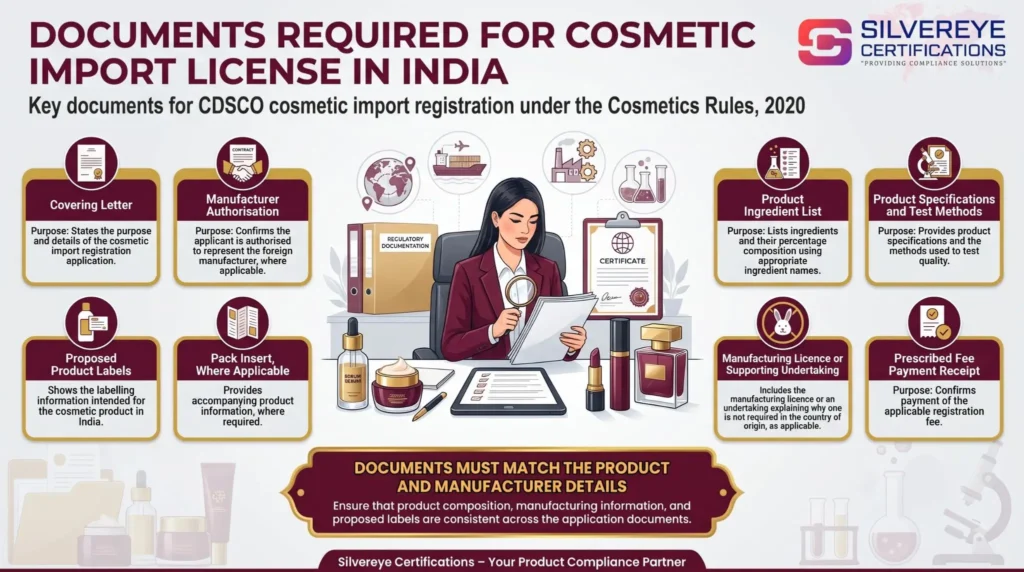
The final checklist depends on the application and must be confirmed against CDSCO's current requirements. Foreign manufacturer authorisation documents must also meet the applicable authentication requirements.
How to Apply for COS-2 Registration
The applicant first creates an account on the CDSCO SUGAM portal and selects the relevant cosmetic registration application. The required manufacturer, product, and manufacturing-site details are entered in Form COS-1, and the prescribed supporting documents are uploaded.
The applicant then pays the applicable fees through Bharatkosh and submits the application. CDSCO reviews the dossier and may request clarification or additional information if discrepancies are identified. The applicant must respond to these queries through the prescribed process.
Once the application satisfies the applicable requirements and receives approval from the Central Licensing Authority, the COS-2 Import Registration Certificate is issued. The applicant should verify that the approved registration covers the products and manufacturing premises intended for import.
Cosmetic Import Registration Fees, Validity and Timeline
Under the Third Schedule of the Cosmetics Rules, 2020, CDSCO's published fee schedule lists USD 1,000 per cosmetic category, USD 500 per manufacturing site, and USD 50 per product variant, with an additional category fee where applicable. Fees are paid through Bharatkosh. Applicants should verify the current fee requirements and any applicable endorsement fees before filing.
Under Rule 14, a COS-2 Import Registration Certificate remains valid in perpetuity, subject to payment of the prescribed retention fee before each five-year period ends, unless suspended or cancelled. Failure to pay the retention fee may result in late fees and eventual cancellation under the rule.
The statutory timeline and actual processing time should not be confused with a guaranteed approval date. Applicants should refer to the applicable rule and current CDSCO guidance for the processing timeline relevant to their application.
COS-5 and COS-8: Cosmetic Manufacturing License in India
Who Needs a COS-5 and COS-8 Manufacturing License?
Businesses intending to manufacture cosmetics for sale or distribution in India must apply to the relevant State Licensing Authority under the Cosmetics Rules, 2020. Form COS-5 is used to apply for a manufacturing license, while Form COS-8 is the license granted after approval. Businesses using another manufacturer's premises under a loan license arrangement must apply through Form COS-6 and, if approved, receive Form COS-9.
Eligibility Requirements for a Cosmetic Manufacturing License
Applicants must demonstrate compliance with the applicable Good Manufacturing Practices (GMP) and requirements for premises, plant, and equipment specified in the Seventh Schedule of the Cosmetics Rules, 2020. The application must include the prescribed documents, undertaking, and self-declaration in Form COS-7 confirming compliance with the applicable requirements.
The proposed cosmetics must also comply with the relevant quality and safety standards under Rule 39. If the application concerns a new cosmetic, prior permission in Form COS-3 from the Central Licensing Authority is required before the State Licensing Authority can grant the manufacturing license.
Documents Required for COS-5
The applicant must submit Form COS-5 with the applicable fee and supporting documents specified in Part II of the Second Schedule of the Cosmetics Rules, 2020. These generally include:
- Application form: Completed Form COS-5 for a manufacturing licence or Form COS-6 for a loan licence.
- Applicant and business details: Information about the applicant and the business entity.
- Manufacturing premises details: Site plan, layout, and information about the premises, plant, and equipment.
- Technical staff details: Information about the personnel responsible for manufacturing and quality control, as required.
- Proposed product details: List of cosmetics intended for manufacture and their relevant formulation or product particulars.
- GMP compliance declaration: Self-declaration in Form COS-7 covering the requirements of the Seventh Schedule.
- Prescribed undertaking: Information and undertaking specified in Part II of the Second Schedule.
- Fee payment receipt: Evidence of payment of the applicable fee under the Third Schedule.
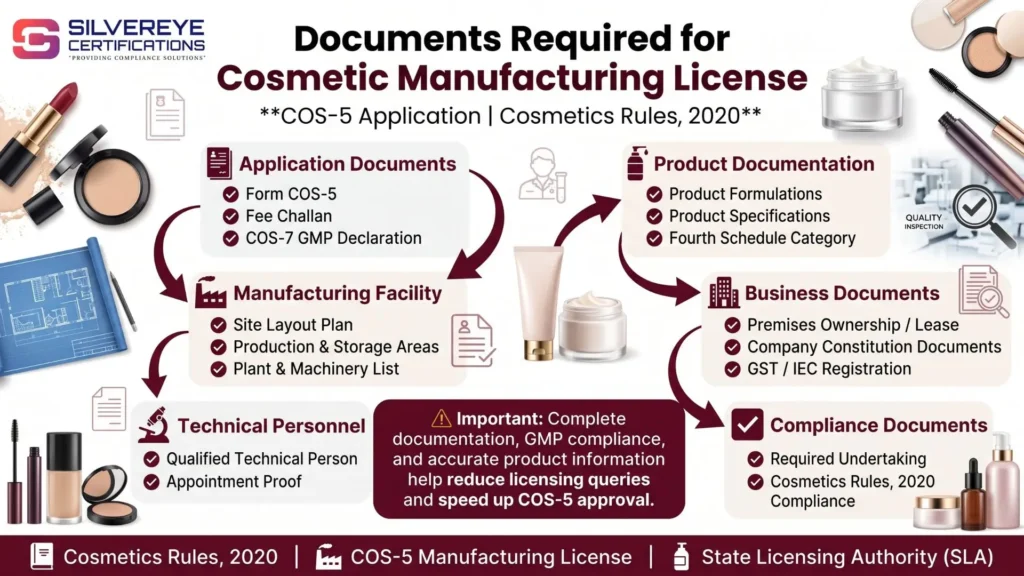
The exact documents depend on the application type and the requirements of the relevant State Licensing Authority.
COS-5 to COS-8: Step-by-Step Manufacturing License Process
- Step 1: Prepare the application. Identify the applicant, manufacturing premises, proposed cosmetic products, and applicable licence type.
- Step 2: Submit Form COS-5. File the application with the relevant State Licensing Authority through the applicable online portal or the permitted offline procedure where the portal is not operational.
- Step 3: Submit supporting documents and fees. Provide the required information under Part II of the Second Schedule, the Form COS-7 self-declaration, and the prescribed fee.
- Step 4: Application scrutiny. The State Licensing Authority examines the application and supporting documents to determine whether the requirements have been fulfilled.
- Step 5: Licence grant or communication of deficiencies. Under Rule 23(5), the authority must grant the licence or communicate the deficiencies within 45 days from the date of application, as applicable under the rule.
- Step 6: Post-grant inspection. Under Rule 23(7), the State Licensing Authority or an authorised officer must inspect the manufacturing site and verify the information provided in Form COS-7 within 30 days from the date the licence is granted.
- Step 7: Upload the licence. Under Rule 23(6), the licence must be uploaded to the CDSCO website before the applicant begins manufacturing cosmetics for sale or distribution.

Cosmetic Manufacturing License Fees, Validity and Timeline
The manufacturing license fees are prescribed under the Third Schedule of the Cosmetics Rules, 2020. The applicant should confirm the applicable amount with the relevant State Licensing Authority before submitting Form COS-5 or COS-6.
Under Rule 30, a manufacturing license in Form COS-8 or a loan license in Form COS-9 remains valid in perpetuity, subject to payment of the prescribed retention fee before completion of each five-year period from the date of issue, unless suspended or cancelled by the State Licensing Authority.
For planning purposes, Rule 23 provides a 45-day period from the application date for grant of the license or communication of deficiencies, subject to the conditions specified in the rule. The post-grant site inspection must take place within 30 days of the license being granted. Applicants should ensure that their premises and documentation comply with the rules throughout the process.
Which Cosmetic Products Need CDSCO Registration?
Cosmetics imported into India generally require CDSCO registration before import, while cosmetics manufactured domestically must comply with the applicable manufacturing license requirements under the Cosmetics Rules, 2020. Products should be classified correctly, and their applicable quality and safety standards should be checked before submitting an application. The Ninth Schedule specifies standards for relevant cosmetics; it is not simply a list of all cosmetic product categories.
The following table provides examples of common cosmetic products and their general regulatory routes.
| Category | Representative Products | Applicable Route |
|---|---|---|
| Skin Care | Face creams, moisturisers, serums, face washes, body lotions | Import registration or domestic manufacturing licence |
| Sun Care | Sunscreens, sunblock lotions, after-sun gels | Import registration or domestic manufacturing licence |
| Hair Care | Shampoos, conditioners, hair oils, hair colours and dyes | Import registration or domestic manufacturing licence |
| Colour Cosmetics and Makeup | Lipsticks, foundations, kajal, eyeliners, nail polish | Import registration or domestic manufacturing licence |
| Oral Care | Toothpaste, mouthwash, tooth powder | Import registration or domestic manufacturing licence |
| Fragrance | Perfumes, body mists, attars and applicable deodorants | Import registration or domestic manufacturing licence |
| Bath and Shower | Soaps, body washes, bath salts, shower gels | Import registration or domestic manufacturing licence |
| Shaving and Men's Grooming | Shaving creams, aftershave lotions, beard oils | Import registration or domestic manufacturing licence |
| Baby Care | Baby lotions, baby powders, baby shampoos | Import registration or domestic manufacturing licence |
| Antiperspirants and Deodorants | Roll-on and spray products | Import registration or domestic manufacturing licence |
| Nail Care | Nail polish, nail polish remover, cuticle oils | Import registration or domestic manufacturing licence |
| Talcum and Powders | Talcum powder, dusting powder, foot powder | Import registration or domestic manufacturing licence |
Important: The applicable route depends on where the cosmetic is manufactured and the nature of the application. Imported cosmetics generally follow the COS-1 application and COS-2 registration certificate route. Domestic manufacturing generally follows the COS-5 application and COS-8 manufacturing license route. Loan manufacturing arrangements use COS-6 and COS-9, respectively. New cosmetics may require prior permission in Form COS-3.
Benefits of CDSCO Cosmetic Registration and Licensing
Obtaining the applicable registration or manufacturing license helps businesses meet India's regulatory requirements and prepare their cosmetics for lawful market entry.
- Regulatory compliance: Helps importers and manufacturers meet the applicable requirements of the Cosmetics Rules, 2020.
- Import readiness: A valid import registration is an essential requirement for importing covered cosmetics into India.
- Market access: Supports the lawful sale and distribution of compliant cosmetic products, subject to other applicable requirements.
- Consumer confidence: Proper documentation, product information and quality compliance can strengthen confidence among buyers and retail partners.
- Lower compliance risk: Helps reduce the risk of regulatory action, shipment delays, product seizure or market withdrawal arising from non-compliance.
Registration does not automatically guarantee customs clearance, e-commerce approval or acceptance by every retailer. Businesses must also meet any other applicable requirements.
Common Cosmetic Registration and Licensing Mistakes to Avoid
- Confusing import registration with a manufacturing licence: COS-2 and COS-8/COS-9 serve different purposes and are not interchangeable.
- Submitting incomplete documentation: Import applications may require authenticated manufacturer authorisation, product details, ingredient composition, labels, specifications and a duly authenticated Free Sale Certificate, as applicable.
- Incorrect product or variant details: Ensure the application accurately reflects the products, variants, pack sizes and manufacturing premises covered by the registration.
- Overlooking new cosmetic requirements: A product meeting the definition of a new cosmetic may require prior permission in Form COS-3 before import registration or manufacturing approval.
- Missing retention-fee deadlines: COS-2, COS-8 and COS-9 remain valid in perpetuity, subject to payment of the prescribed retention fee before completion of each five-year period. Failure to pay can lead to cancellation under the applicable rules.
- Ignoring manufacturing inspections: Manufacturing license holders must comply with the applicable inspection and verification requirements under the Cosmetics Rules, 2020.
CDSCO Cosmetic Registration Fees and Validity at a Glance
| Form | Purpose | Validity | Retention Requirement |
|---|---|---|---|
| COS-1 / COS-2 | Application for import registration / Import Registration Certificate | Perpetual, unless suspended or cancelled | Prescribed retention fee before each five-year period |
| COS-5 / COS-8 | Application for manufacturing licence / Manufacturing Licence | Perpetual, unless suspended or cancelled | Prescribed retention fee before each five-year period |
| COS-6 / COS-9 | Application for loan licence / Loan Licence | Perpetual, unless suspended or cancelled | Prescribed retention fee before each five-year period |
The applicable fees are prescribed under the Third Schedule of the Cosmetics Rules, 2020. The amount depends on the application and relevant fee category. Before paying, check the latest applicable requirements on the official CDSCO Cosmetics page and confirm the relevant process with the concerned licensing authority.
Why Choose Silvereye Certifications as Your CDSCO Cosmetic Registration Consultant?
Navigating cosmetic registration in India involves understanding the difference between import registration and domestic manufacturing licensing, identifying the correct application route, preparing product-specific documentation and meeting the applicable regulatory requirements.
Silvereye Certifications provides consultancy support for cosmetic registration and licensing, helping importers, manufacturers and brand owners understand the requirements relevant to their products. Our support can include product-category review, document preparation, application assistance, SUGAM portal guidance and coordination support for the applicable registration or licensing process.
Whether you are importing skincare, haircare, fragrances or colour cosmetics, or planning to manufacture cosmetics in India, Silvereye Certifications can help you understand the applicable compliance steps and prepare your application for submission to the relevant authority.
Planning to register or manufacture cosmetic products in India? Contact Silvereye Certifications to discuss your product category, application route and documentation requirements.
Conclusion
CDSCO cosmetic registration and licensing are important steps for businesses planning to import or manufacture cosmetics in India. Choosing the correct application route—COS-1/COS-2 for import registration or COS-5/COS-8 for domestic manufacturing—and preparing accurate documentation can help businesses meet applicable regulatory requirements and avoid preventable delays. Timely payment of retention fees and ongoing compliance are also essential to maintain valid registration or licensing.
Silvereye Certifications provides consultancy support for cosmetic registration, including product category review, documentation preparation, application filing guidance, and coordination support. Contact Silvereye Certifications to understand the requirements for your cosmetic products and plan your registration or licensing process with confidence.
Frequently Asked Questions
What is the difference between COS-1 and COS-2?
COS-1 is the application form filed to seek cosmetic import registration; COS-2 is the Registration Certificate that CDSCO issues once that application is approved.
What is the difference between COS-5 and COS-8?
COS-5 is the application for a cosmetic manufacturing license; COS-8 is the license granted by the State Licensing Authority once the application and site inspection are cleared.
Is CDSCO registration mandatory for all cosmetics sold in India?
Yes. Under Rule 12 of the Cosmetics Rules, 2020, no cosmetic can be imported, and no cosmetic can be manufactured for sale, without the relevant CDSCO or State Licensing Authority approval.
How long does COS-2 import registration take?
Rule 13(5) allows the licensing authority up to 180 working days for a complete application, though well-documented filings from established manufacturing markets are often cleared sooner.
How long is a COS-2 certificate valid?
A COS-2 Registration Certificate is valid for 5 years from its date of issue, unless it is suspended or cancelled earlier by the licensing authority.
What is the validity of a COS-8 manufacturing license?
A COS-8 license remains valid in perpetuity, provided the manufacturer pays the prescribed retention fee before completion of every 5-year period from the date of issue.
Can one COS-1 application cover multiple products?
Yes. A single COS-1 application can cover multiple products, variants, and manufacturing sites belonging to the same applicant, subject to the applicable government fees for each category.
Is animal-testing data accepted for cosmetic registration in India?
No. India does not permit the submission of animal-testing data in support of a cosmetic registration application; a non-animal testing declaration is required instead.
What happens if I sell cosmetics without registration?
Unregistered cosmetics can be seized at customs or in the market, and the importer or manufacturer can face penalties under the Drugs and Cosmetics Act, 1940. There is no provision to register a product retroactively after import.
Do I need both COS-2 and COS-8 if I import and manufacture?
Yes, if your brand both imports finished cosmetics and manufactures other products domestically. You only need COS-2 if you exclusively import, and only COS-8 if you exclusively manufacture in India.
What is a loan license for cosmetics?
A loan license lets a brand manufacture cosmetics through a third-party facility rather than owning one. It is applied for in Form COS-6 and granted in Form COS-9, following the same broad process as COS-5/COS-8.
Who is the licensing authority for manufacturing versus import?
Cosmetic manufacturing licences (COS-5/COS-8) are granted by the State Licensing Authority of the state where the facility is located. Cosmetic import registration (COS-1/COS-2) is granted centrally by CDSCO's Central Licensing Authority.