
Soaps, deodorants, talcum powders, shaving products and baby care items may fall under the cosmetics category in India and must comply with the applicable requirements of the Cosmetics Rules, 2020. The required registration or manufacturing license depends on the product and whether it is imported or manufactured in India.
- Imported cosmetics: Importers apply in Form COS-1 to obtain a registration certificate in Form COS-2.
- Domestic manufacturing: Manufacturers apply in Form COS-5 to obtain a manufacturing license in Form COS-8.
- Baby care products: These generally follow the applicable import or domestic manufacturing route. Their ingredients, safety and intended use require particular attention because they are designed for infants.
- Products with medicinal claims: Products marketed for antimicrobial, antiseptic or therapeutic purposes, such as certain hand sanitizers, may be regulated as drugs rather than cosmetics, depending on their composition, intended use and claims. Classification should be assessed on a product-specific basis.
Introduction
India's cosmetics industry covers a wide range of personal care products, including soaps, deodorants, talcum powders, shaving products and baby care items. Before these products can be imported, manufactured or marketed in India, businesses must understand the applicable requirements under the Cosmetics Rules, 2020, governed by the Central Drugs Standard Control Organization (CDSCO).
The licensing process depends on whether the product is imported or manufactured domestically. Importers generally apply through Form COS-1 for a registration certificate in Form COS-2, while domestic manufacturers use Form COS-5 to obtain a manufacturing license in Form COS-8. Products intended for babies may require particular attention to ingredient safety and product suitability. Additionally, products making medicinal or therapeutic claims may fall under drug regulations instead of cosmetics regulations.
This guide explains the CDSCO cosmetic license requirements for personal care products, including applicable forms, documentation, product classification and the key compliance steps businesses should understand before entering the Indian market.
What Is a CDSCO Cosmetic License for Personal Care Products?
A CDSCO cosmetic license for personal care products is the regulatory approval or registration required for eligible cosmetic products to be imported or manufactured for sale in India under the Drugs and Cosmetics Act, 1940, and the Cosmetics Rules, 2020.
It applies to personal care products such as soaps, body washes, deodorants, talcum powders, shaving preparations, baby lotions, baby oils and other products classified as cosmetics based on their composition, intended use and claims.
The approval route depends on where the product is made:
- Imported personal care cosmetics: The importer applies to the Central Licensing Authority through the CDSCO SUGAM portal using Form COS-1. The registration certificate is issued in Form COS-2.
- Domestically manufactured personal care cosmetics: The manufacturer applies to the concerned State Licensing Authority using Form COS-5. The manufacturing license is issued in Form COS-8.
The license or registration confirms that the product and applicant have met the applicable regulatory requirements for the relevant activity. It does not mean that every personal care product follows the same route. Products with therapeutic, medicinal or germ-killing claims may fall under drug regulations instead.
Therefore, businesses should first establish the correct product classification and applicable approval route before preparing their application.
Do You Need a CDSCO Cosmetic License for Personal Care Products?
Yes, if your product falls within the legal definition of a cosmetic, it must comply with the applicable requirements of the Drugs and Cosmetics Act, 1940, and the Cosmetics Rules, 2020. The approval route depends on whether the product is imported into India or manufactured domestically.
- Imported cosmetics: The manufacturer, its authorized agent, an authorized Indian subsidiary or an Indian importer can apply in Form COS-1 to obtain an Import Registration Certificate in Form COS-2 from the Central Licensing Authority.
- Domestic manufacturing: The manufacturer applies to the concerned State Licensing Authority in Form COS-5 to obtain a manufacturing license in Form COS-8. A loan manufacturing license may be issued in Form COS-9, where applicable.
- Validity of Form COS-2: The import registration certificate remains valid in perpetuity, subject to payment of the prescribed retention fee before completion of each five-year period, unless suspended or cancelled.
- Validity of Form COS-8: The manufacturing license also remains valid in perpetuity, subject to the applicable five-year retention fee and other license conditions.
- Product classification: A product's composition, intended purpose and marketing claims must be assessed together. Products making medicinal or therapeutic claims may fall under drug regulation rather than the cosmetic route.
Important: If a cosmetic is already registered for import into India under Form COS-2, another eligible importer may need to apply through Form COS-4 to obtain an Import Registration Number in Form COS-4A, rather than submit a fresh COS-1 application.
Why Personal Care Products Need CDSCO Registration or a Manufacturing License?
Section 3(aaa) of the Drugs and Cosmetics Act, 1940 defines a cosmetic as an article intended to be rubbed, poured, sprinkled or sprayed on, introduced into or otherwise applied to the human body for cleansing, beautifying, promoting attractiveness or altering appearance. It also includes articles intended for use as components of cosmetics.
Under the Cosmetics Rules, 2020, the regulatory authority depends on the activity:
- Import: Cosmetics must be registered with the Central Licensing Authority before import into India. The application is generally submitted in Form COS-1, followed by issuance of Form COS-2 when approved.
- Domestic manufacturing: Manufacturing cosmetics for sale or distribution requires the applicable license from the State Licensing Authority, generally in Form COS-8 or, where applicable, Form COS-9.
- Product standards: Cosmetics must comply with the applicable quality and safety standards under the Rules, including the relevant standards specified in the Ninth Schedule or other applicable requirements.
- Labelling and packaging: Products must comply with the applicable labelling, packing and other requirements under the Cosmetics Rules, 2020.
Two areas require particular attention during classification:
- Baby care products: Products such as baby lotions, oils, shampoos and powders must meet the applicable cosmetic safety and quality requirements. Their intended use and formulation should be carefully assessed before filing.
- Products with antimicrobial or therapeutic claims: Claims relating to treating a disease, preventing infection or providing a medicinal effect may affect whether a product qualifies as a cosmetic. Classification should be assessed individually rather than assuming that every antimicrobial product is automatically a drug.
CDSCO Personal Care Product Categories and Regulatory Notes
The following table provides a practical overview of common personal care products and their possible regulatory treatment. The category descriptions are based on the Cosmetics Rules, 2020, particularly the Fourth Schedule categories used for import registration. They are not a substitute for product-specific classification.
| Product type | Relevant category or classification | Regulatory notes |
|---|---|---|
| Bar soap | Soap products | Listed as a separate category in the Fourth Schedule. The product's intended use and claims should be checked. |
| Body wash / shower gel | Bath / shower products | Generally treated as cosmetics when intended for ordinary cleansing. |
| Bath salts / bath bombs / bubble bath | Relevant bath / shower or other applicable category | Classification depends on the product's formulation, intended use and presentation. |
| Talcum powder / body powder | Relevant body care or skin product category | Confirm the appropriate category and applicable quality and safety requirements for the formulation. |
| Deodorant (stick / spray / roll-on) | Products without antiperspirant activity | The Fourth Schedule separately identifies products without antiperspirant activity. |
| Antiperspirant | Products with antiperspirant activity | Expressly listed as a separate category in the Fourth Schedule. |
| Shaving cream / gel | Shaving products | Listed under shaving products when intended for ordinary grooming. |
| Aftershave | Pre- / after-shaving products | Medicinal or therapeutic claims may affect product classification. |
| Beard oil / grooming balm | Relevant skin or body care category | Classification depends on the product's intended use and claims. |
| Baby shampoo / lotion / oil / powder | Relevant hair, skin, body or cleansing category | The Fourth Schedule does not create a separate general baby-care category. The appropriate category depends on the product type. |
| Feminine hygiene wash / intimate wash | External intimate hygiene products or external intimate care products | The intended use and claims should be reviewed. Claims to treat an infection or medical condition require particular regulatory assessment. |
| Hand sanitiser | Requires product-specific classification | Do not assume that every hand sanitiser follows the cosmetic registration route. Its formulation, intended use, claims and applicable drug-related provisions must be assessed before filing. |
Regulatory note: The Fourth Schedule is specifically titled the list of categories of cosmetics for import. For domestic manufacturing, applicants must follow the applicable licensing requirements and product standards. A product's inclusion in a broad category does not automatically confirm its classification or approval route.
Eligibility and Requirements for a CDSCO Cosmetic License
The eligibility criteria depend on whether the business intends to import cosmetics, manufacture them at its own facility or use another licensed manufacturer's premises through a loan license.
| Application route | Who can apply | Main regulatory requirement |
|---|---|---|
| Import registration (COS-1) | Foreign manufacturer, its authorised agent in India, an authorised Indian subsidiary or an importer in India | The applicant must submit the required product and manufacturing-site information, supporting documents and applicable fees to the Central Licensing Authority. |
| Manufacturing licence (COS-5) | A person or business intending to manufacture cosmetics for sale or distribution in India | The manufacturing premises must meet the Seventh Schedule requirements, and the applicant must provide the prescribed GMP self-declaration in Form COS-7. |
| Loan manufacturing license (COS-6) | A business intending to manufacture cosmetics using the premises of another licensed manufacturer | The applicant must meet the loan-license requirements and submit Form COS-7 along with the application. The license, if granted, is issued in Form COS-9. |
Technical staff requirements for domestic manufacturing
Under Rule 26 of the Cosmetics Rules, 2020, manufacturing must take place under the direction and personal supervision of competent technical staff. At least one person must be a whole-time employee and hold one of the following qualifications:
- A Diploma in Pharmacy approved by the Pharmacy Council of India.
- Registration under the Pharmacy Act, 1948.
- Intermediate Examination with Chemistry as one of the subjects, or an examination recognised by the Licensing Authority as equivalent.
- A bachelor's degree in Cosmetic Technology from a recognised university.
The manufacturing premises must also comply with the applicable requirements of the Seventh Schedule. The manufacturer must maintain appropriate testing arrangements through its own facilities or an eligible approved laboratory, subject to the applicable provisions.
Important product-level requirements
Before submitting an application, businesses should check the following:
- Correct product category: For import registration, classify each cosmetic under the applicable category in the Fourth Schedule. Do not assume that all personal care products fall under one category.
- Product formulation: Maintain accurate ingredient names, percentage composition, specifications and other relevant formulation details.
- Product standards: Ensure compliance with the applicable quality and safety standards under Rule 39 and the relevant schedules.
- Labelling compliance: Product labels must meet the applicable requirements of Rule 34 and other relevant provisions.
- Product claims: Avoid false or misleading claims. Claims suggesting treatment of a medical condition may require a different regulatory assessment.
- New cosmetics: A product containing a novel ingredient not previously used or recognised for cosmetic use may require prior permission in Form COS-3 before import or manufacture.
These requirements should be assessed against the product formulation, intended use and applicable regulatory provisions before filing.
Documents Required for Personal Care Cosmetic Registration
The documents required depend on the application route and the details of the product and manufacturing premises. Preparing the dossier in advance helps reduce incomplete submissions and avoidable queries.
Documents for Import Registration (Form COS-1)
CDSCO's official checklist for registration in Form COS-2 identifies the following documents:
- Covering letter explaining the purpose of the application.
- Manufacturer's authorisation in favour of the applicant, duly authenticated where required.
- Part I of the Second Schedule, duly completed.
- Complete ingredient list, including the percentage composition of ingredients.
- Proposed product labels showing the required product and manufacturer information.
- Product specifications and testing methods relevant to the cosmetic.
- Pack insert, where applicable.
- Manufacturing licence or an undertaking explaining the absence of a manufacturing-licence provision in the country of origin, as applicable.
- Certificate of Free Sale (CFS), duly authenticated.
- Non-animal-testing declaration as required under the applicable provisions.
- Declaration regarding heavy metals and hexachlorophene content.
- Bharatkosh payment receipt showing payment of the applicable government fee.
- Other supporting documents, where applicable.
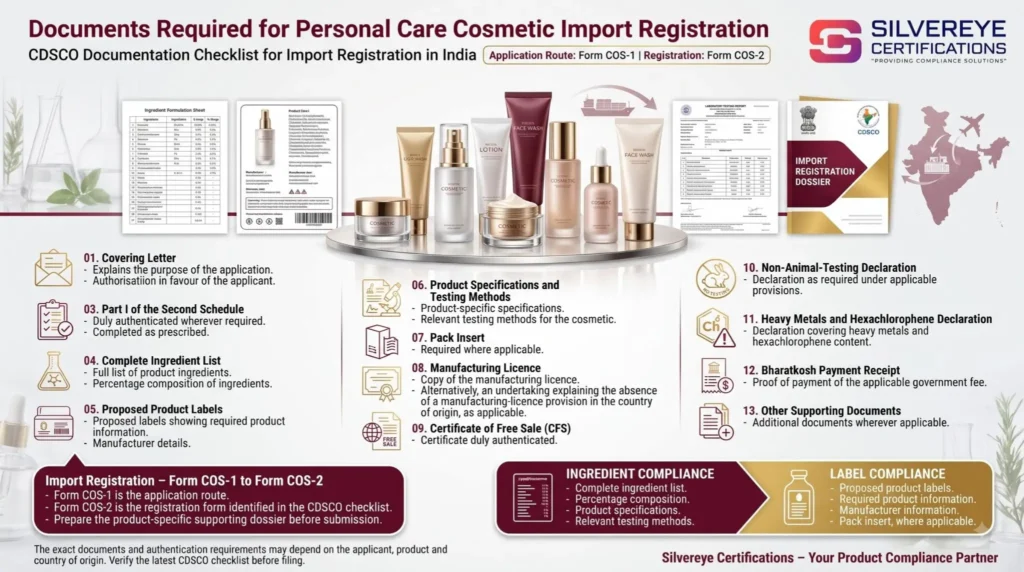
The final dossier should be prepared according to the current CDSCO checklist and the Second Schedule of the Cosmetics Rules, 2020. Requirements may differ depending on the product, manufacturer and application circumstances.
Documents for Domestic Manufacturing (Form COS-5)
For domestic manufacturing, the application must be accompanied by the documents specified in Part II of the Second Schedule and the applicable fee.
The applicant should prepare the following information and supporting records as relevant to the application:
- Completed Form COS-5 with the details of the proposed manufacturing premises.
- Plan of the manufacturing premises, as required under the application form.
- Product details, including cosmetic names, ingredients, ingredient percentages and specifications.
- Names, qualifications and experience of the proposed technical staff.
- Details of manufacturing equipment, premises and applicable GMP arrangements.
- Documents establishing ownership or occupation of the manufacturing premises.
- Details of the applicant's business constitution.
- Form COS-7, containing the self-declaration of compliance with GMP and the Seventh Schedule.
- Applicable government fee payment proof.
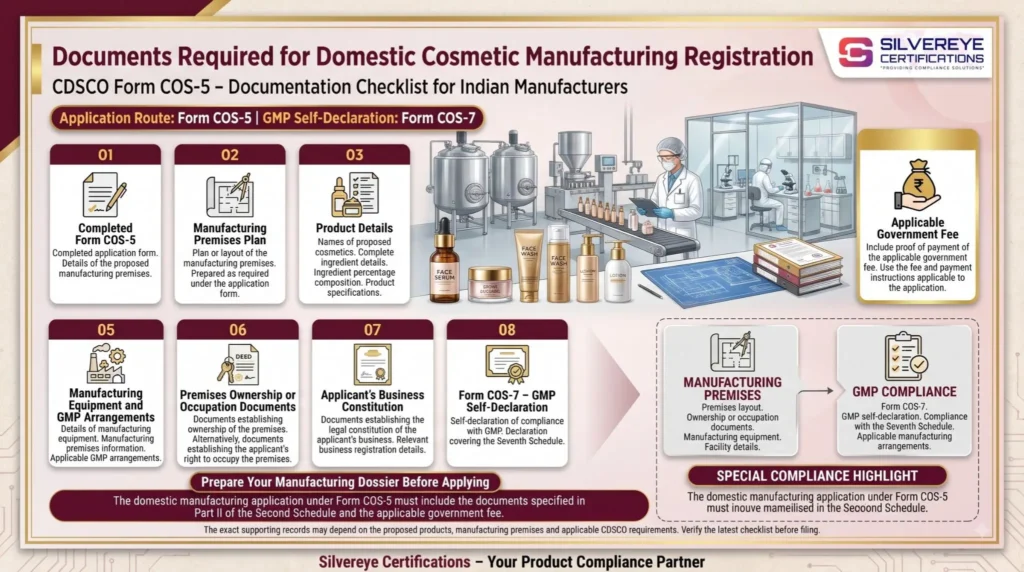
The State Licensing Authority may require additional information or supporting documents during scrutiny. Applicants should therefore follow the relevant State Licensing Authority's current application checklist.
Additional Documents for Loan License Applications
A business applying for a loan manufacturing licence should prepare:
- Form COS-6 as the application for a loan licence.
- Details of the proposed manufacturing premises and the existing licensed manufacturer.
- Product and technical information required under Part II of the Second Schedule.
- Form COS-7 self-declaration for GMP compliance.
- Applicable supporting documents and government fee payment proof.
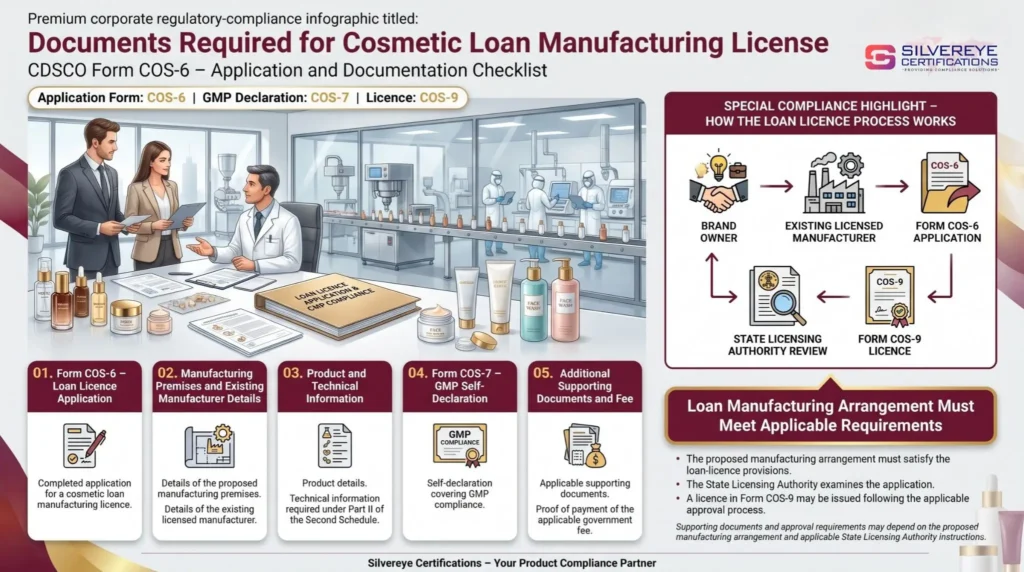
The proposed manufacturing arrangement must satisfy the loan-licence provisions. The application is examined by the State Licensing Authority before a licence in Form COS-9 can be issued.
Product-specific documentation: Additional evidence may be appropriate for products such as baby cosmetics and talc-based powders to support ingredient quality, specifications and product safety. However, a separate universal CDSCO document checklist specifically for baby products or talcum powders should not be assumed.
Category-Specific Regulatory Considerations for Baby Care, Deodorants and Hand Sanitizers
Baby Care Products: Classification and Safety Requirements
Baby shampoos, lotions, oils, powders and nappy creams may fall within the cosmetic definition when their intended purpose is cleansing, moisturising or protecting the appearance of the skin without medicinal claims.
There is no separate general baby-care license form under the Cosmetics Rules, 2020. The applicable route depends on whether the product is imported or manufactured in India.
- Imported baby cosmetics follow the applicable import registration procedure under Form COS-1 and Form COS-2.
- Domestically manufactured baby cosmetics follow the manufacturing licence procedure under Form COS-5 and Form COS-8, or the loan-licence route where applicable.
- Ingredient composition, product specifications, quality and safety information should be properly documented.
- Labels and marketing claims must accurately describe the product and must not be false or misleading.
For baby products, businesses should pay particular attention to formulation suitability and supporting safety information. However, the Cosmetics Rules do not establish a separate universal approval process or additional mandatory document list for every baby-care product.
Deodorants and Antiperspirants: Understanding the Difference
Deodorants and antiperspirants are both expressly recognised in the Fourth Schedule of the Cosmetics Rules, 2020, under separate categories:
- Products with antiperspirant activity
- Products without antiperspirant activity
This distinction is important when preparing an import registration application. A deodorant intended to control body odour and an antiperspirant intended to reduce sweating should not automatically be placed under the same import category.
The product's formulation, intended use, claims and applicable standards should be checked before filing. A therapeutic or medicinal claim may require a separate classification assessment.
Hand Sanitizers and Medicated Soaps: Cosmetic or Drug?
Not every hand sanitiser or antibacterial soap automatically follows the same regulatory route.
The classification must be assessed based on the product's composition, intended purpose, claims and applicable legal provisions. A product intended for ordinary cleansing may fall within the cosmetic definition, whereas a product presented for medicinal or therapeutic purposes may be regulated differently.
Before preparing a cosmetic registration dossier, businesses should establish whether their product qualifies as a cosmetic under Section 3(aaa) of the Drugs and Cosmetics Act, 1940, or falls under another applicable regulatory framework.
This is particularly important for products claiming to treat infections, prevent disease or provide a medicinal effect. Do not assume that a COS-1 or COS-5 application is appropriate without first checking the classification.
Import vs Manufacturing: Which CDSCO Approval Route Applies?
The applicable route depends mainly on the product's manufacturing location and the activity being undertaken in India.
| Parameter | Import route | Domestic manufacturing route | Loan manufacturing route |
|---|---|---|---|
| Application form | COS-1 | COS-5 | COS-6 |
| Approval issued | COS-2 | COS-8 | COS-9 |
| Authority | Central Licensing Authority | State Licensing Authority | State Licensing Authority |
| Applicant | Manufacturer, authorised agent, authorised Indian subsidiary or importer | Person or business intending to manufacture cosmetics | Applicant intending to use another licensee's manufacturing premises |
| Main requirement | Product and manufacturing-site registration | Compliant manufacturing premises and GMP requirements | Compliance with loan-licence and GMP requirements |
| Validity | Perpetuity, subject to five-year retention fee | Perpetuity, subject to five-year retention fee | Perpetuity, subject to five-year retention fee |
Note: A separate route is available under Form COS-4 for importing cosmetics that are already registered in India. The resulting Import Registration Number is issued in Form COS-4A and has a validity of three years, unless suspended or cancelled.
Step-by-Step CDSCO Cosmetic Registration Process
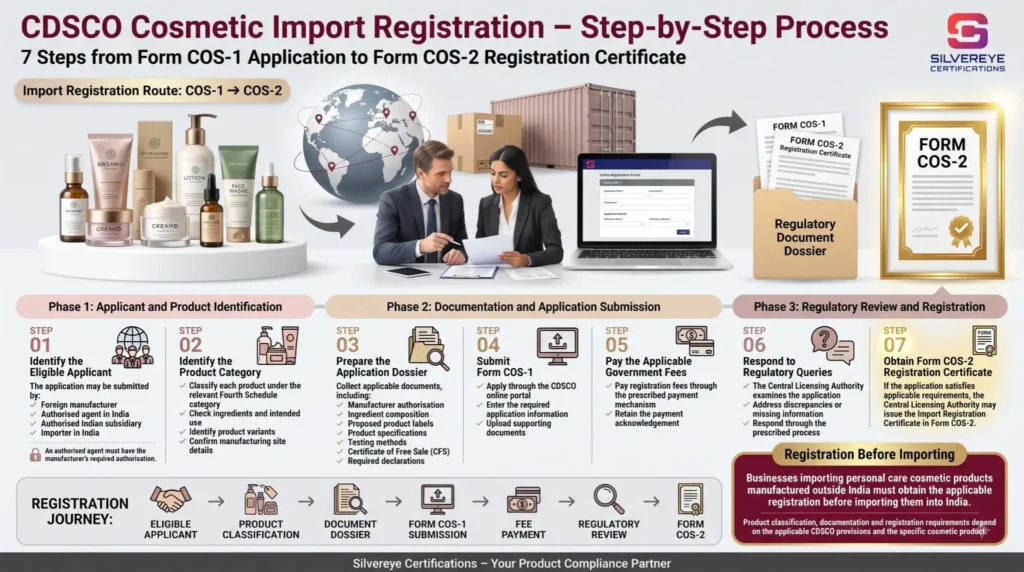
1. Importer Route: Form COS-1 to Form COS-2
Businesses importing personal care products manufactured outside India must obtain the applicable registration before importing them into India.
Step 1: Identify the eligible applicant
The application may be submitted by the foreign manufacturer, its authorized agent in India, an authorized Indian subsidiary or an importer in India. An authorized agent must have the manufacturer's required authorization.
Step 2: Identify the product category
Classify each product under the relevant Fourth Schedule category. Check its ingredients, intended use, variants and manufacturing site details.
Step 3: Prepare the application dossier
Collect the applicable documents, including the manufacturer authorization, ingredient composition, proposed labels, specifications, testing methods, Free Sale Certificate and required declarations.
Step 4: Submit Form COS-1
Apply through the CDSCO online portal and upload the required information and supporting documents.
Step 5: Pay the applicable government fees
Pay the registration fees through the prescribed payment mechanism and retain the payment acknowledgement.
Step 6: Respond to regulatory queries
The Central Licensing Authority examines the application. If discrepancies or missing information are identified, respond through the prescribed process.
Step 7: Obtain Form COS-2
If the application satisfies the applicable requirements, the Central Licensing Authority may issue the Import Registration Certificate in Form COS-2.
2. Domestic Manufacturer Route: Form COS-5 to Form COS-8
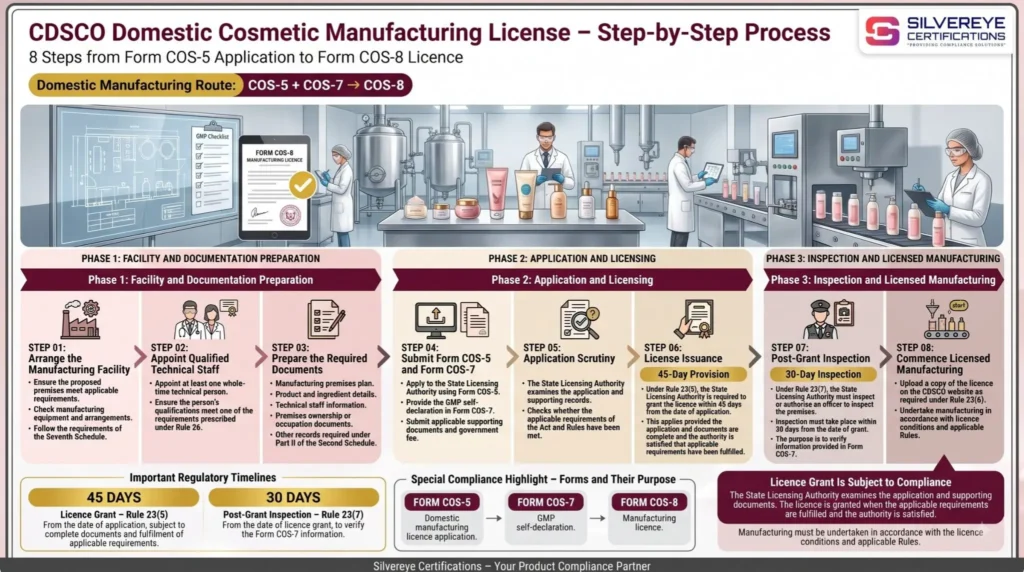
Businesses manufacturing personal care cosmetics in India for sale or distribution must obtain the applicable manufacturing licence from the State Licensing Authority.
Step 1: Arrange the manufacturing facility
Ensure that the proposed premises, equipment and manufacturing arrangements meet the applicable requirements of the Seventh Schedule.
Step 2: Appoint qualified technical staff
Ensure that at least one whole-time technical person meets one of the qualifications prescribed under Rule 26.
Step 3: Prepare the required documents
Compile the manufacturing-premises plan, product and ingredient details, technical staff information, premises documents and other records required under Part II of the Second Schedule.
Step 4: Submit Form COS-5 and Form COS-7
Apply to the State Licensing Authority in Form COS-5 and provide the GMP self-declaration in Form COS-7, along with the applicable fee and supporting documents.
Step 5: Application scrutiny
The State Licensing Authority examines the application and supporting records to determine whether the requirements of the Act and Rules have been met.
Step 6: License issuance
Under Rule 23(5), the State Licensing Authority is required to grant the license within 45 days from the date of application, provided the application and documents are complete and the authority is satisfied that the applicable requirements have been fulfilled.
Step 7: Post-grant inspection
Under Rule 23(7), the State Licensing Authority must inspect or authorize an officer to inspect the premises within 30 days from the date of grant to verify the information provided in Form COS-7.
Step 8: Commence licensed manufacturing
After receiving the license, upload a copy on the CDSCO website as required under Rule 23(6). Manufacturing may then be undertaken in accordance with the license conditions and applicable Rules.
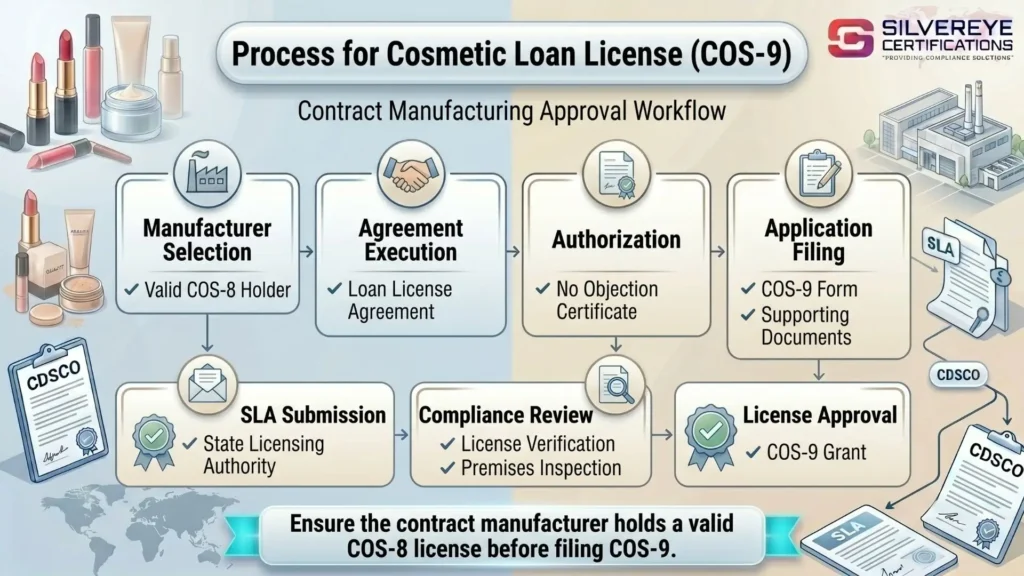
3. Loan License Route: Form COS-6 to Form COS-9
Businesses that do not own a manufacturing facility may consider the loan-license route, which allows them to use the manufacturing site of another licensee for manufacturing cosmetics.
Step 1: Identify a suitable licensed manufacturer
Select an existing cosmetic manufacturer whose premises and manufacturing arrangements can support the proposed products.
Step 2: Check the manufacturing arrangement
Confirm that the proposed products and manufacturing activities can be undertaken at the selected premises in compliance with the license and applicable GMP requirements.
Step 3: Prepare the application documents
Collect the product details, manufacturing-site information, technical staff details and other supporting documents required under Part II of the Second Schedule.
Step 4: Submit Form COS-6 and Form COS-7
Apply to the concerned State Licensing Authority using Form COS-6 and submit the GMP self-declaration in Form COS-7, along with the applicable fee and supporting documents.
Step 5: Regulatory scrutiny and inspection
The State Licensing Authority examines the application and may verify the proposed manufacturing arrangements and compliance with the applicable requirements.
Step 6: Obtain Form COS-9
If the application meets the regulatory requirements, the State Licensing Authority may grant the loan manufacturing license in Form COS-9.
A loan license is not an exemption from manufacturing compliance. The applicant and the facility must continue to meet the applicable license conditions and requirements of the Cosmetics Rules, 2020.
Fees for CDSCO Cosmetic Registration and Manufacturing License
The government fees for cosmetic import registration and domestic manufacturing licenses are prescribed under the Third Schedule of the Cosmetics Rules, 2020. The amount depends on the application route, number of product categories, variants and manufacturing sites.
Import Registration Fees (Form COS-1 / COS-2)
| Fee component | Government fee |
|---|---|
| Registration certificate for each cosmetic category | USD 1,000 |
| Each additional cosmetic category | USD 1,000 |
| Each product variant | USD 50 |
| Each overseas manufacturing site | USD 500 |
| Inspection of each overseas manufacturing site, where applicable | USD 5,000 |
The fee structure applies to the registration and retention of the import registration certificate, as prescribed in the Third Schedule.
Domestic Manufacturing License Fees (Form COS-5 / COS-8)
| Fee component | Government fee |
|---|---|
| COS-8 licence for up to 10 items in each cosmetic category | ₹10,000 |
| Each additional item in the same category | ₹500 |
| Each additional category covering up to 10 items | ₹10,000 |
| Retention fee for COS-8 covering up to 10 items in each category | ₹10,000 |
| Retention fee for each additional item | ₹500 |
| Retention fee for each additional category covering up to 10 items | ₹10,000 |
Loan Manufacturing License Fees (Form COS-6 / COS-9)
The Third Schedule also prescribes a fee of ₹10,000 for a loan license covering up to 10 items in each cosmetic category, with additional fees for extra items and categories. The corresponding retention fees are also prescribed in the Schedule.
Important points before budgeting:
- Import registration fees are calculated according to the applicable cosmetic categories, manufacturing sites and variants.
- A product variant, such as a different colour, shade or flavour, may attract a separate fee under the applicable rules.
- The Fourth Schedule categories should be checked carefully. For example, baby care is not a separate general category in the Schedule; the relevant category depends on the product.
- Testing charges, overseas site inspection expenses where applicable, professional consultancy charges and other business costs may be additional.
- Check the current payment instructions and applicable fee amount before submitting the application.
The above amounts are statutory government fees, not consultancy charges.
Validity and Retention of CDSCO Cosmetic Registration and Licenses
Under the Cosmetics Rules, 2020, both import registration certificates and domestic manufacturing licences remain valid in perpetuity, subject to payment of the prescribed retention fee and continued compliance with applicable conditions.
| Particulars | COS-2: Import Registration Certificate | COS-8: Manufacturing Licence |
|---|---|---|
| Validity | In perpetuity, unless suspended or cancelled | In perpetuity, unless suspended or cancelled |
| Retention requirement | Pay the prescribed retention fee before completion of every five-year period | Pay the prescribed retention fee before completion of every five-year period |
| Relevant provision | Rule 14 | Rule 30 |
| Authority | Central Licensing Authority | State Licensing Authority |
| Consequence of non-payment | Late fee of 2% of the retention fee for every month or part thereof; non-payment within 180 days results in deemed cancellation | Late fee of 2% of the retention fee for every month or part thereof; non-payment within 180 days results in deemed cancellation |
What happens if the retention fee is not paid?
The Rules provide a 180-day period after the retention-fee due date during which the outstanding fee and applicable late fee can be paid. If payment is not made within this period, the registration certificate or manufacturing license is deemed cancelled.
Important distinction: Form COS-4 is not the routine renewal form for COS-2. It is used when another eligible importer applies for an Import Registration Number for a cosmetic already registered in India. That Import Registration Number, issued in Form COS-4A, has a validity of three years.
Keep the five-year retention date on your compliance calendar and begin preparing for payment well before the due date.
CDSCO Cosmetic Registration Timeline for Personal Care Products
The processing time depends on the application route, completeness of documents, regulatory scrutiny and any additional information requested by the authority.
| Application stage | Import route (COS-1 / COS-2) | Manufacturing route (COS-5 / COS-8) |
|---|---|---|
| Document preparation | Depends on the product portfolio and manufacturer documentation | Depends on facility readiness and application documents |
| Regulatory review | Central Licensing Authority examines the application | State Licensing Authority scrutinises the application and supporting documents |
| Statutory processing period | Up to six months under Rule 13 | 45 days from the date of application under Rule 23(5), subject to fulfilment of the prescribed requirements |
| Site inspection | Overseas manufacturing-site inspection may be required where considered necessary | Inspection to verify the COS-7 self-declaration within 30 days after grant of the licence |
| Final approval | Form COS-2, if approved | Form COS-8, if approved |
How should applicants interpret these timelines?
- Import applications: CDSCO's FAQ refers to the six-month statutory period under Rule 13. It also mentions a 90-day processing target based on an earlier CDSCO circular. The 90-day target should not be treated as a guaranteed approval timeline.
- Manufacturing applications: Rule 23(5) provides for grant of the license within 45 days from the date of application where the authority is satisfied that the requirements have been fulfilled.
- Post-grant inspection: Under Rule 23(7), the State Licensing Authority must inspect the manufacturing site within 30 days from the date of licence grant to verify the information in Form COS-7.
The time required to prepare documents, resolve queries or make corrections can extend the overall project timeline. Therefore, applicants should avoid relying on estimated approval dates when planning a product launch.
Common Mistakes in Personal Care Cosmetic Registration
Businesses can face application queries, delays or regulatory complications when product classification and documentation are not checked properly. Some common mistakes include:
- Incorrect product classification: Filing a hand sanitiser, medicated soap or other product under the cosmetic route without first checking its intended use, composition and claims.
- Incorrect category selection: Assuming that every personal care product belongs to one broad category instead of checking the applicable Fourth Schedule category for import registration.
- Incomplete product information: Submitting ingredient details without the required composition, specifications, testing methods or supporting information.
- Incorrect variant calculation: Failing to account for applicable fees for product variants, additional categories or manufacturing sites.
- Incorrect validity assumptions: Treating COS-2 or COS-8 as licences that expire every five years instead of understanding the five-year retention-fee requirement.
- Confusing COS-4 with COS-2 retention: Using the procedure for an already registered cosmetic as though it were the routine retention process.
- Non-compliant labelling: Submitting product labels with missing particulars, inaccurate information or claims that may be false or misleading.
- Manufacturing-site non-compliance: Failing to maintain the premises, technical staff, testing arrangements and GMP requirements prescribed under the Rules.
Reviewing the application against the relevant forms, schedules and official checklist before submission can help reduce avoidable errors.
Benefits of Proper CDSCO Cosmetic Compliance
Following the applicable cosmetic registration and manufacturing requirements helps businesses establish a compliant foundation for selling personal care products in India.
- Regulatory compliance: Importers and manufacturers can meet the applicable registration or licensing requirements before placing cosmetics on the Indian market.
- Product quality and safety: Compliance with prescribed standards, testing requirements and manufacturing practices supports product quality and consumer safety.
- Import readiness: An applicable import registration certificate is required before cosmetics can be imported into India, subject to the provisions of the Rules.
- Manufacturing accountability: A valid manufacturing licence establishes the authorised manufacturing premises and the conditions under which products may be manufactured.
- Better documentation: Proper product records, labels, ingredient details and supporting documents help businesses manage regulatory obligations.
- Consumer confidence: Transparent product information and compliance with applicable safety and labelling requirements help businesses build consumer trust.
A registration certificate or manufacturing license does not guarantee marketplace acceptance, customs clearance in every circumstance or a particular commercial outcome. Products must continue to comply with the applicable laws and license conditions.
Why Choose Silvereye Certifications for Personal Care Product Licensing?
Obtaining a CDSCO cosmetic registration or manufacturing license involves product classification, technical documentation, regulatory forms and coordination with the appropriate licensing authority. Silvereye Certifications provides regulatory consultancy, documentation guidance and application support to businesses planning to import or manufacture personal care cosmetics in India.
Here's how Silvereye Certifications can assist:
- Product Classification Guidance: Understand the applicable cosmetic category and identify products that may require a different regulatory assessment based on their composition, intended use and claims.
- Documentation Support: Get assistance in organising product details, ingredient information, manufacturing documents, labels and other applicable supporting records.
- Import Registration Assistance: Receive guidance on the Form COS-1 application process and the documentation required for Form COS-2 registration.
- Manufacturing Licence Assistance: Get support with the documentation and application requirements for Form COS-5 and the applicable loan-licence route.
- Fee and Compliance Guidance: Understand the applicable government fee components, retention requirements and documentation obligations before proceeding.
- Regulatory Coordination: Get assistance in understanding application queries and preparing relevant responses during the regulatory process.
Silvereye Certifications supports businesses with compliance guidance and application-related assistance. Import registration certificates and manufacturing licences are issued by the respective government licensing authorities. Silvereye Certifications does not issue these approvals or guarantee their grant.
If you are planning to introduce soaps, deodorants, baby care products or other personal care cosmetics in India, Silvereye Certifications can help you understand the applicable regulatory route and prepare for the application process.
Conclusion
Personal care products such as soaps, deodorants, body washes, shaving preparations and baby care cosmetics must meet the applicable requirements of the Cosmetics Rules, 2020 before they are imported or manufactured for sale in India.
The correct regulatory route depends on the product and business activity. Importers generally apply through Form COS-1 for Form COS-2, while domestic manufacturers apply through Form COS-5 for Form COS-8. Businesses using another licensed manufacturer's premises may consider the loan-license route through Form COS-6 and Form COS-9.
Before filing, businesses should verify the product classification, ingredient composition, labelling requirements, manufacturing-site compliance and applicable government fees. They should also plan for the five-year retention-fee requirement to maintain the validity of their registration or license.
A well-prepared application and a clear understanding of the applicable rules can help businesses avoid preventable compliance issues. For assistance with CDSCO cosmetic registration, manufacturing license documentation or product classification, Silvereye Certifications can provide guidance throughout the compliance process.
Frequently Asked Questions
Do I need CDSCO registration to sell soap in India?
Yes. Bar soap and body wash fall under the bath-and-body cosmetic category and need COS-2 (if imported) or COS-8 (if manufactured domestically) before legal sale.
Is deodorant regulated the same way as antiperspirant in India?
Broadly yes. India's Cosmetics Rules, 2020 use a claims-based approach, so both are generally registrable as cosmetics if claims stay cosmetic rather than therapeutic. Some other markets treat antiperspirants as drugs by default.
Are baby care products regulated differently from adult personal care products?
They follow the same COS-1/COS-2 or COS-5/COS-8 route, but typically get closer ingredient-safety scrutiny, particularly on fragrance, preservatives and talc purity.
Is hand sanitizer a cosmetic or a drug in India?
Hand sanitizers making antimicrobial or antiseptic "kills germs" claims are typically regulated as drugs, not filed under the standard cosmetic route. Confirm the classification before filing.
What documents do I need to import a personal care brand into India?
The standard COS-1 dossier: Certificate of Free Sale, manufacturer's GMP certificate, ingredient list, safety and test data, English-language labels, Power of Attorney and IEC. Baby care items need extra safety substantiation.
How long does it take to get a personal care product registered?
Import registration (COS-2) can take up to 180 working days. Manufacturing licenses (COS-8) generally take about 45 days after document verification, following a 30–60 day inspection window.
Can medicated or antibacterial soap be registered as a cosmetic?
It depends on the claim. A soap positioned as cleansing is generally cosmetic. One making a therapeutic claim, such as treating a skin infection, risks classification as a drug.
Do I need a separate CDSCO fee for each personal care category?
Yes. Products in different Fourth Schedule categories, such as soap, deodorant and baby lotion, typically each need their own category fee, even within one COS-1 filing.
Can I manufacture personal care products without owning a factory?
Yes. Use the loan license route: Form COS-6 with a GMP self-declaration in Form COS-7, which grants Form COS-9 and lets you manufacture at a third party's licensed facility.
What claims should I avoid on personal care product labels?
Avoid therapeutic or medical language, such as claiming to treat an infection, cure a rash or produce a drug-like physiological effect. This can move a product into stricter drug regulation.
How much does it cost to register a personal care product line?
Import fees are commonly around USD 1,000 per category, USD 500 per manufacturing site and USD 50 per variant. Manufacturing license fees are typically ₹2,500–₹5,000 at the state level, varying by state.
Is talcum powder subject to any special safety review?
Talc purity and sourcing is a documented global safety consideration, so dossiers for talcum powder should clearly document the talc's quality and origin.