- Every hair dye or hair colour, including herbal and henna-based variants, needs CDSCO registration before sale
- Imports need COS-1 to COS-2; domestic manufacturing needs COS-5 to COS-8
- Hair colour formulations must comply with BIS IS 4707 and IS 8481, and may be sent for lab testing
- Labels must carry ingredient disclosure, warning statements, and patch-test instructions under Rule 37
Introduction
CDSCO Cosmetic hair colour registration is mandatory for every permanent, semi-permanent, temporary, or henna-based hair dye sold in India, whether imported or manufactured locally, under the Cosmetics Rules, 2020. Importers file Form COS-1 and receive the COS-2 Registration Certificate; domestic manufacturers file Form COS-5 and receive the COS-8 Manufacturing License.
Hair colour products face extra scrutiny because CDSCO can send samples for lab testing to verify allergenic ingredients such as PPD and ammonia, and must meet BIS standards IS 4707 and IS 8481. A June 2026 CDSCO circular reinforced mandatory warning statements, patch-test instructions, and reporting of any label or formula change before distribution.
What Is CDSCO Cosmetic Hair Colour Registration?
Hair colour products — anything intended to alter, enhance, or restore hair colour — are regulated as cosmetics under the Drugs and Cosmetics Act, 1940 and the Cosmetics Rules, 2020. Like every other cosmetic category, hair dyes follow one of two CDSCO registration pathways depending on where they are made: imported hair colours go through the Central Licensing Authority via Form COS-1 and COS-2, while domestically manufactured hair colours go through the State Licensing Authority via Form COS-5 and COS-8.
What sets hair colour apart from most other cosmetic categories is the extra layer of ingredient scrutiny. In a circular issued by CDSCO's Cosmetics Division in June 2026, the Drugs Controller General (India) directed all importers and manufacturers of hair colour cosmetics to ensure compliance with BIS standards IS 4707 (Parts 1 and 2) and IS 8481, alongside the labelling requirements under the Cosmetics Rules, 2020.
The same circular reinforced that any change to a hair colour product's label, composition, or quality specification must be reported to the relevant licensing authority before commercial distribution, under Rule 15(2) and Rule 26(k) of the Cosmetics Rules, 2020.
Import vs Manufacturing: The Two CDSCO Cosmetic Hair Colour Registration Pathways
| Pathway | Application Form | Grant / Certificate | Licensing Authority | Validity |
| Import of hair colour products | COS-1 | COS-2 (Registration Certificate) | Central Licensing Authority (CDSCO, via SUGAM) | 5 years from date of issue |
| Manufacturing hair colour in India | COS-5 (COS-6 for loan licence) | COS-8 (COS-9 for loan licence) | State Licensing Authority | Perpetual, subject to 5-year retention fee |
COS-1 & COS-2: Importing Cosmetic Hair Colour Products Into India
Who Needs It
Any foreign hair colour brand, its Indian subsidiary, authorized agent, or importer/distributor must secure COS-2 registration before the first consignment reaches an Indian port. This applies equally to permanent chemical hair dyes, semi-permanent colours, and imported herbal or henna-based hair colour products, since Indian law treats all of them as regulated cosmetics regardless of natural-origin claims.
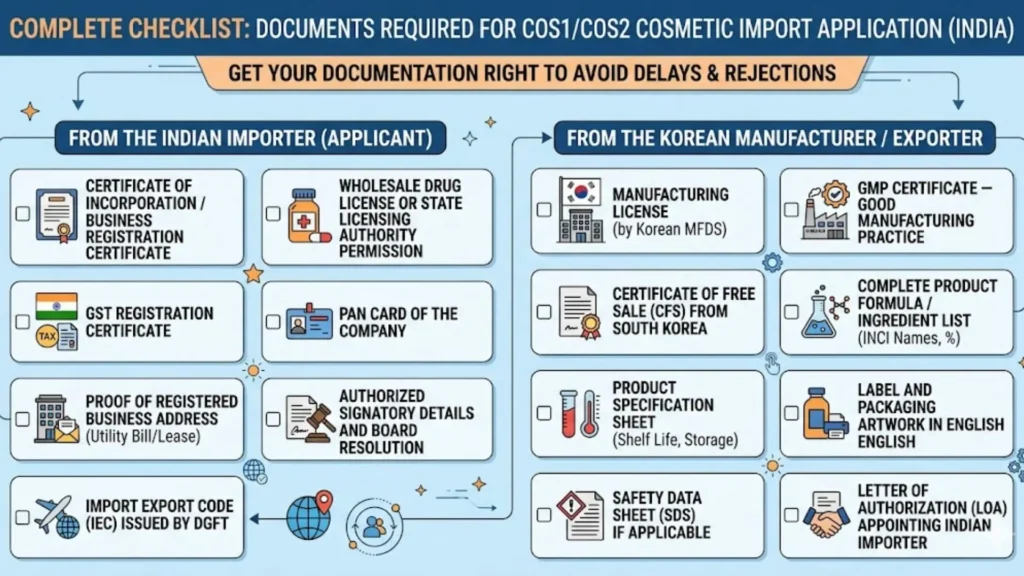
Documents Required for COS-1 (Hair Colour Specific)
- Duly filled Form COS-1 with product, manufacturing site, and labelling details
- Complete ingredient formulation sheet, including precursor dyes, developers/oxidants, and colourants used
- Free Sale Certificate from the National Regulatory Authority of the country of origin
- Certificate of Analysis and safety data supporting the formulation
- Non-animal testing declaration and no-hexachlorophene declaration
- Draft product labels showing ingredient disclosure, directions for use, warning statements, and patch-test instructions
- Power of Attorney authorizing the Indian agent, and the government fee receipt
COS-1 to COS-2: Step-by-Step Process
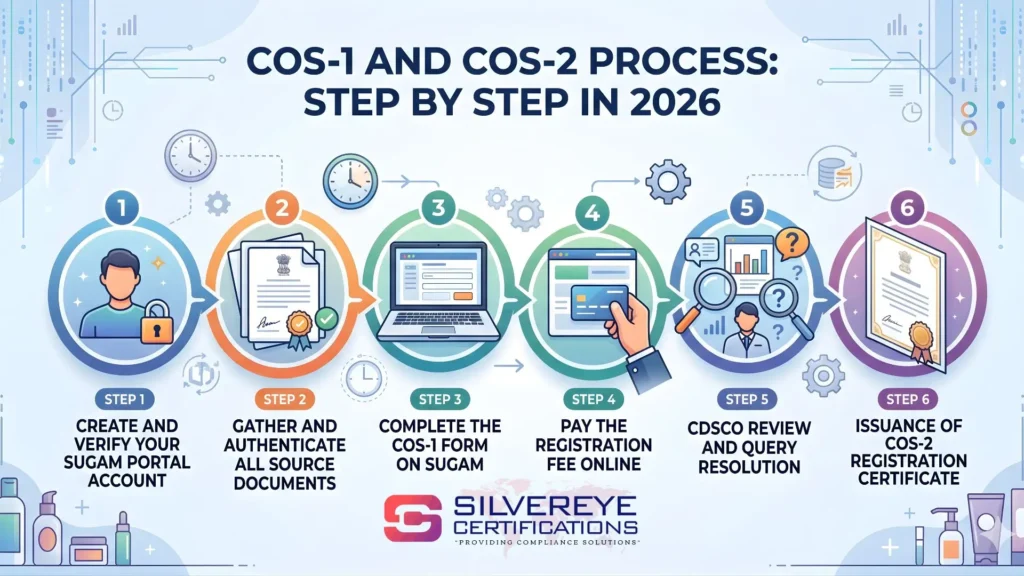
- Register on the CDSCO SUGAM portal and upload Form COS-1 with the complete hair colour dossier
- CDSCO's Central Licensing Authority scrutinises the formulation, labelling, and safety data
- For hair colour products specifically, CDSCO may draw samples for laboratory testing to verify allergenic ingredients such as PPD and ammonia before approval
- Discrepancies or lab-test queries are raised on the SUGAM dashboard for the applicant to resolve
- Once cleared, CDSCO issues the COS-2 Registration Certificate on the applicant's SUGAM dashboard
Fees, Validity, Renewal & Timeline
- Fees are payable per the Third Schedule of the Cosmetics Rules, 2020 through the Bharatkosh gateway, and industry sources commonly cite a structure of roughly USD 1,000 per product category plus USD 500 per variant — always confirm the current figure on SUGAM before paying
- COS-2 is valid for 5 years from date of issue and must be renewed before expiry, with no retrospective renewal permitted
- Rule 13(5) allows up to 180 working days for processing, but hair colour applications can run longer where lab testing of PPD, ammonia, or other allergens is required
COS-5 & COS-8: Manufacturing Cosmetic Hair Colour Products in India
Who Needs It
Any business manufacturing hair dyes, hair colour sprays, bleaching or highlighting kits, or henna-based colours inside India needs a manufacturing license before production. This includes contract manufacturing arrangements filed as a loan license in Form COS-6, granted as Form COS-9.
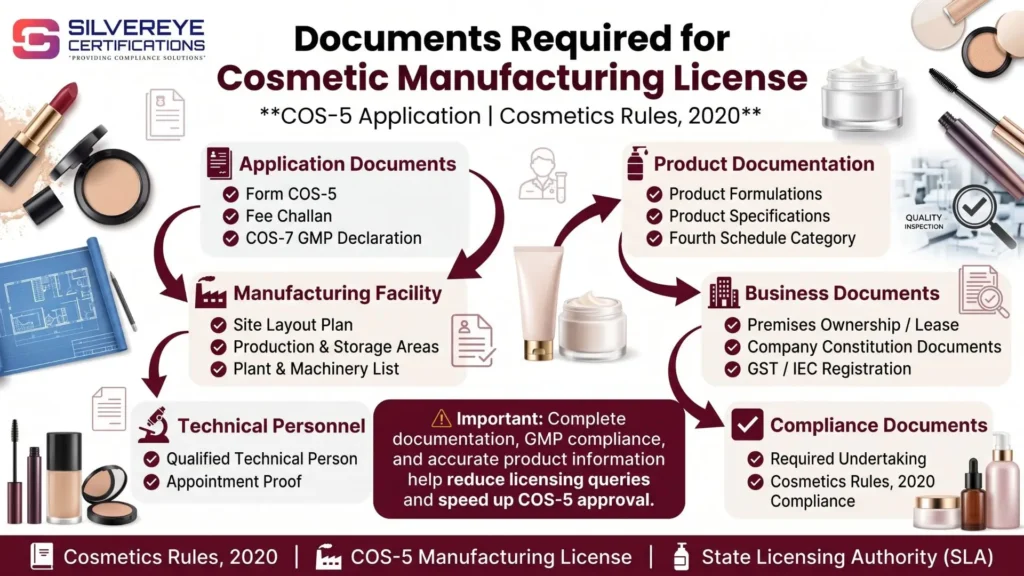
Documents Required for COS-5 (Hair Colour Specific)
- Duly filled Form COS-5 (or COS-6 for a loan license)
- Manufacturing formula listing all precursor dyes, developers, and colourants
- Site plan, GMP compliance declaration, and details of the technically competent person in charge
- Undertaking under Part-II of the Second Schedule of the Cosmetics Rules, 2020
- Draft labels compliant with Rule 34 and Rule 37, and the government fee receipt
COS-5 to COS-8: Step-by-Step Process
- Submit Form COS-5 with the complete document set to the concerned State Licensing Authority
- The SLA reviews the manufacturing formula and labelling for GMP and ingredient compliance
- Once verified, the license is granted in Form COS-8, typically within 45 days of document verification
- A GMP site audit inspection follows within 30 days of the license being granted

Fees, Validity, Renewal & Timeline
- Fees follow the Third Schedule of the Cosmetics Rules, 2020, set by the respective State Licensing Authority
- COS-8 (or COS-9 loan license) is valid in perpetuity, subject to a retention fee paid before completion of every 5-year period from the date of issue
- Realistic timeline is around 45 days after document verification, plus the post-grant site inspection
Types of Hair Colour Products That Need CDSCO Registration
Every format of hair colouring product sold in India, regardless of whether it is marketed as chemical, natural, or herbal, must be registered before sale. The table below lists the main hair colour product types and how each is treated under CDSCO's registration framework.
| Product Type | Representative Products | Applicable Route |
| Permanent Hair Dyes | Oxidative permanent hair colour creams, cream-based hair dyes | Import & Manufacturing |
| Semi-Permanent Hair Colours | Semi-permanent colour creams, toning gels | Import & Manufacturing |
| Temporary Hair Colours | Colour sprays, hair mascaras, temporary colour chalks | Import & Manufacturing |
| Henna & Herbal Hair Colours | Henna powder, herbal-based hair colour pastes | Import & Manufacturing |
| Highlighting & Bleaching Kits | Bleach powder, highlighting kits, lightening creams | Import & Manufacturing |
| Hair Colour Developers/Oxidants | Hydrogen peroxide developer creams and lotions | Import & Manufacturing |
| Root Touch-Up Products | Root touch-up sprays, root concealer powders | Import & Manufacturing |
| Colour-Depositing Hair Care | Colour-depositing shampoos and conditioners | Import & Manufacturing |
Mandatory Labelling Requirements for Hair Colour Products
Hair dye labelling in India is governed specifically by Rule 34 (manner of labelling) and Rule 37 (labelling of hair dyes containing dyes, colours and pigments) of the Cosmetics Rules, 2020. These requirements go beyond standard cosmetic labelling because hair dyes carry a documented risk of allergic reaction.
- Full disclosure of dyes, colours, and pigments used in the formulation
- Clear directions for use, including recommended application time and rinsing instructions
- Mandatory caution and warning statements about potential skin reactions
- Patch-test instructions advising a skin test before full application
- Any revision to the label text, layout, or active ingredient concentration must be reported to the licensing authority before the revised product is distributed
Ingredient Compliance Checkpoints for Hair Colour Products
Hair colour formulations are screened more closely than most cosmetic categories because several conventional ingredients are well-documented skin allergens or are restricted as cosmetic colourants under Indian rules. CDSCO's June 2026 circular specifically ties hair colour approval to compliance with IS 4707 and IS 8481, which set out the permitted colourant list and hair-dye-specific test methods.
- Para-phenylenediamine (PPD): a common ingredient in darker permanent shades and one of the most frequently reported causes of hair dye contact allergy, requiring accurate labelling and concentration disclosure
- Ammonia: used to open the hair cuticle in oxidative dyes; concentration and safety data are reviewed as part of formulation scrutiny
- Resorcinol and toluene-2,5-diamine: common dye-system ingredients that face ongoing scientific and regulatory attention
- Lead compounds: prohibited as cosmetic colourants under India's cosmetic ingredient framework, which is relevant for gradual hair-darkening products that historically used lead acetate in some overseas markets
- All colourants used in the dye system must appear on BIS's permitted colourant list under IS 4707
Benefits of CDSCO Hair Colour Registration
- Legal clearance to import, manufacture, sell, and list hair colour products across Indian retail and e-commerce platforms
- Uninterrupted customs clearance for imported hair dye shipments
- Stronger consumer trust in a category where allergy risk makes safety credentials a genuine purchase factor
- Reduced risk of product seizure, market withdrawal, or license action over ingredient or labelling non-compliance
- Smoother response to CDSCO's 2026 compliance advisories on label and formula-change reporting
Common Mistakes in Hair Colour Registration
- Assuming a herbal or henna-based hair colour is exempt from CDSCO registration — it is not
- Submitting incomplete ingredient disclosure for precursor dyes and developers, which is a leading cause of delay
- Overlooking the mandatory patch-test instruction and warning statement on labels required under Rule 37
- Failing to report a label or formulation change to the licensing authority before distributing the revised product
- Not budgeting extra time for CDSCO's lab testing of allergenic ingredients like PPD and ammonia
Fees & Validity at a Glance
| Form | Purpose | Validity | Renewal / Retention |
| COS-2 | Hair Colour Import Registration Certificate | 5 years from date of issue | Renew before expiry; no retrospective renewal |
| COS-8 / COS-9 | Hair Colour Manufacturing / Loan Licence | Perpetual | Retention fee due before every 5-year period |
Why Work With a CDSCO Cosmetic Registration Consultant
Hair colour sits among the more closely scrutinized cosmetic categories, given its documented allergy profile and the fresh 2026 CDSCO compliance directive tying approval to IS 4707, IS 8481, and Rule 37 labelling. Silvereye Certifications works with hair colour importers, brand owners, and manufacturers to prepare compliant COS-1, COS-2, COS-5, and COS-8 filings — handling ingredient disclosure, label review, SUGAM portal filing, and coordination with the Central and State Licensing Authorities from application through approval.
Conclusion
CDSCO hair colour registration is a more detailed process than most cosmetic categories, given the allergy-risk profile of common hair dye ingredients and CDSCO's tightened 2026 compliance stance on labelling and formula-change reporting. Getting COS-1/COS-2 or COS-5/COS-8 right — with complete ingredient disclosure, compliant Rule 37 labelling, and readiness for possible lab testing — keeps hair colour products moving through customs and on shelves without disruption. Reach out to Silvereye Certifications to plan your hair colour registration filing with confidence.
Frequently Asked Questions
Is CDSCO registration mandatory for hair dyes and hair colours in India?
Yes. Every hair colour product, whether imported or manufactured in India, needs CDSCO or State Licensing Authority approval before it can be legally sold, including herbal and henna-based variants.
What is the difference between COS-1 and COS-2 for hair colour products?
COS-1 is the application filed to seek import registration for a hair colour product; COS-2 is the Registration Certificate CDSCO issues once that application, including any required lab testing, is cleared.
What is the difference between COS-5 and COS-8 for hair colour manufacturing?
COS-5 is the application for a manufacturing license for hair colour products made in India; COS-8 is the license the State Licensing Authority grants after document verification and a site inspection.
Does henna or herbal hair colour need cosmetic registration?
Yes. Even herbal, organic, or henna-based hair colours are classified as cosmetics under Indian law and require the same COS-1/COS-2 or COS-5/COS-8 registration as chemical hair dyes
Which BIS standards apply to hair colour products in India?
Hair colour products must comply with BIS standards IS 4707 (Parts 1 and 2), which cover permitted colourants and ingredient classification, and IS 8481, the hair-dye-specific standard, alongside the Cosmetics Rules, 2020.
Why do hair dyes face extra scrutiny compared to other cosmetics?
Hair dyes carry a documented risk of allergic reaction from ingredients such as PPD and ammonia, so CDSCO may draw samples for laboratory testing and enforces additional labelling rules under Rule 37 of the Cosmetics Rules, 2020.
What labelling warnings are mandatory on hair colour products?
Labels must disclose the dyes, colours, and pigments used, give clear directions for use, carry mandatory caution/warning statements, and include patch-test instructions, as required under Rule 37.
How long does CDSCO hair colour import registration take
Rule 13(5) allows up to 180 working days for a complete application, though hair colour filings can take longer if CDSCO requests laboratory testing of allergenic ingredients.
What happens if I change a hair colour product's label or formula after approval?
Any change to the label, composition, or quality specification must be reported to the Central or State Licensing Authority under Rule 15(2) and Rule 26(k) before the revised product is distributed commercially.
Can I sell imported hair dyes online in India without CDSCO registration?
No. Cosmetic registration is required to list hair colour products on e-commerce platforms, and unregistered products remain liable for seizure and penalties even in online marketplaces.