
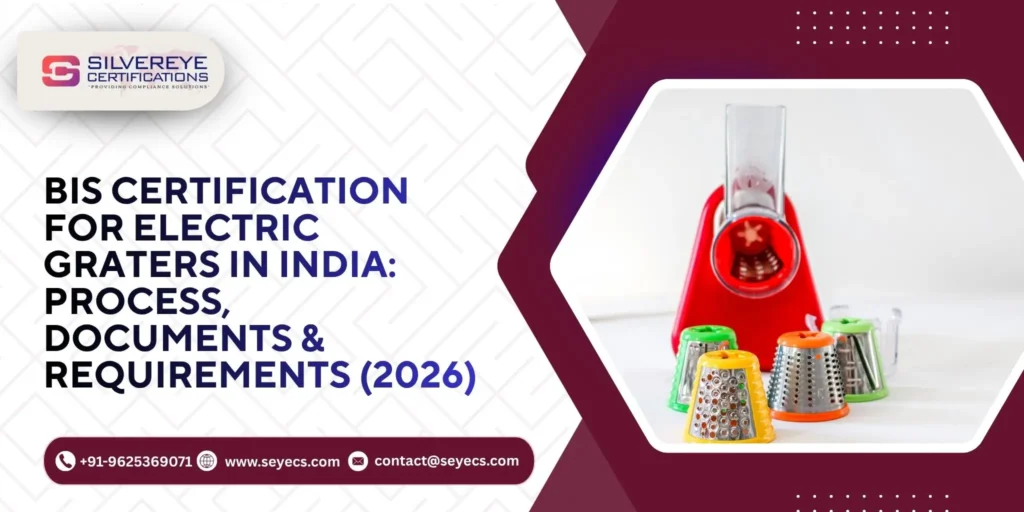
- Electric Graters are specifically listed at Sl. No. 28 in the Schedule to the Safety of Household, Commercial and Similar Electrical Appliances (Quality Control) Order, 2026, notified through S.O. 1739(E), dated 6 April 2026.
- Mandatory BIS Certification: Covered Electric Graters must conform to the applicable Indian Standard and bear the BIS Standard Mark (ISI Mark) under a valid BIS license granted through Scheme-I of Schedule II of the BIS (Conformity Assessment) Regulations, 2018.
- Implementation Dates: The QCO came into force on 1 October 2026 for enterprises other than micro and small enterprises. Small enterprises must comply from 1 January 2027, while micro enterprises must comply from 1 April 2027.
- Applicable Indian Standard: The 2026 QCO specifies IS 302 (Part 1):2024, aligned with IEC 60335-1:2020, titled Household and Similar Electrical Appliances – Safety, Part 1: General Requirements, for Electric Graters.
- Product Applicability: The QCO covers electrical appliances intended for household, commercial or similar applications within the specified voltage limits. Manufacturers should verify the product's classification and applicable BIS testing requirements before applying for certification.
Introduction
BIS Certification for electric graters is mandatory for products covered under the Safety of Household, Commercial and Similar Electrical Appliances (Quality Control) Order, 2026. Under S.O. 1739(E), dated 6 April 2026, electric graters are listed at Sl. No. 28 and must conform to IS 302 (Part 1): 2024 and bear the ISI Mark under a valid BIS license through Scheme-I of the BIS Conformity Assessment Regulations, 2018.

The Order came into effect on 1 October 2026 for general manufacturers, with extended implementation dates of 1 January 2027 for small enterprises and 1 April 2027 for micro enterprises. Goods manufactured in India exclusively for export are exempt under the specified conditions. Manufacturers should check the product's applicability and applicable requirements before starting the certification process.
What Is BIS Certification for Electric Graters?
BIS certification for electric graters is a product conformity certification issued by the Bureau of Indian Standards (BIS). It confirms that the product meets the applicable Indian Standard and that the manufacturer is authorized to use the ISI Mark under a valid BIS license.
Electric graters contain electrical and mechanical components, including motors and cutting or grating mechanisms. Their safety assessment may involve checking relevant aspects such as electrical insulation, protection against electric shock, mechanical hazards, temperature rise and construction safety, as applicable under the standard.

Under the Safety of Household, Commercial and Similar Electrical Appliances (Quality Control) Order, 2026, electric graters are listed at Sl. No. 28. The notified standard is IS 302 (Part 1): 2024, aligned with IEC 60335-1:2020, titled Household and Similar Electrical Appliances – Safety, Part 1: General Requirements. Manufacturers should confirm the applicable testing scope and requirements for their specific product model before applying.
Who Needs BIS Certification for Electric Graters?
The BIS requirement applies to manufacturers and other businesses involved in placing covered electric graters on the Indian market. The responsibilities differ depending on the business model:
- Indian manufacturers: Manufacturers producing electric graters in India for the domestic market must obtain the applicable BIS license and use the ISI Mark once the relevant implementation date applies.
- Foreign manufacturers: Overseas manufacturers supplying covered electric graters to India must obtain BIS certification under the Foreign Manufacturers Certification Scheme (FMCS) and nominate an Authorized Indian Representative (AIR) in India.
- Importers: Importers bringing electric graters into India should ensure that the products are manufactured by a BIS-licensed manufacturer and carry the required Standard Mark. An importer cannot apply for an FMCS license on behalf of a foreign manufacturer.
- Private-label and D2C brands: Brands selling electric graters manufactured by a third-party factory should coordinate with the actual manufacturer. The BIS license is associated with the manufacturing premises and the products or varieties covered by that license.
- Online sellers and distributors: Sellers and distributors should verify that covered electric graters offered for sale comply with the applicable QCO requirements, including the presence of a valid ISI Mark and license details.
- Commercial kitchens and hospitality businesses: Businesses purchasing electric graters for their own use are not required to obtain a manufacturer's BIS license merely because they use the appliance. However, the products supplied to them must meet applicable requirements when covered by the Order.
Exemptions and exclusions: Electric graters manufactured in India exclusively for export are exempt under the Order. Appliances covered by another applicable Quality Control Order or notified for mandatory BIS certification under another Act are also outside the scope of this particular Order. Specific exemptions, such as qualifying research and development imports, are subject to the conditions stated in the notification.
Benefits of BIS Certification for Electric Graters
- Regulatory compliance: Helps manufacturers meet the mandatory requirements of the applicable Quality Control Order before manufacturing or supplying covered products in the Indian market.
- Consumer confidence: The ISI Mark indicates that the product has been assessed against the applicable Indian Standard under the BIS certification system.
- Market access: A valid BIS license is essential for placing products covered by the mandatory QCO on the Indian market after the applicable implementation date.
- Reduced compliance risk: Following BIS requirements helps businesses avoid regulatory action for non-compliance under the BIS Act, 2016.
- Improved quality control: BIS certification involves factory assessment and applicable inspection, testing and quality-control requirements, helping manufacturers maintain consistency in production.
BIS Certification Requirements for Electric Graters
To obtain a BIS license for electric graters under Scheme-I, manufacturers generally need to meet the following requirements:
- Product conformity: The electric grater must comply with IS 302 (Part 1): 2024 and the applicable requirements identified by BIS for the product.
- Product testing: The product must undergo the prescribed testing through a BIS-recognized laboratory, as applicable to the certification process.
- Factory assessment: BIS assesses the manufacturing premises and relevant production and quality-control arrangements as part of the Scheme-I certification process.
- Testing facilities: Manufacturers must maintain the in-house testing facilities, equipment and quality-control arrangements required under the applicable BIS product requirements.
- Standard Marking: Products must carry the prescribed ISI Mark and BIS license number in accordance with BIS marking requirements and the terms of the license.
- Foreign manufacturer requirements: Overseas manufacturers must apply through FMCS and nominate an eligible Authorized Indian Representative (AIR) in India.
Eligibility for BIS Certification of Electric Graters
The following eligibility conditions are relevant for manufacturers seeking BIS certification:
- Indian or foreign manufacturer: The applicant must be the actual manufacturer of electric graters covered by the QCO. Importers, distributors and brand owners cannot independently obtain a manufacturer's license merely by selling or marketing the product.
- Manufacturing premises: The manufacturer must have an identifiable manufacturing facility where the electric graters are produced.
- Testing and quality control: The facility must have the required production controls, testing arrangements and technical resources to demonstrate conformity with the applicable Indian Standard.
- Product details: The manufacturer should be able to provide product specifications, model or variety details, technical documents and samples required for testing and assessment.
- Micro and small enterprise classification: Eligible micro and small enterprises may follow the extended implementation dates specified in the QCO. Their classification must meet the definitions under the MSMED Act, 2006 and applicable rules.
Important: The applicable implementation date depends on the manufacturer's enterprise category. The extended dates do not remove the certification requirement; they provide additional time for eligible small and micro enterprises to comply.
Which Products Are Covered Under BIS Certification for Electric Graters?
The Safety of Household, Commercial and Similar Electrical Appliances (Quality Control) Order, 2026 specifically lists Electric Graters at Sl. No. 28. The Order does not provide individual examples or detailed product descriptions for this category. Therefore, the classification of a particular appliance should be assessed based on its design, intended use and function.
The following table provides an indicative guide. These examples are not separate classifications officially confirmed by BIS.
| Product type | Indicative classification |
|---|---|
| Mains-powered electric cheese or vegetable grater | May fall under Sl. No. 28 – Electric Graters |
| Rotary drum electric grater for kitchen use | May fall under Sl. No. 28, depending on its design and function |
| Rechargeable or battery-operated electric grater | May fall within the Order's scope because battery-operated appliances are included; confirm the product classification |
| Grater attachment supplied with an electric food processor | Check whether the complete appliance is classified as an Electric Food Processor under Sl. No. 26 or whether separate classification is applicable |
| Electric shredders | Separately listed at Sl. No. 34 |
| Slicing machines | Separately listed at Sl. No. 36 |
| Manual graters without electrical components | Outside the scope of this electrical-appliance Order |
Important: The Order covers electrical appliances intended for household, commercial or similar applications within its specified voltage limits. A product's marketing name alone does not determine its classification. Manufacturers should verify the applicable entry and testing requirements for each model before applying for BIS certification.
What Has Changed? The BIS Electric Appliances QCO 2026 at a Glance
On 6 April 2026, the Department for Promotion of Industry and Internal Trade (DPIIT), under the Ministry of Commerce and Industry, issued the Safety of Household, Commercial and Similar Electrical Appliances (Quality Control) Order, 2026, through S.O. 1739(E).
The 2026 Order supersedes the 2025 QCO, except in respect of actions already taken or omissions made before the supersession. It establishes mandatory conformity requirements for the electrical appliances listed in its Schedule.
Here are the key provisions relevant to electric grater manufacturers, importers and brands:
- Scope of application: The Order applies to electrical appliances intended for household, commercial or similar use, with a rated voltage not exceeding 250 V for single-phase appliances and 480 V for other appliances. This includes direct-current-supplied and battery-operated appliances.
- Product coverage: Electric Graters are listed at Sl. No. 28 in the Schedule to the Order.
- Applicable Indian Standard: The listed standard is IS 302 (Part 1): 2024, aligned with IEC 60335-1:2020.
- Mandatory certification: Covered products must conform to the applicable Indian Standard and bear the BIS Standard Mark (ISI Mark) under a valid license issued through Scheme-I of Schedule-II of the BIS (Conformity Assessment) Regulations, 2018.
- Certifying and enforcing authority: The Bureau of Indian Standards (BIS) is the certification and enforcement authority under the Order.
- Penalty for non-compliance: Contravention of the Order may attract penalties under the Bureau of Indian Standards Act, 2016.
- Latest standard requirement: The Note to the Schedule specifies that the latest version of the applicable Indian Standard will apply.
- Exclusion for other QCOs: The Order does not apply to electrical appliances that fall within the scope of another QCO issued under the BIS Act or are notified for mandatory BIS certification under another Act.
BIS Certification Implementation Dates for Electric Graters
The QCO provides different implementation dates based on the manufacturer's enterprise classification under the Micro, Small and Medium Enterprises Development Act, 2006.
| Manufacturer category | Implementation date |
|---|---|
| General category (other than micro and small enterprises) | 1 October 2026 |
| Small enterprises | 1 January 2027 |
| Micro enterprises | 1 April 2027 |
These dates are specified in the QCO. The extended timelines are available to eligible small and micro enterprises that meet the applicable MSMED Act definitions.
Exemptions and Transitional Relief Under the 2026 QCO
The Order provides certain exemptions and transitional provisions. Manufacturers should check the conditions carefully before relying on them.
- Goods manufactured exclusively for export: Electric graters and other covered goods manufactured domestically for export are exempt from the requirements of this Order.
- Research and development imports: Manufacturers of household and similar electrical appliances may import up to 200 units per year for research and development without the requirements of this Order. These products must not be sold commercially and may be disposed of as scrap. Manufacturers must maintain year-wise records and provide them to the Central Government if requested.
- Existing stock: Goods manufactured in India or imported before the applicable implementation date may qualify for transitional relief where the manufacturer is already BIS-certified or has applied to BIS for certification of the relevant goods. The manufacturer must submit the required declaration to BIS. Qualifying declared stock may be sold, displayed or offered for sale for up to six months from the applicable implementation date.
Practical note (as of 19 November 2026): The general implementation date of 1 October 2026 has already passed. For eligible declared stock covered by the transitional provision, the six-month period runs from the applicable implementation date. For the general category, this period extends up to 1 April 2027, subject to the Order's conditions and the required declaration to BIS. Eligible small enterprises have until 1 January 2027, while eligible micro enterprises have until 1 April 2027 to meet the applicable requirements. Manufacturers should not treat the stock-relief provision as a general extension for new production or imports.
Documents Required for BIS Certification of Electric Graters
The documents required for a BIS license depend on the manufacturer's business structure, product specifications and application details. The following are commonly required documents and technical records for preparing a Scheme-I application:
- BIS application: Application submitted through the BIS online portal.
- Business registration documents: Certificate of incorporation, partnership deed, proprietorship proof or other applicable constitution documents.
- PAN and GST details: PAN of the applicant and GST registration details, where applicable.
- Factory documents: Manufacturing unit address proof, ownership or occupancy documents and factory details.
- Product information: Model list, product specifications, rated voltage, electrical ratings and technical details.
- Technical drawings: Circuit diagram, construction details and relevant product drawings.
- Bill of Materials (BOM): Details of critical components, such as the motor, switch, power cord, safety interlock and blade or grating mechanism.
- Testing records: Product test reports and other testing documents required by BIS. The prescribed testing must be completed through the applicable BIS-recognized laboratory.
- In-house testing facilities: Details of testing equipment, calibration records and laboratory facilities available at the manufacturing premises.
- Quality-control documents: Manufacturing process flow chart, quality-control plan and inspection or testing procedures.
- Brand-related documents: Trademark or brand ownership proof, or an authorisation letter where applicable.
- MSME documents: Valid Udyam Registration Certificate where the manufacturer claims the extended implementation date for a micro or small enterprise.
- Foreign manufacturer documents: Authorization of the Authorized Indian Representative (AIR), overseas manufacturing-unit details and other FMCS-specific documents.
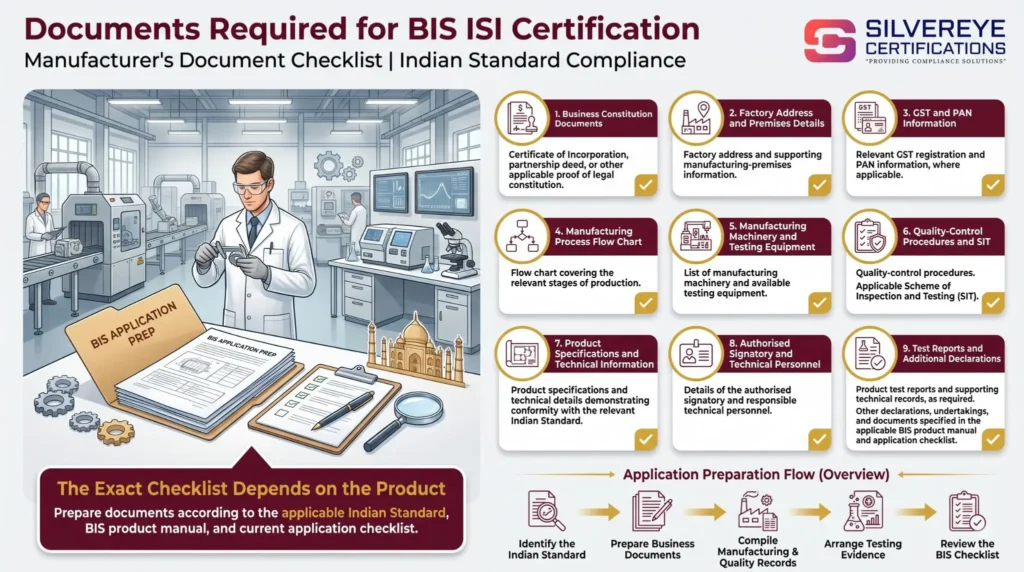
The final checklist should be confirmed against the current BIS application requirements. Submission of these documents alone does not guarantee the grant of a license.
BIS Certification Process for Electric Graters Under Scheme-I
Manufacturers seeking BIS certification for electric graters must follow the applicable Scheme-I certification procedure. The general process involves the following stages:
- Confirm product applicability: Check whether the electric grater falls under Sl. No. 28 of the QCO and verify the applicable voltage limits and Indian Standard.
- Review product design and components: Examine the product's electrical design, motor, switch, power cord, protective arrangements and mechanical construction against the applicable safety requirements.
- Prepare the application: Arrange the required business, factory and technical documents and submit the application through the BIS online portal.
- Product testing: Submit the required product samples for testing at the applicable BIS-recognized laboratory. Testing is carried out against the relevant requirements of the Indian Standard.
- Factory inspection: BIS assesses the manufacturing premises, production process, quality-control arrangements and testing facilities as required under Scheme-I.
- Resolve observations: Respond to any queries or non-conformities raised by BIS during document review, product testing or factory assessment.
- Grant of BIS license: If the manufacturer meets the applicable certification requirements, BIS may grant the license authorizing the use of the ISI Mark.
- Marking and continued compliance: After receiving the license, the manufacturer must apply the Standard Mark and license details according to BIS marking requirements and comply with applicable surveillance and license conditions.
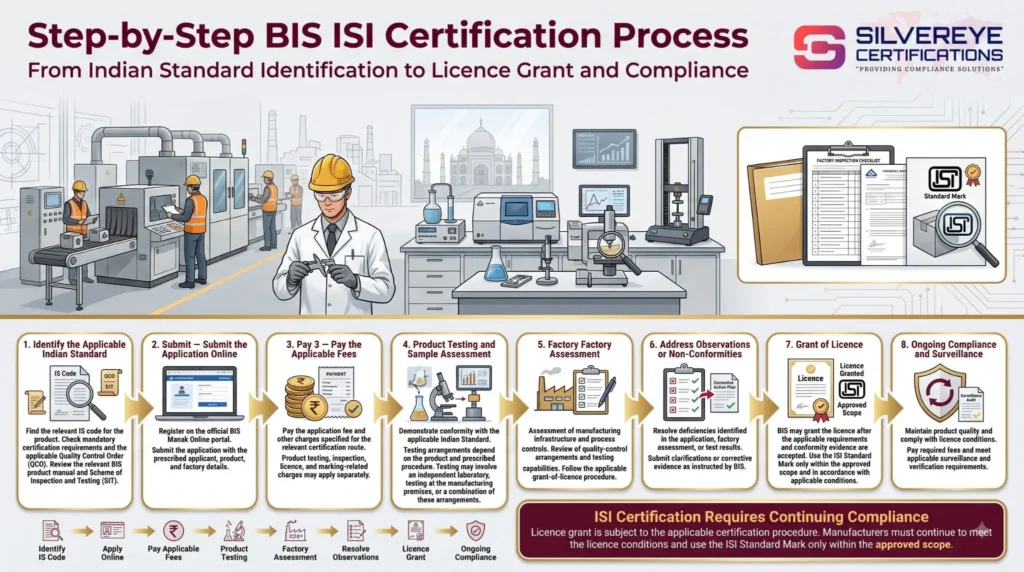
For foreign manufacturers: Applications are handled under the Foreign Manufacturers Certification Scheme (FMCS). The overseas manufacturer must appoint an eligible AIR in India and fulfil the additional requirements applicable to foreign manufacturing units.
BIS Certification Fees for Electric Graters
The total cost of BIS certification for electric graters depends on the applicable BIS fee schedule, product testing requirements, number of models or varieties, factory inspection arrangements and any additional professional support required.
The following table explains the main cost components. It is a cost-structure guide, not a quotation of fixed or current BIS charges.
| Fee component | What it covers | Cost basis |
|---|---|---|
| Application fee | Processing of the BIS license application | Applicable BIS fee schedule |
| License fee | Grant or renewal of the BIS license | Applicable BIS fee schedule |
| Marking fee | Use of the ISI Mark on certified products | Applicable BIS fee schedule and marking requirements |
| Product testing fee | Testing of electric grater samples | Laboratory charges |
| Inspection-related expenses | Factory assessment and related expenses, where applicable | Applicable BIS provisions and actual expenses |
| Consultant charges | Application preparation, documentation and coordination | Service provider's professional fee |
| AIR charges | Representation and coordination for foreign manufacturers, where applicable | Agreed service-provider fee |
Before budgeting: Check the latest BIS fee schedule and obtain the applicable laboratory quotation. Testing and professional charges can vary depending on the product and certification requirements. For foreign manufacturers, additional FMCS and AIR-related expenses may apply.
Validity and Renewal of BIS Certification for Electric Graters
A BIS license under Scheme-I is granted for a specific period and covers only the product varieties mentioned in the licence. Manufacturers must monitor the license expiry date and apply for renewal through the BIS online portal.
| Aspect | Details |
|---|---|
| Initial validity | BIS may initially grant a licence for one to two years, depending on the certification decision. |
| Renewal period | A licence may be renewed for a period of one to five years, subject to BIS approval and applicable requirements. |
| Renewal application | Apply through the Manakonline portal with the required documents and applicable fees. |
| Renewal assessment | BIS may consider production details, marking-fee payments, surveillance results, product conformity and compliance with licence conditions. |
| Missed renewal | If the licence expires without renewal, the manufacturer must not continue using the ISI Mark or claim to hold a valid licence. |
| Changes during validity | Adding product models or varieties, changing the manufacturing premises or modifying the product may require a change in the licence scope or additional assessment. |
Important: The QCO specifies that the latest version of the applicable Indian Standard must be followed. If IS 302 (Part 1) is revised, manufacturers should check the relevant BIS implementation instructions to understand whether additional testing, documentation or other compliance action is required.
Timeline for BIS Certification of Electric Graters
There is no single guaranteed timeline for obtaining BIS certification for electric graters. The actual processing time depends on the completeness of the application, product testing, factory inspection and the time taken to resolve BIS observations.
The main factors affecting the timeline include:
- Document preparation: Incomplete business, factory or technical documents can delay application processing.
- Laboratory testing: The time required depends on sample availability, laboratory workload and the tests applicable to the product.
- Factory inspection: BIS must assess the manufacturing and quality-control arrangements as required under Scheme-I.
- Technical observations: Additional clarification or corrective action may be required if testing or inspection identifies non-conformities.
- Application category: Applications under the domestic certification route and the Foreign Manufacturers Certification Scheme may involve different procedural requirements.
Manufacturers should plan for several weeks to a few months, rather than relying on a fixed completion date. Foreign manufacturers should allow additional time for FMCS documentation, AIR arrangements and overseas factory-related requirements.
Common Mistakes to Avoid When Applying for BIS Certification
Manufacturers, importers and brands should avoid the following mistakes during the BIS certification process:
- Assuming CE certification replaces BIS certification: A CE marking or another international certificate does not replace mandatory BIS certification under the Indian QCO.
- Delaying the application: Waiting until the implementation deadline can leave insufficient time for product testing, factory inspection and resolving BIS observations.
- Incorrect applicant details: Confusing the manufacturer, importer and brand owner can create problems because the BIS license is associated with the manufacturer and its approved manufacturing premises.
- Ignoring stock declaration requirements: Eligible pre-implementation stock must meet the conditions specified in the QCO, including the required declaration to BIS. Simply manufacturing or importing goods before the deadline does not automatically establish eligibility for transitional relief.
- Confusing product categories: Electric graters, electric shredders and slicing machines have separate entries in the QCO. Manufacturers should verify the correct classification rather than assuming that similar products share the same entry.
- Changing critical components without assessment: Changes to motors, switches, power cords, blade guards or other safety-related components may affect product conformity. Manufacturers should check whether the change requires testing, approval or an amendment to the license scope.
- Using the ISI Mark without a valid license: Products must not carry the Standard Mark unless the manufacturer has the necessary BIS authorization and follows its license conditions.
Why Choose Silvereye Certifications for BIS Certification of Electric Graters?
Silvereye Certifications is an Indian regulatory consultancy providing guidance and application support for businesses dealing with product certification and regulatory compliance, including BIS, CDSCO and cosmetic registrations.
For electric grater manufacturers and brands, our team can assist with:
- Product applicability assessment: Reviewing the product details to help identify the relevant QCO entry, applicable Indian Standard and implementation date.
- Document preparation: Helping organise and review the technical, business and manufacturing documents required for the application.
- Testing coordination: Assisting with coordination for product testing and the required certification documentation.
- Application support: Guiding manufacturers through the BIS application process and helping prepare responses to queries.
- Licence and amendment guidance: Providing support with renewal planning, product-variety additions and changes requiring BIS assessment.
- Stock declaration guidance: Helping eligible manufacturers understand the documentation and declaration requirements for qualifying pre-implementation stock.
We focus on transparent communication, practical compliance guidance and clear cost information so that manufacturers can understand their certification responsibilities at each stage. The final certification decision and grant of the licence remain with BIS.
Conclusion
BIS certification for electric graters is a mandatory compliance requirement under the Safety of Household, Commercial and Similar Electrical Appliances (Quality Control) Order, 2026 for products covered by the notification. Electric graters are listed at Sl. No. 28 and must conform to IS 302 (Part 1): 2024 and carry the ISI Mark under a valid BIS license through Scheme-I.
As of 19 November 2026, the general implementation date of 1 October 2026 has passed. Eligible small enterprises have until 1 January 2027, while eligible micro enterprises have until 1 April 2027. Manufacturers should confirm their enterprise classification, verify the applicable product requirements, prepare the required documents and begin the certification process in time.
If you manufacture, import or sell electric graters in India, understanding the applicable QCO requirements is essential to avoiding compliance issues. Silvereye Certifications can guide you through the documentation, testing coordination and BIS application process.
Frequently Asked Questions
Is BIS certification mandatory for electric graters in India?
Yes. Electric Graters (Sl. No. 28) are in the Table of the QCO Order of 6 April 2026, so they must conform to the notified standard and carry the ISI Mark.
Does this cover electric cheese graters?
Electric cheese and vegetable graters are commonly sold as electric graters. Confirm the entry for your model with BIS or a consultant.
Are shredders and slicers covered by the same entry?
No. The Table lists Electric Shredders (Sl. No. 34) and Slicing Machines (Sl. No. 36) as separate entries.
Which Indian Standard applies For Electric Graters?
IS 302 (Part 1): 2024, aligned with IEC 60335-1: 2020. The latest version of the standard applies.
From when is it mandatory?
From 1 October 2026 for general manufacturers, 1 January 2027 for small enterprises and 1 April 2027 for micro enterprises.
Can I import electric graters without BIS certification?
Not for sale in India, unless an exemption applies. The Order allows up to 200 units per year for R&D by appliance manufacturers, and they cannot be sold commercially.
Are graters made for export covered?
No. Goods manufactured domestically for export are exempt.
Can I sell old stock after the deadline?
Goods made or imported before the implementation date by a BIS-certified manufacturer, or one who has applied for certification, can be sold for up to six months from that date if a declaration is made to BIS.
What is the penalty for selling without BIS certification?
Contravention is punishable under the Bureau of Indian Standards Act, 2016.
Do foreign manufacturers need an Indian representative?
Generally yes. They apply through FMCS and appoint an Authorized Indian Representative.