
BIS certification is mandatory for electric call bells and buzzers intended for indoor use under the Safety of Household, Commercial and Similar Electrical Appliances (Quality Control) Order, 2026.
Key requirements include:
- Mandatory BIS Certification: Electric call bells and buzzers for indoor use must comply with the applicable BIS certification requirements.
- Implementation Dates: The QCO took effect on 1 October 2026 for general enterprises. Small enterprises must comply from 1 January 2027, while micro enterprises must comply from 1 April 2027.
- Applicable Indian Standard: Products must conform to IS 302 (Part 1): 2024 / IEC 60335-1:2020, covering general safety requirements for household and similar electrical appliances.
- ISI Mark Requirement: Manufacturers must obtain a BIS license under Scheme-I and use the authorized ISI Standard Mark on covered products.
- Penalties for Non-Compliance: Manufacturing, importing or selling covered products without the required certification can attract action under the Bureau of Indian Standards Act, 2016.
Introduction
Electric call bells and buzzers are widely used in homes, offices, hotels, hospitals and commercial establishments for signalling and communication. With the introduction of the Safety of Household, Commercial and Similar Electrical Appliances (Quality Control) Order, 2026, BIS certification has become mandatory for covered indoor electric call bells and buzzers in India. Manufacturers and importers must ensure compliance with IS 302 (Part 1): 2024 and obtain a BIS licence under Scheme-I before selling products covered by the Order.

The implementation dates vary according to enterprise size, making it important for businesses to understand the applicable deadlines, testing requirements, certification process, documents and costs before manufacturing or importing these products.
What Is BIS Certification for Electric Call Bells and Buzzers for Indoor Use?
BIS certification for electric call bells and buzzers for indoor use is a mandatory product certification requirement under the Safety of Household, Commercial and Similar Electrical Appliances (Quality Control) Order, 2026.
Under this Order, covered products must conform to IS 302 (Part 1): 2024 and bear the BIS Standard Mark (ISI Mark) under a valid licence issued by the Bureau of Indian Standards (BIS).

The certification follows Scheme-I of Schedule-II of the BIS (Conformity Assessment) Regulations, 2018. BIS assesses the manufacturer's ability to maintain product conformity through appropriate manufacturing infrastructure, quality control, testing arrangements and product testing.
This requirement is intended to ensure that covered electrical appliances meet the applicable safety requirements before entering the Indian market.
Which Products Are Covered Under the BIS QCO 2026?
The Gazette specifically lists Electric Call Bells and Buzzers for Indoor Use at Serial No. 14.
Depending on their intended use, design and technical specifications, products that manufacturers should assess include:
- Wired electric doorbells and indoor door chimes.
- Mains-powered electric call bells.
- Indoor signalling bells and buzzers.
- Desk and counter call bells.
- Battery-operated or wireless indoor call bell systems, where classified under the notified product category.
Important: The Gazette does not separately list every design or commercial product name. Manufacturers should confirm whether their specific model falls within the notified category and the applicable Indian Standard before applying.
BIS Certification for Indoor Call Bells and Buzzers at a Glance
| Question | Answer |
|---|---|
| Is BIS certification mandatory? | Yes, for products covered by the 2026 QCO |
| Which QCO applies? | Safety of Household, Commercial and Similar Electrical Appliances (QCO), 2026 |
| Gazette notification | S.O. 1739(E), dated 6 April 2026 |
| Product category | Electric Call Bells and Buzzers for Indoor Use |
| QCO serial number | 14 |
| Applicable Indian Standard | IS 302 (Part 1): 2024 |
| Certification scheme | Scheme-I, BIS (Conformity Assessment) Regulations, 2018 |
| Who obtains the licence? | The manufacturer |
| What marking is required? | BIS Standard Mark (ISI Mark) under a valid licence |
| Is a laboratory test report sufficient? | No. A test report alone does not authorise the use of the ISI Mark |
What Changed Under the BIS Quality Control Order 2026?
The Government of India issued the Safety of Household, Commercial and Similar Electrical Appliances (Quality Control) Order, 2026 on 6 April 2026 through Gazette notification S.O. 1739(E).
The Order superseded the 2025 QCO, except for actions already taken or omitted before its supersession.
Electric call bells and buzzers for indoor use are specifically included in the new Order at Serial No. 14. Consequently, manufacturers and importers must assess their products against the applicable BIS certification requirements and implementation dates.
Once the relevant implementation date applies, covered products must conform to the prescribed Indian Standard and carry the BIS Standard Mark under a valid licence.
Key Details of the BIS QCO 2026 Notification
| Particular | Official Requirement |
|---|---|
| Notification number | S.O. 1739(E) |
| Notification date | 6 April 2026 |
| Issuing department | DPIIT, Ministry of Commerce and Industry |
| Applicable Order | Safety of Household, Commercial and Similar Electrical Appliances (QCO), 2026 |
| Legal authority | Section 16 of the BIS Act, 2016 |
| Product category | Electric Call Bells and Buzzers for Indoor Use |
| Product serial number | 14 |
| Indian Standard | IS 302 (Part 1): 2024 |
| International reference | IEC 60335-1:2020 |
| Certification requirement | BIS Standard Mark under Scheme-I |
| General implementation date | 1 October 2026 |
| Small enterprise deadline | 1 January 2027 |
| Micro enterprise deadline | 1 April 2027 |
| Certification and enforcement authority | Bureau of Indian Standards (BIS) |
Applicable Voltage Scope
The 2026 QCO covers electrical appliances intended for household, commercial or similar applications with:
- Rated voltage not exceeding 250 V for single-phase appliances.
- Rated voltage not exceeding 480 V for other appliances, including DC-supplied and battery-operated appliances.
The Order excludes electrical appliances covered by another applicable Quality Control Order or separately notified for mandatory BIS certification under another Act.
Who Needs BIS Certification for Indoor Call Bells and Buzzers?
Businesses involved in manufacturing, importing or selling indoor electric call bells and buzzers should understand their responsibilities under the QCO.
- Indian Manufacturers: Domestic manufacturers producing covered electric call bells and buzzers must obtain the applicable BIS licence for their manufacturing premises before the relevant implementation deadline.
- Foreign Manufacturers: Overseas manufacturers supplying covered products to India must obtain BIS certification under the Foreign Manufacturers Certification Scheme (FMCS). They must nominate an Authorised Indian Representative (AIR) as required by BIS.
- Importers: Importers sourcing finished products from overseas manufacturers should verify that the foreign manufacturing facility holds the required BIS licence. An importer cannot independently obtain an FMCS licence on behalf of the foreign manufacturer.
- Brand Owners: Businesses selling products under their own brand through contract manufacturing should confirm the applicable licence and brand-marking arrangements with BIS. The licence is associated with the manufacturer and manufacturing premises.
- Distributors and Marketplace Sellers: These businesses should source covered products from appropriately licensed manufacturers and verify the applicable BIS marking and licence details before distribution or sale.
Important: BIS certification is a manufacturer-based licensing requirement. A test report, supplier declaration or overseas certification does not independently replace the BIS licence required under the QCO.
Compliance Dates: Which One Applies to Your Enterprise?
The Safety of Household, Commercial and Similar Electrical Appliances (Quality Control) Order, 2026 provides different implementation dates based on enterprise classification under the Micro, Small and Medium Enterprises Development Act, 2006.
| Enterprise category | Mandatory compliance date | Status as of 24 November 2026 |
|---|---|---|
| General enterprises (other than micro and small) | 1 October 2026 | In force |
| Small enterprises | 1 January 2027 | Upcoming |
| Micro enterprises | 1 April 2027 | Upcoming |
The later dates for micro and small enterprises provide additional preparation time, not a permanent exemption. Manufacturers should plan for product testing, factory readiness, documentation and the BIS application process well before their applicable deadline.
Latest BIS Updates: November 2026
1. QCO implementation has started
The 2026 Order came into force for general enterprises on 1 October 2026. Small enterprises must comply from 1 January 2027, while micro enterprises must comply from 1 April 2027.
2. Conditional relief for existing stock
The Order permits eligible manufacturers to sell, display or offer for sale certain goods manufactured in India or imported before the applicable implementation date for up to six months from that date. The manufacturer must already hold BIS certification or have applied for certification of the relevant goods before the implementation date and must submit the required stock declaration to BIS.
Based on the implementation dates, the respective six-month periods are:
| Enterprise category | Implementation date | Maximum stock sell-through period |
|---|---|---|
| General enterprises | 1 October 2026 | Up to 1 April 2027 |
| Small enterprises | 1 January 2027 | Up to 1 July 2027 |
| Micro enterprises | 1 April 2027 | Up to 1 October 2027 |
This is a conditional provision, not a blanket permission to sell any uncertified inventory. Manufacturers should verify eligibility and complete the required declaration with BIS.
3. BIS (Conformity Assessment) Amendment Regulations, 2026
The amendment was notified in the Gazette on 25 February 2026. Among other changes, it introduced annual advance fee-payment provisions for the continuation of a valid licence and revised the Scheme-I licence validity provisions. Under the amended Scheme-I provisions, a licence is initially granted for up to five years and may be renewed for further periods of up to five years, subject to the applicable requirements and fees.
4. MSME marking-fee concessions
A separate BIS notification dated 17 March 2026 extended specified annual minimum marking-fee concessions under Scheme-I until 31 May 2029. The notified concessions include an 80% concession for micro enterprises and a 50% concession for small enterprises against the annual minimum marking fee payable by large-scale enterprises. Additional provisions apply to eligible start-ups and women entrepreneur enterprises.
These are marking-fee concessions, not a waiver of product testing or certification requirements. Check the current BIS fee schedule for the applicable product and enterprise category before preparing your budget.
5. Confirm the applicable standard edition
The QCO identifies IS 302 (Part 1): 2024 for Electric Call Bells and Buzzers for Indoor Use. Before arranging testing, confirm the applicable standard edition, amendments and any relevant product-specific requirements with BIS or the testing laboratory.
Exemptions and Special Provisions Under the Order
The 2026 Order contains specific provisions that manufacturers should understand before planning production, imports or sales.
- Goods manufactured for export: The Order does not apply to electrical appliances manufactured domestically for export.
- Research and development imports: Manufacturers of household and similar electrical appliances may import up to 200 units per year for research and development. These units must not be sold commercially. They may be disposed of as scrap, and the manufacturer must maintain year-wise records and provide them to the Central Government when requested.
- Existing stock: Goods manufactured domestically or imported before the applicable implementation date may qualify for the six-month sell-through provision, provided the manufacturer was already BIS-certified or had applied for certification of the relevant goods before that date. The manufacturer must also submit the required declaration to BIS.
- Later implementation dates for MSMEs: Small and micro enterprises receive the later compliance dates specified in the Order: 1 January 2027 and 1 April 2027, respectively. These are deferred implementation dates, not permanent exemptions.
- Products covered under other mandatory requirements: The Order does not apply to electrical appliances falling within the scope of another Quality Control Order issued under the BIS Act or notified for mandatory BIS certification under another Act.
The existing-stock provision is conditional. Manufacturers relying on it should retain purchase, import and production records, identify the eligible stock clearly and complete the declaration required by BIS.
Benefits of BIS Certification for Electric Call Bells and Buzzers
BIS certification is primarily a regulatory requirement for products covered by the QCO. It also supports product quality management, buyer confidence and access to compliant markets.
| Stakeholder | Potential benefit | Why it matters |
|---|---|---|
| Manufacturers | Permission to use the Standard Mark under a BIS license | Covered products must meet the applicable QCO requirements from the relevant implementation date |
| Manufacturers | Better buyer confidence | Institutional buyers, distributors and business customers may ask for evidence of BIS compliance |
| Manufacturers | Improved quality-control practices | Certification activities encourage documented production checks and conformity monitoring |
| Importers | Better compliance verification | Importers can verify that the overseas manufacturer holds the appropriate BIS licence for the product |
| Retailers and distributors | Reduced compliance risk | Sourcing products from appropriately licensed manufacturers helps reduce the risk of dealing in non-compliant goods |
| Consumers and commercial users | Greater assurance of conformity | The applicable safety standard addresses electrical and construction-related safety requirements |
Business Benefits in More Detail
- Regulatory market access: Manufacturers can meet the mandatory BIS requirements applicable to their products and enterprise category.
- Buyer confidence: The authorised Standard Mark provides evidence that the product is covered by a BIS licence and meets the applicable conformity requirements.
- Better production controls: The certification process encourages manufacturers to maintain appropriate quality-control, inspection and testing arrangements.
- Reduced compliance risk: Meeting the QCO requirements helps manufacturers avoid enforcement action associated with non-compliant products.
- Product-range planning: Manufacturers can assess additional models and variants for inclusion in the licence scope through the applicable BIS procedures.
- Stronger business credibility: Demonstrable compliance can support discussions with distributors, institutional buyers and other business customers.
Certification does not guarantee fewer product failures, customs clearance or acceptance by every buyer. Those outcomes depend on product performance, documentation and the requirements of the relevant buyer or authority.
Requirements for BIS Certification of Electric Call Bells and Buzzers
Manufacturers seeking a BIS license must establish that the relevant product conforms to the applicable Indian Standard and that the manufacturing arrangements meet BIS requirements.
| Requirement | What it means for the manufacturer |
|---|---|
| Applicable Indian Standard | The product must conform to IS 302 (Part 1): 2024, as specified for this QCO entry, subject to applicable amendments and requirements confirmed by BIS |
| Product testing | The manufacturer must arrange testing in accordance with the applicable BIS procedure and sampling requirements. The testing route and laboratory requirements should be confirmed for the application |
| Manufacturing capability | The manufacturing unit must demonstrate the infrastructure and production capability needed to manufacture conforming products consistently |
| Quality control | The manufacturer should maintain documented inspection, testing and quality-control arrangements for production |
| Testing capability | The manufacturer must identify and demonstrate the testing capabilities and facilities required under the applicable certification procedure |
| Standard Mark and licence details | The Standard Mark and other required marking details must be applied in accordance with the BIS licence and applicable marking requirements |
| Online application | Product certification applications are submitted through the BIS online system, Manakonline, in accordance with the applicable procedure |
Important before arranging product testing: The QCO table specifies IS 302 (Part 1): 2024 for this product category. Do not assume that every design requires an additional product-specific standard or that a particular power arrangement automatically changes the applicable standard. Share the product's technical specifications, intended use, rated voltage and power arrangement with BIS or the laboratory so the correct testing requirements can be confirmed before samples are submitted.
Eligibility: Who Can Apply for BIS Certification?
BIS product certification under Scheme-I is intended for the manufacturer of the product, not a trader or reseller.
The following applicants may use the applicable certification route:
- Indian manufacturers: A manufacturer producing the notified electric call bells or buzzers at an Indian factory can apply for a BIS licence for that manufacturing premises.
- Foreign manufacturers: Overseas manufacturers can apply through the Foreign Manufacturers Certification Scheme (FMCS). They must nominate an Authorised Indian Representative (AIR) who meets BIS requirements.
- Micro and small enterprises: Eligible micro and small manufacturers can access the applicable MSME concessions on minimum marking fees. The QCO also provides them with later implementation dates. Medium enterprises should not assume that the micro and small enterprise concessions apply to them.
Can traders and resellers apply? No. A trader or reseller cannot obtain a manufacturer's BIS licence for a product made by another company. They should source covered products from manufacturers holding the appropriate BIS licence and verify that the product falls within its approved scope.
Documents Required for BIS Certification
The documents required depend on the manufacturer's location, application option and product details. The following is a preparation checklist, not a fixed BIS-prescribed list for every application.
| Document or information | Purpose |
|---|---|
| Online application and prescribed declarations | Formal application for the BIS licence |
| Business registration documents | Establishes the applicant's legal identity |
| Factory address and ownership or occupancy documents | Identifies the manufacturing premises |
| Factory layout and manufacturing process flow | Helps BIS understand the production arrangement |
| List of machinery and production equipment | Demonstrates manufacturing capability |
| List of testing equipment and calibration records | Shows the available testing facilities |
| Quality control plan and inspection records | Explains how product quality is controlled |
| Product specifications, models and ratings | Defines the product proposed for certification |
| Circuit diagrams, construction details and technical literature, where applicable | Supports technical assessment of the product |
| Test reports, where required under the selected application option | Provides evidence of conformity with the applicable standard |
| Authorised signatory details and authorisation | Identifies the person representing the applicant |
| Udyam registration certificate, if claiming an applicable MSME concession | Supports the enterprise's MSME classification |
| For foreign manufacturers: AIR nomination and overseas factory documents | Supports the FMCS application |
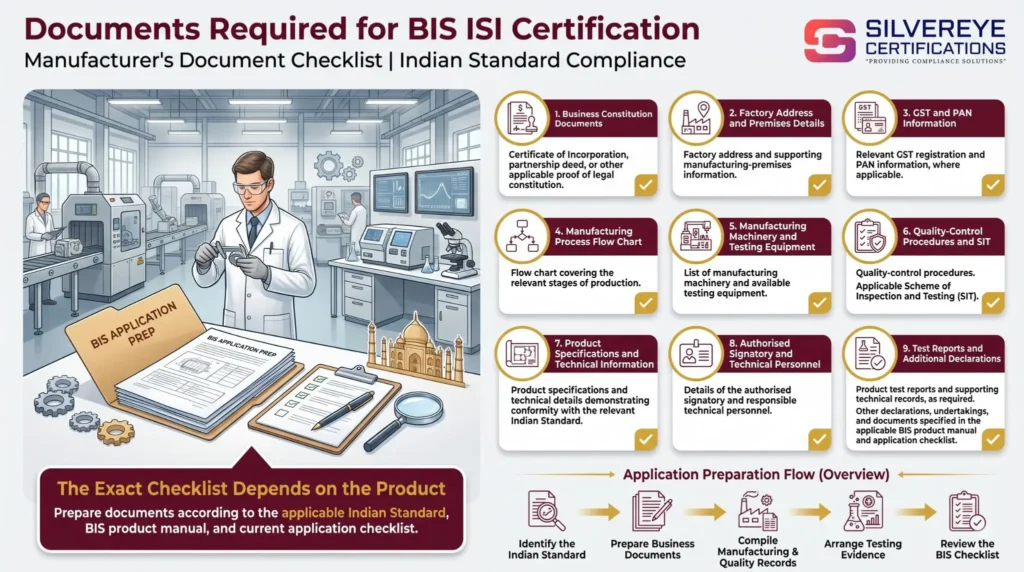
BIS may require additional information, records or documents during application scrutiny and factory assessment. Check the current applicant instructions and product-specific requirements on the Manakonline portal before submitting the application.
BIS Certification Process for Call Bells and Buzzers: Step by Step
BIS certification follows Scheme-I of Schedule-II of the BIS (Conformity Assessment) Regulations, 2018. BIS provides two application options, and the testing and assessment arrangements can differ between them.
- Confirm product coverage and the applicable deadline. Check whether the exact call bell or buzzer falls under Serial No. 14 of the QCO and identify the implementation date applicable to your enterprise.
- Identify the applicable Indian Standard. Confirm the requirements of IS 302 (Part 1): 2024 and check whether any additional product-specific requirements apply to the particular model.
- Assess the factory and product. Review manufacturing infrastructure, process controls, quality control arrangements and testing capabilities. Address any gaps before applying.
- Prepare the application and supporting documents. Finalise product specifications, factory information, quality records and other documents required for the selected application option.
- Submit the application online. File the application through the Manakonline portal and pay the applicable fees.
- Complete the BIS assessment and testing requirements. BIS assesses the manufacturing premises and the manufacturer's production, quality-control and testing capabilities. Product conformity may be established through third-party laboratory testing, testing at the manufacturing premises, or a combination of both, depending on the applicable procedure.
- Respond to BIS observations. Provide clarifications, additional documents or corrective actions if BIS raises any queries or identifies gaps during the assessment.
- Obtain the BIS licence. If the factory assessment and product conformity requirements are satisfactorily completed, BIS may grant the licence for the product and manufacturing premises.
- Apply the Standard Mark as authorised. After the licence is granted, mark only the product varieties covered by the licence scope and follow the applicable marking conditions.
- Maintain compliance after certification. Continue production controls, testing, record-keeping and payment of applicable annual dues. BIS may conduct factory and market surveillance to verify continued conformity.
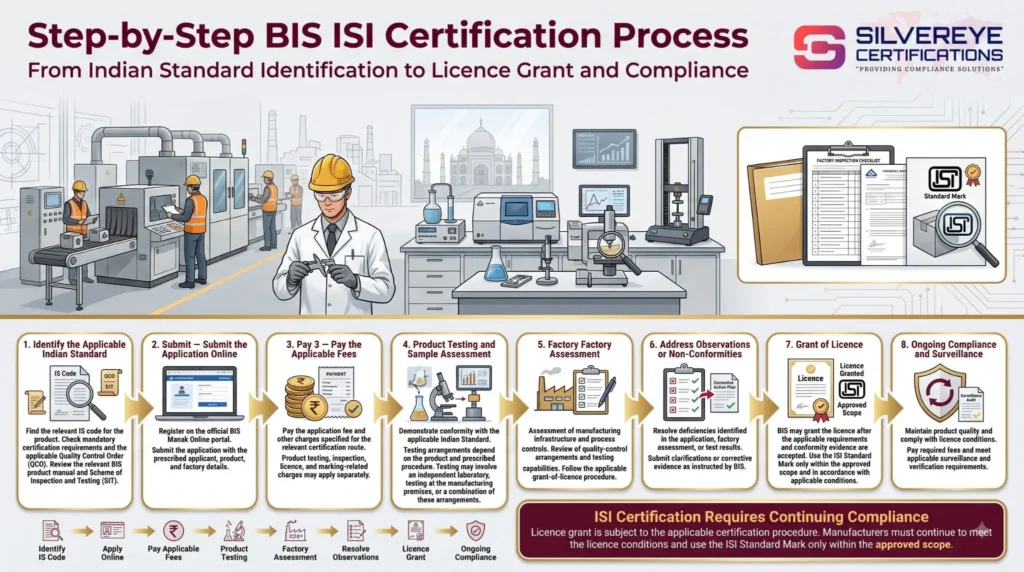
Important: BIS does not follow a single mandatory sequence of factory inspection followed by laboratory testing for every application. The applicable application option and BIS instructions determine the assessment and testing arrangements.
BIS Certification Fees for Call Bells and Buzzers
The cost of BIS certification includes application charges, inspection charges, annual licence fees, product-specific marking fees and testing expenses. The final amount depends on the applicable fee schedule, the application route, the number of models and the testing requirements.
The following are the published fee references and cost heads to consider:
| Fee component | Published basis or indicative amount | Important details |
|---|---|---|
| Application fee | ₹1,000 | BIS's published product certification FAQ lists this amount |
| Inspection fee | ₹7,000 per man-day | The published FAQ lists this charge for inspection; actual assessment requirements may vary |
| Annual licence fee | ₹1,000 | Payable in addition to the applicable marking fee |
| Minimum marking fee | Product- and enterprise-specific | Check the current Scheme-I schedule for the applicable Indian Standard |
| Testing charges | As charged by the laboratory | Depend on the tests, sample requirements and laboratory |
| Additional assessment expenses | As applicable | May include expenses associated with the assessment and factory visit |
| Consultant fees | Varies | Optional; depends on the support required |
MSME Concessions on Minimum Marking Fees
BIS has extended concessions on annual minimum marking fees under Scheme-I until 31 May 2029:
- Micro enterprises: 80% concession on the annual minimum marking fee payable by large-scale enterprises.
- Small enterprises: 50% concession on the annual minimum marking fee payable by large-scale enterprises.
- Start-up enterprises: 80% concession on the annual minimum marking fee payable by large-scale enterprises.
- Women entrepreneur enterprises: An additional 10% concession on the applicable enterprise-scale minimum marking fee.
These concessions are subject to the applicable BIS notification and eligibility conditions. They apply to the minimum marking fee, not automatically to every certification expense.
Important: The BIS marking-fee schedule can be amended. Check the current fee for the applicable Indian Standard on the BIS portal before preparing your certification budget. If the product is being considered for its first BIS licence and a product-specific marking-fee rate has not yet been defined, BIS may determine the applicable product-specific requirements through the All India First Licence process.
Validity and Renewal of BIS Certification
A BIS licence under Scheme-I is not permanent. The validity period, renewal and annual fee obligations must be managed separately.
BIS's published product certification FAQ states that a licence may initially be granted for up to two years and may be renewed for up to five years. The actual validity and product varieties covered are specified in the licence.
| Aspect | What manufacturers should know |
|---|---|
| Initial validity | Up to 2 years, as stated in the BIS product certification FAQ |
| Renewal | May be granted for up to 5 years, subject to BIS requirements |
| Renewal application | Submit online through the Manakonline portal before the licence expires |
| Renewal documents | Include production details for the relevant period and other documents required by BIS |
| Renewal charges | Depend on the renewal period and applicable fees, including annual licence and marking-fee dues |
| Annual fee payment | The 2026 amendment requires applicable annual fees to be paid in advance for continuation of a valid licence |
| Annual production statement | Submit the required production statement along with annual dues within the prescribed timeline |
| Non-payment of annual dues | The licence's operation may be suspended for 90 days if the annual fee and production statement are not received by the due date |
| Late payment during suspension | Payment within the 90-day period, together with the prescribed ₹5,000 late fee, can revoke the suspension, subject to the other applicable conditions |
| Failure to pay within the suspension period | The licence may be cancelled if the annual fee and production statement are not received within the prescribed period |
What Changed Under the BIS Amendment Regulations, 2026?
The BIS (Conformity Assessment) Amendment Regulations, 2026, notified on 25 February 2026, introduced an annual advance-payment requirement for licence fees and provisions governing the continuation of valid licences.
Under the amendment, failure to pay annual dues along with the production statement by the prescribed due date can result in a 90-day suspension. If the dues are paid within that period with the prescribed late fee, the suspension may be revoked, provided no other unresolved ground for suspension remains. If payment is not received within the suspension period, the licence can be cancelled.
Practical tip: Track both the licence expiry date and the annual fee and production-statement due dates. Do not wait until the last moment to prepare renewal documents or make payments. As a planning measure, start the renewal process well in advance and follow the due date shown in the BIS portal and applicable licence conditions.
Marking Requirements: How the ISI Mark Must Appear on Your Product
Once BIS grants the licence, the manufacturer can use the ISI Standard Mark only on products and models covered by the approved licence scope.
The manufacturer must follow the marking conditions specified by BIS, including:
- Use the ISI mark only after licence grant. Do not print, display or apply the Standard Mark before receiving the BIS licence.
- Display the required licence details. The marking must include the applicable licence number and Indian Standard number in the manner prescribed by BIS.
- Ensure clear and durable marking. The Standard Mark and required details must remain legible and comply with the marking requirements applicable to the product.
- Follow packaging requirements. Where BIS requires additional information on the packaging or accompanying documents, include it as specified.
- Mark only approved models. A model not covered by the licence scope must not carry the Standard Mark until BIS approves its inclusion through the applicable scope-extension process.
The exact marking format and location should be confirmed from the licence conditions and applicable BIS marking instructions.
After the License: Surveillance and Ongoing Compliance
Obtaining a BIS licence is not the end of the certification process. Manufacturers must continue to maintain product conformity and comply with the conditions of their licence.
BIS may carry out factory surveillance, inspection and market-sample testing to check whether licensed products continue to meet the applicable Indian Standard.
To maintain compliance:
- Conduct routine quality checks: Carry out the inspections and tests required under the approved quality control arrangements and maintain the relevant records.
- Maintain testing equipment: Keep testing equipment in working condition and ensure calibration is carried out at the required intervals.
- Control changes to the product: Inform BIS about changes to product design, ratings, critical components or other details that may affect conformity. Obtain the required approval before marking changed products where applicable.
- Report factory changes: Follow BIS procedures if the manufacturing premises or production arrangements change.
- Maintain production records: Keep manufacturing, inspection, testing and marking records available for BIS verification.
- Track standard revisions: Monitor amendments to IS 302 (Part 1). The QCO specifies that the latest version of the Indian Standard applies.
A valid licence does not remove the manufacturer's responsibility to maintain conformity in every production batch.
Importers: What You Should Know
Importers bringing electric call bells or indoor buzzers into India should verify BIS compliance before placing purchase orders or arranging shipment.
Under the applicable certification route, the foreign manufacturer must obtain the BIS licence for the covered product and manufacturing premises. Foreign manufacturers apply through the Foreign Manufacturers Certification Scheme (FMCS) and must nominate an eligible Authorised Indian Representative (AIR).
An importer cannot obtain an FMCS manufacturing licence on behalf of a foreign manufacturer.
Before importing, check the following:
- Ask the supplier for its valid BIS licence number.
- Verify the licence and approved product scope through the BIS portal.
- Confirm that the actual model and manufacturing premises are covered by the licence.
- Check that the product carries the required Standard Mark and licence details.
- Confirm that the product's technical specifications and marking match the approved certification details.
What about R&D imports? The QCO permits manufacturers to import up to 200 units per year for research and development, subject to its conditions. These units cannot be sold commercially, must be disposed of as scrap, and must be supported by the required year-wise records.
Importers should not treat this limited R&D provision as a general exemption for commercial shipments. Other exemptions, such as goods manufactured domestically for export, have separate conditions under the Order.
Non-compliant imports may face regulatory or customs-related difficulties. Verify the applicable requirements before dispatch rather than relying on certification documents supplied without checking their validity and scope.
Penalty for Non-Compliance
The QCO makes compliance with the applicable Indian Standard and BIS certification requirements mandatory from the relevant implementation date. Contravention is punishable under the Bureau of Indian Standards Act, 2016.
Depending on the nature of the violation, the Act provides for penalties that may include fines and imprisonment. BIS also has enforcement powers under the Act, which may include action against non-conforming goods and misuse of the Standard Mark.
For manufacturers and importers, the consequences can extend beyond statutory penalties:
- Regulatory action: Non-compliant products may be subject to enforcement measures under the BIS Act.
- Import difficulties: Shipments that do not meet mandatory certification requirements may face delays or other action by the relevant authorities.
- Marketplace restrictions: Retailers and online platforms may restrict or remove products that cannot demonstrate the required compliance.
- Commercial losses: Delays, product withdrawals and corrective action can increase operating costs.
- Brand reputation: Selling products without the required certification can affect buyer confidence and business relationships.
Manufacturers should confirm the applicable QCO deadline and complete certification before selling covered products after that date.
Common Mistakes to Avoid For BIS Certification
Manufacturers and importers should watch out for these common compliance mistakes:
- Assuming a test report is the same as a BIS licence: A laboratory report alone does not authorise the manufacturer to use the ISI Standard Mark.
- Ignoring the enterprise-size implementation date: Confirm whether the applicable deadline is 1 October 2026, 1 January 2027 or 1 April 2027.
- Assuming every doorbell is automatically covered: Check the product's intended use, design and classification against the notified category before deciding whether the QCO applies.
- Skipping factory readiness checks: Inadequate manufacturing controls, testing facilities or documentation can delay the certification process.
- Using the ISI mark before licence grant: The mark must not be applied to covered products without the required BIS authorisation.
- Failing to declare eligible existing stock: Manufacturers relying on the six-month stock-relief provision must meet its conditions, including submitting the required declaration to BIS.
- Selling models outside the licence scope: New models or variants must be included through the applicable BIS approval process before they are marked.
- Overlooking changes to product specifications: Changes to ratings, construction or critical components may require BIS review or approval.
- Missing annual payment and renewal requirements: Track annual dues, production statements and licence expiry dates to avoid suspension or cancellation.
Why Choose Silvereye Certifications for BIS Certification of Call Bells and Buzzers?
BIS certification involves more than submitting an application. Manufacturers need to understand the applicable Indian Standard, prepare their factory and testing arrangements, organise technical documents and complete the BIS assessment requirements.
Silvereye Certifications provides compliance consultancy and application support to help manufacturers and businesses navigate this process.
Here is how our team can assist:
- Product applicability guidance: We help assess whether your electric call bell or indoor buzzer falls under the notified QCO category and identify the applicable compliance requirements.
- Documentation support: We assist in preparing and reviewing application documents, product specifications, factory details and quality-control records.
- Factory readiness guidance: We help manufacturers understand the production, inspection and testing arrangements expected under the applicable BIS certification process.
- Testing coordination: We provide guidance on applicable testing requirements and help coordinate with suitable laboratories.
- Application assistance: We support the preparation and submission of the BIS application through the relevant online process.
- BIS query support: We help organise responses and supporting documents when BIS raises observations or requests additional information.
- Ongoing compliance guidance: We assist with understanding licence conditions, marking requirements, scope extensions and renewal-related obligations.
Our approach focuses on clear guidance, transparent communication and practical support throughout the certification process. BIS is the authority responsible for assessing applications and granting licences; Silvereye Certifications provides consultancy and application assistance, not government-issued certification.
Conclusion
BIS certification is a mandatory compliance requirement for electric call bells and buzzers covered under the Safety of Household, Commercial and Similar Electrical Appliances (Quality Control) Order, 2026. The applicable standard is IS 302 (Part 1): 2024, and manufacturers must obtain the required BIS licence before using the ISI Standard Mark and selling covered products after their respective implementation dates.
General enterprises have been subject to the requirement since 1 October 2026, while small enterprises must comply from 1 January 2027 and micro enterprises from 1 April 2027. Manufacturers should not wait until the deadline to begin product testing, factory preparation and documentation.
A planned approach can help reduce avoidable application delays and support continued compliance after the licence is granted. If you need assistance understanding product coverage, preparing documents or navigating the BIS application process, Silvereye Certifications can guide you through the required steps.
Frequently Asked Questions
Is BIS certification mandatory for electric call bells and buzzers?
Yes, for indoor-use electric call bells and buzzers listed at Sl. No. 14 of the 2026 Quality Control Order, from the date applicable to your enterprise.
Which Indian Standard applies For Electric Call Bells and Buzzers?
The Order's table lists IS 302 (Part 1): 2024, which is aligned with IEC 60335-1: 2020. Confirm with your lab whether any additional product-specific part applies to your model.
From when does the rule apply for electric call bells and buzzers?
From 1 October 2026 for general manufacturers, 1 January 2027 for small enterprises and 1 April 2027 for micro enterprises.
Does it cover battery-operated or wireless doorbells?
The Order's scope clause includes DC-supplied and battery-operated appliances within the voltage limits. Confirm the position for your specific model before filing.
Can I sell old stock after the deadline?
Only under the conditional proviso: the manufacturer must be BIS-certified or have applied, the goods must have been made or imported before the implementation date, and a declaration must be made to BIS. Sale is allowed for up to six months from the implementation date.
Are exports covered?
No. Goods manufactured domestically for export are exempt from the Order.
How much does BIS certification cost?
There is an application fee, an annual licence fee, a product-specific marking fee and testing charges at actuals. Verify current figures on the BIS portal because 2026 amendments revised some provisions.
How long does the process take?
There is no fixed number. It depends on your document readiness, factory inspection scheduling, lab turnaround and whether samples pass first time.
How long is the licence valid and how do I renew it?
Validity is stated in your licence and can be up to five years under the 2026 amendment. Renew online, preferably two months before expiry.
What happens if I miss the renewal date for BIS Certification?
BIS can defer renewal for up to 90 days with a late fee. After that the licence may lapse and you must stop marking and selling.
Can an importer apply instead of the foreign manufacturer?
The licence is generally held by the manufacturer. A foreign manufacturer applies through the overseas route with an Authorised Indian Representative.
What is the penalty for selling without certification?
The Order says violations are punishable under the BIS Act, 2016, which provides for fines and imprisonment.