
- Application fee: ₹1,000.
- Inspection fee: ₹7,000 per man-day, payable in advance of the factory inspection.
- Annual licence fee: ₹1,000.
- Minimum marking fee: Product-specific and varies depending on the applicable Indian Standard and enterprise category. It can range from thousands to lakhs of rupees.
- MSME concessions: Eligible micro enterprises and start-ups receive an 80% concession, while small enterprises receive a 50% concession on the annual minimum marking fee. These concessions are currently valid until 31 May 2029, subject to BIS conditions.
- Advance payment under the 2026 guidelines: Applicants generally pay 50% of the annual minimum marking fee at the time of application and the remaining balance when the license is granted.
- Late renewal: A renewal application submitted after the license validity date attracts a late fee of ₹5,000, subject to applicable BIS rules. If the renewal application and prescribed fees are not received by the expiry date, BIS may defer its renewal decision for up to 90 days; this does not automatically extend the license.
Introduction
BIS ISI Mark Certification cost include an application fee of ₹1,000, an inspection fee of ₹7,000 per man-day, an annual license fee of ₹1,000, and a product-specific minimum marking fee. Applicable GST is added wherever chargeable.

The minimum marking fee is the main variable in the total certification cost, as it depends on the product and applicable BIS fee schedule. Under the February 2026 BIS guidelines, applicants pay 50% of the annual minimum marking fee at the time of application and the remaining 50% at the time of license grant.

Laboratory testing charges are generally separate under Option 1, while the Option 2 verification-sample testing cost is included in the applicable annual minimum marking fee. Eligible micro enterprises and start-ups receive an 80% concession, while small enterprises receive a 50% concession on the minimum marking fee.
These concessions are available until 31 May 2029, subject to BIS eligibility conditions. The applicable license and marking fees must be paid in advance for the relevant license period, in accordance with the current BIS fee rules.
BIS ISI Certification Cost: Complete Cost Breakdown
The BIS ISI Mark Certification cost includes application, factory inspection, annual licence and product-specific marking fees. Additional expenses may apply for laboratory testing, renewal, changes to the licence scope and other services. The following table covers the main charges under Scheme-I. Amounts are before applicable GST and other bank or payment charges.
| Fee | Amount | When it applies |
|---|---|---|
| Application fee | ₹1,000 | When submitting a new BIS licence application |
| Factory inspection fee | ₹7,000 per man-day | Payable in advance before the BIS factory inspection |
| Annual licence fee | ₹1,000 | At the time of licence grant and as applicable during renewal |
| Minimum marking fee | Product-specific, as prescribed under Scheme-I | 50% at application submission and the balance at licence grant; subsequent annual payments are due in advance |
| Actual marking fee | Based on applicable production and marking-fee rates | Calculated using production details and adjusted against the applicable minimum marking fee |
| Laboratory testing charges | As charged by the applicable laboratory | Under Option 1, the applicant bears the sample-testing charges. Under Option 2, the verification-sample testing cost is included in the applicable annual minimum marking fee |
| Renewal application fee | ₹1,000 | When applying for licence renewal |
| Late fee for missed annual payment | ₹5,000 | If the annual fee and production statement are submitted within the 90-day suspension period to seek revocation of suspension |
| Additional service or scope-change charges | Depends on the applicable BIS notification and service | For requests such as adding varieties, changing licence details or other approved scope modifications |
Important Points About BIS Fees
- Minimum marking fee: This is the main variable in the certification cost. It depends on the product-specific marking-fee schedule and applicable Indian Standard. Check the latest rate on the official BIS Fee page.
- Advance payment: Under the 25 February 2026 guidelines, applicants pay 50% of the applicable annual minimum marking fee at application submission and the remaining amount at the time of licence grant.
- Refund of advance marking fee: BIS's 2026 grant guidelines state that the advance minimum marking fee is returned if the application is rejected or closed. This refund provision should not be assumed to apply to every other fee.
- Annual payment requirement: Under the February 2026 amendment, applicable annual fees must be paid in advance along with the production statement by the prescribed due date.
- Late annual payment: If the annual fee and production statement are not received by the due date, the licence operation is suspended for 90 days. Payment within that period, along with the ₹5,000 late fee, may revoke the suspension, subject to other compliance requirements. If payment is not received within the suspension period, the licence may be cancelled.
- Laboratory charges: Testing charges vary by product and laboratory. Option 1 applicants bear the testing fee, whereas the Option 2 verification-sample testing cost is included in the applicable annual minimum marking fee.
Additional Costs for Foreign Manufacturers
Foreign manufacturers applying under the Foreign Manufacturers Certification Scheme (FMCS) must also account for applicable inspection-related expenses, including travel, accommodation, per-diem charges and other amounts specified in the current FMCS fee schedule. These expenses are additional to the applicable BIS certification fees. Check the latest FMCS fee instructions with BIS before preparing your budget.
Before applying: Do not rely on an old fee chart or assume that every additional service has a fixed charge. Verify the latest product-specific marking fee, applicable concessions and service charges on the official BIS website or through the concerned BIS Branch Office.
BIS Minimum Marking Fee: How It Affects Your Certification Cost
The minimum marking fee is often the largest component of the BIS ISI Mark Certification cost. Unlike the fixed application and inspection charges, this fee varies by product and applicable Indian Standard. It is calculated using the marking-fee schedule notified by BIS.
How the BIS Marking Fee Works
- Annual minimum marking fee: A product-specific minimum amount payable for the license period, even if the manufacturer's actual production is low. The applicable amount depends on the Indian Standard and enterprise category.
- Unit marking rate: BIS prescribes a rate per unit, such as per piece, tonne, pair or another measurement, depending on the product.
- Actual marking fee: This is calculated using the quantity of products manufactured and marked during the relevant period multiplied by the applicable unit rate.
- Minimum versus actual fee: The manufacturer is liable for the applicable marking fee based on production, subject to the prescribed minimum. If the calculated actual fee exceeds the minimum already paid, the difference becomes payable.
- Payment under the 2026 guidelines: The applicant pays 50% of the annual minimum marking fee at application submission and the remaining amount at the time of license grant. Subsequent annual payments are made in advance as prescribed by BIS.
- Refund provision: The 2026 grant guidelines provide for the return of the advance minimum marking fee if the application is rejected or closed, subject to the applicable provisions.
Examples of Product-Specific Marking Fees
BIS publishes the marking-fee schedule product by product. The following examples are taken from the 7 October 2024 Gazette notification and are useful for understanding how the schedule is structured. They are historical reference figures, not a confirmation of the current payable rates.
| Product | Indian Standard | Unit | Large-scale minimum fee in the 2024 notification | Unit rate in the 2024 notification |
|---|---|---|---|---|
| Electric ceiling fans and regulators | IS 374:2019 | 1 piece | ₹1,76,000 | ₹0.65 |
| Electric table fans and regulators | IS 555:1979 | 1 piece | ₹1,54,000 | ₹0.65 |
| Storage water heaters | IS 302-2-21:2018 | 1 piece | ₹1,30,000 | ₹6.00 |
| Air filters for general ventilation | IS 17570-1:2021 | 1 piece | ₹2,99,000 | ₹1.75 |
| Cold-formed welded hollow steel sections | IS 18573:2024 | 1 MT | ₹74,000 | ₹5.55 |
Important: BIS has published further marking-fee amendments dated 2 January 2026 and 10 June 2026. The figures above should not be used to calculate a current application cost without checking the latest applicable schedule. You can search for your product's Indian Standard through the official BIS Marking Fee page.
BIS Marking Fee Concessions for MSMEs, Start-ups and Women Entrepreneurs
BIS provides concessions on the annual minimum marking fee for eligible enterprises under Scheme-I. The concession extension notified in March 2026 is valid until 31 May 2029, subject to the prescribed eligibility conditions.
| Enterprise category | Concession | Applicable condition |
|---|---|---|
| Micro enterprise | 80% | On the annual minimum marking fee payable by large-scale enterprises |
| Small enterprise | 50% | On the annual minimum marking fee payable by large-scale enterprises |
| Start-up enterprise | 80% | Subject to the applicable BIS start-up eligibility requirements |
| Women entrepreneur enterprise | Additional 10% | On the fee applicable to its micro, small or medium enterprise category |
The additional concession for women entrepreneur enterprises is available subject to the conditions in the BIS notification. It is not a separate replacement for the applicable enterprise-category concession.
What documents should you keep ready?
- Valid Udyam Registration and supporting enterprise details, where claiming an MSME concession.
- Valid start-up recognition documents, where claiming the start-up concession.
- Prescribed supporting documents to establish eligibility for the women entrepreneur concession, where applicable.
Do not assume that every enterprise registered as an MSME automatically receives the same concession. The applicable category and supporting documents must meet BIS requirements.
The concessions are specified in the BIS Gazette notification dated 17 March 2026.
BIS ISI Certification Cost: How to Calculate Your Budget
The total certification cost depends on the applicable minimum marking fee, enterprise category, inspection requirements and testing arrangements. The following example explains the calculation method without treating an older marking-fee notification as a current quotation.
Illustrative Cost Calculation
Assume a manufacturer applies for an ISI licence for electric ceiling fans under IS 374:2019. The 7 October 2024 notification listed a large-scale annual minimum marking fee of ₹1,76,000 and a unit rate of ₹0.65.
For illustration, applying the 80% micro-enterprise concession to that historical minimum fee would give:
| Cost component | Large-scale enterprise | Eligible micro enterprise |
|---|---|---|
| Historical annual minimum marking fee | ₹1,76,000 | ₹35,200 |
| Application fee | ₹1,000 | ₹1,000 |
| One man-day inspection fee | ₹7,000 | ₹7,000 |
| Annual licence fee | ₹1,000 | ₹1,000 |
| Illustrative total | ₹1,85,000 | ₹44,200 |
This is an illustration based on the 2024 notified marking-fee figure, not a current BIS fee quotation. The latest product-specific marking fee and applicable concessions must be checked before using these totals for budgeting.
The calculation also excludes applicable GST, laboratory testing charges, professional consultancy fees, calibration expenses and any additional inspection or equipment costs.
What Happens to the Cost in the Following Years?
From the next licence year, the manufacturer must budget for the annual licence fee and applicable minimum marking fee, along with any additional marking fee arising from production, where payable. Routine testing under the Scheme of Inspection and Testing, instrument calibration and quality-control operations should also be included in the ongoing compliance budget.
Normal vs Simplified BIS Procedure: Cost Comparison
Both Option 1 and Option 2 involve the applicable application, inspection, licence and minimum marking fees. The main cost difference is related to when testing is carried out and who pays for the relevant laboratory tests.
| Cost factor | Option 1 – Normal Procedure | Option 2 – Simplified Procedure |
|---|---|---|
| Test report before application | Generally not required as a pre-condition in the same way as Option 2 | Conforming test report required from an eligible laboratory |
| Pre-application testing cost | Generally not required for the standard Option 1 route | Applicant pays the laboratory for the required pre-application test report |
| BIS-drawn sample testing | Applicant generally bears the applicable testing charges | Verification-sample testing cost is included in the applicable annual minimum marking fee |
| Inspection fee | Applicable at ₹7,000 per man-day | Applicable at ₹7,000 per man-day |
| Processing target under the 2026 guidelines | 90 days | 30 days |
| Main cost consideration | Laboratory testing and the time required for the normal assessment process | Pre-application testing expense and the risk of corrective action if the verification sample fails |
Which procedure is more economical?
There is no single answer for every manufacturer. Option 2 may reduce the expected processing time, but it requires the applicant to arrange and pay for the required test report before filing. Option 1 may be more suitable where the product is not eligible for Option 2 or where the applicant needs to follow the normal assessment route.
A failed verification sample under Option 2 can also lead to suspension and corrective action. Therefore, compare the total testing cost, applicable marking fee, factory-readiness requirements and processing time before selecting the available procedure.
Costs That Are Not Included in the BIS Fee Schedule
The official BIS fee schedule does not cover every expense involved in obtaining and maintaining an ISI licence. Depending on the product, factory setup and application route, manufacturers may also need to budget for the following:
| Additional cost | Why it may arise | How to manage it |
|---|---|---|
| Laboratory testing | Testing laboratories charge separately for product tests. Under Option 2, the applicant must arrange conforming test reports before applying. | Obtain a quotation covering all applicable tests and confirm which product varieties can be grouped under the BIS guidelines. |
| Testing equipment and calibration | The factory must have suitable testing facilities or acceptable testing arrangements to meet the applicable Standard and Scheme of Inspection and Testing (SIT). | Review the product-specific requirements before applying. Explore shared or external testing arrangements only where BIS permits them. |
| Factory improvements | Inadequate machinery, testing facilities, production controls or factory arrangements may affect the assessment. | Compare your factory setup with the relevant Indian Standard, product manual and SIT before filing. |
| Additional inspection or repeat visits | Further visits may be required in certain cases, including when additional verification is necessary. Inspection charges are calculated at the applicable BIS rate per man-day. | Conduct an internal readiness check and keep machinery, test records and quality-control documents organised. |
| Consultant or application support | Professional assistance is a separate commercial expense and is not part of the BIS government fee. | Request a written quotation that separates professional charges, BIS fees and laboratory expenses. |
| Marking and labelling | Manufacturers must arrange compliant product marking, including the applicable Standard Mark and licence details. | Finalise the marking and packaging design in line with BIS requirements before production for sale. |
| GST and other applicable taxes | Taxes may apply to the relevant fees and services. | Include applicable taxes in the overall budget and confirm the amount at the time of payment. |
| Late payment charges | A ₹5,000 late fee applies under the 2026 amendment when overdue annual fees and the production statement are submitted within the prescribed 90-day suspension period. | Track annual payment and production-statement due dates to avoid suspension and late charges. |
Important: Laboratory charges, equipment costs and factory-upgrade expenses vary by product. Do not assume that every manufacturer needs to purchase a separate in-house testing facility. BIS may accept other testing arrangements where they meet the applicable requirements and are permitted for that product.
BIS Fees and Payment Rules Under the 2026 Amendments
The BIS (Conformity Assessment) Amendment Regulations, 2026, notified on 25 February 2026, introduced important changes to annual fee payments and the continuation of license operations. The main provisions for manufacturers applying under Scheme-I are:
- Annual payment in advance: The applicable annual fees must be paid in advance at the time of licence grant and for the continued operation of a valid license.
- Production statement: The licensee must submit the production statement along with the annual dues within the prescribed timeline.
- Suspension for non-payment: If BIS does not receive the annual fee and production statement by the due date, the licence operation is treated as suspended for 90 days from that date, subject to the applicable Scheme.
- ₹5,000 late fee: If the outstanding annual fee and production statement are submitted within the 90-day period, along with the ₹5,000 late fee, the suspension can be revoked.
- Cancellation if dues remain unpaid: If the required annual fee and production statement are not received within the suspension period, the licence is liable to be cancelled under the amended provisions.
- Five-year initial validity: Under the amended Scheme-I, a licence may initially be granted for up to five years and renewed for a further period of up to five years. Annual fee payments still continue.
- Split payment of minimum marking fee: Under the February 2026 grant guidelines, 50% of the applicable annual minimum marking fee is payable at the application stage, with the balance payable when the licence is granted.
What this means for manufacturers: A licence granted for five years does not mean that you pay all the applicable annual fees only once. You must budget for the required annual payments and production-statement submissions throughout the licence period.
Validity of the BIS ISI License
The 2026 amendment changed the initial validity period under Scheme-I. Manufacturers should distinguish the licence's validity from the annual payments required to keep it operational.
| Aspect | Applicable provision |
|---|---|
| Initial validity | Up to five years. The actual period granted is stated in the BIS licence. |
| Renewal period | Up to a further five years, subject to BIS requirements and approval. |
| Annual fees | Applicable annual fees must be paid in advance within the prescribed timeline, even when the licence has a multi-year validity period. |
| Production statement | Must be submitted along with the annual dues within the applicable timeline. |
| Non-payment of annual dues | The licence operation is suspended for 90 days if the annual fee and production statement are not received by the due date. The prescribed late-payment provision applies during this period. |
| Licence scope | The licence covers only the product varieties, models or grades included in its approved scope. Additional varieties require a scope-extension application and applicable charges. |
| Manufacturing premises | The licence is specific to the approved manufacturing premises. A factory relocation requires compliance with BIS's prescribed shifting procedure. |
Renewal reminder: Apply for renewal before the license expires and follow the payment and documentation requirements shown on the Manak Online portal. BIS recommends applying preferably two months before expiry. Do not treat the annual payment deadline and the license renewal deadline as the same date; they serve different purposes.
BIS ISI License Renewal: Fees, Process and Timeline
A BIS ISI licence must be renewed before its validity expires if the manufacturer wants to continue using the Standard Mark. Renewal is submitted through the Manak Online portal, and the fees depend on the renewal period, applicable marking fee and any outstanding dues.
| Renewal requirement | Details |
|---|---|
| Where to apply | Manak Online, through the licence holder's account |
| Renewal application fee | ₹1,000, subject to the applicable BIS fee schedule |
| Late renewal fee | ₹5,000 where the renewal application is submitted after the licence validity date, within the permitted 90-day period |
| Other payments | Applicable licence fee, advance minimum marking fee for the requested renewal period and outstanding dues, if any |
| Renewal period | Minimum one year and up to five years, depending on the period requested and applicable payment requirements |
| Recommended filing time | Preferably two months before the licence expiry date |
| If the application is delayed | BIS may defer its renewal decision for up to 90 days from the licence expiry date, subject to the prescribed conditions |
| If the licence is suspended | Renewal cannot be completed until the suspension is revoked |
| Marking fee adjustment | The production statement is used to calculate the applicable marking fee. Any additional amount payable must be cleared as required by BIS. |
Important: The ₹5,000 late fee is not a general charge for every delayed renewal. Under the renewal guidelines, it applies when the manufacturer submits the renewal application after the licence expiry date within the permitted 90-day period. If the licence is already under suspension, the suspension must first be addressed.
Suggested BIS License Renewal Calendar
The following schedule is a practical planning guide, not a statutory deadline:
| When | Suggested action |
|---|---|
| Five to four months before expiry | Review production records, calibration certificates, testing records and the latest applicable Indian Standard. Check whether the relevant QCO has changed. |
| Four to three months before expiry | Review surveillance observations, resolve pending non-conformities and check outstanding BIS dues. |
| At least two months before expiry | Prepare and submit the renewal application through Manak Online, with the required documents and fees. |
| Every year, before the applicable due date | Pay the annual fees in advance and submit the production statement as required under the applicable rules. |
BIS ISI Certification Process and Documents
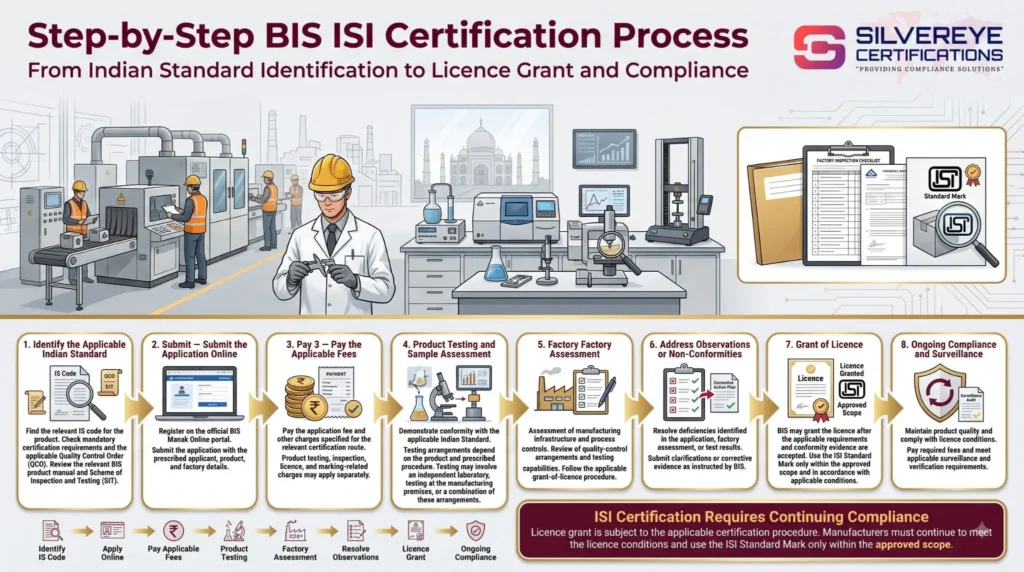
The BIS ISI certification process starts with identifying the applicable Indian Standard and confirming the correct application route. The manufacturer then submits Form-V, the required documents and the Self-Evaluation-cum-Verification Report through Manak Online.
The main steps are:
- Identify the applicable Indian Standard: Confirm the product's standard, scope and whether certification is mandatory under a current Quality Control Order (QCO).
- Select the application procedure: Check whether the product is eligible for Option 1 (Normal Procedure) or Option 2 (Simplified Procedure).
- Prepare the documents: Arrange the application form, factory details, machinery and testing equipment information, quality-control records and other product-specific documents.
- Submit the application: File the application and prescribed documents through Manak Online and pay the applicable initial fees.
- Complete factory assessment: BIS assesses the manufacturing facilities, quality-control arrangements and product conformity. The assessment and sample-testing requirements depend on the selected procedure.
- Complete payment and licence formalities: Pay the applicable balance amount and fulfil the remaining requirements before BIS grants the licence.
The document checklist generally includes:
- Business constitution and legal identity documents
- Proof of the manufacturing premises
- Factory layout and manufacturing process flow chart
- Details of manufacturing machinery and testing equipment
- Calibration records and quality-control personnel details
- Product drawings, technical specifications and brand details, where applicable
- Self-Evaluation-cum-Verification Report
- Product test reports for eligible Option 2 applications
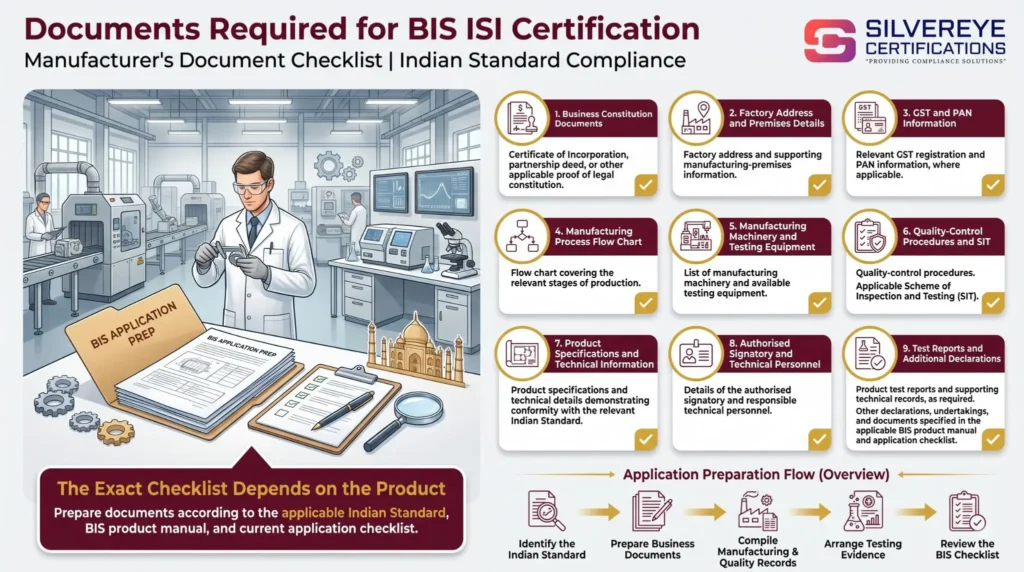
Option 2 applicants must also submit the required conforming laboratory test reports within the prescribed validity period. The latest report is generally required to be no more than 90 days old when the application is received. Exact requirements depend on the product and applicable BIS guidelines.
For a detailed explanation, refer to our guides on the BIS ISI Certification Process and Documents Required for BIS ISI Certification.
Benefits and Eligibility for BIS ISI Mark Certification
Benefits of BIS ISI Certification
- Regulatory compliance: Helps manufacturers meet mandatory certification requirements for products covered by applicable QCOs.
- Market access: Enables the sale of covered products in accordance with the relevant QCO and BIS licence conditions.
- Customer confidence: The Standard Mark helps buyers identify products certified against the applicable Indian Standard.
- Tender and buyer requirements: Supports compliance where government tenders, institutional buyers or business customers require BIS certification.
- Quality-control discipline: Encourages manufacturers to maintain testing, inspection and production-control systems.
Who Can Apply BIS ISI Certification?
A manufacturer can apply for an ISI licence when:
- The product is covered by an applicable Indian Standard for which BIS offers Scheme-I certification.
- The manufacturing unit has the infrastructure and process controls needed to produce conforming goods.
- The factory has suitable testing facilities or other testing arrangements accepted by BIS.
- The manufacturer can demonstrate that the product meets the applicable Indian Standard.
Remember: BIS certification is linked to the manufacturer, product and approved factory premises. A separate application is generally required for each relevant product–Indian Standard combination and manufacturing location. The licence covers only the varieties included in its approved scope.
Latest BIS ISI Certification Fee and Regulatory Updates for 2026
The following developments are relevant to manufacturers planning a new application, licence renewal or annual compliance budget.
| 2026 update | What manufacturers should know |
|---|---|
| BIS (Conformity Assessment) Amendment Regulations, 2026 – 25 February 2026 | Introduced changes to licence validity and annual payment requirements, including advance annual payments, production-statement obligations and provisions dealing with suspension for non-payment. |
| Revised Guidelines for Grant of Licence – 25 February 2026 | Set out the current application and fee-payment procedure, including the 50% advance minimum marking fee, inspection-fee requirements and testing arrangements under Option 1 and Option 2. |
| Marking fee concessions extended until 31 May 2029 | Eligible micro enterprises and start-ups receive an 80% concession, while eligible small enterprises receive a 50% concession on the annual minimum marking fee. Eligible women entrepreneur enterprises may receive an additional 10% concession, subject to the notification's conditions. |
| Updated product-wise marking fee schedules | BIS updates product-specific marking fee rates through notifications and amendments. Manufacturers should check the latest applicable rate for their Indian Standard before making payment. |
| Transition Facilitation (Quality Control) Order, 2026 | Provides a specific facilitation mechanism for eligible cases under notified QCOs. It is not a general self-declaration route that replaces Scheme-I certification for all manufacturers. Check the relevant order and product-specific conditions before relying on it. |
Before applying or renewing: Check the latest BIS fee schedule, the current product manual, applicable QCO and the licence-specific requirements on the official BIS portal. Fee rates and regulatory conditions can change through subsequent notifications.
Why Choose Silvereye Certifications for BIS ISI Mark Certification?
Obtaining a BIS ISI licence involves more than submitting an application. Manufacturers must identify the correct Indian Standard, prepare technical documents, arrange product testing and ensure that their factory meets the applicable BIS requirements.
Silvereye Certifications (SEYECS) provides professional guidance and application support to help manufacturers navigate the BIS certification process.
Here is how Silvereye Certifications can assist:
- Product and Standard Identification: Guidance on identifying the applicable Indian Standard, product category and relevant QCO requirements.
- Documentation Support: Assistance with preparing application documents, factory details, machinery lists, testing equipment records and quality-control information.
- Application Filing Guidance: Support with preparing and submitting the application through the Manak Online portal.
- Laboratory Coordination: Assistance in understanding product-testing requirements and coordinating with suitable testing laboratories.
- Factory Readiness Support: Guidance on factory inspection preparation, testing arrangements and applicable quality-control requirements.
- Application Follow-up: Assistance with tracking application progress and understanding responses to BIS observations or queries.
- Renewal and Compliance Assistance: Guidance on renewal documentation, production statements, annual fee requirements and licence-scope changes.
Whether you are applying for a new ISI licence or managing an existing one, Silvereye Certifications aims to make the compliance process clearer through structured guidance and documentation support.
Please note: Silvereye Certifications is a consultancy. BIS is the government authority responsible for evaluating applications and granting, renewing, suspending or cancelling ISI licences. Certification decisions remain entirely with BIS.
Conclusion
BIS ISI Mark Certification is an important compliance requirement for manufacturers whose products fall under applicable Quality Control Orders. The process involves identifying the correct Indian Standard, selecting the eligible application procedure, preparing factory and product documents, completing testing and meeting BIS assessment requirements.
The overall cost of ISI certification depends on the product-specific minimum marking fee, application and inspection charges, laboratory testing, factory readiness and applicable concessions. Manufacturers must also plan for annual payments, production statements and timely licence renewal, even when the licence is granted for multiple years.
Before applying, check the latest BIS notifications, product manual, marking fee schedule and QCO requirements. Preparing the factory and documentation in advance can help reduce avoidable delays and additional expenses.
With guidance from Silvereye Certifications (SEYECS), manufacturers can better understand the applicable requirements and receive support throughout the BIS application and compliance process.
Frequently Asked Questions
How much does BIS ISI mark certification cost?
BIS charges ₹1,000 as application fee, ₹7,000 per man-day for inspection, ₹1,000 as licence fee and a product-specific minimum marking fee, plus GST where applicable. Lab testing is extra. The marking fee varies widely, from tens of thousands to lakhs of rupees.
What is the minimum marking fee?
It is the annual amount BIS charges for the right to mark your production, set product by product in Scheme-I. If your actual marking fee, calculated from production and the unit rate, is higher, you pay the difference.
When do I pay the marking fee?
Half at the time of filing and the balance at grant of licence, and then annually in advance under the 2026 rules.
Is there a discount for MSMEs and start-ups?
Yes. Until 31 May 2029, micro enterprises and start-ups get an 80% concession on the annual minimum marking fee and small enterprises get 50%. Women entrepreneur enterprises get an additional 10%.
Is the application fee refundable?
No. The application fee of ₹1,000 is non-refundable, but the advance minimum marking fee is returned if the application is rejected or closed.
Who pays for testing?
Under Option 1 the applicant pays for testing of the samples. Under Option 2 you pay the lab for your own pre-application report, while the BIS verification sample test is covered within the minimum marking fee.
What is the inspection fee?
₹7,000 per man-day, paid in advance. A factory visit normally takes one day for an Indian manufacturer. Repeat visits are charged again.
What happens if I miss the annual fee?
Under the 2026 rules the licence is suspended for 90 days from the due date. Paying the dues with a ₹5,000 late fee within that period lifts the suspension, and if you do not pay, the licence is cancelled.
How long is an ISI license valid?
Up to five years on initial grant under the amendment notified on 25 February 2026, renewable for up to five years at a time. Annual fees are still due every year.
How much is the renewal fee?
The renewal application fee is ₹1,000 and is non-refundable. A late renewal attracts a ₹5,000 late fee. Licence and marking fees are paid as the portal asks.
Does adding a new product variety cost extra?
Yes. BIS charges ₹5,000 per variety, or per group of varieties where grouping guidelines exist.
Are there other costs besides BIS fees?
Yes. Lab testing, equipment and calibration, labelling, consultant fees and GST are not part of BIS fees, so include them in your budget.