

Fabric steamers are specifically covered under Sl. No. 71 of the Safety of Household, Commercial and Similar Electrical Appliances (Quality Control) Order, 2026. Manufacturers must obtain BIS certification under Scheme-I and affix the ISI Mark to covered products according to the applicable compliance deadlines.
- Mandatory ISI Mark: BIS certification under Scheme-I is compulsory for covered fabric steamers.
- General implementation date: The QCO came into force on 1 October 2026.
- Small enterprises: Must comply from 1 January 2027.
- Micro enterprises: Must comply from 1 April 2027.
- Applicable Indian Standard: IS 302 (Part 1): 2024, aligned with IEC 60335-1: 2020, specifies the applicable general safety requirements.
Introduction
BIS certification is mandatory for fabric steamers sold in the Indian market under the Safety of Household, Commercial and Similar Electrical Appliances (Quality Control) Order, 2026. As per Gazette Notification S.O. 1739(E), dated 6 April 2026, fabric steamers are listed at Sl. No. 71 and must comply with IS 302 (Part 1): 2024 and carry the ISI Mark under a valid BIS license through Scheme-I. The QCO came into effect on 1 October 2026, while small enterprises must comply from 1 January 2027 and micro enterprises from 1 April 2027. Products manufactured in India exclusively for export are exempt, subject to the conditions specified in the Order.
This guide explains the applicable BIS requirements, certification process, documentation and compliance deadlines that fabric steamer manufacturers should understand before supplying their products in India.
What Is BIS Certification for Fabric Steamers?
BIS certification for fabric steamers is a product safety certification issued by the Bureau of Indian Standards (BIS). It confirms that a covered product meets the applicable Indian Standards and that the manufacturer is authorized to use the ISI Mark under a valid BIS license.
Fabric steamers use electricity to heat water and generate steam for removing wrinkles from garments. Their design involves electrical components, heating elements, water and high-temperature steam. Therefore, product safety assessment needs to consider relevant electrical, thermal and mechanical risks.
Under the Safety of Household, Commercial and Similar Electrical Appliances (QCO) Order, 2026, fabric steamers are covered at Sl. No. 71 and are subject to mandatory BIS certification under Scheme-I.
Which Indian Standards Apply to Fabric Steamers?
Manufacturers should consider both the general safety requirements and the specific requirements applicable to fabric steamers:
- IS 302 (Part 1): 2024: Covers general safety requirements for household and similar electrical appliances. It is aligned with IEC 60335-1: 2020.
- IS 302 (Part 2/Sec 85): 2026: Covers particular safety requirements for fabric steamers and is based on IEC 60335-2-85: 2022.
The specific standard for fabric steamers was established through a BIS notification dated 17 September 2026, published in the Gazette in October 2026. Manufacturers should confirm the applicable testing requirements and certification scope with BIS before submitting an application.
Who Needs BIS Certification for Fabric Steamers?
BIS certification requirements are relevant to businesses involved in manufacturing, importing and selling fabric steamers in India.
- Indian manufacturers: Manufacturers producing handheld, upright or other covered fabric steamers for the Indian market must obtain the applicable BIS license before the relevant QCO deadline.
- Foreign manufacturers: Overseas manufacturers supplying covered fabric steamers to India generally need to apply under the Foreign Manufacturers Certification Scheme (FMCS) and nominate an Authorized Indian Representative (AIR) in India.
- Private-label and D2C brands: Brands selling fabric steamers manufactured by third-party factories should coordinate with the actual manufacturer to ensure that the relevant product, manufacturing location and brand are covered under the BIS license.
- Importers: Importers should ensure that the foreign manufacturer holds the required BIS license before importing covered fabric steamers into India.
- Distributors and online sellers: Businesses involved in distributing or listing fabric steamers should verify that the products carry the required ISI Mark and are covered by a valid BIS license.
Products outside the applicable scope: Fabric steamers manufactured in India exclusively for export are exempt under the QCO, subject to its conditions. Products already covered under another applicable QCO should be assessed under that order rather than automatically treated as covered by this one.
Benefits of BIS Certification for Fabric Steamers
Obtaining BIS certification is not just a regulatory requirement. It also helps manufacturers establish product safety and quality controls.
- Regulatory compliance: Helps manufacturers meet the mandatory requirements of the 2026 QCO before manufacturing or supplying covered products in the Indian market.
- Customer confidence: The ISI Mark provides customers with an identifiable indication that the product is covered by a BIS license.
- Market access: Helps manufacturers and brands meet the mandatory certification requirements when supplying regulated fabric steamers to distributors, retailers and customers in India.
- Reduced enforcement risk: Manufacturing, importing, selling or distributing covered products without the required Standard Mark and valid BIS license can attract action under the BIS Act, 2016.
- Improved quality control: The certification process requires manufacturers to maintain appropriate testing facilities, production controls and records in accordance with applicable BIS requirements.
BIS Certification Requirements for Fabric Steamers
To obtain a BIS license for fabric steamers, manufacturers must meet the applicable product safety, testing and factory assessment requirements under Scheme-I of the BIS (Conformity Assessment) Regulations, 2018.
The key requirements include:
- Product conformity: The fabric steamer must comply with the applicable requirements of IS 302 (Part 1): 2024 and the relevant particular requirements under IS 302 (Part 2/Sec 85): 2026, as applicable to the product and BIS certification scope.
- BIS license under Scheme-I: The manufacturer must obtain a valid license from BIS before using the ISI Mark on covered products.
- Product testing: Samples must undergo the applicable tests at a BIS-recognized laboratory in accordance with the prescribed testing procedure.
- Factory assessment: BIS assesses the manufacturing premises, production arrangements and quality control systems as required under Scheme-I.
- In-house testing facilities: Manufacturers must maintain the testing equipment and facilities required by the applicable product-specific requirements and BIS inspection arrangements.
- ISI marking: Products must carry the authorized ISI Mark and BIS license number in accordance with the applicable marking requirements.
- Foreign manufacturer requirements: Overseas manufacturers must follow the FMCS procedure and nominate an eligible Authorized Indian Representative (AIR).
Eligibility Criteria for BIS Certification for Fabric Steamers
Manufacturers seeking BIS certification should meet the following basic eligibility conditions:
- Manufacturer status: The applicant must be the actual manufacturer of the fabric steamer. Importers cannot independently obtain an FMCS license in place of the foreign manufacturer.
- Manufacturing premises: The applicant must have an identifiable manufacturing facility where the covered product is manufactured.
- Technical capability: The factory must have the required production infrastructure, testing facilities and quality control arrangements to meet the applicable Indian Standards.
- Product compliance: The fabric steamer must meet the applicable general and particular safety requirements.
- Foreign manufacturer eligibility: Manufacturers located outside India must follow the FMCS requirements, including the nomination of an eligible AIR.
- Enterprise classification: Micro and small enterprises may follow their respective extended QCO implementation dates, provided they qualify under the applicable MSMED Act, 2006 classification and the conditions of the Order.
What Has Changed Under the Safety of Household, Commercial and Similar Electrical Appliances (QCO) Order, 2026?
On 6 April 2026, the Department for Promotion of Industry and Internal Trade (DPIIT), under the Ministry of Commerce and Industry, issued Notification S.O. 1739(E) introducing the Safety of Household, Commercial and Similar Electrical Appliances (Quality Control) Order, 2026.
The 2026 Order supersedes the previous 2025 QCO, while preserving actions already taken or omissions that occurred before the supersession. It makes BIS certification and the use of the Standard Mark (ISI Mark) compulsory for the electrical appliances listed in its Schedule, including fabric steamers.
Here are the key provisions that fabric steamer manufacturers and businesses should understand.
Key Provisions of the Fabric Steamer QCO 2026
- Product scope: The Order covers electrical appliances intended for household, commercial or similar applications with a rated voltage not exceeding 250 V for single-phase appliances and 480 V for other appliances. This includes DC-supplied and battery-operated appliances.
- Fabric steamer coverage: Fabric steamers are specifically listed at Sl. No. 71 in the Table of the Order.
- Mandatory BIS certification: Covered fabric steamers must conform to the Indian Standard specified in the Order and bear the Standard Mark (ISI Mark) under a valid BIS license in accordance with Scheme-I of Schedule-II of the BIS (Conformity Assessment) Regulations, 2018.
- Certifying and enforcing authority: The Bureau of Indian Standards (BIS) is responsible for certification and enforcement under the Order.
- Penalty for non-compliance: Contravention of the Order is punishable under the provisions of the Bureau of Indian Standards Act, 2016.
- Latest version of the standard: The Order specifies that the latest version of the applicable Indian Standard will apply. Manufacturers should therefore check for revisions before applying and during ongoing compliance.
- Exclusion for products covered by other QCOs: The Order does not apply to electrical appliances that fall under another Quality Control Order issued under the BIS Act or have been notified for mandatory BIS certification under another Act.
BIS Certification Implementation Dates for Fabric Steamers
The QCO provides different compliance dates for general enterprises, small enterprises and micro enterprises.
| Enterprise category | Mandatory compliance date |
|---|---|
| General enterprises (other than micro and small enterprises) | 1 October 2026 |
| Small enterprises (as defined under the MSMED Act, 2006) | 1 January 2027 |
| Micro enterprises (as defined under the MSMED Act, 2006) | 1 April 2027 |
Important: The general implementation date has already passed. Small and micro enterprises can follow their respective extended deadlines only if they qualify under the applicable MSMED Act classification and the QCO provisions.
Exemptions and Relaxations Under the 2026 QCO
The Order provides certain exemptions and transitional relaxations. Fabric steamer manufacturers should understand the conditions before relying on them.
1. Products Manufactured Exclusively for Export
Fabric steamers manufactured domestically for export are exempt from the requirements of this QCO. This exemption applies to products manufactured for export rather than products intended for sale in the Indian domestic market.
2. Import of Fabric Steamers for Research and Development
Manufacturers of household and similar electrical appliances can import up to 200 units per year for research and development purposes without the QCO requirements, subject to the following conditions:
- The imported products must be used for research and development purposes.
- They must not be sold commercially.
- They may be disposed of as scrap.
- The manufacturer must maintain year-wise records of the imported units.
- These records must be provided to the Central Government if requested.
3. Relaxation for Existing or Legacy Stock
The QCO permits eligible manufacturers to sell, display or offer for sale certain goods manufactured domestically or imported before the applicable implementation date for up to six months from that date.
This relaxation is subject to the following conditions:
- The manufacturer must already be BIS-certified or must have applied to BIS for certification of the relevant goods before the implementation date.
- The goods must have been manufactured domestically or imported before the applicable implementation date.
- The manufacturer must submit a declaration to BIS regarding the existing stock.
- The relaxation applies only to the declared stock and is limited to the six-month period specified in the Order.
Practical Impact for Fabric Steamer Manufacturers in November 2026
As of 18 November 2026, the general implementation date of 1 October 2026 has passed. Therefore, manufacturers falling under the general category must already meet the applicable BIS certification requirements for covered fabric steamers supplied to the Indian market.
For eligible manufacturers who satisfy the declared-stock conditions, the six-month transitional period for the general implementation date runs until 1 April 2027. However, this relief is not automatic: the manufacturer must meet the eligibility conditions and submit the required declaration to BIS.
Small enterprises have until 1 January 2027, while micro enterprises have until 1 April 2027 to meet their respective compliance requirements.
Manufacturers should not wait until the final implementation date to begin the certification process. Product testing, factory assessment, documentation and BIS license approval can take time, so early preparation helps reduce the risk of supply-chain and compliance delays.
Documents Required for BIS Certification of Fabric Steamers
To obtain a BIS license for fabric steamers, manufacturers must submit the prescribed application and supporting documents through the BIS online portal. The exact document checklist depends on the applicant's manufacturing location, product configuration and certification route.
The following documents are commonly required:
| Document | Purpose |
|---|---|
| BIS online application | Application submitted through the Manakonline portal |
| Company registration documents | Establishes the legal identity of the manufacturing business |
| PAN and GST registration | Verifies the company's tax and business details, as applicable |
| Factory address proof | Confirms the location of the manufacturing premises |
| Manufacturing unit details | Provides information about production infrastructure and manufacturing activities |
| Product specifications and model list | Identifies the fabric steamer models and their technical characteristics |
| Circuit diagram and wiring details | Helps assess the electrical design and safety arrangements |
| Bill of Materials (BOM) | Lists important components used in the product |
| Critical component details | Includes information about heating elements, thermostats, thermal cut-outs, power cords and water tanks |
| Testing equipment details | Shows the availability of the required in-house testing facilities |
| Quality control documents | Includes manufacturing process details, inspection arrangements and quality control procedures |
| Brand authorisation or ownership documents | Establishes the applicant's right to use the relevant brand, where applicable |
| Udyam registration certificate | Supports the enterprise's micro or small classification claim, where applicable |
| Laboratory test report | Provides product conformity evidence where required under the selected certification route |
Additional documents for foreign manufacturers:
- Details and registration documents of the overseas manufacturing company.
- Authorisation of the Authorised Indian Representative (AIR).
- Undertakings and declarations prescribed under the Foreign Manufacturers Certification Scheme (FMCS).
- Details of the manufacturing premises and proposed product models.
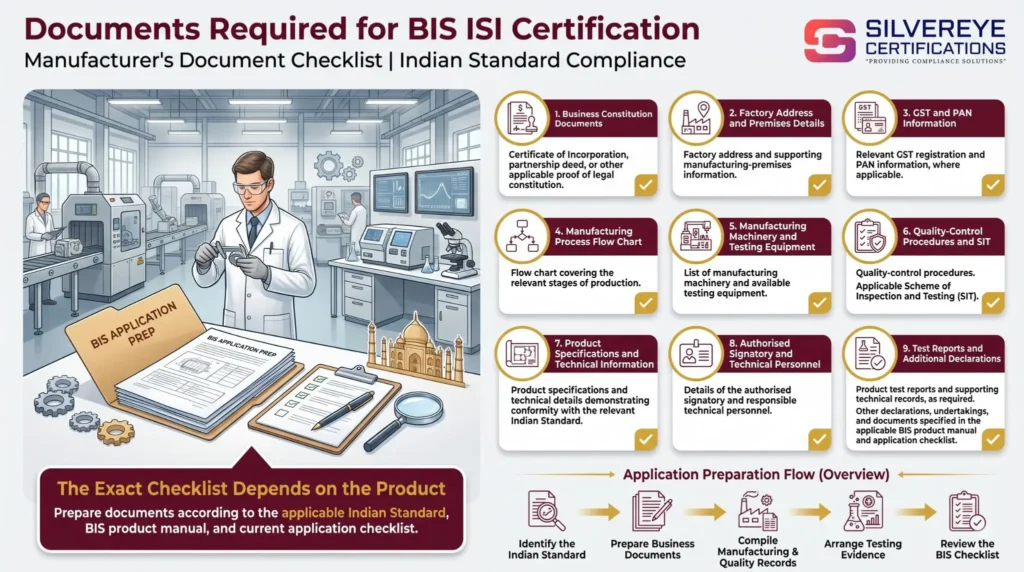
Note: This is an indicative checklist, not a substitute for the prescribed BIS application requirements. BIS may request additional technical documents, declarations, test reports or supporting records during application processing.
BIS Certification Process for Fabric Steamers Under Scheme-I
Manufacturers must follow the BIS product certification procedure to obtain permission to use the ISI Mark on covered fabric steamers.
Step 1: Confirm Product Applicability and Applicable Standards
Identify whether your product falls under Sl. No. 71 of the 2026 QCO. Check its intended use, rated voltage and product specifications.
Also identify the applicable standards:
- IS 302 (Part 1): 2024 – General safety requirements.
- IS 302 (Part 2/Sec 85): 2026 – Particular safety requirements for fabric steamers.
Step 2: Review Product Design and Critical Components
Review the fabric steamer's design and safety-related components before submitting samples for testing.
Important components include:
- Heating element
- Thermostat and temperature control system
- Thermal cut-out and over-temperature protection
- Electrical wiring and power cord
- Water tank and steam-generation arrangement
- Steam outlet and associated safety features
The product should meet the applicable requirements of the relevant Indian Standards.
Step 3: Prepare Documents and Submit the BIS Application
Register on the BIS Manakonline portal and complete the applicable product certification application.
Submit the prescribed company, factory, technical and quality control documents. Select the applicable certification option and pay the required application fee.
Step 4: Product Testing
Product samples must undergo the applicable conformity assessment and testing.
Depending on the certification route and BIS requirements, testing may be conducted through a recognised external laboratory, at the manufacturing premises or through a combination of testing arrangements.
Step 5: Factory Assessment and Inspection
BIS assesses the manufacturing facility to verify whether the manufacturer has the required:
- Manufacturing infrastructure
- Production process controls
- Quality control arrangements
- In-house testing facilities
- Inspection and testing records
Step 6: Respond to BIS Queries
If BIS identifies missing documents, technical discrepancies or non-conformities during the assessment, the manufacturer must provide the required clarification or corrective action.
Timely responses help avoid unnecessary application delays.
Step 7: Grant of BIS License
After satisfactory evaluation of the application, product conformity and manufacturing arrangements, BIS may grant the licence under Scheme-I.
The manufacturer can use the ISI Mark only after obtaining the applicable licence and in accordance with its approved scope and marking conditions.
Step 8: Product Marking and Ongoing Compliance
After licence approval, the manufacturer must:
- Apply the authorised ISI Mark and licence details as prescribed.
- Manufacture products in accordance with the applicable Indian Standards.
- Maintain production and quality control records.
- Follow BIS inspection and surveillance requirements.
- Obtain approval for applicable changes to the licence scope.
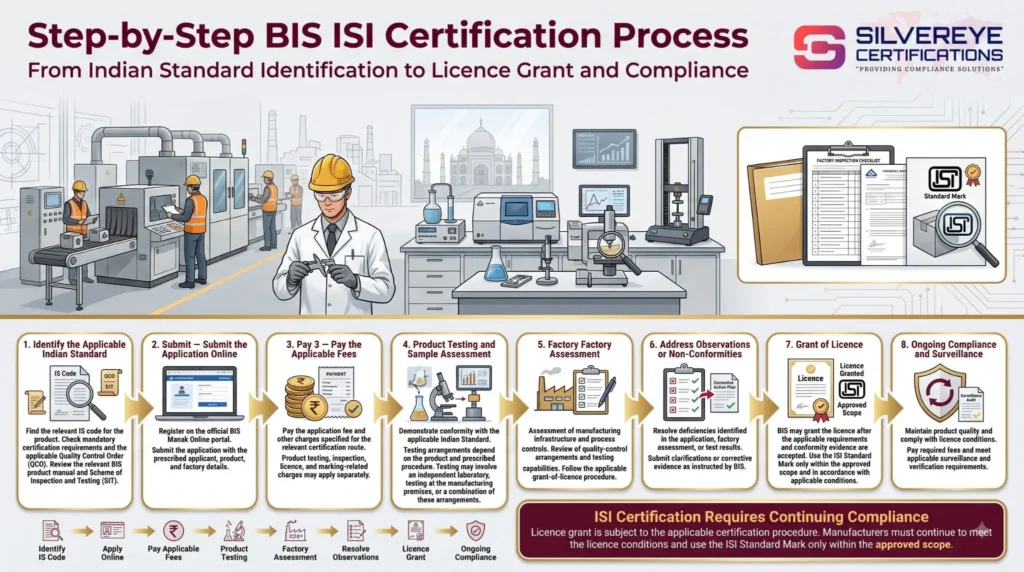
For foreign manufacturers: Applications are submitted by the overseas manufacturer under FMCS. The importer cannot independently obtain an FMCS licence on behalf of the foreign manufacturing factory. The manufacturer must follow the applicable AIR, factory assessment and product testing requirements.
BIS Certification Fees for Fabric Steamers
The cost of BIS certification for fabric steamers depends on the application route, product testing requirements, factory inspection arrangements and applicable BIS fees.
There is no single all-inclusive certification fee applicable to every manufacturer. The following table explains the main cost components.
| Fee component | What it covers | Payment or cost basis |
|---|---|---|
| Application fee | Processing the BIS licence application | BIS fee schedule |
| Inspection fee | Assessment of the manufacturing facility | Applicable BIS inspection charges |
| Annual licence fee | Maintaining the BIS licence | BIS fee schedule |
| Marking fee | Authorised use of the ISI Mark | Product-specific BIS marking fee |
| Laboratory testing fee | Testing of fabric steamer samples | Laboratory charges |
| Additional testing charges | Retesting or additional model testing, where required | Applicable testing charges |
| Foreign inspection expenses | Travel and related expenses for overseas factory assessment, where applicable | Actual applicable expenses |
| Consultant or AIR service charges | Documentation, application coordination and representative services | Service provider's charges |
Important: BIS fees and marking charges can be revised. Manufacturers should check the latest official fee schedule before preparing their certification budget. Consultant fees and laboratory charges should be considered separately from government fees.
BIS License Validity and Renewal for Fabric Steamers
A BIS license under Scheme-I is granted for a specified validity period and covers only the product varieties included in its approved scope.
The following table explains the general validity and renewal provisions:
| Aspect | Details |
|---|---|
| Initial licence validity | May be granted for up to two years, subject to BIS approval |
| Renewal period | Renewal can be requested for a minimum of one year and up to five years |
| Renewal application | Submitted online through the Manakonline portal |
| Renewal requirements | Applicable fees, production details, marking fee calculations and other prescribed documents |
| Surveillance | BIS may conduct factory and market surveillance to verify continued compliance |
| Scope changes | Additional models, varieties or manufacturing changes may require an approved scope amendment |
| Missed renewal | An expired or deferred licence cannot be treated as a valid authorisation to use the ISI Mark |
What Happens If the Indian Standard Is Revised?
The 2026 QCO specifies that the latest version of the applicable Indian Standard will apply.
If BIS revises the applicable standard, manufacturers must review the changes and follow the implementation instructions issued by BIS. Depending on the nature of the revision, additional testing, technical documentation or changes to the existing licence may be required.
Manufacturers should not assume that an existing licence automatically covers every future revision or additional product model.
How Long Does BIS Certification for Fabric Steamers Take?
There is no single guaranteed processing time for every fabric steamer certification application. The timeline depends on the selected certification option, completeness of the application, laboratory testing, factory inspection and response to BIS queries.
BIS's published FAQ gives the following general indicative timelines for Scheme-I applications:
| Certification route | General indicative timeline |
|---|---|
| Option 1 | Approximately four months |
| Option 2 | Approximately one month |
These are general BIS estimates, not guaranteed timelines specifically for fabric steamers. Actual processing may take longer if additional testing, inspection, documentation or clarification is required.
Foreign manufacturers should allow additional time for international factory inspection arrangements and FMCS-related formalities.
Practical recommendation: Begin the certification process well before your applicable QCO deadline, especially if you need product redesign, laboratory testing or overseas factory assessment.
Common Mistakes to Avoid During BIS Certification for Fabric Steamers
Manufacturers and importers should avoid the following mistakes when applying for BIS certification:
- Assuming CE certification replaces BIS certification: CE marking or another international certificate does not automatically replace the mandatory BIS licence required under the Indian QCO.
- Using an incorrect Indian Standard: Checking only the general safety standard and overlooking the fabric-steamer-specific requirements can lead to an incomplete testing plan.
- Submitting incomplete technical documents: Missing circuit diagrams, component specifications or manufacturing details can delay application processing.
- Applying under the wrong business entity: The actual manufacturer, brand owner and importer have different roles in the certification process. The licence must be obtained by the eligible manufacturer.
- Ignoring the applicable compliance deadline: Manufacturers should identify their correct enterprise category and prepare for the relevant implementation date.
- Misunderstanding the existing-stock exemption: The six-month transitional relief is subject to eligibility and the prescribed declaration requirements. It should not be assumed to cover all existing inventory.
- Changing critical components after testing: Changes to the heating element, thermostat, thermal cut-out, power cord or water tank may affect product conformity and should be assessed under the applicable BIS change-control requirements.
- Using the ISI Mark before licence approval: A manufacturer must not apply the Standard Mark without the required BIS licence.
Why Choose Silvereye Certifications for BIS Certification of Fabric Steamers?
Obtaining a BIS license involves product-standard identification, technical documentation, testing coordination and factory assessment. Silvereye Certifications provides regulatory consultancy and application support to manufacturers, importers and brand owners dealing with Indian compliance requirements.
For fabric steamer certification, our support includes:
- Product applicability assessment: Helping identify the applicable QCO entry, product category and compliance requirements.
- Standard identification: Guidance on the relevant general and particular Indian Standards for fabric steamers.
- Documentation assistance: Helping prepare and review company, factory and product-related documents.
- Testing coordination: Assistance with understanding testing requirements and coordinating with the appropriate laboratory.
- Application support: Guidance through the BIS application process and responses to application-related queries.
- FMCS guidance: Assistance with foreign manufacturer documentation and AIR-related requirements.
- Renewal and amendment support: Guidance on licence renewal, product additions and applicable scope changes.
- Regulatory updates: Helping businesses stay informed about relevant BIS standards, QCO notifications and implementation deadlines.
Our aim is to make the certification process more organised and transparent through practical guidance, clear communication and documentation support.
Conclusion
The Safety of Household, Commercial and Similar Electrical Appliances (QCO) Order, 2026 makes BIS certification mandatory for covered fabric steamers supplied to the Indian market. Manufacturers must ensure conformity with the applicable requirements of IS 302 (Part 1): 2024 and IS 302 (Part 2/Sec 85): 2026, obtain a valid BIS licence under Scheme-I and use the ISI Mark in accordance with BIS requirements.
With the general implementation date of 1 October 2026 already passed, manufacturers should review their compliance status immediately. Small enterprises must meet the requirements from 1 January 2027, while micro enterprises have until 1 April 2027, subject to the applicable eligibility conditions.
Preparing technical documents, checking critical components, completing product testing and arranging factory assessment in advance can help reduce certification delays.
If you need assistance with BIS certification for fabric steamers, Silvereye Certifications can guide you through the applicable documentation, testing coordination and license application process.
Frequently Asked Questions
Is BIS certification mandatory for fabric steamers in India?
Yes. Fabric Steamers (Sl. No. 71) are in the Table of the QCO Order of 6 April 2026, so they must conform to the notified standard and carry the ISI Mark.
Does this cover handheld garment steamers?
Handheld, upright and travel garment steamers are all commonly sold as fabric steamers. Confirm the entry for your model with BIS or a consultant.
Is a steam iron covered?
The Table does not name steam irons. Check which order or standard applies to your product before applying.
Which Indian Standard applies For fabric steamers?
IS 302 (Part 1): 2024, aligned with IEC 60335-1: 2020. The latest version of the standard applies.
From when is it mandatory?
From 1 October 2026 for general manufacturers, 1 January 2027 for small enterprises and 1 April 2027 for micro enterprises.
Can I import fabric steamers without BIS certification?
Not for sale in India, unless an exemption applies. The Order allows up to 200 units per year for R&D by appliance manufacturers, and they cannot be sold commercially.
Are steamers made for export covered?
No. Goods manufactured domestically for export are exempt.
Can I sell old stock after the deadline?
Goods made or imported before the implementation date by a BIS-certified manufacturer, or one who has applied for certification, can be sold for up to six months from that date if a declaration is made to BIS.
What is the penalty for selling without BIS certification?
Contravention is punishable under the Bureau of Indian Standards Act, 2016.
How long is the BIS license valid and can it be renewed?
BIS sets the validity when it grants the license, and the license can be renewed. Apply before expiry.