

Oral Hygiene Appliances, including DC-supplied and battery-operated toothbrushes, are covered under the Safety of Household, Commercial and Similar Electrical Appliances (Quality Control) Order, 2026.
The QCO includes the following product categories:
- Sl. No. 55: Oral Hygiene Appliances.
- Sl. No. 88: DC-supplied and battery-operated toothbrushes and other oral hygiene appliances.
- Mandatory BIS Certification: Covered products must comply with the applicable requirements and carry the ISI Mark under BIS Scheme-I.
- Implementation Date: The Order came into force on 1 October 2026.
- Small Enterprises: Must comply from 1 January 2027.
- Micro Enterprises: Must comply from 1 April 2027.
- Applicable Indian Standard: IS 302 (Part 1): 2024, aligned with IEC 60335-1:2020.
Introduction
Oral hygiene appliances, including electric toothbrushes, battery-operated toothbrushes and other electrical oral care devices, must meet the applicable product safety requirements before being sold in the Indian market. To ensure electrical safety and product quality, the Government of India has included these products under the Safety of Household, Commercial and Similar Electrical Appliances (Quality Control) Order, 2026.
Under S.O. 1739(E), dated 6 April 2026, oral hygiene appliances listed under Sl. No. 55 and Sl. No. 88 must conform to IS 302 (Part 1): 2024 and obtain a BIS license under Scheme-I to use the ISI Mark. The Order came into force on 1 October 2026, with extended compliance deadlines of 1 January 2027 for small enterprises and 1 April 2027 for micro enterprises. This guide explains the BIS certification requirements, applicable standards, documents, testing procedures and application process for oral hygiene appliances in India.
What Is BIS Certification for Oral Hygiene Appliances?
BIS Certification for Oral Hygiene Appliances is a product safety certification issued by the Bureau of Indian Standards (BIS). It confirms that an appliance has been tested against the applicable Indian Standard and that the manufacturer has obtained a license to use the ISI Mark on the product.
Oral hygiene appliances, such as electric toothbrushes and water flossers, are frequently used near water and come into direct contact with the mouth. Therefore, electrical safety, insulation, moisture protection, overheating prevention and battery or charger safety are important considerations.

Under the 2026 Quality Control Order, the applicable Indian Standard is IS 302 (Part 1): 2024, aligned with IEC 60335-1:2020 – Household and Similar Electrical Appliances: Safety, Part 1 – General Requirements.
Depending on the specific appliance, BIS may also consider applicable particular requirements during product testing. Manufacturers should confirm the exact testing scope and applicable standards for each model before applying for certification.
What Has Changed? The 2026 QCO at a Glance
On 6 April 2026, the Department for Promotion of Industry and Internal Trade (DPIIT), under the Ministry of Commerce and Industry, published the Safety of Household, Commercial and Similar Electrical Appliances (Quality Control) Order, 2026.
The 2026 Order supersedes the previous 2025 Order, subject to the provisions concerning actions already taken or omitted before its supersession.
For oral care appliance manufacturers and importers, the following requirements are particularly important:
- Product Scope: The Order covers electrical appliances intended for household, commercial or similar use, with a rated voltage not exceeding 250 V for single-phase appliances and 480 V for other appliances. DC-supplied and battery-operated appliances are also included within the specified scope.
- Covered Product Categories: The Table includes two relevant entries: Oral Hygiene Appliances (Sl. No. 55) and DC-supplied/battery-operated toothbrushes and other oral hygiene appliances (Sl. No. 88).
- Mandatory BIS Certification: Covered products must conform to the applicable Indian Standard and carry the Standard Mark (ISI Mark) under a valid BIS license through Scheme-I of Schedule-II of the BIS (Conformity Assessment) Regulations, 2018.
- Certifying Authority: The Bureau of Indian Standards (BIS) is responsible for certification and enforcement under the Order.
- Penalties: Contraventions of the Order may attract penalties under the Bureau of Indian Standards Act, 2016.
- Latest Standard Requirement: The latest applicable version of the Indian Standard must be considered as specified in the Order.
- Overlap with Other QCOs: Appliances covered under another applicable Quality Control Order or notified for mandatory BIS certification under another Act are subject to the relevant provisions and exclusions.
Implementation Dates for Oral Hygiene Appliances
The QCO provides different implementation dates for general manufacturers and eligible micro and small enterprises.
| Category of Manufacturer | Date of Implementation |
|---|---|
| General category (other than micro and small enterprises) | 1 October 2026 |
| Small enterprises (as per MSMED Act, 2006) | 1 January 2027 |
| Micro enterprises (as per MSMED Act, 2006) | 1 April 2027 |
Exemptions and Relief Under the 2026 QCO
The Order provides certain exemptions and transitional relief for specific products and business activities.
- Products Manufactured Exclusively for Export: Goods manufactured in India exclusively for export are exempt from the requirements of this QCO.
- Research and Development Imports: Manufacturers of household and similar electrical appliances may import up to 200 units per year for research and development purposes. These products must not be sold commercially and may be disposed of as scrap. Manufacturers must maintain year-wise records and provide them to the Central Government when requested.
- Existing Stock: Products manufactured in India or imported before the applicable implementation date by a BIS-certified manufacturer, or a manufacturer that has applied to BIS for certification of those goods, may qualify for a transitional sale period of up to six months from the implementation date, subject to the prescribed conditions and declaration to BIS.
Practical Note (as of 30 October 2026): The general implementation date of 1 October 2026 has passed. The six-month transitional period for eligible declared stock in the general category extends up to 1 April 2027. This relief is conditional and should not be treated as an automatic exemption. Small and micro enterprises have later implementation dates and should begin preparing their certification applications well in advance.
Which Products Are Covered Under the 2026 QCO?
The 2026 QCO identifies oral hygiene appliances under specific product entries. However, the exact classification of an individual product depends on its design, electrical configuration and intended function.
The following table provides examples of products and their likely classification. Manufacturers should confirm the applicable entry and testing requirements before applying.
| Product Type | Likely QCO Entry |
|---|---|
| Mains-powered oral irrigator or water flosser | Sl. No. 55 – Oral Hygiene Appliances |
| Rechargeable or battery-operated electric toothbrush | Sl. No. 88 – DC-supplied/battery-operated toothbrushes and other oral hygiene appliances |
| Battery-operated water flosser or portable oral irrigator | Sl. No. 88 |
| Charging base, adapter or travel case supplied with the product | Confirm the applicable coverage and testing requirements for the complete product configuration |
| Teeth-whitening or LED oral care devices | Classification depends on product design, intended use and claims; confirm the applicable QCO entry or other regulatory requirements |
| Manual toothbrushes and non-electrical floss picks | Generally outside this electrical appliance QCO because they do not contain electrical components |
Important: If an oral hygiene product is marketed with medical or therapeutic claims, businesses should also assess whether other regulatory requirements apply. This guide focuses on the 2026 electrical appliance QCO.
Who Needs BIS Certification for Oral Hygiene Appliances?
BIS certification requirements apply to businesses involved in manufacturing, importing and supplying covered oral hygiene appliances in the Indian market.
The following businesses should understand their applicable certification responsibilities:
- Indian Manufacturers: Businesses manufacturing electric toothbrushes, water flossers and other covered oral hygiene appliances for the domestic market must obtain the applicable BIS license.
- Importers and Foreign Manufacturers: Overseas manufacturers supplying covered oral care appliances to India must follow the applicable Foreign Manufacturers Certification Scheme (FMCS) and appoint an Authorized Indian Representative (AIR) where required.
- D2C and Private-Label Brands: Businesses selling oral hygiene appliances under their own brand names should coordinate with the actual manufacturing facility to ensure that the products are covered by the appropriate BIS license.
- Online Sellers and Distributors: Businesses selling regulated electrical oral care products should verify that the products carry a valid ISI Mark and corresponding BIS license details.
- Dental and Hospitality Businesses: Businesses purchasing oral hygiene appliances for resale or commercial supply should verify the applicable certification and product compliance requirements.
Exemptions: Products manufactured exclusively in India for export are exempt from this QCO. Products covered under another applicable QCO should be assessed under the relevant regulatory requirements.
Benefits of BIS Certification for Oral Hygiene Appliances
Obtaining BIS certification helps manufacturers demonstrate compliance with applicable product safety requirements and improves confidence among buyers, distributors and business partners.
The major benefits include:
- Legal Compliance: Helps manufacturers and importers meet the mandatory requirements of the 2026 QCO before supplying covered products in India.
- Marketplace Readiness: A valid BIS license and ISI Mark support the sale of regulated electrical products through online marketplaces, retail stores and distribution networks.
- Customer Trust: The ISI Mark provides assurance that the product has been assessed against the applicable Indian safety standard. This is particularly relevant for oral care appliances used near water and inside the mouth.
- Reduced Enforcement Risk: Following BIS requirements helps businesses avoid regulatory action associated with the manufacture, import or sale of non-compliant products.
- Improved Manufacturing Quality: Certification encourages manufacturers to maintain appropriate testing facilities, production controls and quality assurance procedures.
- Brand Credibility: BIS certification demonstrates a manufacturer's commitment to electrical safety, product quality and regulatory compliance.
BIS Certification Requirements for Oral Hygiene Appliances
To obtain BIS Certification for Oral Hygiene Appliances, manufacturers must fulfil the applicable product safety, testing and factory assessment requirements under BIS Scheme-I.
The major certification requirements include:
- Applicable Indian Standard: Products must comply with IS 302 (Part 1): 2024 and any applicable particular requirements identified for the specific appliance.
- BIS License: Manufacturers must obtain a valid BIS license under Scheme-I to use the ISI Mark on covered products.
- Product Testing: Samples must undergo testing at a BIS-recognized laboratory to demonstrate conformity with the applicable safety requirements.
- Factory Inspection: BIS assesses the manufacturing facility, production processes and quality control arrangements as part of the certification process.
- In-House Testing Facilities: Manufacturers must maintain the testing equipment and quality control facilities required under the applicable BIS certification requirements.
- ISI Marking: Certified products must carry the prescribed ISI Mark and CM/L license number according to BIS marking requirements.
- Foreign Manufacturer Requirements: Overseas manufacturers must follow the applicable Foreign Manufacturers Certification Scheme (FMCS) and appoint an eligible Authorized Indian Representative (AIR).
Eligibility for BIS Certification of Oral Hygiene Appliances
Manufacturers applying for BIS certification must meet the applicable eligibility and technical requirements. The following conditions should be considered before submitting an application:
- Domestic and Foreign Manufacturers: Eligible manufacturers in India and abroad can apply if their oral hygiene appliances fall within the scope and voltage limits of the 2026 QCO.
- Manufacturing Facility: Applicants must have a functioning manufacturing unit with suitable infrastructure and production arrangements.
- Testing and Quality Control: The factory must maintain the testing equipment, facilities and quality control arrangements required under Scheme-I.
- Product Conformity: The oral hygiene appliance must meet the applicable Indian Standard and relevant product testing requirements.
- Authorized Indian Representative: Foreign manufacturers must appoint an eligible AIR to represent them during the FMCS certification process.
- MSME Classification: Eligible micro and small enterprises can benefit from the extended implementation dates specified in the QCO, provided they meet the applicable classification requirements under the MSMED Act, 2006.
Important: Eligibility to apply does not automatically guarantee BIS certification. The license is granted only after the manufacturer fulfils the applicable documentation, testing, factory assessment and other BIS requirements.
Documents Required for BIS Certification of Oral Hygiene Appliances
To apply for BIS Certification for Oral Hygiene Appliances, manufacturers must submit the required business, product and manufacturing documents through the official BIS online portal.
The commonly required documents include:
- BIS Application Form: Completed application submitted through the official BIS online portal.
- Business Registration Documents: Certificate of incorporation, partnership deed or other applicable business constitution documents.
- PAN and GST Certificate: PAN details and GST registration certificate of the manufacturing business.
- Factory Address Proof: Documents confirming the registered address and location of the manufacturing facility.
- Manufacturing Unit Details: Information about the factory, production capacity and manufacturing activities.
- Product Details: List of oral hygiene appliance models, product descriptions and technical specifications.
- Circuit Diagram: Electrical circuit diagrams and relevant product drawings.
- Bill of Materials (BOM): Details of raw materials and critical components, such as batteries, charging circuits, motors and waterproofing components.
- Product Test Report: Test report from a BIS-recognized laboratory, as applicable to the certification application.
- Testing Equipment Details: List of testing instruments and details of the in-house laboratory facilities.
- Quality Control Documents: Quality control plan, manufacturing process flow chart and inspection procedures.
- Brand and Trademark Documents: Trademark registration or brand ownership proof, along with brand authorization where applicable.
- MSME/Udyam Certificate: Valid Udyam registration certificate for eligible micro and small enterprises claiming the extended implementation dates.
- Foreign Manufacturer Documents: Manufacturer details, Authorised Indian Representative (AIR) authorisation and other documents required under FMCS.
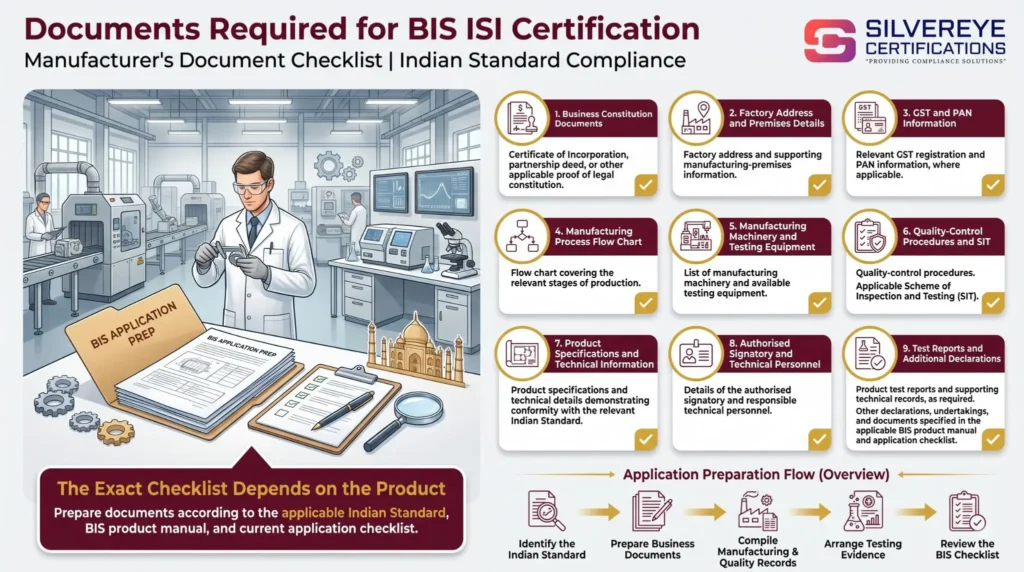
Note: The final document checklist may vary depending on the product category, manufacturing location and BIS application requirements. Applicants should verify the latest checklist before submitting their application.
BIS Certification Process for Oral Hygiene Appliances (Scheme-I)
Manufacturers must follow the BIS Scheme-I certification procedure to obtain a license for using the ISI Mark on oral hygiene appliances. The process involves product applicability assessment, document preparation, laboratory testing and factory inspection.
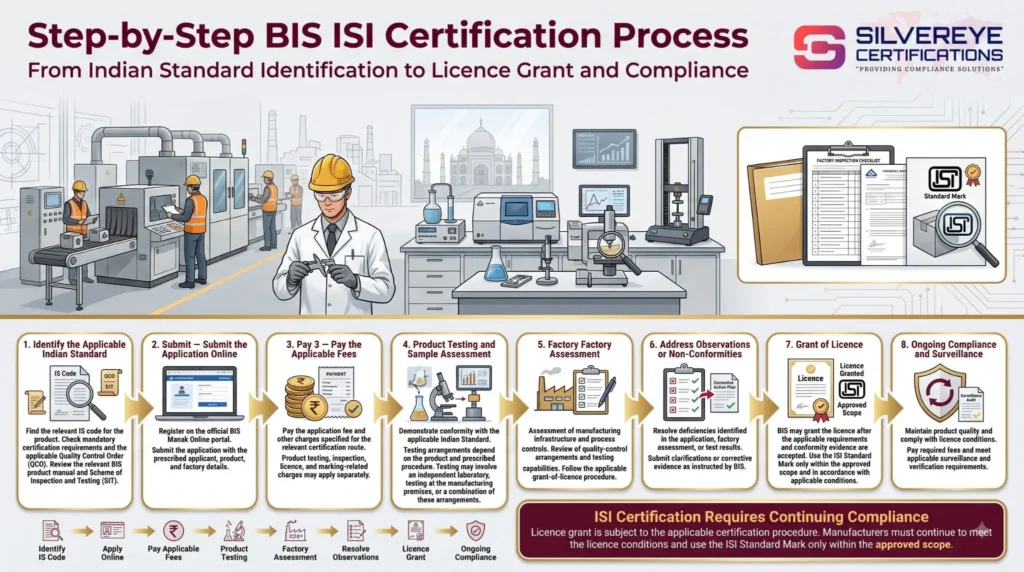
The general certification process includes the following steps:
- Confirm Product Applicability: Check whether each oral hygiene appliance falls under Sl. No. 55 or Sl. No. 88 of the 2026 QCO. Verify the product's voltage rating, scope and applicable Indian Standard.
- Conduct a Design and Component Assessment: Review the product design, electrical insulation, battery, charging system and applicable moisture or water-ingress protection requirements against the relevant safety standards.
- Submit the BIS Application: Prepare the required business, product and manufacturing documents. Submit the application through the official BIS portal along with the prescribed fee.
- Product Testing: Submit product samples to a BIS-recognized laboratory for evaluation against the applicable safety requirements.
- Factory Inspection: BIS assesses the manufacturing facility, production arrangements, quality control system and in-house testing facilities.
- Resolve BIS Queries: Respond to observations or queries raised by BIS regarding the application, test reports or factory inspection findings.
- Grant of BIS License: After successful completion of the applicable certification requirements, BIS may grant the license authorizing the manufacturer to use the ISI Mark.
- ISI Marking and Ongoing Compliance: Once the license is granted, the manufacturer must apply the ISI Mark and CM/L number according to the license conditions and follow applicable surveillance, testing and renewal requirements.
For Foreign Manufacturers: Overseas manufacturers must follow the applicable FMCS certification procedure. The license is associated with the approved foreign manufacturing facility, and the manufacturer must appoint an eligible Authorized Indian Representative (AIR).
Fees for BIS Certification of Oral Hygiene Appliances
The total cost of BIS Certification for Oral Hygiene Appliances depends on the applicable BIS fee schedule, product testing requirements, factory inspection and the number of models included in the application.
The following table explains the major cost components:
| Fee Component | What It Covers | Who Sets It? |
|---|---|---|
| Application Fee | Filing and processing the BIS licence application | BIS fee schedule |
| Licence or Annual Fee | Grant and maintenance of the BIS licence | BIS fee schedule |
| Marking Fee | Authorised use of the ISI Mark on certified products | BIS fee schedule |
| Product Testing Fee | Testing of oral hygiene appliance samples at a recognised laboratory | Laboratory |
| Inspection and Travel Costs | Factory assessment and associated inspection expenses; foreign factory assessments may involve additional costs | BIS fee schedule and applicable actuals |
| Consultant or AIR Fee | Documentation, application assistance, coordination and AIR services, where required | Service provider |
Note: BIS fees and laboratory charges may change. Manufacturers should verify the latest applicable fee schedule on the official BIS website before preparing their certification budget.
Validity and Renewal of BIS Certification for Oral Hygiene Appliances
A BIS license under Scheme-I is granted for a specified validity period and must be renewed according to the applicable BIS requirements. Manufacturers should monitor their license expiry date and maintain compliance with testing, marking and quality control conditions.
The following table explains the important validity and renewal requirements:
| Aspect | Details |
|---|---|
| Initial Validity | BIS grants a Scheme-I license for a fixed period as specified by the applicable certification requirements. |
| Renewal | Manufacturers can apply for licence renewal through the BIS portal within the prescribed timeframe. |
| Renewal Assessment | BIS may consider test results, surveillance records, marking compliance, fee payments and customer complaints. |
| Failure to Renew | Using the ISI Mark without a valid licence is not permitted and may result in regulatory action. |
| Changes During Validity | New models, manufacturing facility changes, brand changes and revisions to the applicable standard may require BIS approval, licence amendments or additional testing. |
Important: The 2026 QCO specifies that the latest applicable version of the Indian Standard must be followed. Therefore, any revision to IS 302 (Part 1) should be reviewed to determine whether additional testing, documentation or license amendments are necessary, even during the existing license period.
Timeline for BIS Certification of Oral Hygiene Appliances
The time required to obtain BIS Certification for Oral Hygiene Appliances depends on document readiness, laboratory testing, factory inspection scheduling and the time taken to resolve queries raised by BIS.
Generally, manufacturers should plan for several weeks to a few months to complete the certification process. Applications involving foreign manufacturing facilities under FMCS may require additional time because of overseas factory inspection and coordination.
To avoid delays, manufacturers should:
- Prepare all required business and product documents in advance.
- Confirm the applicable Indian Standard and testing requirements for each model.
- Arrange product samples for laboratory testing.
- Ensure that the factory has the required testing equipment and quality control arrangements.
- Respond promptly to BIS queries and inspection observations.
Common Mistakes to Avoid During BIS Certification
Manufacturers and importers should avoid the following mistakes while applying for BIS certification for oral hygiene appliances:
- Assuming CE Certification Is Sufficient: International certifications such as CE do not replace mandatory BIS certification under the applicable QCO.
- Delaying the Application: Waiting until the implementation deadline has passed can create regulatory and business difficulties.
- Incorrect Manufacturer Details: The manufacturer, brand owner and importer details must be correctly represented in the application.
- Ignoring Stock Declaration Requirements: Businesses intending to use the applicable pre-implementation stock relief must follow the prescribed BIS declaration procedure and conditions.
- Incorrect Product Classification: Mains-powered and DC-supplied or battery-operated products should be assessed against the relevant entries, particularly Sl. No. 55 and Sl. No. 88.
- Changing Critical Components Without Assessment: Changes to batteries, chargers, motors or waterproofing arrangements may affect product conformity and should be evaluated under applicable BIS requirements.
- Overlooking Standard Revisions: Manufacturers must monitor revisions to the applicable Indian Standard and follow BIS transition requirements.
Avoiding these mistakes can help manufacturers reduce application delays and maintain compliance with the 2026 Quality Control Order.
Why Choose Silvereye Certifications for BIS Certification of Oral Hygiene Appliances?
Obtaining BIS certification involves technical documentation, product testing, factory assessment and compliance with the applicable Quality Control Order. Silvereye Certifications provides professional regulatory consultancy to help manufacturers, importers and brand owners understand and manage these requirements.
Our team can assist with:
- Product Applicability Assessment: Identify the relevant QCO entry for each model and understand the applicable implementation deadline.
- Documentation Support: Prepare and review the documents required for BIS certification.
- Product Testing Coordination: Provide guidance on applicable Indian Standards, sample preparation and laboratory testing.
- BIS Application Assistance: Support manufacturers throughout the application and documentation process.
- BIS Query Support: Assist in understanding and responding to queries raised during certification.
- Licence Renewal and Amendment Guidance: Help plan renewals, model additions, manufacturing changes and other applicable amendments.
- Stock Declaration Guidance: Assist businesses in understanding the applicable requirements for pre-implementation inventory declarations, where available.
With practical compliance guidance and documentation support, Silvereye Certifications helps businesses navigate the BIS certification process more efficiently. Our focus is on clear communication, accurate documentation and helping manufacturers understand their regulatory responsibilities.
Conclusion
The Safety of Household, Commercial and Similar Electrical Appliances (Quality Control) Order, 2026 makes BIS certification mandatory for oral hygiene appliances covered under its scope, including electric toothbrushes, battery-operated toothbrushes and other electrical oral care products.
The general implementation date of 1 October 2026 has already passed, while eligible small enterprises have until 1 January 2027 and micro enterprises until 1 April 2027 to meet the applicable requirements.
Manufacturers and importers should identify the correct QCO entry for each product, confirm compliance with IS 302 (Part 1): 2024, prepare the required documents, complete product testing and obtain a valid BIS license under Scheme-I before supplying covered products in the Indian market.
Businesses with existing inventory or upcoming imports should also review the applicable stock declaration conditions and exemptions. If you need assistance with product assessment, documentation, laboratory testing or BIS application procedures, Silvereye Certifications can guide you through the certification process and help you manage your compliance requirements.
Frequently Asked Questions
Is BIS certification mandatory for oral hygiene appliances in India?
Yes. Oral Hygiene Appliances (Sl. No. 55) and DC supplied/battery-operated toothbrush and other oral hygiene appliances (Sl. No. 88) are in the Table of the QCO Order of 6 April 2026.
Is BIS needed for an electric toothbrush?
A rechargeable or battery-operated electric toothbrush maps to Sl. No. 88, so it must conform to the notified standard and carry the ISI Mark. Confirm the entry for your model.
What about water flossers
Water flossers and oral irrigators are oral hygiene appliances. Mains-powered models likely map to Sl. No. 55 and battery-operated ones to Sl. No. 88. Confirm with BIS or a consultant.
Which Indian Standard applies for oral hygiene appliances?
IS 302 (Part 1): 2024, aligned with IEC 60335-1: 2020. The latest version of the standard applies.
From when is it mandatory?
From 1 October 2026 for general manufacturers, 1 January 2027 for small enterprises and 1 April 2027 for micro enterprises.
Can I import oral hygiene appliances without BIS certification?
Not for sale in India, unless an exemption applies. The Order allows up to 200 units per year for R&D by appliance manufacturers, and they cannot be sold commercially.
Are products made for export covered?
No. Goods manufactured domestically for export are exempt.
Can I sell old stock after the deadline?
Goods made or imported before the implementation date by a BIS-certified manufacturer, or one who has applied for certification, can be sold for up to six months from that date if a declaration is made to BIS.
What is the penalty for selling without BIS certification?
Contravention is punishable under the Bureau of Indian Standards Act, 2016.
Is a CE or international test report enough?
No. BIS requires its own process, including testing at a BIS-recognized lab and a license.
Do foreign manufacturers need an Indian representative
Generally yes. They apply through FMCS and appoint an Authorized Indian Representative.
How long is the BIS license valid and can it be renewed?
BIS sets the validity when it grants the license, and the licence can be renewed. Apply before expiry.