
- Mandatory compliance: The Quality Control Order (QCO), 2026 has applied to large and medium manufacturers since 1 October 2026. Small enterprises must comply from 1 January 2027, while micro enterprises must comply from 1 April 2027.
- Applicable standard and marking: Heating pads must meet IS 302 (Part 1):2024, aligned with IEC 60335-1:2020, and carry the authorized ISI Mark under BIS Scheme-I.
- BIS assessment: The certification process involves laboratory test reports and a factory assessment. BIS indicates an average processing time of approximately one month for Option-2 and four months for Option-1.
- Ongoing compliance costs: Manufacturers must account for the annual license fee, marking fee and yearly production statement. BIS licenses can now have a validity of up to five years, subject to applicable renewal conditions.
Introduction
Robotic vacuum cleaners are becoming increasingly popular in Indian households because they offer automated floor cleaning, smart navigation and convenient operation. However, manufacturers and importers must also meet the applicable product safety and regulatory requirements before selling these appliances in India.
Under the Safety of Household, Commercial and Similar Electrical Appliances (Quality Control) Order, 2026, robotic vacuum cleaners fall within the listed vacuum cleaner categories, subject to the applicable product classification. Manufacturers must obtain the required BIS certification under Scheme-I and ensure that their products carry the authorized ISI Mark before placing them on the Indian market, once the relevant implementation date applies.

This guide explains the BIS requirements for robotic vacuum cleaners, applicable Indian Standards, compliance dates, certification procedures, documents and fees. It will help manufacturers, importers and brand owners understand the steps involved in achieving regulatory compliance in 2026.
What Is BIS Certification for Robotic Vacuum Cleaners?
BIS Certification for Robotic Vacuum Cleaners is a product conformity assessment process through which the Bureau of Indian Standards (BIS) verifies that robotic vacuum cleaners meet the applicable Indian safety standards.

Under the Safety of Household, Commercial and Similar Electrical Appliances (Quality Control) Order, 2026, vacuum cleaners are covered under the relevant entries in the order:
- Entry No. 1: Vacuum cleaners and water suction cleaning appliances.
- Entry No. 84: DC-supplied or battery-operated vacuum cleaners.
Since robotic vacuum cleaners generally operate using rechargeable batteries and electric motors, they may fall within these categories, depending on their design and technical specifications.
The applicable certification route is Scheme-I of Schedule-II of the BIS (Conformity Assessment) Regulations, 2018. Under this route, the manufacturer must complete the required product testing at a BIS-recognized laboratory and undergo a factory assessment.
After successful completion of the certification requirements, BIS grants a license to the manufacturer to use the ISI Standard Mark on the approved product.
Important points to understand:
- Applicable standard: IS 302 (Part 1):2024, covering general safety requirements for household and similar electrical appliances.
- Product-specific requirements: The relevant requirements of the IS 302 (Part 2) series for vacuum cleaners must also be checked with the testing laboratory.
- Certification scheme: Scheme-I, which follows the ISI Mark licensing route.
- Factory inspection: BIS assesses the manufacturer's production and quality control arrangements.
- License holder: The BIS license is granted to the manufacturer, not independently to an importer or trader.
BIS certification helps demonstrate that a robotic vacuum cleaner has undergone the applicable conformity assessment and meets the prescribed safety requirements. Manufacturers should confirm the exact product classification and applicable standard with their testing laboratory before beginning the application process.
Do Robotic Vacuum Cleaners Need BIS Certification?
Yes. BIS certification for robotic vacuum cleaners is mandatory under the Safety of Household, Commercial and Similar Electrical Appliances (Quality Control) Order, 2026 (S.O. 1739(E), dated 6 April 2026).
Manufacturers must obtain a BIS license under Scheme-I and ensure that their products comply with the applicable Indian safety standards. The certification process involves product testing at a BIS-recognized laboratory and a factory assessment by BIS.
The applicable government fees include an application fee of ₹1,000, an annual license fee of ₹1,000 and a product-specific minimum marking fee. Selling covered products without the required certification can attract penalties under the Bureau of Indian Standards Act, 2016.
Is BIS Certification Mandatory for Robotic Vacuum Cleaners in 2026?
Yes. BIS certification is mandatory for manufacturers placing covered robotic vacuum cleaners on the Indian market, subject to the implementation dates applicable to their enterprise category.
The Department for Promotion of Industry and Internal Trade (DPIIT) notified the Safety of Household, Commercial and Similar Electrical Appliances (Quality Control) Order, 2026, on 6 April 2026. The order supersedes the 2025 order of the same name and came into force on 1 October 2026.
Although the order does not mention "robotic vacuum cleaners" as a separate product category, it includes two relevant entries:
- Entry No. 1: Vacuum cleaners and water suction cleaning appliances.
- Entry No. 84: DC-supplied or battery-operated vacuum cleaners.
Robotic vacuum cleaners are motorized, battery-powered cleaning appliances. Therefore, they may fall within these categories, depending on their design and technical specifications. Manufacturers should confirm the classification of unusual or specialized models with BIS or a recognized testing laboratory before applying.
Key Details of the 2026 Quality Control Order
| Detail | What the Notification Says |
|---|---|
| Order | Safety of Household, Commercial and Similar Electrical Appliances (Quality Control) Order, 2026 |
| Reference | S.O. 1739(E); CG-DL-E-06042026-271584 |
| Notification date | 6 April 2026, Ministry of Commerce and Industry (DPIIT) |
| Previous order | Supersedes the 2025 order of the same name |
| Voltage scope | Up to 250 V for single-phase appliances and up to 480 V for other appliances, including DC-supplied and battery-operated appliances |
| Relevant entries | No. 1: Vacuum cleaners and water suction cleaning appliances; No. 84: DC-supplied or battery-operated vacuum cleaners |
| Indian Standard | IS 302 (Part 1):2024, aligned with IEC 60335-1:2020 |
| Certification mark | BIS Standard Mark (ISI Mark) under Scheme-I of Schedule-II of the BIS (Conformity Assessment) Regulations, 2018 |
| Certifying authority | Bureau of Indian Standards (BIS) |
| Standard version | The latest applicable version of the Indian Standard must be followed. |
BIS Compliance Dates by Enterprise Size
The implementation timeline varies according to the manufacturer's enterprise classification.
| Enterprise Category | Mandatory Compliance Date |
|---|---|
| Large and medium enterprises (all enterprises other than micro and small) | 1 October 2026 (already in force) |
| Small enterprises | 1 January 2027 |
| Micro enterprises | 1 April 2027 |
The classification of small and micro enterprises is determined under the Micro, Small and Medium Enterprises Development Act, 2006. Manufacturers should check their enterprise category and applicable deadline before planning production, imports or product launches.
Which BIS Standard and Certification Scheme Apply to Robotic Vacuum Cleaners?
The 2026 Quality Control Order specifies IS 302 (Part 1):2024 for the listed appliances. This standard is aligned with IEC 60335-1:2020 and covers general safety requirements for household and similar electrical appliances.
For robotic vacuum cleaners, the general requirements of Part 1 must be considered alongside the relevant particular requirements for vacuum cleaners and water suction cleaning appliances under the IS 302 (Part 2) series.
The exact product-specific standard and applicable edition should be confirmed with a BIS-recognized testing laboratory before submitting samples. This helps ensure that the product is tested against the correct requirements.
Certification Requirements at a Glance
| Point | Requirement |
|---|---|
| Certification route | ISI Mark license under Scheme-I |
| Application platform | Online application through the BIS MANAK portal |
| Licence scope | Product and Indian Standard-specific licence scope; separate applications are required for different factory locations |
| Indian manufacturer | Application submitted by the manufacturer for the manufacturing facility |
| Foreign manufacturer | Application under the Foreign Manufacturers Certification Scheme (FMCS), with an Authorised Indian Representative |
| CRS applicability | The applicable route under this QCO is Scheme-I, not the Compulsory Registration Scheme (CRS). |
Who Needs BIS Certification for Robotic Vacuum Cleaners?
The certification requirements depend on the product's manufacturing location and the role of the business in the supply chain. The following table explains the general requirements for different applicants.
| Applicant Category | BIS Certification Requirement |
|---|---|
| Indian manufacturer | Must apply for an ISI Mark licence under Scheme-I for the manufacturing facility and comply by the implementation date applicable to its enterprise category. |
| Foreign manufacturer exporting to India | Must apply through FMCS and appoint an Authorised Indian Representative. BIS may assess the overseas manufacturing facility. |
| Importer or brand owner | Should source robotic vacuum cleaners from a BIS-licensed manufacturer and verify that the product and model are covered by the licence before shipment. |
| Private-label brand using contract manufacturing | The manufacturing factory holds the BIS licence. The brand owner should confirm that the relevant brand and model are covered by the approved licence scope. |
| Seller or e-commerce marketplace | Should ensure that covered robotic vacuum cleaners offered for sale carry the authorised ISI Mark and valid BIS licence details. |
Benefits of BIS Certification for Robotic Vacuum Cleaners
Obtaining BIS certification offers several advantages to robotic vacuum cleaner manufacturers, importers and brand owners in India.
- Legal market access: BIS certification helps manufacturers meet mandatory compliance requirements and sell covered products through retail stores, online marketplaces and other distribution channels.
- Product safety assurance: Robotic vacuum cleaners combine lithium batteries, charging docks, motors and electrical components. BIS testing helps assess potential electrical, thermal and mechanical safety risks.
- Customer confidence: The recognized ISI Mark helps Indian customers identify products that have undergone the applicable safety conformity assessment.
- Reduced enforcement risk: Proper certification helps businesses avoid regulatory action, including potential penalties, seizure or withdrawal of non-compliant products.
- Better marketplace acceptance: Online marketplaces and distributors may request valid BIS license details before onboarding a brand or listing its products.
Documents Required for BIS Certification of Robotic Vacuum Cleaners
The final document checklist depends on the product, manufacturing facility and application route. Manufacturers should refer to the applicable BIS product manual and confirm the latest requirements before submitting an application.
The following documents are generally required:
- Online application: Application submitted through the BIS MANAK portal, along with the applicable ₹1,000 application fee.
- Business identity documents: Company incorporation or partnership documents, GST registration and proof of the manufacturing facility's address.
- Factory documents: Manufacturing process flow chart and factory layout.
- Machinery and equipment details: List of production machinery and in-house testing equipment, including calibration details.
- Quality control documents: Quality control plan, inspection procedures and relevant quality records.
- Product test report: Test report for the relevant model from a BIS-recognized or approved laboratory. For Option-2, check the applicable report validity requirements; the report is generally expected to be recent.
- Product technical details: Model list, bill of materials, circuit diagram and critical components list.
- Product labelling and instructions: User manual, rating plate details and proposed ISI marking layout.
- Foreign manufacturer documents: Appointment letter for the Authorized Indian Representative and overseas factory details, where applicable.
- Brand authorization: Trademark or brand authorization documents, where the brand owner is different from the manufacturer.
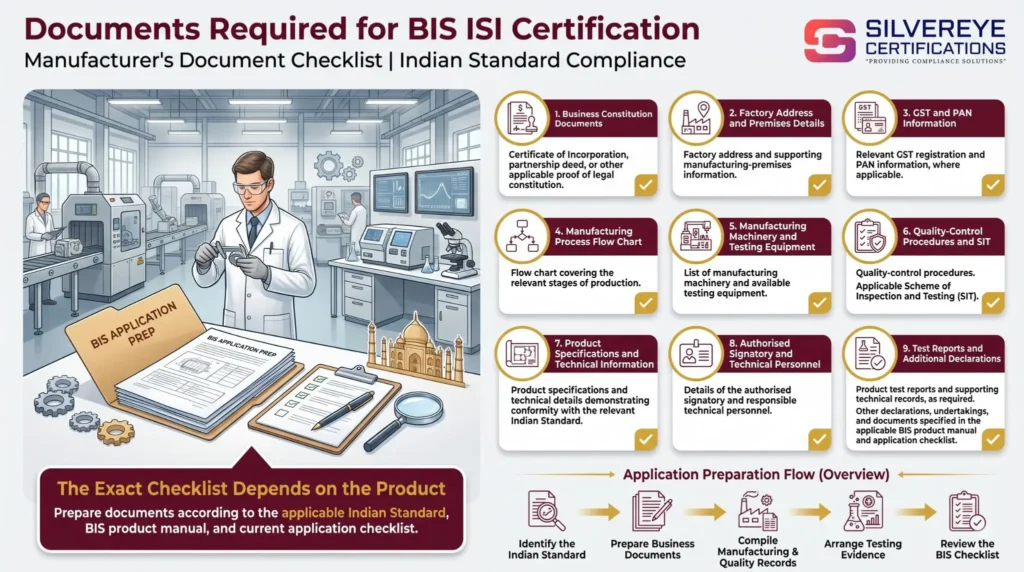
Preparing these documents in advance can help reduce application queries and delays during the certification process.
BIS Certification Process for Robotic Vacuum Cleaners: Step-by-Step Guide
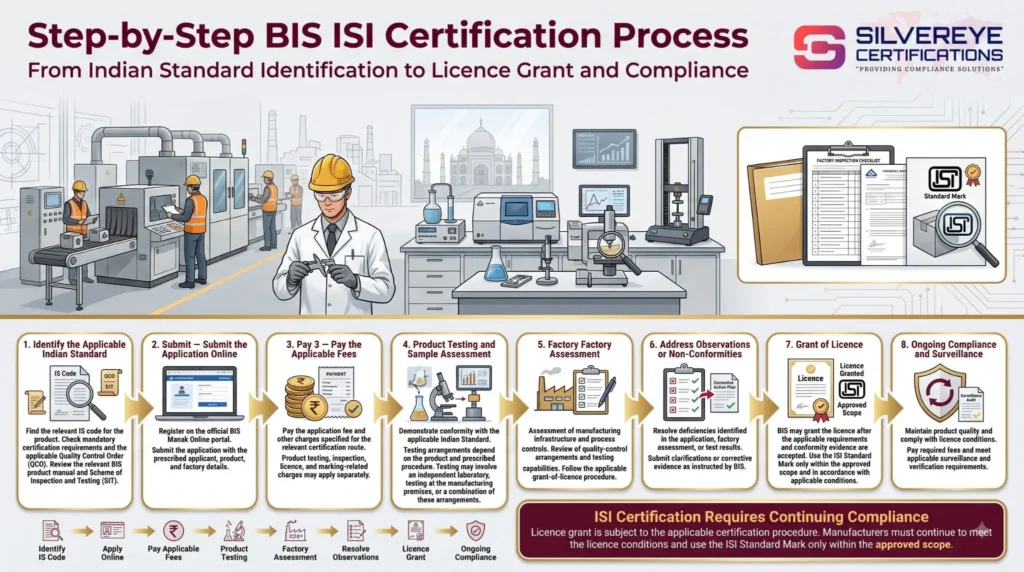
BIS certification for robotic vacuum cleaners follows the Scheme-I product certification route. Manufacturers can follow the steps below to complete the process.
Step 1: Confirm the product classification
Identify whether your robotic vacuum cleaner falls under Entry No. 1 or Entry No. 84 of the 2026 Quality Control Order. Also confirm the applicable Indian Standard and your enterprise category.
Step 2: Select the certification option
Choose the applicable certification route under Scheme-I:
- Option-1: BIS-led testing and assessment.
- Option-2: Submission of a test report from an approved laboratory, subject to applicable BIS requirements.
Step 3: Prepare the manufacturing facility
Arrange the required testing equipment, quality control procedures, inspection records and manufacturing documentation. Ensure that the factory is ready for the BIS assessment.
Step 4: Conduct product testing
Submit representative product samples to a BIS-recognized laboratory for testing against IS 302 (Part 1):2024 and the applicable product-specific requirements for vacuum cleaners.
Step 5: Submit the online application
Complete the application through the BIS MANAK portal. Upload the required documents, provide product and factory details, and pay the applicable application fee.
Step 6: Complete the factory inspection
A BIS officer assesses the manufacturing facility, production process, quality control arrangements and testing equipment. The officer may also witness relevant tests during the inspection.
Step 7: Obtain the BIS license
After satisfactory evaluation of the application, test reports and factory assessment, BIS takes a decision on granting the licence. Pay the applicable annual license fee and minimum marking fee as required. The manufacturer receives the licence with its CM/L number after the grant requirements are completed.
Step 8: Apply the ISI Mark
Once the licence is granted, apply the authorised ISI Mark and licence number to the approved robotic vacuum cleaner models in accordance with BIS marking requirements.
Step 9: Maintain ongoing compliance
Maintain production and marking records, pay applicable annual fees and comply with BIS surveillance requirements. Apply for renewal within the prescribed period and obtain approval before adding new models to the licence scope.
What Tests Do Robotic Vacuum Cleaners Undergo?
Robotic vacuum cleaners must undergo the applicable safety tests under IS 302 (Part 1):2024 and the relevant particular requirements for vacuum cleaners. The exact testing programme depends on the product design and applicable standard.
Laboratory testing may cover the following areas:
- Protection against access to live parts: Checks whether users are protected from accidental contact with hazardous electrical parts.
- Power input and current: Verifies electrical consumption and current-related requirements.
- Heating and temperature rise: Evaluates whether the product operates within permitted temperature limits.
- Leakage current and electric strength: Assesses electrical insulation and protection against electric shock.
- Moisture resistance: Checks the product's protection against moisture under the applicable test conditions.
- Stability and mechanical hazards: Evaluates stability, moving parts and other mechanical safety risks.
- Abnormal operation: Checks how the appliance responds to specified fault and abnormal operating conditions.
- Construction requirements: Examines electrical clearances, creepage distances and construction safety.
- Resistance to heat and fire: Evaluates the relevant materials and components for heat and fire resistance.
- Marking and instructions: Checks product labels, safety warnings and user instructions.
Additional Compliance for Batteries, Chargers and Wireless Modules
Robotic vacuum cleaners may contain components that are subject to separate Indian regulatory requirements, depending on their specifications and intended use.
- Lithium batteries: Check whether the battery falls under a separate applicable BIS Compulsory Registration Scheme requirement.
- Power adapters and charging docks: Verify whether the adapter or charging equipment requires separate BIS certification under an applicable order.
- Wi-Fi and Bluetooth modules: Wireless modules may require applicable Wireless Planning and Coordination (WPC) approval or other regulatory compliance.
Manufacturers should review the bill of materials (BOM) and identify applicable requirements for each component before starting product testing. Separate component approvals may be necessary even after the robotic vacuum cleaner receives its own BIS licence.
BIS Certification Fees for Robotic Vacuum Cleaners
The total cost of BIS certification depends on the applicable government fee schedule, product testing charges, factory inspection and consultancy support. The following table provides the fee structure and indicative amounts supplied for this article.
| Fee Component | Amount | Details |
|---|---|---|
| Application fee | ₹1,000 | Paid when submitting the online application. |
| Inspection fee | ₹7,000 per person per day | Applicable for the BIS factory inspection, as per the relevant fee schedule. |
| Annual licence fee | ₹1,000 | Payable after BIS decides to grant the licence, along with the applicable minimum marking fee. |
| Marking fee | Product-specific | Determined under the applicable Scheme-I marking-fee schedule. |
| Minimum marking fee payment | 50% at application and 50% at grant | Subject to the applicable 2026 BIS amendment and current payment requirements. |
| Late fee | ₹5,000 | The stated fee for curing suspension due to non-payment, subject to applicable conditions and deadlines. |
| Laboratory testing charges | Laboratory-specific | Depend on the applicable tests, number of models and laboratory charges. |
| Consultancy fee | Varies | Depends on the project scope, number of models and factory location. |
MSME concessions: BIS has extended certain concessions on the Scheme-I annual minimum marking fee until 31 May 2029. Eligible micro and small enterprises should check the latest BIS provisions to confirm the applicable concession and supporting documents.
Important: BIS fees and concessions may change. Confirm the current fee schedule, inspection charges, minimum marking fee and payment conditions on the official BIS website before preparing your certification budget.
BIS License Validity and Renewal for Robotic Vacuum Cleaners
After receiving a BIS license, manufacturers must follow the applicable validity, renewal and annual compliance requirements. The license may have a validity of up to five years under the BIS (Conformity Assessment) Amendment Regulations, 2026.
| Item | Applicable Requirements |
|---|---|
| Initial validity | Up to 5 years under the BIS Conformity Assessment Amendment Regulations, 2026. Older BIS FAQ material may mention an initial validity of up to 2 years. Check the validity stated on the actual licence. |
| Renewal period | A licence may be renewed for up to 5 years at a time, subject to applicable conditions. |
| Renewal procedure | Apply online through the licence holder's dashboard on the BIS MANAK portal and submit the required production details and renewal fee. |
| Annual obligations | Pay applicable annual fees in advance and submit the required annual production statement, even where the licence has a five-year validity. |
| Missed payment or renewal deadline | Renewal may be deferred, and non-payment can result in suspension or cancellation under applicable BIS provisions. |
| Ongoing surveillance | BIS may conduct factory inspections, draw factory samples and purchase products from the market for testing. |
| New models or changes | Add new models through the applicable licence scope extension process. A different manufacturing facility requires a separate application. |
Manufacturers should maintain a calendar for annual fee payments, production statements and licence renewal dates. A longer licence validity does not remove the responsibility to meet annual payment and ongoing compliance requirements.
How Long Does BIS Certification for Robotic Vacuum Cleaners Take?
The certification timeline depends on the selected Scheme-I option, product testing, document readiness and factory assessment. The following are the average timelines stated for the two certification routes.
| Certification Route | Typical BIS Timeline | Factors That May Cause Delays |
|---|---|---|
| Option-2 (approved laboratory test report) | Approximately 1 month on average | Delayed responses to BIS queries and outstanding fee payments. |
| Option-1 (BIS-led testing) | Approximately 4 months from a complete application | Sample submission, laboratory testing, inspection scheduling and application queries. |
These are indicative average timelines and should not be treated as guaranteed completion dates. Manufacturers should also allow time for laboratory bookings, document preparation and pre-compliance corrections. If a product fails testing, additional testing and a revised report may be required before certification can proceed.
Exemptions and Sell-Off Rules Under the QCO 2026
The QCO 2026 provides four specific exemptions. However, each exemption is subject to certain conditions. Businesses should review these requirements carefully, as failure to meet the conditions may result in the exemption no longer applying.
| Situation | What the Order Says |
|---|---|
| Made in India for export | The order does not apply to products manufactured in India exclusively for export. |
| Research and development imports | Up to 200 units per year may be imported by manufacturers of household and similar appliances for research and development purposes. These units cannot be sold commercially, must be disposed of as scrap, and must be supported by year-wise records maintained for the Central Government. |
| Stock manufactured or imported before the implementation date | A manufacturer holding BIS certification or having applied for certification may sell, display or offer declared stock for up to six months from the applicable implementation date, subject to filing the required declaration with BIS. |
| Products covered under other mandatory certification requirements | Appliances covered by another Quality Control Order or mandatory BIS certification under another Act are excluded from this order. |
Important: For micro and small enterprises, the six-month sell-off period begins from their respective implementation dates, rather than the general implementation date.
Product Marking: How Must the ISI Mark Appear?
Once BIS certification is granted, the certified robotic vacuum cleaners must carry the BIS Standard Mark (ISI Mark) in accordance with the license conditions.
The product marking should include the ISI Mark, BIS license number (CM/L number) and other applicable product details required under IS 302 (Part 1):2024. The marking information on the product and packaging must be consistent with the details approved under the BIS license.
Manufacturers should get their rating label and packaging artwork reviewed by their consultant or testing laboratory before mass printing. Using an incorrect, unauthorized or unlicensed ISI Mark can create compliance risks similar to selling a product without the required certification.
Penalties for Selling Robotic Vacuum Cleaners Without BIS Certification
Selling or distributing robotic vacuum cleaners without the required BIS certification can lead to legal and regulatory consequences under the Bureau of Indian Standards Act, 2016.
BIS may also suspend or cancel an existing license if the manufacturer fails to comply with the applicable Conformity Assessment Regulations or license conditions. Importers may face additional difficulties with the clearance of non-compliant products at customs.
Businesses should therefore treat BIS certification as a pre-launch requirement and complete the applicable compliance process before manufacturing or importing products for sale in the Indian market.
Common Mistakes That Delay BIS Approval for Robotic Vacuum Cleaners
Manufacturers and importers can avoid unnecessary delays by identifying common compliance mistakes early in the certification process.
- Using an outdated standard: Testing products against an older edition of IS 302 instead of the applicable IS 302 (Part 1):2024 requirements.
- Incorrect application scope: Submitting one application for multiple products or factory locations when separate applications are required for the applicable product, standard and manufacturing location.
- Choosing an unsuitable testing laboratory: Using a laboratory that is not recognised or accepted by BIS for the relevant testing requirements.
- Using an outdated test report: Allowing the test report to exceed the validity period accepted by BIS.
- Ignoring additional component approvals: Delaying checks for batteries, adapters and wireless modules until after the main ISI license is granted.
- Missing post-certification requirements: Overlooking annual license fees, production statements and other ongoing compliance obligations.
- Using the ISI Mark prematurely: Printing or applying the ISI Mark before the BIS license has been granted and the license number issued.
Why Choose Silvereye Certifications for BIS Certification of Robotic Vacuum Cleaners?
Silvereye Certifications is a compliance and certification consultancy supporting businesses with BIS ISI, BIS CRS and BIS FMCS certification, along with related regulatory approvals such as WPC-ETA, BEE Star Rating, TEC, EPR and CDSCO.
This broader compliance experience is useful for robotic vacuum cleaner manufacturers because a product may require the main BIS licenes as well as separate compliance checks for its battery, charging adapter or wireless components, depending on the applicable requirements.
Here is how Silvereye Certifications can support your certification journey:
- End-to-end documentation and application support: Assistance with documentation, testing coordination, application filing and follow-up with BIS through a single point of contact.
- Product scope assessment: Guidance on identifying the applicable QCO entry, relevant Indian Standard and implementation deadline before testing begins.
- Support for Indian and foreign manufacturers: Assistance with domestic applications under Scheme-I and foreign manufacturer applications through FMCS, including guidance on the Authorized Indian Representative requirement.
- Coordination of related approvals: Support in planning ISI, CRS and WPC compliance requirements to help avoid delays caused by overlooked approvals.
- Post-certification compliance guidance: Assistance with annual fees, production statements, license renewals and scope extensions.
- Clear communication: Practical updates throughout the process, along with guidance on the documents and requirements expected by BIS and the testing laboratory.
Silvereye Certifications is an independent private consultancy and is not affiliated with BIS or any government department. The certification license is issued exclusively by the Bureau of Indian Standards (BIS).
Conclusion
BIS certification is an important compliance requirement for manufacturers and importers of robotic vacuum cleaners covered under the Safety of Household, Commercial and Similar Electrical Appliances (Quality Control) Order, 2026. Businesses should identify the applicable QCO entry, confirm the relevant Indian Standard, prepare the required documents and complete testing and factory assessment before placing products on the Indian market.
Planning ahead is equally important for battery, adapter and wireless-related approvals, product marking, annual compliance and license renewal. A clear understanding of the applicable requirements can help businesses avoid approval delays, compliance risks and interruptions to product launches.
Silvereye Certifications supports Indian and foreign manufacturers with BIS certification guidance, documentation, testing coordination and related regulatory approvals. With the right compliance planning and timely preparation, businesses can bring their robotic vacuum cleaners to market with greater confidence.
Frequently Asked Questions
Is BIS certification mandatory for robot vacuum cleaners in India?
Yes. They fall under the Quality Control Order 2026 (entries 1 and 84), and the order has been in force since 1 October 2026 for large and medium manufacturers.
Which Indian Standard applies for robot vacuum cleaners?
IS 302 (Part 1):2024, aligned with IEC 60335-1:2020. Your lab will confirm the related particular requirements for vacuum cleaners.
Which BIS scheme applies: ISI or CRS?
The order requires the Standard Mark under Scheme-I, which is the ISI Mark route with a factory assessment.
How much does BIS certification cost?
BIS charges Rs 1,000 as the application fee, Rs 7,000 per person per day for the initial inspection, Rs 1,000 as the annual license fee and a product-specific marking fee. Testing and consultant fees are extra.
How long does it take to get the ISI license?
BIS quotes about one month on average under Option-2 and about four months under Option-1, from a complete application.
How long is the BIS license valid?
The 2026 amendment allows up to five years on grant. Check the date on your license, since older BIS text mentions an initial two years.
Do I still pay fees every year if my license runs five years?
Yes. The annual fee and production statement stay due every year, and non-payment can lead to suspension.
Can a foreign manufacturer or importer get the license?
Foreign factories apply through FMCS with an Authorized Indian Representative. Importers should buy from a BIS-licensed factory.
What if I already have stock in India?
A manufacturer certified by BIS, or one who has applied, can sell declared stock for six months from the implementation date after filing a declaration with BIS.
Can I import robot vacuums for R&D without BIS?
Yes, up to 200 units a year, but the units cannot be sold, must be scrapped afterwards, and you must keep yearly records.
What is the penalty for selling without certification?
Anyone breaking the order is punishable under the Bureau of Indian Standards Act, 2016.