

- Listed Under Serial No. 43: Heating pads are covered under the Blankets, Pads, Clothing and Similar Flexible Heating Appliances category of the 2026 Quality Control Order.
- Implementation Dates: The requirements apply from 1 October 2026 for general manufacturers, 1 January 2027 for small enterprises and 1 April 2027 for micro enterprises.
- Battery-Operated and USB Heating Pads: The order also covers DC-supplied and battery-operated appliances, including applicable USB-powered heating pads, subject to the specified voltage limits.
- Check Product Classification Carefully: Medical-use products, pet heating pads and foot warmers may fall under different standards or QCO entries. Confirm the applicable classification before starting BIS testing.
Introduction
BIS certification for heating pads is a license to use the ISI Standard Mark under Scheme-I of the BIS (Conformity Assessment) Regulations, 2018. The Safety of Household, Commercial and Similar Electrical Appliances (Quality Control) Order, 2026 (S.O. 1739(E)) lists Blankets, Pads, Clothing and Similar Flexible Heating Appliances at Serial No. 43 and requires compliance with IS 302 (Part 1):2024 and the use of the Standard Mark.

The order comes into effect on 1 October 2026 for general manufacturers, 1 January 2027 for small enterprises and 1 April 2027 for micro enterprises. Products manufactured exclusively for export are exempt from this requirement. The BIS license must be obtained by the manufacturer, as certification is linked to the manufacturing facility and product conformity.
What Is BIS Certification for Heating Pads and Why Is It Required?
The Bureau of Indian Standards (BIS) is India's national standards body. BIS certification for a heating pad means that the manufacturer has received a license to use the ISI Standard Mark after demonstrating that the product meets the applicable Indian Standard and that the manufacturing facility can consistently maintain the required quality and safety standards.

Under the 2026 Quality Control Order, certification follows Scheme-I of Schedule-II of the BIS (Conformity Assessment) Regulations, 2018. This is a factory-based certification process, not the Compulsory Registration Scheme (CRS) used for many consumer electronics.
Three important elements determine the certification requirements:
- General safety standard: The order specifies IS 302 (Part 1):2024, aligned with IEC 60335-1:2020. It covers general safety requirements for household and similar electrical appliances.
- Product-specific requirements: The international product standard for heating pads is IEC 60335-2-17, which covers blankets, pads, clothing and similar flexible heating appliances. The applicable Indian Standard and edition for your model should be confirmed with the testing laboratory.
- BIS license and ISI Mark: The manufacturer receives the license after the required product testing and factory assessment. The authorized ISI Mark must then be applied to the product as required.
Why Should Heating Pad Manufacturers and Importers Check BIS Requirements Early?
Heating pads are widely sold through online marketplaces, retail stores and distributors. Although they may appear to be simple electrical products, their heating elements, controllers, insulation and electrical connections must meet the applicable safety requirements.
These products are often used directly against the skin on areas such as the back, neck and shoulders for extended periods. A faulty heating element, damaged insulation or inadequate temperature control can create risks of overheating, burns and electrical hazards. This is why product testing and manufacturing quality controls are important.
The Department for Promotion of Industry and Internal Trade (DPIIT) issued the Safety of Household, Commercial and Similar Electrical Appliances (Quality Control) Order, 2026 on 6 April 2026. Under Serial No. 43, the order includes blankets, pads, clothing and similar flexible heating appliances. The implementation date for general manufacturers was 1 October 2026, meaning the requirement is already applicable to them.
This guide explains the BIS requirements specifically for heating pads, including the applicable standards, product classification, exemptions, documents, testing and certification process.
What Does the 2026 Quality Control Order Say About Heating Pads?
The Safety of Household, Commercial and Similar Electrical Appliances (Quality Control) Order, 2026 establishes the applicable certification and marking requirements for the electrical appliances listed in its Table. The following points explain the relevant provisions for heating pad manufacturers and importers.
Key Details of the 2026 Quality Control Order
| Item | Details |
|---|---|
| Order name | Safety of Household, Commercial and Similar Electrical Appliances (Quality Control) Order, 2026 |
| Notification | S.O. 1739(E), dated 6 April 2026 |
| Issued by | Ministry of Commerce and Industry, Department for Promotion of Industry and Internal Trade |
| Legal authority | Section 16 of the Bureau of Indian Standards Act, 2016 |
| Effect on earlier order | Supersedes the 2025 order of the same name, except for actions already taken or omissions before supersession |
| Commencement | 1 October 2026 |
Which Heating Appliances Fall Within the Scope of the Order?
Clause 1 explains the application and scope of the QCO:
- It applies to electrical appliances intended for household, commercial or similar applications.
- The rated voltage must not exceed 250 V for single-phase appliances and 480 V for other appliances.
- The scope also includes direct-current (DC) supplied and battery-operated appliances, subject to the specified voltage limits.
- Appliances already covered under another Quality Control Order issued under the BIS Act, or notified for mandatory BIS certification under another Act, are excluded.
Which BIS Standard and Certification Scheme Apply?
Under Clause 2, products listed in Column (2) of the order's Table must conform to the Indian Standard specified in Column (3) and carry the Standard Mark under a BIS license.
The order specifies IS 302 (Part 1):2024, corresponding to IEC 60335-1:2020 and titled Household and Similar Electrical Appliances: Safety, Part 1 – General Requirements.
Certification must follow Scheme-I of Schedule-II of the BIS (Conformity Assessment) Regulations, 2018. The order also states that the latest version of the applicable Indian Standard will apply for its purposes.
When Does BIS Certification Become Mandatory for Heating Pads?
The implementation dates depend on the manufacturer's enterprise classification under the MSME Development Act, 2006.
| Manufacturer category | Implementation date |
|---|---|
| General manufacturers (other than micro and small enterprises) | 1 October 2026 |
| Small enterprises | 1 January 2027 |
| Micro enterprises | 1 April 2027 |
What Exemptions Are Available Under the 2026 QCO?
Clause 2 includes certain exemptions and special provisions that manufacturers should understand before planning certification.
- Export exemption: The order does not apply to goods manufactured domestically for export.
- Small and micro enterprises: These enterprises must comply from their respective implementation dates specified in the order.
- Research and development imports: Manufacturers of household and similar electrical appliances may import up to 200 units per year for research and development. These units cannot be sold commercially. They may be disposed of as scrap, and the manufacturer must maintain year-wise records and provide them to the Central Government when requested.
- Existing stock: Goods manufactured domestically or imported before the applicable implementation date by a BIS-certified manufacturer or a manufacturer who has applied for certification may be sold, displayed or offered for sale for up to six months from the relevant implementation date, subject to the required declaration to BIS.
Who Is Responsible for Certification and Enforcement?
Under Clause 3, the Bureau of Indian Standards (BIS) is the certifying and enforcing authority for the products listed in the order's Table.
The manufacturer must obtain the applicable BIS license and ensure that the heating pads meet the prescribed conformity requirements.
What Happens If a Manufacturer Does Not Follow the QCO?
Clause 4 states that anyone who contravenes the Quality Control Order may face penalties under the Bureau of Indian Standards Act, 2016. Manufacturers should therefore identify the applicable requirements and obtain the required certification before the relevant implementation date.
Other Heating and Related Products Listed in the 2026 QCO
Heating pads should not be confused with other electrical products that appear under separate entries in the order. The following entries are particularly relevant when classifying products.
| Serial No. | Product category |
|---|---|
| 43 | Blankets, Pads, Clothing and Similar Flexible Heating Appliances |
| 68 | Foot Warmers and Heating Mats |
| 89 | DC-Supplied / Battery-Operated Foot Warmers and Heating Mats |
| 9 | Massage Appliances |
| 86 | DC-Supplied / Battery-Operated Massage Appliances |
Important: A product's intended use, construction, heating arrangement and electrical design can affect its classification. Medical-use heating products, pet heating pads and foot warmers should be assessed separately rather than automatically treated as products under Serial No. 43.
Which Heating Pads Are Covered?
The 2026 Quality Control Order identifies a product category rather than listing every individual heating pad. The relevant international product standard covers blankets, pads, clothing and similar flexible heating appliances, including the control unit supplied with the appliance and DC-supplied or battery-operated versions.
However, it excludes certain products, such as foot warmers and heating mats, water-bed heaters, animal-breeding and rearing appliances, rigid bed warmers, heated carpets and appliances specifically intended for medical use under supervision. Appliances designed for use in vehicles may also require additional safety considerations.
Use the table below as an initial guide to understand where different heating pad products may fall. The final classification should be confirmed with your testing laboratory.
| Pad Type | Likely Classification | What to Confirm |
|---|---|---|
| Mains-powered body heating pad for the back, neck or shoulders | Serial No. 43 | Confirm the applicable entry for your model. |
| USB or power-bank heating pad | Serial No. 43, as a DC-supplied or battery-operated appliance | Check whether the cable, adapter or battery has separate BIS requirements. |
| Rechargeable cordless heating pad | Serial No. 43 | Ask your laboratory whether the battery and charger require separate BIS certification. |
| Heated seat cushion or pad for home or office | Serial No. 43 | Confirm the applicable entry for your model. |
| Heat-and-massage pad or cushion | Serial No. 43 and potentially Serial Nos. 9 or 86 | Ask your laboratory to confirm the classification of the dual-function product. You can also refer to our guide on massage appliances. |
| Heated seat pad designed for vehicle use | The international pad standard specifies additional requirements for vehicle use | Confirm the applicable standard and Quality Control Order before testing. |
| Foot warmer or heating mat | Serial Nos. 68 and 89 | These products are listed separately in the Quality Control Order. |
| Heating pad designed for pets or animals | Excluded from the international pad standard | Confirm the applicable standard and regulatory requirements separately. |
| Heating pad intended for treatment under medical supervision | Excluded from the international pad standard | Check separately whether medical device regulations or other requirements apply. |
Two additional checks before applying:
- Claims on product packaging: If your packaging, website or product listing claims that the heating pad treats a medical condition, check whether medical device regulations could apply. This is a separate regulatory question and should be reviewed before finalising product claims and labelling.
- Other mandatory orders: The 2026 Quality Control Order does not apply to appliances covered by another Quality Control Order. Although Serial No. 43 specifically includes pads, confirm the applicable classification with your laboratory and obtain written clarification where necessary.
How Heating Pads Differ From Electric Blankets in Testing
Heating pads and electric blankets fall under the same product category, so many safety tests overlap. However, certain product-specific factors are particularly important for heating pads:
- Size and heat concentration: Heating pads are generally smaller and designed to deliver heat to a specific body area. Therefore, surface temperature behaviour and controller response are important during safety assessment.
- Mechanical strength: The international product standard includes a tumbling barrel test for pads to assess whether the heating element, covering and construction can withstand repeated handling.
- Control unit: The standard also covers the control unit supplied with the appliance. For products with a handheld controller or USB switch, the controller forms part of the product assessment.
- Overheating protection during supply interruption: The latest edition introduced requirements intended to protect users against overheating when the mains supply is interrupted.
- Fire resistance: The latest edition also updated certain test methods used to assess resistance to fire.
- Washing and moisture resistance: If the heating pad has a removable or washable cover, inform the laboratory so that the relevant moisture-related tests can be planned correctly.
These points provide a general overview rather than a complete testing checklist. The applicable standard, product configuration and laboratory test report determine the final assessment.
Benefits of BIS Certification for Heating Pads
Obtaining BIS certification offers several important benefits to heating pad manufacturers, importers and brand owners:
- Legal compliance: Once the applicable implementation date arrives, selling a covered heating pad without the required BIS certification can lead to action under the BIS Act, 2016.
- Smoother import operations: Proper certification and ISI marking help manufacturers and importers meet applicable requirements before products enter the Indian market.
- Improved product safety: Testing helps identify electrical and overheating risks in products that are used directly against the body, often for extended periods.
- Retailer and marketplace confidence: Distributors and online marketplaces may ask for BIS license details before accepting electrical products for sale.
- Reduced product complaints: Identifying potential defects during laboratory testing can help reduce the risk of customer complaints, returns and product claims.
- Stronger brand credibility: A valid BIS license and authorized ISI marking help demonstrate that the product has undergone the applicable conformity assessment process.
Who Can Apply for BIS Certification for Heating Pads? Eligibility
The applicable certification route depends on whether the applicant manufactures the heating pad in India or outside the country.
| Applicant | Applicable Route | Key Requirement |
|---|---|---|
| Indian manufacturer | Scheme-I licence | Must have a manufacturing facility with the required production and testing arrangements. |
| Foreign manufacturer | Foreign Manufacturers Certification Scheme (FMCS) | Must appoint an authorised Indian representative. BIS may inspect the overseas manufacturing facility. |
| Importer or trader | Sources products from a BIS-licensed manufacturer | Cannot independently obtain the manufacturer's licence simply by importing or trading. Covered products must be manufactured by a licensed manufacturer and carry authorised marking. |
| Brand owner using contract manufacturing | Licence held by the manufacturing unit | Brand details and the manufacturing arrangement should be properly declared and agreed upon before placing orders. |
| Micro or small enterprise | Same applicable certification route | The implementation dates are extended to 1 January 2027 for small enterprises and 1 April 2027 for micro enterprises. |
Udyam Registration is generally used as supporting evidence to establish an enterprise's classification as a micro or small enterprise. Manufacturers should keep their valid registration and supporting business documents ready when applying for BIS certification.
Requirements for BIS Certification for Heating Pads
To obtain BIS certification, manufacturers must ensure that their heating pads meet the applicable safety standards and that their manufacturing facilities are ready for inspection. The key requirements include:
- Product conformity: Every model must comply with IS 302 (Part 1):2024 and the relevant product-specific safety requirements.
- Testing at a BIS-recognised laboratory: Product samples must be tested at a BIS-recognised laboratory. Alternatively, the manufacturer must have a recognised in-house testing facility, where permitted.
- Factory readiness: The manufacturing unit should maintain a documented quality system, calibrated testing equipment, incoming inspection procedures for critical components and routine testing arrangements for finished heating pads.
- Critical components: Maintain a detailed list of important components, including heating wires or carbon-fibre heating elements, insulation and sheathing, temperature sensors, thermal fuses, control units, switches, connectors, power cords or USB cables and outer covers. Record their makes, specifications and ratings.
- ISI marking and labelling: The product must carry the authorized ISI Mark and BIS license number, along with the required electrical ratings, warnings and user instructions.
- Production and marking records: Maintain accurate production and marking records, as these are important for compliance and minimum marking fee calculations.
Documents Required for BIS Certification
The documents required may vary depending on the product design, manufacturing facility and applicant category. However, manufacturers generally need to prepare the following documents:
| Category | Documents Required |
|---|---|
| Applicant identity | Company incorporation or partnership documents, GST registration and authorized signatory letter. |
| Factory details | Proof of manufacturing premises address, factory layout and list of manufacturing machinery. |
| Enterprise classification | Udyam Registration Certificate to support micro or small enterprise classification and applicable concessions. |
| Product details | Model list, rating label artwork, circuit diagram, heating element and controller details, critical components list, user manual and safety instructions. |
| Quality system | Manufacturing process flow chart, quality control plan or test scheme, list of testing equipment and calibration certificates. |
| Product testing | Test report issued by a BIS-recognized laboratory. |
| Foreign manufacturers | Appointment letter for the authorized Indian representative, manufacturing unit details and other documents required under FMCS. |
| Existing stock | Declaration to BIS for eligible products manufactured or imported before the applicable implementation date, if claiming the six-month stock clearance provision. |
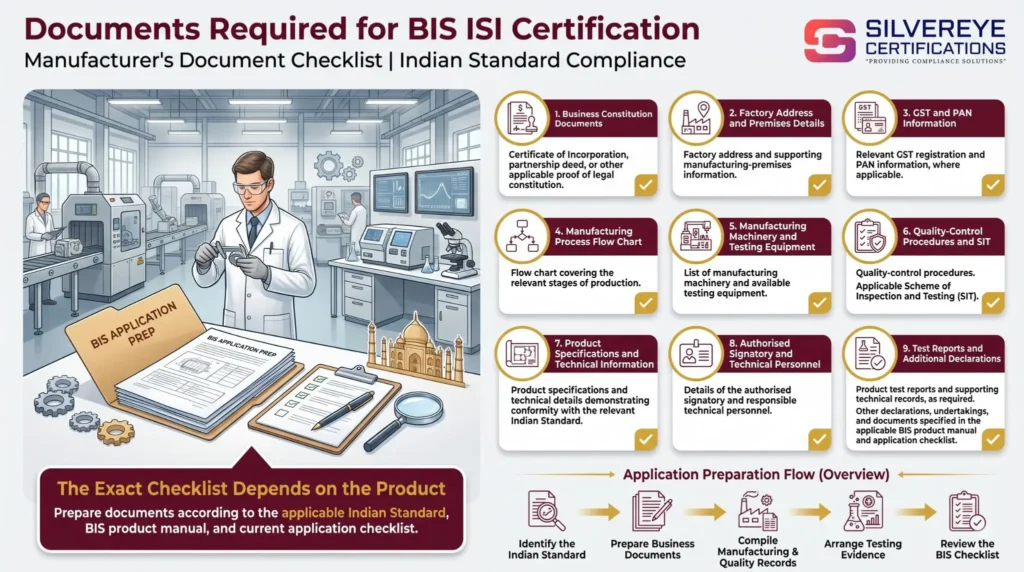
Preparing these documents in advance can help reduce delays during application scrutiny and factory assessment.
BIS Certification Process for Heating Pads: Step-by-Step Guide
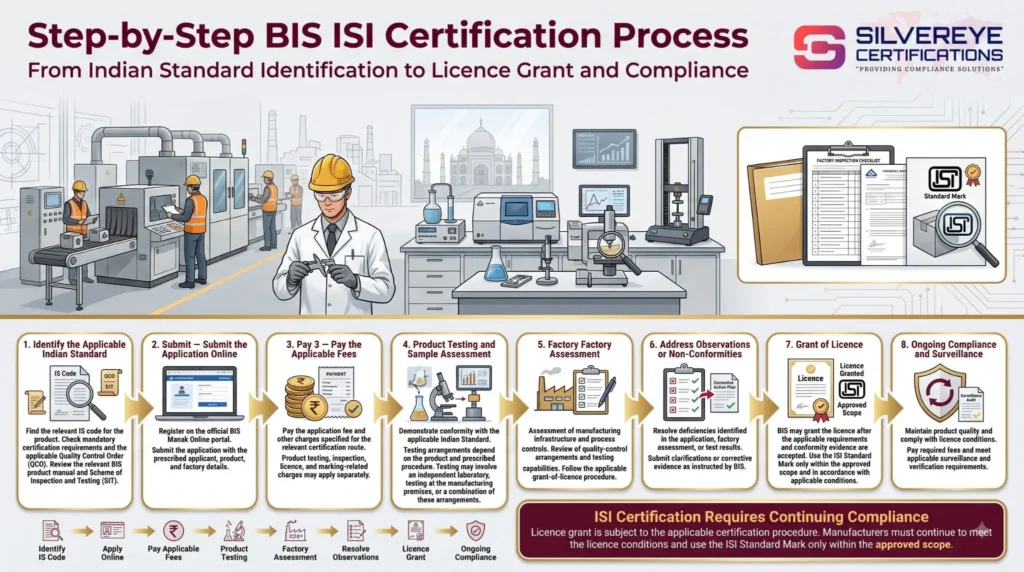
The BIS certification process for heating pads follows the Scheme-I product certification route. It involves product testing, document submission, factory assessment and approval before the manufacturer can use the ISI Mark.
Step 1: Identify the applicable product category
Check whether each heating pad model falls under Serial No. 43 or another relevant entry in the 2026 Quality Control Order. Confirm the applicable Indian Standard and product-specific testing requirements.
Step 2: Finalize models and critical components
Prepare the model list and freeze the critical components before testing. This includes heating elements, controllers, temperature sensors, thermal fuses, switches and power connections. Changes to important components after testing may require additional assessment or retesting.
Step 3: Conduct product testing
Submit product samples to a BIS-recognized laboratory. The samples are evaluated against IS 302 (Part 1):2024 and the applicable product-specific safety requirements.
Step 4: Submit the online application
BIS product certification applications are submitted online. Upload the required documents, provide the manufacturing and product details, and pay the applicable application fee.
Step 5: Complete the factory assessment
A BIS officer assesses the manufacturing facility, production arrangements, quality control system and testing equipment. For foreign manufacturers, the inspection may take place at the overseas factory.
Step 6: Complete sample verification
Samples may be drawn from the manufacturing facility for testing or verification to confirm that the production model matches the product assessed during the certification process.
Step 7: Obtain the BIS license
After the application, testing and factory assessment requirements are satisfactorily completed, BIS takes a decision on granting the license. The manufacturer must pay the applicable annual license fee and balance minimum marking fee as required before the license is issued.
Step 8: Apply the ISI Mark and maintain compliance
After receiving the license, the manufacturer can apply the authorized ISI Mark and BIS license details to the approved heating pad models. Production records, marking records and quality control procedures must be maintained. BIS may also conduct surveillance inspections and product sampling during the license period.
How Long Does BIS Certification for Heating Pads Take?
The time required for BIS certification depends on factors such as laboratory availability, product complexity, number of models, document readiness and factory inspection scheduling. The following timeline is indicative and should not be treated as a commitment from BIS.
| Certification Stage | Indicative Time |
|---|---|
| Product classification and document preparation | 1–2 weeks |
| Testing at a recognised laboratory | 2–4 weeks, depending on the number of models and laboratory queue |
| Online application and scrutiny | 1–2 weeks |
| Factory inspection scheduling and assessment | 2–4 weeks |
| Licence grant after successful compliance | 1–2 weeks |
| Estimated overall timeline | Approximately 2–3 months, provided documents and samples are ready |
Plan testing early: Heating pads are seasonal products, and demand for laboratory testing may increase before the winter season. Manufacturers should book laboratory slots in advance to avoid unnecessary delays.
BIS Certification Fees for Heating Pads
The cost of BIS certification depends on the applicable fee schedule, product category, number of models, laboratory testing requirements and factory location. BIS fees may also be revised, so manufacturers should confirm the latest amounts through the official BIS portal before preparing their budget.
| Fee Component | Indicative Amount or Basis | Important Details |
|---|---|---|
| Application fee | ₹1,000 | Paid online when submitting the application. |
| Annual licence fee | ₹1,000 per year | Payable as required after the decision to grant. |
| Minimum marking fee | Product-specific | Depends on the applicable BIS marking-fee schedule and production category. |
| Minimum marking fee payment | Reported 50% at application and 50% at grant | Confirm the applicable payment arrangement under current BIS guidelines. |
| MSME concessions | Reported concessions for eligible micro and small enterprises | Eligibility and applicable concessions should be checked against the latest BIS provisions. |
| Laboratory testing charges | As charged by the laboratory | Depend on the number of models and tests required. |
| Factory inspection charges | As applicable | May vary depending on the factory location and inspection requirements. |
| Consultancy fee | Based on project scope | Depends on the number of models, factory location and support required. |
Important: The minimum marking fee schedule and MSME concessions may change. Confirm the applicable rates, eligibility conditions and payment requirements directly with BIS before making financial commitments.
Where BIS product-grouping guidelines permit, similar heating pad models may be considered together in an application. Models that differ only in size or outer cover fabric may be more suitable for grouping than products with different heating elements, controllers or electrical designs. Final grouping depends on the applicable BIS guidelines and technical assessment.
Validity and Renewal of BIS Certification for Heating Pads
BIS certification for heating pads is subject to validity and renewal requirements. Manufacturers should track their license expiry date, annual payments and compliance obligations to avoid suspension or cancellation.
| Aspect | Details |
|---|---|
| Initial validity | Up to 5 years under the BIS (Conformity Assessment) Amendment Regulations, 2026, dated 25 February 2026. Older BIS material and FAQs may still mention a validity of up to 2 years. Always check the validity stated on your actual license. |
| Renewal period | Renewal may be granted for up to 5 years at a time. |
| Annual payments | Applicable license and marking fees may remain payable annually in advance, even when the license has a longer validity period. |
| When to apply for renewal | Preferably apply at least 2 months before the licence expiry date, in line with BIS renewal guidance. |
| Renewal documents | Production and marking records, compliance reports, applicable fees and evidence that outstanding dues have been cleared. |
| Licence lapse or violation | Renewal may be deferred if the application and required fee are not received by the prescribed deadline. Violations may also lead to suspension or cancellation of the licence. |
| New models and variants | Add new models or variants to the approved licence scope before applying the ISI Mark or selling them. |
Important: A longer license validity does not remove the manufacturer's ongoing responsibilities. Annual payments, BIS surveillance, product conformity and accurate production and marking records must be maintained throughout the license period.
Importing Heating Pads: What Changes?
Importers and foreign manufacturers must pay attention to the certification route, product marking and applicable implementation dates before shipping heating pads to India.
- Foreign manufacturer certification: Overseas manufacturers must apply under the Foreign Manufacturers Certification Scheme (FMCS) and appoint an authorized Indian representative. The required ISI Mark must be applied to the product in accordance with BIS requirements before it is placed on the Indian market.
- Existing stock manufactured or imported before the deadline: Eligible products manufactured domestically or imported before the applicable implementation date may be sold, displayed or offered for sale for up to six months from that date, subject to the conditions of the order and the required declaration to BIS. For general manufacturers, the six-month period from 1 October 2026 runs until 1 April 2027. Small and micro enterprises should confirm the applicable period based on their respective implementation dates.
- Research and development samples: Up to 200 units per year may be imported for R&D purposes, subject to the applicable conditions. These products cannot be sold commercially, and manufacturers must maintain year-wise records.
- Marketplace sellers: Online marketplaces and distributors may request BIS license details before accepting electrical products for listing. Keep the license number and relevant product information ready.
- Import planning: Include the BIS certification and ISI marking requirements in purchase orders and supplier agreements. Addressing certification requirements before shipment can help avoid delays, additional costs and import-related complications.
Common Mistakes to Avoid When Applying for BIS Certification
Manufacturers, importers and brand owners should avoid the following mistakes while preparing for BIS certification of heating pads:
- Assuming USB heating pads are exempt: A low-priced or USB-powered heating pad may still fall within the applicable product category. Check its design, power supply and classification rather than assuming it is exempt.
- Confusing product categories: Heating pads under Serial No. 43 should not be confused with heating mats and foot warmers listed separately under Serial Nos. 68 and 89.
- Choosing the wrong certification route: Applying under the Compulsory Registration Scheme (CRS) instead of Scheme-I can result in an incorrect application route for products covered by this order.
- Testing only one model: Selling variants with different heating elements, controllers or electrical designs without confirming their inclusion in the license scope can create compliance issues.
- Ignoring the controller: The control unit supplied with the heating pad is part of the product assessment and should be included in the testing and documentation plan.
- Using medical treatment claims without checking applicable rules: Medical claims on packaging or online listings may raise separate regulatory questions. Review the claims before finalising product labelling.
- Misusing the six-month stock clearance provision: This provision applies to eligible stock manufactured or imported before the relevant implementation date, subject to the required conditions and declaration to BIS. It is not an exemption for newly manufactured or imported stock.
- Budgeting only for the application fee: Include laboratory testing, minimum marking fees, annual license fees, factory inspection charges and other applicable costs in the certification budget.
Why Choose Silvereye Certifications for BIS Certification?
BIS certification projects can face delays because of small but important details, such as an unclear testing plan, missing critical component records or a manufacturing facility that is not prepared for inspection.
Silvereye Certifications is an Indian regulatory consultancy providing support for BIS, CDSCO, WPC and other regulatory compliance requirements. We help heating pad manufacturers, importers and brand owners manage the certification process with better planning and documentation.
Here's how we can support your BIS certification project:
- Accurate product classification: We help identify the applicable Quality Control Order entry for your heating pads and highlight components, product features or claims that may require separate attention before testing begins.
- Laboratory coordination: We assist with sample submission, testing arrangements and model grouping wherever permitted under applicable BIS guidelines.
- Application and documentation support: We help prepare the required documents, complete the online application and coordinate applicable fee payments.
- Factory inspection preparation: Our team helps you prepare for the BIS factory assessment through documentation checks and a pre-inspection checklist.
- Importer and foreign manufacturer support: We provide FMCS guidance, Indian representative coordination and assistance with applicable existing-stock declarations.
- Post-certification assistance: We support renewal planning, marking fee coordination and the addition of new models to the licence scope.
Planning to obtain BIS certification for your heating pads? Contact the Silvereye Certifications team and share your product model list. We can help you understand the applicable requirements, documentation and estimated project costs.
Conclusion
BIS certification for heating pads is an important compliance requirement under the Safety of Household, Commercial and Similar Electrical Appliances (Quality Control) Order, 2026. The order covers relevant products under Serial No. 43, with the implementation date for general manufacturers already in force. The extended deadlines for small and micro enterprises are also approaching.
To prepare for certification, manufacturers and importers should:
- Identify the correct product category and applicable Indian Standard for each heating pad model.
- Finalise critical components, including heating elements, controllers, sensors and power connections, before testing.
- Complete the required laboratory testing and prepare accurate application documents.
- Prepare the factory for BIS assessment and maintain the necessary quality control records.
- Plan ISI marking, applicable fees and renewal requirements from the beginning.
- Review product claims, cables, batteries and accessories to identify any additional compliance requirements.
Starting the process early can help reduce avoidable delays and make it easier to meet the applicable requirements. With proper product classification, testing and documentation, manufacturers can work towards obtaining the BIS license and using the authorized ISI Mark on their heating pads.
Frequently Asked Questions
Is BIS certification mandatory for heating pads in India?
The 2026 order lists Blankets, Pads, Clothing and Similar Flexible Heating Appliances at serial no. 43, so listed goods must conform to IS 302 (Part 1):2024 and bear the ISI Standard Mark under a BIS license, subject to the implementation dates and exemptions.
Which standard applies for heating pads?
The order specifies IS 302 (Part 1):2024, which corresponds to IEC 60335-1:2020, and says the latest version of the Indian Standards applies. For product-specific requirements, the international reference is IEC 60335-2-17, and your lab confirms the Indian equivalent.
What are the deadlines for heating pads?
1 October 2026 for general manufacturers, 1 January 2027 for small enterprises and 1 April 2027 for micro enterprises.
Are USB or battery-operated heating pads covered?
The order applies to direct current supplied and battery-operated appliances within its voltage limits, and the international pad standard also covers them. Ask your lab about the cable, adapter or battery separately.
Are heating mats and foot warmers the same entry as pads?
No. Foot warmers and heating mats are at serial no. 68, and DC supplied or battery-operated versions are at serial no. 89.
What about heat-plus-massage pads?
Massage appliances are named at serial nos. 9 and 86. Ask your lab how a dual-function product is treated, and see our massage appliances guide.
Are pet heating pads covered?
The international pad standard excludes heating appliances for breeding and rearing animals. Confirm the governing standard and order before testing.
Can I sell my existing stock after the deadline?
Goods made or imported before the implementation date by a BIS-certified manufacturer, or one who has applied, can be sold or offered for sale for up to six months from that date. A declaration to BIS is required.
Can I import sample pads for R&D?
Up to 200 units per year can be imported for R&D by manufacturers of household and similar electrical appliances. They cannot be sold commercially, and records must be kept.
Are export-only pads exempt?
Goods manufactured domestically for export are outside the order.
How much does BIS certification for a heating pad cost?
Government fees include a Rs 1,000 application fee, a Rs 1,000 annual license fee and a product-specific minimum marking fee. Testing and inspection are charged at actuals. Verify current figures on the BIS portal.
How long is the license valid?
Under the 2026 amendment, up to 5 years initially and renewable for up to 5 years. Annual fees still apply.
What is the penalty for non-compliance?
The order says contravention is punishable under the BIS Act, 2016.