
Two Orders, One Product Family: Portable immersion rods and fixed immersion heaters fall under different Quality Control Orders. Portable immersion rods are covered under IS 368:2014 through the domestic water heating order, whereas fixed immersion heaters are specifically listed under the 2026 electrical appliances order.
- 2026 Order: The Safety of Household, Commercial and Similar Electrical Appliances (Quality Control) Order, 2026 specifically lists Fixed Immersion Heaters at Serial No. 66. The order applies from 1 October 2026.
- BIS Certification Requirement: Manufacturers covered by the applicable order must obtain a BIS license under Scheme-I to use the ISI Mark. The certification process involves product testing in a recognized laboratory and a factory assessment, subject to the applicable BIS requirements.
- Check the Applicable Order First: The 2026 order excludes appliances already covered under another Quality Control Order. Therefore, manufacturers should verify the product's classification and the applicable QCO before applying for BIS certification.
Introduction
BIS certification for electric immersion water heaters requires a Scheme-I license to use the ISI Standard Mark under the applicable Quality Control Order (QCO). Portable immersion rods are covered under IS 368:2014 through the Electrical Appliances for Domestic Water Heating (Quality Control) Order, 2025.

In contrast, the Safety of Household, Commercial and Similar Electrical Appliances (Quality Control) Order, 2026 (S.O. 1739(E)) separately lists Fixed Immersion Heaters at Serial No. 66, with IS 302 (Part 1):2024 becoming mandatory from 1 October 2026 for general manufacturers, 1 January 2027 for small enterprises, and 1 April 2027 for micro enterprises. Manufacturers should confirm which order applies to their specific product before arranging laboratory testing or applying for a BIS license.
What Is BIS Certification for an Electric Immersion Water Heater?
The Bureau of Indian Standards (BIS) is India's national standards body responsible for developing and implementing product quality and safety standards. BIS certification for an electric immersion water heater means obtaining a Scheme-I license that allows a manufacturer to use the ISI Standard Mark on products that comply with the applicable Indian Standard.
Before granting the license, BIS assesses whether the product meets the relevant safety requirements and whether the manufacturing facility has the necessary quality control systems to maintain consistent product quality.

Both applicable Quality Control Orders (QCOs) follow Scheme-I under Schedule-II of the BIS (Conformity Assessment) Regulations, 2018. This is a factory-based certification process and is different from the Compulsory Registration Scheme (CRS) used for several categories of electronic products.
The applicable Indian Standard depends on the type of immersion heater being manufactured:
| Product Type | Applicable Standard | Quality Control Order |
|---|---|---|
| Portable electric immersion water heater (rod type) | IS 368:2014 – Electric Immersion Water Heaters | Electrical Appliances for Domestic Water Heating (Quality Control) Order, 2025 |
| Fixed immersion heater | IS 302 (Part 1):2024, as listed in the 2026 order, subject to applicable product-specific requirements | Safety of Household, Commercial and Similar Electrical Appliances (Quality Control) Order, 2026, Serial No. 66 |
The BIS standards portal describes an electric immersion water heater under IS 368:2014 as a device that heats water through direct immersion. Portable rod-type heaters generally have a flexible connecting cord. However, manufacturers should verify the exact scope of the standard for their product design, particularly if the appliance incorporates a thermostat, as such designs may require a different standards assessment.
Why This Product Needs a BIS Certification For Electric Immersion Water Heater
Electric immersion heaters are widely used because of their simple design and convenient operation. However, their direct contact with water makes electrical safety particularly important. Problems such as inadequate insulation, poor cord connections, defective heating elements, or corrosion of the protective sheath can create serious risks for users.
This is why immersion heaters are subject to mandatory BIS certification under the applicable Quality Control Orders. However, the regulatory position requires careful attention in 2026 because two different orders address different products within the immersion heater category.
The Electrical Appliances for Domestic Water Heating (Quality Control) Order, 2025 covers portable immersion rods, while the Safety of Household, Commercial and Similar Electrical Appliances (Quality Control) Order, 2026, issued by the Department for Promotion of Industry and Internal Trade (DPIIT) on 6 April 2026, specifically lists fixed immersion heaters.
The 2026 order also excludes appliances that are already covered under another Quality Control Order. Therefore, identifying the correct product category and applicable Indian Standard is essential before beginning the BIS certification process.
This guide is intended for manufacturers, importers, and brand owners of electric immersion water heaters. It explains the applicable Quality Control Orders, product standards, certification requirements, documentation, fees, and license validity. For information about other regulated products, you can also explore our main guide on BIS Certification for Electrical Appliances.
2026 Regulatory Update: Safety of Household, Commercial and Similar Electrical Appliances (QCO) 2026
The following section explains the key provisions of the Safety of Household, Commercial and Similar Electrical Appliances (Quality Control) Order, 2026, based on the order's stated requirements. Manufacturers should refer to the official Gazette notification and applicable BIS implementation guidelines before making compliance decisions.
Order Details
| Particulars | Details |
|---|---|
| Order Name | Safety of Household, Commercial and Similar Electrical Appliances (Quality Control) Order, 2026 |
| Notification Number | S.O. 1739(E) |
| Notification Date | 6 April 2026 |
| Issuing Authority | Ministry of Commerce and Industry, Department for Promotion of Industry and Internal Trade |
| Legal Authority | Section 16 of the Bureau of Indian Standards Act, 2016 |
| Earlier Order | Supersedes the 2025 order of the same name, subject to the stated saving provision |
| Commencement Date | 1 October 2026 |
Clause 1: Application
The order applies to electrical appliances intended for household, commercial, or similar applications, subject to the specified voltage limits.
It covers appliances with a rated voltage not exceeding 250 V for single-phase appliances and 480 V for other appliances. This includes direct-current-supplied and battery-operated appliances.
However, the order does not apply to appliances that fall within the scope of another Quality Control Order issued under the BIS Act or are notified for mandatory BIS certification under another Act.
Clause 2: Compulsory Use of the Standard Mark
Under Clause 2, products listed in Column (2) of the order's Table must comply with the corresponding Indian Standard specified in Column (3). These products must also carry the BIS Standard Mark under a valid license granted through Scheme-I of Schedule-II of the BIS (Conformity Assessment) Regulations, 2018.
The order specifies IS 302 (Part 1):2024, corresponding to IEC 60335-1:2020, titled Household and Similar Electrical Appliances: Safety, Part 1 – General Requirements.
The order also states that the latest version of the applicable Indian Standard will apply for its purposes.
Implementation Dates Under the 2026 QCO
The implementation dates vary according to the size of the manufacturing enterprise.
| Enterprise Category | Implementation Date |
|---|---|
| General manufacturers (other than micro and small enterprises) | 1 October 2026 |
| Small enterprises | 1 January 2027 |
| Micro enterprises | 1 April 2027 |
Manufacturers should confirm their MSME classification and the applicable implementation date before planning product testing and BIS certification.
Exemptions and Provisos Under Clause 2
The 2026 order provides specific exemptions and transitional provisions:
- Export Exemption: The order does not apply to goods manufactured domestically for export.
- Small and Micro Enterprises: Enterprises covered under the Micro, Small and Medium Enterprises Development Act, 2006, must comply according to the implementation dates specified for their respective categories.
- Research and Development Imports: Manufacturers of household and similar electrical appliances may import up to 200 units per year for research and development purposes. These units cannot be sold commercially. They may be disposed of as scrap, and the manufacturer must maintain year-wise records and provide them to the Central Government when requested.
- Existing Stock: Goods manufactured domestically or imported before the applicable implementation date by a manufacturer certified by BIS, or one who has applied for BIS certification, may be sold, displayed, or offered for sale for up to six months from the relevant implementation date, subject to the required declaration to BIS.
Clause 3: Certification and Enforcement Authority
The Bureau of Indian Standards (BIS) is the designated certification and enforcement authority for products listed in Column (2) of the order's Table. Manufacturers must obtain the applicable BIS licence before using the Standard Mark.
Clause 4: Penalty
Any person who contravenes the requirements of the 2026 Quality Control Order may face action under the applicable provisions of the Bureau of Indian Standards Act, 2016.
Product Entries Relevant to Immersion Heaters
The following entries appear in the Table of the 2026 order:
| Serial Number | Product Category |
|---|---|
| 66 | Fixed Immersion Heaters |
| 8 | Appliances for Heating Liquids |
| 15 | Electric Water Boilers |
The order specifically identifies Fixed Immersion Heaters at Serial No. 66. It does not separately name portable immersion water heaters in this entry. Portable immersion rods are addressed under the separate Electrical Appliances for Domestic Water Heating (Quality Control) Order, 2025.
This distinction is important because the applicable QCO determines the relevant Indian Standard and certification requirements. The next section explains the regulatory position for portable immersion rods and how manufacturers can identify the correct BIS certification route.
Which Order Governs Your Immersion Heater?
Identifying the correct Quality Control Order (QCO) is essential before applying for BIS certification for an electric immersion water heater. The applicable order depends on the product's design, construction, and intended use.
The Electrical Appliances for Domestic Water Heating (Quality Control) Order was initially notified through S.O. 1253(E), dated 5 March 2024, under its 2023 title. It was subsequently superseded by S.O. 355(E), dated 16 January 2025, titled the Electrical Appliances for Domestic Water Heating (Quality Control) Order, 2025.
The 2025 order covers electric immersion water heaters under IS 368:2014, along with other domestic water heating appliances, such as stationary storage and instantaneous water heaters.
The following table explains the likely regulatory route for different types of immersion heaters:
| Product Type | Likely Applicable Order | What Manufacturers Should Do |
|---|---|---|
| Portable immersion rod with a flexible cord | Domestic water heating order, IS 368:2014 | Treat certification as mandatory and check the BIS licence status |
| Immersion heater with a built-in thermostat | Reported to fall outside the scope of IS 368 | Confirm the applicable standard and QCO with a recognised laboratory |
| Fixed immersion heater built into a tank or appliance | 2026 order, Serial No. 66 | Follow the applicable implementation date and standard requirements |
| Storage or instantaneous water heater | Domestic water heating order | Refer to the relevant product-specific BIS certification requirements |
| Electric water boiler or kettle | 2026 order, relevant table entries | Check the applicable requirements under the order for the specific appliance |
The reported implementation dates under the 2025 domestic water heating order are 1 March 2025 for general manufacturers, 1 June 2025 for small enterprises, and 1 September 2025 for micro enterprises. If these dates apply to your product, the mandatory compliance deadlines have already passed for all three categories.
Manufacturers should also remember that the 2026 QCO excludes appliances already covered under another Quality Control Order. Therefore, the six-month stock clearance provision under the 2026 order should not automatically be assumed to apply to portable immersion rods governed by the separate domestic water heating order.
What Do Labs Check on an Immersion Heater?
Product testing is an important part of the BIS certification process for electric immersion water heaters. The testing laboratory evaluates the appliance against the applicable Indian Standard to determine whether it meets the required electrical safety and performance requirements.
Depending on the product design and applicable standard, testing may cover the following areas:
- Insulation and Electric Strength: Checks whether electrical insulation provides adequate protection against electric shock, particularly because the heating element operates in direct contact with water.
- Leakage Current: Measures leakage current during operation to assess electrical safety.
- Earthing and Earth Continuity: Verifies the effectiveness of protective earthing wherever required by the product design.
- Temperature Rise and Abnormal Operation: Evaluates temperature limits and the appliance's behaviour under abnormal operating conditions, including relevant tests involving operation without water.
- Cord, Plug and Cord Entry: Examines the connecting cable, plug, strain relief, insulation, and electrical connections.
- Construction and Materials: Checks the heating element sheath, seals, terminal enclosure, and other important construction components.
- Corrosion and Rust Resistance: Evaluates the durability of relevant metal components and their resistance to corrosion, where required by the applicable standard.
- Marking and Instructions: Checks product labels, safety warnings, ratings, and user instructions.
The exact test requirements depend on the applicable Indian Standard and product construction. The laboratory's test report provides the technical evidence used during the BIS certification process.
Benefits of BIS Certification for Immersion Water Heaters
Obtaining BIS certification for electric immersion water heaters helps manufacturers meet mandatory safety requirements and establish greater confidence among buyers, distributors, and retailers.
- Legal Compliance: BIS certification is mandatory for products covered under the applicable QCO. Selling non-compliant products can lead to enforcement action under the BIS Act, 2016.
- Improved Product Safety: Testing helps identify electrical safety issues involving insulation, leakage current, earthing, heating elements, and other critical components.
- Smoother Market Access: A valid BIS license and correct product marking help manufacturers meet applicable regulatory requirements when supplying products in the Indian market.
- Retail and Marketplace Acceptance: Retailers and online marketplaces may require BIS license details before accepting regulated electrical products for sale.
- Reduced Product Failures: Identifying defects during laboratory testing and factory quality checks can help reduce product complaints, returns, and potential safety incidents.
- Stronger Brand Credibility: Using the authorized ISI Mark demonstrates that the product has been assessed under the applicable BIS certification scheme, helping build customer confidence.
Who Can Apply? Eligibility for BIS Certification
The applicable BIS certification route depends on the applicant's role and the location of the manufacturing facility. Manufacturers must obtain the required license before using the ISI Mark on products covered by a mandatory QCO.
| Applicant Category | Applicable Route | Key Requirement |
|---|---|---|
| Indian Manufacturer | Scheme-I license | Must have a manufacturing facility with the necessary production, quality control, and testing arrangements |
| Foreign Manufacturer | Scheme-I through the Foreign Manufacturers Certification Scheme (FMCS) | Must appoint an authorised Indian representative and meet applicable factory inspection and certification requirements |
| Importer or Trader | Procure from a BIS-licensed manufacturer | Cannot independently use the ISI Mark without the required manufacturing licence |
| Brand Owner Using Contract Manufacturing | Certification through the manufacturing unit | Brand details and manufacturing arrangements must be properly declared and accepted under applicable BIS requirements |
| Micro or Small Enterprise | Scheme-I licence | Must follow the applicable QCO implementation dates and provide valid enterprise classification documents |
Udyam Registration is commonly used to establish micro or small enterprise status. Eligible manufacturers should keep their registration details ready when applying for certification or claiming applicable implementation-date provisions.
Requirements for BIS Certification
Before applying for a BIS license for an electric immersion water heater, manufacturers should ensure that their product, manufacturing facility, and quality control arrangements meet the applicable requirements.
The main requirements include:
- Product Conformity: The product must comply with the applicable Indian Standard, such as IS 368:2014 for covered portable immersion water heaters or IS 302 (Part 1):2024 and relevant product-specific requirements for fixed immersion heaters.
- Laboratory Testing: The product must undergo the required testing through a BIS-recognized laboratory, following the applicable certification procedure.
- Factory Readiness: The manufacturing facility should have documented quality control procedures, calibrated testing equipment, incoming material inspections, and routine testing arrangements.
- Critical Component Details: Manufacturers should maintain records of important components, including heating elements, sheath materials, terminal parts, seals, thermal cut-outs where fitted, connecting cords, and plugs.
- Marking and Labelling: Products must carry the authorized ISI Mark and license number, along with the required electrical ratings, warnings, and product information.
- Production and Testing Records: Manufacturers must maintain production, quality inspection, testing, and marking records to demonstrate ongoing compliance and support applicable marking fee calculations.
Documents Required for BIS Certification
Manufacturers applying for BIS certification must submit documents relating to their business, manufacturing facility, product specifications, and quality control arrangements. The exact documentation may vary depending on the product category and application route.
| Document Category | Commonly Required Documents |
|---|---|
| Applicant Identity | Company incorporation certificate or partnership documents, GST registration, and authorised signatory details |
| Manufacturing Facility | Factory address proof, manufacturing facility layout, and machinery list |
| Enterprise Classification | Udyam Registration Certificate, where applicable for micro and small enterprise classification |
| Product Details | Model list, rating label artwork, circuit or construction diagrams, critical component list, user manual, and safety instructions |
| Quality Management | Manufacturing process flow chart, quality control plan, test scheme, and list of testing equipment with calibration certificates |
| Product Testing | Test report from a BIS-recognised laboratory or details of the recognised in-house testing facility, where applicable |
| Foreign Manufacturer | Indian representative appointment letter, overseas manufacturing facility details, and other documents required under FMCS |
| Existing Stock | Declaration to BIS, where the applicable QCO provides a stock clearance provision and the manufacturer intends to use it |
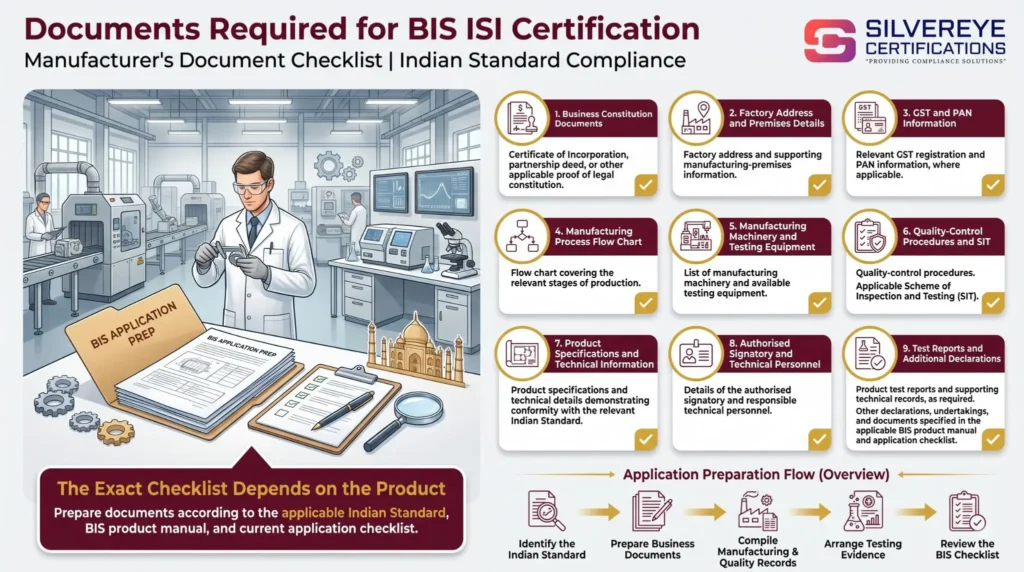
Submitting accurate and complete documentation helps BIS assess the application and reduces the likelihood of delays caused by missing information or inconsistencies.
BIS Certification Process for Immersion Water Heaters: Step by Step
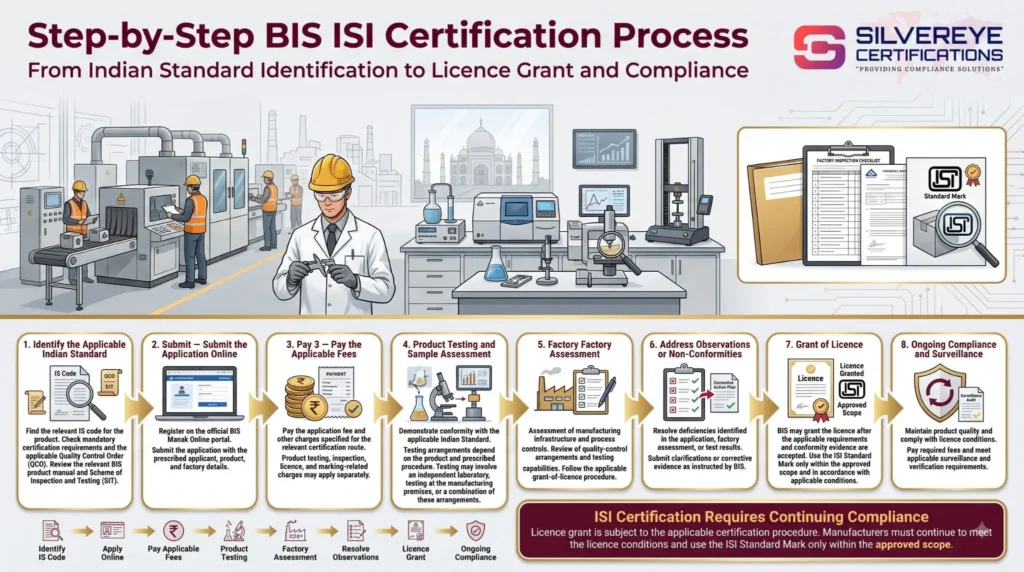
Obtaining BIS certification for an electric immersion water heater involves several stages, from identifying the applicable Indian Standard to completing product testing and factory assessment. Manufacturers must follow the correct certification route under Scheme-I of the BIS (Conformity Assessment) Regulations, 2018.
The following steps explain the general application process:
- Confirm the Applicable Quality Control Order and Standard: Identify whether your product is a portable immersion rod, a thermostat-fitted heater, or a fixed immersion heater. Confirm the applicable QCO and Indian Standard before beginning the certification process.
- Finalize Product Models and Critical Components: Prepare the list of models and finalize the Bill of Critical Components (BCC). Details such as heating elements, sheath materials, plugs, connecting cords, and terminal components should be consistent with the product submitted for testing. Changes after testing may require additional evaluation or retesting.
- Get the Product Tested at a BIS-Recognized Laboratory: Submit representative product samples to the appropriate recognized laboratory. The samples are tested against the applicable Indian Standard, and the laboratory issues a test report based on the results.
- Submit the Online BIS Application: BIS product certification applications are submitted online. Manufacturers must complete the application, upload the required business, factory, and product documents, and pay the applicable fees through the official BIS portal.
- Complete the Factory Assessment: A BIS officer assesses the manufacturing facility to verify production arrangements, quality control procedures, testing equipment, and the manufacturer's ability to maintain product conformity. For foreign manufacturers, the inspection may take place at the overseas manufacturing facility under FMCS.
- Undergo Sample Verification, Where Required: BIS may draw product samples from the factory for independent testing to verify that the manufactured product matches the approved specifications and tested model.
- Obtain the BIS License: After the application, testing, and factory assessment requirements are satisfactorily completed, BIS evaluates the case for license grant. The manufacturer must pay the applicable license fee and marking fee as required before the license is issued.
- Apply the ISI Mark and Maintain Compliance: After receiving the license, the manufacturer can apply the authorized ISI Mark and BIS license number to covered products. Compliance continues through applicable surveillance inspections, product sampling, quality checks, and record maintenance.
How Long Does BIS Certification Take?
The time required to obtain BIS certification for an electric immersion water heater depends on several factors, including product testing, laboratory availability, document preparation, factory readiness, and BIS application scrutiny.
The following timeline is an indicative estimate based on typical project planning. It is not an official BIS service commitment or guaranteed approval period.
| Certification Stage | Indicative Time |
|---|---|
| Product assessment and document preparation | 1–2 weeks |
| Testing at a recognised laboratory | 2–4 weeks, depending on the number of models and laboratory availability |
| Online application and initial scrutiny | 1–2 weeks |
| Factory inspection scheduling and assessment | 2–4 weeks |
| Licence grant after satisfactory compliance | 1–2 weeks |
| Overall Estimated Duration | Approximately 2–3 months, provided documents, samples, and the factory are ready |
The actual duration may be longer if the laboratory identifies product defects, documents require correction, or the factory needs improvements before assessment.
Manufacturers already selling portable immersion rods should pay particular attention to the applicable QCO deadlines. If the mandatory implementation date has passed, the certification requirement should be treated as an immediate compliance priority rather than a routine future task.
BIS Certification Fees for Electric Immersion Water Heaters
The cost of BIS certification for electric immersion water heaters depends on the applicable Indian Standard, number of product models, laboratory testing requirements, factory location, and marking fee structure.
BIS fees and concessions may change through official notifications. The following table provides indicative figures and cost categories; manufacturers should confirm the latest applicable amounts through the official BIS portal before submitting an application.
| Fee Component | Indicative Amount | Details |
|---|---|---|
| Application Fee | ₹1,000 | Paid online during application submission |
| Annual Licence Fee | ₹1,000 per year | Payable as required for the grant and continuation of the licence |
| Minimum Marking Fee | Product-specific | Calculated according to the applicable BIS marking fee schedule and production category |
| Marking Fee Payment | As per applicable BIS guidelines | The payment schedule should be confirmed against the current grant-of-licence requirements |
| MSME Concessions | Subject to eligibility | Applicable concessions may be available to eligible micro and small enterprises under current BIS provisions |
| Laboratory Testing | Charged at actuals | Depends on the applicable standard, number of models, and tests required |
| Factory Inspection | Charged as applicable | May involve additional travel-related expenses for overseas manufacturing facilities |
| Consultancy Charges | Based on project scope | Depends on model count, documentation, factory location, and support requirements |
Eligible manufacturers should also check whether they qualify for applicable MSME or women entrepreneur concessions under the latest BIS fee notifications. The percentage of concession, eligible fee components, and validity period must be confirmed before budgeting.
Where BIS product grouping guidelines permit, similar models may be considered together for certification. Models with limited differences, such as certain wattage variations or cord lengths, may be suitable for grouping. However, significant changes in heating element design, sheath material, construction, or safety components may require separate testing or evaluation.
Validity and Renewal of BIS License
A BIS license for an electric immersion water heater is subject to validity, renewal, fee payment, and continuing compliance requirements under the applicable BIS regulations.
The following table summarises the important licence-related aspects:
| Aspect | Details |
|---|---|
| Initial Validity | Up to 5 years, subject to the applicable BIS (Conformity Assessment) Regulations, including the 2026 amendments |
| Renewal | May be granted for a further period of up to 5 years, subject to applicable conditions |
| Annual Payments | Applicable annual licence and marking fees must be paid as required, even where the licence has a longer validity period |
| Renewal Application | Manufacturers should preferably apply at least two months before expiry, following the applicable BIS renewal procedure |
| Renewal Documents | Production and marking details, compliance records, applicable fees, and clearance of outstanding dues, as required |
| Delay or Non-Renewal | Failure to submit the renewal application or pay applicable fees within the prescribed period may affect licence continuation |
| Addition of New Models | New models and variants must be added to the licence scope through the applicable BIS procedure before using the ISI Mark |
A longer license validity does not remove the manufacturer's ongoing responsibilities. Surveillance inspections, annual fee payments, product conformity, and accurate production records remain important throughout the license period.
Importing Immersion Water Heaters: What Changes?
Importers and foreign manufacturers must also comply with the applicable BIS certification requirements before placing regulated immersion water heaters on the Indian market. The requirements depend on the product category and the relevant Quality Control Order.
- Foreign Manufacturer Certification: Overseas manufacturers must follow the applicable Foreign Manufacturers Certification Scheme (FMCS) requirements under Scheme-I. This generally involves appointing an authorized Indian representative and completing the required factory assessment. Covered products must carry the authorized ISI Mark before being sold in India.
- Existing Stock Clearance: The six-month stock clearance provision under the 2026 QCO applies to eligible goods listed in its Table and is subject to the conditions specified in the order. For fixed immersion heaters, the six-month period from 1 October 2026 would extend to 1 April 2027, subject to the required declaration to BIS and other applicable conditions. Importers of portable immersion rods should separately check the provisions of the domestic water heating order.
- Research and Development Imports: The 2026 order permits eligible manufacturers of household and similar electrical appliances to import up to 200 units per year for research and development purposes. These units cannot be sold commercially, and the prescribed record-keeping and disposal conditions must be followed. Any similar provision under the domestic water heating order should be checked separately before relying on it for portable immersion rods.
- Plan Import Compliance in Advance: Importers should include BIS certification requirements in their purchase orders, supplier agreements, and shipment planning. Confirming the manufacturer's license and product marking before dispatch can help avoid customs-related delays, non-compliance issues, and additional costs.
Common Mistakes to Avoid
Manufacturers and importers should carefully identify the applicable QCO and follow the correct BIS certification process. Some common mistakes can lead to application delays, testing problems, or regulatory action.
- Confusing Portable and Fixed Immersion Heaters: Assuming that the 2026 electrical appliances order covers all immersion heaters can result in applying under the wrong QCO. Portable rods and fixed immersion heaters may follow different regulatory routes.
- Ignoring Existing Compliance Deadlines: Manufacturers of portable immersion rods should check the implementation dates under the domestic water heating order rather than relying on the later dates specified in the 2026 order.
- Choosing the Wrong Certification Scheme: Applying under the Compulsory Registration Scheme (CRS) instead of the applicable Scheme-I certification route can delay the process.
- Changing Product Components After Testing: Replacing heating elements, sheath materials, cords, plugs, or other critical components without the required assessment may affect product conformity.
- Overlooking Thermostat-Related Scope Issues: A thermostat-fitted immersion heater may require a different standards assessment if it falls outside the scope of IS 368:2014. Confirm the correct route before testing.
- Underestimating Certification Costs: Budgeting only for the application fee while overlooking laboratory testing, factory inspection, marking fees, and applicable annual charges can create unexpected expenses.
- Confusing Immersion Heaters with Other Appliances: Immersion rods, fixed immersion heaters, storage geysers, instantaneous water heaters, and electric water boilers may fall under different standards or QCO entries. Each product should be assessed separately before applying.
Why Choose Silvereye Certifications?
BIS certification projects can face delays because of small but important issues, such as selecting the wrong Quality Control Order, applying an incorrect Indian Standard, missing critical component records, or inadequate factory preparation before inspection.
Silvereye Certifications is an Indian regulatory consultancy providing support for BIS, CDSCO, WPC, and other regulatory compliance requirements. We help manufacturers, importers, and brand owners understand the applicable certification process and prepare their applications with greater clarity.
What You Get When You Work With Us:
- Accurate Order and Standard Identification: We help identify the applicable Quality Control Order and Indian Standard for your immersion heaters, including portable rods, thermostat-fitted models, and fixed immersion heaters.
- Laboratory Coordination: We assist with sample preparation, laboratory coordination, and model grouping wherever permitted under applicable BIS guidelines.
- Application and Documentation Support: We help prepare the required documents, complete the online application, and guide you through the applicable fee payment process.
- Factory Inspection Preparation: Our team helps you prepare for the BIS factory assessment through quality control documentation, component records, and pre-inspection guidance.
- Importer and FMCS Assistance: We provide guidance on foreign manufacturer certification, Indian representative coordination, and applicable stock clearance provisions.
- Post-Licence Support: We assist with renewal requirements, marking fee-related guidance, ongoing compliance, and the addition of new models to the licence scope.
Whether you are launching a new immersion heater model or checking compliance for an existing product range, Silvereye Certifications can help you understand the applicable BIS requirements and plan the certification process.
Need help identifying the correct QCO, Indian Standard, and estimated certification cost for your immersion heaters? Share your product model details with the Silvereye Certifications team to discuss the applicable compliance requirements.
Conclusion
BIS certification for electric immersion water heaters requires careful assessment because different product types may fall under different Quality Control Orders and Indian Standards. Portable immersion rods are covered under the Electrical Appliances for Domestic Water Heating (Quality Control) Order, 2025, with IS 368:2014 as the applicable standard. Fixed immersion heaters are specifically listed at Serial No. 66 under the Safety of Household, Commercial and Similar Electrical Appliances (Quality Control) Order, 2026, subject to the order's scope and exclusions.
For manufacturers and importers, the first step is to identify the correct regulatory route for each product model. Finalising critical components, completing the required laboratory testing, preparing factory documentation, and submitting an accurate BIS application can help avoid unnecessary delays and compliance issues.
If you manufacture or import electric immersion water heaters, do not assume that one certification route applies to every model. Verify the applicable QCO, obtain the required BIS license, and maintain product conformity throughout the license period. With the right preparation and regulatory guidance, businesses can meet mandatory safety requirements and use the authorized ISI Mark to strengthen product credibility in the Indian market.
Frequently Asked Questions
Is BIS certification mandatory for electric immersion water heaters in India?
Portable immersion water heaters are covered by IS 368:2014 under the Electrical Appliances for Domestic Water Heating (Quality Control) Order, 2025, and fixed immersion heaters are named at serial no. 66 of the 2026 order. Confirm which applies to your model.
Which standard applies to immersion rods?
IS 368:2014, Electric Immersion Water Heaters, is the standard reported for portable rod-type heaters under the domestic water heating order.
What does the 2026 order say about immersion heaters?
It names Fixed Immersion Heaters at serial no. 66, requires IS 302 (Part 1):2024 and the Standard Mark, and applies from 1 October 2026 for general manufacturers, 1 January 2027 for small enterprises and 1 April 2027 for micro enterprises.
Does the 2026 order replace the domestic water heating order?
No. The 2026 order says it does not apply to appliances that fall under another Quality Control Order. Products under the domestic water heating order stay under it.
Does an immersion heater with a thermostat need IS 368?
Consultancy summaries note that IS 368 does not cover immersion heaters that incorporate a thermostat. Ask your lab which standard applies to your design.
What is the voltage limit under the 2026 order?
Up to 250 V for single-phase appliances and up to 480 V for other appliances.
Can I sell my existing stock?
Under the 2026 order, goods made or imported before the implementation date by a BIS-certified manufacturer, or one who has applied, can be sold or offered for sale for up to six months from that date, with a declaration to BIS. For portable rods, check the domestic water heating order.
Can I import sample heaters for R&D?
The 2026 order allows up to 200 units per year for R&D by manufacturers of household and similar electrical appliances. They cannot be sold commercially, and records must be kept.
Are export-only heaters exempt?
The 2026 order does not apply to goods manufactured domestically for export.
How much does BIS certification for an immersion water heater cost?
Government fees include a Rs 1,000 application fee, a Rs 1,000 annual license fee and a product-specific minimum marking fee. Testing and inspection are charged at actuals. Verify current figures on the BIS portal.
How long is the license valid?
Under the 2026 amendment, up to 5 years initially and renewable for up to 5 years. Annual fees still apply.
Can a foreign manufacturer apply?
Yes, through FMCS with an Indian representative. BIS may inspect the overseas factory.
What is the penalty for non-compliance?
The 2026 order says contravention is punishable under the BIS Act, 2016.
Can Silvereye Certifications manage the full process?
Yes. We handle order and standard mapping, lab coordination, application filing, factory audit preparation and renewals.