
- Where electric kettles fall under the Order: Electric kettles are not necessarily named separately in the illustrative list. They fall within the category of appliances for heating liquids, subject to the applicable QCO scope and exclusions.
- Implementation deadlines: The stated deadlines are 1 October 2026 for general manufacturers, 1 January 2027 for small enterprises, and 1 April 2027 for micro enterprises. Manufacturers should confirm their enterprise classification and the applicable notified provisions before relying on an extended deadline.
- Applicable standard: IS 302 (Part 1):2024 / IEC 60335-1:2020 covers general electrical safety requirements. Electric kettles must also be assessed against the applicable product-specific requirements for appliances for heating liquids, where required.
- Certification route: Certification is under BIS Scheme-I (ISI Mark Scheme). The process generally involves product testing, assessment of the manufacturing premises and quality-control arrangements, and obtaining a BIS license before using the ISI Mark, in accordance with the applicable requirements.
Introduction
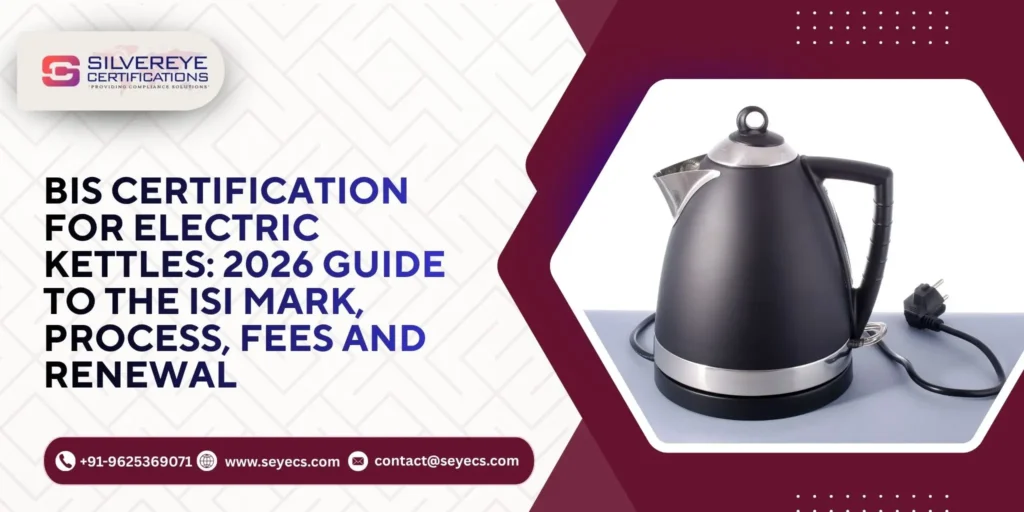
BIS Certification for Electric Kettles is a license issued by the Bureau of Indian Standards (BIS) that authorizes manufacturers to use the ISI Mark on products covered by the applicable certification requirements. Under the relevant 2026 Quality Control Order (QCO), electric kettles may fall under Sl. No. 8, covering appliances for heating liquids, depending on the product's classification and the Order's scope.

The stated implementation deadlines are 1 October 2026 for general manufacturers, 1 January 2027 for small enterprises, and 1 April 2027 for micro enterprises. The applicable requirements include testing against IS 302 (Part 1):2024, together with the relevant product-specific standard, where applicable, assessment of the manufacturing facility, and obtaining the required BIS license before using the ISI Mark.

Before manufacturing, importing, or selling a covered kettle, confirm the product classification, applicable standards, and implementation date against the latest official QCO and amendments. A recognized laboratory or BIS compliance consultant can help clarify the requirements for your specific model.
What Is BIS Certification for Electric Kettles?
An electric kettle combines boiling water, electricity and high operating temperatures, making product safety an important consideration. BIS certification verifies conformity with the applicable Indian Standard, while the ISI Mark indicates that the manufacturer is authorized to use the Standard Mark under a valid BIS license.
The certification process generally involves four key elements:
- BIS licence: The manufacturer must obtain the applicable licence before using the ISI Mark on covered products.
- Product testing: Samples are tested for applicable safety requirements, which may include protection against electric shock, temperature rise, abnormal operation, stability, mechanical hazards and moisture resistance.
- Factory assessment: BIS assesses the manufacturing facility and quality-control arrangements to determine whether production can consistently meet the relevant standard.
- ISI Mark and licence details: Covered products must bear the required Standard Mark in accordance with the applicable BIS marking requirements.
The 2026 Quality Control Order specifies the Scheme-I (ISI Mark) certification route. This is different from the Compulsory Registration Scheme (CRS), which applies to specified product categories under a separate certification framework.
What the 2026 Order Says
On 6 April 2026, the Ministry of Commerce and Industry, through the Department for Promotion of Industry and Internal Trade (DPIIT), issued S.O. 1739(E), titled the Safety of Household, Commercial and Similar Electrical Appliances (Quality Control) Order, 2026. It was issued under Section 16 of the Bureau of Indian Standards Act, 2016, superseding the 2025 Order, subject to the provision concerning actions or omissions before supersession.
| Point | What the 2026 Order says |
|---|---|
| Scope | Electrical appliances intended for household, commercial or similar applications, rated up to 250 V for single-phase appliances and 480 V for other appliances, including DC-supplied and battery-operated appliances, subject to the Order's exclusions. |
| General standard | IS 302 (Part 1):2024 / IEC 60335-1:2020, covering general safety requirements. |
| Certification route | The Standard Mark (ISI Mark) under a BIS licence through Scheme-I of Schedule-II of the BIS (Conformity Assessment) Regulations, 2018. |
| Standard version | The Order states that the latest version of the applicable Indian Standards shall apply. |
| Certifying and enforcing authority | Bureau of Indian Standards (BIS). |
| Penalty | Contravention is punishable under the BIS Act, 2016. |
| Exclusions | Appliances covered by another Quality Control Order under the BIS Act or notified for mandatory BIS certification under another Act. |
Implementation Deadlines
| Business category | Implementation date |
|---|---|
| General manufacturers and importers, other than micro and small enterprises | 1 October 2026 |
| Small enterprises | 1 January 2027 |
| Micro enterprises | 1 April 2027 |
The small and micro enterprise categories are determined under the Micro, Small and Medium Enterprises Development Act, 2006. As of 30 October 2026, the general implementation date has passed, while the specified deadlines for small and micro enterprises are still in the future. Eligibility for a particular deadline should be confirmed against the applicable provisions and enterprise classification.
The Order also provides for certain exemptions, including qualifying domestic manufacturing for export, specified research-and-development imports, and the sale of declared legacy stock subject to the conditions stated in the Order.
Related reading: Explore our wider guides to BIS certification for domestic water-heating products and BIS certification for heating appliances. This article focuses specifically on electric kettles.
Are Electric Kettles Covered? Understanding the Classification
The 2026 Order does not name electric kettles separately. Instead, its illustrative list includes Sl. No. 8, “Appliances for Heating Liquids.” BIS material identifies IS 302 (Part 2/Sec 15):2009 as the particular-requirements standard for appliances for heating liquids, including electric kettles. The applicable standard and certification scope should nevertheless be confirmed for the specific product.
| Sl. No. | Entry in the Order | Relevance to electric kettles |
|---|---|---|
| 8 | Appliances for Heating Liquids | The relevant category to assess for conventional electric kettles. |
| 15 | Electric Water Boilers | May be relevant to products designed and marketed as water boilers; confirm classification based on the product's construction and intended use. |
| 16 | Electric Coffee Makers | Relevant where the appliance's principal function is coffee preparation rather than simply boiling water. |
For conventional electric kettles, Sl. No. 8 is the relevant starting point, but the final classification depends on the product's design, intended use and applicable requirements. Multifunction appliances that also cook, steam or maintain liquid temperature may require further assessment.
Before arranging product testing, ask a BIS-recognized laboratory or qualified compliance consultant to confirm the classification, applicable standard editions and any additional requirements. This can help avoid testing against an unsuitable standard.
Kettle Types to Check With Your Lab
| Kettle type | What to confirm before applying |
|---|---|
| Cordless kettle with a power base | Confirm the assessment requirements for the kettle and its matching power base. |
| Corded kettle | Check the power cord, plug, electrical connections and applicable safety requirements. |
| Gooseneck or temperature-control kettle | Declare adjustable temperature controls and any additional operating modes. |
| Travel or foldable kettle | Provide details of its capacity, construction, rated voltage and intended use. |
| Glass, stainless-steel or plastic-bodied kettle | Confirm the relevant construction, thermal and mechanical safety checks for the materials used. |
| Multifunction kettle with keep-warm, cooking or steaming functions | Request a classification review to establish the applicable standard and any additional requirements. |
Important: The examples above are practical considerations, not a substitute for the full test requirements. The laboratory should determine the applicable tests from the relevant Indian Standards and the product's construction.
Who Needs the BIS License for Electric Kettles?
Under the Safety of Household, Commercial and Similar Electrical Appliances (Quality Control) Order, 2026, covered electric kettles must comply with the applicable Indian Standard and carry the ISI Mark under a valid BIS license once the relevant implementation date applies.
The responsibilities differ depending on your role in the supply chain:
- Indian manufacturers: Manufacturers producing covered electric kettles at an Indian factory must obtain the applicable BIS license and meet the relevant testing, factory assessment and quality-control requirements.
- Foreign manufacturers: Manufacturers with factories outside India can apply under the Foreign Manufacturers Certification Scheme (FMCS). An Authorised Indian Representative (AIR) resident in India must be nominated as required by BIS. The licence is associated with the foreign manufacturer's manufacturing premises and covered products.
- Importers and brand owners: Importers do not ordinarily obtain the product license in their own capacity under Scheme-I. They must source covered products from a manufacturer holding the appropriate valid BIS license. If you sell kettles under your own brand, confirm that the manufacturer's license covers the relevant product, manufacturing location and brand arrangements.
- Retailers, distributors and online sellers: These businesses must ensure that covered kettles they source and sell comply with the applicable QCO. A retailer or importer cannot rely solely on a supplier's assurance; check the manufacturer's license and the product's coverage.
Important: A BIS application submitted by a manufacturer is not the same as a granted license. Any transitional stock provision must be assessed separately against the exact conditions in the Order.
Why BIS Certification Matters for Electric Kettles
BIS certification is important for manufacturers and supply-chain businesses dealing with electric kettles covered by the QCO.
- Regulatory compliance: Covered products must meet the applicable requirements and carry the ISI Mark under a valid BIS license once the relevant deadline applies, subject to any specific exemption or transitional provision.
- Electrical and thermal safety: Electric kettles operate with water, electricity and high temperatures. Applicable safety testing helps assess risks such as electric shock, excessive temperature, abnormal operation and other hazards covered by the relevant standard.
- Retail and distribution readiness: Buyers and retail partners may request BIS license details and product compliance records. Requirements vary by buyer and sales channel.
- Quality control: Factory assessment and ongoing conformity requirements help manufacturers maintain consistent production quality rather than relying on a single tested sample.
- Consumer confidence: Correct use of the ISI Mark provides a recognizable indication that the covered product is certified under the applicable BIS scheme.
Certification does not guarantee that a product will never fail or that every marketplace will accept it. Its purpose is to establish conformity with the applicable standard and regulatory requirements.
Applicable Standards for Electric Kettles
The 2026 QCO specifies IS 302 (Part 1):2024, aligned with IEC 60335-1:2020, as the general safety standard for the listed electrical appliances.
For electric kettles, the relevant product-specific requirements must also be checked. The corresponding international particular standard is IEC 60335-2-15, which covers particular requirements for appliances for heating liquids and other specified appliances. BIS material identifies IS 302 (Part 2/Sec 15):2009 for appliances for heating liquids, including electric kettles.
The precise Indian Standard parts and applicable editions should be confirmed with BIS or a BIS-recognized laboratory before testing. The QCO also states that the latest applicable version of the Indian Standards applies.
Latest Update (October 2026): What the 2026 Order Means for You
The Ministry of Commerce and Industry (DPIIT) issued S.O. 1739(E) on 6 April 2026, superseding the 2025 Safety of Household, Commercial and Similar Electrical Appliances QCO, subject to the provision for actions or omissions before supersession. The 2026 Order came into force on 1 October 2026 and includes “Appliances for Heating Liquids” at Sl. No. 8.
Implementation dates and transitional stock
| Business category | Implementation date | Potential stock sell-through period | Recommended action |
|---|---|---|---|
| General manufacturers and importers, excluding micro and small enterprises | 1 October 2026 | Up to six months from the applicable implementation date, subject to the Order's conditions and a declaration to BIS | Confirm licence status and eligibility for the transitional stock provision before selling covered stock. |
| Small enterprises | 1 January 2027 | Up to six months from the applicable implementation date, subject to the Order's conditions and a declaration to BIS | Complete product testing and the licensing process well before the deadline. |
| Micro enterprises | 1 April 2027 | Up to six months from the applicable implementation date, subject to the Order's conditions and a declaration to BIS | Confirm enterprise classification and prepare the factory and documentation for assessment. |
The six-month stock provision is conditional. It concerns qualifying goods manufactured domestically or imported before the relevant implementation date by a BIS-certified manufacturer or a manufacturer that has applied for certification, and requires a declaration to BIS. It should not be interpreted as a general grace period for every importer, retailer or seller.
The estimated end dates are 1 April 2027 for the general category, 1 July 2027 for small enterprises, and 1 October 2027 for micro enterprises. These dates are calculated by adding six months to the respective implementation dates; confirm the applicable counting and declaration requirements with BIS before relying on them.
Before making a compliance decision, check the latest QCO, amendments and BIS guidance. Enterprise classification and eligibility for any transitional relief should be confirmed for the specific business and stock.
Documents Required for BIS Certification of Electric Kettles
The following is a working preparation checklist for a Scheme-I application. The final requirements depend on the application route, product, manufacturing premises and current BIS instructions.
| Document or information | Purpose |
|---|---|
| Application through the BIS online portal | Initiates the certification application. |
| Business registration documents | Establish the applicant's legal identity and business details. |
| Udyam registration certificate, where applicable | Supports the claimed small or micro enterprise classification; BIS may require additional evidence. |
| Factory address and premises details | Identify the manufacturing location to be assessed. |
| Factory layout and manufacturing process flow chart | Explain the production process and manufacturing controls. |
| List of manufacturing machinery | Demonstrates the facilities available for production. |
| Testing equipment and calibration records | Show the available in-house testing capability and reliability of measurements. |
| Quality-control plan, inspection records and applicable testing arrangements | Demonstrate how conformity will be maintained during production. |
| Product technical details | Include model numbers, rated voltage, power, capacity, heating element, thermostat, boil-dry protection, cord, plug, base and critical components, as applicable. |
| Circuit diagram, component list and user instructions | Support technical assessment of the product design and its intended use. |
| Authorised signatory details | Identify the person authorised to represent the applicant. |
| Product test reports, where required or already available | Support conformity assessment. BIS may arrange sampling and independent testing as part of the certification process. |
| Foreign manufacturer and AIR documents, where applicable | Support an FMCS application and the required representation in India. |
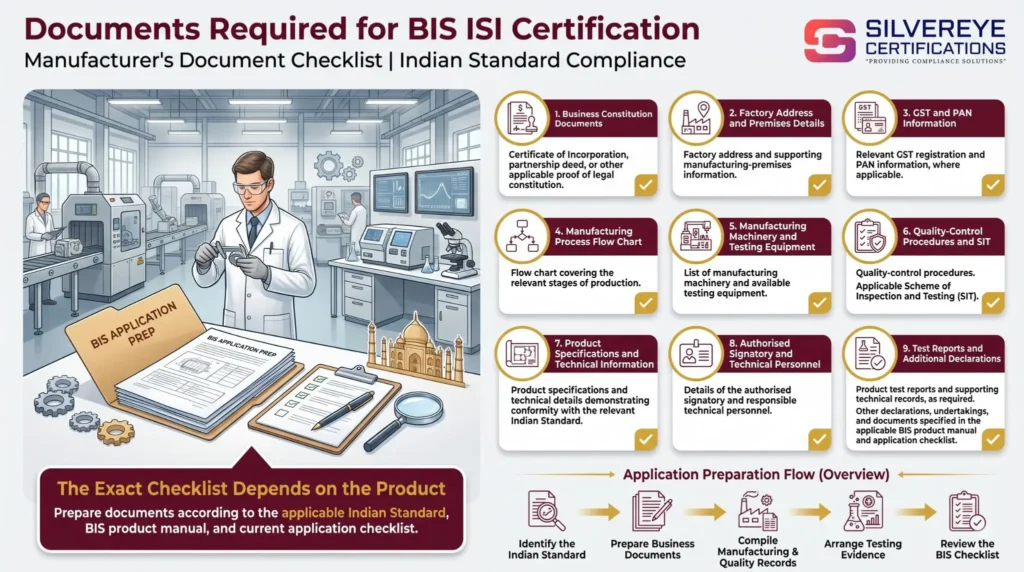
Do not assume that an independent laboratory test report must always be available before submitting the application. Follow the current BIS application checklist and the testing and sampling procedure applicable to your case. BIS may require a factory visit, verification of manufacturing and testing infrastructure, and independent product testing before granting the license.
Before applying, confirm the applicable Indian Standard, product classification, factory requirements and current document checklist with BIS or a recognized laboratory. This helps reduce avoidable queries and delays during certification.
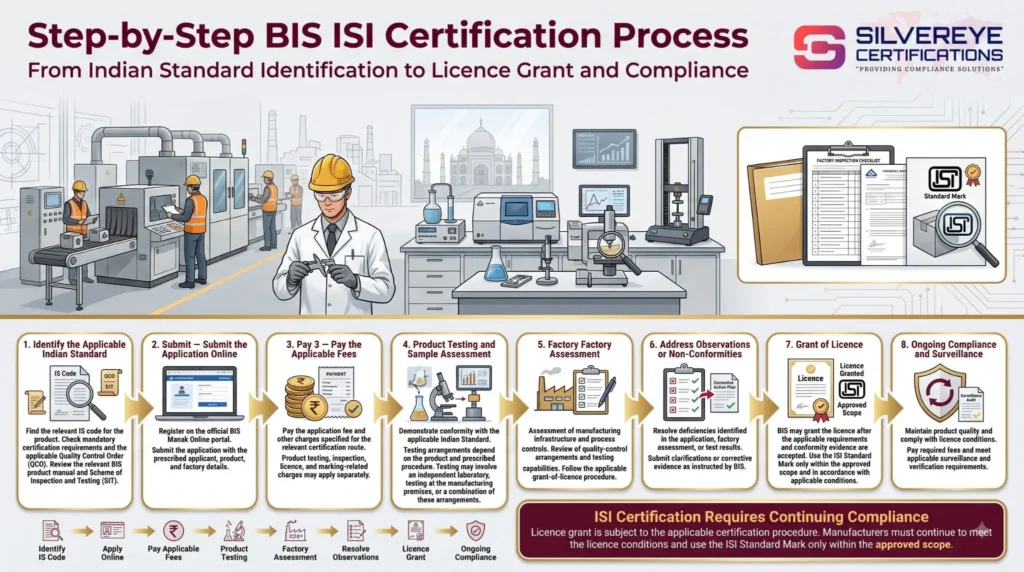
BIS Certification Process for Electric Kettles: Step by Step
Manufacturers applying for BIS certification for electric kettles must establish product conformity and demonstrate that their manufacturing facility can consistently produce compliant products. The application is submitted through the BIS online portal under Scheme-I (ISI Mark Scheme).
Step 1: Confirm the Product Classification and Applicable Standards
Check whether your kettle falls under Sl. No. 8, Appliances for Heating Liquids, in the 2026 Quality Control Order. Identify the applicable general and product-specific Indian Standards before arranging testing.
Step 2: Prepare the Manufacturing Facility
Ensure that the factory has the required manufacturing infrastructure, process controls, quality-control procedures and testing facilities. Keep relevant equipment calibration records and inspection records ready for assessment.
Step 3: Submit the BIS Application
Apply through the official Manak Online portal with the required company, factory and product details. Pay the applicable application fee and respond to any queries raised by BIS.
Step 4: Arrange Product Testing
Follow the applicable BIS testing procedure for your product. Depending on the certification route, conformity may be established through third-party laboratory testing, testing at the manufacturing premises, or a combination of these methods.
Step 5: Complete the Factory Assessment
BIS assesses the manufacturing and testing infrastructure, process controls and quality-management arrangements. Samples may be drawn for independent testing as part of the applicable procedure.
Step 6: Resolve Queries and Non-Conformities
If BIS or the laboratory identifies missing information or product non-conformities, address the issues and provide the required evidence or corrective actions.
Step 7: Obtain the BIS License
BIS evaluates the application, factory assessment and test results. Once the applicable requirements and payments are completed, BIS may grant the licence covering the specified product varieties and manufacturing premises.
Step 8: Apply the ISI Mark Correctly
After the licence is granted, mark covered kettles in accordance with the BIS licence conditions and applicable marking requirements. Do not use the ISI Mark merely because an application has been submitted or testing has started.
Step 9: Maintain Compliance After Certification
Maintain production and testing records, meet applicable marking-fee and reporting obligations, and cooperate with BIS surveillance and market-surveillance activities. Inform BIS about relevant changes to the product, manufacturing premises or licence scope through the applicable procedure.
How Long Does BIS Certification Take?
The timeline depends on the application route, completeness of the documentation, laboratory scheduling, factory inspection, test results and the time needed to resolve queries.
BIS publishes indicative timelines for different Scheme-I application options. These should be treated as guidance rather than a guarantee, particularly for products requiring additional testing or corrective action. Before planning a launch, confirm the current route and expected timeline with BIS or a qualified compliance professional.
If you manufacture multiple kettle models, discuss the applicable product-variety grouping and scope-of-licence requirements before testing. Different models cannot automatically be included under one licence simply because they share the same product category.
BIS Certification Fees, Validity and Renewal
The total cost of BIS certification for electric kettles depends on the applicable fee schedule, testing requirements, factory assessment and number of product varieties involved. BIS publishes its fee information and marking-fee notifications online, so check the latest applicable rates before budgeting.
Cost Components
| Fee component | What it covers |
|---|---|
| Application fee | Submission and processing of the Scheme-I application. |
| Inspection fee | Applicable charges for factory assessment, as specified by BIS. |
| Licence fee | The prescribed fee associated with granting or maintaining the licence. |
| Minimum marking fee and marking charges | Fees determined under the applicable BIS schedule and product-specific marking-fee provisions. |
| Laboratory testing charges | Testing costs based on the applicable standards, samples and laboratory arrangements. |
| FMCS-related costs | Additional requirements and charges applicable to foreign manufacturers. |
| Consultant fees | Optional professional support for documentation, coordination and compliance preparation. |
Important: The final cost should be confirmed against the current BIS fee schedule and the specific product's marking-fee requirements. Laboratory and consultant charges may be separate from fees payable to BIS.
BIS License Validity and Renewal
| Licence aspect | Details |
|---|---|
| Initial validity | A Scheme-I licence may initially be granted for a period of up to two years, subject to the applicable procedure. |
| Renewal period | Renewal may be granted for up to five years, subject to BIS requirements. |
| Renewal application | Submit the renewal request through Manak Online with the applicable fees and supporting information. |
| Production records | Production details may be required to calculate marking fees and assess compliance. |
| Changes to the licence | Changes to product varieties, manufacturing premises or other licence details must be handled through the applicable BIS procedure. |
| Expired licence | Do not assume that an expired licence continues to authorise ISI marking. Confirm the licence status and applicable requirements before marking or dispatching products. |
Exemptions and Transition Rules Under the 2026 Order
The 2026 QCO provides specific exemptions and transitional provisions. Businesses should check the exact wording and eligibility conditions before relying on any of them.
- Products manufactured domestically for export: The Order excludes goods manufactured domestically for export from its requirements.
- Research and development imports: Up to 200 units per year may be imported by manufacturers of household and similar electrical appliances for research and development, subject to the conditions in the Order. These units must not be sold commercially, must be disposed of as scrap, and must be recorded year-wise for production to the Central Government on request.
- Qualifying pre-deadline stock: Goods manufactured domestically or imported before the relevant implementation date by a BIS-certified manufacturer, or a manufacturer that has applied for certification for the relevant goods, may qualify for the six-month stock sell-through provision. The manufacturer must submit the required declaration to BIS. This is not a blanket grace period for all importers or retailers.
- Staggered implementation for small and micro enterprises: The specified implementation dates are 1 January 2027 for small enterprises and 1 April 2027 for micro enterprises, compared with 1 October 2026 for the general category. Enterprise classification and eligibility must be verified.
Penalty for BIS Non-Compliance
The 2026 Quality Control Order states that contraventions are punishable under the Bureau of Indian Standards Act, 2016. The applicable consequences depend on the nature of the violation and the relevant provisions of the Act.
Businesses should not assume that an uncertified product can be sold simply because its certification application is pending. Before manufacturing, importing, marking or selling covered electric kettles, confirm the applicable deadline, licence status and eligibility for any exemption or transitional provision.
Common Mistakes to Avoid For BIS Certification
- Assuming electric kettles are exempt because the Table does not name them separately.
- Choosing the wrong product classification without checking the applicable QCO entry and standards.
- Testing a cordless kettle with a different power base from the one intended for sale.
- Using only the general safety standard without checking applicable product-specific requirements.
- Using a laboratory or testing route that does not meet the applicable BIS procedure.
- Assuming an importer can obtain the manufacturing licence on behalf of a foreign factory under FMCS.
- Changing critical components, such as the thermostat, switch or boil-dry protection, without checking whether BIS approval or a licence-scope change is required.
- Using the ISI Mark before the licence is granted or after the licence has expired.
- Missing renewal and marking-fee obligations or failing to maintain required records.
Why Choose Silvereye Certifications for BIS Certification?
Preparing for BIS certification involves more than submitting an application. Correct product classification, suitable testing arrangements, complete documentation and factory readiness all contribute to a smoother process.
Silvereye Certifications can support manufacturers and businesses in understanding the applicable requirements for electric kettles.
- Product and standard assessment: Get assistance in identifying the relevant QCO entry and applicable Indian Standard parts for your kettle model.
- Documentation support: Prepare and review the application documents and technical information required for the relevant certification route.
- Testing coordination: Understand the applicable testing requirements and coordinate the preparation of samples and technical records.
- Factory-readiness guidance: Identify documentation, process-control and testing-capability gaps before the factory assessment.
- Process and compliance support: Get guidance on application follow-ups, licence-scope changes and renewal requirements.
The certification decision rests with BIS, and approval timelines depend on the applicable process and assessment results. Silvereye Certifications can help you prepare the required information and plan the process, but cannot guarantee a licence or a fixed approval date.
Planning to manufacture or import electric kettles in India? Share your product details, manufacturing location and intended launch date with Silvereye Certifications to discuss the applicable compliance route.
Conclusion
BIS Certification for Electric Kettles is an important compliance requirement for covered products under the Safety of Household, Commercial and Similar Electrical Appliances (Quality Control) Order, 2026. Manufacturers and businesses should confirm their product classification, applicable Indian Standards, testing requirements and licensing obligations before entering the Indian market.
The implementation deadlines are 1 October 2026 for general manufacturers and importers, 1 January 2027 for small enterprises, and 1 April 2027 for micro enterprises, subject to the applicable provisions and eligibility criteria. Preparing the required documents, arranging product testing and ensuring factory readiness can help businesses plan their certification process effectively.
For guidance on product classification, BIS documentation, testing coordination and licence requirements, Silvereye Certifications can help you understand the applicable compliance route. Always verify the latest BIS notifications, standards and fee requirements before making business decisions.
Frequently Asked Questions
Is BIS certification mandatory for electric kettles?
Kettles are normally assessed as appliances for heating liquids, which is Sl. No. 8 in the 2026 Order's Table, so the ISI Mark is expected from the dates below. Confirm your model's classification first.
Are electric kettles named in the Order?
Not by name. The Table lists appliances for heating liquids, and kettles are the usual example of that category.
What is the deadline BIS Certification for Electric kettles?
1 October 2026 for general manufacturers, 1 January 2027 for small enterprises and 1 April 2027 for micro enterprises.
Which standard applies for electric kettles?
IS 302 (Part 1): 2024, aligned with IEC 60335-1:2020, usually tested with the product-specific part for appliances for heating liquids.
Does a travel or foldable kettle need certification?
If it is an electric kettle for household use within the rated voltage limits, it is likely in scope. Declare its size and design clearly to the lab.
What about kettles that also cook or steam?
They may fall under a different entry or need extra standard parts, so get the classification confirmed before testing.
Can an importer get the licence?
The licence is issued to the manufacturer. A foreign manufacturer applies under FMCS, usually with an Authorised Indian Representative.
How long is the licence valid?
Generally one or two years, at the manufacturer's option, and it must be renewed before expiry.
How long does certification take?
There is no fixed time. Many applicants plan for roughly two to three months, depending on testing and inspection.
Can I sell kettles made before the deadline?
Possibly. Certified manufacturers, or those who have applied, may sell declared stock for up to six months from the implementation date, subject to a declaration to BIS.
Are export-only kettles exempt?
Yes. The Order does not apply to goods manufactured domestically for export.
What are the penalties for selling without certification?
Violations are punishable under the BIS Act, 2016, which provides for fines and, in serious cases, imprisonment.