
- Named in the order: Appliances for Heating Liquids are listed at serial number 8 of the 2026 Quality Control Order.
- Implementation deadlines: 1 October 2026 for general manufacturers, 1 January 2027 for small enterprises, and 1 April 2027 for micro enterprises, subject to the applicable order and eligibility criteria.
- Certification requirement: Manufacturers should assess the need for a BIS Scheme-I license to use the ISI Mark, including testing against the applicable standard and factory assessment requirements.
- Check related products: Water boilers, coffee makers and steam cookers may have separate entries or fall under different orders. Confirm the product's classification and applicable Indian Standard before applying.
Introduction
BIS Certification for Appliances for Heating Liquids is a license to use the ISI Mark under Scheme-I of the BIS (Conformity Assessment) Regulations, 2018. The Safety of Household, Commercial and Similar Electrical Appliances (Quality Control) Order, 2026, notified through S.O. 1739(E), lists Appliances for Heating Liquids at serial number 8.
- Applicable Standard: IS 302 (Part 1):2024, covering general safety requirements for household and similar electrical appliances.
- Products Covered: Depending on their classification and applicable product-specific requirements, the category may include electric kettles, milk heaters, egg boilers and similar liquid-heating appliances.
- Implementation Dates: 1 October 2026 for general manufacturers, 1 January 2027 for small enterprises and 1 April 2027 for micro enterprises.
- Certification Requirement: Applicable products must conform to the prescribed Indian Standard and bear the ISI Mark under a valid BIS licence once the relevant implementation date applies.
- Export Exemption: The QCO exempts goods manufactured domestically for export, subject to the order's provisions.
Manufacturers should verify their product classification, applicable standard and certification requirements before applying for a BIS license.
What Is BIS Certification for Appliances for Heating Liquids?
The Bureau of Indian Standards (BIS) is India's national standards body. BIS certification for appliances for heating liquids allows manufacturers to use the ISI Standard Mark after meeting the applicable product safety requirements and obtaining a BIS licence.

Under the Safety of Household, Commercial and Similar Electrical Appliances (Quality Control) Order, 2026, the applicable certification route is Scheme-I under Schedule II of the BIS (Conformity Assessment) Regulations, 2018. This is a factory-based certification process involving product testing and factory assessment, rather than the Compulsory Registration Scheme (CRS) used for certain electronic products.
Three key elements determine the certification requirements:
- Applicable general safety standard: IS 302 (Part 1):2024 covers general safety requirements for household and similar electrical appliances. It is aligned with the relevant IEC safety framework.
- Product-specific safety requirements: IEC 60335-2-15 covers particular requirements for appliances for heating liquids. Manufacturers should confirm the applicable Indian Standard, edition and product-specific requirements for their appliance model.
- BIS licence and ISI Mark: The manufacturer must complete the applicable testing and factory assessment requirements and obtain a BIS licence before applying the ISI Mark to products covered by the order.
Manufacturers should confirm the product's classification and the applicable Indian Standards with BIS before beginning the certification process.
Why Kitchen Appliance Brands Should Pay Attention
Electric kettles, milk heaters and other liquid-heating appliances combine electricity, hot liquids and steam, making product safety an important consideration for manufacturers and importers.
The Ministry of Commerce and Industry, through the Department for Promotion of Industry and Internal Trade (DPIIT), issued the Safety of Household, Commercial and Similar Electrical Appliances (Quality Control) Order, 2026 on 6 April 2026. The order lists Appliances for Heating Liquids at serial number 8 and establishes implementation dates for general, small and micro enterprises. The general implementation date is 1 October 2026.
This guide explains the order's requirements, the potential product scope, applicable standards, exemptions and certification considerations for manufacturers, importers and brand owners. If your business manufactures several types of kitchen appliances, review the requirements for each product category rather than assuming that one classification covers the entire range.
2026 Regulatory Update: Safety of Household, Commercial and Similar Electrical Appliances (QCO) 2026
The following summary is based on the text of the official Gazette notification, S.O. 1739(E), dated 6 April 2026. Manufacturers should consult the complete notification and current BIS guidance before making compliance decisions.
Order details
| Item | What the order states |
|---|---|
| Official name | Safety of Household, Commercial and Similar Electrical Appliances (Quality Control) Order, 2026 |
| Notification number | S.O. 1739(E) |
| Notification date | 6 April 2026 |
| Issuing department | Department for Promotion of Industry and Internal Trade, Ministry of Commerce and Industry |
| Legal authority | Section 16 of the Bureau of Indian Standards Act, 2016 |
| Previous order | Supersedes the 2025 QCO, except for actions already taken or omissions before supersession |
| Commencement date | 1 October 2026 |
Clause 1: Application and scope
The order applies to electrical appliances intended for household, commercial or similar applications, subject to the specified voltage limits:
- Single-phase appliances: Rated voltage not exceeding 250 V.
- Other appliances: Rated voltage not exceeding 480 V, including direct-current-supplied and battery-operated appliances.
- Exclusions: Appliances covered by another Quality Control Order under the BIS Act or notified for mandatory BIS certification under another Act are excluded from this order's scope.
The applicability of the order should be checked against the product's intended use, rated voltage and any other applicable regulatory order.
Clause 2: Compulsory use of the Standard Mark
Products listed in the order must conform to the corresponding Indian Standard and bear the BIS Standard Mark under a valid licence issued through Scheme-I of Schedule II of the BIS (Conformity Assessment) Regulations, 2018, once the relevant implementation date applies.
For the listed appliance categories, the QCO specifies IS 302 (Part 1):2024, corresponding to IEC 60335-1:2020, titled Household and Similar Electrical Appliances — Safety, Part 1: General Requirements. The order also states that the latest version of the Indian Standards applies.
For appliances for heating liquids, manufacturers should also determine whether additional product-specific standards or requirements apply to their particular model. Do not assume that the general safety standard alone resolves every testing requirement.
Implementation dates under the 2026 QCO
| Enterprise category | Implementation date |
|---|---|
| General manufacturers, excluding micro and small enterprises | 1 October 2026 |
| Small enterprises | 1 January 2027 |
| Micro enterprises | 1 April 2027 |
These dates are specified in the order. Enterprises should establish their applicable MSME classification and confirm the relevant implementation date before planning product launches or imports.
Exemptions and provisos under Clause 2
The order contains specific exemptions and transitional provisions:
- Goods manufactured for export: The order does not apply to goods manufactured domestically for export.
- Small and micro enterprises: These enterprises must comply from their respective implementation dates specified in the order.
- Research and development imports: Up to 200 units per year may be imported by manufacturers of household and similar electrical appliances for R&D, subject to the conditions that the goods are not sold commercially, are disposed of as scrap where applicable, and are recorded annually. Records must be furnished to the Central Government if requested.
- Existing stock: Certain goods manufactured domestically or imported before the relevant implementation date may be sold, displayed or offered for sale for up to six months from that date, subject to the conditions in the order. These include the specified manufacturer-certification or application status and a declaration to BIS covering the stock.
These provisions are subject to the exact wording and conditions in the Gazette. Businesses should verify eligibility before relying on an exemption.
Clause 3: Certification and enforcement authority
The Bureau of Indian Standards (BIS) is the certification and enforcement authority for the products specified in the order.
Clause 4: Penalty
Contravention of the order is punishable under the provisions of the Bureau of Indian Standards Act, 2016. Manufacturers and importers should therefore confirm their product classification and certification obligations before the relevant implementation date.
Related product entries in the QCO
The order lists several appliance categories separately. Examples include:
| Serial number | Product category |
|---|---|
| 7 | Frying pans, deep fat fryers and similar appliances |
| 8 | Appliances for heating liquids |
| 10 | Electric forced-convection ovens, steam cookers and steam-convection ovens |
| 12 | Electric steam cookers |
| 15 | Electric water boilers |
| 16 | Electric coffee makers |
| 66 | Fixed immersion heaters |
These are separate entries in the QCO. The appropriate classification depends on the actual product and the wording of the relevant entry. A product's marketing name alone may not determine its regulatory classification.
Which Products Does BIS Certification for Appliances for Heating Liquids Cover?
The 2026 QCO lists Appliances for Heating Liquids as a separate product category, but it does not name every individual appliance in that entry. IEC 60335-2-15:2024 provides useful context because its scope includes several types of household liquid-heating appliances. However, the IEC standard's scope alone does not determine which QCO entry applies to a product in India.
Examples covered by the international product standard include:
- Coffee makers
- Cooking pans
- Egg boilers
- Feeding-bottle heaters
- Kettles and other water-boiling appliances with a rated capacity not exceeding 10 litres
- Milk heaters
- Pressure cookers with a rated cooking pressure not exceeding 140 kPa and a capacity not exceeding 10 litres
- Rice cookers
- Slow cookers and steam cookers
- Soy milk makers and tea makers
- Wash boilers and yoghurt makers
The standard also excludes certain appliance types, including frying pans and deep-fat fryers, storage and instantaneous water heaters, portable immersion heaters, commercial dispensing appliances, vending machines and household humidifiers. Confirm the applicable Indian Standard and any separate QCO requirements before classifying a product.
Product Classification Guide for Manufacturers
| Product | Potential classification consideration | What to confirm |
|---|---|---|
| Corded or cordless electric kettle | Appliances for Heating Liquids may be relevant | Confirm the applicable QCO entry and Indian Standard |
| Milk heater, egg boiler or feeding-bottle heater | Examples in the international liquid-heating standard | Verify the applicable Indian product standard and licence scope |
| Electric water boiler | The QCO has a separate entry for Electric Water Boilers | Check the distinction between a water boiler and a storage water heater |
| Coffee maker | The QCO lists Electric Coffee Makers separately | Confirm the requirements under that specific entry |
| Electric steam cooker | Steam cookers appear in the international product standard, while the QCO lists separate steam-cooker categories | Determine the correct entry based on the product's design and function |
| Rice cooker or cooking pan | Included in the international standard's examples | Confirm the applicable QCO entry; inclusion in the IEC scope does not automatically establish coverage under serial number 8 |
| Pressure cooker | Included within defined limits in the international standard | Check the applicable pressure-cooker requirements and whether another QCO governs the product |
| Storage or instantaneous water heater | A separate product category may apply | Verify the relevant QCO and Indian Standard |
| Portable immersion heater | Excluded from the cited IEC product standard | Confirm the applicable Indian regulatory requirements |
| Deep-fat fryer | Listed separately in the QCO | Check the requirements for its specific category |
Practical tip: Before finalising a product design, placing a manufacturing order or applying for a BIS licence, ask your testing laboratory or compliance consultant to confirm the classification and applicable Indian Standard in writing.
What Do Laboratories Check on Appliances for Heating Liquids?
Laboratory testing assesses whether an appliance meets the applicable electrical safety requirements. The exact test plan depends on the product, its design, the applicable Indian Standard and the relevant product-specific requirements.
Common areas of assessment may include:
- Protection against electric shock and moisture: Evaluates protection against access to live parts and relevant moisture or spillage conditions.
- Surface temperatures: Checks accessible surfaces for compliance with applicable temperature limits.
- Abnormal operation: Evaluates relevant fault conditions, such as operation without sufficient water, where applicable to the appliance.
- Electrical safety: Includes applicable leakage-current and electric-strength tests.
- Stability and mechanical safety: Examines stability, handles, lids, bases and other relevant mechanical features.
- Construction and components: Reviews internal wiring, electrical components, insulation, clearances and earthing where applicable.
- Materials and containers: May include applicable impact or other material-related tests for glass or plastic containers.
- Marking and instructions: Checks ratings, safety warnings, product identification and instructions.
The applicable test requirements must be confirmed against the relevant Indian Standard and product-specific requirements. International-standard revisions do not automatically establish that every new clause applies to an Indian BIS licence.
The laboratory report and factory assessment form part of the applicable BIS certification process.
Benefits of BIS Certification for Appliances for Heating Liquids
Obtaining the required BIS licence can help manufacturers meet regulatory obligations and demonstrate that their products have undergone the prescribed conformity assessment.
- Regulatory compliance: Helps manufacturers meet the applicable QCO requirements once the relevant implementation date applies.
- Product safety assurance: Testing assesses important electrical, thermal and mechanical safety risks.
- Import and distribution readiness: Helps businesses prepare the required certification and marking documentation for regulated products.
- Retailer and marketplace confidence: A valid licence and compliant product marking can support verification by distributors and retail partners.
- Reduced product-quality risks: Identifying potential issues during testing can help manufacturers address them before commercial production.
- Brand credibility: Proper certification and accurate product marking demonstrate a commitment to applicable safety and compliance requirements.
Manufacturers should confirm the applicable product category, standard, implementation date and licensing requirements before placing regulated appliances on the Indian market.
Who Can Apply for BIS Certification for Appliances for Heating Liquids?
BIS certification under Scheme-I is intended for manufacturers seeking a licence to use the ISI Mark on products covered by the applicable Indian Standard and QCO. The application route and supporting documents depend on the manufacturer's location, enterprise category and business arrangement.
| Applicant category | Applicable route or arrangement | Key consideration |
|---|---|---|
| Indian manufacturer | Scheme-I product certification | Must demonstrate manufacturing capability, quality controls and compliance with the applicable standard |
| Foreign manufacturer | Foreign Manufacturers Certification Scheme (FMCS), where applicable | Must meet BIS requirements for overseas manufacturing, authorised Indian representation and factory assessment |
| Importer or trader | Sources products from a BIS-licensed manufacturer | Must ensure the products are covered by a valid licence and comply with applicable marking requirements |
| Brand owner using contract manufacturing | Certification arrangement based on the actual manufacturing unit and applicable BIS rules | Confirm the licence holder, brand details and product scope before placing production orders |
| Small or micro enterprise | Applicable Scheme-I route | Check eligibility and the implementation date specified in the QCO |
Udyam registration can help establish an enterprise's MSME classification where applicable. Keep it and the supporting business records ready, and verify eligibility for any fee concession under the current BIS rules.
Requirements for BIS Certification
Before applying, manufacturers should ensure that the product and factory are ready for the certification process.
- Product conformity: Identify the applicable Indian Standard, including IS 302 (Part 1):2024 and any relevant product-specific requirements, such as those for appliances for heating liquids.
- Product testing: Arrange testing through a laboratory recognised by BIS for the relevant standard and product. Follow the applicable testing and sampling procedure.
- Factory readiness: Maintain documented quality controls, incoming inspection procedures, calibrated test equipment and routine production checks as required.
- Critical components: Prepare a list of components such as heating elements, thermostats, thermal cut-outs, switches, cordless bases, connectors, wiring, power cords and plugs, with their relevant makes and ratings.
- Material specifications: Document the materials used for the liquid container, lid and handles, including stainless steel, glass or plastic where applicable.
- Marking and labelling: Prepare rating labels, safety information and product markings in accordance with the applicable standard and BIS licence conditions.
- Production records: Maintain production, testing and marking records required for compliance and marking-fee calculations.
BIS assesses the manufacturing infrastructure, process controls and product conformity as part of its licensing process. The precise requirements depend on the product and the applicable certification guidelines.
Documents Required for BIS Certification
The exact checklist may vary depending on the applicant, product and factory. The following documents are commonly relevant to a Scheme-I application.
| Category | Documents to prepare |
|---|---|
| Applicant identity | Incorporation certificate or partnership documents, GST registration and authorised signatory details |
| Manufacturing premises | Factory address proof, manufacturing-unit details and factory layout |
| Enterprise classification | Udyam registration and supporting records, where relevant |
| Product information | Model list, rating-label artwork, circuit diagrams, bill of materials and user manual |
| Quality system | Manufacturing process flow chart, quality-control plan, inspection procedures and test-equipment list |
| Testing | Applicable laboratory test reports and supporting technical documentation |
| Foreign manufacturers | Documents relating to the overseas manufacturing unit, authorised Indian representative and FMCS application requirements |
| Existing stock | Relevant stock declaration and supporting records, if relying on a transitional provision under the QCO |
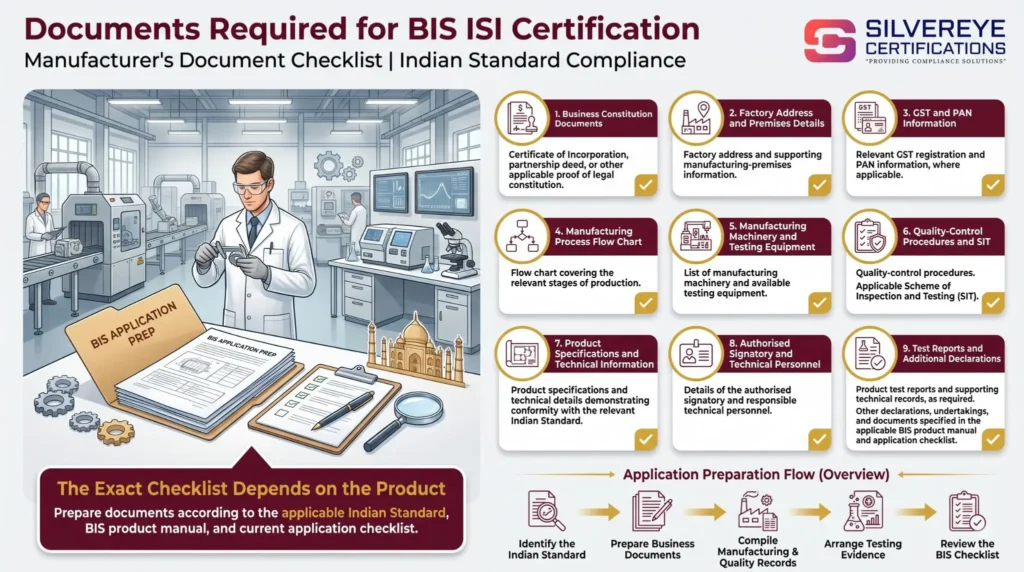
Prepare the documents according to the current BIS application checklist. Additional information or clarification may be requested during scrutiny or factory assessment.
BIS Certification Process: Step by Step
The following steps outline the general Scheme-I process for appliances for heating liquids.
- Confirm the product classification. Determine the relevant QCO entry and applicable Indian Standard for each model.
- Finalise the product design. Document the model specifications and critical components before testing.
- Arrange product testing. Submit samples for testing under the applicable standard and follow the laboratory's instructions.
- Apply online. Submit the application and supporting documents through the official BIS online application portal.
- Complete factory assessment. BIS assesses the manufacturing infrastructure, process controls, quality system and testing capability.
- Address any deficiencies. Respond to queries and complete any additional testing or corrective actions required.
- Obtain the licence. After the applicable requirements are satisfied, pay the prescribed fees and complete the remaining formalities for the grant.
- Apply the ISI Mark correctly. Mark products in accordance with the licence scope and applicable BIS conditions. Continue meeting production-control and surveillance requirements.
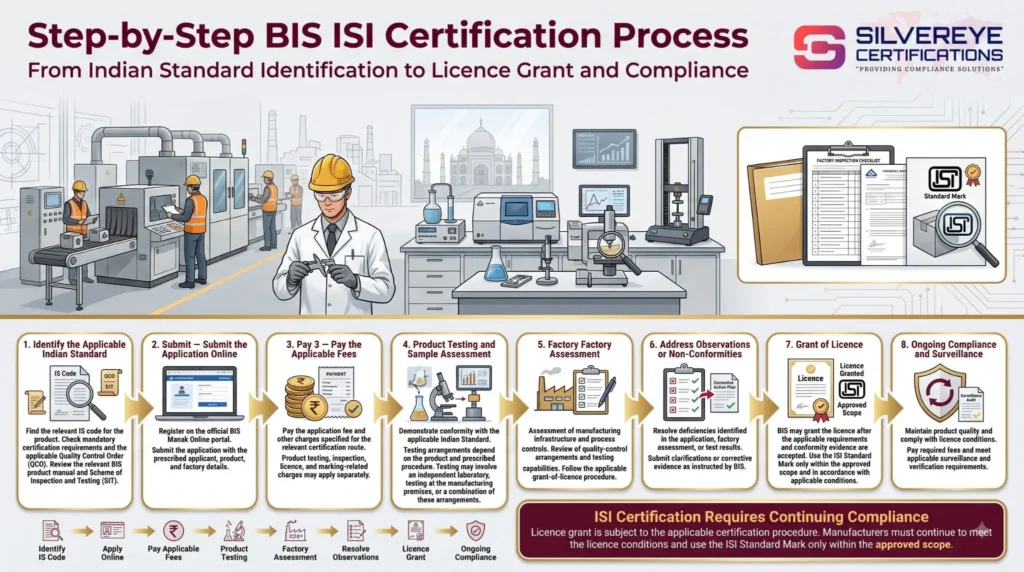
BIS accepts product certification applications online, including payments. Testing and factory assessment arrangements depend on the applicable certification procedure.
How Long Does BIS Certification Take?
The total time depends on product complexity, laboratory availability, document completeness, factory readiness and the applicable BIS licensing procedure.
The following figures are planning estimates, not guaranteed BIS timelines.
| Stage | Indicative planning time |
|---|---|
| Product classification and document preparation | 1–2 weeks |
| Laboratory testing | 2–4 weeks, depending on model count and laboratory availability |
| Application scrutiny | Depends on completeness and queries raised |
| Factory inspection scheduling and assessment | Depends on availability and factory readiness |
| Final processing and licence grant | Depends on satisfactory reports, compliance and payment of applicable fees |
| Overall planning estimate | Approximately 2–3 months in a straightforward case; complex cases may take longer |
BIS publishes different processing expectations for different application options. Its general guidance indicates that timelines can vary because of queries, inspections, sample submission and outstanding payments. Do not treat the planning estimate above as an official service commitment.
For manufacturers with multiple kettle, cooker or coffee-maker variants, begin with a clear product list and confirm which models can be grouped under the applicable BIS guidelines.
BIS Certification Fees for Appliances for Heating Liquids
The total certification cost includes BIS fees, laboratory testing and any additional expenses associated with factory assessment or professional assistance. The minimum marking fee is product-specific, so it should not be confused with the application fee or annual licence fee.
| Fee component | Amount or basis | What to know |
|---|---|---|
| Application fee | ₹1,000 under the general Scheme-I fee guidance | Confirm the current fee when applying |
| Annual license fee | ₹1,000 under the general Scheme-I fee guidance | Pay as required under the applicable grant and licence conditions |
| Minimum marking fee | Product-specific | Check the current BIS marking-fee schedule for the applicable Indian Standard |
| Laboratory testing | Charged according to the laboratory's applicable rates | Depends on the product, tests and number of models |
| Factory assessment and inspection | As applicable under BIS rules | May depend on inspection requirements and location |
| Consultant fee | Depends on the agreed scope | Obtain a written quotation before engaging a consultant |
BIS's published product-certification guidance lists the application fee and annual license fee and directs applicants to the product-specific marking-fee schedule. The current fee schedule should be checked before budgeting.
MSME concessions and payment arrangements
Concessions for micro and small enterprises, including any additional concessions for eligible women entrepreneurs, should be checked against the current BIS notification and eligibility conditions. Do not rely on an older concession percentage or expiry date without confirming that it remains applicable.
Likewise, payment arrangements for the minimum marking fee may depend on the current grant-of-licence guidelines. Confirm the amount due at application and at the grant stage with BIS before submitting payment.
Can grouping models reduce certification costs?
Where BIS grouping guidelines permit, similar models may be considered together under an application or licence scope. However, eligibility depends on the relevant standard and product-specific grouping rules.
Models with differences in heating elements, temperature controls, electrical construction or container materials may require separate evaluation or additional testing. Confirm grouping eligibility with the relevant laboratory or BIS before finalising the application.
Validity and Renewal of BIS Certification for Appliances for Heating Liquids
Under the BIS (Conformity Assessment) Amendment Regulations, 2026, the initial validity of a Scheme-I license may be up to five years, subject to the applicable regulations and the period granted by BIS. Renewal may also be granted for up to five years. Always check the validity period stated on your actual license.
| Aspect | Details |
|---|---|
| Initial validity | Up to five years, subject to the licence granted by BIS |
| Renewal | May be granted for up to five years |
| Annual payments | Applicable annual license fees and other dues must be paid within the prescribed timelines, even where the license has a longer validity |
| When to apply for renewal | Apply well before expiry and follow the current BIS renewal instructions |
| Renewal documents | May include production statements, marking-fee calculations, compliance information and payment of applicable fees and outstanding dues |
| If the licence lapses | The licence may cease to remain valid; non-payment or non-compliance may lead to suspension or cancellation under the applicable rules |
| Adding new models | Obtain approval to extend the licence scope where required before applying the ISI Mark to additional models |
A longer licence validity does not remove ongoing compliance obligations. Manufacturers must maintain product conformity, production records, applicable annual payments and compliance with BIS surveillance requirements.
Importing Appliances for Heating Liquids: What Changes?
Importers and foreign manufacturers should plan for BIS certification before supplying appliances covered by the applicable Quality Control Order to the Indian market.
- Foreign manufacturer certification: Overseas manufacturers must follow the applicable BIS certification route, including the Foreign Manufacturers Certification Scheme (FMCS) where required. They should arrange the necessary Indian representation, factory assessment and product testing. Products must comply with the applicable certification and marking requirements before being placed on the Indian market.
- Existing stock: The 2026 QCO provides a transitional period of up to six months from the relevant implementation date for qualifying goods manufactured domestically or imported before that date. The provision applies to stock associated with a manufacturer certified by BIS or one that has applied for certification of the relevant goods, subject to the required declaration to BIS. For general manufacturers, the implementation date is 1 October 2026, making the six-month period run to 1 April 2027, subject to the order's conditions. Small and micro enterprises have later implementation dates, so the applicable period must be calculated from their respective dates.
- Research and development samples: The QCO exempts up to 200 imported units per year for R&D by manufacturers of household and similar electrical appliances, subject to the stated conditions. These units must not be sold commercially, and year-wise records must be maintained and furnished to the Central Government if requested.
- Supplier agreements and purchase orders: Include applicable BIS certification, product marking, documentation and delivery requirements in supplier contracts. Confirm the licence and product scope before shipping goods to India.
Important: The existing-stock provision is not a blanket exemption for newly manufactured or imported goods after the implementation date. Confirm that your products and stock qualify before relying on this transitional arrangement.
Common BIS Certification Mistakes to Avoid
Manufacturers, importers and brand owners should watch out for these common compliance mistakes:
- Assuming small appliances are exempt: Products such as kettles and milk heaters may be covered by a QCO. Confirm the applicable entry and implementation date.
- Choosing the wrong certification route: The 2026 QCO specifies Scheme-I for the listed products. Do not assume the CRS route applies.
- Testing only one model without checking variants: Changes to heating elements, controllers, wiring or container materials may affect testing requirements and licence scope.
- Misclassifying the product: Appliances within the international standard's scope do not automatically fall under serial number 8 of the Indian QCO. Water boilers, coffee makers and steam cookers have separate entries.
- Misusing the existing-stock provision: The six-month transitional period applies only to qualifying pre-implementation stock and is subject to the prescribed declaration and other conditions.
- Budgeting only for the application fee: Include laboratory testing, applicable marking fees, annual licence fees and any factory-assessment expenses.
- Confusing different appliance categories: Kettles, storage water heaters and immersion heaters may fall under different product categories or regulatory requirements. Verify the applicable Indian Standard and QCO entry before applying.
A careful review of the product classification, testing requirements and licence scope before commercial production can help reduce avoidable delays and compliance risks.
Why Choose Silvereye Certifications for BIS Certification?
BIS certification projects can face delays because of incorrect product classification, incomplete documentation, missing component records or inadequate factory preparation. Silvereye Certifications provides regulatory compliance guidance to help manufacturers, importers and brand owners navigate the certification process.
Here's how we can support your BIS certification project:
- Product Classification Guidance: Identify the potentially applicable QCO entry and Indian Standard for each appliance before proceeding with testing.
- Laboratory Coordination: Get assistance with sample preparation, testing requirements and model grouping, where permitted under applicable BIS guidelines.
- Application and Documentation Support: Receive guidance on preparing application documents and completing the online filing process.
- Factory Assessment Preparation: Review manufacturing records, quality-control procedures and relevant testing arrangements before the factory assessment.
- Importer and FMCS Guidance: Understand the applicable requirements for overseas manufacturers, Indian representation and eligible existing-stock provisions.
- Post-Licence Support: Get guidance on renewal requirements, marking-fee obligations and applications to extend the licence scope to additional models.
Need clarity on which of your appliances may require the ISI Mark, the applicable certification route or the documents you should prepare? Contact Silvereye Certifications with your product and model list to discuss your compliance requirements.
Conclusion
BIS certification for appliances for heating liquids is an important compliance consideration under the Safety of Household, Commercial and Similar Electrical Appliances (Quality Control) Order, 2026. The order lists this category at serial number 8 and specifies different implementation dates for general, small and micro enterprises.
To prepare effectively, identify the correct QCO entry for each product, confirm the applicable Indian Standards, finalise critical components, arrange the required testing and prepare your factory for assessment. You should also budget for applicable certification and testing fees, maintain production records and monitor licence-related obligations.
If you intend to rely on an exemption or the transitional period for existing stock, carefully check the conditions in the official notification before proceeding. A well-planned certification process can help your business meet applicable requirements and avoid preventable delays.
Silvereye Certifications can guide you through the relevant documentation and certification steps so you can plan your BIS compliance project with greater clarity.
Frequently Asked Questions
Is BIS certification mandatory for appliances for heating liquids in India?
The 2026 order lists Appliances for Heating Liquids at serial no. 8, so listed goods must conform to IS 302 (Part 1):2024 and bear the ISI Standard Mark under a BIS license, subject to the implementation dates and exemptions.
Does this include electric kettles?
Kettles are a core example in the international product standard for this category, so they are normally scoped under it. Have your lab confirm the entry for your exact model.
Which standard applies heating liquid appliances?
The order specifies IS 302 (Part 1):2024, which corresponds to IEC 60335-1:2020, and says the latest version of the Indian Standards applies. For product-specific requirements, the international reference is IEC 60335-2-15, and your lab confirms the Indian equivalent.
What are the deadlines for bis certification for heating liquid appliances?
1 October 2026 for general manufacturers, 1 January 2027 for small enterprises and 1 April 2027 for micro enterprises.
Are water boilers and coffee makers covered separately?
Yes. Electric Water Boilers are at serial no. 15 and Electric Coffee Makers at serial no. 16, and both carry the same implementation dates.
What about rice cookers and pressure cookers?
The product standard covers them, but they are not named separately in the Table, and pressure cookers have their own BIS requirements. Confirm which order governs before testing.
Are geysers covered?
No. Storage and instantaneous water heaters are a separate product family with their own order.
Can I sell my existing stock after the deadline?
Goods made or imported before the implementation date by a BIS-certified manufacturer, or one who has applied, can be sold or offered for sale for up to six months from that date. A declaration to BIS is required.
Can I import sample appliances for R&D?
Up to 200 units per year can be imported for R&D by manufacturers of household and similar electrical appliances. They cannot be sold commercially, and records must be kept.
Are export-only products exempt?
Goods manufactured domestically for export are outside the order.
How much does BIS certification cost?
Government fees include a Rs 1,000 application fee, a Rs 1,000 annual license fee and a product-specific minimum marking fee. Testing and inspection are charged at actuals. Verify current figures on the BIS portal.
How long is the license valid?
Under the 2026 amendment, up to 5 years initially and renewable for up to 5 years. Annual fees still apply.