
- Class C Classification: CDSCO’s official classification notice places hydrophilic wound dressings intended for exudate absorption under Class C, within the Wound Dressings/Bacteriostatic Wound Dressings category, alongside wound-care beads.
- Manufacturers Need MD-7/MD-9: Indian manufacturers must apply using Form MD-7 and obtain the manufacturing license in Form MD-9 from CDSCO’s Central Licensing Authority.
- Importers Need MD-14/MD-15: Foreign manufacturers must appoint an authorized Indian agent, who applies through Form MD-14 and obtains the import license in Form MD-15 from CDSCO.
- Wholesalers Need MD-41/MD-42: Businesses involved in the commercial stocking, sale, or distribution of hydrophilic wound dressings must apply using Form MD-41 and obtain the registration certificate in Form MD-42, subject to the applicable Medical Devices Rules, 2017.
Introduction
A CDSCO Registration for hydrophilic wound dressings is mandatory under the Medical Devices Rules, 2017, as hydrophilic wound dressings intended for wound exudate absorption are classified as Class C medical devices under CDSCO’s classification notice No. DCG(I)/Misc./2017(68), within the Wound Dressings/Bacteriostatic Wound Dressings category.
- Manufacturers: Apply using Form MD-7 and obtain the manufacturing licence in Form MD-9 from CDSCO’s Central Licensing Authority.
- Importers: Appoint an authorized Indian agent, apply using Form MD-14, and obtain the import license in Form MD-15.
- Wholesalers and distributors: Apply using Form MD-41 and obtain the registration certificate in Form MD-42, where applicable.
- Application portal: Submit the relevant applications through the CDSCO online licensing system, as applicable to the licence type.
Unlike certain lower-risk medical devices, Class C devices generally fall under the Central Licensing Authority’s licensing framework. License validity and renewal requirements depend on the applicable provisions of the Medical Devices Rules, 2017; applicants should confirm the current requirements before filing.
What Is a CDSCO Registration for Hydrophilic Wound Dressing?
A CDSCO Registration for hydrophilic wound dressing is the regulatory authorization required, where applicable, to manufacture or import hydrophilic wound dressings in India under the Medical Devices Rules, 2017 (MDR 2017). The Central Drugs Standard Control Organization (CDSCO), under the Ministry of Health and Family Welfare, regulates medical devices in India under the applicable provisions of the Drugs and Cosmetics Act, 1940, and the Medical Devices Rules, 2017.
A hydrophilic wound dressing is designed to absorb wound exudate—the fluid released by a wound—and help maintain a suitable moist environment for wound healing. These dressings may be used for chronic wounds, pressure ulcers, and wounds that produce substantial amounts of exudate.
It is important to distinguish hydrophilic wound dressings from basic wound-covering products. Plain gauze and simple bandages primarily cover or protect a wound, whereas certain hydrophilic dressings are specifically intended for active exudate management. Their regulatory classification depends on the product’s intended purpose, design, and the applicable CDSCO classification entry.
Manufacturers, importers, and businesses involved in the commercial distribution of these products must identify the authorization applicable to their activities before placing the devices on the Indian market.
Why Are Hydrophilic Wound Dressings Classified as Class C?
India follows a risk-based medical device classification system with four categories: Class A, Class B, Class C, and Class D. These classes represent increasing levels of regulatory risk under the Medical Devices Rules, 2017.
CDSCO classification notice No. DCG(I)/Misc./2017(68) identifies wound-care product categories, including Wound Dressings/Bacteriostatic Wound Dressings. Hydrophilic wound dressings intended for wound exudate absorption are identified under the relevant Class C category, subject to the precise product description and intended use.
The following comparison illustrates the distinction between selected wound-care products. The final classification should always be checked against the applicable CDSCO entry for the specific device.
| Product category | Classification indicated | Intended use |
|---|---|---|
| Wound dressings/bacteriostatic wound dressings, including specified hydrophilic dressings for exudate absorption | Class C | Active wound management and exudate absorption |
| Certain cotton gauze and medical bandages | Class B | Wound covering, protection, or securing |
| Sterile drapes | Class B | Creating a sterile barrier during procedures |
| Certain casting tapes and splint rolls | Class B | Supporting immobilisation and casting applications |
Important: Do not classify a product solely by its common name. The material, intended purpose, design, and exact description in CDSCO’s notified device list can affect its classification.
Verify your product’s classification before applying. Check the relevant entry in CDSCO’s current classification list and confirm the applicable application route before submitting Form MD-7 or another prescribed form. If the classification is unclear, seek clarification from the appropriate regulatory authority.
Who Needs a CDSCO Registration for Hydrophilic Wound Dressings?
The regulatory requirements depend on the role a business performs in the product’s supply chain. Manufacturers and importers follow different licensing routes, while wholesalers and distributors must meet the applicable registration requirements.
| Entity | Application form | Licence or certificate | Issuing authority |
|---|---|---|---|
| Indian manufacturer of a Class C device | Form MD-7 | Form MD-9 — Manufacturing Licence | CDSCO Central Licensing Authority |
| Importer | Form MD-14 | Form MD-15 — Import License | CDSCO Central Licensing Authority |
| Wholesaler/distributor | Form MD-41, where applicable | Form MD-42 — Registration Certificate | Relevant State Licensing Authority |
Manufacturers: Indian manufacturers of Class C hydrophilic wound dressings generally apply using Form MD-7 and, following approval, receive the manufacturing license in Form MD-9 from CDSCO’s Central Licensing Authority.
Importers: Businesses importing hydrophilic wound dressings must follow the applicable import-licensing requirements. The foreign manufacturer’s authorized Indian agent generally submits Form MD-14 and obtains the import license in Form MD-15 after approval.
Wholesalers and distributors: Businesses undertaking activities covered by the relevant registration provisions should determine whether they need to apply using Form MD-41 and obtain a registration certificate in Form MD-42 from the relevant State Licensing Authority.
For Class C hydrophilic wound dressings, the manufacturing and import licensing routes are handled by the Central Licensing Authority. Wholesale registration is governed by the applicable provisions and authority for that activity. Businesses should confirm the latest requirements before submitting an application.
CDSCO Manufacturing Registration for Hydrophilic Wound Dressings (MD-7 & MD-9)
Indian manufacturers intending to manufacture Class C hydrophilic wound dressings for sale or distribution must obtain the applicable manufacturing license under the Medical Devices Rules, 2017. The application is submitted in Form MD-7 to CDSCO’s Central Licensing Authority, and the manufacturing license is granted in Form MD-9 after the application and required compliance evidence are reviewed.
Eligibility for MD-7/MD-9
- The applicant must be a legally constituted business with a defined manufacturing facility in India.
- The facility must establish an appropriate Quality Management System (QMS) and meet the applicable manufacturing and quality-control requirements. ISO 13485:2016 can provide a framework for medical device quality management.
- The manufacturer must have appropriately qualified technical personnel as required by the applicable rules.
- The facility must demonstrate that the dressing meets the applicable safety, performance, biocompatibility, and risk-management requirements for its intended use.
- Manufacturing processes, including sterilisation where applicable, must be adequately validated and documented.
Documents Required for an MD-7 Application
The documents depend on the device, manufacturing process, and applicable CDSCO checklist. Common documents and technical records may include:
- Covering letter and completed Form MD-7.
- Proof of the applicant’s constitution, such as a certificate of incorporation or partnership deed, as applicable.
- Site Master File describing the manufacturing facility, layout, personnel, equipment, and quality systems.
- Device Master File describing the dressing material, design, variants, intended purpose, specifications, manufacturing process, and labelling.
- Performance evaluation data supporting the product’s intended use, including relevant fluid absorption and moisture-management performance.
- Biocompatibility assessment and supporting test data appropriate to the nature and duration of contact with skin or the wound bed.
- Sterilisation validation, packaging validation, and packaging-integrity evidence, where applicable to sterile products.
- Risk-management documentation prepared in accordance with applicable requirements and recognised principles, such as ISO 14971.
- Details of manufacturing equipment, quality-control equipment, testing arrangements, and process controls.
- Documentation demonstrating conformity with the applicable Essential Principles of Safety and Performance under the Medical Devices Rules, 2017.
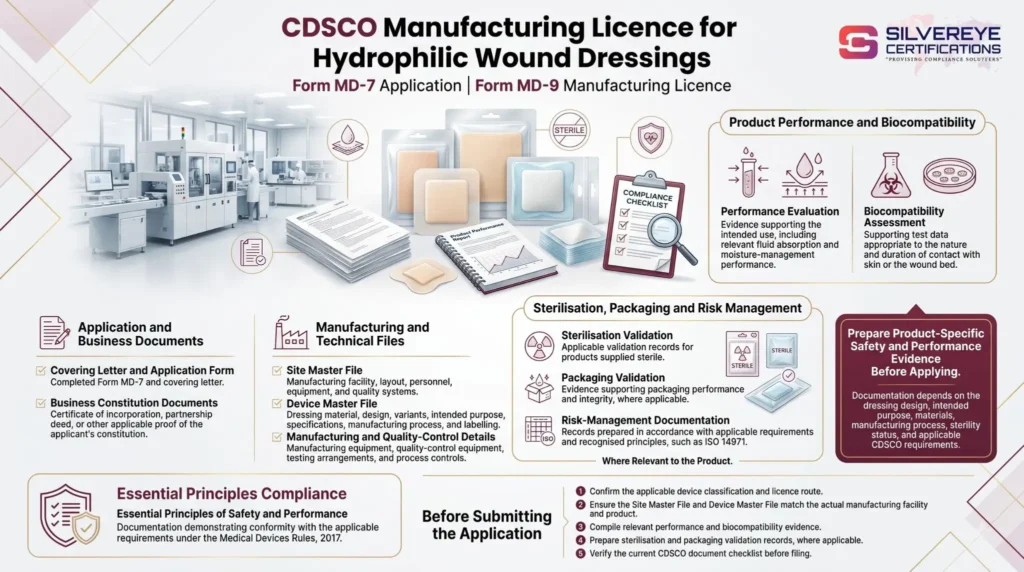
The final document set should be checked against the current CDSCO application checklist and the requirements applicable to the specific device.
MD-7/MD-9 Process: Step by Step
- Register on the online medical devices portal: Create the required applicant account and select the applicable manufacturing licence application.
- Prepare the application: Complete Form MD-7 and compile the required site, device, quality-management, and technical documentation.
- Submit the application and fee: Upload the prescribed documents and pay the applicable government fee.
- Regulatory scrutiny: The Central Licensing Authority reviews the submission and may request clarification or additional evidence.
- Facility inspection: For Class C and Class D medical devices, CDSCO’s published FAQ states that inspection is carried out by Medical Device Officers within 60 days of the application date, provided the submitted data is found satisfactory.
- Grant of licence: If the applicable requirements are met, the Central Licensing Authority grants the manufacturing licence in Form MD-9.
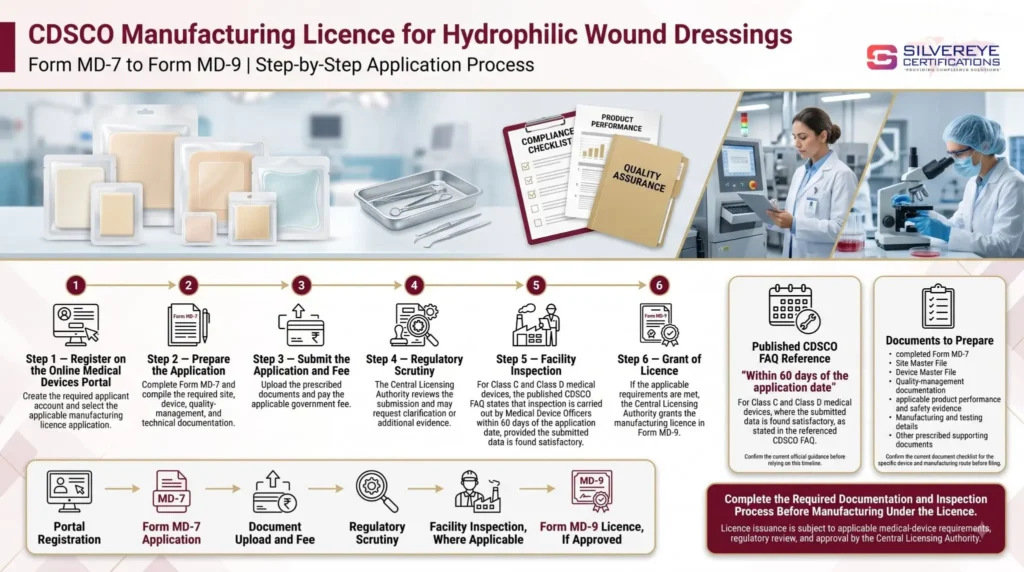
The 60-day inspection timeline should not be interpreted as a guarantee that the complete application will be approved within 60 days. Review, clarification, inspection findings, and compliance requirements may affect the overall timeline.
CDSCO Import Registration for Hydrophilic Wound Dressings (MD-14 & MD-15)
Foreign manufacturers seeking to market hydrophilic wound dressings in India must follow the applicable import-licensing requirements under the Medical Devices Rules, 2017. The overseas manufacturer appoints an Authorized Indian Agent through a Power of Attorney. The agent submits Form MD-14 to CDSCO’s Central Licensing Authority to obtain the import license in Form MD-15.
The authorized agent must hold an eligible manufacturing license, wholesale license, or Form MD-42 registration certificate, as applicable under the rules. The application must identify the foreign manufacturer and manufacturing site and provide the required device-specific and site-related documentation.
Documents Required for an MD-14 Application
The application checklist may require the following, depending on the product and circumstances:
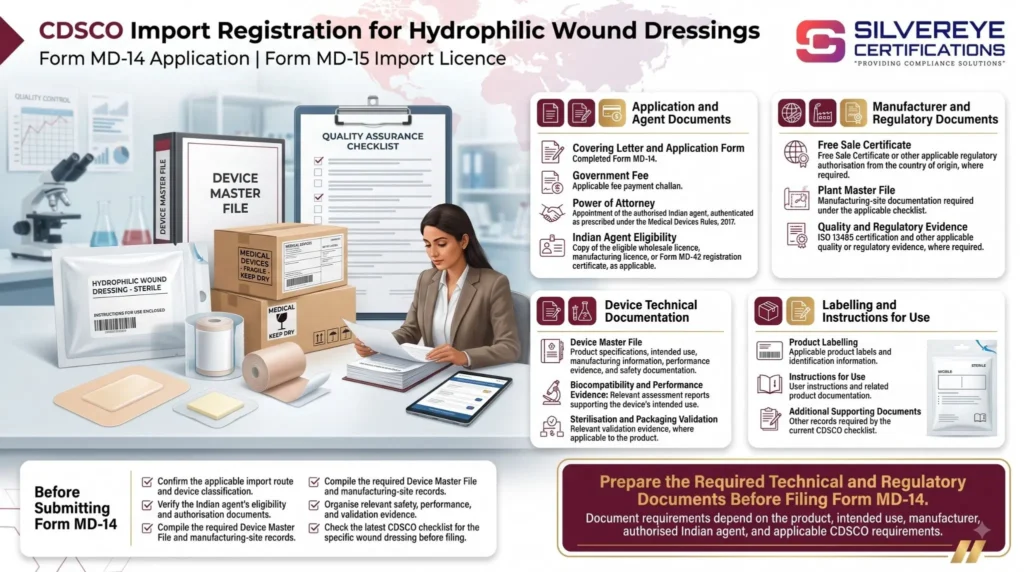
- Covering letter and completed Form MD-14.
- Government fee payment challan.
- Power of Attorney appointing the authorised Indian agent, authenticated as prescribed under the Medical Devices Rules, 2017.
- Copy of the authorised agent’s eligible wholesale licence, manufacturing licence, or Form MD-42 registration certificate.
- Free Sale Certificate or other applicable regulatory authorisation from the country of origin, as required.
- Device Master File containing product specifications, intended use, manufacturing information, performance evidence, and safety documentation.
- Plant Master File or applicable manufacturing-site documentation.
- Relevant biocompatibility, performance evaluation, risk-management, and sterilisation or packaging validation evidence, where applicable.
- Product labelling and instructions for use, along with other documents required by the current CDSCO checklist.
- ISO 13485 certification and other applicable quality or regulatory evidence, where required for the application.
A CE certificate or other international approval should not automatically be treated as a substitute for Indian import authorisation. The documents required depend on the current Indian regulatory requirements and the specific application.
MD-14/MD-15 Process: Step by Step
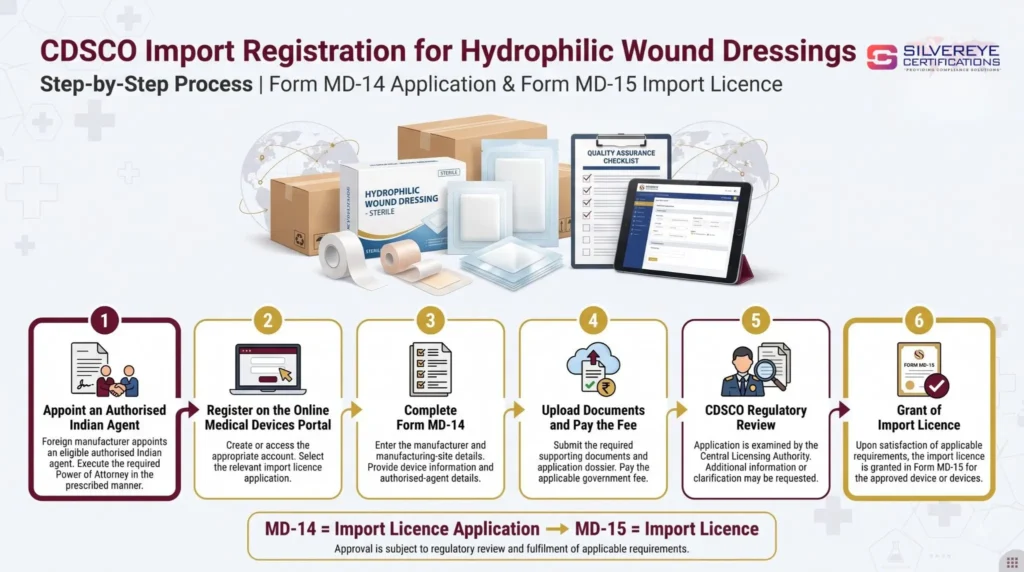
- Appoint an authorised Indian agent: The foreign manufacturer executes the required Power of Attorney.
- Register on the online medical devices portal: The agent creates or uses the appropriate account and selects the import licence application.
- Complete Form MD-14: Enter the required information about the manufacturer, manufacturing site, device, and authorised agent.
- Upload supporting documents and pay the fee: Submit the prescribed application dossier and applicable government fee.
- Regulatory review: CDSCO examines the application and may raise queries or request additional information.
- Grant of import licence: Once the applicable requirements are satisfied, CDSCO’s Central Licensing Authority grants the import licence in Form MD-15 for the approved device or devices.
Absorbency and moisture-management evidence matters. For hydrophilic wound dressings, the technical dossier should support the product’s intended performance and safe use. The relevant tests depend on the dressing’s materials, design, intended purpose, and claims. A complete, consistent dossier can help reduce avoidable clarification requests, although it cannot guarantee approval or eliminate review queries.
CDSCO Wholesale Registration for Hydrophilic Wound Dressings (MD-41 & MD-42)
Businesses involved in selling, stocking, exhibiting, offering for sale, or distributing medical devices must determine the applicable registration or licensing requirements under the Medical Devices Rules, 2017. Where the relevant provisions require a registration certificate, the business applies in Form MD-41 and obtains the certificate in Form MD-42 from the relevant State Licensing Authority.
This requirement may apply to medical device distributors, hospital-supply businesses, and other commercial stockists. However, the exact requirement depends on the activity and whether the business already holds a license that satisfies the applicable provisions.
Eligibility and Documents for MD-41/MD-42
Applicants should check the requirements of the relevant State Licensing Authority. Commonly requested information and documents may include:
- Completed Form MD-41 and the prescribed fee payment receipt.
- Proof of business constitution and identity of the applicant.
- Proof of the business and storage premises address.
- Premises layout or other details of the storage facility, where required.
- Details of the person responsible for technical or regulatory oversight, along with evidence of qualifications or competence where applicable.
- Arrangements for appropriate storage, stock records, traceability, and distribution.
- Procedures to preserve product packaging integrity and sterile barriers according to the manufacturer’s instructions.
- Any additional documents requested by the relevant State Licensing Authority.
Premises inspection: The State Licensing Authority may verify the premises and supporting information in accordance with the applicable rules and state procedures. Applicants should confirm whether an inspection or additional state-specific documentation is required before submitting the application.
Maintaining appropriate storage conditions, distribution records, and product traceability helps protect the integrity of hydrophilic wound dressings throughout the supply chain.
CDSCO Fees for Hydrophilic Wound Dressing Registration
Government fees for CDSCO licensing of hydrophilic wound dressings are prescribed under the applicable fee schedule of the Medical Devices Rules, 2017. The total amount depends on the type of application, device classification, manufacturing site, and applicable product or grouping requirements.
| Licence Type | Applicable Government Fee | Important Notes |
|---|---|---|
| Manufacturing Licence (MD-7/MD-9) | As prescribed under the Medical Devices Rules, 2017 | Depends on the applicable manufacturing licence fee structure and device details. |
| Import Licence (MD-14/MD-15) | As prescribed under the Medical Devices Rules, 2017 | Fees may depend on the overseas manufacturing site and the devices covered by the application. |
| Wholesale Registration (MD-41/MD-42) | ₹3,000 per premises, as specified in the applicable fee schedule | Confirm the current fee and payment requirements before submitting the application. |
Important: Government fees are separate from professional consultancy charges, testing expenses, and other costs associated with preparing a regulatory application. Always verify the current fee schedule and payment instructions on the official CDSCO medical devices portal before making payment.
Processing Timeline and Validity of CDSCO Wound Dressing Licenses
Processing time depends on application completeness, technical review, inspection requirements, and the time taken to respond to regulatory queries.
| Licence Type | Processing Timeline | Validity and Retention |
|---|---|---|
| MD-9 (Manufacturing) | Depends on document review, facility inspection, and compliance findings. | Generally valid in perpetuity, subject to applicable retention requirements and unless suspended, cancelled, or surrendered. |
| MD-15 (Import) | Depends on the completeness of the application, regulatory review, and any queries raised. | Generally valid in perpetuity, subject to applicable retention requirements and unless suspended, cancelled, or surrendered. |
| MD-42 (Wholesale Registration) | Depends on the State Licensing Authority’s review and applicable procedures. | Confirm the applicable retention and validity requirements under the current rules. |
Under the Medical Devices Rules, 2017, relevant licenses, including MD-9 and MD-15, generally remain valid in perpetuity, provided the prescribed retention fee is deposited at the required five-year intervals and the license has not been suspended, cancelled, or surrendered. This is different from a conventional five-year license expiry.
There is no single guaranteed processing timeline for every hydrophilic wound dressing application. Applicants should plan for document preparation, regulatory review, any required inspection, and possible clarification requests.
Renewal and retention planning: Track the license issue date and applicable five-year retention deadlines. Begin preparing the retention submission well in advance, and check the current CDSCO requirements for the relevant license and any subsequent endorsements.
Benefits of CDSCO Licensing for Hydrophilic Wound Dressings
- Legal market access: The applicable CDSCO authorisation enables businesses to manufacture or import hydrophilic wound dressings in accordance with Indian medical device regulations.
- Hospital and wound-care procurement readiness: Maintaining the relevant licence and product documentation helps businesses respond to regulatory checks during supplier onboarding and procurement.
- Regulatory compliance: Appropriate authorization and accurate records help reduce the risk of enforcement action associated with unauthorized manufacturing, import, or sale.
- Supply-chain credibility: A documented regulatory status supports communication with distributors, healthcare institutions, and other business partners.
- Support for international regulatory planning: Indian licensing documentation may contribute to a company’s regulatory dossier, but it does not automatically replace the approvals required in export markets.
Penalties for Selling Hydrophilic Wound Dressings Without a CDSCO License
Manufacturing, importing, or selling hydrophilic wound dressings without the applicable regulatory authorisation may violate the Medical Devices Rules, 2017, and relevant provisions of the Drugs and Cosmetics Act, 1940.
Depending on the nature and severity of the violation, consequences may include regulatory enforcement, seizure of products, suspension or cancellation of licenses, financial penalties, or prosecution under the applicable law. The specific consequences depend on the offence, the applicable statutory provisions, and the facts of the case.
Because hydrophilic wound dressings may be used on chronic wounds and compromised skin, businesses should ensure that their products meet applicable safety, performance, labelling, and quality requirements before placing them on the market.
Common Mistakes to Avoid During CDSCO Wound Dressing Registration
- Assuming the classification: Do not automatically classify every hydrophilic dressing as Class C based only on its name. Verify the exact device description and intended use against CDSCO’s current classification list.
- Submitting incomplete technical documentation: Ensure the dossier includes the applicable performance, biocompatibility, risk-management, and manufacturing evidence.
- Confusing basic gauze with specialized dressings: Classification depends on the specific product and its intended purpose, not simply on whether it is used for wound care.
- Underestimating regulatory review time: Allow time for technical scrutiny, inspections where required, and responses to regulatory queries.
- Missing retention deadlines: Track the relevant five-year retention requirements instead of assuming that every licence expires after five years.
- Assuming one authorization covers every activity: Manufacturing, importing, and wholesale or distribution activities may have separate licensing or registration requirements.
- Ignoring sterile-product storage conditions: Where dressings are supplied sterile, maintain packaging integrity, traceability, and storage conditions in accordance with the manufacturer’s instructions and applicable requirements.
Conclusion
Whether you manufacture hydrophilic wound dressings in India, import them from an overseas supplier, or distribute them to hospitals and wound-care clinics, obtaining the applicable CDSCO license or registration is an important step towards regulatory compliance. Before applying, verify your product’s classification against CDSCO’s current notified device list, select the appropriate application route, and prepare complete technical documentation, including relevant performance evaluation, absorbency, biocompatibility, and quality-management records.
The application route depends on your business activity: Form MD-7 for manufacturing, Form MD-14 for importing, and Form MD-41 for wholesale registration where applicable. Accurate documentation and timely responses to regulatory queries can help reduce avoidable delays during the review process.
Silvereye Certifications provides support for CDSCO medical device registration, including device classification reviews, technical dossier preparation, application documentation, online submissions, and post-approval compliance guidance. Contact our team to discuss your hydrophilic wound dressing registration requirements and prepare your application in line with the applicable regulatory framework.
Frequently Asked Questions
Is a CDSCO Registration mandatory for hydrophilic wound dressings in India?
Yes. Hydrophilic wound dressings are notified medical devices under MDR 2017, so manufacturing, importing, or distributing them in India requires the applicable CDSCO license or registration.
What CDSCO class does a hydrophilic wound dressing fall under?
Class C. CDSCO's official classification notice (No.DCG(I)/Misc./2017(68)) groups hydrophilics for wound exudate absorption, alongside wound-care beads, under the Class C 'Wound Dressings/Bacteriostatic Wound Dressings' category.
Are all wound dressings Class C?
No. Basic cotton gauze and bandages (adhesive, pressure, traction, medical absorbent fibre bandages) are classified as Class B in the same CDSCO notice. Class C specifically applies to wound dressings and beads used for active exudate absorption in wound care.
What is the difference between Form MD-7, MD-14, and MD-41?
MD-7 is the Class C/D manufacturing license application (granted as MD-9), MD-14 is the import license application (granted as MD-15), and MD-41 is the wholesale/distribution registration application (granted as MD-42). Each serves a different role in the supply chain.
Who can apply for the CDSCO manufacturing license for hydrophilic wound dressings?
Any registered business entity manufacturing hydrophilic wound dressings on its own premises in India, with a designated technical person, validated absorbency and sterilization processes, and a documented quality system, can apply on Form MD-7 to CDSCO's Central Licensing Authority.
How long does CDSCO licensing for hydrophilic wound dressings take?
Manufacturing licences (MD-9) and import licences (MD-15) for Class C wound dressings typically take about 6–9 months, including a facility inspection generally conducted within 60 days of a complete application. Wholesale registrations (MD-42) usually take 30–60 days.
What is the validity of a CDSCO hydrophilic wound dressing license?
MD-9 and MD-42 are generally valid for 5 years from the date of issue. MD-15 import licences generally continue indefinitely, subject to payment of a retention fee every 5 years.
What documents are required for CDSCO hydrophilic wound dressing registration?
Core documents include the relevant application form (MD-7, MD-14, or MD-41), business constitution proof, site or premises details, a Device Master File with absorbency, biocompatibility, and sterilisation validation data, technical staff qualifications, and the applicable fee payment receipt. Importers additionally need a Power of Attorney and a Free Sale Certificate from the country of origin.
Can one business hold manufacturing, import, and wholesale licences together?
Yes, if the business genuinely performs all three activities. Each activity still requires its own separate CDSCO authorization — holding one license does not automatically cover the others.
What happens if I sell hydrophilic wound dressings without CDSCO registration?
You risk stock seizure, financial penalties, cancellation of any existing licenses, and prosecution under the Drugs and Cosmetics Act, 1940, which can include imprisonment in serious cases.
Is BIS certification also required for hydrophilic wound dressings?
BIS and CDSCO are separate regulatory frameworks. CDSCO governs hydrophilic wound dressings as medical devices under MDR 2017. Whether a specific BIS textile or polymer standard also applies depends on the product's material composition, and should be checked independently of CDSCO compliance.
How do I renew my CDSCO hydrophilic wound dressing license?
Renewal applications should be filed at least 90 days before expiry, using the previous licence details, updated documents where applicable — including current absorbency and biocompatibility performance data — and the prescribed renewal or retention fee, submitted through the SUGAM portal to CDSCO's Central Licensing Authority or your State Licensing Authority as applicable.