
- Who it covers: Importers selling medical devices notified as drugs under Indian law. Stents, condoms and copper IUDs are subject to specific price controls, while many other notified devices are subject to price-monitoring requirements.
- Two separate requirements: A CDSCO import licence allows the applicable medical device to be imported, while NPPA pricing rules determine the applicable requirements for its sale and pricing.
- Core duties: Register on IPDMS, submit the applicable Form V, ensure the MRP complies with NPPA requirements, report applicable price revisions within the prescribed period, and submit required quarterly returns.
- Cost: NPPA does not charge a separate IPDMS registration fee. CDSCO medical-device import licence fees are prescribed separately under the Medical Devices Rules and vary according to the device class, site and applicable category. Applicable retention requirements every five years should also be tracked.
Introduction
NPPA Registration for medical device importers involves complying with India's applicable price-control requirements once you hold a CDSCO import license. You must check whether your device is scheduled, register on NPPA's IPDMS, file the applicable Form V price details, print an MRP at or below the applicable ceiling price plus GST, and report applicable price revisions within the prescribed period.
For notified devices without a ceiling price, the applicable 10% annual price-increase limit must be followed. NPPA does not charge a separate registration fee; CDSCO import license fees are separate and vary by device class and site, with applicable five-year retention requirements. Any amount charged above the applicable price limit may be subject to recovery with interest under the applicable pricing provisions.
What Is NPPA Registration for Medical Device Importers?
Many importers clear the regulatory hurdle they can see — the CDSCO license — and then find out that a second regulator also monitors the pricing of certain medical devices. The National Pharmaceutical Pricing Authority (NPPA) administers applicable pricing requirements under the Drugs (Prices Control) Order, 2013 (DPCO 2013). These requirements can apply to manufacturers, importers and marketers of notified medical devices.
Importing a device from abroad does not automatically exempt an importer from applicable NPPA pricing and reporting requirements.
This guide focuses on the importer's side: who needs NPPA registration, how to register on IPDMS, what to file, how to determine the applicable MRP requirements, what it costs, and what can go wrong. For current ceiling prices for products such as stents and knee implants, refer to our separate guide on NPPA ceiling prices for medical devices.
| Regulator / Rule | What Does It Govern? | What the Importer Needs to Do |
|---|---|---|
| CDSCO – Medical Devices Rules, 2017 | Can the applicable device be legally imported and sold in India? | Obtain the applicable import licence, including Form MD-15, through the Indian Authorised Agent |
| NPPA – DPCO 2013 | What pricing requirements apply to the device? | Register on IPDMS, submit applicable price information/forms and follow MRP requirements |
| Legal Metrology – Packaged Commodities Rules | Is the product label compliant? | Follow applicable MRP, country-of-origin and other mandatory labelling requirements |
Do Medical Device Importers Need NPPA Registration?
Yes, where the imported device falls within the scope of the applicable NPPA/DPCO requirements. NPPA has issued directions and price-related orders covering certain medical devices and has required relevant manufacturers and importers to submit information through its systems.
Examples of NPPA actions include:
- Coronary stents: NPPA required manufacturers, importers and marketers to provide registration and pricing information through IPDMS and submit applicable forms.
- Non-scheduled medical devices: NPPA has issued directions requiring manufacturers and importers to provide applicable price data.
- Price-control orders: NPPA has taken action where applicable MRP or pricing requirements were not followed.
Because NPPA orders and product-specific requirements can change, importers should check the latest NPPA notification or order applicable to their device before filing.
Which NPPA Pricing Rule Applies to Your Medical Device?
Before completing NPPA registration, first determine which pricing category applies to your device.
| Category | Examples / Scope | What the Importer Needs to Check | First Action |
|---|---|---|---|
| Scheduled devices | Products covered under applicable Schedule I price controls, such as certain coronary stents and contraceptive devices | Applicable ceiling price and MRP requirements | Check the latest NPPA notification and applicable ceiling price |
| Special price-control orders | Devices covered by a specific order, such as certain orthopaedic implants | Product-specific price limits and validity of the order | Check the latest NPPA order before pricing |
| Specific trade-margin orders | Devices covered by an applicable NPPA trade-margin order | Whether the relevant order is currently in force | Verify the latest NPPA notification |
| Notified but non-scheduled devices | Other medical devices notified as drugs but not included in Schedule I | Applicable price-monitoring and annual price-increase requirements | Register on IPDMS and maintain accurate price records |
Important: Do not assume that every medical device is subject to the same NPPA pricing rule. First confirm whether the product is notified, scheduled, or covered by a specific NPPA order.
What Are the Benefits of NPPA Registration for Medical Device Importers?
Proper NPPA registration and pricing records can help importers:
- Maintain pricing compliance for applicable medical devices.
- Keep accurate MRP and product-price records.
- Respond more efficiently to NPPA queries or notices.
- Maintain a clear pricing history for internal and regulatory review.
- Reduce the risk of price-related disputes and recoveries.
- Keep regulatory information organised for distributors, hospitals and institutional buyers.
Who Can Apply for NPPA Registration?
A foreign manufacturer generally operates in India through its Indian Authorized Agent for CDSCO medical-device import licensing. The applicable CDSCO import license is obtained through the prescribed process.
The CDSCO import licence and NPPA registration are separate regulatory requirements. Holding an MD-15 licence does not automatically complete the importer's NPPA obligations.
What Do Medical Device Importers Need for NPPA Registration?
Before starting the IPDMS registration process, an importer should have:
- A clear classification of each device for NPPA pricing purposes.
- An active IPDMS account/company registration, where applicable.
- Accurate details of each product, model, pack size and MRP.
- Relevant importer, manufacturer and product information.
- A designated person responsible for NPPA filings and regulatory deadlines.
- Pricing records linking relevant import cost, trade price and MRP.
- Supporting documents required for the applicable IPDMS form or NPPA filing.
Keeping these details consistent is important because differences between CDSCO, IPDMS, invoices, product records and labels can create avoidable queries.
What Should You Do Before Applying for NPPA Registration?
Before registering, confirm three things:
- Is your medical device notified under the applicable Indian regulatory framework?
- Which NPPA pricing category or order applies to your product?
- What IPDMS registration and filing requirements apply to your device?
Once these points are clear, you can proceed with the applicable NPPA registration and pricing filings with greater confidence
What Documents Should Medical Device Importers Keep Ready for NPPA Registration?
Before starting NPPA registration on IPDMS, importers should organise both their NPPA pricing records and the documents supporting their CDSCO import licence.
| Stage | Document or Record | Why It Matters |
|---|---|---|
| CDSCO licensing | Applicable wholesale/manufacturing license or registration of the Indian Authorized Agent | Supports the applicable CDSCO import-licensing process |
| CDSCO application | Power of Attorney, Free Sale Certificate/Marketing Authorisation, Device Master File, Plant/Site Master File and other applicable documents | Required depending on the device, class and current CDSCO checklist |
| NPPA registration | IPDMS company account and registration details | Used for applicable NPPA submissions |
| Product information | Product names, models, pack sizes and applicable pricing details | Helps maintain accurate product-level records |
| Pricing records | Applicable Form V/price information and supporting records | Supports NPPA price reporting requirements where applicable |
| Cost and sales records | Import invoices, trade prices, distributor prices and MRP history | Useful for pricing verification and NPPA queries |
| Certified price data | Chartered Accountant/Cost Accountant-certified information, where specifically required | NPPA may require certified pricing information for particular filings or monitoring exercises |
| Labelling | Final label artwork showing the applicable MRP and mandatory declarations | Helps ensure the printed MRP matches the approved pricing records |
| Price revisions | Applicable revision filing and acknowledgement | Provides evidence that a required price change was reported |
| Ongoing records | Applicable quarterly/periodic returns and supporting import/sales data | Helps demonstrate continuing compliance where such returns are required |
The exact documents depend on the device, pricing category, applicable NPPA order and current filing requirements. Keep the latest NPPA and CDSCO checklists as the final reference.
How to Complete NPPA Registration as a Medical Device Importer?
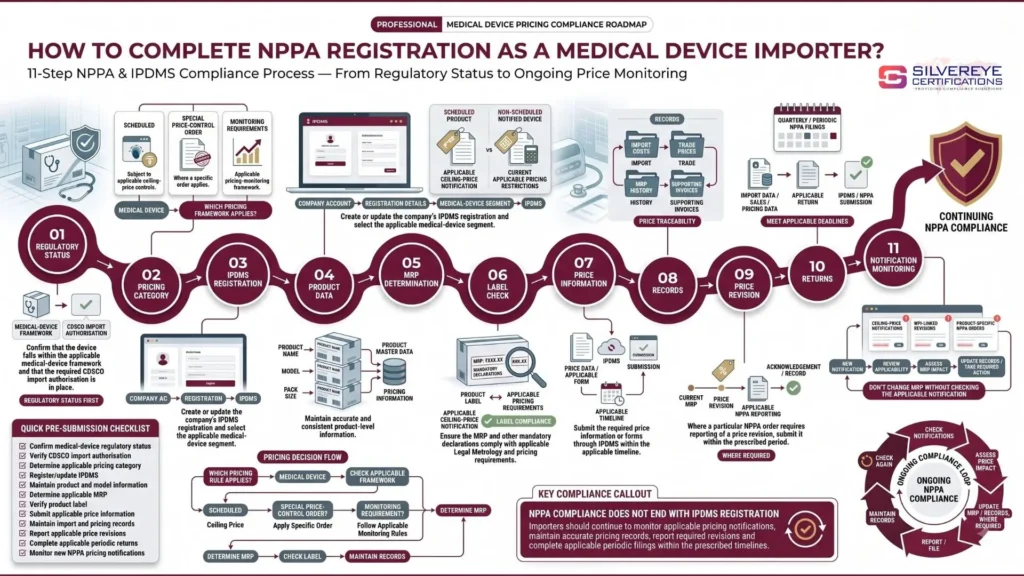
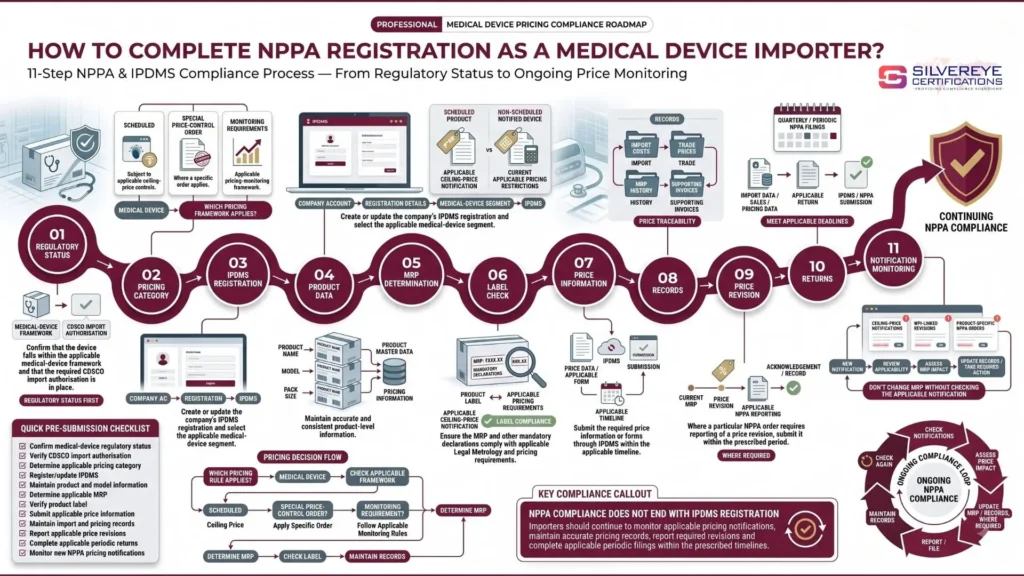
Once you have confirmed that your device falls within the applicable NPPA framework, the process can generally be approached as follows:
- Confirm the device's regulatory status. Check whether the device is notified under the applicable medical-device framework and whether the required CDSCO import authorisation is in place.
- Determine the applicable pricing category. Establish whether the device is scheduled, covered by a special price-control order, or subject to applicable monitoring requirements.
- Register on IPDMS. Create or update the company's IPDMS registration and select the applicable medical-device segment.
- Add product information. Maintain accurate details of the relevant products, models, pack sizes and pricing information.
- Determine the applicable MRP. For a scheduled product, follow the applicable ceiling-price notification. For a non-scheduled notified device, apply the pricing restrictions currently applicable to that category.
- Check the product label. Ensure the MRP and other mandatory declarations comply with the applicable Legal Metrology and pricing requirements.
- Submit applicable price information/forms. File the required information through IPDMS within the applicable timeline.
- Maintain pricing records. Keep import costs, trade prices, MRP history and supporting invoices organised.
- Report applicable price revisions. Where a particular NPPA order requires reporting of a price revision, submit it within the prescribed period.
- Submit applicable returns. Complete required quarterly or periodic NPPA filings within the applicable deadlines.
- Review pricing notifications regularly. Check for new ceiling-price notifications, WPI-linked revisions and product-specific NPPA orders before changing an MRP.
How Should You Set the MRP of an Imported Medical Device?
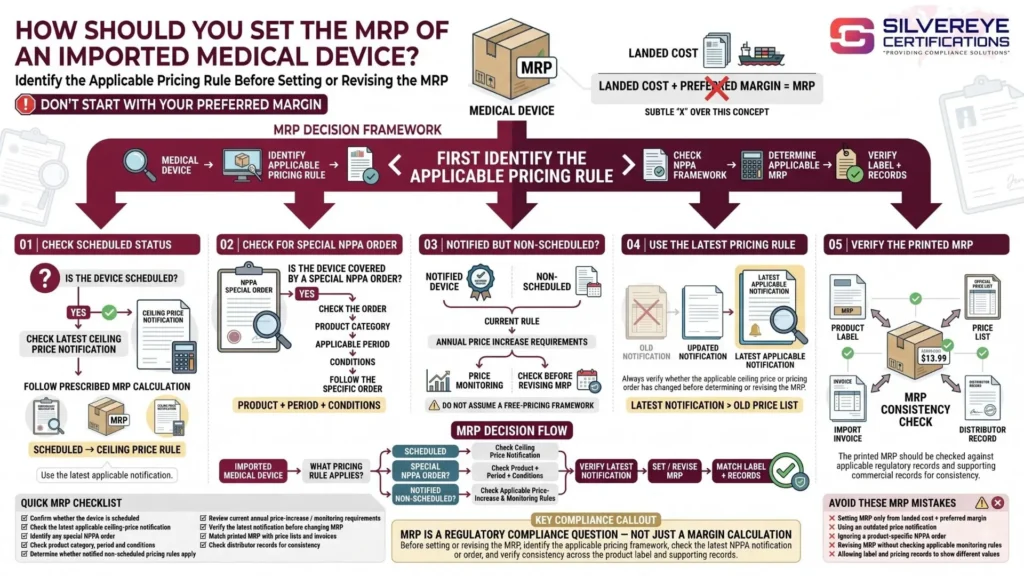
The MRP should not be decided simply by adding a preferred margin to the landed cost. First identify the pricing rule applicable to the device.
Use this checklist:
- Is the device scheduled? If yes, check the latest applicable ceiling price notification and follow the prescribed MRP calculation.
- Is the device covered by a special NPPA order? Check the order's product category, period and conditions.
- Is the device notified but non-scheduled? Check the current rule governing annual price increases and price monitoring before revising the MRP.
- Has the applicable ceiling or pricing order changed? Always use the latest notification rather than an older price list.
- Does the printed MRP match your regulatory records? Check the label, price list, invoices and distributor records for consistency.
Illustrative Example
Suppose an applicable pricing rule limits an eligible non-scheduled device's annual MRP increase to 10% and its relevant previous MRP was ₹10,000.
A 10% increase would result in a maximum MRP of ₹11,000 under that assumption. A proposed MRP of ₹11,500 would exceed that limit.
Important: This is only an illustration of the calculation method. The actual rule applicable to a particular device must be confirmed from the latest NPPA notification/order before changing its MRP.
What Are the Fees, Validity and Renewal Requirements?
It is important to keep NPPA registration and the CDSCO import license separate. They are different regulatory processes.
NPPA Registration and Pricing Filings
| Item | Government Fee | Timing / Requirement |
|---|---|---|
| IPDMS registration | No separate registration fee identified in the NPPA materials reviewed | Register and update applicable company/product information |
| Price information/forms | No separate filing fee generally specified | File when required by the applicable NPPA order |
| Price revision | No separate filing fee generally specified | Follow the timeline prescribed for the applicable revision |
| Periodic returns | No separate filing fee generally specified | Submit where required by the applicable NPPA order |
| Ceiling-price revisions | No separate registration fee | Follow the latest NPPA notification and applicable effective date |
The absence of a separate IPDMS registration fee should not be confused with the government fees payable for CDSCO medical-device licensing.
What Are the CDSCO Import License Fees?
CDSCO medical-device import fees are prescribed separately under the Medical Devices Rules, 2017 and depend on the device class, manufacturing site and applicable category.
For non-IVD medical devices, the commonly applicable Second Schedule structure includes:
| Device Class | Site Fee | Distinct Device Fee |
|---|---|---|
| Class A | USD 1,000 | USD 50 |
| Class B | USD 2,000 | USD 1,000 |
| Class C | USD 3,000 | USD 1,500 |
| Class D | USD 3,000 | USD 1,500 |
The exact fee should always be checked against the current Second Schedule, particularly because IVDs and other categories can have different fee provisions.
What About CDSCO License Validity and Retention?
An applicable Form MD-15 import license is perpetually valid, subject to payment of the prescribed retention fee at the required five-year intervals and continued compliance.
Do not describe MD-15 as a five-year license that simply expires and requires a new application every five years. The five-year point relates to the retention-fee requirement, not ordinary license expiry.
Similarly, avoid quoting a blanket “2% per month late fee” unless the exact current provision or notification is being cited. Late-retention consequences should be checked against the current Medical Devices Rules and applicable CDSCO instructions.
How Long Does CDSCO Approval Take?
There is no single guaranteed six-to-nine-month approval period applicable to every MD-15 application. Processing time can vary depending on:
- Device classification
- Completeness of the application
- Technical review and queries
- Manufacturing-site inspection, where applicable
- Applicant response time
- The complexity of the device and supporting evidence
Therefore, treat any consultant-provided timeline as a planning estimate, not an official CDSCO guarantee.
NPPA Registration Calendar for Medical Device Importers
| When | What to do |
|---|---|
| Before launch | Classify the device, complete IPDMS registration, determine the applicable MRP, prepare labels and complete required price filings. |
| Within 15 days of a relevant price revision | File the applicable Form II with the revised price information as required under NPPA rules. |
| Every quarter | Complete applicable production, import and sales returns as required. |
| Every March and April | Monitor the annual WPI-based price revision and review scheduled price ceilings. |
| Every 5 years from the CDSCO licence date | Pay the applicable CDSCO licence retention fee before the due date. Failure to pay within the permitted period can result in cancellation of the licence. |
| At least 6 months before stopping a scheduled product | Check the applicable NPPA requirement and complete the relevant filing, including Form IV where applicable. |
| Before 15 November 2026 | If you import knee implants, check the latest NPPA notification to confirm whether the applicable price control is extended, replaced or allowed to expire. |
| On receiving an NPPA letter | Respond within the deadline specified in the notice and provide the requested information or documents. |
2026 Updates Medical Device Importers Should Know
| Date | Update | What it means for you |
|---|---|---|
| January 2026 | NPPA communications to device companies highlighted requirements relating to IPDMS registration and applicable forms. | Do not wait for an NPPA notice; keep your registration and product data updated. |
| 2026 | IPDMS 2.0 continues to support company and product-level regulatory data management. | Make sure your medical device segment and product information are correctly registered. |
| 25 March 2026 | WPI-linked revision of applicable scheduled prices, including notified medical devices such as stents. | Re-check applicable prices and ensure your MRP and records reflect the latest requirements. |
| 2026 | Government clarification on proposals relating to uniform pricing for medical devices. | Continue following the existing applicable NPPA price-control framework and current notifications. |
| 2025–2026 | Changes and clarifications affecting packaged-commodity labelling may affect imported medical-device packaging. | Review MRP and consumer-information details against the latest Legal Metrology requirements before printing labels. |
| 15 November 2026 | The applicable knee-implant price-control period is scheduled to reach its stated end date unless further action is taken. | Review the latest NPPA notification before making pricing decisions. |
What Are the Penalties for Failing to Follow NPPA Requirements?
- Recovery with interest: NPPA can recover amounts charged in excess of applicable price controls, along with interest, where the relevant provisions apply.
- Unreported price revision: Failing to report a required price revision can create regulatory and overcharging risks.
- Penalty risk: Depending on the applicable order and legal provision, additional financial consequences may apply.
- Customer scrutiny: Hospitals, distributors and institutional buyers may ask for evidence that your pricing and documentation follow applicable NPPA requirements.
- CDSCO licence risk: Failure to pay the required CDSCO retention fee can result in the medical-device import licence being deemed cancelled after the permitted period.
What Are the Common Mistakes Medical Device Importers Make?
- Treating the CDSCO import licence as the only regulatory requirement and overlooking NPPA pricing requirements.
- Increasing the MRP directly to the ceiling price without checking the applicable rules.
- Registering on IPDMS but failing to keep the medical-device product data updated.
- Allowing old labels to remain in circulation after a valid price revision.
- Not maintaining adequate price and transaction records.
- Relying completely on a distributor without verifying whether required filings have actually been completed.
- Forgetting the CDSCO licence retention fee due every five years.
Need Help With NPPA Registration for Medical Device Importers?
If you are planning to import a medical device, register on IPDMS, revise an MRP or respond to an NPPA notice, professional support can help you identify gaps before they become regulatory issues.
Silvereye Certifications helps medical device importers with NPPA Registration, IPDMS registration, product listing, price and MRP review, applicable Form V/Form II filings, documentation and label review.
Our support can include:
- Device-by-device pricing review: Identify whether the product is scheduled, subject to a special order or covered by applicable monitoring requirements.
- IPDMS 2.0 support: Registration and product-data listing.
- Price and MRP review: Check pricing information and label details before launch or printing.
- Documentation support: Organise applicable NPPA records and filings.
- Compliance calendar: Create a practical calendar for your team to track important filings, revisions and renewals.
- Regulatory update support: Monitor relevant NPPA and medical-device regulatory changes.
Silvereye Certifications can help you manage NPPA Registration requirements alongside your CDSCO medical-device import licensing, so your pricing, documentation and regulatory records stay aligned.
Frequently Asked Questions
Do medical device importers have to follow NPPA rules?
Yes, if the device is notified as a drug. DPCO 2013 applies to manufacturers, importers and marketers.
Is NPPA approval needed to import a device?
No. Import permission comes from CDSCO. NPPA controls the price at which you sell.
What is IPDMS and do importers need it?
IPDMS is NPPA's online system for price lists, returns and product data. NPPA has asked device importers to register, and IPDMS 2.0 needs a separate device registration.
What is Form V?
It is the price list that importers send to NPPA, the State Drug Controller and dealers under DPCO Paragraph 24.
Can an importer raise the MRP after the ceiling price is set?
Only within the rules. If your MRP is below the ceiling, you may raise it by the yearly WPI percentage, not up to the ceiling.
What is the 10% rule for imported devices?
For notified devices without a ceiling, the MRP cannot rise more than 10% in any rolling 12 months.
How much does an import license cost?
NPPA charges nothing. CDSCO fees reported for import licenses are $1,000, $2,000 and $3,000 per site for Class A, B and C or D, plus per-device fees.
How long is an import license valid?
It stays valid in perpetuity if the retention fee is paid every five years and the licence is not suspended or cancelled.
Who applies for the import license?
An authorised Indian agent with a manufacturing or wholesale licence applies in Form MD-14. The licence is issued in Form MD-15.
What if I miss a filing deadline?
NPPA can treat the revision as not made and recover the overcharge with interest. Respond to any NPPA letter within its period.
Which labels must show the MRP?
Every pack of a notified device sold in India must show the MRP. Check current Legal Metrology rules for layout and other details.
Do I need to stop selling a device before discontinuing it?
For scheduled products, NPPA expects notice at least six months before discontinuation, filed in Form IV.
Can I outsource NPPA compliance?
Yes, but you stay accountable. Keep copies of every filing and acknowledgment.