

CRES from the Spice Board of India is mandatory, along with an IEC, for exporters of scheduled spice products.
- The certificate is issued for a three-year period and must be renewed before it expires.
- Merchant exporters and manufacturer exporters have different documentation requirements and applicable fees.
- A consultant can assist with document verification, portal filing, responding to Board queries, and renewal reminders.
Introduction
A Spice Board registration consultant helps exporters obtain and renew the Certificate of Registration as Exporter of Spices (CRES), which is required, along with an IEC, for exporting scheduled spices from India. A consultant can check eligibility, prepare documents such as GST, Central FSSAI and the Annex II bank report, assist with portal filing, respond to Spices Board queries, and track renewal requirements.
The Spices Board's applicable registration fee should be checked against the latest official fee schedule, as fees may be revised. The CRES certificate is issued for a three-year period, subject to the applicable rules and renewal requirements.
If you are planning to export spices from India, the paperwork can be one of the most time-consuming parts of the process, especially for first-time exporters. This guide explains what CRES is, who needs it, the applicable fees, required documents, the registration process, and when a Spice Board registration consultant can actually add value.
It is written from the exporter's perspective, so you can make an informed choice about whether to handle the CRES application yourself or get professional assistance.
What Is Spice Board Registration (CRES)?
The Spices Board of India is a statutory organisation under the Ministry of Commerce & Industry, responsible for the export promotion of India's 52 scheduled spices and the development and research of cardamom.
CRES stands for Certificate of Registration as Exporter of Spices. The Spices Board states that CRES is mandatory for businesses involved in the export or import of spices and spice products covered by its registration requirements. It is an important requirement in addition to the Import Export Code (IEC) required for international trade.
The Board covers 52 scheduled spices, and its official information also covers spices in forms such as spice powders, spice oils, oleoresins and mixtures where spice content is predominant. Exporters should check whether their particular product falls within the applicable schedule and registration requirements before applying.
Who Needs Spice Board Registration?
Businesses exporting covered spices and spice products from India generally need a valid CRES. The Board's registration process distinguishes between merchant exporters and manufacturer exporters, and the category affects the applicable documentation, inspection requirements and fee.
| Exporter Type | Who It Is | Typical Examples |
|---|---|---|
| Merchant Exporter | Purchases spices from other producers or processors and exports them without operating its own manufacturing/processing facility. | Trading companies, sourcing businesses and export firms |
| Manufacturer Exporter | Operates a facility involved in the processing, packing, value addition or other applicable activities relating to the spices being exported. | Spice processors, grinding/blending units and packing units |
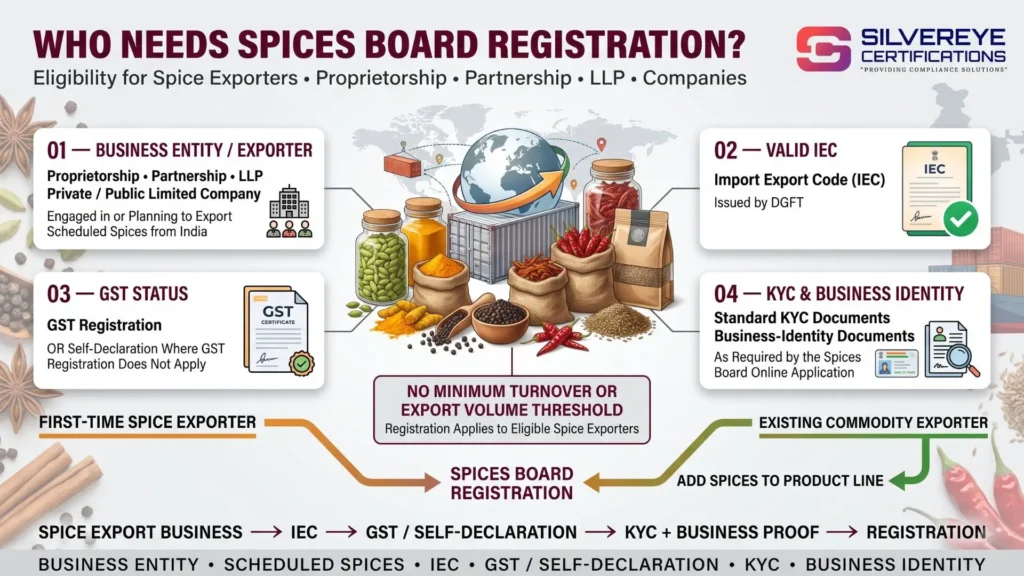
A valid IEC is required for international trade, while CRES is the registration specifically connected with the export of covered spices. Applicants should also ensure that they hold the other applicable food, tax and business registrations required for their particular activity.
If you only sell spices within India and do not export them, CRES is not required merely because you are a domestic spice seller.
Why Hire a Spice Board Registration Consultant?
An exporter can handle the CRES application independently. However, professional assistance can be useful when the applicant is new to the process, has a manufacturing facility, has document discrepancies, or needs help responding to Board queries.
What Does a Spice Board Registration Consultant Do?
- Confirms whether the applicant should register as a merchant or manufacturer exporter.
- Reviews the IEC, PAN, GST and other business details for consistency.
- Helps prepare the required Annex II bank report. The Spices Board provides an official Annex II format for this purpose.
- Assists with preparing and uploading the application and supporting documents.
- Helps respond to Spices Board queries or deficiencies.
- Provides guidance on renewal, quarterly export returns and other continuing compliance requirements.
- Helps manufacturers prepare for applicable facility inspection and documentation requirements.
When Is a Spice Board Registration Consultant Worth It?
| Your Situation | DIY or Consultant? |
|---|---|
| First-time exporter with straightforward documents | DIY is possible if you are comfortable with the application process |
| Manufacturer with a processing or packing facility | Consultant may be useful because additional facility-related requirements can apply |
| Application has received a query or deficiency | Consultant can help identify and correct the issue |
| Previous CRES has lapsed or renewal has complications | Professional assistance may be useful |
| Shipment or export plans are time-sensitive | Early professional support can reduce documentation errors |
What Are the Benefits of Spice Board Registration?
- Regulatory compliance: CRES is an important registration requirement for the applicable export of spices and spice products.
- Export readiness: A valid registration helps exporters maintain the documentation needed for their spice-export activities.
- Access to Board services: Registered exporters can use applicable Spices Board quality, testing and export-support services, subject to the relevant requirements.
- Quality support: The Spices Board operates quality evaluation facilities and implements testing and quality-related programmes for spice exports.
- Ongoing export compliance: CRES holders are required to comply with applicable obligations, including quarterly export returns.
What Documents Are Required for Spice Board Registration?
The exact document requirement can depend on the exporter category and current Spices Board instructions. Common documents include:
| Document | Merchant Exporter | Manufacturer Exporter |
|---|---|---|
| IEC | Required | Required |
| PAN | Required | Required |
| GST Registration | Where applicable | Where applicable |
| Annex II Bank Report | Required | Required |
| Central FSSAI Licence | As applicable | As applicable |
| Constitution Documents | Applicable | Applicable |
| Authorisation/Board Resolution | Where applicable | Where applicable |
| MSME/Udyam Certificate | Where applicable | Where applicable |
| Pollution Control Board Consent | Where applicable | Where applicable |
| Processing/Unit Premises Documents | Where applicable | Applicable where a manufacturing/processing facility is involved |
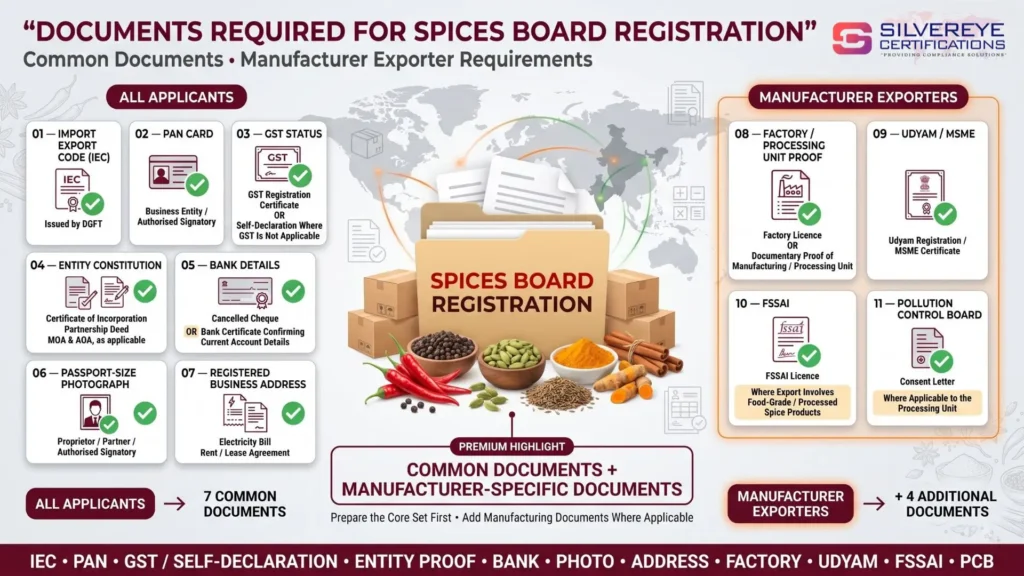
The Spices Board's current forms section provides the Annex II bank-report format, while manufacturer applications can involve additional facility-related requirements.
For renewal, exporters should keep their compliance records up to date. The Spices Board has specifically required exporters to submit quarterly export returns, and its renewal instructions have also referred to clearing pending returns and applicable analytical charges before renewal.
Document requirements and fees can change, so exporters should always check the latest Spices Board instructions and DGFT filing requirements before submitting an application.
Spice Board Registration Process: Step by Step (2026)
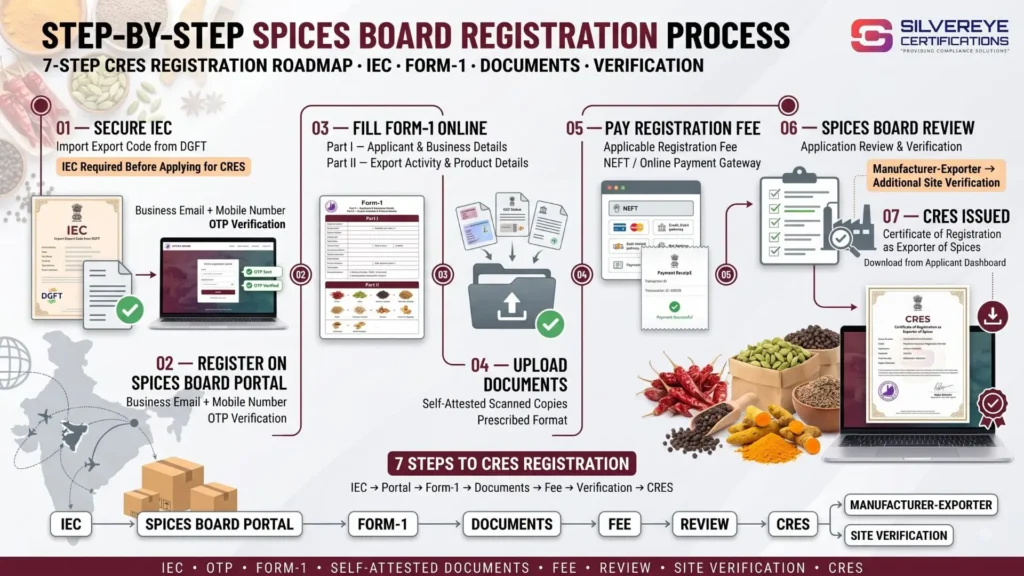
The Spices Board's CRES registration process is handled through the applicable DGFT online system. The exact portal screens and workflow can change, so applicants should follow the current instructions displayed when filing.
How to Apply for CRES?
- Get your IEC in order. A valid Import Export Code (IEC) is required for the CRES application. If your IEC details are outdated, update them through DGFT first.
- Choose your exporter category. Select merchant exporter or manufacturer exporter based on your business activity and whether you operate an applicable processing/manufacturing facility.
- Prepare the documents. Keep your PAN, GST, FSSAI, constitution documents, bank report and other applicable supporting documents ready.
- Obtain the Annex II bank report. Ask your bank to issue the report in the Spices Board's prescribed Annex II format. Check that it is properly completed and authenticated before uploading it.
- Access the DGFT portal. Log in using your IEC-linked credentials and locate the applicable Spices Board/CRES service.
- Complete the application and upload documents. Make sure the business name, address, IEC, PAN and other details are consistent across all documents.
- Pay the applicable government fee. The amount payable is based on the exporter category and type of application. GST is applicable as prescribed.
- Respond to queries. If the Spices Board raises a query or asks for a corrected document, provide the required clarification within the specified time.
- Receive the CRES. Once the application is approved, retain the issued CRES certificate and keep an electronic and physical copy for your records.
How Long Does CRES Registration Take?
There is no single guaranteed processing time that applies to every application. The actual time can depend on document completeness, bank-report preparation, verification, queries and the Board's processing workload.
It is therefore better to apply well before your planned export shipment rather than relying on a fixed number of days.
How Much Does Spice Board Registration Cost?
The applicable Spices Board government fee depends on the exporter category and application type. Based on the Board's published fee schedule:
| Exporter Category | Application | Fee Excl. GST | Fee Incl. 18% GST |
|---|---|---|---|
| Merchant | New registration | ₹10,000 | ₹11,800 |
| Merchant | Renewal / duplicate certificate | ₹7,500 | ₹8,850 |
| Merchant | Amendment | ₹5,000 | ₹5,900 |
| Manufacturer | New registration | ₹15,000 | ₹17,700 |
| Manufacturer | Renewal / duplicate certificate | ₹10,000 | ₹11,800 |
| Manufacturer | Amendment | ₹5,000 | ₹5,900 |
These are government charges. A Spice Board registration consultant's professional fee is separate and depends on the scope of work.
Important: Fee schedules can be revised. Always confirm the amount displayed in the current application/fee schedule before making payment.
What Should You Ask a Spice Board Registration Consultant About Fees?
Before hiring a consultant, ask:
- Is the quotation clearly divided into government fee, GST and professional fee?
- Does the professional fee include Board queries and corrections?
- Is renewal tracking included?
- Who will bear the cost of the Annex II bank report, notarisation or other third-party expenses, where applicable?
- Will you retain access to your DGFT account and submitted documents?
How Long Is CRES Valid?
The CRES is issued for a three-year block period, subject to the applicable Spices Board rules and conditions.
Because renewal windows and block-period arrangements can be updated through Board notices, exporters should check the latest Spices Board circular or portal instructions before planning their renewal calendar.
Do not rely on an older renewal date simply because it applied to the previous block.
How Should You Prepare for CRES Renewal?
| When | What to Do |
|---|---|
| Well before expiry | Review your CRES, IEC, FSSAI and business details |
| Before applying | Check whether quarterly export returns and other applicable compliance requirements are up to date |
| Before renewal | Check the status of applicable analytical charges and Board dues |
| Before submission | Obtain any updated documents required by the current renewal checklist |
| At renewal | Follow the latest DGFT/Spices Board instructions and retain proof of submission |
Important Renewal Points
- Keep your quarterly export returns up to date where applicable.
- Clear any pending analytical charges or other dues that the Board requires before renewal.
- Check the latest renewal instructions rather than relying on an old CRES checklist.
- Do not wait until the certificate is close to expiry to start preparing your documents.
What Commonly Causes CRES Applications to Be Delayed?
- Business name or address mismatch between IEC, GST, PAN and FSSAI.
- Uploading an incorrect or outdated FSSAI licence.
- Bank report not prepared in the prescribed Annex II format.
- Missing signatures, authentication or required information in the bank report.
- Expired PCB consent, lease documents or facility-related documents for manufacturer applicants.
- Blurry, incomplete or incorrectly formatted document scans.
- Selecting the wrong merchant/manufacturer category.
- Pending quarterly export returns or applicable analytical charges during renewal.
CRES vs IEC vs RCMC vs FSSAI: What Is the Difference?
| Registration | Issued By | What It Does |
|---|---|---|
| IEC | DGFT | Identifies an entity for India's import/export activities and is required for the CRES application. |
| CRES | Spices Board of India | Registration for the applicable export/import of spices and spice products covered by the Board's requirements. |
| RCMC | Relevant Export Promotion Council/organisation | Provides membership/registration for applicable export-promotion purposes. The Spices Board treats CRES as its relevant RCMC for its registered exporters. |
| FSSAI Licence | FSSAI | Regulates the applicable food-business activity in India. |
| Organic Certification | Accredited certification system/body | Required in addition to CRES where the product is exported as organic and the destination/import requirements call for organic certification. |
How to Choose a Spice Board Registration Consultant in India?
If you decide to use professional assistance, look for a consultant who:
- Has specific CRES registration and renewal experience, rather than only general business-registration experience.
- Provides a written scope of work covering document review, filing, query handling and renewal support.
- Understands the difference between merchant and manufacturer exporter applications.
- Communicates clearly about pending documents, queries and application status.
- Does not promise guaranteed approval, because the final decision rests with the Spices Board.
- Allows you to retain control of your DGFT login, certificates and original business documents.
A good consultant should make the process easier and reduce avoidable documentation errors — not take away your control over your own export records.
Conclusion: Get Your CRES Right the First Time
Spice Board registration (CRES) is a straightforward process when your documents and business details are in order, but inconsistencies can lead to queries, corrections and processing delays. Whether you choose to apply yourself or work with a Spice Board registration consultant, start with a valid IEC, prepare accurate and up-to-date documents, confirm the applicable government fee before payment, and keep your CRES renewal and compliance dates on your calendar.
Need Help With Your CRES?
Silvereye Certifications provides professional assistance with Spice Board registration (CRES) for exporters. Our support can include:
- Eligibility and category assessment
- Document preparation and verification
- DGFT portal filing assistance
- Spices Board query and clarification support
- Renewal and compliance planning
If you want professional support for your CRES registration or renewal, Silvereye Certifications can help you understand the requirements and manage the application process from document preparation to submission and follow-up.
Contact Silvereye Certifications for a clear, itemised quotation before starting your CRES application.
Frequently Asked Questions
Is Spices Board registration mandatory to export spices?
Yes. The Spices Board Act requires a CRES for exporting scheduled spices, and the Board states it is mandatory in addition to the IEC.
What does CRES stand for?
Certificate of Registration as Exporter of Spices. It is issued by the Spices Board of India under Section 11 of the Spices Board Act, 1986.
How much is the government fee for a new CRES?
The Board's published fee is ₹10,000 for a merchant exporter and ₹15,000 for a manufacturer exporter, plus 18% GST. Confirm the current amount on the portal.
How long is a CRES valid?
It is issued for a three-year block period ending on 31 March. The current block is expected to end on 31 March 2027.
Where do I apply for a CRES?
The Board states that applications must be submitted through the DGFT portal.
Can I get a CRES without an IEC?
No. The IEC is the starting point. Without it you cannot file on the DGFT portal.
What is the difference between a merchant and a manufacturer exporter?
A merchant exporter buys and exports spices. A manufacturer exporter owns or leases a processing unit and exports its own products. Documents and fees differ.
Which documents are needed for a merchant exporter?
IEC, PAN, GST, constitution documents, Central FSSAI license and a bank report in Annex II format.
What happens if my CRES expires?
You lose the right to export scheduled spices until it is reinstated, and a lapsed certificate means applying afresh. Shipments can be held in the meantime.
When should I start my CRES renewal?
Start preparing about six months before the block ends and file at least two months before expiry. Watch the Board's circular for the exact window.
Can I renew if I did not export during the block?
No. The Board does not consider renewal if there were no exports in the block. You would need to apply as a new exporter.
Do I need a Spices Board registration consultant?
Not legally. A consultant helps most with manufacturer files, renewals with pending returns, earlier rejections and tight shipping deadlines.