
- Government fees differ by exporter category — merchant exporters pay less than manufacturer exporters.
- The published fee is only the government charge; GST and any consultant fee sit on top of it.
- Renewal every 3 years costs less than a fresh registration but is still a recurring line item to budget for.
- Getting documents right the first time is the biggest real-world cost saver — resubmissions cost time, not just money.
Introduction
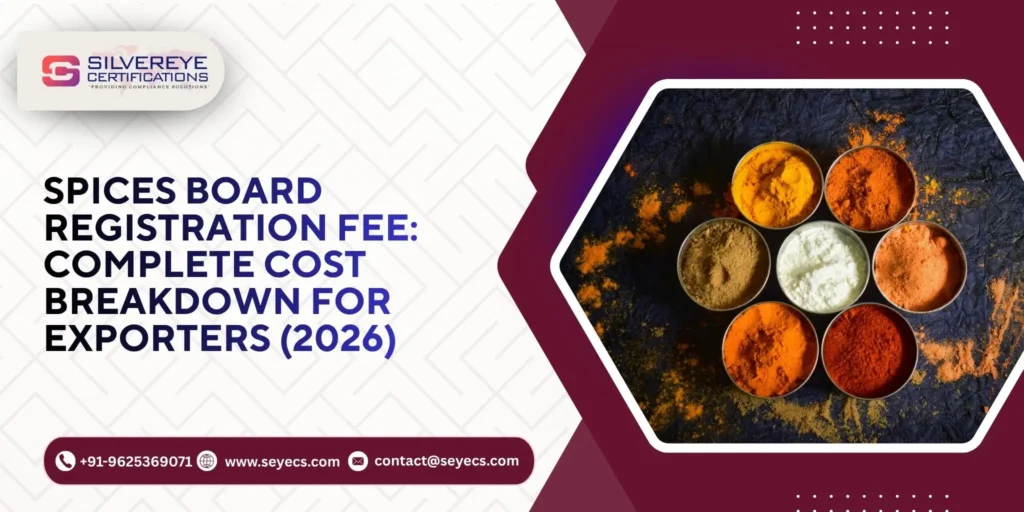
The Spices Board Registration fee is the government charge paid to obtain the Certificate of Registration as Exporter of Spices (CRES) from the Spices Board of India. As an indicative range for 2026, merchant exporters can expect to pay around ₹5,000 for a fresh registration, while manufacturer exporters typically pay ₹10,000 to ₹15,000, with GST charged extra on top. Renewal every 3 years usually costs somewhat less than a fresh application.
These are government charges only — if you engage a consultant for documentation and filing support, their professional fee is separate and billed independently. Always confirm the exact current fee on the official Spices Board portal before paying.
What Does the Spices Board Registration Fee Include?
Spice exporters — especially first-timers — often budget for just one number: the registration fee shown on the Spices Board portal. In practice, the real cost of getting a CRES certificate has a few more moving parts, from GST on the government charge to the cost of any document you need to fix and resubmit because it didn't match your other records. None of these are hidden fees in the shady sense — they're simply costs that don't show up until you're actually going through the process.
Knowing the full breakdown upfront helps you budget accurately, avoid last-minute payment surprises, and decide whether handling the application yourself or bringing in a consultant makes more financial sense for your situation.
Spices Board Registration Fee: Government Charges (2026)
These are the core government fees charged directly by the Spices Board, based on the fee structure commonly referenced for 2026. Because government fees are revised periodically, treat these as indicative figures and verify the exact current amount on the official portal at the time you apply.
| Category | New Registration | Renewal (Every 3 Years) | Amendment/Modification |
| Merchant Exporter | Approx. ₹5,000 | Approx. ₹3,000–₹5,000 | Approx. ₹1,000–₹5,000 |
| Manufacturer Exporter | Approx. ₹10,000–₹15,000 | Approx. ₹7,500–₹10,000 | Approx. ₹1,000–₹5,000 |
What Does the Spices Board Registration Fee Cover?
Included in the Government Fee
- Processing and scrutiny of your Form-1 application by the Spices Board.
- Verification of your submitted documents against your declared business and export details.
- Site inspection for manufacturer exporters, where applicable.
- Issuance of the CRES certificate once your application is approved.
Charged Separately, On Top of the Government Fee
- GST, which applies to the government fee itself and is added at the time of online payment.
- Professional or consultancy charges, if you engage a compliance firm to prepare and file your application.
- Costs for obtaining supporting certificates you don't already hold — such as a fresh Udyam registration or FSSAI license — which have their own separate government fees.
What Additional Costs Should Exporters Consider?
Beyond the headline registration fee, a few smaller costs tend to catch first-time applicants off guard:
- Document notarization or attestation charges, if your bank or local authority charges for issuing an official bank certificate.
- Rework costs in time and, occasionally, re-submission effort if a document mismatch sends your application back for correction.
- IEC-related charges from DGFT, if you don't already have an Import Export Code and need to obtain one first.
- FSSAI licence fees, for manufacturer exporters who don't already hold one and need to apply separately.
- Consultant or filing-assistance fees, which vary by provider and are entirely separate from the Spices Board's own government charge.
Merchant vs Manufacturer Exporter: Full Cost Comparison
The fee gap between the two categories isn't just about the government charge — manufacturer exporters typically carry more supporting-document costs too.
| Cost Factor | Merchant Exporter | Manufacturer Exporter |
| Government Registration Fee | Lower (~₹5,000) | Higher (~₹10,000–₹15,000) |
| Facility-Related Certificates | Not applicable | Udyam, FSSAI, and possibly PCB consent — each with its own fee |
| Site Inspection Cost | None | Indirect cost of facility readiness and downtime during inspection |
| Renewal Fee | Lower (~₹3,000–₹5,000) | Higher (~₹7,500–₹10,000) |
| Overall 3-Year Cost Profile | Comparatively lean | Comparatively higher due to compliance layers |
How Much Does Spices Board Compliance Cost Over 3 Years?
Since the CRES certificate is valid for 3 years, it helps to think of the fee less as a one-time cost and more as a recurring compliance line item. A merchant exporter, for instance, pays the initial registration fee once and then a somewhat lower renewal fee every 3 years after that — a fairly predictable, low-maintenance cost.
A manufacturer exporter carries a higher upfront fee, plus the cost of keeping facility-related certificates like FSSAI and Udyam current, since those need to be valid at both registration and renewal. Budgeting for the full 3-year cycle, rather than just the upfront fee, gives a more realistic picture of what Spices Board compliance actually costs your business over time.
How Is the Spices Board Registration Fee Paid?
- Payment is made online through the Spices Board portal's payment gateway, typically supporting net banking, UPI, or NEFT.
- Fee payment happens after document upload and before your application moves into scrutiny — it's a required step, not optional.
- Always retain your online payment receipt or transaction reference; it's useful if you need to follow up on a delayed or queried application.
What Happens to Your Fee If the Application Is Rejected or Queried?
A document query — the most common outcome when something doesn't match — doesn't mean you lose your fee or have to pay again; you simply correct and resubmit the flagged document within the process. Outright rejection is less common and usually tied to a fundamental eligibility issue rather than a minor document error.
Refund policies for government fees in cases of rejection are determined by the Spices Board's current rules, so it's worth checking the specific refund terms on the official portal or with the Spices Board directly before you apply, rather than assuming a blanket refund policy.
What Are the Best Ways to Avoid Unnecessary Costs?
- Get your IEC, GST, and PAN details consistent across every document before you upload anything — mismatches are the top cause of costly delays.
- Apply for renewal 2–3 months before expiry; a lapsed CRES can force a fresh application, which costs more than a straightforward renewal.
- If you're a manufacturer exporter, make sure your FSSAI and Udyam certificates are current before you start, rather than applying for them mid-process.
- Weigh the cost of a compliance consultant against the time and potential resubmission costs of a DIY application — for many first-time exporters, the fee difference is smaller than expected.
Is the Spices Board Registration Fee Worth It?
For any business planning to export scheduled spices, this isn't really an optional cost to weigh against alternatives — a valid CRES is what allows customs to clear your shipment in the first place. Viewed that way, the government fee is closer to a basic cost of doing business than a discretionary expense.
What you're really deciding is how efficiently you incur it: applying with a clean, consistent document set the first time keeps the cost close to the government fee alone, while repeated corrections, expired supporting certificates, or a lapsed renewal quietly add both time and money to the process.
How Can Silvereye Certifications Help You Control the Real Cost?
The biggest cost overrun in Spices Board Registration usually isn't the government fee itself — it's the time and rework that comes from a document mismatch, a missed renewal window, or an expired supporting certificate discovered mid-application.
Silvereye Certifications reviews your fee category, documents, and timeline upfront, so you know the realistic total cost before you pay a rupee to the portal, and manages the filing so avoidable resubmissions don't quietly add to your bill. For exporters who'd rather have one predictable cost than a string of small surprises, that upfront clarity is often worth more than the consultancy fee itself.
Conclusion
The Spices Board Registration fee itself is fairly modest against the cost of doing international trade — the real budgeting challenge is accounting for everything around it: GST, supporting certificates, potential resubmission delays, and professional filing support. Merchant exporters get off comparatively light; manufacturer exporters carry a heavier but still predictable cost profile once facility-related certificates are factored in.
Either way, the fastest route to keeping your total cost close to the government fee alone is a clean, consistent application the first time around. If you'd rather know your exact cost picture upfront than discover it in instalments, Silvereye Certifications can walk you through the full fee breakdown for your exporter category and manage the registration so nothing adds unplanned cost along the way.
Frequently Asked Questions
What is the government fee for Spices Board Registration?
Indicatively, around ₹5,000 for merchant exporters and ₹10,000–₹15,000 for manufacturer exporters, though exact figures should be confirmed on the official portal.
Is GST charged on top of the registration fee?
Yes, GST is applied to the government fee and added at the time of online payment.
How much does renewal cost compared to a fresh registration?
Renewal is generally lower — roughly ₹3,000–₹5,000 for merchant exporters and ₹7,500–₹10,000 for manufacturer exporters, indicatively.
Do merchant and manufacturer exporters pay the same fee?
No, manufacturer exporters pay a higher government fee, reflecting the additional facility verification involved.
Are there any hidden charges beyond the government fee?
Not hidden in a deceptive sense, but exporters should budget for GST, any consultant fee, and separate charges for supporting certificates like FSSAI or Udyam if not already held.
What payment methods are accepted for the registration fee?
The Spices Board portal typically accepts online payment modes such as net banking, UPI, or NEFT.
Do I get a refund if my application is rejected?
Refund terms depend on the Spices Board's current policy and the reason for rejection — check with the official portal directly rather than assuming a blanket refund.
Is there a separate fee for amending my registration details?
Yes, amendments or modifications to an existing registration typically carry their own smaller fee, indicatively in the ₹1,000–₹5,000 range.
Does hiring a consultant increase my total cost significantly?
It adds a professional fee on top of the government charge, but for many exporters it also reduces the risk of costly resubmissions and delays.
How often will I need to pay the Spices Board Registration fee?
The main recurring cost is the renewal fee, due every 3 years when your CRES certificate's validity ends.
Where can I confirm the exact current fee before applying?
The official Spices Board portal displays the current fee structure at the time of application, since fees are periodically revised.