
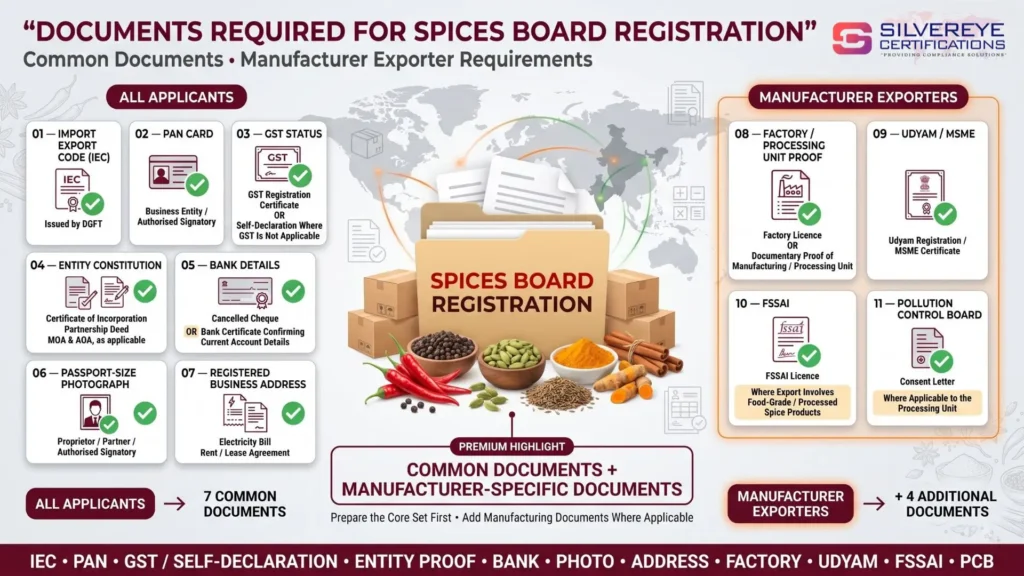
- Seven core documents are common to every Spices Board Registration application, regardless of exporter type.
- Manufacturer exporters need four extra documents to prove their processing facility exists and is compliant.
- Every document must be uploaded as a clear, self-attested scanned copy — unclear scans are a top cause of delay.
- Missing or mismatched documents are the single biggest reason CRES applications get sent back for correction.
Introduction
Spices Board Registration documents are the identity, business, and export-related papers an applicant must upload to obtain the Certificate of Registration as Exporter of Spices (CRES). At minimum, every applicant needs a valid Import Export Code (IEC), PAN card, GST registration or self-declaration, proof of business constitution, bank certificate or cancelled cheque, a passport-size photograph, and proof of business address.

Manufacturer exporters additionally need factory license proof, Udyam/MSME registration, an FSSAI license for food-grade products, and, where applicable, Pollution Control Board consent. All documents must be self-attested, current, and uploaded as clear scanned copies through the Spices Board portal.
Why Are the Right Spices Board Registration Documents Important for Registration?
The Spices Board Registration isn't just running a paperwork exercise — every document in the checklist exists to confirm one thing: that the exporter behind the application is a real, traceable, and legally compliant business. Your IEC proves you're zto trade internationally. Your GST and PAN establish your tax identity. Your bank certificate confirms where export proceeds will be settled. And for manufacturer exporters, facility documents confirm that the processing unit named in Form-1 actually exists and meets basic regulatory standards.
Getting the document set right the first time isn't just about avoiding rejection — it's what keeps your Spices Board Registration timeline on track. Applications with incomplete or mismatched documents are typically sent back for correction, which resets part of the review clock and can add several days or weeks to what should otherwise be a quick process.
Core Documents Required for Every Applicant
These documents apply whether you're registering as a merchant exporter or a manufacturer exporter.
| Document | Purpose | Format Notes |
| Import Export Code (IEC) certificate | Confirms DGFT authorisation to trade internationally | Self-attested scanned copy |
| PAN card | Establishes the tax identity of the business or signatory | Self-attested scanned copy |
| GST registration certificate | Confirms tax registration; self-declaration accepted if not applicable | Self-attested copy or signed declaration |
| Proof of business constitution | Certificate of Incorporation, Partnership Deed, or MOA & AOA depending on entity type | Self-attested copy |
| Bank certificate or cancelled cheque | Confirms the current account details for export transactions | Bank-issued certificate or cancelled cheque scan |
| Passport-size photograph | Identity record of the proprietor/authorised signatory | JPEG/JPG/PNG, per portal size limits |
| Proof of business address | Confirms the registered operating address | Electricity bill, rent or lease agreement |
Additional Documents for Manufacturer Exporters
If you own and operate a processing or manufacturing unit, your application needs these on top of the core list above:
- Factory license or another document proving the manufacturing/processing facility's existence and legal status.
- Udyam Registration certificate (MSME), which the Spices Board commonly accepts as facility and business-scale proof.
- FSSAI license, mandatory wherever the exported spices are processed, packaged, or otherwise food-grade.
- Pollution Control Board consent letter, where your unit's category requires environmental clearance.
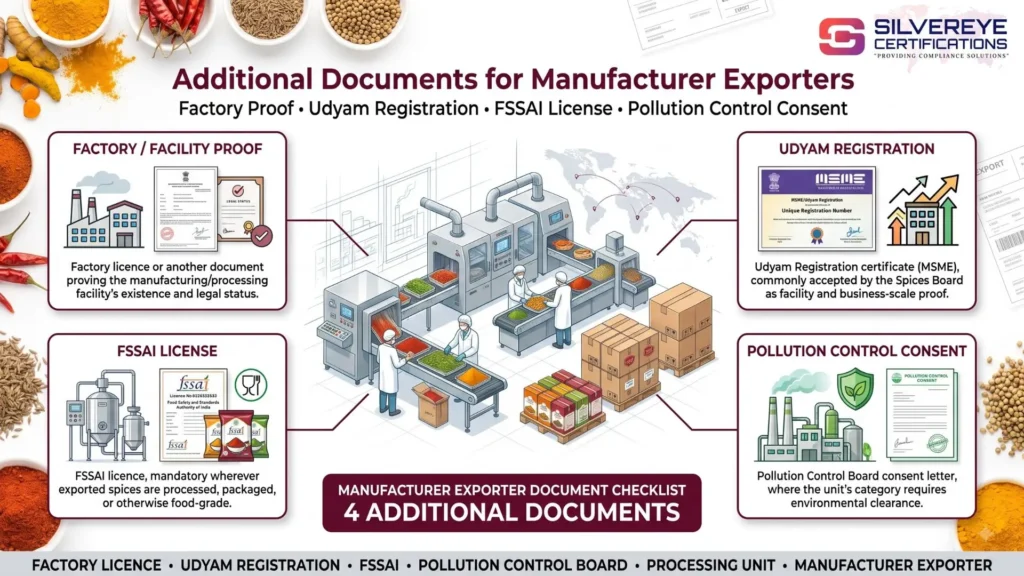
These extra documents are also why manufacturer exporter applications more often involve a site visit — the Spices Board typically wants to physically confirm what's on paper before issuing the certificate.
Where Each Document Fits in the Application
Documents aren't uploaded randomly — Form-1 and the portal expect them at specific points in the flow:
- Part I of Form-1 (business identity) pulls in your IEC, PAN, GST, and constitution documents.
- Part II of Form-1 (export activity) is where manufacturer-specific documents — factory licence, Udyam, FSSAI — get attached.
- The bank certificate/cancelled cheque and address proof are uploaded as supporting KYC documents alongside Form-1.
- Your photograph is attached to the applicant profile section, not to the export-activity section.
Document Format Rules the Spices Board Portal Expects
- All uploads must be self-attested — sign and stamp (where applicable) before scanning, not after.
- Files should be clear and legible; scans with glare, cropping, or low resolution are a common rejection trigger.
- Stick to the accepted file types and size limits shown on the portal — typically JPEG, JPG, or PNG for photographs, and PDF for certificates.
- Business names, addresses, and numbers across all documents should match exactly — a spelling mismatch between your GST certificate and IEC is enough to trigger a query.
- Keep documents current — an expired FSSAI license or an outdated address proof will be flagged during scrutiny.
Common Document Mistakes That Delay CRES Applications
- Submitting an IEC certificate with a different business name or address than what's declared in Form-1.
- Skipping the self-attestation step, assuming a plain scanned copy is enough.
- Uploading an old bank certificate that no longer matches the current account details.
- Manufacturer applicants leaving out FSSAI license proof for products that are clearly food-grade.
- Address proof that doesn't match the registered business address shown on the GST certificate.
Documents Needed When Renewing Your CRES
Renewal doesn't usually mean resubmitting your entire document set from scratch — but it does mean updating anything that's changed or expired since your original registration. In practice, this most often includes a refreshed GST certificate, an updated bank certificate if your account details changed, and, for manufacturer exporters, a current FSSAI licence or Udyam certificate if the earlier one has lapsed. Your original IEC and PAN generally stay valid unless your business itself has changed structure.
Fees and Validity Linked to Your Document Submission
Once your documents are verified and accepted, the registration fee is payable before your application moves to final scrutiny. Indicative government fees run around ₹5,000 for merchant exporters and ₹10,000–₹15,000 for manufacturer exporters, with GST charged extra — though exact figures are periodically revised, so confirm the current fee on the official Spices Board portal before paying.
Once issued, the CRES certificate — and the document set behind it — remains valid for 3 years, after which a renewal application with updated documents is required.
Why a Clean Document Set Pays Off Beyond Registration
- Faster CRES issuance, since desk verification has nothing to query or send back.
- Fewer surprises during a manufacturer site visit, since your paperwork already matches what's on the ground.
- A cleaner audit trail if the Spices Board or customs authorities ever request supporting documents later.
- A smoother renewal cycle, since your original document set becomes the baseline you're simply updating.
How Silvereye Certifications Helps With Your Documents
Most CRES delays trace back to documents, not the process itself — a scan that's too blurry, a name that doesn't match across two certificates, or a facility document that's technically expired. Silvereye Certifications reviews your entire Spices Board Registration document set before it ever reaches the portal: checking IEC, GST, PAN, and constitution documents for consistency, confirming manufacturer-specific paperwork like FSSAI and Udyam certificates are current, and flagging anything likely to trigger a query. That upfront check is often what separates a same-week CRES certificate from an application stuck in back-and-forth corrections.
Frequently Asked Questions on Spices Board Registration Documents
What documents are mandatory for Spices Board Registration?
IEC certificate, PAN card, GST certificate or self-declaration, proof of business constitution, bank certificate or cancelled cheque, a photograph, and address proof are mandatory for every applicant.
What extra documents does a manufacturer exporter need?
Factory license proof, Udyam/MSME registration, FSSAI license for food-grade products, and Pollution Control Board consent where applicable.
Do I need GST registration to apply?
A GST certificate is generally expected; where GST doesn't apply to your business category, a signed self-declaration is accepted instead.
Can I submit unattested document copies?
No. All documents uploaded to the Spices Board portal need to be self-attested before scanning.
What format should documents be uploaded in?
Certificates are typically uploaded as PDFs and photographs as JPEG, JPG, or PNG, within the file-size limits shown on the portal.
Why do document names need to match exactly across certificates?
Mismatches between your IEC, GST, and PAN details are one of the most common reasons applications get queried or delayed during scrutiny.
Is FSSAI license compulsory for every manufacturer exporter?
It's required wherever the exported spice product is food-grade or processed — not every manufacturing scenario, but most commercial spice production falls under it.
Do I need to resubmit all documents at renewal time?
No. You mainly need to update documents that have changed or expired, such as your GST certificate, bank details, or FSSAI license.
What happens if a document is found to be expired during verification?
The Spices Board will typically flag it and ask for a current copy, which pauses your application until it's resubmitted.
Can I use a virtual or co-working office address as business address proof?
Address proof needs to reflect your actual registered business address as declared in your GST and constitution documents; check current portal guidance for specific address-proof acceptability.
Who can help me prepare my Spices Board Registration documents correctly?
Compliance consultants such as Silvereye Certifications routinely review and prepare these document sets for exporters before submission.