- Alcohol-free does not mean unregulated. Attar, perfume oil, solid perfume and oil roll-on products are cosmetics under the Cosmetics Rules, 2020.
- Your route depends on where it is made. Imported products require CDSCO Import Registration (Form COS-2). Products manufactured in India require a license from the State Licensing Authority in Form COS-8 or COS-9, as applicable.
- Small packs get limited labelling relief. Perfume packs of 60 ml or less, and solid packs of 30 g or less, may be exempt from certain specific label declarations under the applicable rules. This does not mean all labelling requirements are waived.
- Registration remains valid in perpetuity, subject to payment of the applicable retention fee before completion of five years from the date of issue.
Introduction
Non-hydroalcoholic perfume registration in India depends on where the product is made. Imported alcohol-free perfume, attar or perfume oil needs an Import Registration Certificate (Form COS-2) from CDSCO, applied for in Form COS-1 through SUGAM. Perfume made in India needs a manufacturing license (Form COS-8) or loan license (Form COS-9) from the State Licensing Authority.
Both are regulated as cosmetics under the Cosmetics Rules, 2020. Import fees are USD 1,000 per category, USD 500 per manufacturing site and USD 50 per variant. Indian manufacturing licenses cost ₹10,000 for up to 10 items per category.
What Counts as a Non-Hydroalcoholic Perfume?
A non-hydroalcoholic perfume is a fragrance product that does not use ethanol as its base. This group can include traditional attars, concentrated perfume oils, solid perfumes and wax-based balms, oil-based roll-ons, and certain water- or glycol-based fragrance products that do not use alcohol as their base.
These non-hydroalcoholic perfume formats are popular with buyers who prefer alcohol-free fragrances, and many Indian brands build their product ranges around them.
The Drugs and Cosmetics Act, 1940 defines a cosmetic as an article intended to be rubbed, poured, sprinkled or sprayed on the human body for cleansing, beautifying, promoting attractiveness or altering appearance. It also covers articles intended for use as a component of a cosmetic. A perfume oil applied to the skin can therefore fall within the cosmetic regulatory framework, just like a spray perfume.
| Format | Typical base | Usual pack | Applicable small-pack labelling relief |
|---|---|---|---|
| Attar / perfume oil | Carrier oil or distilled base | Small bottle or vial | Certain declarations may be exempt for liquid packs of 60 ml or less |
| Roll-on | Oil base | Roller bottle | Certain declarations may be exempt for liquid packs of 60 ml or less |
| Solid perfume / balm | Wax and oil | Tin or jar | Certain declarations may be exempt for solid packs of 30 g or less |
| Water or glycol-based fragrance | Non-ethanol liquid | Spray or dropper | Certain declarations may be exempt for liquid packs of 60 ml or less |
Important: These pack-size provisions provide relief from specific labelling declarations only. They do not mean that the product is completely exempt from all applicable labelling requirements.
Is Non-Hydroalcoholic Perfume Registration Mandatory?
Yes, but the applicable regulatory route depends on where the perfume is manufactured and whether it is being imported or manufactured in India.
| If your perfume is... | What you need | Issued by | Application / certificate form |
|---|---|---|---|
| Made abroad and imported for sale in India | Import registration | CDSCO / Central Licensing Authority | Form COS-2, applied for in Form COS-1 |
| Made in India in your own unit | Manufacturing licence | State Licensing Authority | Form COS-8, applied for in Form COS-5 |
| Made in India by a contract manufacturer for your brand | Loan licence | State Licensing Authority | Form COS-9, applied for in Form COS-6 |
| Already registered by another importer and you want to import it | Follow the applicable registration/endorsement route | CDSCO / Central Licensing Authority | Requirements depend on the specific registration circumstances |
CDSCO's guidance makes clear that cosmetic manufacturing licences are issued by the State Licensing Authority, rather than CDSCO. Commercial manufacture of cosmetics for sale requires the applicable licence, subject to the exemptions provided under the Cosmetics Rules, 2020.
For a small, home-based or traditional production setup, do not assume that the business is automatically exempt. Check the requirements of the relevant State Licensing Authority before starting commercial manufacture.
What Are the Benefits of Non-Hydroalcoholic Perfume Registration?
- Legal market access: A valid COS-2 registration supports the lawful import and sale of applicable imported cosmetics, while COS-8 or COS-9 applies to licensed domestic manufacturing routes.
- Retail and marketplace readiness: Retailers and e-commerce platforms may request regulatory registration or licence documents before onboarding products.
- Regulatory compliance: Operating without the required registration or manufacturing licence can expose a business to regulatory action.
- Product identification: Applicable registration or licence information helps demonstrate that the product is covered by the relevant regulatory framework.
- Range expansion: Additional products or variants can be added through the applicable endorsement or additional-item procedure, where permitted.
Who Is Eligible for Non-Hydroalcoholic Perfume Registration in India?
Who Can Apply Through the Import Route?
For non-hydroalcoholic perfume import registration, CDSCO guidance permits applications by the manufacturer, its authorised agent in India, an importer in India, or an authorised Indian subsidiary, as applicable.
Foreign brands commonly work through an Indian importer or authorised agent who handles the registration and regulatory communication.
Who Can Apply Through the Domestic Manufacturing Route?
For domestic manufacturing:
- The applicant may be an individual, firm or company, subject to the applicable licensing requirements.
- The manufacturing premises, plant and equipment must comply with the applicable requirements of the Seventh Schedule of the Cosmetics Rules, 2020.
- Manufacture must be carried out under the supervision of competent technical staff meeting the qualifications prescribed under the Rules.
- The manufacturer must comply with applicable Good Manufacturing Practices (GMP) requirements and provide the required documentation/self-declaration.
- A brand that does not operate its own manufacturing facility may consider the loan licence route through an eligible licensed manufacturer.
What Are the Requirements for Non-Hydroalcoholic Perfume Registration?
| Area | What applies |
|---|---|
| Ingredient list | Use the applicable standard names and provide ingredient percentages. Carrier oils, waxes, solvents and other formulation ingredients should be appropriately declared. |
| Fragrance ingredients | The manufacturer should provide the applicable fragrance composition information/undertaking and ensure compliance with the relevant cosmetic standards, including IS 4707 (Part 2):2017, where applicable. |
| Prohibited substances | Ingredients prohibited under the applicable cosmetic standards must not be used. |
| New cosmetic check | If the product qualifies as a new cosmetic because of a novel ingredient under the applicable rules, the required prior permission must be obtained before proceeding with the import registration route. |
| “Alcohol-free” claim | The claim must be accurate and not misleading. |
| Other claims | Avoid claims suggesting that the product treats, cures or prevents a disease, as such claims can affect its regulatory classification. |
| Animal testing | Cosmetics tested on animals after 12 November 2014 are subject to import restrictions under the applicable rules. |
| Shelf life at import | Imported cosmetics must meet the applicable remaining shelf-life requirement at the time of import. |
Review your product claims before filing. Statements promising to treat a skin condition, cure a problem or heal the skin can create regulatory issues. For a perfume product, keep claims focused on its fragrance, sensory and cosmetic use unless a different regulatory classification has been established.
What Documents Are Required for Non-Hydroalcoholic Perfume Registration?
The documents required depend on whether the perfume is imported into India, manufactured in your own facility, or manufactured under a loan licence.
| Document | Import (COS-1) | Own manufacture (COS-5) | Loan licence (COS-6) |
|---|---|---|---|
| Application form | Form COS-1 | Form COS-5 | Form COS-6 |
| Manufacturer authorisation | Required and appropriately authenticated | Not applicable | Not applicable |
| Free Sale Certificate | Required for applicable products/variants | Not applicable | Not applicable |
| Overseas manufacturing licence or marketing authorisation | Required where applicable, or applicable undertaking where no such licence exists | Not applicable | Not applicable |
| Ingredient list with percentages | Required | Required | Required |
| Labels | Original or copy for each product/variant | Required | Required |
| Specifications and testing methods | Required; applicable COA/testing documents may also be provided | Required | Required |
| Non-animal testing undertaking | Required where applicable | Required declaration/undertaking as applicable | Required declaration/undertaking as applicable |
| Second Schedule information/undertaking | Part I | Part II | Part II |
| GMP and premises documentation | Not applicable | Required | Applicable to the licensed manufacturing premises |
| Technical staff qualification and consent | Not applicable | Required | Required as applicable to the licensing route |
| Fee receipt | Bharatkosh acknowledgement | State Licensing Authority payment receipt | State Licensing Authority payment receipt |
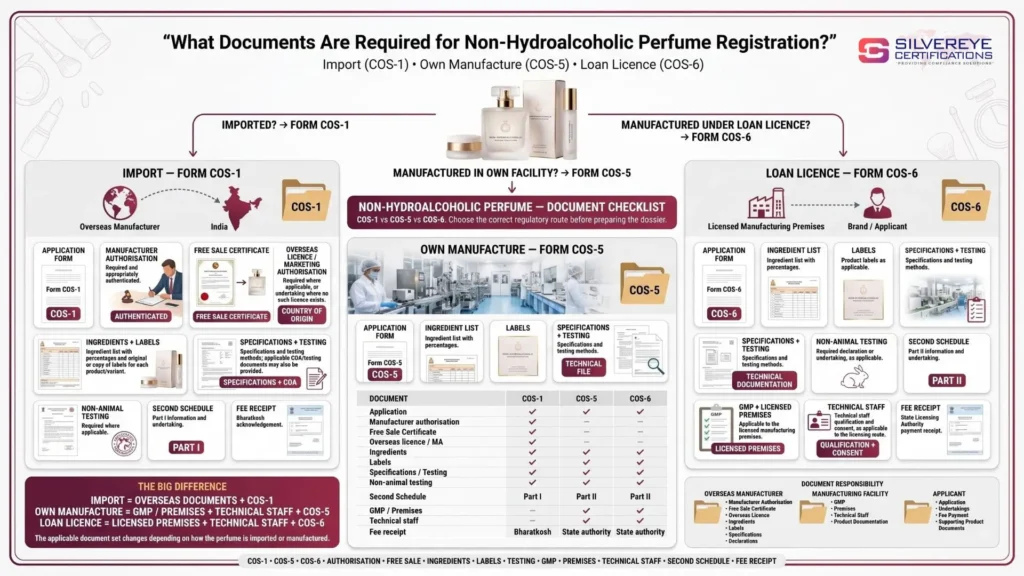
The import documentation follows CDSCO's cosmetic import-registration requirements. For domestic manufacturing, the exact checklist can depend on the State Licensing Authority and the applicable manufacturing premises requirements, so confirm the current checklist before filing.
What Are the Fees for Non-Hydroalcoholic Perfume Registration?
What Are the CDSCO Import Registration Fees?
The applicable Third Schedule fees for cosmetic import registration include:
| Fee head | Amount |
|---|---|
| Registration certificate – each category | USD 1,000 |
| Additional category | USD 1,000 |
| Each manufacturing site | USD 500 |
| Each variant | USD 50 |
What Are the Fees for Indian Manufacturing and Loan Licenses?
For COS-8 and COS-9, the applicable government fees are prescribed under the Third Schedule of the Cosmetics Rules, 2020. The actual amount should be confirmed with the relevant State Licensing Authority before payment.
| Fee head | Amount |
|---|---|
| Licence fee for up to 10 items per cosmetic category | ₹10,000 |
| Each additional item | ₹500 |
| Retention fee | Based on the applicable licence fee |
| Duplicate copy of licence | ₹500 |
| Fresh application after rejection | ₹1,000 |
| Late retention payment | Applicable retention fee plus the prescribed late fee, where applicable |
What Would the Government Fee Look Like?
| Scenario | Calculation | Government fee |
|---|---|---|
| Import 12 attar variants, one category, one site | 1,000 + 500 + (12 × 50) | USD 2,100 |
| Import 20 roll-on variants, one category, one site | 1,000 + 500 + (20 × 50) | USD 2,500 |
| Manufacture 12 attar items in India, one category | 10,000 + (2 × 500) | ₹11,000 |
| Manufacture 25 oil/balm items in India, one category | 10,000 + (15 × 500) | ₹17,500 |
These are government-fee illustrations only. They do not include consultant fees, premises setup, technical staff, testing, foreign-document authentication, packaging or logistics.
The way an “item” is counted for a domestic manufacturing licence should be confirmed with the relevant State Licensing Authority, particularly where different formulations, shades, fragrances or pack sizes are involved. Always verify the current fee schedule before payment.
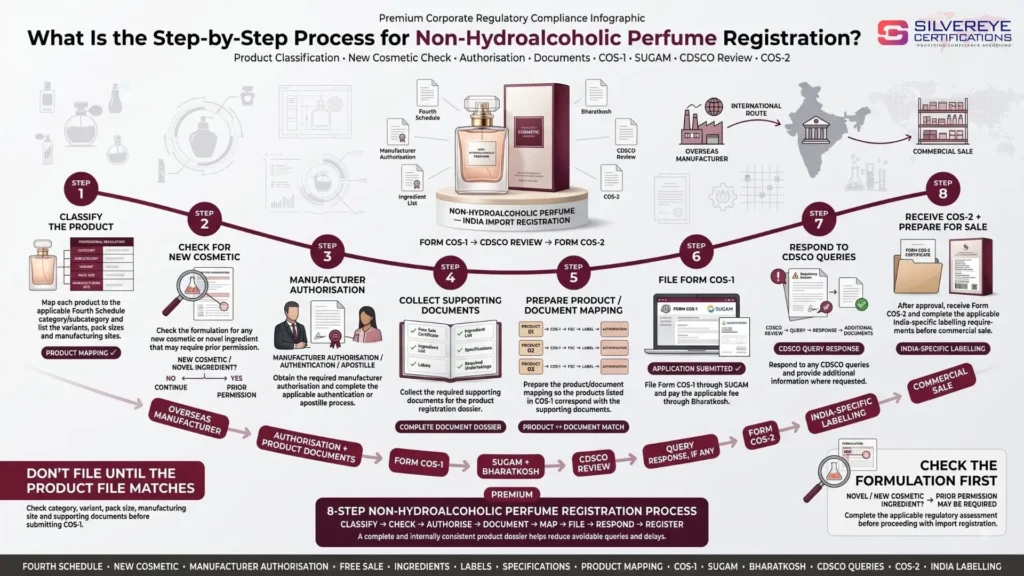
What Is the Step-by-Step Process for Non-Hydroalcoholic Perfume Registration?
How Does the Import Registration Process Work?
| Step | What to do |
|---|---|
| 1 | Map each product to the applicable Fourth Schedule category/subcategory and list the variants, pack sizes and manufacturing sites. |
| 2 | Check the formulation for any new cosmetic/novel ingredient that may require prior permission. |
| 3 | Obtain the required manufacturer authorisation and complete the applicable authentication/apostille process. |
| 4 | Collect the Free Sale Certificate, ingredient list, labels, specifications and required undertakings. |
| 5 | Prepare the product/document mapping so that the products listed in COS-1 correspond with the supporting documents. |
| 6 | File Form COS-1 through SUGAM and pay the applicable fee through Bharatkosh. |
| 7 | Respond to any CDSCO queries and provide additional information where requested. |
| 8 | After approval, receive Form COS-2 and complete the applicable India-specific labelling requirements before commercial sale. |
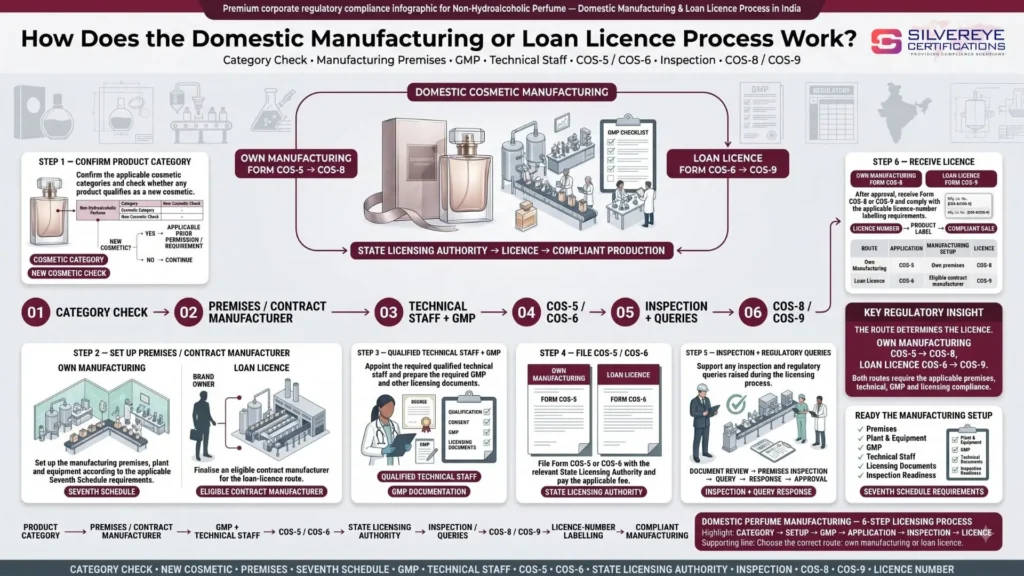
How Does the Domestic Manufacturing or Loan License Process Work?
| Step | What to do |
|---|---|
| 1 | Confirm the applicable cosmetic categories and check whether any product qualifies as a new cosmetic. |
| 2 | Set up the manufacturing premises, plant and equipment according to the applicable Seventh Schedule requirements, or finalise an eligible contract manufacturer for the loan-licence route. |
| 3 | Appoint the required qualified technical staff and prepare the required GMP and other licensing documents. |
| 4 | File Form COS-5 or COS-6 with the relevant State Licensing Authority and pay the applicable fee. |
| 5 | Support any inspection and regulatory queries raised during the licensing process. |
| 6 | After approval, receive Form COS-8 or COS-9 and comply with the applicable licence-number labelling requirements. |
Important: Do not automatically assume that every attar, perfume oil, solid perfume or roll-on is treated as the same “item” for licensing or fee purposes. The formulation, product category, manufacturing route and applicable State Licensing Authority requirements should be checked before filing.
What If You Import Bulk Perfume Oil for a Licensed Filler in India?
Many non-hydroalcoholic perfume brands purchase bulk attar or perfume oil and have it filled into roll-ons, bottles or other retail packs in India.
CDSCO's FAQ addresses the import of bulk finished formulation ready for filling. Depending on the arrangement, the applicant may need to provide the valid manufacturing license of the Indian filler issued by the State Licensing Authority, along with details of the registered brand owner of the finished product in India.
If a trader does not operate its own manufacturing premises and only supplies bulk formulation to a licensed manufacturer, the applicable documentation may include an agreement with the manufacturer and a copy of the manufacturer's licence.
If you are an Indian distiller, blender or bulk perfume-oil supplier selling formulation to other brands, confirm with your State Licensing Authority whether your own activity requires a manufacturing licence before scaling commercial supplies.
How Long Does Non-Hydroalcoholic Perfume Registration Take?
The timeline depends on the regulatory route.
| Route | Timeline |
|---|---|
| Import (COS-2) | Rule 13 provides a period of up to six months for CDSCO to grant or reject a complete application. CDSCO's FAQ also refers to a 90-day targeted processing period based on an earlier circular. |
| Manufacturing or loan licence (COS-8 / COS-9) | The process is handled by the State Licensing Authority and the practical timeline can vary depending on the state, inspection requirements, document completeness and queries. Avoid treating a fixed consultant-quoted timeline as a guaranteed approval period. |
For both routes, delays commonly arise from incomplete documents, overseas authentication, product/category questions, inspections and slow responses to regulatory queries.
How Long Is a Non-Hydroalcoholic Perfume Registration or License Valid?
Both the COS-2 import registration and COS-8/COS-9 manufacturing licenses can remain valid in perpetuity, subject to payment of the applicable retention fee within the prescribed period. The relevant authority may also suspend or cancel the registration/license for applicable non-compliance.
| Point | Import registration (COS-2) | Indian licence (COS-8 / COS-9) |
|---|---|---|
| Validity | Perpetual, subject to retention fee | Perpetual, subject to retention fee |
| Retention fee due | Before completion of five years from issue | Before completion of five years from issue |
| Separate renewal application | Not required in the traditional renewal sense | Not required in the traditional renewal sense |
| Late fee | 2% of the applicable retention fee per month or part thereof, within the prescribed 180-day period | 2% of the applicable retention fee per month or part thereof, within the prescribed 180-day period |
| After the late-payment period | Registration may be deemed cancelled under the applicable rule | Licence may be deemed cancelled under the applicable rule |
| Suspension/cancellation | Central Licensing Authority | State Licensing Authority |
For both imported and domestically manufactured products, add the five-year retention date to your compliance calendar as soon as the registration or license is granted.
What Are the Labelling Rules for Non-Hydroalcoholic Perfume?
Labelling requirements are governed primarily by Rule 34 and Chapter VI of the Cosmetics Rules, 2020, along with applicable Legal Metrology requirements and relevant BIS standards.
| Element | What applies |
|---|---|
| Governing rules | Rule 34 and Chapter VI of the Cosmetics Rules, 2020, along with applicable Legal Metrology requirements and relevant BIS standards |
| Imported products | The Import Registration Certificate number must appear on the unit pack, preceded by “RC”, “RC No” or “Reg. Cert. No”, together with the importer’s name and address. |
| Made in India | The label must carry the applicable manufacturer and manufacturing information, including the licence information required under the rules. |
| Batch and dating | Applicable batch/lot identification and use-before/expiry information must be provided. |
| Net content | The net-content declaration has a specific exemption for perfume/toilet water or similar products of 60 ml or less, and for solid/semi-solid cosmetics of 30 g or less. |
| Ingredient list | The ingredient declaration follows the requirements of Rule 34. There is a specific exemption for liquid packs of 60 ml or less and solid/semi-solid packs of 30 g or less. |
| Very small containers | For liquid packs of 60 ml or less and solid/semi-solid packs of 30 g or less, where the full manufacturer address cannot be given, the rules provide for the manufacturer's name and principal place of manufacture with PIN code. |
| Hazards | Where a hazard exists, the label must provide directions for safe use and applicable warnings/cautions. |
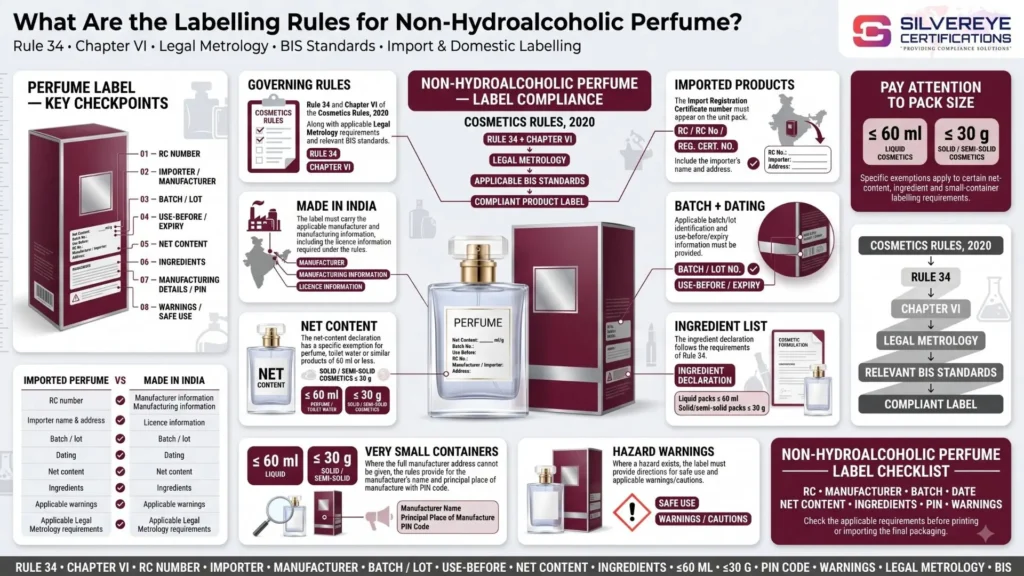
For imported cosmetics, Rule 34 specifically requires the RC number and importer details on the unit pack.
What Are the Rules for Gift Sets, Kits and Variants?
- A retail pack containing several fragrances and sold as one retail unit may be treated according to the applicable CDSCO requirements for kits/variants.
- Different pack sizes should be declared appropriately in the registration documentation even where they do not constitute separate variants under CDSCO's applicable interpretation.
- A kit imported for sale as such may not require a separate registration where each cosmetic in the kit is already registered and the applicable conditions are satisfied.
- Where CDSCO's applicable procedure permits registration of such a kit separately, the relevant fee treatment should be confirmed before filing.
Because variant and kit treatment can affect both registration and fees, confirm the exact product structure with CDSCO before filing a large range.
What Customs and Logistics Requirements Apply to Non-Hydroalcoholic Perfume?
Perfume registration is only one part of the import process. Customs classification, applicable duty and shipment requirements must also be checked separately.
Perfumes and toilet waters fall under HS heading 3303, but the exact tariff classification depends on the product and its formulation. Do not rely only on a supplier's tariff code; confirm the appropriate classification with your customs broker or tariff specialist before import.
Also:
- Ask your freight forwarder whether any carrier-specific requirements apply to the formulation or its ingredients.
- Check the Safety Data Sheet (SDS) for solvents, carrier materials and other potentially regulated components.
- Natural raw materials such as agarwood/oud may be subject to separate trade or conservation requirements depending on the material and source.
- Keep supplier specifications and SDS documents for each relevant batch.
What Are the Common Non-Hydroalcoholic Perfume Registration Mistakes?
| Mistake | Fix |
|---|---|
| Assuming small or traditional makers automatically do not need a licence | Confirm the applicable requirements with the State Licensing Authority before commercial manufacture |
| Calling a product “alcohol-free” without formulation evidence | Keep supplier specifications and formulation records for each batch |
| Making medical or treatment claims | Keep claims within the cosmetic/fragrance scope unless another regulatory route applies |
| Missing products or variants in the Free Sale Certificate | Match the supporting documents with the COS-1 product list |
| Using different product names across documents | Maintain one master product sheet and use consistent names |
| Importing products with insufficient remaining shelf life | Coordinate production, shipment and import dates |
| Forgetting the five-year retention date | Add the retention deadline to your compliance calendar immediately after grant |
What Changed for Cosmetics in 2026?
CDSCO's cosmetics section continues to publish cancellation and surrender actions involving cosmetic registrations and products during 2026, including actions listed in February, July and September 2026.
This reinforces an important point for non-hydroalcoholic perfume businesses: registration or licensing is not the end of compliance. Businesses should maintain accurate product records, comply with labelling and quality requirements, respond to regulatory queries, and track their retention obligations.
For a non-hydroalcoholic perfume brand, the practical approach is simple: obtain the correct registration or manufacturing licence before commercial sale, maintain consistent product documentation, comply with labelling requirements, and keep the five-year retention date on your compliance calendar.
Conclusion
Non-hydroalcoholic perfume may seem simple, but it is regulated like other applicable cosmetics. The key question for non-hydroalcoholic perfume registration in India is not simply whether approval is required, but which regulatory route applies: CDSCO import registration if the product is imported, or a State manufacturing or loan licence if it is manufactured in India.
Choose the correct perfume registration route first, prepare the ingredient list and product claims carefully, use the applicable small-pack labelling relief, and keep the retention fee date in your compliance calendar. Completing the required registration or licence before launch can help avoid unnecessary delays for attar, perfume oil, roll-on and solid perfume businesses.
How Can Silvereye Certifications Help With Non-Hydroalcoholic Perfume Registration?
Silvereye Certifications is an Indian regulatory consultancy that supports manufacturers, importers and brand owners with CDSCO, BIS and related compliance requirements.
For non-hydroalcoholic perfume brands, Silvereye Certifications can assist with:
- Choosing between CDSCO import registration, manufacturing licence and loan licence
- Reviewing documents and product labels before filing
- Checking ingredient lists and product claims
- Preparing the applicable registration or licence application
- Supporting CDSCO or State Licensing Authority queries
- Tracking the applicable retention fee date
If you are planning an attar, perfume oil, roll-on or solid perfume range for the Indian market, consider reviewing your regulatory requirements before finalising your suppliers, labels or launch date. Identifying documentation or compliance gaps early can help reduce avoidable delays later.
Frequently Asked Questions
Is non-hydroalcoholic perfume registration India mandatory?
Yes for commercial sale. Attar, perfume oil, solid perfume and roll-ons are cosmetics. Imports need CDSCO registration and Indian production needs a State Licensing Authority licence.
Is non-hydroalcoholic perfume exempt from CDSCO registration?
No. Only the listed exemptions, such as R&D samples, duty-free sales or bulk export, avoid registration, and none apply to goods sold in India.
Do I need a licence for non-hydroalcoholic perfume made in India?
If you manufacture for sale, you need a manufacturing license in Form COS-8, or a loan license in Form COS-9 if a licensed manufacturer makes it. Confirm how your unit is treated with your State Licensing Authority.
What is the fee for non-hydroalcoholic perfume registration on import?
USD 1,000 per category, USD 500 per manufacturing site and USD 50 per variant, paid through Bharatkosh.
What does an Indian manufacturing license cost?
The published fee is Rs 10,000 for up to 10 items per category, plus Rs 500 for each additional item. Verify current fees with your State Licensing Authority.
How long is non-hydroalcoholic perfume registration valid?
Both stay valid in perpetuity if the retention fee is paid before five years from issue are complete.
How long does CDSCO take to register an imported perfume oil?
Up to six months under Rule 13, with a 90-day target in CDSCO's FAQ.
What label rules apply to small non-hydroalcoholic perfume packs?
It still needs a compliant label, but perfume packs of 60 ml or less can skip the net content statement and ingredient list, and solid packs of 30 g or less have similar relief.
Can I import perfume oil for my non-hydroalcoholic perfume brand and fill it in India?
Yes, for filling by a licensed manufacturer. CDSCO's FAQ asks for the filler's manufacturing license and brand owner details with the application.
Is a gift set of several attars one variant?
CDSCO's FAQ treats a unit pack with different fragrances sold as a single retail unit as one variant.
Can I call my perfume alcohol-free?
Only if it is true for every batch. A cosmetic cannot carry a false or misleading claim.
What happens if I miss the retention fee?
Late fees apply. For import registration, the certificate is deemed cancelled after 180 days. For Indian licences, 2% of the licence fee per month or part applies within six months of expiry.