
- Explains exactly when to file, what documents are needed, and how the PSARA license renewal process works across Indian states.
- Compares state-wise renewal timelines side by side, since the recommended filing window genuinely differs from state to state.
- Covers what happens if a PSARA license is allowed to lapse, and how that differs from a fresh application.
- Details the May 2026 amendment that removed criminal liability under Sections 12 and 20(2) of the PSARA Act — relevant to what renewal reviews now check for.
Introduction
PSARA license renewal is the process of extending a Private Security Agencies (Regulation) Act, 2005 license before its five-year validity ends, so the agency can keep operating legally without a gap. The renewal application goes to the same State Controlling Authority that issued the original license, along with the prescribed fee, updated director and premises documents, proof of continued training-institute tie-up, and — in most states — fresh or updated police verification. Exactly how many days before expiry you should file varies by state: Uttar Pradesh sets a 40-day minimum, Gujarat's guidance points to 45 to 60 days, and several other states recommend a wider 90-day buffer.
Filing late risks the license lapsing, which most states then treat as a fresh application rather than a simple renewal — restarting police verification from scratch. A May 2026 MHA amendment also removed criminal liability for certain procedural lapses under Sections 12 and 20(2) of the Act, though the underlying compliance checks a renewal reviews remain unchanged.
What Is PSARA License Renewal?
PSARA license renewal is how a private security agency extends the validity of its license under the Private Security Agencies (Regulation) Act, 2005, once the original five-year term is coming to an end. Renewal isn't automatic — the agency has to file a fresh renewal application with the same State Controlling Authority that granted the original license, along with the required fee and updated compliance documents, well before the current license expires.
Because PSARA licensing is state-administered, the exact renewal form, fee, and recommended filing window vary from state to state, even though the underlying legal requirement — Sections 6, 7, and 8 of the Act — is the same nationwide. This is one of the most common points of confusion for agencies operating in more than one state, since a renewal timeline that works in one state can leave too little buffer in another.
Who Needs to Renew a PSARA License?
Any proprietorship, partnership, LLP, or company holding a PSARA license needs to renew it before the five-year validity period ends, if it intends to keep operating legally. This applies regardless of:
- Whether the agency has grown, shrunk, or stayed the same size since the original license was granted
- Whether the agency's geographic scope was a single district, multiple districts, or the whole state
- Whether there have been any changes in directors, the Principal Officer, or the registered office address — all of which need to be reflected in the renewal filing
- Whether the agency has had a clean compliance record or has faced any regulatory queries during the license period
Even an agency that hasn't had any client complaints or compliance issues still needs to file for renewal on time — a spotless track record doesn't extend the license automatically, and the Controlling Authority still needs a fresh application to re-confirm eligibility.
Benefits of Renewing on Time
- Uninterrupted legal operation — no gap during which the agency would technically be providing security services without a valid license.
- Avoids the far more time-consuming fresh-application route that most states require if a license lapses.
- Protects existing client contracts, many of which include a clause requiring a continuously valid PSARA license.
- Keeps EPF, ESI, and banking relationships that depend on active licensed status running smoothly.
- Gives the agency a natural checkpoint to update director, training, and compliance records before they go stale.
Eligibility for PSARA License Renewal
For the Agency
- Must hold a currently valid (not yet expired) PSARA license issued by the relevant State Controlling Authority.
- Must still meet the entity-level requirements that applied at the time of original registration — registered office, correct agency naming, and so on.
- Must maintain an active, signed MoU with a recognized training institute, or renew that tie-up if it has lapsed.
For Directors, Partners, and the Principal Officer
- Must continue to meet the citizenship, age, and character requirements that applied at original registration.
- Any new director or Principal Officer added since the original grant typically needs to undergo the same antecedent verification as at first registration.
- Must not have accumulated any disqualifying conviction or dismissal since the license was last granted.
For Guards and Supervisors on Record
- Training and antecedent records for existing guards should be current and available for review.
- Any new guards hired during the license period should already have completed the prescribed training under Section 9 of the Act.
Documents Required for PSARA License Renewal
| Category | Typical Documents |
| Existing License | Original PSARA license certificate and any prior renewal certificates, if this isn't the first renewal |
| Entity Updates | Updated certificate of incorporation details, GST registration, and proof of registered office address if it has changed |
| Directors / Principal Officer | Updated identity and address proof for all current directors and the Principal Officer, plus fresh antecedent documents for anyone added since the last grant |
| Training Tie-Up | Renewed or continuing MoU with a recognised training institute, and training records for guards employed during the license period |
| Compliance Record | Any compliance reports, guard deployment registers, or inspection responses the Controlling Authority may require as part of the renewal review |
| Fee | Renewal fee as prescribed by the relevant state — typically lower than the fee for a fresh license of the same scope |
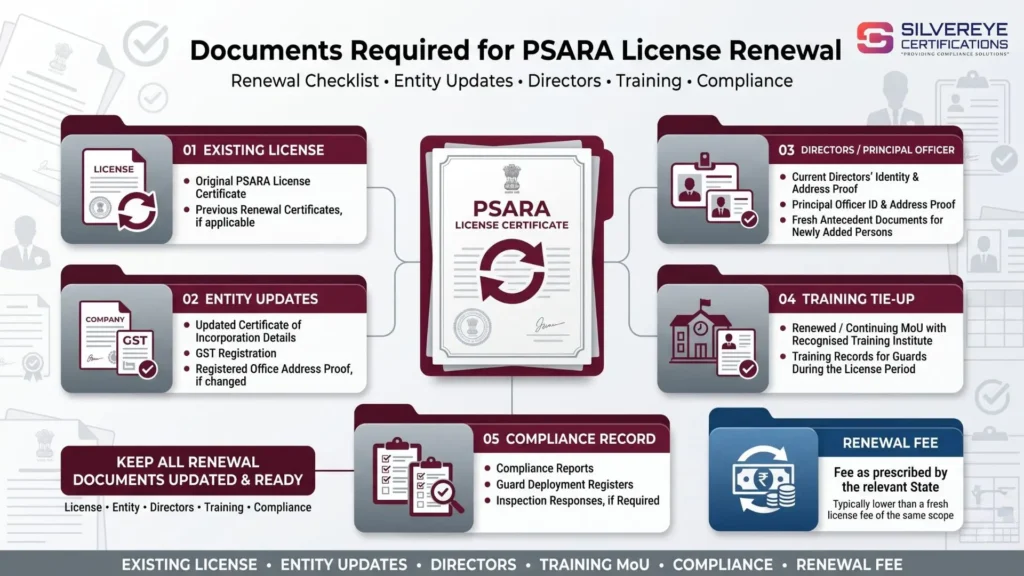
Since renewal applications are reviewed against the same standards as a fresh application, incomplete or outdated documentation is just as likely to delay a renewal as it would a first-time filing — treat it with the same care.
Step-by-Step PSARA License Renewal Process
- Track your license's expiry date well in advance — ideally as soon as the license is granted, not when expiry is already close.
- Confirm your state's recommended renewal filing window, since this varies meaningfully — see the state-wise comparison below.
- Update all entity, director, and Principal Officer documents, and gather fresh antecedent documents for anyone who has joined since the original grant.
- Confirm your training-institute MoU is still active, or renew it if it has lapsed or if the institute's own recognition has expired.
- Compile the renewal application in the format prescribed by your State Controlling Authority, referencing Sections 6, 7, and 8 of the Act.
- Submit the renewal application along with the prescribed fee, either online through the state's portal or offline via demand draft/challan, depending on how your state processes PSARA filings.
- Respond promptly to any queries or requests for additional documents from the Controlling Authority during review.
- Once approved, the renewed license is issued for a further term — typically another five years — and should be displayed at the registered office just like the original.
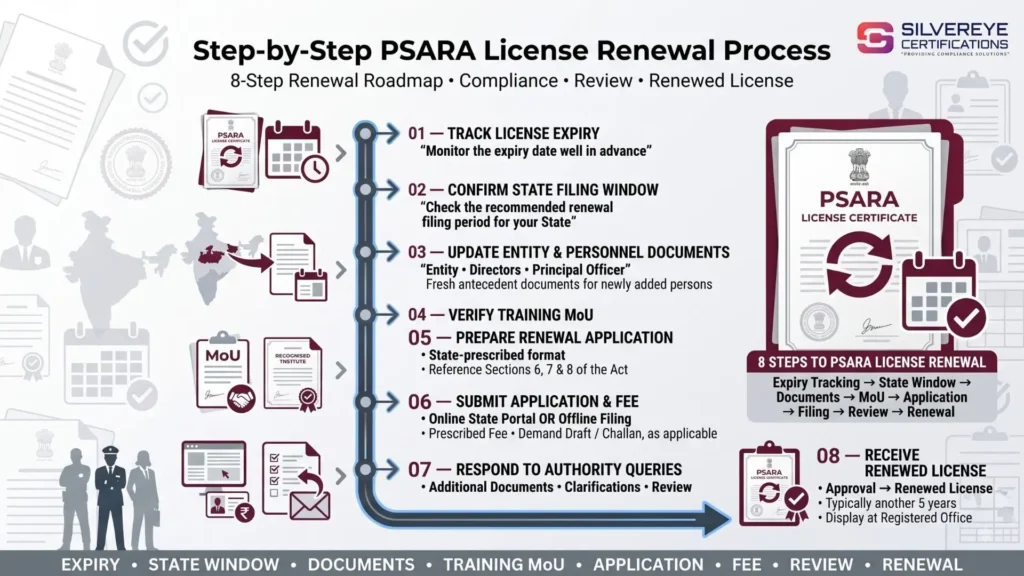
Processing time for renewal is generally shorter than for a fresh application, since the Controlling Authority already has a compliance history to work from, but it can still take anywhere from a few weeks to a couple of months depending on the state and how complete the filing is.
PSARA License Renewal Fees
Renewal fees are set by each state's own PSARA Rules and are typically lower than the fee for a fresh license of the same geographic scope, though the exact figure and structure vary by state — several states use the same district-tiered model (roughly ₹5,000/₹10,000/₹25,000 depending on scope) that applies to fresh applications, while others price renewal separately.
Because these figures are revised periodically, always confirm the current renewal fee with your specific state's Controlling Authority rather than assuming it matches a figure quoted for a different state.
State-Wise PSARA License Renewal Timelines
This is where agencies most often get caught out: the recommended renewal filing window is not the same across India. Based on state-specific guidance, here's how the picture compares:
| State | Renewal Window Guidance |
| Uttar Pradesh | Minimum 40 days before expiry (statutory minimum); 2–3 months recommended as a safer buffer |
| Gujarat | Guidance points to roughly 45–60 days before expiry |
| Rajasthan | Some guidance cites 30–45 days (Form VII); 60–90 days recommended given 1–3 month processing |
| Delhi | Conflicting guidance between 45 and 90 days; 90 days recommended as the safer target |
| Tamil Nadu | At least 90 days before expiry, given the largely offline filing process |
| Karnataka | Guidance ranges from 45–60 days to a recommended 90 days |
| Maharashtra (Mumbai) | Minimum 45 days before expiry; wider buffer advised given 45–120 day processing reports |
The pattern across nearly every state is the same: whatever the stated legal minimum, actual processing time can run well beyond it, so treating the minimum as a deadline to start rather than a deadline to finish is the safer mindset everywhere.
What Happens If a PSARA License Lapses?
If a PSARA license expires without a renewal application filed in time, most states no longer treat the next filing as a renewal at all — it becomes a fresh application, which means:
- Police antecedent verification typically has to restart from the beginning for all directors and the Principal Officer.
- The agency may not be able to legally operate during the gap between expiry and the new license being granted.
- Ongoing client contracts that require a continuously valid PSARA license can be put at risk or breached during the gap.
- The overall timeline to get back to licensed status is usually considerably longer than a straightforward renewal would have been.
This is the single biggest reason renewal guidance across every state converges on the same advice: start early, and don't treat the statutory minimum window as a comfortable target.
The 2026 PSARA Update and What It Means for Renewals
The most significant regulatory change affecting PSARA compliance nationwide in 2026 came from the Ministry of Home Affairs. On 2 May 2026, the MHA issued a notification, effective 15 May 2026, omitting Section 12 and Section 20(2) of the Private Security Agencies (Regulation) Act, 2005.
For renewal purposes specifically, here's what changed and what didn't. Before 15 May 2026, a failure to display the license at the registered office (Section 12), or a violation of training or guard-eligibility norms under Sections 9 and 10, could be treated as a criminal matter under Section 20(2) — potentially affecting a renewal review. From 15 May 2026 onward, these specific procedural lapses are no longer criminal offences, though the Controlling Authority can still refuse or delay a renewal, or suspend/cancel an existing license, for genuine non-compliance found during review.
What this means practically for a renewal filing:
- A minor procedural lapse — like a license not being displayed prominently — is no longer grounds for criminal prosecution, but it can still be flagged during a renewal review as something to correct.
- Training records and guard-eligibility documentation under Sections 9 and 10 are still fully scrutinised during renewal — this hasn't loosened at all.
- Operating without a valid license — including during a lapse between an old license expiring and a new one being granted — remains a criminal offence under Section 4 read with Section 20(1), completely unaffected by this amendment.
- Renewal reviews continue to check the same substantive compliance record; only the criminal-liability angle for certain technical lapses has changed.
This change followed sustained industry advocacy at the national level, including a March 2026 MHA review meeting that specifically raised concerns about renewal pendency and inconsistent implementation across states — the exact issue this guide's state-wise comparison table above is meant to help agencies plan around.
How to Avoid a Renewal Delay
- Set a renewal reminder well before your state's stated minimum window — treat the minimum as a deadline to have started, not to have finished.
- Keep director and Principal Officer documents updated continuously through the license period, rather than scrambling to gather them at renewal time.
- Renew your training-institute MoU proactively if it's due to lapse before your license renewal is filed.
- Maintain guard training and deployment registers throughout the license period so they're ready for review, not reconstructed at the last minute.
- If your agency operates in more than one state, track each state's renewal window separately — don't assume one state's timeline applies to another.
Penalties for Missing a Renewal Deadline
There's no separate criminal penalty specifically for missing a renewal deadline, but the practical consequence is serious: once the license lapses, continuing to operate is treated the same as operating without any license at all — a criminal offence under Section 4 read with Section 20(1) of the Act, carrying a fine and imprisonment of up to one year.
On top of that legal exposure, a lapsed license typically forces the agency into a fresh application, repeating police verification and potentially disrupting every active client contract that requires continuous licensing. In effect, missing a renewal deadline converts an administrative filing into a legal and operational emergency.
How Silvereye Certifications Can Help
Tracking renewal deadlines across different states, keeping director and training documentation current, and filing early enough to beat each state's real-world processing time — not just its stated minimum — is exactly the kind of ongoing compliance work that's easy to deprioritise until it becomes urgent.
Silvereye Certifications works with security agencies across India to track PSARA renewal timelines state by state, prepare complete renewal filings well ahead of expiry, and make sure a lapsed license never becomes the reason a client contract falls through.
Frequently Asked Questions
When should I start my PSARA license renewal process?
It depends on your state — Uttar Pradesh sets a 40-day statutory minimum, while several other states recommend a 90-day buffer. Whatever your state's minimum is, start well before it rather than exactly at it.
Is PSARA license renewal the same process as a fresh application?
No, if filed on time. Renewal reviews an existing compliance record and is generally faster than a fresh application, but if the license is allowed to lapse, most states treat the next filing as a brand-new application instead.
What documents are needed for PSARA license renewal?
Core documents include the existing license certificate, updated director and Principal Officer identity/address proof, a continuing training-institute MoU, and guard training/deployment records, along with the prescribed renewal fee.
How much does PSARA license renewal cost?
Renewal fees are set by each state and are typically lower than a fresh license fee of the same scope, but the exact amount varies — confirm the current figure with your state's Controlling Authority.
What happens if my PSARA license expires before I renew it?
Most states treat this as a lapsed license, requiring a fresh application rather than a simple renewal — which means restarting police verification and risking an operational gap.
Can I keep operating while my PSARA renewal is being processed?
This depends on whether the renewal was filed before the original license expired. If filed on time and still under review, most states allow continued operation; if the license has already lapsed, operating without a valid license is a criminal offence regardless of a pending renewal filing
Do I need fresh police verification for a PSARA license renewal?
Typically only for any new directors, partners, or Principal Officer added since the original grant — existing verified personnel usually aren't re-verified from scratch unless the state specifically requires it or the license has lapsed.
How long does PSARA license renewal take?
It varies by state and can range from a few weeks to a couple of months, generally faster than a fresh application, but real-world timelines often run longer than the state's stated minimum filing window would suggest.
What changed for PSARA renewals in 2026?
Effective 15 May 2026, the MHA removed criminal liability for certain procedural lapses under Sections 12 and 20(2), such as not displaying the license. Training and guard-eligibility compliance under Sections 9 and 10 are still fully checked during renewal, and operating without a valid license remains a criminal offence.
Does the renewal window differ if my agency operates in multiple states?
Yes. Each state sets its own recommended and statutory renewal windows, so an agency licensed in more than one state needs to track each state's timeline separately rather than applying one state's deadline everywhere.
Is the PSARA license renewal fee the same as the fresh application fee?
Usually lower, but the exact structure depends on the state — some use the same district-tiered fee model for both, while others set a distinct renewal fee.
What's the biggest reason PSARA renewals get delayed?
Incomplete or outdated documentation — particularly director details that changed since the original grant and training-institute MoUs that lapsed without being renewed — is the most commonly cited cause of renewal delays across states.