
- The PSARA license process runs through six core stages — entity registration, documentation, training tie-up, police verification, filing Form 1, and Controlling Authority approval.
- Most applications take 60–120 days end-to-end, though the law requires a decision within 60 days of a complete application being received.
- From 15 May 2026, procedural lapses like a missing license display or a delayed training update are no longer criminal offences — though operating without any license still is.
- A completed PSARA license stays valid for 5 years (1 year in most Union Territories) and must be renewed at least 45 days before expiry.
Introduction
The PSARA license process starts with registering a business entity, followed by preparing KYC and compliance documents, signing a training tie-up with a recognized institute, and undergoing police verification of the applicant and directors.
Once that's in place, the agency files Form 1 with the state's Controlling Authority along with the prescribed fee, and the authority is required to grant or refuse the license within 60 days of a complete application. In practice, most applicants get their PSARA license in 60 to 120 days, and it remains valid for five years before renewal is due.
If you're setting up a private security agency anywhere in India — or trying to figure out why an existing application has stalled — the confusion usually isn't about what a PSARA license is. It's about the process: which document goes first, what the Controlling Authority actually checks, how long police verification really takes, and what's changed recently.
This guide breaks the entire PSARA license process into its real, sequential steps, covers the documents and fees involved, and explains a genuinely new 2026 development that every existing and prospective license holder should know about.
What Is a PSARA License and Who Administers the Process?
PSARA stands for the Private Security Agencies (Regulation) Act, 2005 — a central law administered by the Ministry of Home Affairs (MHA) that governs how private security agencies are licensed and monitored across India. Under Section 4 of the Act, no person or company can run a private security agency — supplying guards, bouncers, patrolling staff, or surveillance personnel — without first obtaining a license from the State Controlling Authority.
Here's the part that surprises a lot of first-time applicants: PSARA is a central Act, but the actual licensing process is run at the state level. Each state government designates an officer, typically not below the rank of Joint Secretary in the Home Department, as the Controlling Authority for that state. This means the underlying process — documents, training tie-up, police verification, filing — is broadly the same everywhere, but the exact forms, portals, and fee slabs differ slightly from state to state.
Eligibility Criteria for the PSARA License Process
Before starting the process, it helps to confirm the applicant and key management actually qualify. The eligibility checks fall into a few consistent categories across states:
| Criteria | What It Means in Practice |
| Nationality | Applicant (or, for a company, the entity itself) must be an Indian citizen / registered and incorporated in India |
| Age | 18 years or above at the time of application |
| Character & Antecedents | No conviction for an offence involving moral turpitude; not dismissed from government service for misconduct |
| Financial Standing | Reasonable financial capability to run the agency and pay guard wages and statutory dues on time |
| Business Structure | Proprietorship, Partnership, LLP, or Private/Public Limited Company — all are eligible, provided the entity is legally registered |
| Training Commitment | A signed tie-up (MoU) with a Controlling-Authority-recognised training institute for guard training |
A myth worth clearing up here: many first-time applicants believe hiring an ex-serviceman as a director or supervisor is mandatory to get a PSARA license. It isn't. Any Indian citizen with a clean legal and financial background can apply — having ex-servicemen on the team can help with training credibility and client trust, but it is not a licensing requirement under the Act.
Who Gets Disqualified During the Process?
Police verification exists precisely to catch these, so it's worth screening internally before you file:
- Conviction for an offence involving moral turpitude, or imprisonment under any law.
- Dismissal or removal from government service on grounds of misconduct.
- Not being an Indian citizen, or a company not incorporated in India.
- Being a minor at the time of application.
- A previously cancelled PSARA license where the disqualification period hasn't lapsed yet.
Documents Needed to Start the PSARA License Process
| Document Category | What's Typically Required |
| Entity & Identity Documents | Certificate of Incorporation / Partnership Deed / Proprietorship proof; PAN of the entity and directors/partners; MOA & AOA (for companies); GST registration |
| Address & Statutory Proof | Registered office address proof; Shop & Establishment license; EPF and ESIC registration (where applicable) |
| Personnel Verification | KYC of directors/partners/proprietor; police verification / character certificates; recent photographs; affidavits and declarations as prescribed under the PSARA Act |
| Training & Operations | Signed MoU with a recognised security guard training institute; sample uniform design and identity card format for deployed guards |
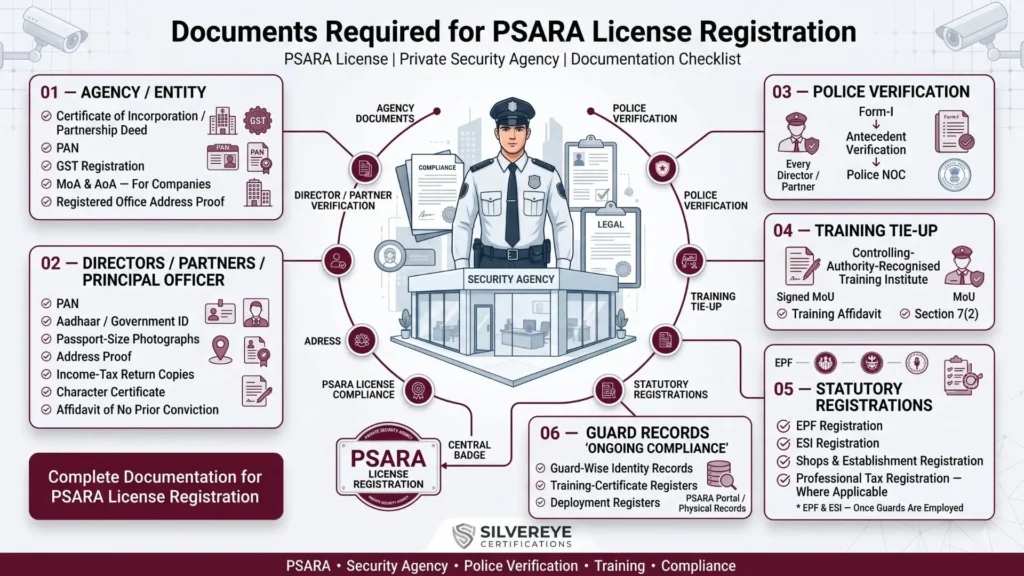
Exact document formats and affidavit wording differ slightly by state, so it's worth cross-checking the current Documents checklist published by your state's Controlling Authority before submission — a mismatched entity name across two documents is one of the most common reasons applications bounce back.
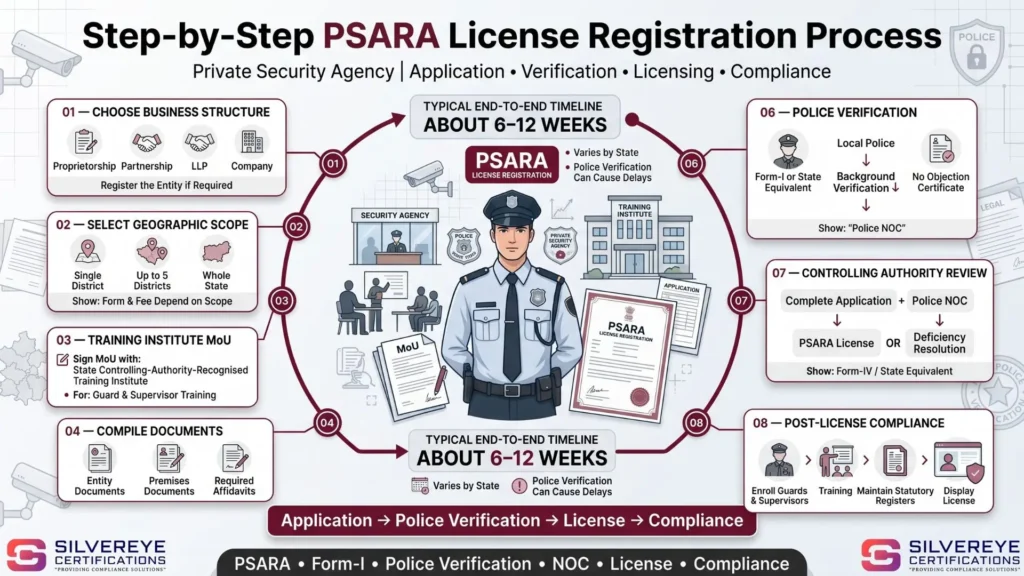
The PSARA License Process: Step by Step
Step 1: Register Your Business Entity
Before anything else, the applicant needs a legally registered business — a Proprietorship, Partnership, LLP, or Private Limited Company — along with GST and Shop & Establishment registration. You cannot apply for a PSARA license without an entity that legally exists on paper.
Step 2: Prepare Documentation and Affidavits
Compile the identity, entity, and address documents listed above, and prepare the statutory affidavits and declarations required under the PSARA Act, confirming eligibility and compliance intent.
Step 3: Sign a Training Institute Tie-Up
This step is non-negotiable. The Act requires that every guard deployed by a licensed agency be trained by a recognised training institute, so the agency needs a signed MoU with such an institute before filing. The Ministry of Home Affairs issued a Standard Operating Procedure in 2023 specifically to streamline how Controlling Authorities recognise and renew these training institutes, which has made it somewhat easier for agencies to identify a genuinely recognised partner rather than an informal training vendor.
Step 4: Undergo Police Verification
The Controlling Authority initiates a background check on the applicant, proprietor, partners, or directors — verifying identity, address, and criminal history. This is typically the single longest step in the process, commonly taking 2–4 weeks, sometimes longer if verification has to be routed through multiple districts or states for different directors.
Step 5: File Form 1 With the Controlling Authority
Form 1 is the prescribed PSARA application form. It's submitted — either online through the state's PSARA portal or in person, depending on how digitised that state's process currently is — along with the government fee and all supporting documents. Some states, like Uttar Pradesh, route this through their police department's dedicated online portal; others still combine online submission with a physical file.
Step 6: Departmental Review, Site Visit, and Approval
The Controlling Authority reviews the complete file, may raise queries for missing or unclear documents, and in some cases conducts a site visit to the agency's registered office. Once satisfied, the license is issued for the geographic area (single district, multiple districts, or the entire state) the applicant applied for.
PSARA License Fees: What the Process Typically Costs
Government fees are structured around how wide an area the license will cover. While the exact numbers are set and revised by each state, the commonly seen slabs look like this:
| Area of Operation | Approximate Government Fee |
| Single district | ₹5,000 – ₹10,000 (approx.) |
| Multiple districts (up to five, in many states) | ₹10,000 – ₹15,000 (approx.) |
| Entire state | ₹15,000 – ₹25,000 (approx.) |
These are indicative figures used widely across states and by licensing consultants; always verify the exact current fee with your state's Controlling Authority before filing, since fee notifications are revised periodically and are not identical in every state.
How Long Does the PSARA License Process Take?
- Police verification: usually 2–4 weeks, longer for multi-director or multi-state verification.
- Statutory decision window: the Controlling Authority must grant or refuse the license within 60 days of receiving a complete application.
- Realistic total timeline: 60–120 days is the commonly reported range once documentation, training tie-up confirmation, and any departmental queries are factored in.
Industry stakeholders have repeatedly flagged license-approval and renewal delays as a persistent pain point at MHA-level review meetings through 2026, so applicants with fully complete documentation upfront tend to move noticeably faster than those who file with gaps and wait for the authority to ask for corrections.
Validity and Renewal: What Happens After the License Is Issued
A PSARA license is generally valid for 5 years from its date of issue in most states; Union Territories commonly follow a shorter, 1-year validity cycle instead. Once issued, treat the license as a recurring compliance item, not a one-time task:
- File the renewal application at least 45 days before the current license expires.
- A lapsed license (no renewal filed before expiry) typically can't simply be renewed — the agency has to file a fresh application and restart parts of the verification process.
- Renewal still requires proof of an active training tie-up and continued statutory compliance (EPF/ESIC, GST), not just a fee payment.
A Note on Foreign Investment in Security Agencies
For agencies structured with foreign backing: Foreign Direct Investment (FDI) in a private security agency in India is permitted up to 49%, but only through the government approval route, administered by the Union Ministry of Home Affairs — it is not available under the automatic route. This is a separate approval from the PSARA license itself and needs to be factored into the process timeline if your agency has foreign shareholders.
What Happens If the Process Is Skipped: Penalties for Non-Compliance
Operating a private security agency without completing the PSARA license process remains a criminal offence under the Act — punishable with imprisonment of up to 1 year, a fine, or both. This has not changed and is unaffected by the 2026 amendment discussed below. What has changed is how certain procedural lapses within an already-licensed agency are treated — covered in detail next.
2026 Update: A Genuine Change to the PSARA License Process
This is the update every current and prospective license holder should actually know about — not a rumoured change, but a notified one.
MHA Notification Decriminalizes Procedural Lapses (Effective 15 May 2026)
On 2 May 2026, the Ministry of Home Affairs issued a notification omitting Section 12 and Section 20(2) of the PSARA Act, 2005, effective 15 May 2026. Until 14 May 2026, procedural lapses — such as failing to display the license at the agency's office premises, or falling behind on training or guard-eligibility documentation — could be treated as criminal offences, carrying fines up to ₹25,000 alongside potential license suspension or cancellation.
From 15 May 2026 onward, these specific procedural failures are no longer criminal in nature. The State Controlling Authority still retains full power to suspend or cancel a license for genuine, substantive non-compliance — this is a decriminalization of technical lapses, not a loosening of the underlying rules. Training standards under Section 9 and guard eligibility norms under Section 10 remain fully mandatory, and operating without any valid license at all is still a criminal offence with the same penalties as before.
In practical terms for the process: an agency that's slightly late updating a guard's training certificate, or forgets to keep the license visibly displayed, is no longer looking at a criminal prosecution for that alone — though it can still face suspension or cancellation if the Controlling Authority finds a genuine pattern of non-compliance.
"PSARA 2.0": A Broader Reform Conversation Is Underway
At a Joint Workshop on PSARA Compliance and Enforcement held in New Delhi on 25 June 2026 under the Ministry of Home Affairs, industry bodies and Controlling Authorities discussed a wider reform agenda now referred to as "PSARA 2.0." Topics raised included licence-approval and renewal pendency across states, inconsistent training infrastructure (with only around 250 actively registered training institutes serving a workforce approaching one crore guards nationally), GST-related concerns under the Reverse Charge Mechanism, and calls for greater digitisation of manpower data on state PSARA portals.
As of now, PSARA 2.0 remains a reform discussion and stakeholder consultation — not a notified rule change — so applicants should continue following the current Form 1 process described above. It's worth tracking, though, since it points toward more digitisation and potentially faster processing timelines in the states that adopt the proposed changes first.
Scale of the Industry Undergoing This Process
For context on why the process matters at a national level: PSARA is currently implemented across 28 states and 8 Union Territories, with more than 30,000 licensed agencies employing close to one crore security personnel between them, according to figures shared at the June 2026 MHA-industry workshop. That scale is part of why processing delays and inconsistent state-level implementation have become such a visible policy issue through 2026.
Common Mistakes That Slow Down the PSARA License Process
- Filing before the training institute tie-up is actually signed and dated.
- Entity name, address, or PAN details that don't match exactly across different documents.
- Skipping an internal background check on directors before filing, then getting flagged during police verification.
- Applying for a state-wide license when the agency's actual operational readiness only covers one or two districts — broader scope invites closer scrutiny.
- Not tracking the 45-day renewal window, leading to a lapsed license that requires a fresh application.
Conclusion
The PSARA license process is genuinely procedural — there's no shortcut around entity registration, a real training tie-up, and police verification — but it's also predictable once you know the sequence and keep documentation consistent across every filing. The 2026 decriminalization of procedural lapses is a meaningful shift in how the law treats agencies that are largely compliant but occasionally slip on paperwork, though it changes nothing about the core requirement: no agency should deploy a single guard before the license itself is in hand.
Need Help Navigating the PSARA License Process?
Silvereye Certifications helps security agencies and first-time applicants manage the entire PSARA license process — from entity and eligibility review to documentation, training-institute coordination, police-verification follow-up, Form 1 filing, and renewal tracking. If you'd rather have an experienced team handle the back-and-forth with the Controlling Authority while you focus on running your agency, Silvereye Certifications can guide the process from the first document to final approval.
Frequently Asked Questions
What are the main steps in the PSARA license process?
Registering the business entity, preparing documentation and affidavits, signing a training institute tie-up, completing police verification, filing Form 1 with the Controlling Authority, and receiving departmental approval.
How long does the entire PSARA license process take?
Most applications are completed in 60 to 120 days. The Controlling Authority is legally required to decide within 60 days of receiving a complete application, but incomplete filings or verification delays can push this further.
Can I start the PSARA license process without registering a company first?
No. You need a legally registered business entity — a proprietorship, partnership, LLP, or company — in place before you can file a PSARA application.
Is training tie-up mandatory before applying?
Yes. A signed agreement with a recognized security guard training institute is a required part of the documentation, since guards deployed by the agency must be trained under the Act.
Is it true that I need an ex-serviceman to get a PSARA license?
No, this is a common myth. Any Indian citizen with a clean legal and financial background can apply. Employing ex-servicemen can help with training credibility but is not a legal requirement.
What is Form 1 in the PSARA license process?
Form 1 is the prescribed application form under the PSARA Act that is filed with the state's Controlling Authority, along with the required fee and supporting documents, to initiate the licensing process.
How much does the PSARA license process cost?
Government fees generally range from about ₹5,000 for a single district to ₹15,000–₹25,000 for state-wide operation, depending on the area of coverage, plus any professional or documentation charges if a consultant is engaged.
What is the validity of a PSARA license once the process is complete?
Most states issue the license for 5 years; Union Territories commonly follow a 1-year validity cycle. Renewal must be filed at least 45 days before expiry.
Can foreign investors be part of a private security agency in India?
Yes, up to 49% FDI is allowed in private security agencies, but only through the government approval route administered by the Ministry of Home Affairs — not the automatic route.
What changed in the PSARA license process in 2026?
Effective 15 May 2026, the Ministry of Home Affairs decriminalized certain procedural lapses (like a missing license display or delayed training paperwork) by omitting Sections 12 and 20(2) of the Act. Operating without any valid license at all remains a criminal offence.
Does decriminalization mean the rules are now optional?
No. Training standards, guard eligibility norms, and the core licensing requirement remain fully mandatory. The Controlling Authority can still suspend or cancel a license for genuine non-compliance — only the criminal-prosecution angle for minor procedural lapses has been removed.
What happens if my PSARA application gets rejected?
Applications are usually rejected due to incomplete documentation, a missing or informal training tie-up, or unresolved police-verification issues. Once these gaps are corrected, the application can be refiled with the Controlling Authority.