
- A PSARA License in Bengaluru is mandatory before any agency can legally supply security guards to offices, tech parks, residential complexes, or events anywhere in the city.
- Applications in Karnataka move through Form I, Form II (antecedent verification), and Form III (affidavit), with the license itself granted on Form IV — typically within 60–120 days.
- The license stays valid for 5 years and must be renewed 45–60 days before expiry, per Karnataka's Controlling Authority guidance.
- Bengaluru's civic restructuring under the Greater Bengaluru Authority (GBA), fully operational since September 2025, is changing which local body issues the trade license and address proof many PSARA applicants rely on.
Introduction
A PSARA License in Bengaluru is the mandatory approval under the Private Security Agencies (Regulation) Act, 2005, that lets a company legally supply security guards anywhere in the city and across Karnataka. To get one, you register your business, sign a tie-up with a recognized training institute, complete police verification through the Bengaluru City Police, and file Form I along with Form II and Form III to Karnataka's Controlling Authority. Processing typically takes 60 to 120 days, and once granted on Form IV, the license remains valid for 5 years before renewal is due.
Bengaluru's security industry runs on a different scale than most Indian cities — sprawling tech parks, gated communities the size of small towns, and a corporate client base that checks vendor compliance closely before signing a contract. That makes the PSARA license less of a formality and more of a genuine business requirement for any agency operating here.
This guide walks through exactly how the process works in Karnataka, the specific forms involved, what it costs, how long it takes, and a real local development — the city's 2025–2026 civic restructuring — that's quietly affecting how Bengaluru-based agencies handle their documentation.
Why the PSARA License Matters More in a City Like Bengaluru
PSARA stands for the Private Security Agencies (Regulation) Act, 2005, the central law requiring every private security agency in India to hold a state-issued license before supplying guards, bouncers, or surveillance staff. In Bengaluru specifically, this isn't just a legal checkbox — it's become a genuine commercial filter. Corporate parks, IT campuses, and large residential associations across the city routinely ask for a valid PSARA license number as part of vendor onboarding, and several housing society management committees now verify it directly before signing a facility-management contract.
The license is issued for Karnataka as a state, not for Bengaluru city alone — an agency licensed for the entire state can legally operate in Bengaluru, Mysuru, Mangaluru, Hubballi, or anywhere else in Karnataka. An agency wanting to operate only within Bengaluru Urban district can also apply for a narrower, single-district license at a lower fee.
Who Issues the PSARA License in Bengaluru?
Karnataka's Controlling Authority — a senior officer designated under the State Home Department, as required by the PSARA Act — is responsible for granting, renewing, and revoking PSARA licenses across the state. For agencies based in Bengaluru, the practical, on-the-ground verification work — checking applicant backgrounds, issuing the police No Objection Certificate (NOC), and verifying directors or partners — is carried out through the Bengaluru City Police Commissionerate, which forwards its findings and recommendation to the state Controlling Authority for the final decision.
Industry bodies such as the Karnataka Security Services Association (KSSA) have also been active participants in national-level PSARA policy discussions through 2026, including Ministry of Home Affairs review meetings on licensing delays and compliance reform — a sign of how organised and vocal Karnataka's private security industry has become.
Eligibility Criteria for a PSARA License in Bengaluru
- The applicant (or, for a company, the entity) must be an Indian citizen or incorporated in India.
- The applicant, proprietor, partners, or directors must be 18 years or older.
- No conviction for an offence involving moral turpitude, and no dismissal from government service on grounds of misconduct.
- The business must be legally registered — as a Proprietorship, Partnership, LLP, or Private/Public Limited Company — before applying.
- A signed tie-up with a training institute recognised by Karnataka's Controlling Authority for guard training.
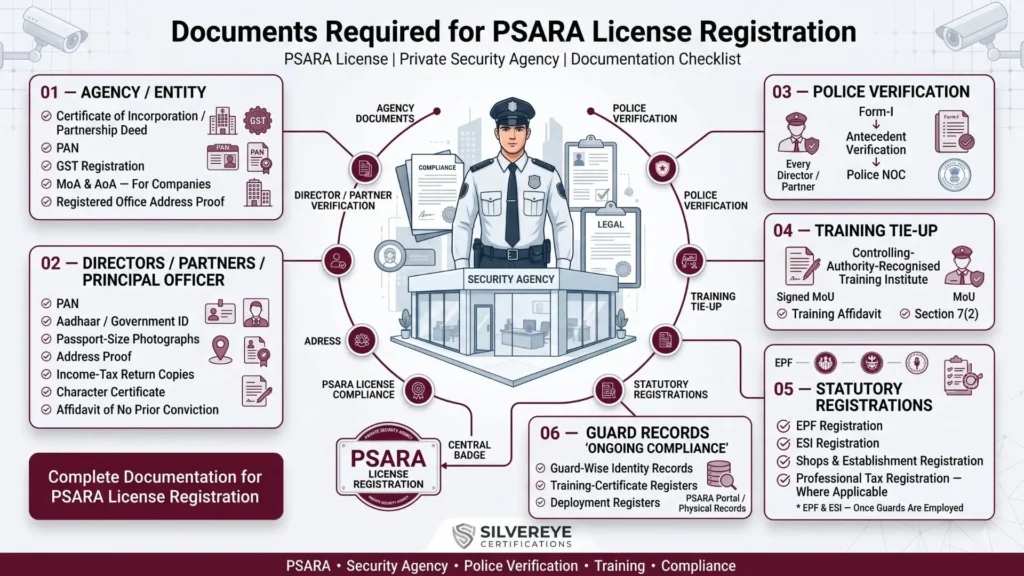
Documents Required for PSARA License in Bengaluru
| Document Category | What's Typically Needed |
| Entity & Business Proof | Certificate of Incorporation / Partnership Deed / Proprietorship proof; PAN and GST of the entity; MOA & AOA for companies; registered office address proof (BBMP/GBA trade license or equivalent, and Shop & Establishment registration) |
| Personnel Documents | PAN, Aadhaar, and photographs of directors/partners/proprietor; police verification / antecedent details via Form II |
| PSARA-Specific Forms | Form I (main application); Form II (antecedent verification of applicant and key personnel); Form III (affidavit accompanying Form I) |
| Training & Statutory Proof | Signed MoU with a recognised training institute; EPF and ESIC registration; income-tax filings, where requested by the Controlling Authority |
Step-by-Step Process to Get a PSARA License in Bengaluru
- Register your business entity with the appropriate structure (Proprietorship, Partnership, LLP, or Company), along with GST and local trade/Shop & Establishment registration.
- Sign a Memorandum of Understanding (MoU) with a Karnataka Controlling-Authority-recognised security guard training institute.
- Prepare Form I (the main application), Form II (antecedent verification details for the applicant and key management), and Form III (the accompanying affidavit).
- 4. Submit Form I with supporting documents to Karnataka's PSARA portal or the Controlling Authority's office, along with the training MoU.
- Undergo police verification through the Bengaluru City Police Commissionerate, which issues a No Objection Certificate (NOC) based on the antecedent check.
- Once the Controlling Authority reviews the file and NOC, the license is either granted on Form IV or refused with a stated reason.
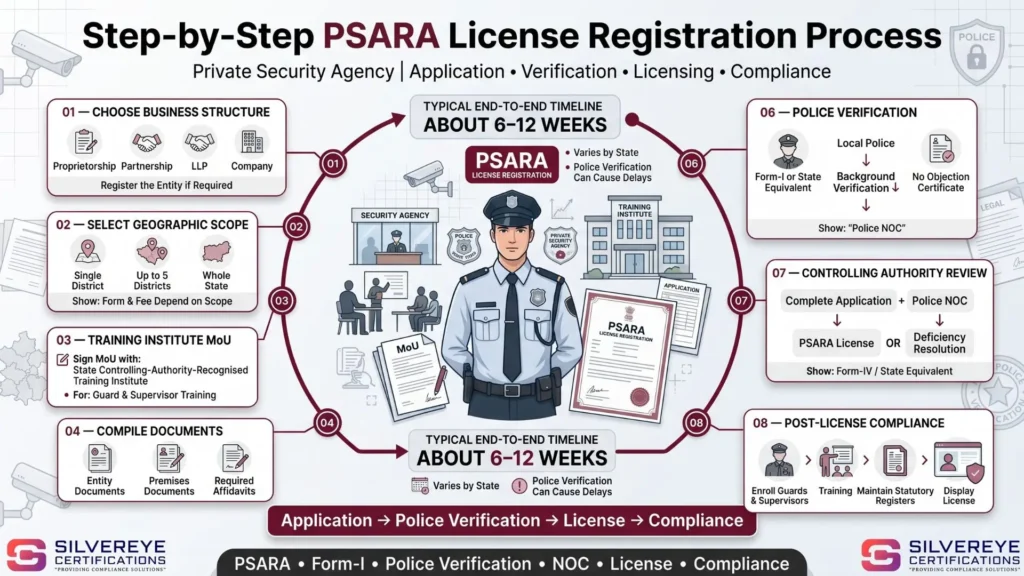
By rule, the Controlling Authority must decide within 60 days of receiving a complete application; in practice, most Bengaluru applicants report a realistic timeline of 60 to 120 days once documentation, training confirmation, and verification queries are factored in.
PSARA License Fees in Bengaluru
Karnataka's PSARA fees, like most states, scale with the area of operation:
| Area of Operation | Approximate Government Fee |
| Single district (e.g., Bengaluru Urban only) | ₹5,000 – ₹10,000 (approx.) |
| Multiple districts | ₹10,000 – ₹15,000 (approx.) |
| Entire state of Karnataka | ₹15,000 – ₹25,000 (approx.) |
These are the commonly cited slabs used by licensing consultants and reported across multiple sources; Karnataka's Controlling Authority revises exact fee notifications periodically, so confirm the current figure before budgeting. On top of the government fee, expect separate costs for training (per guard), notarised affidavits, and any professional fees if a consultant handles the filing.
Validity and Renewal of a PSARA License in Bengaluru
A PSARA license issued in Karnataka is valid for 5 years from the date of issue. Renewal should be filed 45 to 60 days before the license expires to avoid any penalty or gap in legal operating status. A lapsed license generally cannot simply be renewed — the agency has to file a fresh application, repeating much of the documentation and verification process.
- Track your specific expiry date from the date Form IV was issued, not the date you first applied.
- Confirm your training-institute tie-up is still active before filing renewal — an expired MoU is a common cause of renewal delay.
- Keep EPF, ESIC, and GST compliance records current, since the Controlling Authority checks these alongside the renewal application.
2026 Update: What's Changing for Bengaluru-Based Security Agencies
1. The Greater Bengaluru Authority Has Replaced BBMP
This is the single biggest local, practical change affecting Bengaluru businesses right now, including PSARA applicants. Under the Greater Bengaluru Governance Act, 2024, the Greater Bengaluru Authority (GBA) was formally constituted on 15 May 2025 and became fully operational on 2 September 2025, replacing the Bruhat Bengaluru Mahanagara Palike (BBMP) as the city's principal civic body. The Greater Bengaluru region is now being reconstituted into multiple city corporations, with the GBA acting as the coordinating apex authority over them, and elections for these new city corporations are scheduled by August 2026.
For a PSARA applicant, this matters because your registered office address proof — previously a BBMP trade license — is now transitioning to whichever City Corporation covers your registered office location under the new structure. If your business address proof or local trade license was issued under the old BBMP system, it's worth confirming with your local City Corporation office that the document is still being accepted as valid address proof during PSARA filing or renewal, since Controlling Authorities cross-check this address against your GST and other statutory registrations.
2. National PSARA Developments Also Apply in Karnataka
Two broader 2026 developments from the Ministry of Home Affairs apply to Bengaluru-based agencies just as they do nationally. First, following an MHA review meeting on 13 March 2026 — attended by industry bodies including the Karnataka Security Services Association — states are moving toward mandatory digital updating of guard and manpower data on the PSARA portal, replacing manual, paper-based submission. Second, an MHA notification effective 15 May 2026 omitted Sections 12 and 20(2) of the PSARA Act, decriminalising minor procedural lapses like a missing license display, while leaving the core licensing requirement and penalties for operating without a valid license fully in place.
As of now, Karnataka's specific rollout timeline for the digital manpower-reporting requirement hasn't been separately publicised beyond the national MHA announcement, so Bengaluru agencies should continue following the current filing process while watching for state-specific portal updates.
Penalties for Operating Without a Valid PSARA License in Bengaluru
Operating a private security agency in Bengaluru without a valid PSARA license is a criminal offence under the Act, carrying imprisonment of up to 1 year, a fine of up to ₹25,000, or both. Beyond the legal risk, unlicensed agencies routinely lose out on contracts with IT parks, corporate campuses, and larger residential associations, since procurement and facility-management teams in the city now treat license verification as a standard vendor-onboarding step.
Common Mistakes That Delay PSARA Applications in Bengaluru
- Submitting a registered-office address proof that doesn't match the entity name and address on the GST certificate.
- Filing Form I before the training-institute MoU is actually signed and dated.
- Incomplete or inconsistent details across Form I, Form II, and Form III — these three forms are cross-checked against each other.
- Not accounting for the Bengaluru City Police verification timeline, which can extend the overall process if any director's background needs cross-district checks.
- Assuming a Bengaluru-only license lets you operate elsewhere in Karnataka — check whether your area-of-operation scope actually covers where you plan to deploy guards.
Conclusion
Getting a PSARA license in Bengaluru follows the same core legal framework as anywhere else in India, but the local details — Karnataka's specific forms, the Bengaluru City Police verification role, and now the city's civic transition from BBMP to the Greater Bengaluru Authority — are exactly the kind of details that trip up applicants who use generic, non-local guidance. Getting the documentation, forms, and address proof aligned correctly the first time is still the biggest lever any Bengaluru agency has over how fast its license comes through.
Need Help With Your PSARA License in Bengaluru?
Silvereye Certifications helps security agencies across Bengaluru and the rest of Karnataka with end-to-end PSARA license support — eligibility review, Form I–IV documentation, training-institute coordination, police-verification follow-up, and renewal management, including guidance through Bengaluru's shifting civic documentation landscape under the GBA. If you'd rather have the paperwork and local follow-ups handled while you focus on running your agency, Silvereye Certifications can guide you through the process from the first document to final approval.
Frequently Asked Questions
Is a PSARA license mandatory for security agencies in Bengaluru?
Yes. Any agency supplying security guards, bouncers, or surveillance staff in Bengaluru must hold a valid PSARA license issued by Karnataka's Controlling Authority.
Who verifies PSARA applicants in Bengaluru?
The Bengaluru City Police Commissionerate carries out police verification and issues the No Objection Certificate (NOC), which is then forwarded to Karnataka's state Controlling Authority for the final licensing decision.
How long does it take to get a PSARA license in Bengaluru?
Typically 60 to 120 days from filing to approval, though the Controlling Authority is required to decide within 60 days of receiving a fully complete application.
What forms are used in Karnataka's PSARA application process?
Form I is the main application, Form II covers antecedent verification of the applicant and key personnel, Form III is the accompanying affidavit, and Form IV is the license itself once granted.
How much does a PSARA license cost in Bengaluru?
Government fees generally range from about ₹5,000 for a single district to ₹25,000 for state-wide operation across Karnataka, plus training, verification, and any professional fees.
Can a Bengaluru-based agency operate across all of Karnataka on one license?
Yes, if the license is applied for and granted with state-wide area of operation. A single-district license limits the agency to operating only within that district unless upgraded.
How long is a PSARA license valid in Karnataka?
5 years from the date of issue. Renewal should be filed 45 to 60 days before expiry to avoid penalties or a gap in legal operating status.
Has the Greater Bengaluru Authority changed how PSARA applications work?
Not the PSARA process itself, but it has changed which civic body issues the trade license and local address proof many applicants rely on, since BBMP has been replaced by the Greater Bengaluru Authority and its city corporations as of September 2025.
What documents does the Bengaluru City Police check during verification?
Identity, address, and criminal-history details of the applicant, proprietor, partners, or directors, as declared in Form II, cross-checked against the supporting KYC documents submitted with Form I.
What happens if a PSARA license expires while operating in Bengaluru?
Continuing to deploy guards on an expired license is a criminal offence under the Act. If the license lapses without a renewal application on file, the agency typically needs to file a fresh application rather than a simple renewal.
Are there any PSARA-specific 2026 changes unique to Karnataka?
No PSARA-specific rule change has been separately notified for Karnataka in 2026, but the state is affected by the same national MHA developments — digital manpower-data reporting and decriminalisation of minor procedural lapses — alongside Bengaluru's local civic restructuring under the GBA.