
- A PSARA License is the legal permission every private security agency needs before supplying guards, bouncers, or surveillance staff anywhere in Maharashtra.
- Government fees range roughly from ₹5,000 for a single district to ₹15,000–₹25,000 for state-wide operations, on top of professional and documentation costs.
- The license is valid for 5 years from the date of issue and must be renewed at least 45 days before expiry to avoid a compliance gap.
- Operating without a valid PSARA license is a punishable offence and can lead to fines and imprisonment under the PSARA Act, 2005.
Introduction
A PSARA License in Maharashtra is the mandatory approval issued under the Private Security Agencies (Regulation) Act, 2005, that allows a company or individual to legally operate a private security agency and supply guards across the state. To obtain one, you register a business entity, tie up with a recognized security guard training institute, complete police verification of directors and key staff, and file Form 1 with the required documents and fee to Maharashtra's Controlling Authority. Processing typically takes 60 to 120 days, and once issued, the license stays valid for five years before renewal is required.
What Is a PSARA License in Maharashtra?
PSARA stands for the Private Security Agencies (Regulation) Act, 2005 — a central law that governs how private security agencies are allowed to function anywhere in India, including Maharashtra. A PSARA license is the certificate issued under this Act by the state's Controlling Authority, and it's what turns a security business from an informal manpower supplier into a legally recognized private security agency.
In plain terms: if your company plans to supply security guards, bouncers, personal security officers, or surveillance staff to housing societies, offices, malls, factories, banks, warehouses, or events anywhere in Maharashtra, you need this license before you sign your first contract. Without it, every guard you deploy and every invoice you raise sits outside the law.
One detail that trips up new applicants: PSARA licensing is state-specific, not national. An agency operating in both Maharashtra and Gujarat needs two separate PSARA licenses — one for each state — and within Maharashtra itself, the fee and scope depend on whether you want to operate in one district, a few districts, or the entire state.
Legal Framework: The PSARA Act, 2005 in Maharashtra
The Private Security Agencies (Regulation) Act, 2005 lays down the eligibility criteria, licensing procedure, training norms, and code of conduct for security agencies across India. Each state implements the Act through its own rules — in Maharashtra, this is done through the Private Security Agencies (Maharashtra) Rules, with the licensing function carried out by the Controlling Authority under the State Home Department, working through the Police Department at the state and district level.
It helps to know that PSARA licensing sits alongside a second, older Maharashtra-specific law: the Maharashtra Private Security Guards (Regulation of Employment and Welfare) Act, 1981. This Act governs wages, provident fund contributions, and welfare of guards employed in Greater Mumbai, Thane, Pune, Nagpur, Nashik, and Raigad through local Security Guards Boards.
A PSARA license does not exempt an agency from this welfare law where it applies — agencies operating in these specific districts generally need to stay compliant with both frameworks together, not just PSARA.
Why a PSARA License Is Mandatory in Maharashtra
Beyond simply staying on the right side of the law, holding a valid PSARA license gives a security agency real commercial advantages:
- Legal permission to operate anywhere in Maharashtra without the constant risk of a stop-work order.
- Eligibility to bid for corporate, industrial, and government security tenders — most large clients ask for the license number during vendor onboarding.
- Credibility with housing societies, corporate offices, and institutional clients who increasingly verify licensing before signing a contract.
- A cleaner path to expanding into new districts or, eventually, new states, since the compliance groundwork (training tie-ups, verification systems, documentation) is already in place.
- Protection from penalties, licence cancellation, and criminal liability that come with unlicensed operation.
Who Needs a PSARA License in Maharashtra?
You need to apply for a PSARA license in Maharashtra if you are:
- Running or planning to start a private security agency, regardless of size.
- Providing guarding, surveillance, or manpower security services to any commercial or residential establishment.
- Supplying trained security personnel to offices, housing societies, factories, malls, banks, or events on a contractual basis.
- Operating as a proprietorship, partnership, LLP, or private limited company whose core service is deploying security staff to third parties.
An individual can apply for a PSARA license as a sole proprietor, but the underlying business still needs to be registered (Shop & Establishment registration at minimum) before the application is filed — you cannot apply purely in a personal capacity with no registered business entity behind it.
Who Cannot Apply: Disqualifications Under the PSARA Act
Before filing, check that none of the following apply to the applicant, proprietor, partners, or directors — these are common, often-overlooked reasons applications get rejected after weeks of processing:
- Convicted of an offence involving moral turpitude, or sentenced to imprisonment under any law.
- Dismissed or removed from government service on grounds of misconduct or moral turpitude.
- Not a citizen of India (or, for a company, not registered/incorporated in India).
- A minor — below 18 years of age — at the time of application.
- Previously held a PSARA license that was cancelled, where the disqualification period under the Act has not yet lapsed.
Since police verification will surface these issues regardless, it's worth screening every director and key promoter internally before you file, rather than finding out mid-process.
Documents Required for PSARA License in Maharashtra
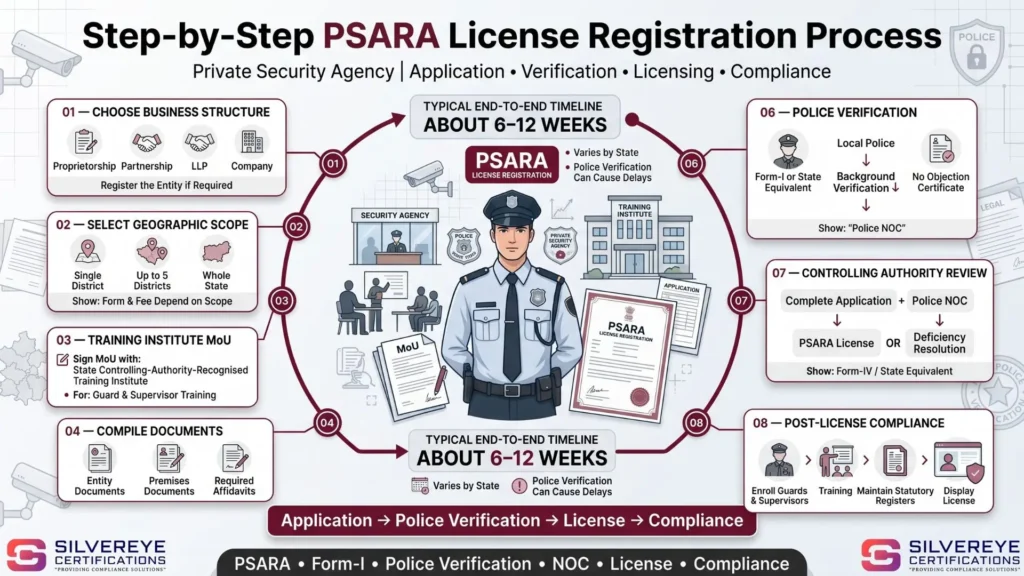
The document list is grouped into three broad categories. Missing or mismatched documents — not the police verification itself — are the single biggest cause of delay.
| Document Category | What's Typically Needed |
| Business & Entity Proof | Certificate of Incorporation / Partnership Deed / Proprietorship proof; PAN of the company and directors/partners; GST registration certificate; registered office address proof; MOA & AOA (for companies) |
| Personnel & Verification | KYC of directors/proprietor/partners; police verification / character certificate of key applicants; affidavits and declarations as prescribed under the PSARA Act; passport-size photographs |
| Training & Operational Setup | Tie-up agreement with a recognised security guard training institute; sample uniform pattern and identity card design for guards; standard operating procedure or agency profile, where required |
| Statutory & Compliance Proof | EPF registration; ESIC registration; Shop & Establishment license; income-tax filings or financial capability proof, if requested by the Controlling Authority |
Step-by-Step Process to Get a PSARA License in Maharashtra
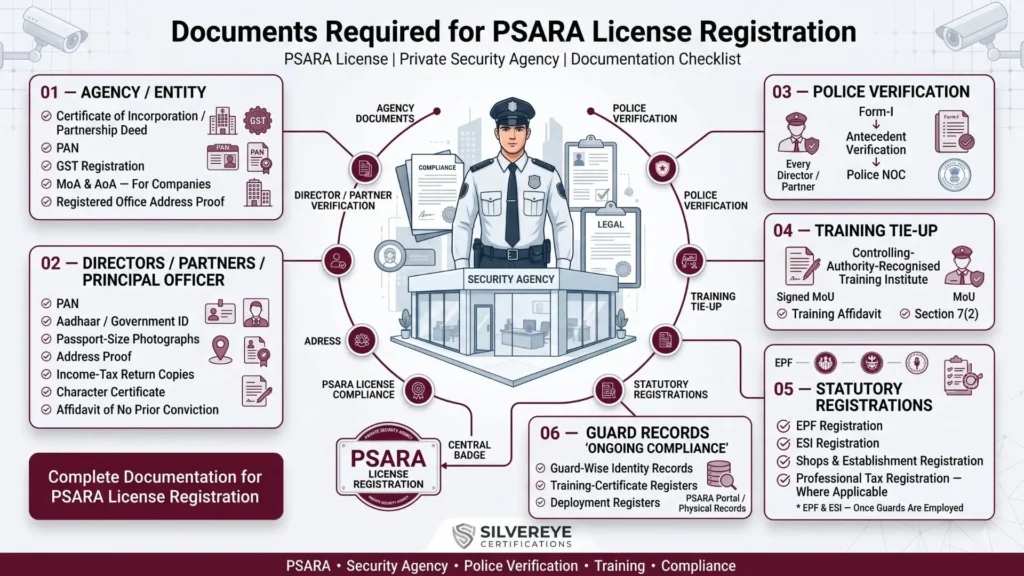
- Register your business entity. Set up a Private Limited Company, LLP, Partnership Firm, or Proprietorship with Shop & Establishment and GST registration — the entity must legally exist before you can apply for the license.
- Prepare documentation and affidavits. Compile identity proofs, business registration papers, address proof, and the statutory declarations and affidavits required under the PSARA Act.
- Arrange training tie-up. Sign an agreement with a government-recognized security guard training institute, since PSARA requires deployed guards to be trained before deployment.
- Complete police verification. The Controlling Authority initiates police verification of the applicant and key directors/partners to confirm there's no disqualifying criminal background.
- File Form 1 with the Controlling Authority. Submit the prescribed application (Form 1) along with the fee and supporting documents, either through psara.gov.in or the applicable district/state office, depending on how Maharashtra is processing applications at the time you apply.
- Departmental review and approval. The authority reviews the file, may raise queries or ask for additional documents, and issues the license once everything checks out.
A practical note on the portal: applications reference psara.gov.in, the central Private Security Agency licensing portal used across states for tracking. In Maharashtra, online filing currently works alongside physical documentation and in-person verification steps — it is not yet a fully paperless, start-to-finish digital process, so budget time for physical follow-ups with the local police/Controlling Authority office.
PSARA License Fees in Maharashtra
Government fees for a PSARA license in Maharashtra are structured around the geographic area you want to operate in — the wider the coverage, the higher the fee:
| Area of Operation | Approximate Government Fee |
| Single district | ₹5,000 – ₹10,000 (approx.) |
| Multiple districts (specified) | ₹10,000 – ₹15,000 (approx.) |
| Entire State of Maharashtra | ₹15,000 – ₹25,000 (approx.) |
These figures reflect the fee structure commonly cited by licensing consultants and reported industry sources; government fee notifications are revised from time to time, so always confirm the exact, current fee with the Controlling Authority or a registered consultant before filing. On top of the government fee, expect separate professional or documentation charges if you engage a consultant — these cover paperwork preparation, training-institute coordination, and follow-ups, and are not part of the statutory fee itself.
How Long Does It Take? Processing Timeline
- Police verification of applicants: typically 2–4 weeks.
- Statutory decision window: the Controlling Authority is required to grant or refuse a license within 60 days of receiving a complete application.
- Realistic end-to-end timeline: 60–120 days is common once documentation cycles, training tie-up confirmation, and verification queries are factored in.
Applications with complete, correctly formatted documentation and an existing training-institute agreement tend to move toward the faster end of that range; incomplete filings or unresolved objections are what push cases toward 120 days or beyond.
Validity and Renewal of PSARA License in Maharashtra
A PSARA license issued in Maharashtra is valid for 5 years from the date of issue — this matches the validity period used in most Indian states (a small number of states, such as Madhya Pradesh, Chhattisgarh, and Uttarakhand, use a 1-year renewal cycle instead).
Renewal rules to keep in mind:
- Apply for renewal at least 45 days before the license expires.
- If the license lapses without a renewal application on file, the agency generally cannot simply "renew" — it has to file a fresh new application, which restarts the documentation and verification cycle.
- Renewal still requires proof of continued compliance: valid training tie-up, EPF/ESIC status, and no adverse findings against the agency during the license period.
A gap in licensed status, even a short one, can jeopardise active contracts — several clients include an automatic termination clause tied to license validity, so treat the 45-day renewal window as a hard deadline, not a guideline.
Which Authority Issues a PSARA License in Maharashtra?
PSARA licensing in Maharashtra is administered by the Controlling Authority functioning under the State Home Department, with day-to-day verification and processing handled through the Police Department at the state and district level. In practice, this means your point of contact depends on where your registered office or primary area of operation is:
| Region | Who Handles It |
| Mumbai | Handled through the state-level Controlling Authority in coordination with Mumbai Police — the main hub for state-wide and multi-district applications. |
| Pune | Verification and processing routed through the Pune Police Commissionerate. |
| Thane | Handled by the Thane Police Commissionerate for local agencies and staff verification. |
| Nagpur | Processed through the Nagpur Police Commissionerate. |
| Nashik | District Police Office, Nashik, handles background checks and local inspection. |
| Chhatrapati Sambhajinagar (Aurangabad) | Police Commissionerate handles agency registration and compliance checks. |
| Other districts (Solapur, Kolhapur, Amravati, Nanded, etc.) | Respective District Police Office/Superintendent of Police handles local verification and forwards recommendations to the Controlling Authority. |
Penalties for Operating Without a Valid PSARA License
The PSARA Act, 2005 treats unlicensed operation as a criminal offence, not just an administrative lapse. Consequences can include:
- Cancellation or refusal of the license application on record.
- Financial penalties imposed on the agency and its directors/proprietor.
- Criminal liability — operating a private security agency without a valid PSARA license can attract imprisonment of up to 1 year, a fine of up to ₹25,000, or both, under the Act's penal provisions.
Beyond the legal exposure, unlicensed agencies routinely lose out on corporate, institutional, and government contracts, since procurement and legal teams now check licence validity as a standard part of vendor onboarding.
| Know More:- PSARA License in Delhi |
2026 Update: What's Changing for PSARA-Licensed Agencies in Maharashtra
A few developments are relevant if you're applying for, renewing, or already holding a PSARA license in Maharashtra in 2026:
1. A larger, more scrutinized licensed base
Publicly reported figures put the number of PSARA licenses issued in Maharashtra in the thousands, with a meaningful share of those already lapsed or inactive by mid-2026. Growth in the number of licensed agencies has, in practice, meant tighter scrutiny during renewal — Controlling Authorities are more likely to flag agencies with gaps in EPF/ESIC filings, outdated training tie-ups, or inconsistent guard records than they were a few years ago.
2. Amendment to the Maharashtra Security Guards Welfare Act
The Maharashtra Private Security Guards (Regulation of Employment and Welfare) Act, 1981 — the separate welfare law covering guards in Mumbai, Thane, Pune, Nagpur, Nashik, and Raigad — was amended by Maharashtra Act No. 26 of 2025. Agencies operating in these districts should treat this as a reminder to review their registration and compliance status with the local Security Guards Board alongside their PSARA license, since the two frameworks are checked together during renewal and inspection in these areas.
Agencies should confirm the specific operative changes with the Board or a compliance professional rather than assume no impact, since welfare-law amendments typically affect wage computation, registration formalities, or board procedures.
3. Continued digitization, but not full paperless processing
psara.gov.in remains the reference portal for application tracking, but Maharashtra continues to combine online filing with physical document submission and in-person police verification. Applicants should not expect a fully digital, contactless process in 2026 — plan for at least one round of physical follow-up with the local police or Controlling Authority office.
4. Emerging conversation around technology-driven security roles
Industry and legal commentary is increasingly discussing how India's new labour codes, and the growing use of biometric access systems, drone surveillance, and cyber-enabled monitoring in high-end facilities, may eventually prompt updates to guard classification, training content, and wage structures. As of now, this remains a developing discussion rather than a notified rule change in Maharashtra — agencies should keep an eye on official notifications rather than assume any of this is already in force.
Common Reasons PSARA Applications Get Rejected in Maharashtra
- Incomplete or mismatched documentation — addresses, PAN details, or entity names that don't match across documents.
- Missing or informal training-institute tie-up that doesn't meet the "recognized institute" requirement.
- Police verification flags on a director, partner, or key promoter that weren't screened before filing.
- Incorrectly filled affidavits or declarations, or affidavits not notarised as required.
- Applying for a broader area of operation (e.g., statewide) than the business is actually ready to service, which invites closer scrutiny.
Conclusion
A PSARA license isn't just paperwork — it's the legal foundation that lets a private security agency in Maharashtra sign contracts, bid for institutional work, and operate without the constant risk of penalties or shutdown. The process itself is well-defined — entity registration, documentation, training tie-up, police verification, and filing — but the details around fees, area-of-operation choices, and district-level verification can genuinely make the difference between a smooth 60-day approval and a stalled application. Staying current with 2026's tighter renewal scrutiny and the related welfare-law amendment is just as important as getting the initial license right.
Need Help With Your PSARA License in Maharashtra?
Silvereye Certifications assists security agencies, startups, and established operators across Mumbai, Pune, Thane, Nagpur, and the rest of Maharashtra with end-to-end PSARA license support — eligibility review, documentation, training-institute coordination, application filing, and renewal management. If you'd rather have the paperwork and follow-ups handled while you focus on running your agency, Silvereye Certifications can guide you through the process from the first document to final approval.
Frequently Asked Questions
What is the full form of PSARA?
PSARA stands for the Private Security Agencies (Regulation) Act, 2005 — the central law that makes licensing mandatory for private security agencies operating anywhere in India, including Maharashtra.
Is a PSARA license mandatory for security agencies in Maharashtra?
Yes. Any business supplying security guards, bouncers, or surveillance staff in Maharashtra must hold a valid PSARA license. Operating without one is a punishable offence under the Act.
How long does it take to get a PSARA license in Maharashtra?
Most applications take between 60 and 120 days from filing to approval, depending on how quickly police verification and document review are completed. The Controlling Authority is statutorily required to decide within 60 days of receiving a complete application.
What is the validity of a PSARA license in Maharashtra?
A PSARA license issued in Maharashtra is valid for 5 years from its date of issue, after which it must be renewed to continue legally operating.
How much does a PSARA license cost in Maharashtra?
Government fees vary by the area of operation — roughly ₹5,000–₹10,000 for a single district, ₹10,000–₹15,000 for multiple districts, and ₹15,000–₹25,000 for state-wide operation — in addition to any professional or documentation charges if you use a consultant.
Can an individual apply for a PSARA license, or only a company?
An individual can apply as a proprietor, but the business still needs basic registration (such as a Shop & Establishment license) in place before the PSARA application is filed. Companies, partnerships, and LLPs can also apply.
Is training compulsory for security guards under PSARA?
Yes. Guards deployed by a licensed agency must be trained through a recognised security guard training institute, and the agency needs a formal tie-up agreement with such an institute as part of its application.
Can a Maharashtra PSARA license be used to operate in other states?
No. A PSARA license is state-specific. An agency that wants to operate in Maharashtra and, say, Karnataka needs a separate PSARA license for each state.
What happens if an agency operates without a valid PSARA license?
Operating without a valid license can lead to penalties, license refusal or cancellation, and criminal liability — including imprisonment of up to 1 year, a fine of up to ₹25,000, or both, under the PSARA Act's penal provisions.
When should I apply for PSARA license renewal in Maharashtra?
At least 45 days before the current license expires. Applying late risks a gap in legal operating status, and a fully lapsed license generally requires filing a fresh application rather than a simple renewal.
Can a rejected PSARA application be resubmitted?
Yes. Most rejections stem from incomplete documentation, a missing training tie-up, or unresolved police-verification issues. Once these are corrected, the application can be refiled with the Controlling Authority.
Which authority issues the PSARA license in Maharashtra?
The Controlling Authority under the Maharashtra Home Department issues the license, with verification and local processing carried out through the Police Department at the state and district level, depending on the applicant's area of operation.