
- Importers need a document set built around the Certificate of Free Sale, manufacturer authorization, and ingredient/safety data for Form COS-1.
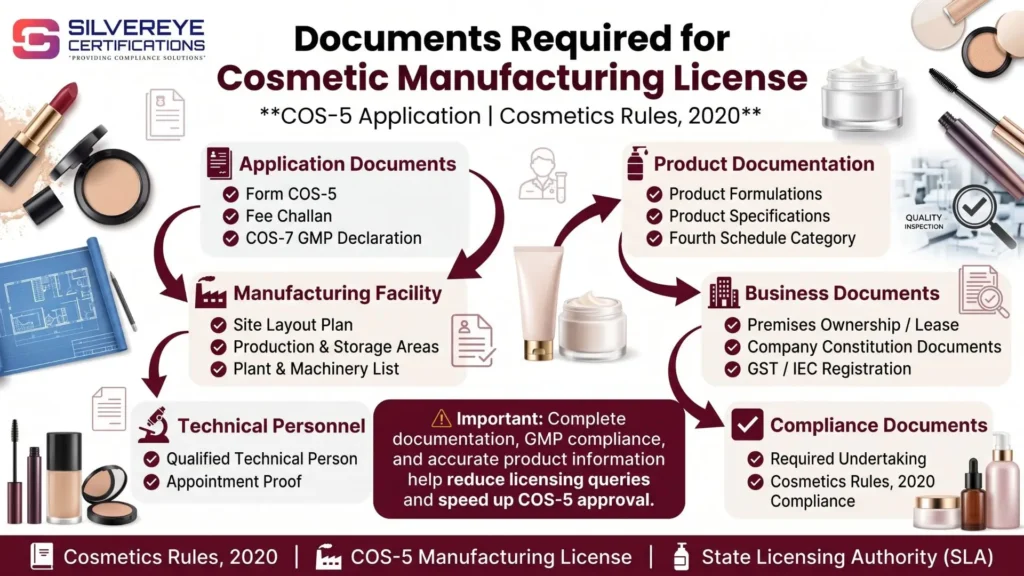
- Manufacturers need a document set built around the Site Master File, plant layout, technical staff proof, and Form COS-7 GMP self-declaration for Form COS-5.
- Every foreign-origin document — CFS, GMP certificate, authorization letter — must be notarized, apostilled, or Indian-Embassy attested, and product names must match exactly across all of them.
- A single mismatched name or missing attestation is the single most common reason CDSCO issues a query letter on either COS-1 or COS-5.
Introduction
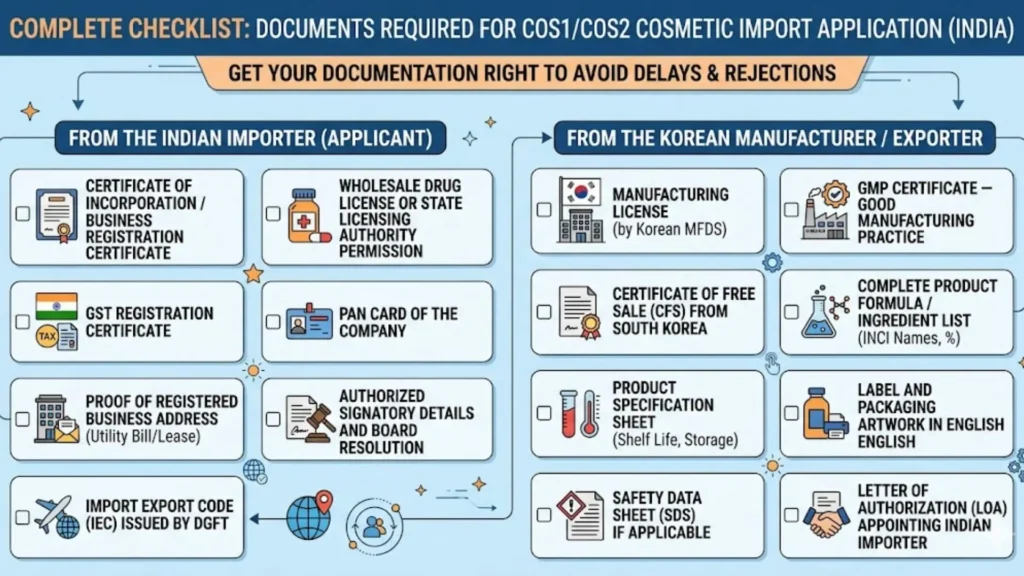
Document Required For Cosmetic Registration in India differ by route. Importers filing Form COS-1 need a Certificate of Free Sale, a notarized/apostilled Power of Attorney from the foreign manufacturer, the manufacturer's GMP certificate, a full ingredient list, English-language labels, and a Bharatkosh fee challan — leading to Form COS-2.
Manufacturers filing Form COS-5 need a Site Master File, plant layout, proof of qualified technical staff, a Form COS-7 GMP self-declaration, and a list of products mapped to CDSCO categories — leading to Form COS-8. Across both routes, every document must show identical product, manufacturer, and address names, and any foreign-origin certificate must be properly authenticated. Missing or mismatched documentation is the leading cause of CDSCO queries and delays.
Ask anyone who has been through a CDSCO cosmetic registration what actually slows an application down, and the answer is rarely the regulation itself — it's the documents. A Free Sale Certificate that lists products slightly differently than the application form. A Power of Attorney that wasn't apostilled the way CDSCO expects. A Site Master File that doesn't match what the inspector finds on-site. These are avoidable, but only if you know exactly what's required before you start compiling the dossier.
This guide is a document-first reference covering both cosmetic registration pathways in India: the import route (Form COS-1 → Form COS-2) and the manufacturing route (Form COS-5 → Form COS-8). It breaks down every document, why CDSCO or the State Licensing Authority asks for it, what format or authentication it needs, and the mistakes that most often trigger a query letter.
Document Required for Cosmetic Registration: Two Registration Routes, Two Document Sets
Cosmetic registration in India runs through two distinct pathways depending on where the product is made, and each has its own documentation:
- Import route — Form COS-1 is filed with CDSCO (Central Licensing Authority) via the SUGAM portal; once approved, CDSCO grants Form COS-2, the Import Registration Certificate.
- Manufacturing route — Form COS-5 is filed with the State Licensing Authority (State Drug Controller); once approved and the facility is inspected, the SLA grants Form COS-8, the Manufacturing License.
The document sets barely overlap. Import documentation centres on proving the foreign product and manufacturer are legitimate and safe; manufacturing documentation centres on proving the Indian facility, its staff, and its processes meet Good Manufacturing Practice standards.
Document Checklist for Importers: Form COS-1 to Form COS-2
COS-1 Documents and What Each One Proves
CDSCO's own Guidance Document on Registration and Import of Cosmetics requires every detail on Form COS-1 to align exactly with the Authorization and the Free Sale Certificate — applicants are asked to cross-reference the serial numbers of products across all three documents. Here is what a complete dossier includes:
| Document | Purpose | Format / Authentication |
| Covering letter | States the purpose of the filing — fresh application, endorsement, or re-registration | On company letterhead, signed by the authorised signatory |
| Form COS-1 | The core application form, filled on the SUGAM portal | Digitally filled, signed, and stamped |
| Authorisation / Power of Attorney from manufacturer | Grants the Indian agent legal authority to apply on the foreign manufacturer's behalf | Prescribed First Schedule format; must be notarised and apostilled, or attested by the Indian Embassy, depending on the country of origin |
| Certificate of Free Sale (CFS) | Confirms the product is freely and legally sold in its country of origin | Issued by the competent national regulatory authority; must list every product/variant with names matching COS-1 exactly; apostilled or embassy-attested |
| Manufacturing licence / GMP certificate | Proves the foreign manufacturing site is approved in its home country | GMP certificate or ISO 22716 certification of the facility, apostilled/attested |
| Ingredient list / composition | Full formulation with percentage breakdown for CDSCO's safety review | Signed by the manufacturer, in English, using standard INCI ingredient naming |
| Product labels and packaging artwork | Demonstrates label compliance with the Cosmetics Rules, 2020 | Inner and outer labels, translated into English, showing no unapproved therapeutic claims |
| Specification sheet and testing methods | Details quality parameters and how the product is tested | Manufacturer-issued technical document |
| Non-animal testing declaration | Confirms compliance with Rule 39(7) of the Cosmetics Rules, 2020 | Signed declaration from the manufacturer |
| Hexachlorophene declaration | Confirms the product does not contain restricted Hexachlorophene beyond permitted limits | Signed declaration from the manufacturer |
| Import Export Code (IEC) | Identifies the Indian importer for customs and trade purposes | Copy of the IEC certificate issued by DGFT |
| Fee payment proof (TR-6/Bharatkosh challan) | Confirms the government fee has been paid | Generated through the Bharatkosh payment gateway and uploaded with the application |
Authentication Rules for Foreign Documents
Every document originating outside India — the CFS, the GMP certificate, the authorization letter, and any foreign lab test reports — needs to be legalized before CDSCO will accept it. The correct pathway depends on the country of origin:
- Apostille — For documents from countries that are signatories to the Hague Apostille Convention; this is the fastest and most commonly accepted route.
- Indian Embassy / Consulate attestation — For documents from non-Hague-Convention countries, where the document must instead be legalized by the Indian mission in that country.
- Notarization — Typically required as a first step before apostille or embassy attestation, depending on local practice in the country of origin.
CDSCO has tightened scrutiny on document authentication in recent review cycles, and documents that were once accepted with simple notarisation from some jurisdictions may now require a full apostille. It's worth confirming the current requirement for your specific country of origin before document collection begins, rather than assuming last year's process still applies.
The Consistency Rule That Avoids Most Queries
Product names, manufacturer names, and addresses must match exactly across the COS-1 form, the CFS, the authorisation letter, and the labels. A shortened company name, a different spelling of a product variant, or an address formatted differently on one document is enough to trigger a formal CDSCO query — adding weeks to the review. Building a simple cross-reference table before submission, mapping each product's name across every document, is one of the most effective ways to catch this before CDSCO does.
Document Checklist for Manufacturers: Form COS-5 to Form COS-8
Manufacturing documentation is less about proving a product's origin and more about proving the Indian facility, its equipment, and its staff can consistently produce safe cosmetics under Good Manufacturing Practice.
| Document | Purpose | Format / Requirement |
| Covering letter | States the purpose of the application and the products/site being registered | On company letterhead |
| Form COS-5 | The core manufacturing license application, filed on the SUGAM portal | Digitally filled, signed, and stamped |
| Site Master File | Describes the facility layout, processes, and quality systems in detail | Prepared per Cosmetics Rules, 2020 documentation guidelines |
| Plant layout and equipment list | Shows the physical arrangement and machinery used in manufacturing | Scaled diagram plus itemised equipment list |
| List of cosmetic products to be manufactured | Maps every intended product to its Fourth Schedule category | Product-wise list with category references |
| Proof of qualified technical staff | Confirms a competent person oversees production, per Cosmetics Rules eligibility criteria | Educational certificates (pharmacy diploma, chemistry qualification, or cosmetic technology degree) and appointment letter |
| Form COS-7 — GMP self-declaration | The facility's own declaration that it meets Good Manufacturing Practice standards ahead of inspection | Signed by the authorised signatory of the manufacturing unit |
| Undertaking of product compliance | Commits the manufacturer to complying with the Cosmetics Rules, 2020 for every listed product | Signed undertaking on the prescribed format |
| Fee payment receipt | Confirms the state government fee has been paid | Challan or online payment receipt as prescribed by the State Licensing Authority |
What Happens After Document Submission
Unlike the import route, submitting a complete COS-5 dossier is only the first half of the manufacturing process. The State Licensing Authority reviews the documents and then schedules a physical inspection of the premises — checking the building, hygiene standards, equipment, standard operating procedures, staff credentials, and batch records against what was declared on paper.
Any mismatch between the Site Master File and what the inspector actually finds is treated the same way a document inconsistency is treated on the import side: as a compliance gap that needs to be resolved before the license is granted.
Common Document Mistakes That Trigger CDSCO Queries or Rejection
- Certificate of Free Sale that is expired, incorrectly issued, or not apostilled/attested.
- Manufacturer's authorization letter that is missing, expired, or lacks proper notarization.
- Mismatch between the product name on the COS-1/COS-5 form and the name printed on the label or CFS.
- Ingredient list containing substances restricted or prohibited under Schedule Q of the Cosmetics Rules, 2020.
- Labels that carry a therapeutic or medicinal claim buried in the product description, pushing the product toward drug classification.
- Site Master File or plant layout for manufacturing applications that doesn't match the facility found during inspection.
- Documents submitted in a language other than English, or without the required translation.
- Treating a reformulated, resized, or re-labelled product as automatically covered under an existing COS-2 or COS-8 — material changes generally need a fresh filing or formal amendment.
Fees for Cosmetic Registration Documentation and Filing
| Route | Fee Component | Typical Amount |
| Import (COS-1/COS-2) | Per product category | USD 1,000 |
| Import (COS-1/COS-2) | Per manufacturing site (foreign) | USD 500 |
| Import (COS-1/COS-2) | Per product variant | USD 50 |
| Manufacturing (COS-5/COS-8) | Manufacturing license fee (state government) | Approx. ₹2,500–₹5,000, varies by state |
| Manufacturing (COS-5/COS-8) | Site inspection fee (where applicable) | Approx. ₹1,000–₹2,000 |
| Manufacturing (COS-5/COS-8) | 5-year retention fee | Generally equal to the original license fee |
Import fees are paid in USD through the Bharatkosh gateway under CDSCO's prescribed head of account; the receipt must be uploaded with the COS-1 dossier. Manufacturing fees are state-specific. Confirm current rates before filing, since fee schedules are periodically revised.
Validity and Renewal Documentation: COS-2 vs COS-8
| Aspect | COS-2 (Import Registration) | COS-8 (Manufacturing License) |
| Validity period | 5 years from date of issue | Indefinite / lifetime, unless suspended or cancelled |
| Renewal trigger | File renewal at least 6 months before expiry | No renewal filing, but a retention fee is due every 5 years |
| Documents needed to renew | Updated CFS, updated authorisation letter, and any changed labels or formulation data, filed through SUGAM like a fresh COS-1 | Retention fee proof; updated documentation if the facility, products, or technical staff have changed |
| Risk of lapse | Importing after expiry without a renewed COS-2 risks customs detention | Non-payment of the retention fee can lead to suspension or cancellation of COS-8 |
Why Getting the Documentation Right Matters
- Faster approval — A complete, consistent dossier is the biggest lever over how close your application stays to CDSCO's statutory timelines rather than drifting toward the outer limit.
- Fewer query cycles — Each CDSCO or SLA query can add weeks to the timeline; most queries trace back to a documentation gap that was avoidable.
- Audit readiness — A well-organized document set (CFS, authorization, Site Master File) also serves as your compliance record for future inspections or renewals.
- Lower rejection risk — Since government fees are generally non-refundable, getting documents right the first time protects the filing cost, not just the timeline.
How Silvereye Certifications Helps with Documentation
Silvereye Certifications is a Noida-based regulatory compliance consultancy supporting manufacturers, importers, and D2C cosmetic brands with BIS Certification, CDSCO Registration, EPR Authorization, and related compliance services across India. On the documentation side specifically, the Silvereye Certifications team assists with:
- Building a document checklist matched to your exact product category and route — import or manufacturing — before collection begins.
- Reviewing the Certificate of Free Sale, authorization letter, and labels for the cross-document consistency CDSCO checks for.
- Advising on the correct apostille, notarization, or Indian Embassy attestation pathway for your country of origin.
- Preparing the Site Master File, plant layout, and Form COS-7 GMP self-declaration for manufacturing applicants ahead of inspection.
- Managing fee computation and challan submission through SUGAM/Bharatkosh, and tracking renewal or retention-fee deadlines.
Brands preparing a COS-1 or COS-5 filing can reach out to Silvereye Certifications for a pre-filing document audit — catching mismatches and missing attestations before they become a formal CDSCO query.
Conclusion
Cosmetic registration in India isn't hard to understand in principle — it's unforgiving in execution, and almost every delay traces back to a document that didn't match, wasn't authenticated correctly, or was simply missing. Whether you're compiling a COS-1 dossier around a Certificate of Free Sale or a COS-5 dossier around a Site Master File, the discipline is the same: get every name, every certificate, and every attestation consistent before you file, not after CDSCO asks for it.
For a pre-filing review of your document set — on either the import or manufacturing route — Silvereye Certifications' regulatory team can help you catch the gaps that typically cost applicants weeks of avoidable delay.
Frequently Asked Questions
What is the most important document in a COS-1 filing?
The Certificate of Free Sale and the manufacturer's Authorisation/Power of Attorney are the two most scrutinised documents — CDSCO checks that every product name and detail on these matches Form COS-1 exactly.
Does the Certificate of Free Sale need to be apostilled?
Generally yes, unless it is instead attested by the Indian Embassy or Consulate in the country of origin — the correct pathway depends on whether that country is a Hague Apostille Convention signatory.
What documents are required for a COS-5 manufacturing license application?
A Site Master File, plant layout, equipment list, proof of qualified technical staff, a Form COS-7 GMP self-declaration, a product list mapped to Fourth Schedule categories, and an undertaking of compliance with the Cosmetics Rules, 2020.
Do labels count as a required document for cosmetic registration?
Yes. Inner and outer label artwork, translated into English and free of unapproved therapeutic claims, must be submitted with both COS-1 and COS-5 applications.
What qualifies as proof of technical staff for a manufacturing license?
Typically a pharmacy diploma, an intermediate examination with chemistry (or equivalent), or a bachelor's degree in cosmetic technology, pharmacy, or a related science, along with an appointment letter for that person at the facility.
Is a GMP certificate mandatory for importing cosmetics into India?
Yes — a GMP certificate or an equivalent quality certification such as ISO 22716 for the foreign manufacturing site is a standard part of the COS-1 document set.
What happens if product names don't match across my documents?
A mismatch between the product name on the COS-1 form, the CFS, the authorization letter, and the label is one of the most common reasons CDSCO issues a formal query, which delays the review.
Can I submit documents in a language other than English?
No. All supporting documents must be in English, or accompanied by a certified English translation, for CDSCO or the State Licensing Authority to review them.
What is Form COS-7?
Form COS-7 is the GMP self-declaration a manufacturing applicant submits alongside Form COS-5, confirming the facility meets Good Manufacturing Practice requirements ahead of the State Licensing Authority's physical inspection.
How is the government fee payment documented?
For import applications, the fee is paid through the Bharatkosh gateway and the receipt (commonly referenced as a TR-6 challan) is uploaded with the COS-1 dossier. Manufacturing fees are paid through the relevant state's prescribed challan or portal.
Do I need to resubmit all documents if I add a new product variant?
Material changes to formulation, packaging, or claims generally require a fresh filing or a formal amendment rather than simply notifying CDSCO — check with the licensing authority on whether your specific change needs a new COS-1/COS-5 or an endorsement.
What documents are needed to renew a COS-2 registration?
An updated Certificate of Free Sale, an updated or reconfirmed authorisation letter, and any revised labels or formulation data, filed through the same SUGAM portal process used for the original COS-1.