


- BEE Star Label documents fall into two layers: company/brand-level papers and model-specific papers such as the NABL lab test report.
- Importers need one document domestic manufacturers don't — a signed authorization letter from the foreign manufacturer, tied to the importer's IEC code.
- A missing trademark certificate, an outdated Indian Standard (IS) test report, or an expired authorization letter are the top three reasons applications get rejected.
- From 2026, several manufacturers must also upload a verified authorized-dealer/retailer list alongside their standard documents to curb counterfeit labels.
Introduction
BEE Star Label documents are the papers manufacturers, importers and traders must submit to India's Bureau of Energy Efficiency to register a brand and each product model for star labelling. At the company level, this includes incorporation proof, PAN, GST registration, trademark certificate and a stamp-paper agreement with a security deposit.
At the model level, you need a test report from a NABL-accredited or BEE-approved lab (valid under one year), technical specifications and a declaration of conformity. Importers must additionally submit a signed authorization letter from the foreign manufacturer linked to their IEC code. From 2026, some categories also require an uploaded list of authorized dealers.
What Are BEE Star Label Documents?
BEE Star Label documents are the set of company, product and testing papers that manufacturers, importers and traders must submit to the Bureau of Energy Efficiency (BEE), the statutory body under the Ministry of Power that administers India's Standards & Labelling (S&L) Programme under the Energy Conservation Act, 2001. These documents prove two things at once: that your business is a legitimate, registered entity, and that your specific product model genuinely meets the energy-efficiency threshold for the star rating you want to display.

Applicants often underestimate how document-heavy this process is. Unlike a one-time form, BEE certification asks for documentation at two distinct levels — once when you register your brand/company, and again every time you register an individual product model. Getting either layer wrong is the single biggest reason applications stall.
Why Getting BEE Documentation Right Matters
- Faster approval: complete, correctly formatted documents are the single biggest factor in how quickly BEE's technical team clears your application.
- Avoiding deficiency notices: incomplete submissions trigger a formal deficiency notice, which restarts your review clock and delays market entry.
- Legal protection: accurate documentation, especially the declaration of conformity, is your evidence trail if BEE ever audits your registration.
- Import clearance: for importers, an improperly worded authorization letter can hold up an entire shipment at customs, regardless of how good the test report is.
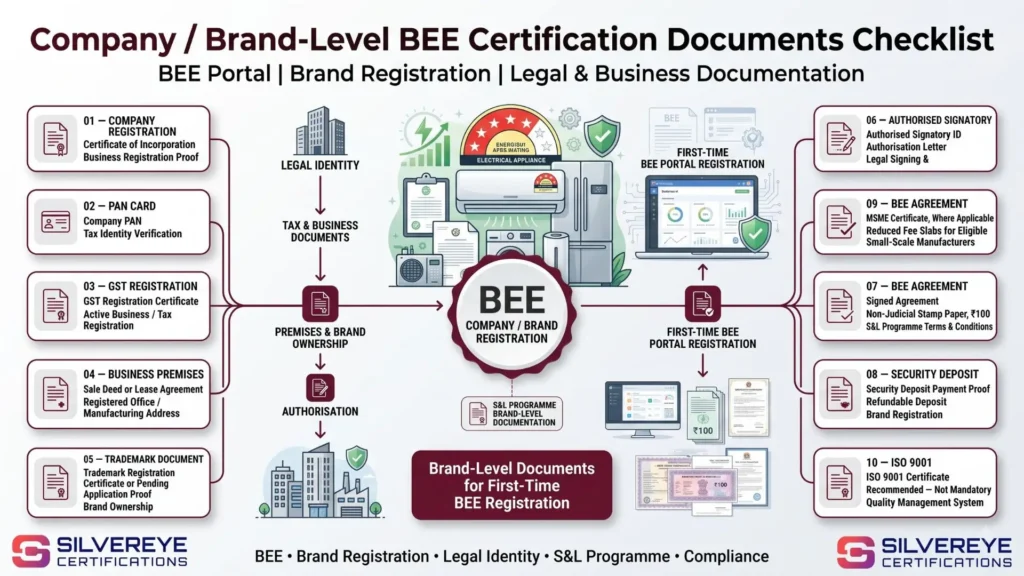
Company / Brand-Level BEE Certification Documents Checklist
These are submitted once, when you first register your brand or company on the BEE portal. They establish your legal identity as an applicant.
| Document | Purpose |
| Certificate of Incorporation / business registration proof | Confirms your company is a legally registered entity in India |
| PAN card of the company | Tax identity verification |
| GST registration certificate | Confirms active business/tax registration |
| Proof of business premises (sale deed or lease agreement) | Verifies your registered office or manufacturing address |
| Trademark registration certificate (or pending application proof) | Confirms ownership of the brand name under which the product will be sold |
| Authorised signatory ID and authorisation letter | Confirms who is legally permitted to sign and submit the application |
| Signed agreement on non-judicial stamp paper (₹100) | A formal undertaking to BEE to abide by the S&L Programme's terms and conditions |
| Security deposit payment proof | Refundable deposit submitted alongside brand registration |
| MSME certificate (if applicable) | Enables reduced fee slabs for eligible small-scale manufacturers |
| ISO 9001 certificate (recommended, not mandatory) | Strengthens the application by demonstrating a quality management system |
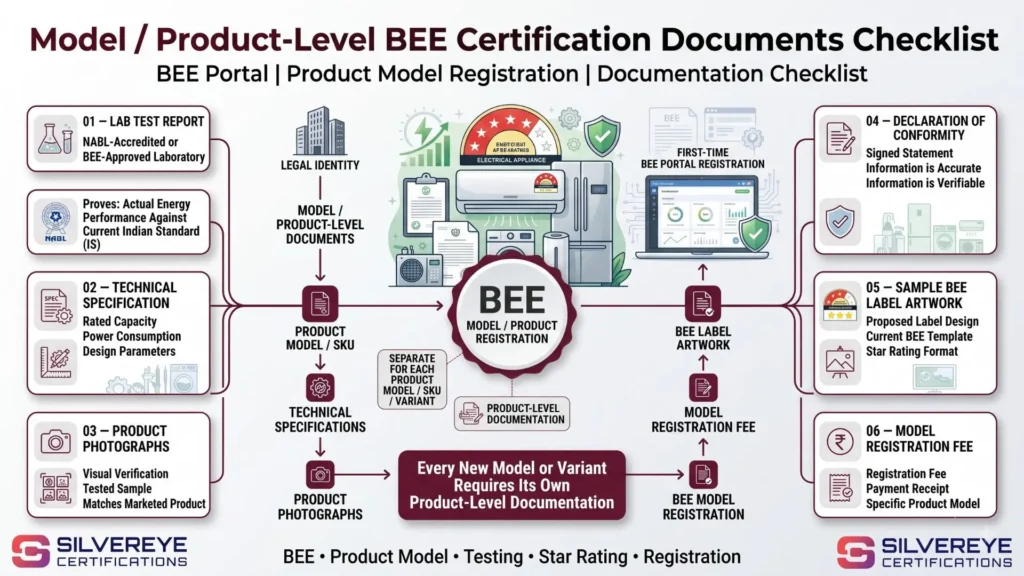
Model / Product-Level BEE Certification Documents Checklist
These are submitted separately for every individual product model you want to register, every time you add a new SKU or variant.
| Document | Purpose |
| NABL-accredited or BEE-approved lab test report | Proves the model's actual energy performance against the current Indian Standard (IS) |
| Product technical specification sheet | Details rated capacity, power consumption and design parameters |
| Product photographs | Visual verification that the tested sample matches the marketed product |
| Declaration of conformity | A signed statement that the submitted information is accurate and verifiable |
| Sample BEE label artwork | Proposed label design following the current BEE template and star rating format |
| Model registration fee payment receipt | Proof of payment for that specific model's registration |
A critical detail: BEE test reports are generally only accepted if they are less than one year old at the time of submission, and they must be benchmarked against the current version of the applicable Indian Standard — an otherwise-valid report tested against a superseded IS version will be rejected.
BEE Certification Documents Required Specifically for Importers
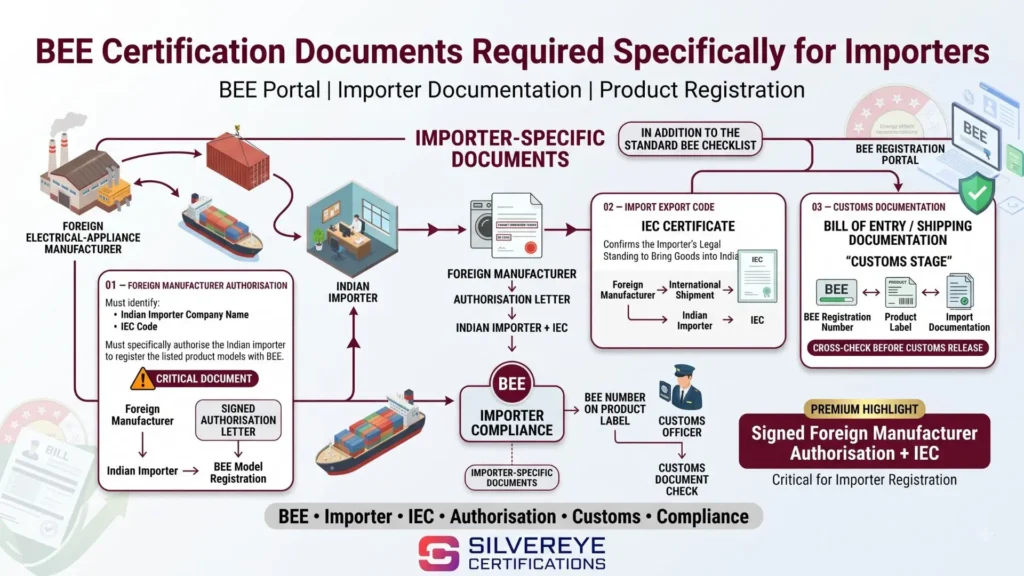
Importers follow the same two-layer checklist above, plus one document that is non-negotiable and importer-specific:
| Document | Why It's Critical |
| Signed authorisation letter from the foreign manufacturer | Must name the Indian importer by company name and IEC code, authorizing them specifically to register the listed models with BEE. Without this, applications are rejected at document scrutiny — regardless of test report quality. |
| Import Export Code (IEC) certificate | Confirms the importer's legal standing to bring goods into India |
| Bill of Entry / shipping documentation (at customs stage) | Cross-checked against the BEE registration number printed on the label before customs release |
Appliances imported strictly for personal use, not commercial sale, generally fall under personal-baggage rules and are not subject to this documentation requirement — but anything intended for resale in India is.
BEE Star Label Documents: What's New in 2026
- Authorized dealer/retailer list upload: As part of a supply-chain transparency push, registered manufacturers in several categories are now expected to upload a verified list of authorized retailers and distributors on the BEE portal, aimed at reducing counterfeit or misused star labels.
- Stricter test report currency checks: With revised star rating tables now running through the 2026–2028 cycle for categories like refrigerators, fans and water heaters, BEE is more actively flagging test reports benchmarked against outdated IS versions or superseded MEPS.
- Expanded mandatory categories mean expanded documentation: Since refrigerators, televisions, LPG stoves, chillers, cooling towers, deep freezers, distribution transformers and grid-connected solar inverters became mandatory from January 1, 2026, businesses in these categories now need the full documentation set for the first time if they were previously operating under voluntary norms.
- Greater emphasis on authorization-letter accuracy for importers: Recent guidance stresses that the foreign manufacturer's authorization letter must exactly match the importer's registered company name and current IEC code — mismatches are a growing rejection trigger.
Who Needs to Submit These Documents?
- Domestic manufacturers of any notified appliance must submit the full company-level and model-level document sets.
- Importers must submit the same sets plus the foreign manufacturer's authorization letter and IEC proof.
- Traders/assemblers selling notified appliances under their own brand must also complete both document layers, even without owning the manufacturing process.
Step-by-Step: How to Submit BEE Documents on the Portal
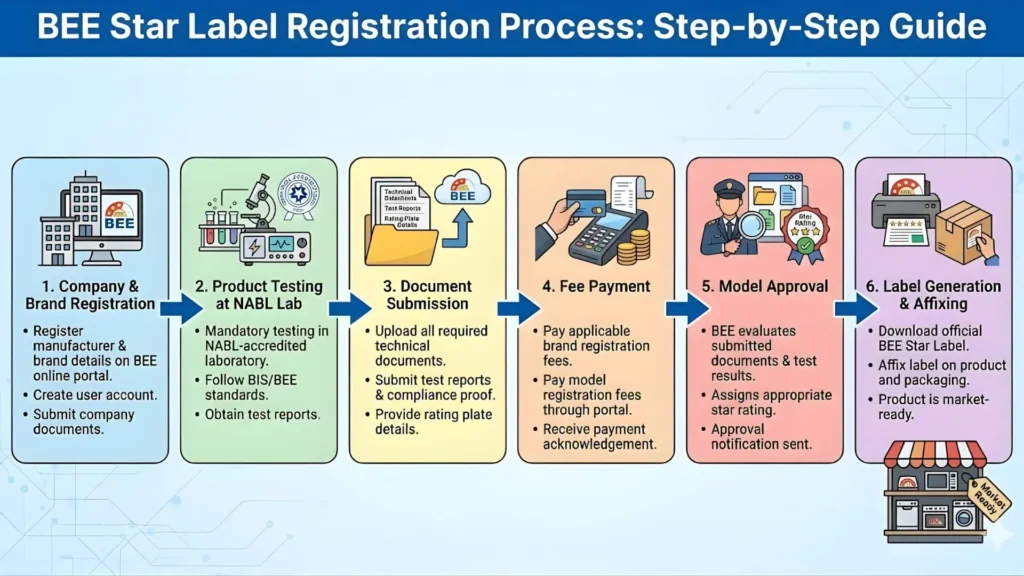
- Create your company profile on beestarlabel.com and upload all company-level documents in the specified format (typically PDF).
- Pay the security deposit and submit the signed stamp-paper agreement to complete brand registration.
- Download the current Product Schedule for your category to confirm the exact Indian Standard (IS) your test report must follow.
- Get your product tested at a NABL-accredited or BEE-approved lab and obtain a test report within the accepted validity window.
- Upload model-level documents — test report, specifications, photographs, declaration of conformity and label artwork — for each product model.
- Pay the model registration fee and submit the hard-copy application with signatures where required.
- Track your application reference number; respond immediately to any deficiency notice with the requested correction or missing document.
- On approval, download your Registration Certificate and use the registration number to generate compliant BEE labels for each unit.
Fees Linked to BEE Document Submission
| Fee Component | Approximate Range |
| Security deposit (brand registration) | Commonly cited around ₹1,00,000; reduced to around ₹25,000 for small-scale industries |
| Model registration fee (per model) | Commonly cited example: around ₹2,000 per model for several categories |
| Overall registration cost across categories | Roughly ₹5,000 to ₹2,00,000 depending on product category and company size |
| Laboratory testing charges | Paid directly to the NABL-accredited lab; varies by product type and complexity |
Fee slabs change periodically and MSMEs may qualify for reduced rates — always confirm the current schedule on the official BEE portal before budgeting your application.
Validity of BEE Documents and What You Need for Renewal
Your Registration Certificate itself is typically valid for 1 to 3 years depending on the product category and current labelling cycle, but your test report has its own, shorter shelf life — generally accepted only if issued within the last year. This means your documents don't all expire on the same date, and tracking each one separately matters.
Documents to Refresh Before Renewal
- A fresh or re-verified test report if the star rating table for your category has been revised since your last registration.
- An updated declaration of conformity reflecting current production data.
- Confirmation that your trademark and company registration details are still current and unchanged.
- An updated authorization letter for importers, if the IEC details or product list have changed.
- Your authorized dealer/retailer list, where applicable under the 2026 transparency requirement.
Start gathering these at least 60 to 90 days before your certificate's expiry date — re-testing, if required, is usually the longest lead-time item in a renewal.
Common Document Mistakes That Cause Rejection
- Submitting a test report older than the accepted validity window, or tested against a superseded IS version.
- A trademark certificate that doesn't match the exact brand name used on the product and label.
- An importer's authorization letter that doesn't name the correct IEC code or company name precisely as registered.
- Missing the declaration of conformity or submitting it unsigned by the authorized signatory.
- Label artwork that doesn't follow the current BEE template, leading to approval delays even after documents are otherwise accepted.
Get Expert Help: Silvereye Certifications
Assembling the right combination of company-level and model-level papers — in the right format, against the right IS version — is where most delays actually happen, not in the testing itself. Silvereye Certifications, a Noida-based regulatory compliance consultancy, helps manufacturers, importers and brands prepare a complete, error-checked BEE Star Label documents package, alongside related approvals such as BIS (ISI/CRS/FMCS), WPC-ETA, FSSAI, MSME and ISO certifications.
Their team reviews your documentation against the current BEE Product Schedule before submission, coordinates with NABL-accredited labs, drafts compliant authorization letters for importers, and manages renewal document refreshes so nothing lapses unnoticed. If paperwork precision isn't your team's core strength, working with an experienced consultant like Silvereye Certifications can meaningfully cut your approval timeline.
Conclusion
BEE Star Label documentation isn't just a formality tucked behind the testing step — it's often the actual bottleneck in getting your product to market. The businesses that move fastest are the ones that treat company-level and model-level documents as two separate checklists, keep test reports current against the latest Indian Standard, and, for importers, get the foreign manufacturer's authorization letter exactly right the first time.
With the mandatory list expanding from January 2026 and dealer-transparency requirements emerging for several categories, now is the right time to audit your document set rather than wait for a rejection notice to force the issue. Get the paperwork right, and the rest of the BEE certification process moves considerably faster.
Frequently Asked Questions
What documents are required for BEE Star Label certification?
At the company level: incorporation proof, PAN, GST registration, business premises proof, trademark certificate and a stamp-paper agreement. At the model level: a NABL-accredited test report, technical specifications, product photographs, declaration of conformity and label artwork.
Is a trademark certificate mandatory for BEE registration?
Yes, a valid trademark certificate (or proof of a pending application) in the brand's name is a standard requirement for company-level registration.
How old can a BEE test report be?
Test reports are generally accepted only if issued within the last year and benchmarked against the current version of the applicable Indian Standard (IS).
What extra documents do importers need for BEE certification?
A signed authorisation letter from the foreign manufacturer, naming the Indian importer by company name and IEC code and authorising them to register the specified models with BEE.
Is an ISO 9001 certificate mandatory for BEE documents?
No, it is recommended as it strengthens the application, but it is not a mandatory requirement.
Do MSMEs need different documents for BEE certification?
The document set is largely the same, but MSMEs can submit an MSME certificate to access reduced security deposit and fee slabs.
What happens if I submit an incomplete BEE application?
You will receive a formal deficiency notice requesting the missing or corrected documents; delayed responses further extend your approval timeline.
What is the new 2026 document requirement for manufacturers?
Several manufacturers are now expected to upload a verified list of their authorised dealers and retailers on the BEE portal, as part of a supply-chain transparency measure to curb counterfeit labels.
Do I need new documents every time I renew my BEE registration?
Yes — particularly a refreshed or re-verified test report if your category's star rating table has been revised, plus updated production and declaration data.
Can I use an international certification instead of a BEE test report?
No. International certifications like CE or Energy Star can be submitted as supporting documents, but a test report from a NABL-accredited or BEE-approved Indian lab is still mandatory.
Where are BEE documents submitted?
All documents are uploaded online through the official BEE portal at beestarlabel.com, with certain hard copies required to be submitted physically for final scrutiny.